Pages
Stay In Touch
More
© 2013 KentuckyGuard
By Olivia Burton, Kentucky National Guard Family Programs

Staff Sgt. Cade Shackelford with his girlfriend Erin Diaz and their 7 month old daughter Isabella outside their new home. Home Builders Care, the nonprofit arm of The Home Builders Association of Lexington dedicated the “Home for a Veteran” to Shackelford and his new family Jan. 25, 2016 in Lexington, Ky. (Photo Credit: HBA, HBC)]
LEXINGTON, Ky. — On a cold January day in Lexington, a Kentucky veteran and his family felt nothing but warmth as they stepped into their brand new home. Staff Sgt. Cade Shackelford with his girlfriend Erin Diaz and their 7-month-old daughter Isabella were chosen for the “Home for a Veteran” building project.
Spearheading the effort was Home Builders Care, a non-profit arm of the Home Builders Association of Lexington. With immense community support, donated labor and materials, a veteran and his family earned the low-mortgage home to honor his service to the United States Military.
City council members, volunteers and friends took part in a dedication ceremony to present this new home to Shackelford and his family.
“It’s hard to believe that we broke ground on this new home on the hottest day of the year last summer and here we are today after a sizeable snow storm,” said David Briggs, President of the Home Builders Association of Lexington. “We are truly honored to provide this home to Cade and his family.”
Shackelford is an active member of the Kentucky National Guard who served in several overseas tours in the Middle East. He is currently serving as a military police officer with the 940th Military Police Company and plans to remain in service until his retirement.
“Saying thank you sometimes you just can’t put into words,” he said. “What everybody has done, what time they’ve donated, what materials they’ve donated, I just can’t express the amount of gratitude that me and my family have for you guys. From the bottom of my heart, from my family to yours, thank you.”
Click here to watch the dedication ceremony in its entirety.
Photos of the dedication event and the home can be found here.
By Sgt. David Cox, 63rd Theater Aviation Brigade
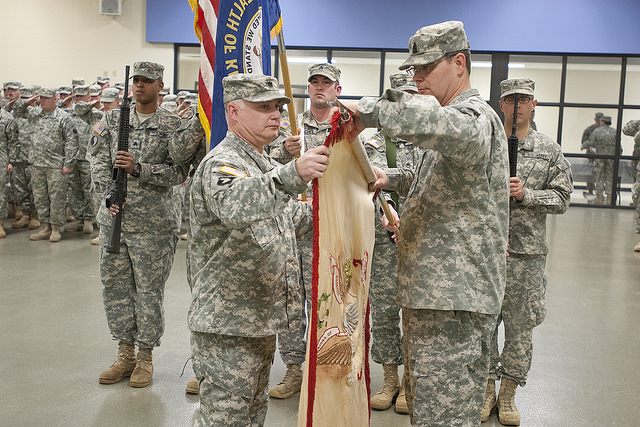
Lt. Col. Mark Brozak, commander of the 1204th Aviation Support Battalion furls the unit’s colors with help from Command Sgt. Maj. Scott Foster during an inactivation ceremony in Burlington, Ky., Jan. 10, 2016. After nearly 10 years of service to the Nation and commonwealth, the unit was stood down due to Army force structure changes. (U.S. Army National Guard photo by Sgt. David Cox)
BURLINGTON, Ky. — Soldiers with 1204th Aviation Support Battalion furled their battalion colors for the last time during an inactivation ceremony Jan. 10, at the National Guard Readiness Center in Burlington, Ky.
The unit of nearly 300 has been inactivated in accordance the Army’s force structure realignment.
Activated in 2006, the 1204th played a vital role in disaster recovery operations during the 2009 Ice Storm and deployed to Iraq in 2011 in support of Operation New Dawn .
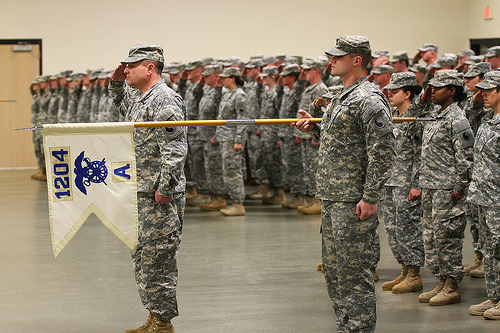
Soldiers of the 1204th Aviation Support Battalion salute during an inactivation ceremony in Burlington, Ky., Jan. 10, 2016. Activated in 2006, the unit was home to nearly 300 Soldiers. (U.S. Army National Guard photo by Staff Sgt. Scott Raymond)
“From 2006 to today, this unit has probably done more as an ASB than the other 12 currently in the force,” said Brig. Gen. Benjamin F. Adams, III, Chief of the Joint Staff. “Being able to deploy as a battalion to five different countries during a time of war says a great deal about the unit and its personnel.”
Click here for more photos.
Lt. Col. Mark Brozak, commander of the 1204th ASB, said “that although the colors are cased, the soldiers of the unit will continue to serve the nation and the commonwealth of Kentucky.”
The 1204th’s mess section finished their service to the unit as recipients of the Connelly Award. The award recognizes food service Soldier that exceed Army standards and operate at a level that showcases teamwork, professionalism, quality and service.
Soldiers expressed a bittersweet satisfaction with what they accomplished while being a part of the unit’s history.
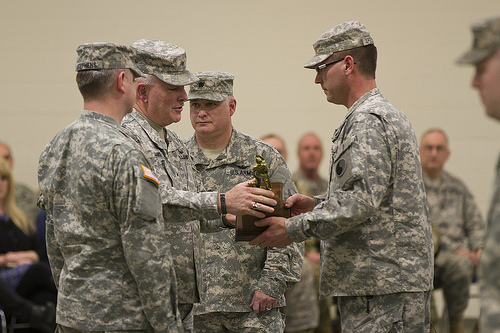
Brig. Gen. Benjamin Adams III presents the Connelly Award to Soldiers of the 1204th Aviation Support Battalion during an inactivation ceremony in Burlington, Ky., Jan. 10, 2016. The Connelly Award recognizes food service units and sections that exceed Army standards of food preparation and promote teamwork. (U.S. Army National Guard photo by Staff Sgt. Scott Raymond)
“I’ve been in almost 18 years and this is home to me,” said Staff Sgt. Bill Hyatt, supply noncommissioned officer with Headquarters Support Company, 1204th ASB. “It’s going to be a big culture shock to me because aviation is where I’ve been since I’ve been in the Kentucky Army National Guard and now I’m going to a transportation company.”
“I’m going to be the first person to arrive to the 1204th and the last person to leave.”
The Burlington Readiness Center, home of the 1204th, will continue to be utilized by the Kentucky Guard. Two new units, the 2061st Multi-Role Bridge Company and the 2112th Transportation Company will be stood up this year to operate out the state-of-the-art armory.
See local news coverage here: WLWT 5, WKRC Local 12.
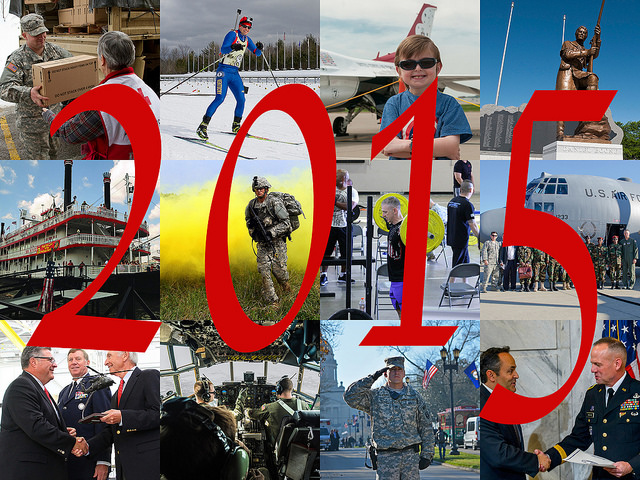 Another year’s in the books, with more pages to document the service of the Kentucky National Guard. Around the commonwealth and across the globe, our Guardsmen once again have displayed what we call unbridled service. Below are a few of our favorite stories of duty and accomplishment.
Thanks to all our friends, families for allowing us to make 2015 another successful year of service to Kentucky and the Nation.
Guard activated for winter storm response
Guardsmen compete in biathlon finals
Air Guard welcomes 9-year-old fighting cancer
Kentucky dedicates Guard memorial
Four million pounds for a purpose
Kentucky hosts Djibouti delegation
Kentucky Guard cuts ribbons on new facilities
123rd Airlift Wing named top airlift unit
Guardsmen support Gubernatorial Inauguration
Kentucky National Guard Public Affairs Staff Report
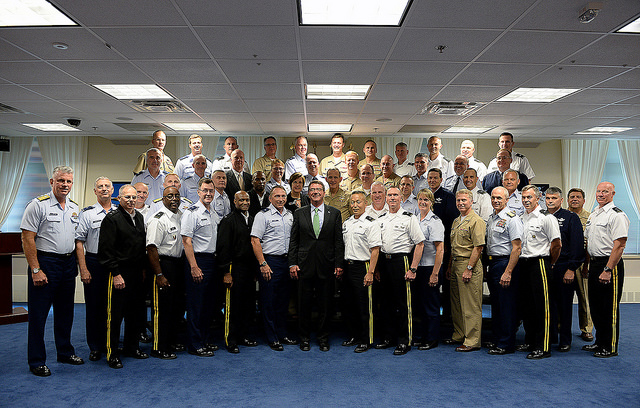
Secretary of Defense, Ash Carter gathers with more than 50 U.S. general officers during the CAPSTONE General and Flag Officer Course in Washington, D.C., July, 2015. Kentucky’s Brig Gen. Scott Campbell was one of six National Guard officers selected to attend. (Courtesy photo)
FRANKFORT, Ky. — Brig. Gen. Scott Campbell, of the Kentucky National Guard, is the deputy commanding general of the 38th Infantry Division and was chosen to attend the Department of Defense’s CAPSTONE Program July 13 to Aug. 14, 2015.
The CAPSTONE General and Flag Officer Course was created in 1982. The Goldwater-Nichols DoD Reorganization Act of 1986 subsequently mandated that all newly selected active duty generals and flag officers attend CAPSTONE. The course is managed by the National Defense University in Washington, D.C. Course attendance is still competitive for National Guard and Reserve general officers.
According to NDU, the course objective is to make these individuals more effective in planning and employing U.S. forces in joint and combined operations. The CAPSTONE curriculum examines major issues affecting national security decision making, military strategy, joint/combined doctrine, interoperability, and key allied nation issues.
Campbell was one of only six National Guard general officers included in the class of 55 Fellows. Few Kentucky Guard general officers have been extended the privilege of attending this course since its inception.
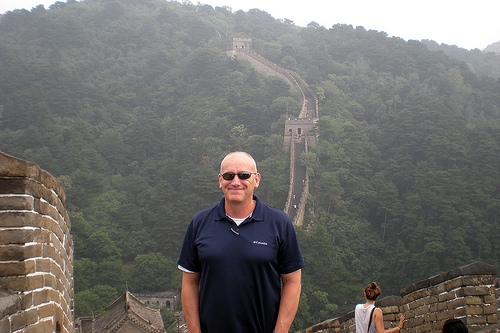
Brig. Gen. Scott Campbell tours the Great Wall of China during the overseas portion of the CAPSTONE General and Flag Officer Course, July, 2015. Campbell visited China, Japan and Korea as part of the course which examines major issues affecting national security decision making, military strategy, joint/combined doctrine, interoperability, and key allied nation issues.(Courtesy photo)
“This was by far the best educational experience of my 34-year career,” said Campbell. “It was an amazing experience that exposed me to senior decision makers, both domestic and international, and gave me a better understanding of the complexities in the world and the security challenges facing the U.S.”
The course began in Washington, D.C. with briefings from directors of the various federal agencies and combatant commanders. Day 3 began stateside travel with visits to various military command headquarters in Virginia, Florida, Nebraska, Colorado, and Illinois.
The class returned to Washington upon completion of the 10-day stateside trip and prepared for overseas travel. The class was broken into three groups traveling to Europe, South America or the Pacific region.
Campbell was selected for the Pacific trip which included stops in Japan, South Korea, and China with a visit to U.S. Pacific Command in Hawaii on the return trip. The overseas trip lasted approximately 13 days with the CAPSTONE Fellows visiting with U.S. and host nation military officials, U.S. Embassy officials to include ambassadors, host nation government officials and local think tanks.
Campbell said the focus of the overseas tour was to study U.S. policy as it relates to the visited nation and the region. The exchanges also included cultural stops which included The Forbidden City and The Great Wall of China, the Demilitarized Zone, Seoul Tower and Gyeongbok Presidential Palace in Korea, and Pearl Harbor in Hawaii.
The course ended back in Washington, D.C. and concluded with briefings from the Secretary of Defense and directors of federal agencies, to include the National Security Agency, Central Intelligence Agency, Federal Emergency Management Agency, as well as the DoD Service Chiefs from each branch of the military.
“I feel very privileged for being selected to attend,” Campbell said. “The senior leader briefers and CAPSTONE staff told us that the most fundamental objective of this course is an understanding and appreciation of the other services and agencies and building relationships with the other Fellows that will stay with you throughout your life. I feel like that objective is being met. I’ve already met several of my Capstone classmates in other forums and we now share a common bond.”
Kentucky National Guard Staff Report
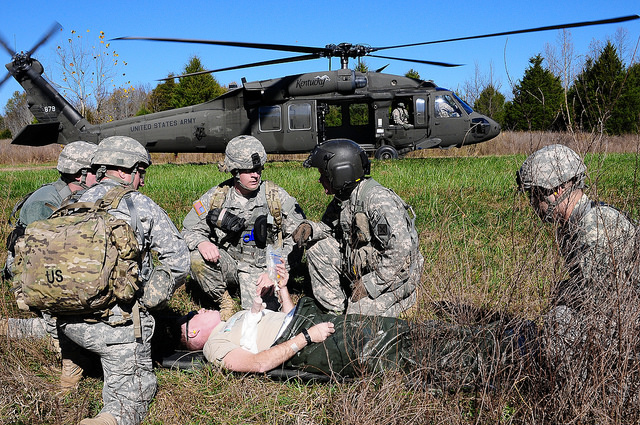
Flight Medic Staff Sgt. Jeremy Lowe with the 2nd Battalion, 238 Aviation Regiment consults with a medic team as they prepare to load a simulated casualty aboard a UH-60 Black Hawk MEDEVAC helicopter for transportation to a field hospital located at the Wendell H. Ford Regional Training Center in Greenville, Ky., Nov. 14. This exercise was a special addition to combat medic sustainment training that provided medics with real world experience working with flight medics and MEDEVAC flight crews that would only be available when deployed overseas. (U.S. Army National Guard photo by Sgt. 1st Class Aaron Hiler)
GREENVILLE, Ky. — When things go wrong in the field, Soldiers turn to the so-called “Angels of the Battlefield.” These highly-trained combat medics are there for when the worst case scenario unfolds, whether on the field of battle or during training exercises, whenever Soldiers are injured or wounded.
In order to stay up-to-date on the best trauma practices, medics receive refresher training every two years. Luckily for medics of the Kentucky National Guard, the refresher training is offered at the Wendell H. Ford Regional Training Center in Greenville.
“This class provides the medics with all of the continuing education units required to re-certify,” said Staff Sgt. Donald King, a combat medic instructor for the 238th Regional Training Institute.
“This course also gives them additional training that they cannot get in their units or elsewhere.”
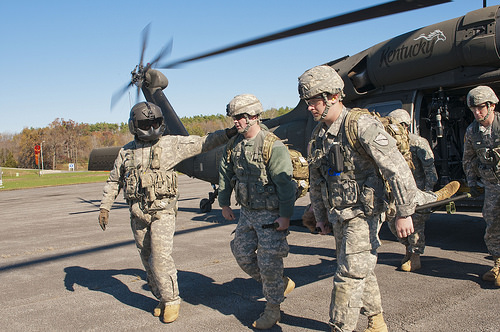
A flight medic with Charlie Company, 2nd Battalion, 238th Aviation guides combat medics from a UH-60 Black Hawk during the medics’ recertification training at the Wendell H. Ford Regional Training Center in Greenville, Ky., Nov. 14, 2015. As part of the training the medics were given scenarios loading and unloading patients from the aircraft to familiarize them with the dangers of doing their job around aircraft. (U.S. Army National Guard photo by Sgt. 1st Class Aaron Hiler)
Click here for more photos.
Following the completion of the course, Soldiers received familiarization training on medical evacuation (MEDEVAC) flight operations . The RTI coordinated with aviation assets from Kentucky’s 2nd Battalion, 238th Aviation Regiment to provide MEDEVAC helicopter support as a culminating event to the course.
“The purpose of this exercise is to give these medics experience with aviation flight medics and MEDEVAC aircrews so they are better prepared to evacuate patients to the next level of medical care,” said Sgt. Daniel Diehl, combat medic instructor. “This is training that they would otherwise only receive when deploying overseas.”
The medics performed triage on simulated casualties at a field aid station and called in nine-line MEDEVAC requests. From that point a UH-60 Black Hawk helicopter arrived to transport their patients to a field hospital.
Soldiers and trainers at Kentucky’s RTI are used to thinking outside the box and developing methods to improve training and bring attention to the possibilities at the Wendell H. Ford Regional Training Center. Training coordinator, Sgt. 1st Class John Riggi said this medic course was just one example of that type of thinking.
“It’s rare to have a portion of this kind of training include actual medical evacuation by aircraft. Thankfully we were able to coordinate with our aviation assets in the state to make it happen,” said Riggi. “And I believe it was certainly a highlight of the course and a critical piece of training that will make these medics better.”
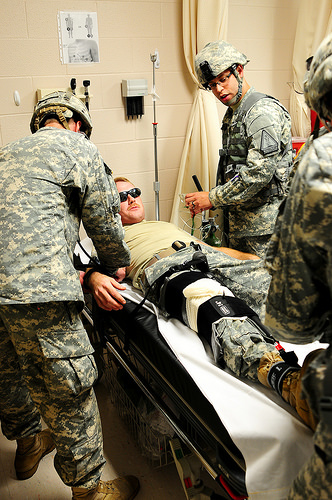
Sgt. Orlando Gonzalez reviews a simulated casualty’s status with a doctor at a field hospital during a practical exercise conducted as part of Combat Medic Sustainment training at the Wendell H. Ford Regional Training Center in Greenville, Ky., Nov. 14, 2015. According to the sustainment training staff this practical exercise and the use of UH-60 Black Hawk MEDEVAC helicopters is unique to the Kentucky National Guard. (U.S. Army National Guard photo by Sgt. 1st Class Aaron Hiler)
“This is the best medic training I’ve ever received,” said Sgt. 1st Class Kirby Jones. Jones, a recruiter for the Kentucky Recruiting & Retention Battalion, took the course to re-certify his combat medic status.
“I’ve been to four previous medic refresher courses at Fort Knox and Fort Campbell and other locations,” he said. “This class has been better by far because of the level of interaction with the instructors and the shared experiences of the other medics. No ‘death by PowerPoint’ here.”
The training also benefited the aviation Soldiers of Detachment 1, Charlie Company, 2/238th. Staff Sgt. Lowe, Flight Medic Standardization NCO for the unit said the training opportunity provided the crew a chance to test their own response and how they work with ground medics in such situations.
“This assists our mission by saving precious time correcting mistakes in patient packaging during an actual lifesaving mission,” said Lowe. “The medics that were involved in this training performed admirably, they were given difficult scenarios in very different environments than they were used to working in. I was very impressed by their hard work.”
A variety of courses are taught at the training site which has become not only a convenience for Kentucky Soldiers but a very cost-effective benefit for the state. With the addition of a realistic MEDEVAC exercise with aircraft, the course garnered the attention of Fort Sam Houston, home of the U.S. Army’s combat medic school.
“A representative from the Army’s Emergency Medical Service program was here to see how we do things in Kentucky, and I believe he was impressed,” said Riggi. “The more unique and high-quality training we can conduct here, the more people will notice what the RTI can do. And that could lead to even more training opportunities and benefits for the Kentucky Guard.”
By Pfc. Courtney Gapac, 138th Field Artillery Brigade
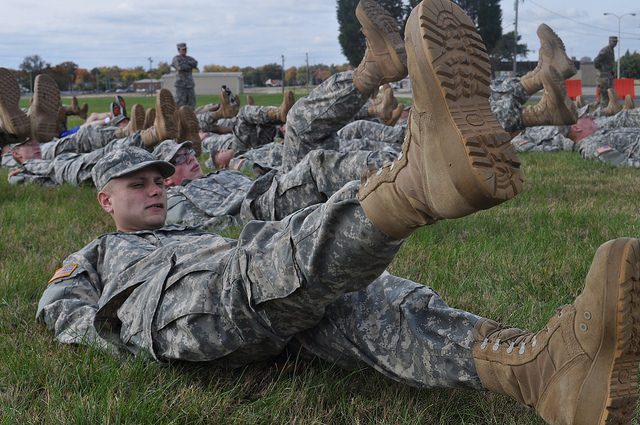
Pvt. Eli Reiners, a recruit from Mt. Washington, Ky., participates in corrective action with the entire company at the Kentucky Guard’s Recruit Sustainment Program’s (RSP) monthly drill in Louisville, Ky., Oct. 25, 2015. Kentucky’s RSP provides new recruits the preparation for basic training and advanced individual training prior to being assigned to a unit. (U.S. Army National Guard photo by Pfc. Courtney L. Gapac, 138th Field Artillery Brigade)
LOUISVILLE, Ky. — The Kentucky National Guard’s Recruit Sustainment Program in Louisville, relocated in August to better accommodate the training needs of new recruits who attend monthly drills here. The RSP recruits were welcomed into the new Bowman Readiness Center which was just opened Oct. 14.
The primary concern of RSP is to reduce training pipeline losses by preparing newly enlisted Soldiers for basic combat training and advanced individual training, said Staff Sgt. Robert H. Foushee, the readiness noncommissioned officer for Detachment 3, Alpha Company, Kentucky Recruiting and Retention Battalion.
State wide, RSP has decreased from eight sites to six, Foushee said. The program has had to evolve due to a tight budget and the constant influx of new recruits.
“We have to figure out how to do more with less,” Foushee said. We’re having to get more creative, and reach back into our toolbox to figure out ways to meet our goals.”
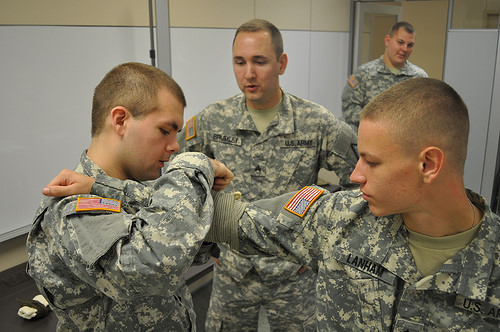
Sgt. Jonathan Brumley, a recruiting and retention non-commisioned officer for the Kentucky Recruiting and Retention Battalion, leads a classroom activity on first aid at the Kentucky Guard’s Recruit Sustainment Program’s monthly drill Oct. 25, 2015. Pvt. Mason Smith, a recruit from Shepherdsville, Ky., and Pvt. Gene Lanham, from Lebanon, Ky., take turns practicing how to properly apply a field dressing. (U.S. Army National Guard photo by Pfc. Courtney L. Gapac, 138th Field Artillery Brigade)
Click here for more photos.
With more classrooms, more adequate storage space, a fitness room, and a classroom with full computer access for Soldiers to complete online training modules, the new facility will only further improve the successes of the RSP here.
It is also beneficial that the new facility is located in the same building as headquarter elements, said Foushee.
“The nature of the Guard, which forces Soldiers to take a break from civilian life, makes them more susceptible to forces that cause failure,” Foushee said. “RSP is setting Soldiers up for success by preparing them for training, keeping them motivated, relieving fear of the unknown, and keep the flow going by giving them someplace to come back to.”
The curriculum for new enlistees preparing to ship to BCT is designed for three months and is organized into a three-phase system. Once the recruits are in-processed, they are integrated into military culture and given instructions on the Army values, the chain of command and proper wear of the uniform.
Later phases focus on the training community, military history and background and physical readiness.
RSP has a continued curriculum for troops who enlisted in the Split Training Option program and are awaiting advanced individual training (AIT). During this phase, they may serve as student leaders while they receive additional physical readiness and leadership responsibilities.
Once Soldiers have completed AIT, they attend three months of drill at RSP to ensure that they are fit to report to their home units.
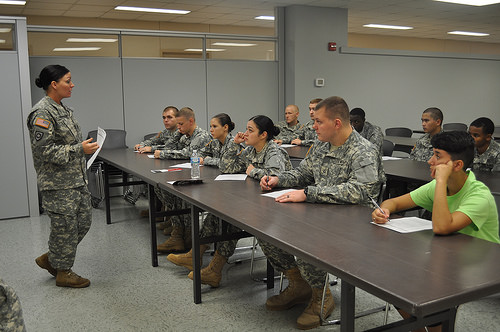
Staff Sgt. Rachel Richmond, a recruiting and retention non-commissioned officer-in-charge for the Kentucky Recruiting and Retention Battalion, leads a classroom discussion with new enlistees in Louisville, Ky., Oct. 25, 2015. New recruits in the Louisville area now drill in the Kentucky Guard’s newly renovated Bowman Readiness Center. (U.S. Army National Guard photo by Pfc. Courtney L. Gapac, 138th Field Artillery Brigade)
“The method of teaching has changed,” said Pfc. Christian Cowgill, a recent AIT graduate who spent more than a year with RSP. “It used to be very rigid, but has evolved into a classroom type of environment-almost like AIT - where there is still a physical aspect of training, but the actual education side of it has become more in-depth.”
“It’s a very productive program,” said Bobby Prather Sr., retired master sergeant and recruit sustainment program specialist for Det. 3. “Our ship rate is up, our completion rate is up, and we have very few administrative issues when the Soldiers get to their training sites.”
Many of the recruits who attend RSP value the experience, and are eager about the future of the program.
“It’s a place where you feel safe to develop and learn,” said Pfc. Jalen Manor North, another recent AIT graduate. “It gave me the chance to interact with NCOs and to try my hand out as a leader.”
The Soldiers that have come through RSP have felt fully prepared to face the challenges to come.
“When it comes to the military, you constantly have to adapt and be combat effective,” said Cowgill. “To build the house, you must have a solid foundation. This program helps make sure we are prepared for anything, so if a deployment happened, we won’t be a fish out of water.”
By Sgt. 1st Class Gina Vaile-Nelson, 133rd mobile Public Affairs Detachment
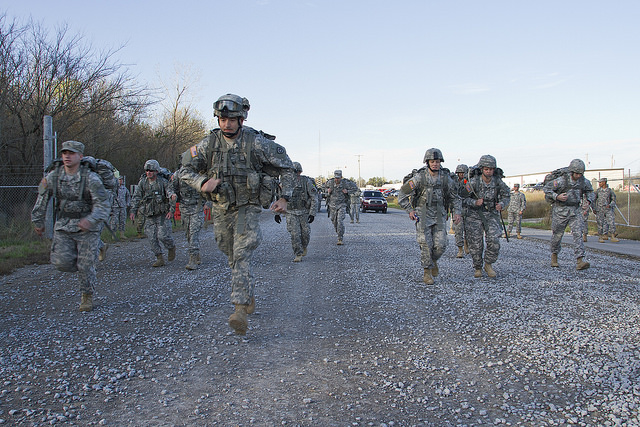
Kentucky Guardsmen begin the ruck march portion of the 2016 Soldier of the Year Competition at the Wendell H. Ford Regional Training Center in Greenville, Ky., Nov. 7, 2015. Soldiers tested their skills in a variety of Army tasks in the three-day competition. (U.S. Army National Guard photo by Staff Sgt. Scott Raymond)
GREENVILLE, Ky. — In a competition there is one thing that is certain: only one winner will prevail.
The Kentucky National Guard’s 2016 Best Warrior competition is no different. Only one Soldier, NCO and Senior NCO is named with the top honor at the conclusion of the strenuous three-day competition. A gauntlet that puts the NBC-hit American Ninja Warrior TV competition to shame.
But as the leaders who competed and supported the competition learned, one person may come out on top, the Kentucky National Guard is one team.
“I learned that no matter what unit you’re from, at the end of the day we are all Soldiers,” said Sgt. Amanda Marlow, human resources specialist, Joint Force Headquarters NCO of the year.
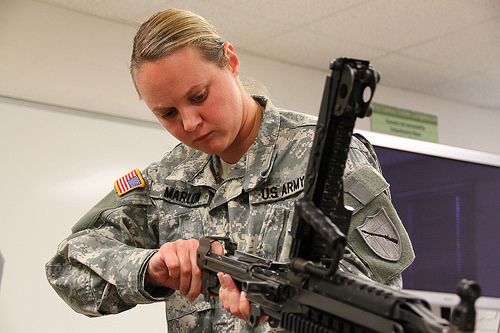
Sgt. Amanda Marlow reassembles a M249 machine gun as part of the Soldier of the Year competition at the Wendell H. Ford Regional Training Center in Greenville, Ky., Nov. 6, 2015. (U.S. Army National Guard photo by Staff Sgt. Scott Raymond)
“Throughout this competition we’ve had competitors continuously cheer for everyone,” she said. “Whether it was cheering on at the end of the run, or coming back to the finish and cheering for those finishing the ruck march. For me that was a neat thing to be a part of.”
It wasn’t just competitors who kept each other going. Marlow said State Command Sgt. Maj. David Munden was instrumental in keeping her and other Soldiers focused on finishing and not giving up.
“Sgt Maj. Munden finished up my last leg of running the IMTG course with me,” she said. “That was pretty awesome to see the state command sergeant major come out and run with his Soldiers. He did that throughout the competition with various events, but that’s something I’ll remember.”
Click here for more photos.
It is the Warrior Ethos, engrained in each of the 2016 competitors, that makes the Best Warrior challenge different than other competition. Never leaving a Soldier behind may be associated with battle scenarios, but it holds true even in competition. It is knowing that you’re only as strong as your weakest link, and digging deep to help make the weak stronger.
For Sgt. Christopher Jones, infantryman, Delta Company, 1st Battalion 149th Infantry NCO of the Year and the 2016 Kentucky NCO of the year, this year’s ruck march was a poignant reminder of the Ethos.
“I’ve never had that much competition before,” he said.
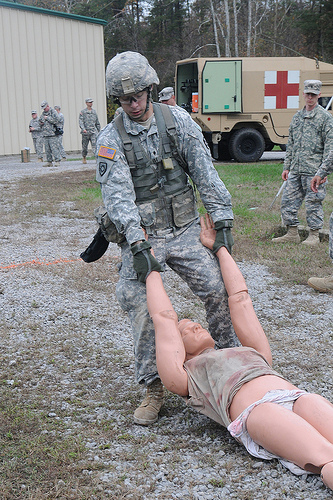
Spc. Michael Miller with the 149th Brigade Support Battalion, drags a dummy to safety as part of the stress-fire obstacle course developed for the 2016 Best Warrior competition Nov. 6 at the Wendell H. Ford Regional Training Center in Greenville, Ky. There were six strenuous tasks, including hitting targets with assigned weapons, that participants had to complete. (U.S. Army National Guard photo by Sgt. 1st Class Gina Vaile-Nelson/133 MPAD/KYARNG)
“For the whole five miles, it was three of us, just constant. He was ahead of me, I was ahead of him, it was the worst. But we couldn’t quit. It pushed us harder.
“It was my most memorable moment,” he said. “This weekend, especially on the ruck march, I had a lot of guys supporting me from my unit. They rucked with me on the way and switched out every mile. They stayed with me.”
Spc. Jacob Heath, a medic assigned to Delta Company, 1st Battalion, 149th Infantry and the 2016 Kentucky Soldier of the Year, said this experience was fun and value-driven.
“Even though we were in competition, I respect the hell out of these guys,” he said.
For 1st Sgt. Josh Baker, first sergeant of 299th Chemical Company, 149th Maneuver Enhancement Brigade, as a senior leader and Kentucky’s NCO of the year for 2016, he said hopes that this experience makes the competitors stronger leaders and in turn, that trickles through the ranks.
“I think that sometimes we get caught up in our day-to-day with the Guard and we forget what a privilege it is to serve with other Soldiers,” Baker said. “This weekend, the caliber of Soldiers who have been here has reminded me, again, what a privilege it is to stand in front of them.
Baker said he hopes to take his experience from this competition and create unit-level competitions that will not only prepare his Soldiers for future Best Warrior events, but also build the esprit de corps among his ranks.
“Pride in service is one of the most important aspects that can get lost on that M-Day Soldier on a drill weekend, so I really want to remind them of the caliber of Soldiers who are in the Kentucky National Guard,” he said. “And show them where they can go if they put their minds to it.”
The 2016 Kentucky National Guard’s Best Warrior competition was held Nov. 5-7 at the Wendell H. Ford Regional Training Center in Greenville, Kentucky. Fifteen Guardsmen competed for Kentucky’s top enlisted honor.
By Sgt. 1st Class Rebecca Wood, 149th Maneuver Enhancement Brigade Public Affairs
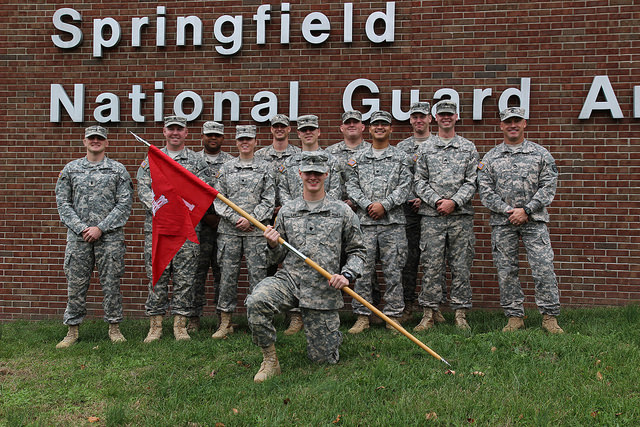
The 441st Survey & Design Team was honored at a departure ceremony on Oct. 31 at the Kentucky National Guard Armory in Springfield, Ky. They will deploy to the Middle East and fall under the 682nd Engineer Battalion. (U.S. Army National Guard photo by Sgt. First Class Rebecca Wood)
SPRINGFIELD, Ky. — More than 80 family members, friends, Kentucky Guardsmen and the City of Springfield said farewell to Soldiers of the 441st Engineer Survey & Design Team Oct. 31, at the Kentucky National Guard Armory in Springfield.
The Soldiers will deploy to the Middle East for an estimated 10 months. Their mission will be to travel throughout the Persian Gulf region to plan and test for engineer work projects, address facility site location environmental concerns, and survey for construction projects and boundary identification throughout various areas of operations.
A representative from the 201st Engineer Battalion, Capt. Stephen Strack said even though the unit is small, the job the Soldiers will perform will make a huge difference.
“The team’s specialty starts off any construction job over there,” said Strack. “The building plans they form with the local populace will help win hearts and minds, while the projects they help construct on the bases will provide force protection, moral, welfare and recreation for the other deployed troops.”
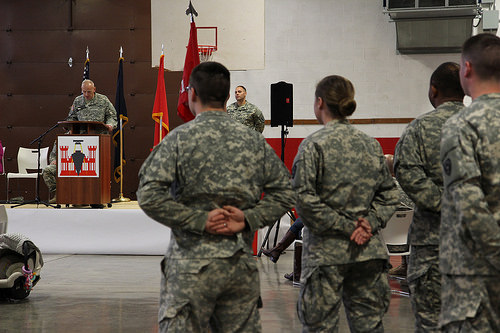
Deputy-commanding General of the 38th Infantry Division Brig. Gen. Scott Campbell was the guest speaker at the 441st Survey & Design Team Departure Ceremony on Oct. 31 at the Springfield Armory. The deployment is the first mobilization for the engineer unit. (U.S. Army National Guard photo by Sgt. First Class Rebecca Wood)
Since 2011, the 441st has served as the Kentucky Army National Guard’s very own survey & design team. This new unit has always supported Kentucky Guard engineers in vertical and horizontal construction projects across the commonwealth, but has never deployed, until now.
The 441st commander, 1st Lt. Cody Lasseigne said though only one of the 14 Soldiers has been deployed before, this team is ready.
“This is the best bunch of guys I have ever encountered,” said Lasseigne. “They work really well together and I foresee them enjoying the experiences they face in real world missions and training opportunities.”
One 441st Soldier, Sgt. Austin Huffman, is a homeland security major at Eastern Kentucky University. He has been in the 441st for three years and said there is a lot more to their job then survey and design, such as material testing for future construction sites and quality control/quality assurance for newly built sites. He also said he set a professional goal to accomplish while in the Middle East.
“I want to get better at sketching on this deployment,” said Huffman. “It’s challenging for me because you have to draw construction sites to scale using pencil and paper instead of a designing program on the computer. We all will test our skills and return home better engineers.”
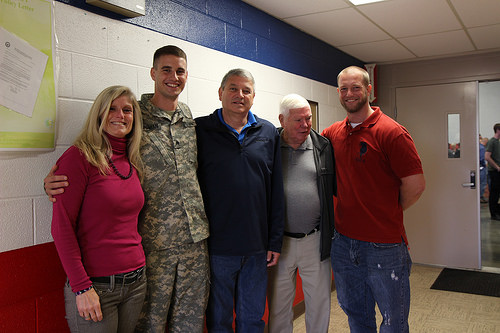
Sgt. Austin Huffman hugs his mother and father at the 441st Survey & Design Team Departure Ceremony on Oct. 31 at the Springfield Armory in Springfield, Ky. The 441st Survey & Design Team will deploy to the Middle East. (U.S. Army National Guard photo by Sgt. First Class Rebecca Wood)
Huffman said the hardest part of deploying is leaving his family and friends behind. His mother, Teresa Price from Gainesville, Virginia, remained misty-eyed throughout the departure ceremony.
“The hardest part will be not being able to pick up the phone and talk to him whenever I want,” said Price.
Huffman’s father, Wade Huffman from Beckley, West Virginia, conveyed he was grateful for the man his son has become and the work he does for his country.
“I am so proud of him,” said Wade. “He is ready for the task at hand.”
Soldiers of the 441st will depart for Fort Hood, Texas for their final pre-mobilization training prior to deploying overseas. They are expected to return home in the fall of 2016.
By Sgt. Lerone Simmons, 133rd Mobile Public Affairs Detachment
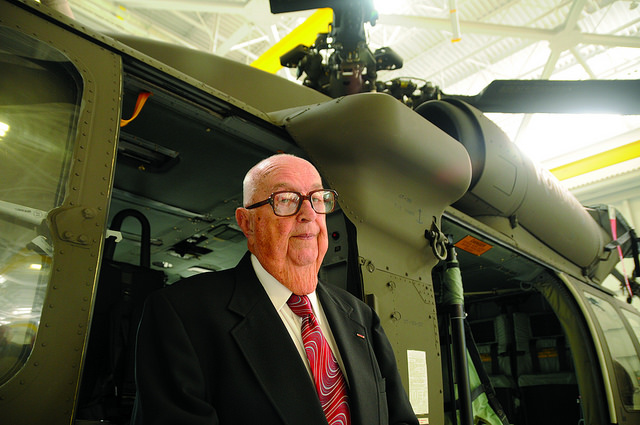
Retired Chief Warrant Officer William H. Canon, former shop foreman assigned to the 2113th Transportation Aircraft Maintenance Company, poses with a new UH-60M Black Hawk helicopter after a ribbon cutting ceremony for Kentucky’s new Army Aviation Support Facility and introduction of a new fleet of UH-60M’s, Boone National Guard Center, Frankfort, Ky., Oct. 14, 2015. Canon gave thirty five years of his life to providing maintenance to Kentucky’s aircraft. (U.S. Army National Guard photo by Sgt. Lerone Simmons)
FRANKFORT, Ky. - Sitting in a new multi-million dollar facility, retired Chief Warrant Officer William Canon Jr., reminisced about providing maintenance to the Kentucky National Guard’s aircraft in high winds, pouring rain, freezing cold and summer heat.
“When I first joined, our pilots had recently flown in World War II,” he said. “Our equipment was old and we didn’t have adequate places to work.
“We had to park trucks around the helicopters to make sure the wind didn’t hit them directly,” said Canon. “The elements are one of the worst things when it comes to properly maintaining aircraft.”
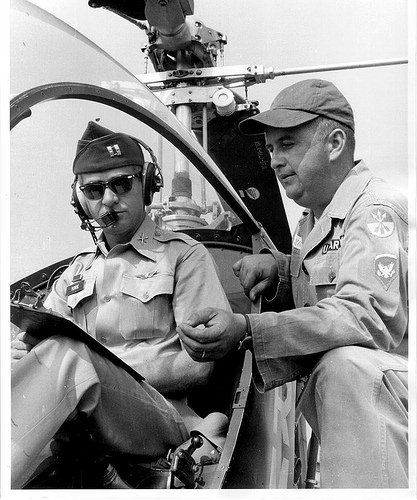
Capt. Yancey York confers with SPEC5 William H. Canon as he prepares for a flight in a OH-13E, circa 1960. (Photo courtesy Chief Warrant Officer(R) Harold Canon)
Click here for more photos.
Canon enlisted in the Army in 1950 and retired in 1990. He would join a fledgling aviation program in 1955.
In 1959, the Kentucky aviation assets found a new home in Frankfort, Kentucky, at the Capital City Airport. Then, 18-or-so-years later in 1971, Canon witnessed a state-of-the-art facility erected at Boone National Guard Center – the Army Aviation Support Facility. A hangar for the helicopters assigned to Kentucky. During his tenure, Canon rose to the level of shop foreman, assigned to the 2113th Transportation Aircraft Maintenance Company, and retired out of the old AASF.
But on Oct. 14, he joined hundreds of other current and former Kentucky National Guardsmen as the ribbon was cut, ceremoniously showing off the Kentucky National Guard’s newest AASF at Boone National Guard Center. He also got to view, sit in, and touch the new UH-60M, the Army’s newest in the Blackhawk fleet.
The new AASF is 126,000 square feet and uses geo-thermal heating and cooling, solar power, 80 kilowatts photovoltaic solar power, high efficiency lighting, daylight harvesting technology, and radiant floor heating. It holds several offices for staff, classrooms, a gym and plenty of space.
“We come from a time where we didn’t always have a climate controlled area or lots of space,” said Canon’s old company commander, retired Lt. Col. Willoughby S. Goin III, a former pilot with 12,000 flying hours.
“This will help allow the Guard to be able to deploy troops to any affected areas in a timely manner,” he said, “at times when ice storms, tornados and floods can destroy roads, the Guard can then utilize the air from this facility.”
Kentucky Gov. Steve Beshear, Maj. Gen. Edward W. Tonini, adjutant general for Kentucky and other special guests honored Canon in their remarks during the building’s dedication. The Kentucky Guard’s aviation safety record was also bragged upon during the remarks.
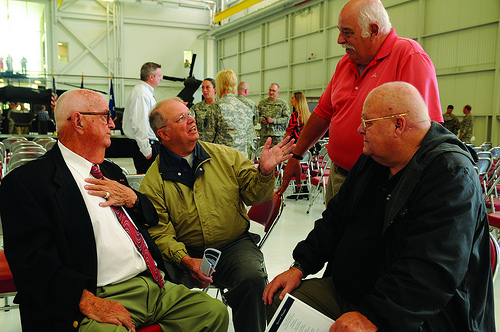
Sitting from left to right, retired Army Chief Warrant Officer William H. Canon, former shop foreman who was assigned to the 2113th Transportation Aircraft Maintenance Company, retired Army Lt. Col. Jere Roche, former commander of the 441st Medical Detachment, and retired Army Lt. Col. Willoughby S. Goin III, former commander of the 2113th Transportation Aircraft Maintenance Company, carry on a conversation after a ribbon cutting ceremony for Kentucky’s new Army Aviation Support Facility in Frankfort, Ky., Oct. 14, 2015. (U.S. Army National Guard photo by Sgt. Lerone Simmons)
Kentucky hasn’t had any major accidents or loss of life for the span of the last 250,000 flying hours, which Tonini said boils down to a huge feat of great maintenance and outstanding flying. He added that the Kentucky Guard has flown at least 15 missions over the Commonwealth during times of disaster, also while supporting the Joint Support Operations counterdrug efforts and overseas contingency operations.
For the many aviation retirees and current Guardsmen who maintain the Commonwealth’s air assets, the day was a reunion and a celebration of moving forward.
“What I’ve seen is outstanding,” said Canon. “I’m proud the progress we’ve made.”
By Staff Sgt. Christopher Barton, 1st Battalion, 149th Infantry
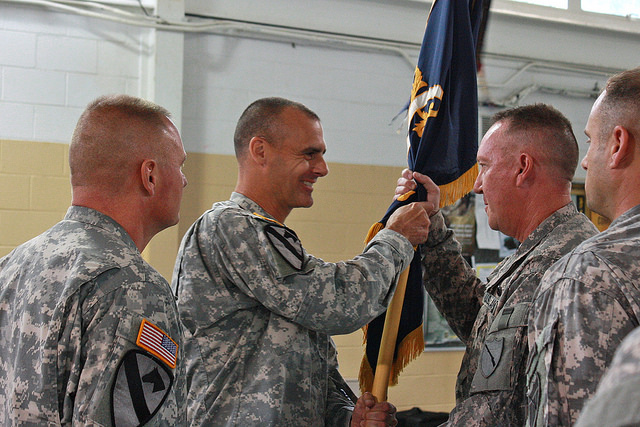
Col. Bryan Howay, commander of the 75th Troop Command passes the colors of the 1st Battalion, 149th Infantry to Lt. Col. Thomas Black during a change of command ceremony in Barbourville, Ky., Oct. 3, 2015. Black took charge from Lt. Col. Joseph Lear who led the battalion since 2013. (U.S. Army National Guard photo by Staff Sgt. Christopher Barton)
BARBOURVILLE, Ky. — Lt. Col. Thomas Black took charge of of the 1st Battalion, 149th Infantry during a change of command ceremony in Barbourville, Oct. 3. Black succeeded Lt. Col. Joseph Lear who has led the battalion since 2013.
Brig. Gen. Charles Jones, Kentucky’s deputy adjutant general, joined friends, family members and Soldiers of the battalion in welcoming Black and congratulating Lear on a successful run as the unit commander. In addition, five former battalion commanders and one former command sergeant major of the unit were in attendance, a testament to the legacy of the Mountain Warriors within the Kentucky Guard and the commonwealth.
Click here for more photos.
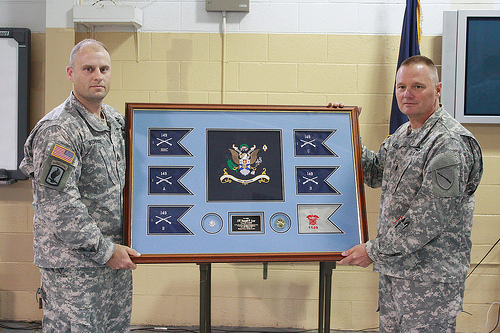
Command Sgt. Maj. Matthew Roberge presents Lt. COl. Joseph Lear with a framed collection of the guidons of the 1st Battalion,, 149th Infantry during a change of command ceremony in Barbourville, Ky., Oct. 3, 2015. Lear commanded the unit since 2013. (U.S. Army National Guard photo by Staff Sgt. Christopher Barton)
“Being here in this moment at this place is nothing short of surreal,” said Black. “I couldn’t help but be reminded of the leadership over the past 3 decades that I have been blessed with, the history I have shared with this battalion, and the heritage that at this very moment I am inheriting.”
Black has served in the Kentucky Guard for more than 30 years, most recently as the operations and planning officer for the 75th Troop Command. As a traditional Guardsman, Black owns and operates a real estate firm in Southern Kentucky.
Lear, who called the chance to lead the battalion the best job he’s ever had, will move to the 75th TC as an operations officer. Black said the battalion has a legacy of great leadership and the last two years were indicative of the same under Lear.
“This battalion is the best combat arms battalion in the Army National Guard. It will remain that way and continue to lead the way. We will emphasize our efforts on near term challenges, constantly evaluating who we are, where we are with respect of who we want to be and where we want to be in respect to long term goals.”
Col. Bryan Howay, commander of the 75th TC called Black a very diverse leader, considering his roles as a Soldier, the father of a Soldier and a local businessman, “there’s nothing he can’t relate to.”
“My most honorable character is being a Dad, my 2nd most honorable character is being a Untied States Army Infantry officer proudly serving in the Kentucky Guard,” said Black. “And now my most honored position while wearing this uniform is commander of the 1st Battalion, 149th Infantry.”
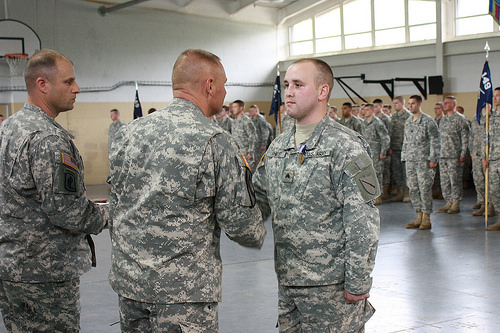
Lt. Col. Joseph Lear presents Sgt. Daniel White with the Soldier’s Medal in Barbourville, Ky., Oct. 3, 2015. White received the award for his actions in saving a motorist’s life in an automobile accident in Frankfort, Ky., in 2014. (U.S. Army National Guard photo by Staff Sgt. Christopher Barton)
In addition to the change of command, the Mountain Warriors also celebrated one of their own with a prestigious honor. Sgt. Daniel White was presented the Soldier’s medal for his actions in helping to save the life of a motorist involved in a fiery automobile accident in January of 2014.
“This means a lot to me, to be recognized for the award,” said White. “It’s not the recognition that any of us were looking for though, the main priority was that Mr. Burdett was out of harm’s way and we did everything that we could do for him. We were lucky enough to be in the right place to put our training in effect and do what anybody in that situation would have done.”