
Pages
Stay In Touch
More
© 2013 KentuckyGuard
Kentucky National Guard Staff Report
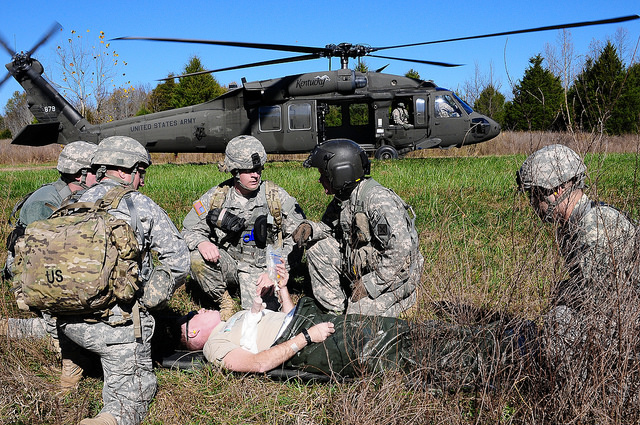
Flight Medic Staff Sgt. Jeremy Lowe with the 2nd Battalion, 238 Aviation Regiment consults with a medic team as they prepare to load a simulated casualty aboard a UH-60 Black Hawk MEDEVAC helicopter for transportation to a field hospital located at the Wendell H. Ford Regional Training Center in Greenville, Ky., Nov. 14. This exercise was a special addition to combat medic sustainment training that provided medics with real world experience working with flight medics and MEDEVAC flight crews that would only be available when deployed overseas. (U.S. Army National Guard photo by Sgt. 1st Class Aaron Hiler)
GREENVILLE, Ky. — When things go wrong in the field, Soldiers turn to the so-called “Angels of the Battlefield.” These highly-trained combat medics are there for when the worst case scenario unfolds, whether on the field of battle or during training exercises, whenever Soldiers are injured or wounded.
In order to stay up-to-date on the best trauma practices, medics receive refresher training every two years. Luckily for medics of the Kentucky National Guard, the refresher training is offered at the Wendell H. Ford Regional Training Center in Greenville.
“This class provides the medics with all of the continuing education units required to re-certify,” said Staff Sgt. Donald King, a combat medic instructor for the 238th Regional Training Institute.
“This course also gives them additional training that they cannot get in their units or elsewhere.”
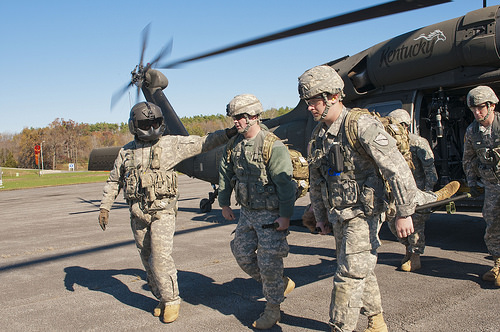
A flight medic with Charlie Company, 2nd Battalion, 238th Aviation guides combat medics from a UH-60 Black Hawk during the medics’ recertification training at the Wendell H. Ford Regional Training Center in Greenville, Ky., Nov. 14, 2015. As part of the training the medics were given scenarios loading and unloading patients from the aircraft to familiarize them with the dangers of doing their job around aircraft. (U.S. Army National Guard photo by Sgt. 1st Class Aaron Hiler)
Click here for more photos.
Following the completion of the course, Soldiers received familiarization training on medical evacuation (MEDEVAC) flight operations . The RTI coordinated with aviation assets from Kentucky’s 2nd Battalion, 238th Aviation Regiment to provide MEDEVAC helicopter support as a culminating event to the course.
“The purpose of this exercise is to give these medics experience with aviation flight medics and MEDEVAC aircrews so they are better prepared to evacuate patients to the next level of medical care,” said Sgt. Daniel Diehl, combat medic instructor. “This is training that they would otherwise only receive when deploying overseas.”
The medics performed triage on simulated casualties at a field aid station and called in nine-line MEDEVAC requests. From that point a UH-60 Black Hawk helicopter arrived to transport their patients to a field hospital.
Soldiers and trainers at Kentucky’s RTI are used to thinking outside the box and developing methods to improve training and bring attention to the possibilities at the Wendell H. Ford Regional Training Center. Training coordinator, Sgt. 1st Class John Riggi said this medic course was just one example of that type of thinking.
“It’s rare to have a portion of this kind of training include actual medical evacuation by aircraft. Thankfully we were able to coordinate with our aviation assets in the state to make it happen,” said Riggi. “And I believe it was certainly a highlight of the course and a critical piece of training that will make these medics better.”
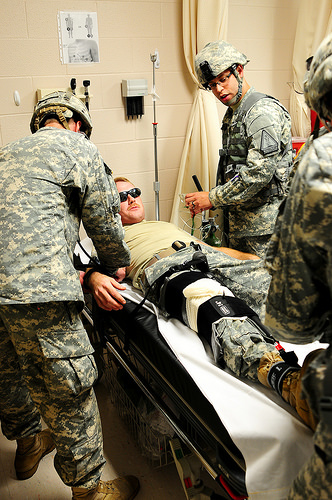
Sgt. Orlando Gonzalez reviews a simulated casualty’s status with a doctor at a field hospital during a practical exercise conducted as part of Combat Medic Sustainment training at the Wendell H. Ford Regional Training Center in Greenville, Ky., Nov. 14, 2015. According to the sustainment training staff this practical exercise and the use of UH-60 Black Hawk MEDEVAC helicopters is unique to the Kentucky National Guard. (U.S. Army National Guard photo by Sgt. 1st Class Aaron Hiler)
“This is the best medic training I’ve ever received,” said Sgt. 1st Class Kirby Jones. Jones, a recruiter for the Kentucky Recruiting & Retention Battalion, took the course to re-certify his combat medic status.
“I’ve been to four previous medic refresher courses at Fort Knox and Fort Campbell and other locations,” he said. “This class has been better by far because of the level of interaction with the instructors and the shared experiences of the other medics. No ‘death by PowerPoint’ here.”
The training also benefited the aviation Soldiers of Detachment 1, Charlie Company, 2/238th. Staff Sgt. Lowe, Flight Medic Standardization NCO for the unit said the training opportunity provided the crew a chance to test their own response and how they work with ground medics in such situations.
“This assists our mission by saving precious time correcting mistakes in patient packaging during an actual lifesaving mission,” said Lowe. “The medics that were involved in this training performed admirably, they were given difficult scenarios in very different environments than they were used to working in. I was very impressed by their hard work.”
A variety of courses are taught at the training site which has become not only a convenience for Kentucky Soldiers but a very cost-effective benefit for the state. With the addition of a realistic MEDEVAC exercise with aircraft, the course garnered the attention of Fort Sam Houston, home of the U.S. Army’s combat medic school.
“A representative from the Army’s Emergency Medical Service program was here to see how we do things in Kentucky, and I believe he was impressed,” said Riggi. “The more unique and high-quality training we can conduct here, the more people will notice what the RTI can do. And that could lead to even more training opportunities and benefits for the Kentucky Guard.”
By Sgt. 1st Class Gina Vaile-Nelson, 133rd mobile Public Affairs Detachment
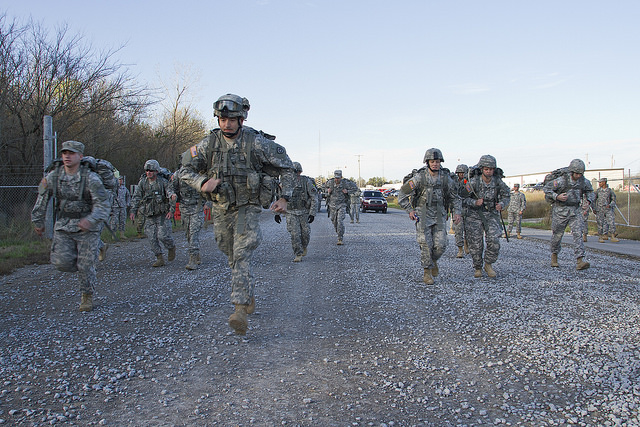
Kentucky Guardsmen begin the ruck march portion of the 2016 Soldier of the Year Competition at the Wendell H. Ford Regional Training Center in Greenville, Ky., Nov. 7, 2015. Soldiers tested their skills in a variety of Army tasks in the three-day competition. (U.S. Army National Guard photo by Staff Sgt. Scott Raymond)
GREENVILLE, Ky. — In a competition there is one thing that is certain: only one winner will prevail.
The Kentucky National Guard’s 2016 Best Warrior competition is no different. Only one Soldier, NCO and Senior NCO is named with the top honor at the conclusion of the strenuous three-day competition. A gauntlet that puts the NBC-hit American Ninja Warrior TV competition to shame.
But as the leaders who competed and supported the competition learned, one person may come out on top, the Kentucky National Guard is one team.
“I learned that no matter what unit you’re from, at the end of the day we are all Soldiers,” said Sgt. Amanda Marlow, human resources specialist, Joint Force Headquarters NCO of the year.
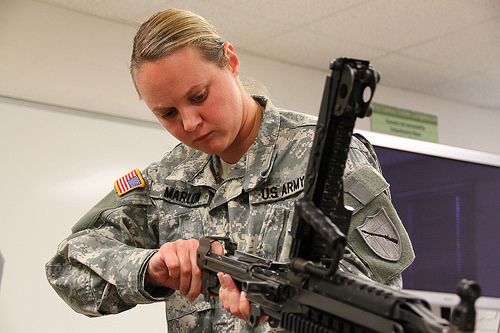
Sgt. Amanda Marlow reassembles a M249 machine gun as part of the Soldier of the Year competition at the Wendell H. Ford Regional Training Center in Greenville, Ky., Nov. 6, 2015. (U.S. Army National Guard photo by Staff Sgt. Scott Raymond)
“Throughout this competition we’ve had competitors continuously cheer for everyone,” she said. “Whether it was cheering on at the end of the run, or coming back to the finish and cheering for those finishing the ruck march. For me that was a neat thing to be a part of.”
It wasn’t just competitors who kept each other going. Marlow said State Command Sgt. Maj. David Munden was instrumental in keeping her and other Soldiers focused on finishing and not giving up.
“Sgt Maj. Munden finished up my last leg of running the IMTG course with me,” she said. “That was pretty awesome to see the state command sergeant major come out and run with his Soldiers. He did that throughout the competition with various events, but that’s something I’ll remember.”
Click here for more photos.
It is the Warrior Ethos, engrained in each of the 2016 competitors, that makes the Best Warrior challenge different than other competition. Never leaving a Soldier behind may be associated with battle scenarios, but it holds true even in competition. It is knowing that you’re only as strong as your weakest link, and digging deep to help make the weak stronger.
For Sgt. Christopher Jones, infantryman, Delta Company, 1st Battalion 149th Infantry NCO of the Year and the 2016 Kentucky NCO of the year, this year’s ruck march was a poignant reminder of the Ethos.
“I’ve never had that much competition before,” he said.
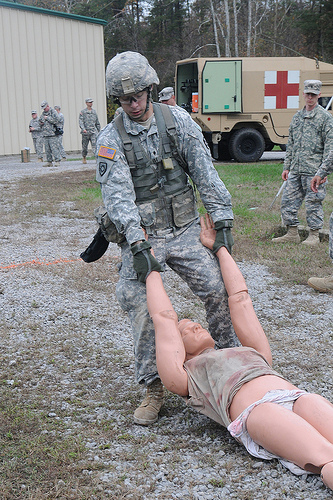
Spc. Michael Miller with the 149th Brigade Support Battalion, drags a dummy to safety as part of the stress-fire obstacle course developed for the 2016 Best Warrior competition Nov. 6 at the Wendell H. Ford Regional Training Center in Greenville, Ky. There were six strenuous tasks, including hitting targets with assigned weapons, that participants had to complete. (U.S. Army National Guard photo by Sgt. 1st Class Gina Vaile-Nelson/133 MPAD/KYARNG)
“For the whole five miles, it was three of us, just constant. He was ahead of me, I was ahead of him, it was the worst. But we couldn’t quit. It pushed us harder.
“It was my most memorable moment,” he said. “This weekend, especially on the ruck march, I had a lot of guys supporting me from my unit. They rucked with me on the way and switched out every mile. They stayed with me.”
Spc. Jacob Heath, a medic assigned to Delta Company, 1st Battalion, 149th Infantry and the 2016 Kentucky Soldier of the Year, said this experience was fun and value-driven.
“Even though we were in competition, I respect the hell out of these guys,” he said.
For 1st Sgt. Josh Baker, first sergeant of 299th Chemical Company, 149th Maneuver Enhancement Brigade, as a senior leader and Kentucky’s NCO of the year for 2016, he said hopes that this experience makes the competitors stronger leaders and in turn, that trickles through the ranks.
“I think that sometimes we get caught up in our day-to-day with the Guard and we forget what a privilege it is to serve with other Soldiers,” Baker said. “This weekend, the caliber of Soldiers who have been here has reminded me, again, what a privilege it is to stand in front of them.
Baker said he hopes to take his experience from this competition and create unit-level competitions that will not only prepare his Soldiers for future Best Warrior events, but also build the esprit de corps among his ranks.
“Pride in service is one of the most important aspects that can get lost on that M-Day Soldier on a drill weekend, so I really want to remind them of the caliber of Soldiers who are in the Kentucky National Guard,” he said. “And show them where they can go if they put their minds to it.”
The 2016 Kentucky National Guard’s Best Warrior competition was held Nov. 5-7 at the Wendell H. Ford Regional Training Center in Greenville, Kentucky. Fifteen Guardsmen competed for Kentucky’s top enlisted honor.
By Sgt. 1st Class Gina Vaile-Nelson, 133rd Mobile Public Affairs Detachment
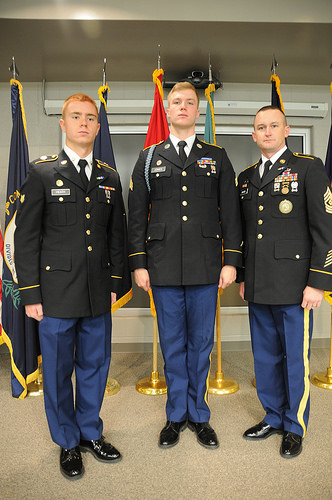
The Kentucky National Guard winners of the Best Warrior Competition were named during a ceremony Nov. 8, at the Wendell H. Ford Regional Training Center in Greenville, Kentucky. Winners are: Spc. Jacob Heath, Soldier of the Year; Sgt. Christopher Jones, NCO of the Year; and 1st Sgt. Josh Baker, Senior NCO of the Year. (U.S. Army National Guard photo by Sgt. 1st Class Gina Vaile-Nelson)
GREENVILLE, Ky. — The Kentucky National Guard has named the 2016 Soldier, Noncommissioned Officer and Senior NCO of the year for the Commonwealth:
Soldier of the Year: Spc. Jacob Heath, a medic assigned to Detachment 2, Headquarters and Headquarters Company, 1st Battalion, 149th Infantry
NCO of the Year: Sgt. Christopher Jones, an infantryman assigned to Delta Company, 1st Battalion, 149th Infantry
Senior NCO of the Year: 1st Sgt. Josh Baker, first sergeant with the 299th Chemical Company
The three Guardsmen received ribbons and trophies in a brief awards ceremony Nov. 8, at the Wendell H. Ford Regional Training Center in Greenville, Kentucky, following the competition.
“So many times we get caught up in the day-to-day, conducting the Guard business, all the mandatory training, that it is easy to lose sight, sometimes, of what a privilege it is to stand shoulder to shoulder with these guys,” said Baker. “The caliber of Soldiers who were here, I’m just speechless of the caliber of competition.”
Click here for more photos.
Warriors were tested on their military knowledge and military history; completed an Army Physical Fitness Test; conducted weapons qualification on the M4 rifle and 9 mm pistol; were physically and mentally strained on a stress-shoot obstacle course; ran land navigation and 5-mile ruck march and completed numerous Warrior Task skills before appearing before boards.
“I’ve had a 17-year career in the Guard, I’ve seen a lot of what right looks like,” Baker said. “Now I want to do that for my Soldiers. I want to impart everything I’ve learned here on my Soldiers.”
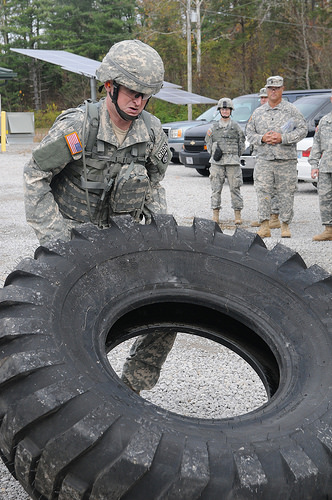
Kentucky National Guard 1st Sgt. Josh Baker, 299th Chemical Company first sergeant, strains to flip a tire as part of the stress-fire obstacle course developed for the 2016 Best Warrior competition Nov. 6. Baker was one of four senior noncommissioned officers who competed for the title of Kentucky Guard’s Senior NCO of the Year at Wendell H. Ford Regional Training Center in Greenville, Ky. (U.S. Army National Guard photo by Sgt. 1st Class Gina Vaile-Nelson)
Kentucky’s six brigades sent their best and brightest representatives for the annual Best Warrior competition held Nov. 5-7. The three-day competition pushed each of the 15 competitors to their mental and physical limits. The competition is designed to prepare the three winners to represent the Commonwealth at the regional and national level competitions.
For Jones, he’s well aware of how difficult the regionals can be. In 2015, he represented Kentucky as the Soldier of the Year at regionals. After learning from his experience there and competing as a NCO for 2016, Jones said he has one goal.
“Hopefully to win it all this year and take the national,” he said.
Jones said one of his downfalls in 2015 was tackling the state and regional competition as if it was meant for infantrymen, and not encompassing the whole Soldier concept.
“This isn’t infantry of the year, this is Soldier of the Year,” he said.
That same sentiment is what Heath said kept him going through the competition.
“I serve in a platoon of medics; it goes to show that there’s no limits, nothing there to stop you,” said Heath.
Heath said that his preconceived idea that the Best Warrior competition was only for an infantryman is something he wants to ensure other Soldiers don’t think.
“I’ve got motivation to make my peers better Soldiers and better competitors,” he said.
Kentucky State Command Sgt. Maj. David Munden said he was not only proud of the winners, but also of the spirit and resiliency the other competitors exuded.
“These (15) are the best and the brightest of what the Kentucky National Guard has to offer,” he said.
He also thanked the competitors for staying motivated and pushing each other through the stress.
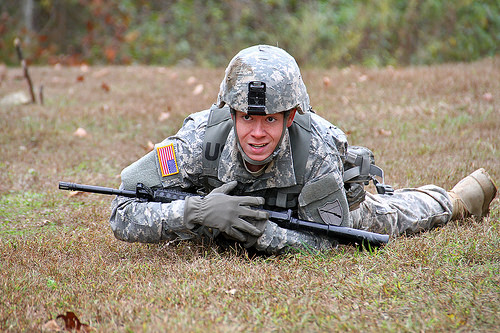
Spc. Jacob Heath, a medic with the 1st Battalion, 149th Infantry crawls through an obstacle course during the 2016 Soldier of the Year Competition at the Wendell H. Ford Regional Training Center in Greenville, Ky., Nov. 7, 2015. Heath was named Soldier of the Year following the competition and will represent Kentucky in the regional best warrior competition in the spring. (U.S. Army National Guard photo by Staff Sgt. Scott Raymond)
“When you came in on Thursday night, I asked you one thing,” he said. “While you’re driving home, can you look within yourself and say I left it all out there. I did everything I could do, to do as well as I can. And I hope that you did.
“I hope you go home with a satisfied mind and a satisfied soul,” he said.
Kentucky’s Soldier and NCO of the Year will continue to train with senior leadership to compete in the regional competition in Spring 2016. This years runners up included:
Soldier of the Year Runner Up: Spc. Michael Miller, a paralegal assigned to Headquarters and Headquarters Company, 149th Brigade Support Battalion
NCO of the Year Runner Up: Sgt. Justin Gottke, an engineer assigned to the Western Kentucky Training Center
Senior NCO of the Year Runner Up: Sgt. 1st Class Lance Warmath, automated logistics specialist, Joint Force Headquarters
Story by Chief Warrant Officer Joseph Lyddane
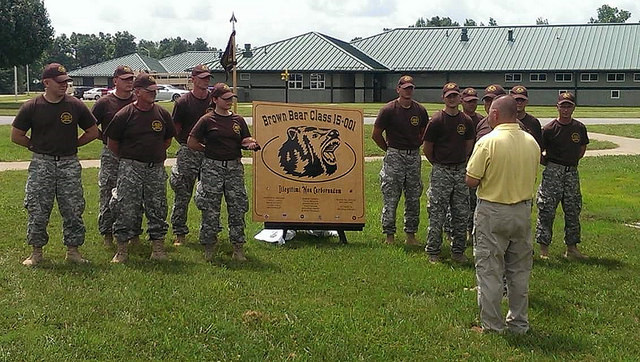
Warrant Officer Candidate Stephanie Bradley and her fellow Warrant Officer Candidates from Class 15-001 take part in a WOCS tradition by presenting their class sign to the Fort Rucker, Alabama staff. (Kentucky Army National Guard photo by Chief Warrant Officer Joseph Lyddane)
GREENVILLE, Ky. — Prior to August 26, 1920, women were considered inferior to men, they were limited to careers that many believed to be suppressive, and society’s view placed them as being less capable than their male counterparts. After more than seventy years of campaigning (the first women’s rights conference was held a Seneca Falls, New York, in 1848) history was made when women were officially added to the US Constitution under the 19th Amendment, granting them the right to vote. A small victory but a huge accomplishment at the time and also marked a turning point in the struggle for equality and women’s rights; no longer were women considered second class citizens. For this reason, August 26th has been declared by the President as Women’s Equality Day since 1972.
Click here for more photos.
Throughout the last century women like Eleanor Roosevelt, Rosa Parks, Grace Hopper, Jackie-Joyner-Kersee, and Maya Lin have shattered barriers and confronted stereotypes; each joining the ranks of thousands who have fueled the imagination and drive of others with aspirations of making a difference. Similar to those original trail blazers, there is a new generation of women on the forefront proving that women are skilled, qualified, and resilient enough to overcome the challenges offered in today’s military.
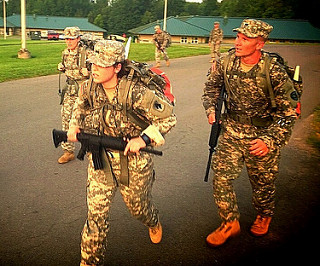
In the early morning hours on July 18, 2015, the Warrant Officer Candidates of Class 15-001 are required to complete a 6.2 mile ruck march in less than 106 minutes. This is one the many tests required of WOCs during their training and — according to Warrant Officer Candidate Stephanie Bradley — one of the toughest challenges yet. (Kentucky Army National Guard photo by WOC David Cureton)
Stephanie Bradley is one such example. One of five siblings, three brothers and a twin sister she decided to enlist in the Kentucky Army National Guard eight years ago in order to support her personal goal of attending college.Because of her background, hard work ethic, and accompanying reputation, she is in pursuit of a new goal after receiving approval to become a Warrant Officer. She is one of eleven Warrant Officer Candidates currently attending the 238th Regimental Training Institute’s Warrant Officer Candidate School at the Wendell H. Ford Regional Training Center in Greenville, Kentucky – and in observance of Women’s Equality Day it is important to point out she is the only female.
“I was inspired by all the Warrant Officers I have met and wanted to progress in my professional career,” said Bradley.
Upon commissioning and after completing her Warrant Officer Basic Course she will be a 920B, Supply Systems Technician responsible for instructing, managing, and supervising the receipt, storage, and issuance of supplies and equipment.
The male dominated Warrant Officer Candidate Class 15-001, aptly named the Brown Bears can be an intimidating environment to some but for Warrant Officer Candidate (WOC) Bradley, it’s a welcomed challenge and, now six months into the course, has almost solidified her dream. As a previous nominee for Unit NCO of the year and Battalion Soldier of the year, it is clear that her superiors have recognized her talent.
“WOC Bradley consistently demonstrates the subject matter expertise that Warrant Officers are known for. She will make an excellent addition to the Warrant Officer Corps,” said Capt. Jake Kwiek, commander of Alpha Company, 103rd Brigade Support Battalion.
When her peer and fellow candidate WOC John Smith was asked what makes her stand out from the rest, he replied, “She always goes above what is expected and has been an asset for the entire class, she personally developed our study methods that has kept us all on track.”
“From the first day I met WOC Bradley during last January’s OCS/WOCS open house, I was impressed with her initiative and ability to get things done, and done right,” said State Command Chief Warrant Officer Dean Stoops. “She initially stood out amongst her fellow applicants by her ability to complete the application process in a very short period of time, and in time to attend Zero Phase in March and begin Phase Two in April.
“I knew then, this Soldier was Warrant Officer material and would go far as a Supply Systems Technician. I have no doubts she has a bright future ahead of her and will be a great asset to the Kentucky Army National Guard and the Quartermaster Corps.”
With a Bachelor’s Degree in Arts (minor in psychology) from Lindsey Wilson College, an extensive amount of military training, several accolades, and a reputable civilian career in production control at Lockheed-Martin, this future warrant officer has proven to be one of the Kentucky Army National Guard’s rising stars.
Bradley’s advice to other females in the military? “Do not let the perceived physical standards hold you back. Be willing to step outside of their comfort zones and if you’re the one complaining and wishing things would change, then put yourself in a position where you can change it – as a leader.”
For more information on the Kentucky National Guard’s warrant officer program contact Chief Warrant Officer Ryan Turner at (502) 607-6200, Cell: (502) 320-3653 or email at [email protected].
By Staff Sgt. Scott Raymond, Kentucky National Guard Public Affairs
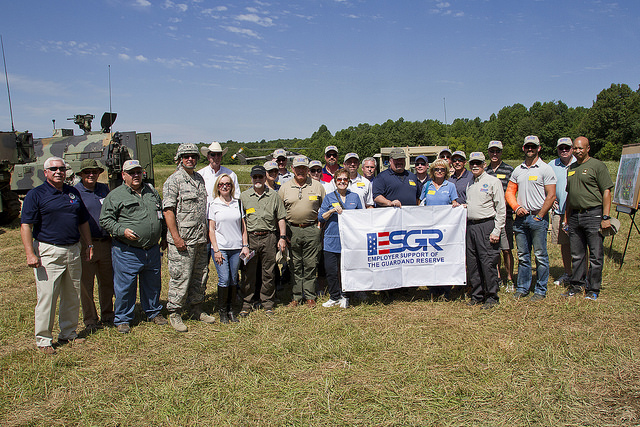
Kentucky civic leaders and employers visit with Kentucky Guardsmen as part of an Employer Support of the Guard and Reserve (ESGR) Boss Lift at Fort Knox, Ky., July 22, 2015. (U.S. Army National Guard photo by Staff Sgt. Scott Raymond)
FRANKFORT, Ky. — When a National Guard Soldier or Airman serves their one weekend and month and two-weeks in the summer, they are considered a traditional Guardsman. With the overwhelming majority of Kentucky’s Guardsmen falling into that category, hundreds of employers across the commonwealth are included in the extended Guard family. During ceremonies to welcome home, promote or award Guardsmen, we always hear the common gratitude to the families for sharing their loved one with the Guard. But it also a familiar acknowledgment to the employers and businesses that have also supported Kentucky’s Citizen-Soldiers.
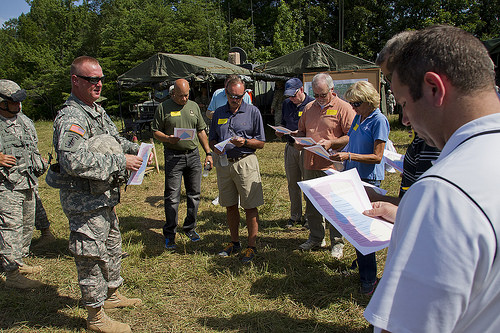
Lt. COl. Rob Larkin, command of the 138th Field Artillery Brigade speaks to employers and civic leaders during the civilians’ visit to the unit as part of an Employer Support of the Guard and Reserve boss lift at Fort Knox, Ky., July 22, 2015. The ESGR group toured the 138th’s tactical operations center, interacted with Soldiers and witnessed a live fire exercise of M109 Paladins. (U.S. Army National Guard photo by Staff Sgt. Scott Raymond)
As a thank you to several such military-friendly employers, Kentucky’s Employer Support of the Guard and Reserve held a day with the troops event, July 22. Commonly referred to as a Bosslift, such events provide employers and civic leaders the opportunity to see first hand what Kentucky’s Guardsmen, their employees, do when they are “off work.”
More than 30 representatives from local agencies and businesses from Lexington to Bowling Green flew by Blackhawk helicopter to Fort Knox, Kentucky and the Wendell H. Ford Regional Training Center in Greenville, Kentucky for the up-close view of National Guard training.
“The ESGR Bosslift program is essential in helping employers and community leaders understand what our Citizen-Soldiers do while in uniform,” said retired Army Brig. Gen. Mike Richie, a support specialist with Kentucky’s ESGR. “Most develop a deep appreciation for the dedication and sacrifice required to serve in the military. It’s also an opportunity to thank them for their contribution to our nation’s defense by employing and supporting our Service members.”
Click here for more photos.
Soldiers with the 138th Field Artillery Brigade were first to play host to the ESGR group at Fort Knox. Kentucky Adjutant General, Maj. Gen. Edward W. Tonini joined Lt. Col. Rob Larkin, commander of the 138th in greeting the civilians in a field environment the 138th was occupying for annual training. The employers met with the artillery Soldiers, toured their tactical operation center and vehicles, and witnessed a live fire exercise by the unit’s M109 Paladins.
One of the Paladin crew members was Sgt. 1st Class James Hatfield, a fireman with the Bardstown FIre Department. Among the visitors was Chief Marlin Howard, Hatfield’s boss.
“He has seen me in uniform before, but never in the field, never in this atmosphere, I’m sure his perspective will probably change a little bit,” said Hatfield. “Telling someone what you do is one thing, but when they see you in the environment you do it, is a completely different story. It’s hard for them to get that visual.”
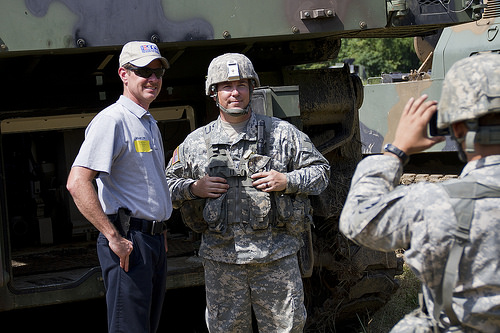
Chief Marlin Howard, chief of the Bardstown FIre Department has he photo taken with Sgt. 1st Class James Hatfield during an Employer Support of the Guard and Reserve boss lift at Fort Knox, Ky., July 22, 2015. Hatfield serves with Howard in Bardstown as his full-time employment. (U.S. Army National Guard photo by Staff Sgt. Scott Raymond)
“It means a lot that he came out here,” Hatfield added. “We are super busy at work and for him to take the time, see what I do and be a part of it, and to have a boss care enough to want to know what you do is pretty awesome.”
Hatfield has spent 21 years in the military uniform and 14 years as a fireman. The balance has worked for him, but knows some still believe that Guardsmen just get a couple extra days off each month.
“Employers on these boss lifts can see first hand, this isn;t a vacation out here, it’s good quality training for something we might have to do down the road.”
Howard said he has a small and close department, so everyone knows each other pretty well but hearing and seeing are two different things.
“He is a great employee and I kinda knew what he did outside work, but until you put boots on the ground with him, stand there beside with the equipment he works with, it’s an unbelievable moment,” said Howard. “It’s great to know and see that training that they get here, they take it back to their community.”
“I really appreciate everything the Guard has done to make us feel welcome into all of this, it’s been very nice and educational.”
In addition to the visit with the 138th, the employers and civic leaders traveled to the Kentucky’s Guard’s primary training facility in Greenville to see members of the 103rd Chemical Company during search and rescue training and Soldiers with the 138th Signal Company conducting vehicle roll-over training.
Chief Keith Jackson has a unique view of the day as he spent 27 years in the military. Now the Lexington Fire Department chief returns to the training fields to see Larkin, his friend and fellow fireman. Jackson expressed the pride he has for Larkin and the accomplishments he continues in the Guard and knows the sights and sounds will have an impact on the other employers.
“I think, today has opened their eyes to what truly at Citizen-Soldier is,” he said. “And they see what the Service members can offer, not only to the country but to the average American citizen.”
For more information on ESGR, visit www.esgr.mil, and www.kentuckyguard.com for information on Kentucky’s ESGR program.
Story by Capt. Curtis Persinger, Training Center Garrison Command, Wendell H. Ford Regional Training Center
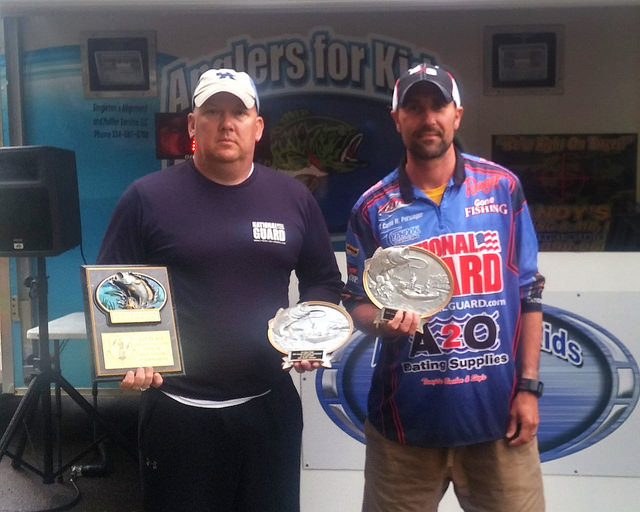
1st Sgt. Scott Carrier and Capt. Curtis Persinger show off their “hardware” after winning first place at the 20th annual Air National Guard bass tournament held in Lake Martin, Ala. This is the third year in a row the two Army Guard Soldiers have taken the event. (Photo courtesy Capt. Curtis Persinger)
Editor’s note: Capt. Curtis Persinger is a professional Soldier and a consummate officer in the Kentucky National Guard. His enthusiasm for training the troops second only to his passion for catching largemouth bass. In his own words he describes the events that led up to a third year in a row win for the Kentucky Army National Guard at the 20th annual Air National Guard bass tournament held in Lake Martin, Ala.
ALEXANDER CITY, Ala. — First, I want to thank the Alabama Air National Guard for putting on such a great event. My partner 1st Sgt. Scott Carrier and I started fishing these tournaments back when the Army National Guard received the invitation back in 2012 on Kentucky Lake. We haven’t seen a poorly executed event yet. Like anything there is a lot of “behind the scenes work” that must be completed for these things to run smoothly. We are both grateful for being associated with this group of people and the tradition that continues to move from state to state. Scott and I are humbled to win against this group of Fishing Fanatics.
Click here for more information on the tournament.
Click here for more photos.
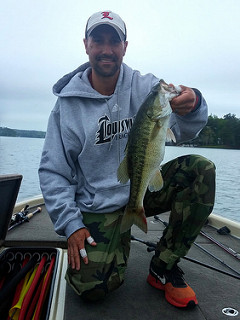
Capt. Curtis Persinger shows off one of the prize winning largemouth bass that helped his team get first place at the 20th annual Air National Guard bass tournament held in Lake Martin, Ala. This is the third year in a row the two Army Guard Soldiers have taken the event. (Photo courtesy Capt. Curtis Persinger)
We were discussing the tournament decisions and results after the tournament; it is something we do routinely after any time we fish together. Most anglers can relate to this. It’s a simple check and balance to receive some type of clarity/closure. Honestly though we never saw this one coming! The last few years we definitely fished to our strengths and or gave us some confidence. We were both very comfortable on Lake Guntersville that we go to routinely throughout the year. Last year’s event on Patoka was my home lake and June is a very tough month to fish but I understand what the fish are doing and how to catch them.
However, at Lake Martin we were just happy to defend. No pressure and no expectations. A local FLW BFL result clued me in on the size and type of fish we should be chasing! I initially thought it would take four decent spotted bass (man those Tallapoosa River spots can fight) and one kicker largemouth to win. I commented to Scott and a few other teams from various states who were staying at the Super 8 Motel that I thought it would take 24lbs to win. At the time we were well off that mark. It took every practice day to figure Lake Martin out.
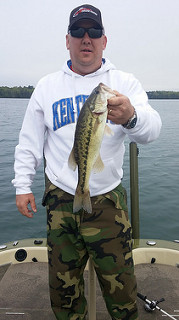
1st Sgt. Scott Carrier is half of the team that one first place at the 20th annual Air National Guard bass tournament held in Lake Martin, Ala. This is the third year in a row the two Army Guard Soldiers have taken the event. (Photo courtesy Capt. Curtis Persinger)
There are a lot of fish are in that lake. Well, I went five hours on the first day of practice while Scott was en-route without a bite. I completely abandoned my “kicker largemouth” search in the first day and in the next several hours I figured out a very deep spotted bass pattern. It was your typical assortment of baits and techniques for structure fishing. A pattern that held up under blue bird sunny skies and dark cloudy rainy conditions.
Our day one and day two bags were almost identical except for the two largemouth that happened to be lost out in about 25 feet of water. They were the only two largemouth that we touched all week! We never thought we would enjoy chasing Lake Martin Magnum spotted bass like we did! We are actually excited to return to Lake Martin in 2017 to chase down those elusive MAG spots (four plus pounders) giants that I know live in the lake!
Now off to Lake St. Clair in 2016. Man, are we excited to go up there and chase some toads and defend our title! We know this will be one tall order. Neither one of us have ever fished above the state of Indiana. We assume those Michigan anglers have a little something for us. We guess those brown fish will throw us a curve ball or two. They are known for that!
With that said, I can guarantee one thing: Scott and I will be working our tails off from daylight to dark giving everything we have.
Good luck to all the anglers and safe travels!
Story by Master Sgt. Phil Speck, 123rd Airlift Wing Public Affairs
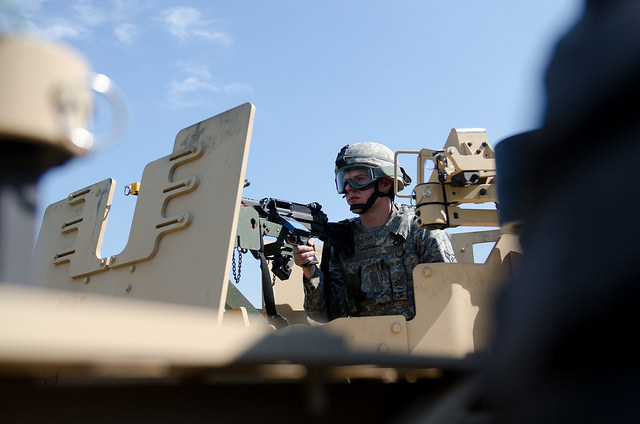
Airman First Class Adam Cantrell, a security forces journeyman from the Kentucky Air National Guard’s 123rd Security Forces Squadron, provides over watch during a mounted patrol as part of a training exercise at the Wendell H. Ford Regional Training Center in Greenville, Ky., on Sept. 17, 2014. The unit’s Airmen conducted a five-day, combat-skills training course to prepare for future deployments. (U.S. Air National Guard photo by Master Sgt. Phil Speck)
GREENVILLE, Ky. — Airmen from the Kentucky Air National Guard’s 123d Security Forces Squadron conducted five days of intense field training here recently to prepare them for future deployments in potentially hostile environments.
The training kicked off Sept. 15 with the Airmen being inserted into the Wendell H. Ford Regional Training Center via a Kentucky Army National Guard UH-60 Blackhawk helicopter. From there, they set up a perimeter, completed a two-mile patrol and assaulted a village to rescue two simulated prisoners of war — all in just the first two hours.
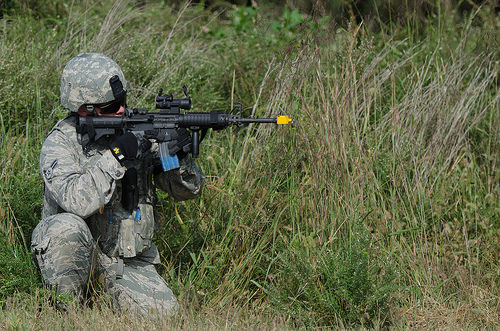
An Airman from the Kentucky Air National Guard’s 123 Security Forces Squadron aims his weapon at opposing-force actors during a training exercise at the Wendell H. Ford Regional Training Center in Greenville, Ky., on Sept. 18, 2014. The unit’s Airmen conducted a five-day, combat-skills training course to prepare for future deployments. (U.S. Air National Guard photo by Master Sgt. Phil Speck)
The Airmen also conducted exercises on land navigation and night patrols before concluding the week with a robust field-training scenario designed to simulate air base defense and mounted patrols in a combat environment, according to Lt. Col. George Imorde, commander of the 123d Security Forces Squadron.
Imorde said the training couldn’t have come a better time, as many of the squadron’s Airmen were preparing at the time to deploy to Africa in support of Operation United Assistance, the U.S. government’s multi-agency effort to stop the largest Ebola outbreak in history.
“This field training exercise enhanced our rapid-deployment ability to support Operation United Assistance, and the realistic base defense/force protection training provided a refresher of the duties and expectations directly related to our combat mission,” Imorde said.
A common misconception is that security forces only guard the gates at Air Force installations, secure the flight line and patrol the base, according to Tech. Sgt. Craig Davis, NCOIC of combat arms for the 123rd. But that is just a small portion of their responsibilities, he said.
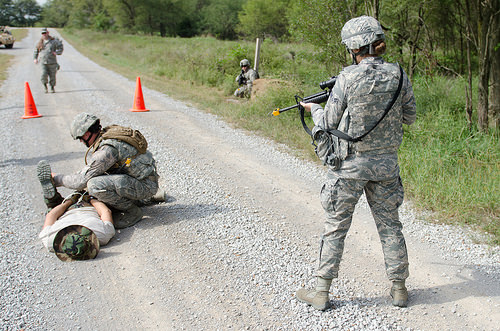
Personnel from the Kentucky Air National Guard’s 123 Security Forces Squadron apprehend a simulated opposing-force actor during a training exercise at the Wendell H. Ford Regional Training Center in Greenville, Ky., on Sept. 18, 2014. The unit’s Airmen conducted a five-day, combat-skills training course to prepare for future deployments. (U.S. Air National Guard photo by Master Sgt. Phil Speck)
“The bigger picture of what we do is the defense and protection of air bases in deployed environments,” Davis said. “The methodology of completing those tasks is really our primary mission. When we deploy, these Airmen and NCOs are expected to know air base defense.”
For some of the 123rd’s newest NCOs, the Greenville exercise provided their first opportunity to demonstrate leadership under a deployed base-defense scenario, Davis said.
“Letting these young Airmen see what we do, and how we do it, is a very rewarding thing,” Davis said. “You get to see young NCOs become seasoned NCOs and take charge by bringing teams together. Everyone is an individual, but when people come together and work toward a common goal as a team, it’s pretty rewarding. When they are no longer looking to you for instruction, and they are looking to each other for approval, then you know the training has been successful.”
Members of the Wing’s 123rd Force Support Squadron also participated in the exercise, serving hot meals prepared in the unit’s Disaster Relief Mobile Kitchen Trailer.
Story by 2nd Lt. Michael Reinersman, 133rd Mobile Public Affairs Detachment
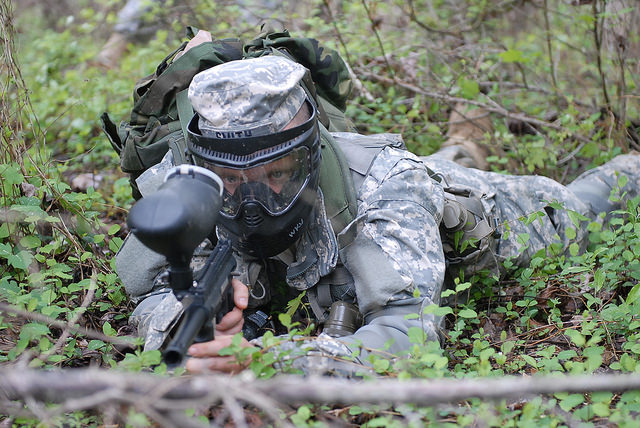
Officer Candidate Benjamin Smith from Class 57-15 pulls security during the combined Officer Candidate School, Reserve Officer Training Corps with Western Kentucky University and Murray State University during a field training exercise at Wendell H. Ford Regional Training Center in Greenville, Ky., April 17, 2015. Smith and 73 other Soldiers participated in the second combined OCS and ROTC exercise. (U.S. Army National Guard photo by 2nd. Lt. Michael Reinersman)
GREENVILLE, Ky. - Future Army leaders from across the commonwealth joined forces to conduct a combined field training exercise at Wendell H. Ford Regional Training Center in Greenville, Ky., April 16-18, 2015.
Officer candidates from the Kentucky National Guard Officer Candidate School along with cadets from Murray State University and Western Kentucky University’s Reserve Officer Training Corps spent three days in the field covering troop leading procedures while conducting platoon and squad level tactics.
This included scenarios such as movement to contact and platoon ambush and raids. The goal of the combined field training exercise is to assess and provide instruction to the officer candidates and ROTC cadets in leadership positions while conducting infantry tasks.
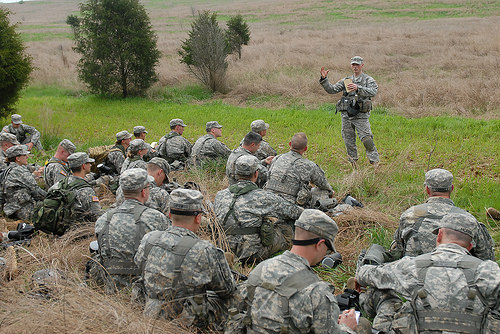
Capt. Colin Bair, Assistant Professor of Military Science at Murray State University conducts an after action review with cadets from Western Kentucky University and Kentucky Guard Officer Candidates during field training exercise at the Wendell H. Ford Regional Training Center in Greenville, Ky., April 17, 2015. This marks the second year that ROTC programs from Western Kentucky and Murray State have participated in the field training exercises with the Kentucky OCS program. (U.S. Army National Guard photo by 2nd. Lt. Michael Reinersman)
According to Western Kentucky University’s Assistant Professor of Military Science, Capt. Lincoln Ward, there are many benefits to training and collaborating with the Kentucky Guard.
“This has been a good partnership,” said Ward. “Working with new soldiers from different backgrounds provides a new challenge to the cadets.” Adding that, “The Kentucky National Guard provides us with resources that we don’t normally have at a ROTC program or the NCO support that can help access land and medics.”
This marks the second year that ROTC programs from Western Kentucky and Murray State have participated in the field training exercises with the Kentucky OCS program. To enhance training this year, cadets and candidates used a military grade paintball system, to simulate live fire.
Click here for more photos.
“This enhancement from last year’s training will make it more realistic and environmentally friendly by using bio degradable paint balls,”said Sgt. 1st Class Anthony Kennedy, operations noncommissioned officer for the 238th Regimental Training Institute. “It is a better alternative than having shell casing all over the training area.”
Officer candidate Jennifer Steinmetz also echoed the mutual benefits of the training exercise.
“This would have been a hard training event to conduct since we don’t have the numbers,” said Steinmetz. “There are eight officer candidates, training with the cadets allowed the officer candidates to participate in full platoon and squad lanes,”
“Now, that we have those spots filled, during phase three, it will not be such a shock when we conduct platoon and squad lanes.”
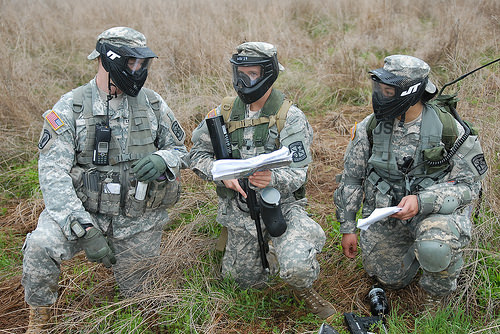
Capt. Colin Bair, Assistant Professor of Military Science at Murray State University checks the coordinates of ROTC Cadet Kelsey McArthur and Chrystal Falefata from Western Kentucky University during field training exercise at the Wendell H. Ford Regional Training Center in Greenville, Ky., April 17,2015. The goal of the combined field training exercise is to assess and provide instruction to the officer candidates and ROTC cadets in leadership positions while conducting infantry tasks. (U.S. Army National Guard photo by 2nd. Lt. Michael Reinersman)
Phase three is the last step in the OCS commissioning process. The final phase covers troop leading procedures, infantry squad tactics, and culminates with a field leadership exercise at Fort McClellan, Alabama.
Cadet Kyle Taylor with Western Kentucky University and a member of Kentucky’s Bravo Company, 149th Infantry, said training on a college campus is just plain difficult.
“Since we don’t have a lot space on campus, it’s great to be in a tactical environment and run lanes,” he said. “We are able to evaluate each other and work to get better.”
According to both Kentucky OCS and ROTC leadership, the Spring FTX was another successful collaboration between two commissioning programs to develop future leaders in the Kentucky Guard, Army Reserve and active duty.
Video by Spc. Cody Cooper, 133rd MPAD
Story by Staff Sgt. Scott Raymond, Kentucky National Guard Public Affairs
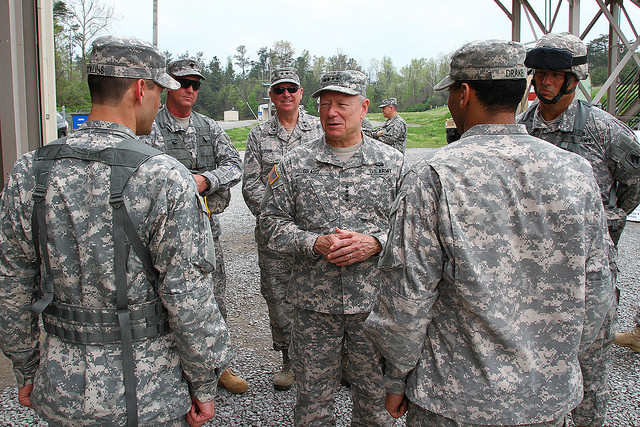
Gen. Frank J. Grass, chief of the National Guard Bureau speaks with Soldiers with the 138th Field Artillery Brigade at the Wendell H. Ford Regional Training Center in Greenville, Ky., April 17, 2015. During his three-day visit, Grass met with Soldiers and Airmen across the state, attended Thunder Over Louisville and Military Appreciation Day at Keeneland in Lexington, Ky. (U.S. Army National Guard photo by Staff Sgt. Scott Raymond)
FRANKFORT, Ky. — Military challenge coins are handed out everyday for excellence, but it’s not everyday that a Soldier’s first coin is from a four-star general. That was the case for Pfc. Lauren Walker, a combat medic with the 1163rd Area Support Medical Company.
“That was my first coin, my first big recognition as a Soldier that I’m doing the right thing,” said Walker. “It’s a pretty big deal to me.”
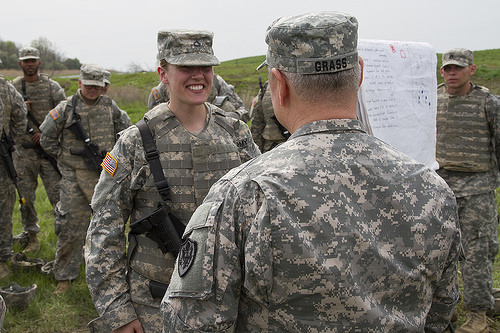
Pfc. Lauren Walker with the 1163rd Area Support Medical Company speaks with Gen. Frank J. Grass, chief of the National Guard Bureau at the Wendell H. Ford Regional Training Center in Greenville, Ky., April 17, 2015. The 1163rd was finishing up the unit’s pre-mobilization training prior to a scheduled deployment to Afghanistan this spring. (U.S. Army National Guard photo by Staff Sgt. Scott Raymond)
“It means a lot to us that he came down here from D.C. to see the little 1163rd. It was a great reminder for us to stay motivated to keep up the hard work and keep driving on.”
Visit our flickr page for more photos of Gen. Grass’ visit to Kentucky.
For Soldiers with the 1163rd, pre-mobilization training was going according to schedule April 18 at the Wendell H. Ford Regional Training Center in Greenville, Ky. Then in the middle of a field training class, everything came to a brief halt as Gen. Frank J. Grass, chief of the National Guard Bureau rolled up on their location.
Escorted by Maj. Gen. Edward W. Tonini, Kentucky’s adjutant general, Grass visited as part of his initiative to travel to every state and territory to personally thank Guardsmen around the Nation.
“Every time I travel, one of the things I find is I learn something about the National Guard that I didn’t know,” said Grass. “Getting to visit Soldiers and Airmen here and learn about the missions that you all are doing is phenomenal.”
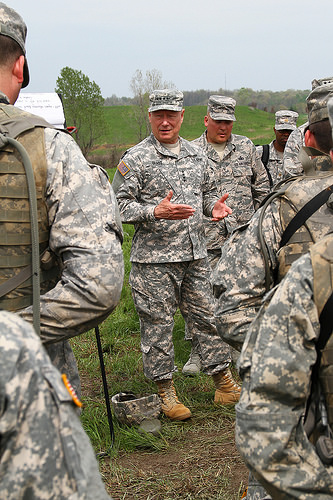
Gen. Frank J. Grass, chief of the National Guard Bureau speaks with Kentucky Guardsmen of the 1163rd Area Support Medical Company during a visit to the Wendell H. Ford Regional Training Center in Greenville, Ky., April 17, 2015. Grass thanked the Soldiers for their service and answered questions from them on the state of the National Guard. (U.S. Army National Guard photo by Staff Sgt. Scott Raymond)
“You think about the number of people that serve in uniform, this is an all volunteer force, and you’ve got to thank them,” he said.
Grass observed part of the training class then spoke with the unit about their upcoming deployment and their thoughts on being a part of the Guard.
“What I find interesting everywhere I go is how young the force is, how talented and how astute they are to what is happening in the world, and they know exactly why they’re joining.”
Sgt. Duncan Wooster’s story also inspired Grass. Wooster enlisted late in life and has a stable career as an airline pilot, but is also determined to be a true non-commissioned officer to the 1163rd. Grass complimented Wooster on helping young Soldiers of the 1163rd to devise plans to be smarter with the extra money they will make during the deployment.
“I’m excited and very honored to go work with such a great group of people and just want to try to influence them to make better decisions,” said Wooster. “I took everything Gen. Grass said to heart and was very impressed that he took time to come out in the field to see us. It was an honor to meet him and speak with him one-on-one.”
The National Guard chief’s visit left a positive buzz with the unit. A drive that their leadership hopes carries them into and through their deployment to Afghanistan.
“The time Gen. Grass spent with the Soldiers indicates to me that we stood out and made a positive impression on him,” said 1st Lt. Anna Mataspha, officer in charge of the 1163rd’s training. “How many other units in the Guard have come across the Chief of the National Guard, that’s pretty special and it elevates us to be even better than what we already are. It’s a great boost right before they deploy.”
During his three-day visit to Kentucky, Grass also met with Soldiers of the 138th Field Artillery Brigade in Greenville and Soldiers with Charlie Co., 1st Battalion, 376th Security and Support Aviation upon his return to Louisville. Grass was also an impressed spectator at Thunder Over Louisville, April 18 and a special guest at Military Appreciation Day at Keeneland in Lexington, Kentucky, April 19.
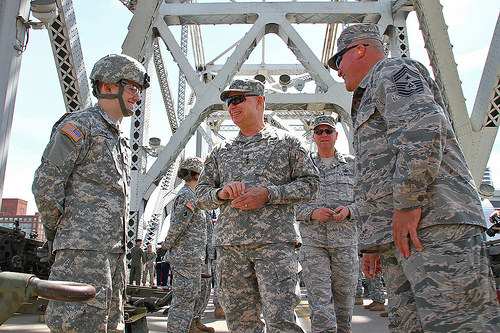
Gen. Frank J. Grass, chief of the National Guard Bureau and Chief Master Sgt. Mitch Brush speak with Spc. Kyle Shenk with the 138th Field Artillery Brigade during Thunder Over Louisville, April 18, 2015. Grass visited with Kentucky Guardsmen on duty for the event throughout downtown Louisville. (U.S. Army national Guard photo by Staff Sgt. Scott Raymond)
“Thunder Over Louisville was just phenomenal and to see how much the military was involved, the salute to Veterans, the salute the Kentucky Army and Air National Guard, there was a half-million people there and you couldn’t move without bumping into a Guardsmen or their family member somewhere.”
In awe of the events and the participation of the Kentucky Guard, Grass departed Kentucky with final thoughts to the Citizen-Soldiers and Airmen of the bluegrass.
“I would tell them thank you for serving your nation and look at the opportunities you’re getting as a member of the Guard, and thanks to their families and employers. It all becomes a family and the Guard is more family than anything I’ve seen.”
Story by Capt. Ryan Hubbs, Kentucky National Guard Resilience Coordinator
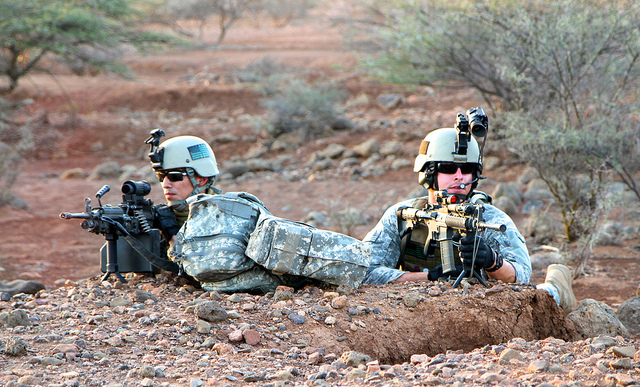
Multiple deployments can take their toll on our citizen soldiers and their families, which in turn degrades readiness. Resilience training offers tools and resources to combat the negative affects incurred during mobilization. (Photo by Sgt. Alexa Becerra, 2/138th PA)
GREENVILLE, Ky. — What makes a person be able to bounce back from adversity? Why do some people seem to thrive under pressure, while others can barely cope with the stresses of everyday life? Is it something you were born with, or is it a skill that can be learned?
For answers to these questions, the U.S. Army teamed up with the University of Pennsylvania and prominent psychologists to see what it was that makes an individual “resilient.”
Resilience is defined as the ability of an object to spring back into shape, or more specifically (when dealing with Soldiers) the ability of a person to recover quickly from adversity. Although originally, psychologist believed that resiliency was a trait individuals were born with, they have now discovered that resiliency is a skill that can be learned by anyone.
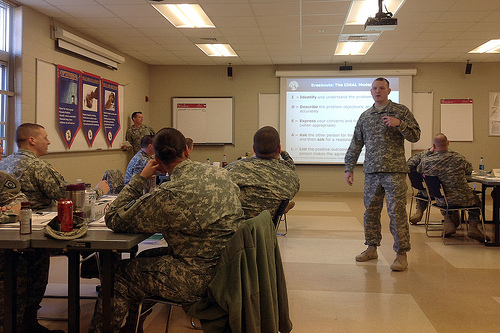
Kentucky Guardsmen participate in a group discussion as part of their Master Resiliency Trainer Course at the Wendell H. Ford Regional Training Center in Greenville, Ky., Jan. 20, 2015. (U.S. Army National Guard photo by Capt. Mike Moynahan)
It is no secret that today our men and women who serve in the National Guard face many situations which bring about stress. Juggling deployments, annual training, and drill weekends with a civilian job and family relationships can be extremely difficult, even for the most resilient individuals. It is because of this recognized stress that the Kentucky Army National Guard has seen fit to get as many Master Resilience Trainers as possible to teach these skills in their units, in order to make our Guard stronger.
From Jan. 12-23, leaders from a variety of units of the Kentucky Army Guard attended the Master Resilience Trainer Course at the Wendell H. Ford Regional Training Center in Greenville. Lead by Abbey Bradshaw, a resilience specialist from Fort Knox, the Resilience Team from the Michigan National Guard’s Great Lakes Resilience Center and some help from the Army Reserves, Soldiers from across Kentucky were immersed in the optimistic world of resiliency.
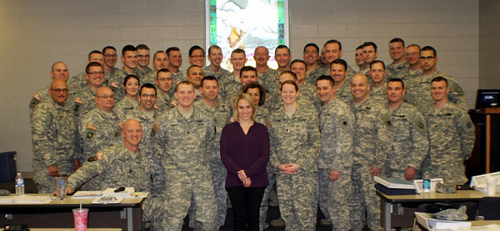
The graduating class of the Kentucky National Guard’s Master Resiliency Trainer Course at the Wendell H. Ford Regional Training Center in Greenville, Ky., Jan. 23, 2015. (U.S. Army National Guard photo by Capt. Mike Moynahan)
The two-week course teaches Soldiers a variety of skills dealing with how to become more self-aware of counterproductive thoughts and emotions and how to regulate them. The course focuses on optimistic thinking and gives Soldiers the tools be cool and confident in any situation. The course even teaches skills such as active constructive responding that help to foster better relationships with friends, family, and coworkers alike.
The course is with not without its critics though. The Army has been trying to eliminate the perception that it is “not okay” to share feelings.
“I was concerned about having to sit in a drum circle and talk about feelings,” said Master Sgt. Chuck Shuff with the 20th Special Forces Group when he first learned he was going to attend the course. “I was relieved when that turned out not to be the case at all. These are practical skills that Soldiers need to have.”
It is not uncommon for those who enter the course to be a little leery at first. However, by the end, almost all who complete the course say they come away with invaluable skills that not only help them become better Soldiers, but also better people.
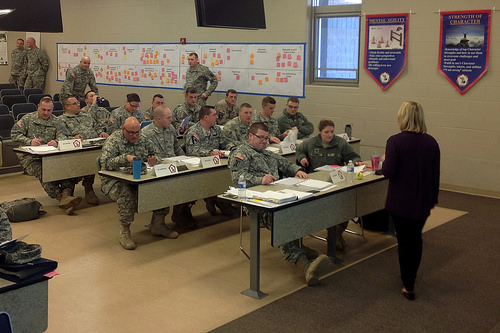
Kentucky Guardsmen attend a Master Resiliency Trainer Course at the Wendell H. Ford Regional Training Center in Greenville, Ky., Jan. 15, 2015. (U.S. Army National Guard photo by Capt. Mike Moynahan)
In an effort to spread the resiliency program, it is important to get buy-in from leaders at the top and whom Soldiers respect.
Capt. Mike Moynahan, a Ranger qualified Infantry company commander said, “The skills taught during the course are proven and effective, but it takes practice to become good at them. Mandatory training requirements can be overwhelming at times, but these skills will pay dividends while deployed for soldiers and their families.”
Overall, the 32 Soldiers who participated in the training had overwhelmingly positive things to say about the course. In addition, the Kentucky Army Guard is now at 96% strength for units that require an MRT. Facts that keep leadership optimistic for the future of resiliency in the military.
“The positive response for the program here in Kentucky has been encouraging,” said Maj. John Harvey who oversees the program. “With more than 125 MRTs trained and more classes scheduled, the Kentucky Guard is quickly becoming one of the most resilient states in the Nation.”
For more details on how you can receive resilience training or become involved in the state resilience program, please contact your unit MRT or State Resilience Coordinator.
