Pages
Stay In Touch
More
© 2013 KentuckyGuard
Staff Report
Detachment 1, Charlie Co, 2nd Battalion 238th Aviation MEDEVAC, based out of Frankfort, Ky., is currently deployed and providing support to the troops stationed all over Kuwait.
Their primary mission is to provide lifesaving support and transport.
To see all the photos from this story, please click HERE.
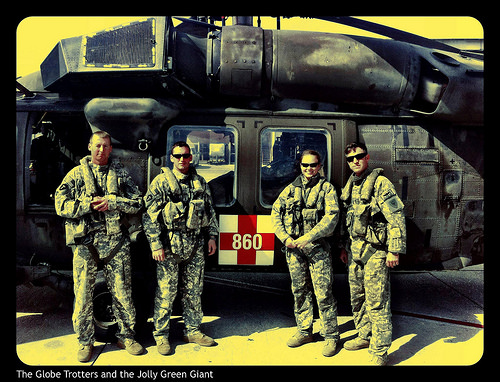
Staff Sgt. Jake White, Chief Warrant Officer two Jason Conley, Sgt. Heather Mehltretter and Chief Warrant Officer three Kevin Keith crew a UH-60 Blackhawk during their deployment to Kuwait. (photo submitted)
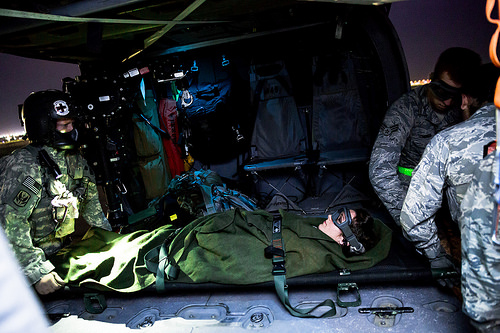
Sgt. Jordan Haley, a crew chief with Company C, 2nd Battalion, 238th Air Ambulance, 42nd Combat Aviation Brigade (CAB), loads a mock casualty during a training event with Air Force medical practitioners on UH-60 Black Hawk medical evacuation procedures on Feb. 28th, 2014, somewhere in southwest Asia. The air ambulance, comprised of Indiana and Kentucky Army National Guardsmen, is a medical response force able to quickly reach critical patients and deliver care on location and en route to an advanced care facility. The 42nd CAB, New York Army National Guard, is currently deployed to Kuwait in support of Operation Enduring Freedom. (N.Y. Army National Guard photo by Sgt. Harley Jelis/Released)
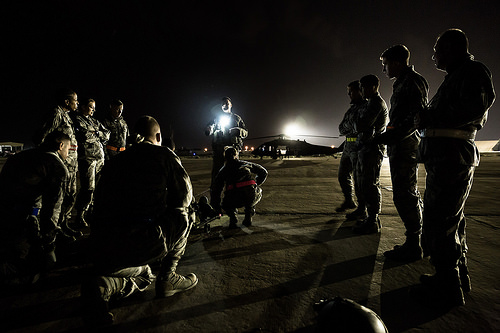
Sgt. 1st Class Michael Ball, a flight medic with Company C, 2nd Battalion, 238th Air Ambulance, 42nd Combat Aviation Brigade (CAB), trains Air Force medical practitioners in UH-60 Black Hawk medical evacuation procedures on Feb. 28th, 2014, somewhere in southwest Asia. The air ambulance, comprised of Indiana and Kentucky Army National Guardsmen, is a medical response force able to quickly reach critical patients and deliver care on location and en route to an advanced care facility.
The 42nd CAB, New York Army National Guard, is currently deployed to Kuwait in support of Operation Enduring Freedom. (N.Y. Army National Guard photo by Sgt. Harley Jelis/Released)
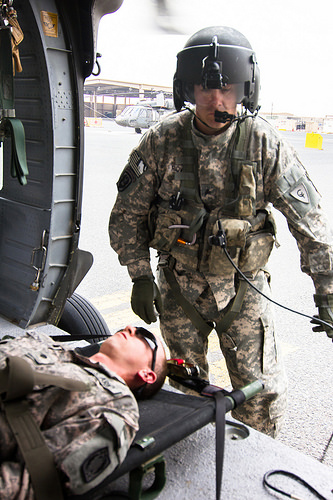
Staff Sgt. Mike Powers, Det. 1, C. Co, 2nd Battalion, 238th Medevac, helps off load a patient from the aircraft. The Medevac unit is currently deployed to Kuwait. (photo submitted)
Story by Maj. Randy Stillinger, 36th Combat Aviation Brigade Public Affairs
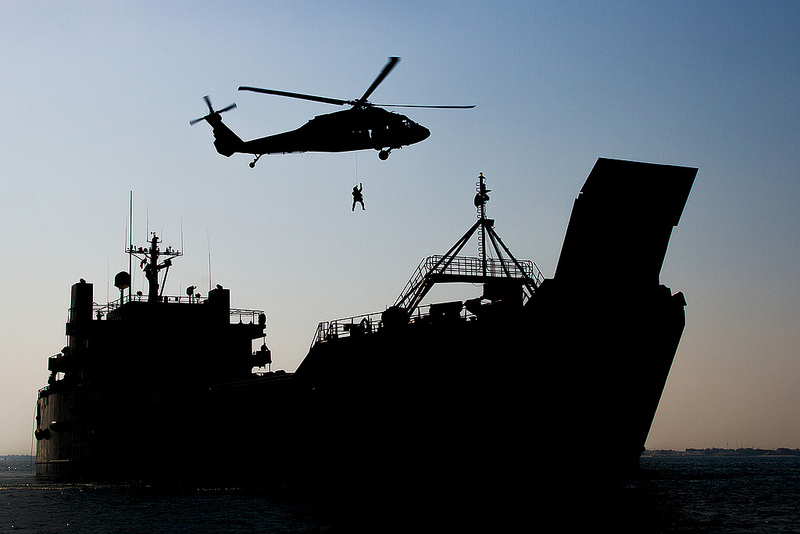
UH-60 “Black Hawk” helicopters from C Company, 2nd Battalion, 238th General Support Aviation Battalion conducts hoist training off the coast of Kuwait in the Arabian Gulf. The specialized training prepares medevac crews to extract downed aviators while at sea. The 2-238th includes Soldiers from both the Indiana and Kentucky Army National Guard and is currently deployed to the Middle East with the 36th Combat Aviation Brigade (Texas Army National Guard) in support of Operation Enduring Freedom. (U.S. Army photo by Sgt. Mark Scovell/Released)
CAMP BUEHRING, Kuwait – As winter weather appears on the horizon in the United States, the blowing sand of the Kuwaiti desert continues to challenge its Army Aviators.
To see all the photos from this unit’s deployment, please click HERE.
Since their arrival in Kuwait, Charlie Company, 2-238th General Support Aviation Battalion has endured harsh conditions that few Americans will ever experience.
These Army National Guard soldiers from Indiana and Kentucky, and their UH-60 Black Hawk helicopters, are deployed with the 36th Combat Aviation Brigade (CAB) to the Middle East in support of Operation Enduring Freedom. Their mission is to provide Medical Evacuation (MEDEVAC) capabilities to the region and build partnerships with countries that will further long-term stability in and around the Arabian Gulf.
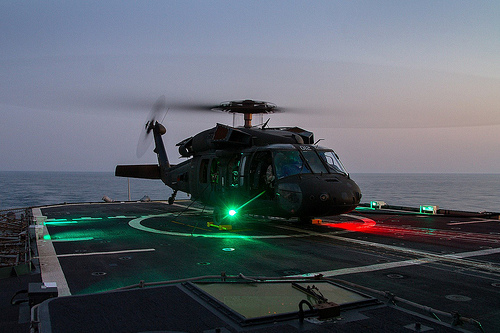
A UH-60 “Black Hawk” helicopter from C Company, 2nd Battalion, 238th General Support Aviation Battalion conducts shipboard operations off the coast of Kuwait in the Arabian Gulf. The specialized training prepares medevac crews to extract downed aviators while at sea. The 2-238th includes Soldiers from both the Indiana and Kentucky Army National Guard and is currently deployed to the Middle East with the 36th Combat Aviation Brigade (Texas Army National Guard) in support of Operation Enduring Freedom. (U.S. Army photo by Sgt. Mark Scovell/Released)
For the deployment Charlie Company was actually split into two “phases” with both groups serving nine-month tours, one after another. The company swapped out in September.
Charlie Company actually has a front row seat for what may be the future of Army Aviation operations in the post-Iraq/Afghanistan era as they venture out over the water. Once used as a stepping stone for units headed north into Iraq, Camp Buehring is their home base for operations and training missions across the region.
A significant key to regional security is the free flow of maritime traffic in the Arabian Gulf. Of particular importance is the Strait of Hormuz between the United Arab Emirates and Iran, which is crucial to the export of oil to the world market.
Working over the water and embarking on ships is a new skill for most Army Aviators, but these soldiers have risen to the challenge. Maritime missions for Black Hawk helicopters include Combat Search and Rescue (CSAR), Medical Evacuation, the transfer of personnel and logistics support to U.S. ships in the area. These overwater missions require Army Aviators to add challenging tasks and extensive knowledge to an already long list of training requirements.
Maj. Bryon Blohm, who commanded Phase 1, said, “The personnel recovery mission executed by MEDEVAC is a unique opportunity to leverage existing assets in this theater to meet today’s joint operational environment.”Although utilizing the helicopter’s ability to hoist patients from the ground into the aircraft is common for these aviators, a recent training event challenged even the most experienced MEDEVAC pilots. The training included flying out into the Persian Gulf off the coast of Kuwait to a U.S. Army cargo transport ship.
A Flight Medic was then lowered from the hovering helicopter onto the cargo deck of U.S. Army Vessel (USAV) SP/4 James A. Loux (LSV-6). A simulated “patient” was then loaded into a rescue basket and then hoisted into the waiting aircraft for the flight back to a hospital on land.
Overwater hoisting mission is normally carried out by Coast Guard or Naval aviators so this type of training for the Army is somewhat uncommon. Capt. Scott Oden, the Company Commander for Phase 2, said that to his knowledge this has never been done before by Army soldiers from Kentucky or Indiana.
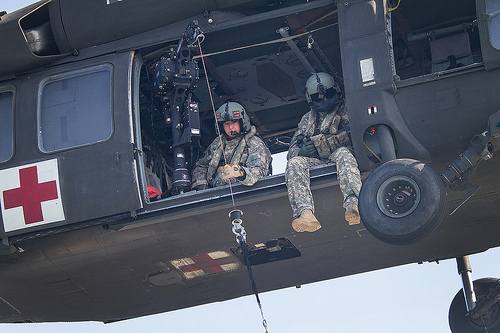
Staff Sgt. Jacob White and other crew members from Det. 1 C Company, 2nd Battalion, 238th General Support Aviation Battalion conducts hoist training in a UH-60 “Blackhawk” helicopter off the coast of Kuwait in the Arabian Gulf. The specialized training prepares medevac crews to extract downed aviators while at sea. The 2-238th includes Soldiers from both the Indiana and Kentucky Army National Guard and is currently deployed to the Middle East with the 36th Combat Aviation Brigade (Texas Army National Guard) in support of Operation Enduring Freedom. (U.S. Army photo by Sgt. Mark Scovell/Released)
Oden, of Indianapolis, said, “We’re here to develop the training, the Tactics, Techniques, and Procedures (TTP) so we can go back and continue to train our crew members to be able to respond in a moment’s notice from anywhere in Kuwait.”
The soldiers are also working with the Kuwaiti Air Force and other multi-national partners in the region to strengthen their ties, execute joint training events, and learn best practices from each other to provide long-term stability.
The 1-189th General Support Aviation Battalion from Montana serves as the company’s higher headquarters for this deployment. Lt. Col. Jamie Wilkins, who serves as the battalion’s commander, said that he’s very proud of everything that the MEDEVAC company has done since they’ve arrived and is impressed with their initiative to take on new and challenging training.
Oden also appreciates all the support that they’ve received from home since they left.
“We know that you have a very difficult job maintaining the home front as well as sacrificing your time,” Oden said. “It does not go unnoticed. We’re very appreciative of it and we’re looking forward to seeing you.”
The second half of the company will return home to their respective bases in Shelbyville, Ind., and Frankfort, Ky., in the spring of 2014.
Staff Report
KUWAIT — Detachment 1, C Company, 2nd Battalion, 238th Aviation Medical Evacuation (MEDEVAC) unit, based out of Frankfort, Ky., is currently deployed to Kuwait providing much needed support to the military in that region, both on and off the coast (stay tuned for upcoming stories on this unit).
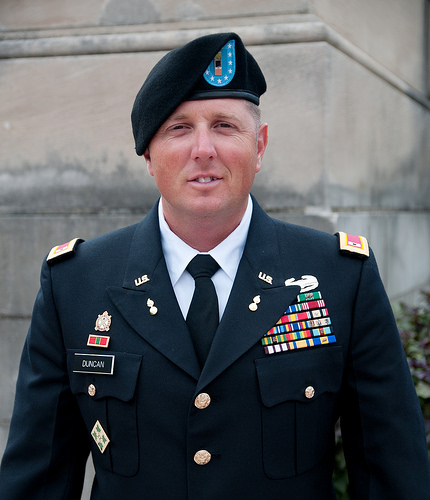
Chief Warrant Officer Three Kevin Keith is currently deployed with the MEDEVAC as a UH-60 Blackhawk Maintenance Test Pilot. You can see him below, then a Chief Warrant Officer two, pinning his wife, Misty, with a Freedom Lapel in 2006. Keith had just returned from a deployment as a young pilot to Iraq and was attending the Freedom Salute Ceremony with his family.
You can find stories like these and more in our Bluegrass Guard section of the website. Click HERE to see many of our Bluegrass Guard’s from over the years.
KUWAIT — Charlie Co 2nd Battalion 238th Aviation MEDEVAC, based out of Frankfort, Ky., is currently deployed and providing support to the troops stationed all over Kuwait.
Their primary mission is to provide lifesaving support and transport.
Here’s a snapshot of just a few of the missions they’re supporting…
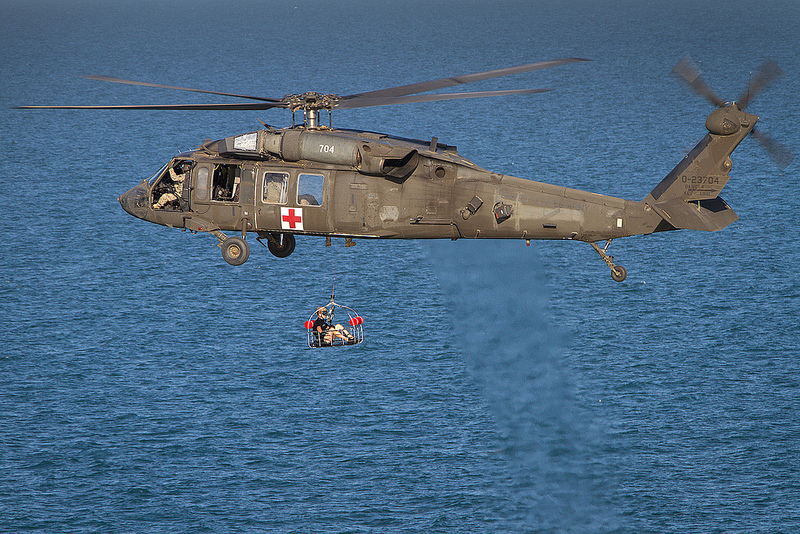
C Co 2nd Battalion, 238th MEDEVAC conducts personnel recovery (PR) operations over the Northern Arabian Gulf (NAG) Oct. 10, 2013. The unit is qualifying all army aviation crewmembers on overwater hoist PR while on deployment. This was conducted as a joint training exercise with a sister flight company who deployed the Navy EOD teams into the water via HeloCast and were recovered by the MEDEVAC aircraft. (photo submitted)
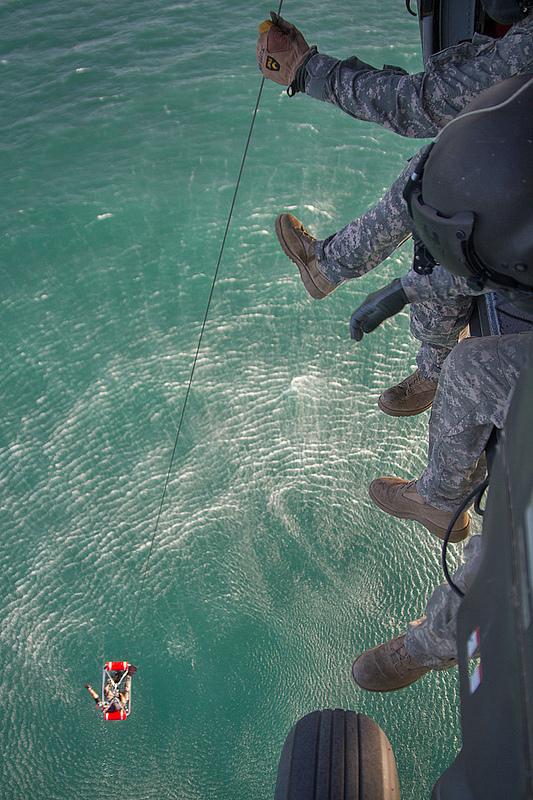
C Co 2nd Battalion, 238th MEDEVAC conducts personnel recovery (PR) operations over the Northern Arabian Gulf (NAG) Oct. 10, 2013. The unit is qualifying all army aviation crewmembers on overwater hoist PR while on deployment. This was conducted as a joint training exercise with a sister flight company who deployed the Navy EOD teams into the water via HeloCast and were recovered by the MEDEVAC aircraft. (photo submitted)
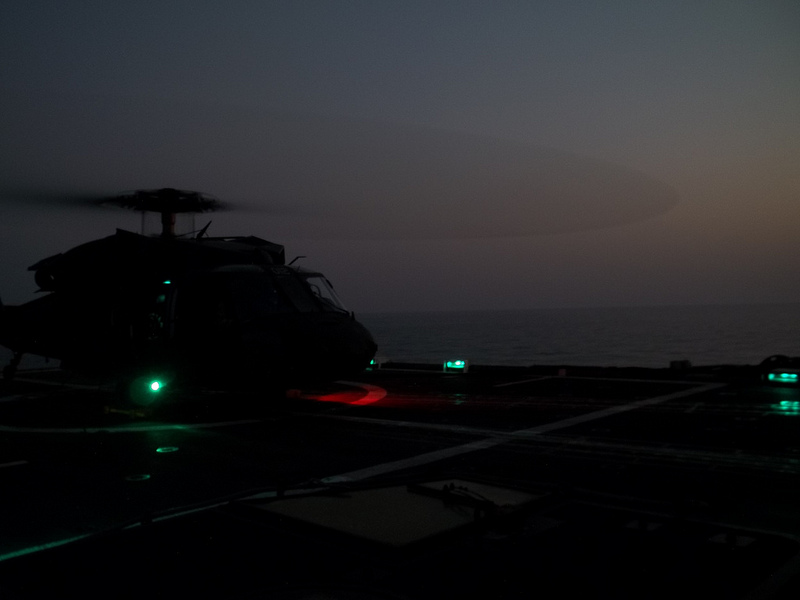
C Co 2nd Battalion, 238th MEDEVAC conducts Deck Landing Qualifications for the unit in the Northern Arabian Gulf (former Persian Gulf). This is to qualify pilots to land on ships in the event that someone had to evacuate for medical reasons from the ship. The Medevac Company, based out of Frankfort, Ky., is currently deployed to Kuwait. (photo submitted)
Story by Spc. Brandy Mort, 133rd Mobile Public Affairs Detachment
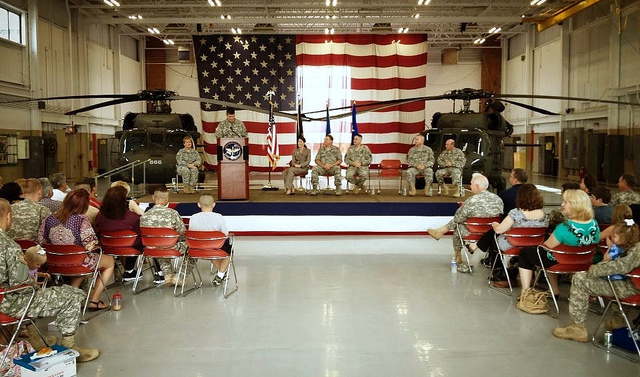
Capt. James Caniff, Commander of Detachment 1, Co. C, 2nd Battalion, 238th Aviation speaks to the crowd gathered during a departure ceremony for the unit in Frankfort, Ky., July 10, 2013. The unit will deploy to the Middle East to conduct medical evacuation missions in support of Operation Enduring Freedom. (U.S. Army National Guard photo by Staff Sgt. Scott Raymond)
FRANKFORT Ky. – Friends, family and Service members of the Kentucky National Guard packed the Army Aviation Support Facility in Frankfort, Ky., July 10, to honor the Soldiers of Detachment 1, Company C, 2nd Battalion, 238th Aviation as they prepare to deploy to the Middle East. The unit will fly UH-60 Blackhawk helicopters in support of medical evacuation (MEDEVAC) and training missions throughout the region.
Det. 1 is a platoon sized MEDEVAC element and are attached to C. Co 2/238th out of Shelbyville, Ind. They last deployed overseas in 2009-2010 to Kosovo.
“We have been preparing for this mission for three years,” said Capt. James Caniff, Det. 1 Commander, “And I can say without a doubt we will be the most prepared and proficient unit doing this mission.”
To see more photos from the departure, click here.
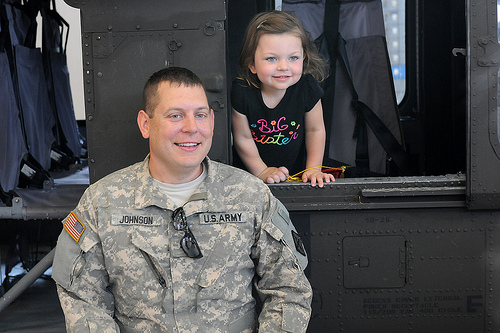
Chief Warrant Officer Tyler Johnson smiles with his daughter at a departure ceremony for Det. 1, Co. C, 2nd Battalion, 238th Aviation in Frankfort, Ky., July 10, 2013. Approximately 20 Soldiers of the unit will train at Fort Hood, Texas prior to deploying to the Middle East. (U.S. Army National Guard photo by Staff Sgt. Scott Raymond)
Most of the Soldiers deploying will be leaving children, one child recently turned six months old. One Soldier in particular laughed as his daughter toured the inside of a UH-60 Blackhawk helicopter prior to the ceremony.
“Leaving behind your child is always extremely hard,” said Chief Warrant Officer Tyler Johnson, a pilot assigned to the unit. “But it’s a sacrifice military children have to face. I’m proud of how strong my daughters will be after enduring this.”
Another Soldier is leaving behind her five year old daughter. She is thankful of how much technology she will be able to use in order to stay connected to her daughter.
“I’m going to miss Cora,” said Sgt. Heather Mehltretter, Flight Medic assigned to the unit. “But I’m happy that I will be able to use Skype or FaceTime to at least be able to see her face.”
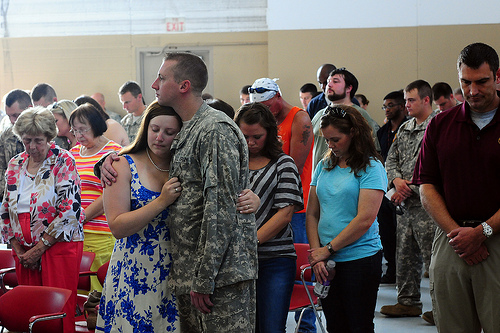
Staff Sgt. Jacob White embraces his wife, Jill, during a departure ceremony for Det. 1, Co. C, 2nd Battalion, 238th Aviation in Frankfort, Ky., July 10, 2013. White and other Soldiers of the unit will deploy to the Middle East to perform medical evacuation mission in the region. (U.S. Army National Guard photo by Staff Sgt. Scott Raymond)
Kentucky’s adjutant general, Maj. Gen. Edward W. Tonini joined Caniff in thanking the families and friends of the unit for the support and to remind the Soldiers of the quality training they have recieved in order to conduct the mission with the expected unbridled service of the Kentucky Guard.
The ceremony concluded with the audience joining Maj. April Brown in the tradition of singing ‘My Old Kentucky Home’.
The 2-238Th will head for Fort Hood, Texas for final preparations before deploying to the Middle East.
Story by Sgt. Scott Raymond, Kentucky National Guard Public Affairs
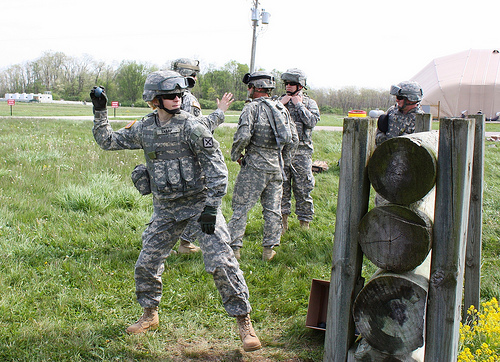
1st Lt. Jessica Tharp of Det 1 Charlie Co. 2/238th MEDEVAC Unit prepares to throw a training grenade at Camp Atterbury Joint Maneuver Training Center, April 15, 2012. Members of the unit received instruction in basic warrior tasks as part of their annual training. (U.S. Army photo by Sgt. Matthew Phelps, 2/238th MEDEVAC/Released)
GRISSOM AIR RESERVE BASE, Indiana - For members of Detachment 1, Charlie Company, 2nd Battalion, 238th Medical Evacuation Unit, training in Indiana is not just a road trip, it’s a journey closer to their “flag pole”. The company headquarters is located in Indiana. Detachments of the unit from both the Kentucky and Indiana National Guards converged on Camp Atterbury Joint Maneuver Training Center in April to begin their annual training.
To see more photos from this story, click here
The 2/238th MEDEVAC is scheduled to deploy next year to Southwest Asia and members of the units said it only made sense to train together.
“We are a platoon sized MEDEVAC element and we are attached to C Co 2/238th out of Shelbyville, Indiana,” said 1st Lt. Jessica Tharp, a platoon leader with the 2/238th. “Since we will be deploying with our Indiana brethren, this Annual Training was an opportune time to learn and train their MEDEVAC standard operating procedures and compare differences in their way of conducting training and ours.”
While at Camp Atterbury, the unit conducted simulator training and qualified personnel on the hand grenade range. The stay was short, however, as the unit moved training to Grissom Air Reserve Base just north of Indianapolis.
Members finished any remaining Army Warrior Task requirements and the unit prepared for flight training.
“Grissom was very accommodating and a great selection to accomplish AWTs and set-up Flight Operations and launch simulated 9-line scenarios,” said Tharp.
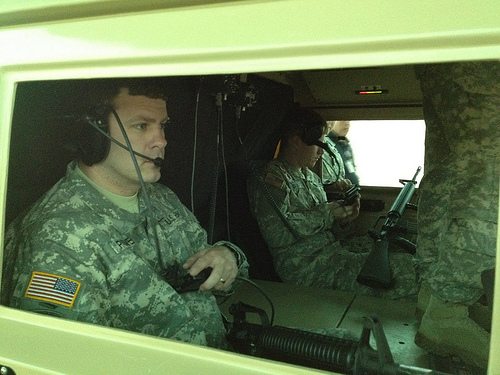
Sgt Mike Powers of Det 1 Charlie Co. 2/238th MEDEVAC Unit checks communications inside a convoy simulation at Camp Atterbury Joint Maneuver Training Center in Indiana, April 15, 2012. The unit travelled to Indiana to conduct their annual training. (U.S. Army photo by Sgt. Matthew Phelps, 2/238th MEDEVAC/Released)
The air base provided the unit the ability to fly MEDEVAC scenarios based upon their unit’s mission. Primarily the UH-60 Black Hawks of the 2/238th are used for aero-medical evacuations, but are also capable of other medical related needs including search and rescue operations and transporting patients and medical supplies.
Kentucky Soldiers said the training gave them a feel for their entire command and built a foundation for future cooperation with an out of state chain of command. They had a positive take away from the training and now what what they should work on before deploying.
“Kentucky brought a lot of experience to the table,” said Tharp. “We have seasoned crewmembers that collectively work very well together to accomplish the mission. This annual training was a chance to demonstrate that experience and continue to grow not only as a detachment, but as a company.”
Click here to read the Grissom Air Reserve Base article on this joint training
dwa
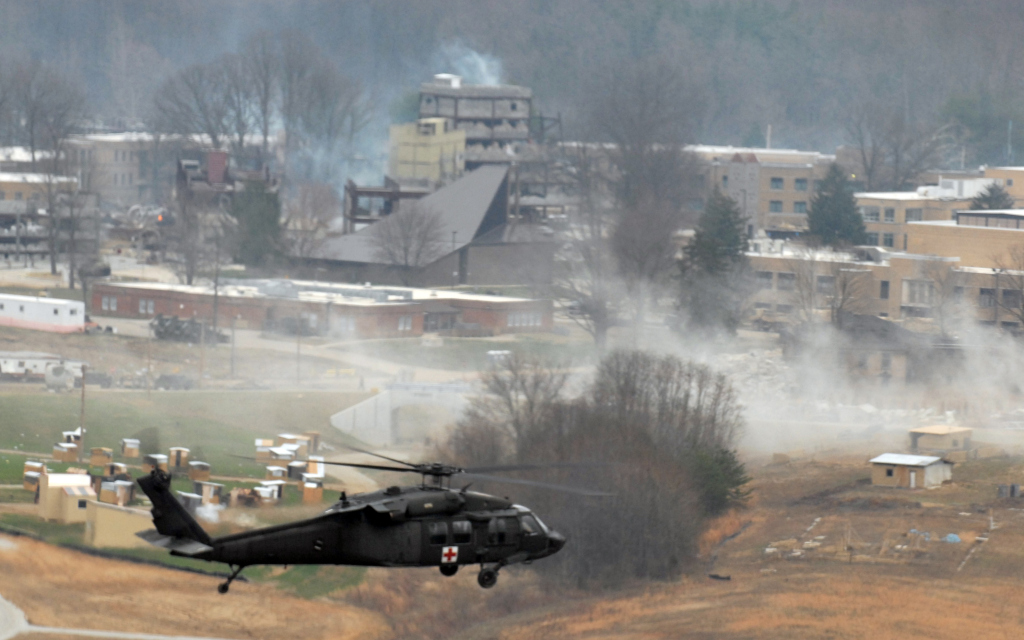
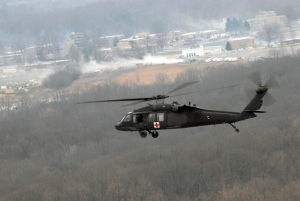
A Kentucky National Guard UH-60 Blackhawk flies a MEDEVAC mission over the Muscatatuck Urban Training Center which masqueraded as Louisville, KY during Exercise Vibrant Response 11.1.
Story and photos by Maj. Ben Singleton, 63rd Theater Aviation Brigade Public Affairs Officer
CAMP ATTERBURY, In. – What if a 10-kiloton nuclear device exploded in Louisville? No more Churchill Downs, no more Heine Brothers Coffee, no more Ear X-tacy. As The Princess Bride’s Vizzini might proclaim: “Inconceivable!” But that scenario was the very locus of the recent Vibrant Response Exercise designed to test and strengthen the Chemical Biological Radiological High-Yield Explosive Consequence Management Response Force (CCMRF). Over 3,500 military and civilian personnel from around the country converged on Central Indiana to participate in the exercise.
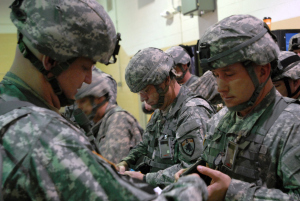
Col. Aaron T. Barrier inspects Chief Warrant Officer Scott McCauley in preparation for Vibrant Response 11.1.
The Kentucky National Guard’s 63rd Theater Aviation Brigade is a major player in CCMRF, providing command and control of aviation assets for Joint Task Force-Civil Support, the unit charged with heading up the Department of Defense response in the event of a major catastrophe. Past exercises have set similar scenarios in places like Nebraska and Missouri, but this was the first time the 63rd TAB would be participating in a scenario set in the Bluegrass.
“My section is responsible for providing maps, analysis and information about the area we are working in,” stated Maj. Mark Brozak, Brigade Intelligence Officer, who just happens to live near Louisville. “It creates an eerie sense of realism when the disaster is in our own backyard. We’ve driven down the streets affected and been in the buildings that have been reduced to rubble in the virtual world of the exercise.”
And if the fact that the disaster is set in our own state wasn’t enough of a coincidence, the unfortunate recent events in Japan brought the importance of the CCMRF mission into sharp focus.
Soldiers of the Kentucky National Guard's 63rd Theater Aviation Brigade head to work before the sunrise.
“The earthquake and subsequent tsunami and nuclear calamity in Japan provided a surreal parallel to the exercise,” said M
aj. Phil Honican, who works in the Brigade Future Operations Cell. “We were watching real video footage from Japan while planning missions based on similar circumstances in the exercise. It really drove the point home how important this mission is to our nation.”
The 63rd TAB provided the command and control of aviation assets to ensure that missions requiring aviation support happened, missions like moving people and equipment in the robust CH-47 Chinooks or providing aerial surveys from a UH-72 Lakota. Transporting needed supplies like blood, water and medicine in mass quantity was facilitated in the fixed-wing C-23 Sherpa. And as always in these exercises, the critical management of Medical Evacuations, or MEDEVAC, was high priority.
Humvees staged at sunset during Vibrant Response 11.1, Camp Atterbury, Indiana.
Cries of “9-line” rang out frequently in the Tactical Operation Center (TOC), meaning that a request for a MEDEVAC was coming in. Coordinates were checked and rechecked as missions were planned. Across the road from the 63rd’s TOC the whir of helicopter blades could be heard as the MEDEVAC crew prepared to launch from the airfield. Time is the enemy for a MEDEVAC and getting to those in need as soon as possible is of the utmost importance..
Another matter of great importance in the exercise was the mission of protecting the force. Soldier safety is imperative because if the soldiers aren’t kept safe, how can they go about the task of providing relief and support to the affected populace? Each soldier wears a dosimeter to monitor radiation exposure and plans were put in place to monitor rest and work cycles to ensure effective fatigue management. Risk management is always a key concern in helping to keep Soldiers safe. In the 63rd TAB, safety is always a primary goal.
Task Force Aviation provides support during Vibrant Response 11.1.
And, there is no bigger proponent of that tenet than the 63rd’s commander, Col. Aaron T. Barrier.
“My goal is to not have to issue a single band-aid during this exercise,” Barrier emphasized. “This is inherently dangerous work and we must constantly be on our guard against accidents. I won’t consider this exercise complete until every Soldier in the brigade is home safe and sound.”
With another successful CCMRF exercise under their belts, the Soldiers of the 63rd TAB returned home safely. Mission Complete.
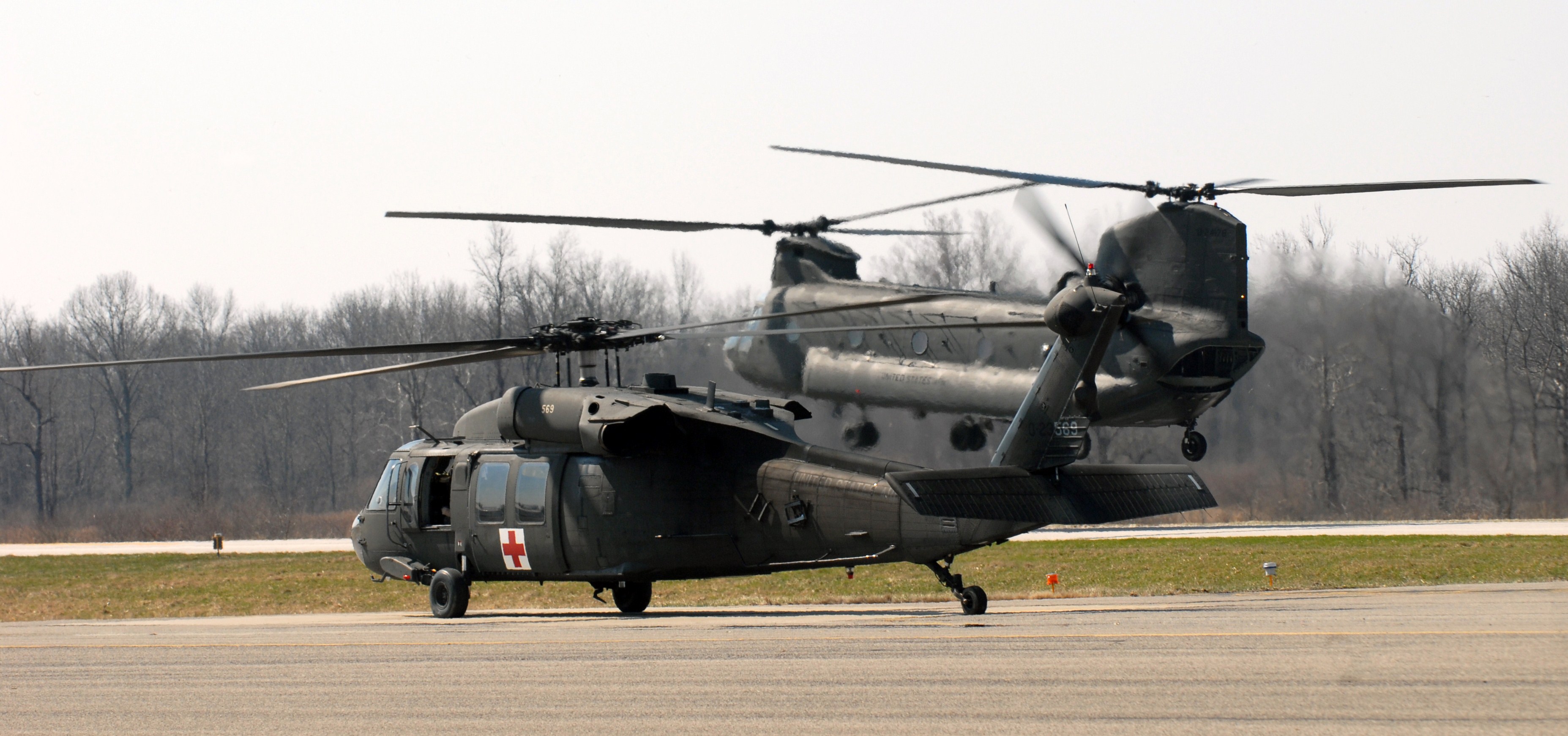
Blackhawks and Chinooks team up to support Task Force Aviation during Vibrant Response 11.1.
###
Jacklynn and Dalton Geen, children of Sgt. Douglas Green of Co. B, 2-147th Aviation, hold up a sign welcoming their father home after a year-long deployment to Kosovo. Company B, 2-147th Aviation conducted flight operations in support of the NATO-led peacekeeping operations in Kosovo. (U.S. Army photo by Staff Sgt. Aaron Hiler, 133rd Mobile Public Affairs Detachment)
ABH
By Staff Sgt. Aaron Hiler/133rd Mobile Public Affairs Detachment
FRANKFORT, Ky. (July 22, 2010) — Friends and family showed up in large numbers to welcome home 86 Kentucky Army National Guard aviation Soldiers as they return from a tour of duty in Kosovo. The ceremony was held at 12:30 p.m. today at Hangar #2, Boone National Guard Center.
Bravo Co., 2nd Battalion, 147th Aviation and Charlie Co. 169th MEDEVAC (Medical Evacuation) mobilized August 2009 with 11 UH-60 Blackhawk helicopters for the Kosovo mission, supporting slingload and waterbucket/firefighting operations, troop transport and hoist operations, as well as medical evacuation missions for US and NATO troops and civilians.
This is the second deployment for each unit, Bravo Co. having deployed to Iraq in 2005-2006 and Charlie Co. in 2004-2005.
“It is great to welcome you home,” said Brig. Gen. Michael Dornbush, Director of the Joint Staff of the Kentucky National Guard. “It is truly a blessing to both your Families and to Kentucky to have you home after successfully completing your important mission in Kosovo.”
The Kentucky aviators were among the more than 9,000 Servicemembers from 31 nations that comprised the NATO-led peacekeeping force in Kosovo.
For more about this story: