Pages
Stay In Touch
More
© 2013 KentuckyGuard
By Maj. Stephen Martin, Kentucky National Guard Public Affairs
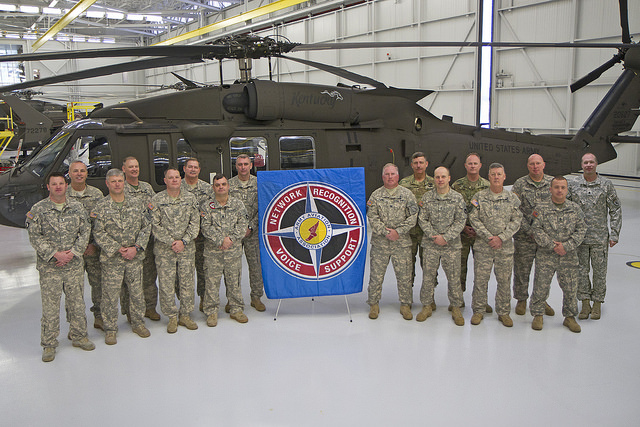
Fifteen members of the Kentucky National Guard’s 63rd Theater Aviation Brigade have accumulated 4,000 military flight hours or more in their career. The Bluegrass Chapter of The Army Aviation Association of America has recognized these aviation Soldiers for their accomplishment. Pictured from LEFT to RIGHT: Chief Warrant Officer 4 Porter Whitney, Chief Warrant Officer 4 John Boyle, Chief Warrant Officer 4 Eric Mattingly, Chief Warrant Officer 4 Tony Villier, Chief Warrant Officer 5 Steve Bowling, Command Chief Warrant Officer 5 Dean Stoops, Staff Sgt. Daryl Casey, Chief Warrant Officer 5 Harold Grider, Col. Brian Abney (State Army Aviation Officer), Chief Warrant Officer 5 Steve Knight, Chief Warrant Officer 4 Shawn Gabhart, Chief Warrant Officer 5 Stuart Lindfors, Chief Warrant Officer 5 Gerald Carroll, 1st Sgt. Matt Singer, 1st Sgt. Troy Logsdon, Lt. Col. Dewayne Lewis. (U.S. Army National Guard photo by Staff Sgt. Scott Raymond)
FRANKFORT, Ky. — The Kentucky National Guard’s Army aviation community is steeped in history. From their arrival in 1959 at the Capital City Airport in Frankfort, Ky. through being the first National Guard unit in the country assigned Blackhawks, Kentucky’s aviation Soldiers have remained at the forefront of their career field.
Fifteen members of the 63rd Theater Aviation Brigade have 4,000 military flight hours or more. They represent a wealth of aviation experience which few aviation formations can match. Because of this, The Bluegrass Chapter of the Army Aviation Association of America (Quad A) took time to recognize these Soldiers for their accomplishments.
To see photos of these Army Aviators in action over the years, please click HERE.
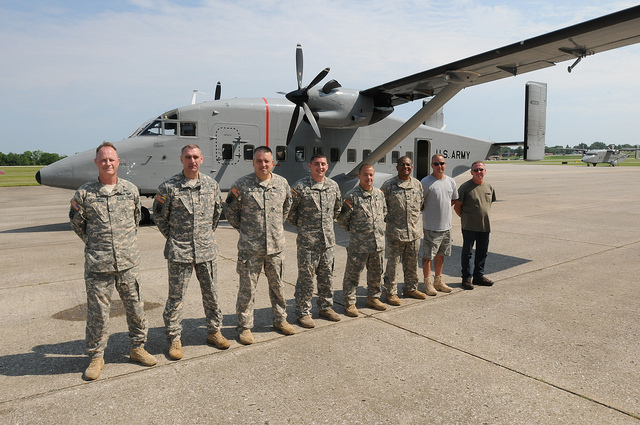
The Kentucky National Guard said farewell to their C-23 Sherpas during a ceremony at Capital City Airport in Frankfort, Ky., July 9, 2013. (U.S. Army National Guard photo by Staff Sgt. Scott Raymond)
“The Kentucky Guard aviation community is recognized by any measurable metric as one of the finest aviation organizations in any component of the Army,” said Col. Brian Abney, State Army Aviation Officer. “These 15 Soldiers are indicative of the quality of our program here in Kentucky for sure… The flying hour milestones that these individuals have reached remain a notable accomplishment for any organization and I am especially proud of this group of aviation professionals.”
An old aviator’s quote says, “You can always take off, but you can’t always land…” An axiom like this reminds all flyers the cost of the profession and the decisions that need to be made on a regular basis.
Collectively these 15 aviation Soldiers have accumulated in excess of 80,000 flight hours without a Class A, B or C accident and an average time in service of more than 28 years.
What does this mean to the Kentucky Guard?
For one, the safety record of the Kentucky Army National Guard is unparalleled. Indeed, the Kentucky Guard has not experienced a Class A or B Army accident since 1970. A time frame which encompasses multiple combat tours and numerous overseas deployments with more than 250,000 flight hours flown on a variety of different types of aircraft. This can be attributed to the level of experience that the troops in this profession boast.
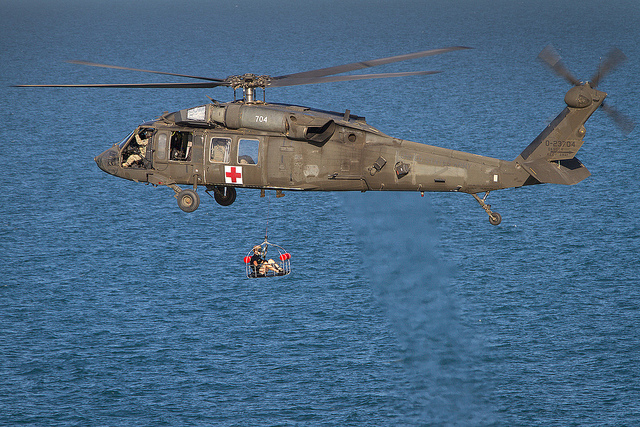
C Co 2/238th MEDEVAC conducts personnel recovery (PR) operations over the Northern Arabian Gulf (NAG) Oct. 10, 2013. The unit is qualifying all army aviation crewmembers on overwater hoist PR while on deployment. This was conducted as a joint training exercise with a sister flight company who deployed the Navy EOD teams into the water via HeloCast and were recovered by the MEDEVAC aircraft. (photo submitted)
Regarding combat flight time exclusively, these 15 aviation Soldiers have accumulated 10,000 hours across a combined total of 30 deployments since 9/11. These high flyers have flown in Afghanistan, Iraq, Kosovo, Kuwait, not to mention Europe, South America and Central Asia among other locations.
Considerably, these operations couldn’t be accomplished without the crew-chiefs, administrative and supply personnel. It’s a coordinated effort to get a multi-million dollar aircraft airborne. That’s why it’s equally impressive that three of the Soldiers on this list are enlisted crew-chiefs.
“Everybody plays a part, from the maintenance guys giving us a safe aircraft to operations ensuring we are safe to the crews executing the mission,” said 1st Sgt. Matt Singer, Company C., 1st Battalion 376th Aviation. ” 4,000 flight hours requires a whole lot more than 4,000 hours of work on the part of a lot of folks.”
“We may not go to flight school, but we can certainly give beneficial technical or tactical advice from a different point of view… in addition to providing comic relief and stinging sarcasm, which is required of all crew chiefs.”
63rd TAB Command Sgt. Major Bill Stocker talks about the significance of the enlisted Soldiers accomplishments.
“Crew-Chief’s in this community are the unsung heroes of aviation. These ‘part-time’ Guardsmen have the same requirements as their active duty counterparts and are held to the same standard. They are required to make sure the aircraft is in good working order especially after the officers upfront do their level-best to break the thing.”
Stocker points out that these service members are charged with both the fight abroad on behalf of the nation as well as providing support to the commonwealth. “Their experience level is kept here in this organization and is not turned over every three years. This is crucial to accomplishing the mission the way we do.”
“This band of brothers are great mentors for the next generation of crew-members and in showing us what right looks like. They are an invaluable commodity for this brigade,” said Stocker. “The Kentucky National Guard’s Army enlisted aviation community will reap the rewards of their hard work and commitment for years to come.”
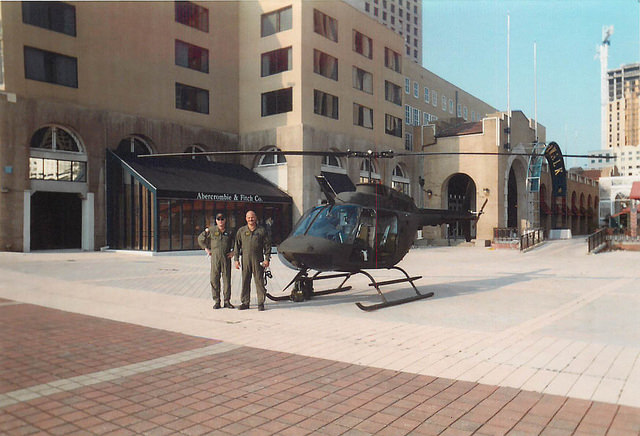
Chief Warrant Officers Bowling and Johnston pose just after they land an OH-58 A/C helicopter on Canal Street in New Orleans, La. in support of Hurricane Katrina in 2005. Fifteen members of the 63rd Theater Aviation Brigade have 4,000 military flight hours or more. This photo represents the storied history of that endeavor.(Photo courtesy of the 63rd TAB aviation community)
Chief Warrant Officer Steve Bowling offered up a piece of advice to new Soldiers entering the field.
“Today’s young aviators are better equipped than ever before, the new facilities are top notch, and the aircraft are awesome. The new aviator skill level with the newest systems are better than they have ever been. The Guard has done a great job of equipping the force for the future. In addition the amount of trust we can place on the younger folks has never wavered. They are as good as ever in my experience.”
“However being an old guy I still want them to know how to do things ‘the old fashioned way’ for when the new and improved stuff breaks. GPS is great but I still want to know I can pull out the old ‘HHM’ (Hand Held Map) and we all make it home at the end of the day safe.”
“Those are the things the REAL old guys taught me.”
Order from highest to lowest amount of hours: Chief Warrant Officer 4 John Boyle, 9,000 hours; Chief Warrant Officer 5 Harold Grider, 7,000 hours; Chief Warrant Officer 5 Gerald Carroll, 6,000 hours; Chief Warrant Officer 4 Eric Mattingly, 5,000 hours; Lt. Col. Dwayne Lewis, 5,000 hours; Command Chief Warrant Officer 5 Dean Stoops, 5,000 hours; Chief Warrant Officer 5 Steve Knight, 5,000 hours; Chief Warrant Officer 5 Stuart Lindfors, 5,000 hours; Chief Warrant Officer 4 Porter Whitney, 5,000 hours; Chief Warrant Officer 5 Steve Bowling, 5,000 hours; Chief Warrant Officer 4 Shawn Gabhart, 5,000 hours; 1st Sgt. Troy Logsdon, 4,000 hours; 1st Sgt. Matt Singer, 4,000 hours; Staff Sgt. Daryl Casey, 4,000 hours; Chief Warrant Officer 4 Tony Villier, 4,000 hours.
By Sgt. David Cox, 63rd Theater Aviation Brigade
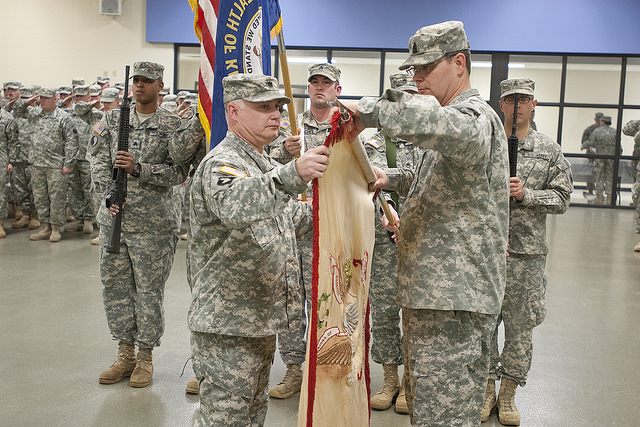
Lt. Col. Mark Brozak, commander of the 1204th Aviation Support Battalion furls the unit’s colors with help from Command Sgt. Maj. Scott Foster during an inactivation ceremony in Burlington, Ky., Jan. 10, 2016. After nearly 10 years of service to the Nation and commonwealth, the unit was stood down due to Army force structure changes. (U.S. Army National Guard photo by Sgt. David Cox)
BURLINGTON, Ky. — Soldiers with 1204th Aviation Support Battalion furled their battalion colors for the last time during an inactivation ceremony Jan. 10, at the National Guard Readiness Center in Burlington, Ky.
The unit of nearly 300 has been inactivated in accordance the Army’s force structure realignment.
Activated in 2006, the 1204th played a vital role in disaster recovery operations during the 2009 Ice Storm and deployed to Iraq in 2011 in support of Operation New Dawn .
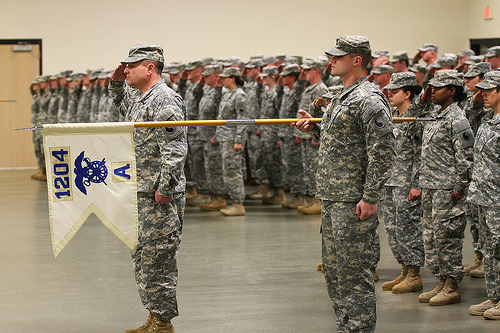
Soldiers of the 1204th Aviation Support Battalion salute during an inactivation ceremony in Burlington, Ky., Jan. 10, 2016. Activated in 2006, the unit was home to nearly 300 Soldiers. (U.S. Army National Guard photo by Staff Sgt. Scott Raymond)
“From 2006 to today, this unit has probably done more as an ASB than the other 12 currently in the force,” said Brig. Gen. Benjamin F. Adams, III, Chief of the Joint Staff. “Being able to deploy as a battalion to five different countries during a time of war says a great deal about the unit and its personnel.”
Click here for more photos.
Lt. Col. Mark Brozak, commander of the 1204th ASB, said “that although the colors are cased, the soldiers of the unit will continue to serve the nation and the commonwealth of Kentucky.”
The 1204th’s mess section finished their service to the unit as recipients of the Connelly Award. The award recognizes food service Soldier that exceed Army standards and operate at a level that showcases teamwork, professionalism, quality and service.
Soldiers expressed a bittersweet satisfaction with what they accomplished while being a part of the unit’s history.
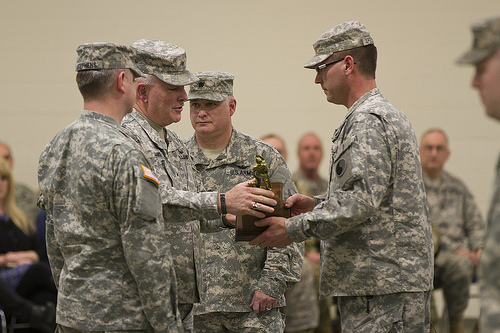
Brig. Gen. Benjamin Adams III presents the Connelly Award to Soldiers of the 1204th Aviation Support Battalion during an inactivation ceremony in Burlington, Ky., Jan. 10, 2016. The Connelly Award recognizes food service units and sections that exceed Army standards of food preparation and promote teamwork. (U.S. Army National Guard photo by Staff Sgt. Scott Raymond)
“I’ve been in almost 18 years and this is home to me,” said Staff Sgt. Bill Hyatt, supply noncommissioned officer with Headquarters Support Company, 1204th ASB. “It’s going to be a big culture shock to me because aviation is where I’ve been since I’ve been in the Kentucky Army National Guard and now I’m going to a transportation company.”
“I’m going to be the first person to arrive to the 1204th and the last person to leave.”
The Burlington Readiness Center, home of the 1204th, will continue to be utilized by the Kentucky Guard. Two new units, the 2061st Multi-Role Bridge Company and the 2112th Transportation Company will be stood up this year to operate out the state-of-the-art armory.
See local news coverage here: WLWT 5, WKRC Local 12.
By Staff Sgt. David Bolton, 133rd Mobile Public Affairs Detachment
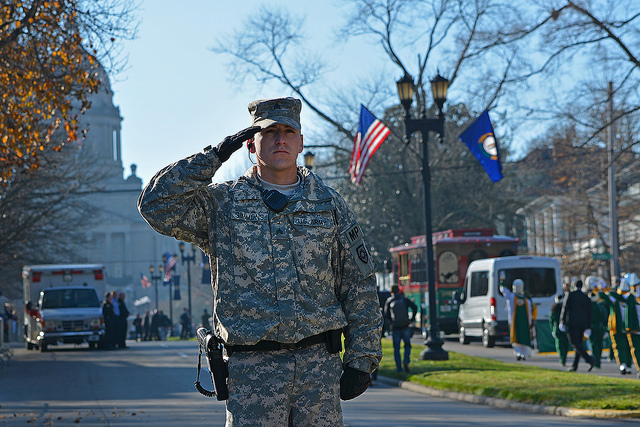
Sgt. Caleb Simmons with the 940th Military Police Company salutes a passing Color Guard during the Gubernatorial Inauguration parade in Frankfort, Ky., Dec. 8, 2015. Kentucky Guard military police Soldiers assisted local law enforcement in securing areas near the Capitol for events surrounding Gov. Matt Bevin’s public swearing in. (Kentucky National Guard photo by Walt Leaumont)
FRANKFORT, Ky. — Out in full force, the Kentucky National Guard celebrated with fellow Kentuckians as Gov. Matt Bevin was publicly sworn in Dec. 8, in Frankfort. Also sworn in was Army Brig. Gen. Stephen R. Hogan, the Kentucky Guard’s 52nd adjutant general.
“This is really the one big event we get to do every four years to really support the Commonwealth and let them know we have a band,” said Sgt. Shari Kinslow, a musician assigned to the 202nd Army Band.
“For us, this is the time of year where we get to be compared to some of the active duty bands up in D.C.,” she said.
The 202nd played several events for the inaugural celebration, including the private swearing-in ceremony, the parade and the public swearing in.
The inaugural events were special for Kinslow since this was her last performance before retirement. She served 20 years with the Kentucky Guard.
“I’ll miss this, it’s more like a family than just a unit,” she said.
Click here for more photos.
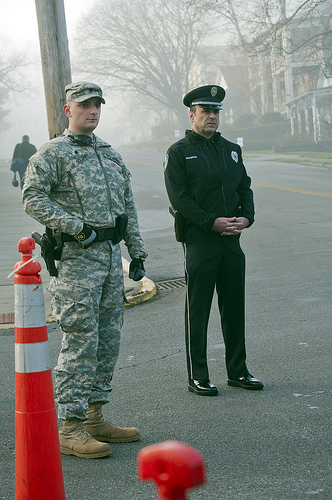
Spc. Josh Goldener, military police with the 1103rd MP Detachment, and Officer Mike Davidson, Frankfort Police Department, conduct traffic surveillance for Governor Matt Bevin’s inauguration at the Capitol building in Frankfort, Ky. Dec. 8, 2015. Present at the inauguration was the Kentucky National Guard’s new Adjutant General Brig. Gen. Stephen R. Hogan. (U.S. Army National Guard photo by Staff Sgt. David Bolton)
More than 150 Soldiers and Airmen were on duty in a variety of roles in and around the downtown area.
If the event patrons didn’t know the Kentucky Guard has a band, the 19-round artillery salute proved the Kentucky Guard has artillery. Getting the 105mm Howitzers and personnel in place, took special planning and coordination.
“You have to know how many people it will take to fire the guns, and coordinate the transportation of the artillery pieces from Lexington to Frankfort,” said Master Sgt. Joseph Mattingly, intelligence non-commissioned officer, 138th Field Artillery Brigade. “You have to draw ammo from Fort Knox, make sure everyone knows what’s going on, and run through rehearsals.”
As the liaison officer between color guard and artillery salute, Mattingly said the hardest part of the event was making sure he could reach everybody and keeping everyone on a timeline. The duty, he said, was fulfilling.
“It’s always an honor every time you do something like this,” said Mattingly.
Spc. Josh Goldener, said the honor of serving and protecting the attendees of the inauguration is a memory that will last with him a lifetime.
“It’s a huge honor to get to be a part of both the new governor and TAG’s first day,” said Goldener. “I mean this is history. I’m standing here getting to serve in something that happens every four or eight years. It’s very cool to be able to say I was a part of this and someday I can tell my kids or grandkids I was part of this event.”
Goldener provided security with his unit, the 1103rd Law and Order Detachment. Along with members of the 940th Military Police, the Kentucky Guard force ensured the safety of the patrons downtown.
“The hardest part is really just dealing with the circumstances surrounding today,” said Goldener.
“Not only because of its importance,” he said, “but because of what’s going on everywhere in the world at this time. We’re all on high alert even though there is no specific threat, we’re doing our best to stay vigilant and make sure we catch anything before it happens.”
The Kentucky Guard’s 63rd Theater Aviation Brigade closed out the inaugural ceremonies with a flyover of three UH-60 Blackhawk helicopters.
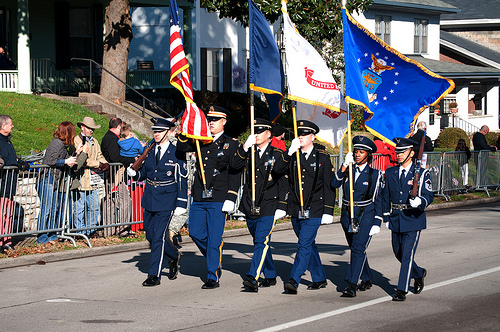
Soldiers and Airmen of the Kentucky National Guard act as Color Guard during the inaugural parade in front of the Capitol building in Frankfort, Ky. Dec. 8, 2015. The parade was part of the inaugural day activities for newly-elected Governor Matt Bevin. (U.S. Army National Guard photo by Staff Sgt. David Bolton)
In his closing remarks, Bevin – a former U.S. Army officer – thanked the Guard for being part of the day and always being ready to serve.
“We thank those of you who have paid that price and to your families,” said Bevin. “Thank you for all your support. Our thanks go to the men and women who have served, so that we might gather here.”
By Sgt. Lerone Simmons, 133rd Mobile Public Affairs Detachment
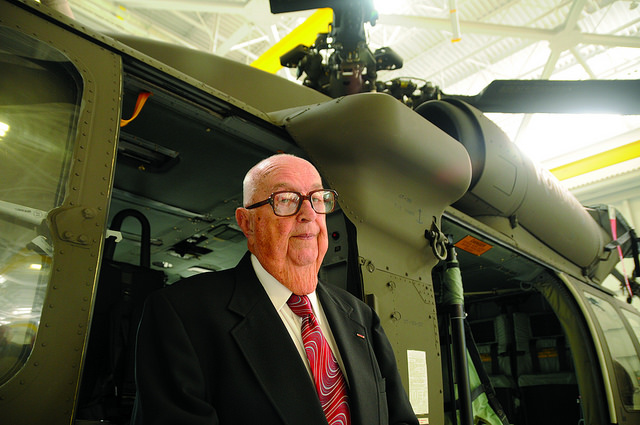
Retired Chief Warrant Officer William H. Canon, former shop foreman assigned to the 2113th Transportation Aircraft Maintenance Company, poses with a new UH-60M Black Hawk helicopter after a ribbon cutting ceremony for Kentucky’s new Army Aviation Support Facility and introduction of a new fleet of UH-60M’s, Boone National Guard Center, Frankfort, Ky., Oct. 14, 2015. Canon gave thirty five years of his life to providing maintenance to Kentucky’s aircraft. (U.S. Army National Guard photo by Sgt. Lerone Simmons)
FRANKFORT, Ky. - Sitting in a new multi-million dollar facility, retired Chief Warrant Officer William Canon Jr., reminisced about providing maintenance to the Kentucky National Guard’s aircraft in high winds, pouring rain, freezing cold and summer heat.
“When I first joined, our pilots had recently flown in World War II,” he said. “Our equipment was old and we didn’t have adequate places to work.
“We had to park trucks around the helicopters to make sure the wind didn’t hit them directly,” said Canon. “The elements are one of the worst things when it comes to properly maintaining aircraft.”
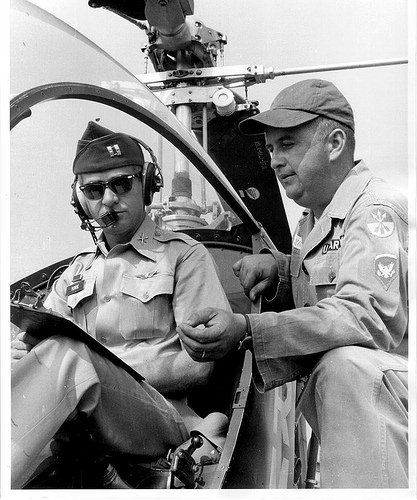
Capt. Yancey York confers with SPEC5 William H. Canon as he prepares for a flight in a OH-13E, circa 1960. (Photo courtesy Chief Warrant Officer(R) Harold Canon)
Click here for more photos.
Canon enlisted in the Army in 1950 and retired in 1990. He would join a fledgling aviation program in 1955.
In 1959, the Kentucky aviation assets found a new home in Frankfort, Kentucky, at the Capital City Airport. Then, 18-or-so-years later in 1971, Canon witnessed a state-of-the-art facility erected at Boone National Guard Center – the Army Aviation Support Facility. A hangar for the helicopters assigned to Kentucky. During his tenure, Canon rose to the level of shop foreman, assigned to the 2113th Transportation Aircraft Maintenance Company, and retired out of the old AASF.
But on Oct. 14, he joined hundreds of other current and former Kentucky National Guardsmen as the ribbon was cut, ceremoniously showing off the Kentucky National Guard’s newest AASF at Boone National Guard Center. He also got to view, sit in, and touch the new UH-60M, the Army’s newest in the Blackhawk fleet.
The new AASF is 126,000 square feet and uses geo-thermal heating and cooling, solar power, 80 kilowatts photovoltaic solar power, high efficiency lighting, daylight harvesting technology, and radiant floor heating. It holds several offices for staff, classrooms, a gym and plenty of space.
“We come from a time where we didn’t always have a climate controlled area or lots of space,” said Canon’s old company commander, retired Lt. Col. Willoughby S. Goin III, a former pilot with 12,000 flying hours.
“This will help allow the Guard to be able to deploy troops to any affected areas in a timely manner,” he said, “at times when ice storms, tornados and floods can destroy roads, the Guard can then utilize the air from this facility.”
Kentucky Gov. Steve Beshear, Maj. Gen. Edward W. Tonini, adjutant general for Kentucky and other special guests honored Canon in their remarks during the building’s dedication. The Kentucky Guard’s aviation safety record was also bragged upon during the remarks.
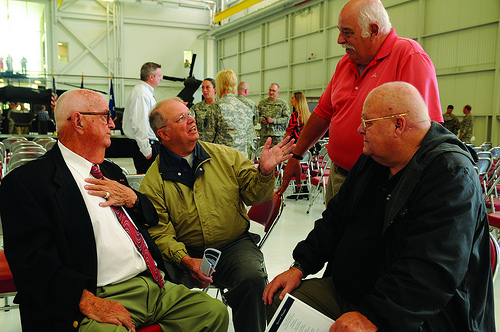
Sitting from left to right, retired Army Chief Warrant Officer William H. Canon, former shop foreman who was assigned to the 2113th Transportation Aircraft Maintenance Company, retired Army Lt. Col. Jere Roche, former commander of the 441st Medical Detachment, and retired Army Lt. Col. Willoughby S. Goin III, former commander of the 2113th Transportation Aircraft Maintenance Company, carry on a conversation after a ribbon cutting ceremony for Kentucky’s new Army Aviation Support Facility in Frankfort, Ky., Oct. 14, 2015. (U.S. Army National Guard photo by Sgt. Lerone Simmons)
Kentucky hasn’t had any major accidents or loss of life for the span of the last 250,000 flying hours, which Tonini said boils down to a huge feat of great maintenance and outstanding flying. He added that the Kentucky Guard has flown at least 15 missions over the Commonwealth during times of disaster, also while supporting the Joint Support Operations counterdrug efforts and overseas contingency operations.
For the many aviation retirees and current Guardsmen who maintain the Commonwealth’s air assets, the day was a reunion and a celebration of moving forward.
“What I’ve seen is outstanding,” said Canon. “I’m proud the progress we’ve made.”
Story and photos by: Spc. Abe Morlu, 133rd Mobile Public Affairs Detachment
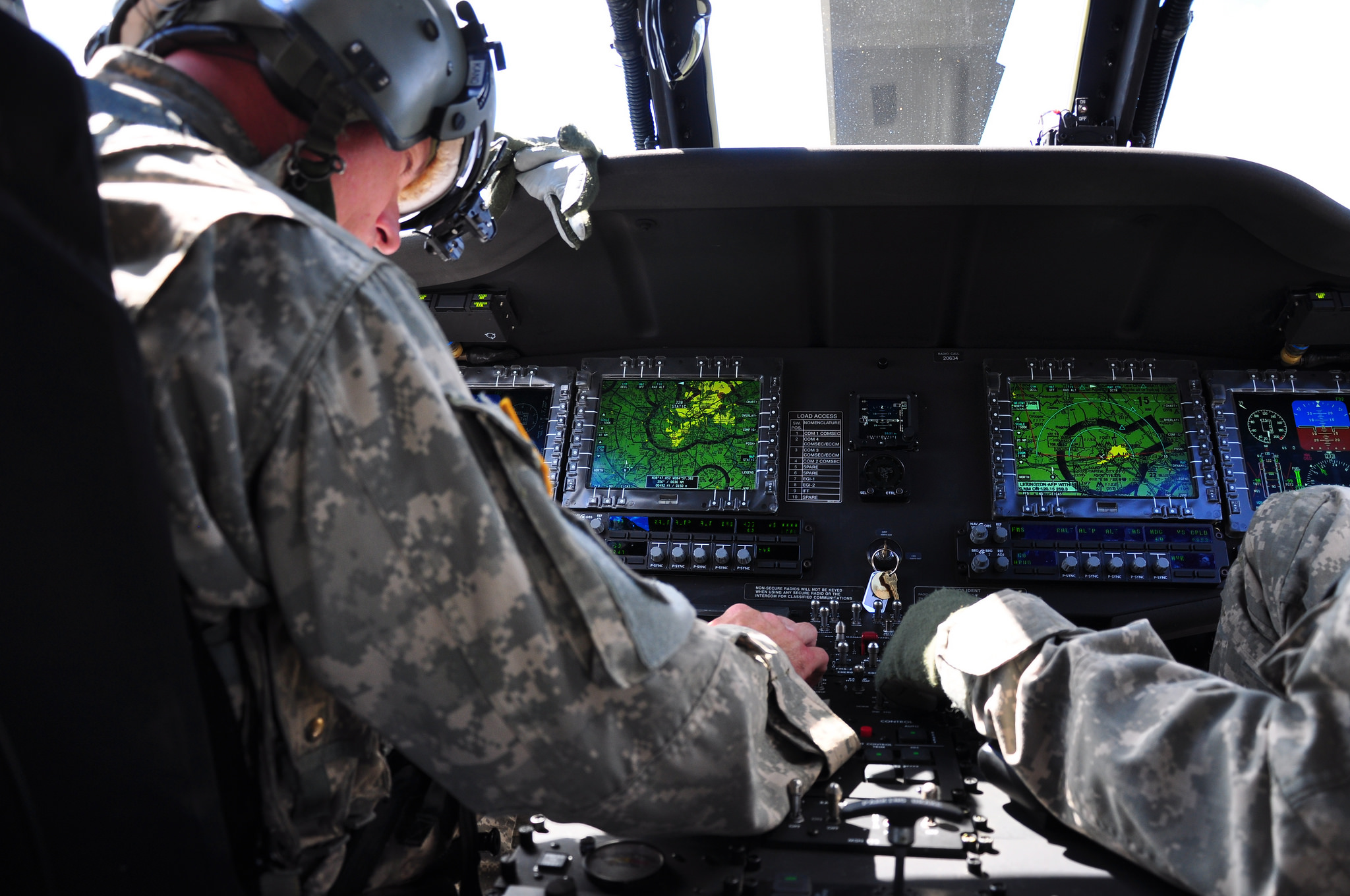
Chief Warrant Officer Wallace Kand, a UH-60 Black Hawk pilot, performs preflight checks on the helicopter prior to a training mission at the Boone National Guard Center in Frankfort, Ky., Sept. 23, 2015. These Kentucky Guard pilots train as much as they can to stay current and be ever ready should they be called upon. U.S. Army National Guard photo by Spc. Abe Morlu
FRANKFORT, Ky. -In its ongoing mission to support both state and federal missions, the Kentucky National Guard has added a new flight facility at the Boone National Guard Center. Along with the facility is a fleet of 16 new helicopters as well.
To see all the photos, please click HERE.
Construction is coming to a close on the new hangar to house the 20 aircraft used by the KYNG. That fleet consists of ten brand-new UH-60M Blackhawks, six two-year-old UH-72A Lakotas, three UH-60L (older model) Blackhawks, and one C-12 (King Air) Huron Airplane. The C-12 is currently housed in a hangar at the Capital City Airport leased by the KYNG.
“For the first time since 1983, when the Kentucky Guard was the first Guard unit to receive Blackhawks, all the aircraft will be able to fit in one building,” said Chief Warrant Officer Gerald Carroll, aviation safety officer for the Army Aviation Support Facility. The original hangar was constructed in 1972, and housed both the UH-1 Iroquois and OH-58 Kiowa.
“These were much smaller aircraft so was no problem storing them in the hangar,” according to Carroll.
Once the UH-60L arrived in 1983 that was no longer the case. Aircraft had to be left outside due to the lack of hangar space. “It is not ideal to store the craft outside because they are susceptible to damage from Mother Nature,” said Staff Sgt. Daryl Casey, a crew chief at the AASF.
Corrosion and lightning strikes are the nemesis of aircraft. They can cause millions of dollars of damages. “Lightning can damage bearings as well as the hull of the craft on its escape,” said Chief Warrant Officer Stephanie Motley, one of the instructor pilots for the new UH-60 mike model aircraft.
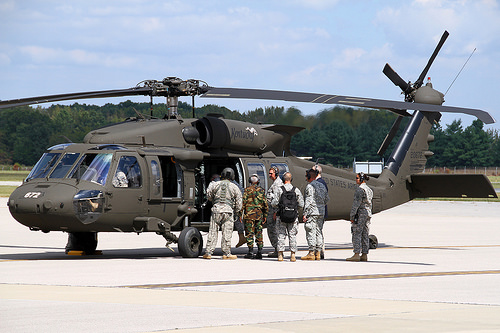
Kentucky Guardsmen and members of the Djibouti military board a UH-60M Blackhawk at Fort Knox, Ky., Sept. 16, 2015. During the Djibouti delegation’s visit to Kentucky, the new Blackhawks provided aerial tours of Kentucky Guard facilities as part of the National Guard’s State Partnership Program. (U.S. Army National Guard photo by Staff Sgt. Scott Raymond)
Not only will the new facility keep the aircraft out of the elements saving the Kentucky Guard from high costs in maintenance and repair, but it will also save energy consumption. The new facility will allow more natural light to enter during the day, relieving the reliance on electric lighting to preform daily tasks. This change directly eased the budget strains created by high energy costs.
Should there not be enough sunlight to illuminate the hangar, electric lighting can be used. However the electricity to turn the lights on does not come from the local power company. It is produced by the solar array installed on the roof of the hangar.
Gone are the days of heating the hangar with vents high up on the ceiling. The floors of the new hangar use geothermal energy to heat itself. They bring the heat closer to the crew and not inefficiently blowing down from above as hot air rises.
“The new technologies and availability of necessary outlets, allow us to better maintain the new Mikes,” said Chief Warrant Officer Stuart Lindfors,” a UH-60 instructor pilot.
Servicing the new helicopters is the same as its predecessor however, there are a few new parts alien to the UH-60L which require maintenance. The new model has new systems such as a rotor brake, said Casey.
“It’s like working on a 2000 Ford truck versus working on a 2015 Ford truck,” Casey said. “It pretty much works the same but has a few extra bells and whistles.”
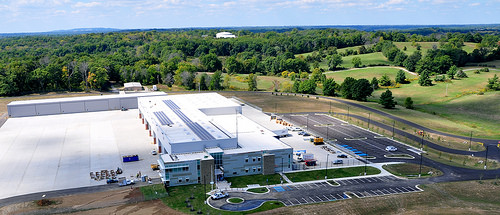
An overhead view of the new Army Aviation Support Facility at the Boone National Guard Center in Frankfort, Ky., Sept. 23, 2015. The new AASF is spacious enough for all the aircraft to be stored indoors, and it is also very energy efficient using solar and other natural power sources. (U.S. Army National Guard photo by Spc. Abe Morlu)
One of those bells and whistles is the hover hold function present in the new model. It allows the pilot to hold a set altitude and position with no input form the pilot. No more having to fight with external forces to hold position as in the older model.
“They are both great aircraft but, the new technology helps us better use our skills learned in training,” said Chief Warrant Officer Wallace Kand, a recent graduate of the UH-60M flight course.
“No longer will we envy the equipment and facilities of other states,” said Carroll. “Kentucky is a leader when it comes to Army aviation.”
Spirits are high with anticipation of beginning operations in the new facility as well. It will be the first time in almost 40 years being able to house and maintain all the aircraft indoors.
“We have accomplished so much with our antiquated equipment and facilities over the years,” said Col. Brian Abney, commander of the AASF. “I cannot wait to see what we will produce with the new facilities.”
By Staff Sgt. Scott Raymond, Kentucky National Guard Public Affairs
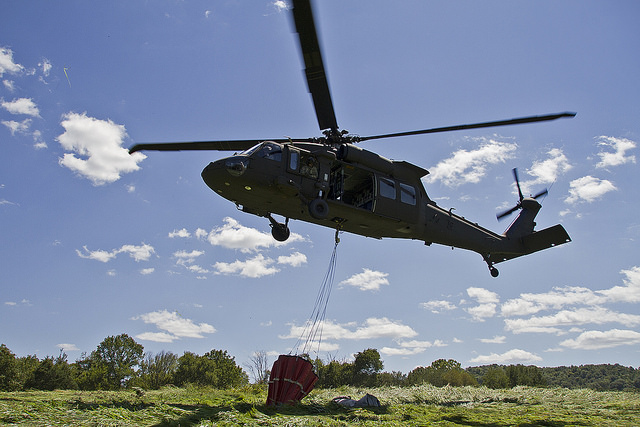
A UH-60 Blackhawk with the Kentucky National Guard’s 63rd Theater Aviation Brigade lifts off with a Bambi Bucket System attached to train on water drops in Franklin County, Ky., Aug. 24, 2015. Air crews train annually with the water drop system to wildfires locally or nationally. (U.S. Army National Guard photo by Staff Sgt. Scott Raymond)
FRANKFORT, Ky. — As an annual requirement, many National Guard air crews train to fight wildfires in their UH-60 Blackhawks. With so many wildfires burning in the country, this annual training comes at an appropriate time for Kentucky Guard aviators.
In August, Soldiers with the 63rd Theater Aviation Brigade practiced water drops in a rural area of Franklin County, Kentucky.
“The training keeps our crews up to date so that in the event we do get called for forest fires or anything like that, we have the crews readily available, trained up and delay free in any response,” said Warrant Officer Candidate Michael Lona.” 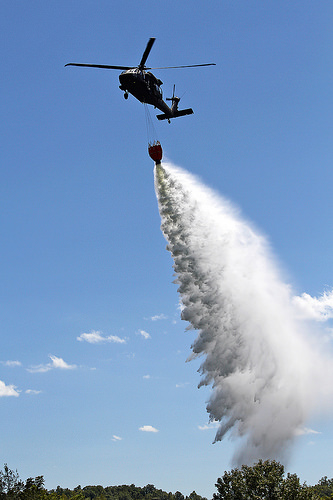
With the use of the Bambi Bucket System, a water delivery bucket attached to the helicopter, crews are able to make water drops of several hundred gallons of water on hotspots or fires.
Click here for more photos.
Crews train in multiple ways of filling the bucket and making the drops, each dependent upon the terrain, the type of fire and the firefighting strategy.
“This is an extremely technical skill, so it’s necessary that that our crews remain proficient,” said Capt. James Caniff, Flight Operations Supervisor. “Being able to fight a forest fire with our helicopters is a huge assets to state and in some instances the nation.”
There are five Bambi Bucket Systems available on the commonwealth, all managed by the Forest Service and shared with the Kentucky Guard when needed.
Story by Sgt. 1st Class Gina Vaile-Nelson, 133rd Mobile Public Affairs Detachment
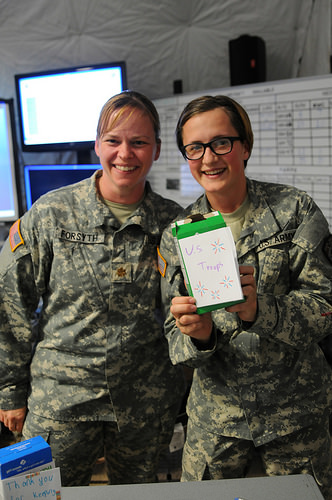
Kentucky National Guard Maj. Catherine Forsyth, logistics officer-in-charge, and Spc. Madison Witzleb, aviation operations specalist, Headquarters and Headquarters Company, 63rd Theater Aviation Brigade, enjoy a box of Girl Scout cookies during an annual training exercise at Camp Atterbury, Ind., April 27. Girl Scout Troop #1199, a Taylorsville, Ky.-based troop, donated boxes of cookies to the Kentucky Guardsmen as a comfort care-package to open during the unit’s week-long annual training exercise in support of Vibrant Response 2015. The cookies were used as a service project to earn the Troop to Troops badge for the Girl Scouts. (U.S. Army National Guard photo by Sgt. 1st Class Gina Vaile-Nelson)
CAMP ATTERBURY, Ind. - When Soldiers are away from their families, it’s the little things that mean the most. Even if you’re only across the river for a training exercise at Camp Atterbury, Indiana.
For Soldiers of the 63rd Theater Aviation Brigade, comfort was in the form of America’s favorite chocolate, shortbread and lemon-flavored cookies that only come out one time a year. And thanks to the Taylorsville, Ky.-Girl Scout Troop #1199, it was the perfect treat at the end of a 12-hour shift.
“Reading the handmade card attached to each box of Girl Scout Cookies thanking Soldiers for their service has touched our hearts,” said Staff Sgt. Carrie Payne, training noncommissioned officer for Headquarters and Headquarters Company, 63rd TAB.
“Everyone enjoyed the contribution of the cookies,” she said.
In 2014, the Girl Scouts, nationally, donated 12,108 boxes of cookies to U.S. Service members around the world.
Known as “Troop to Troops,” the gift of caring is a combined effort of community donations and extra cookies purchased to spread the joy in each box. According to Troop leader Jennifer Pucko, the Taylorsville troop has donated boxes shipped overseas before, but wanted to do something local this year.
“Most of the cookies are paid for by local donations the girls receive at the cookie booths,” she said. “One of our girl’s dad is in the National Guard, so we thought this year we’d find a local unit.”
Troop #1199’s cookies were served April 27 during shift change at the 63rd TAB’s annual training. The Kentucky Guardsmen were part of 3,000 military, federal and civilian personnel who participated in Vibrant Response, the nation’s premiere homeland defense exercise.
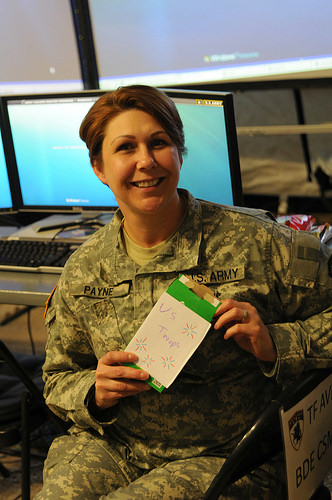
Staff Sgt. Carrie Payne, training noncommissioned officer, Headquarters and Headquarters Company, 63rd Theater Aviation Brigade, holds a box of Girl Scout cookies during an annual training exercise at Camp Atterbury, Ind., April 27. Payne said the hand-written notes attached to the boxes that Girl Scout Troop #1199, a Taylorsville, Ky.-based troop donated, were very much appreciated by her Soldiers that were on their annual training exercise in support of Vibrant Response 2015. (U.S. Army National Guard photo by Sgt. 1st Class Gina Vaile-Nelson)
There is a special patch that the Girl Scouts receive if they donate at least six boxes of cookies to Troop to Troops. According to its website, the Girl Scouts is a leadership-driven organization that engages girls to discover who they are, connect with others and take action to make the world a better place. The same types of activities and values that Soldiers like Payne experience in the National Guard.
“These young girls should be proud of themselves as individuals for recognizing those who serve our country,” Payne said.
My message to each one of these girls is to take one day at a time and always put your best foot forward,” she said. “Stay the leader you are being taught to be, not a follower.”
Story by Sgt. 1st Class Gina Vaile-Nelson, 133rd Mobile Public Affairs Detachment
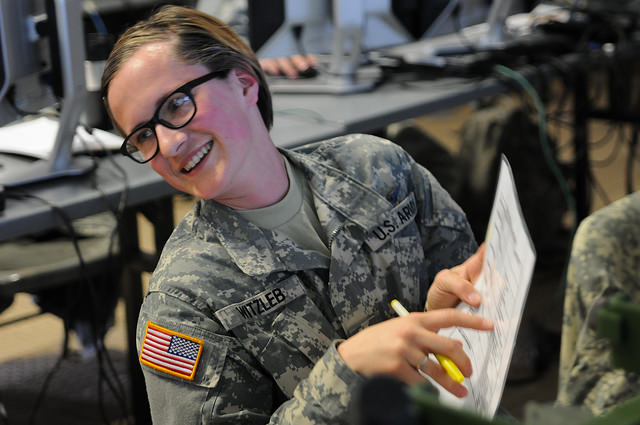
Kentucky National Guard Spc. Madison Witzleb’s smile and positive attitude keeps the 63rd Theater Aviation Brigade’s Tactical Operations Center a little less stressful during USARNORTH’s Vibrant Response 2015 exercise at Camp Atterbury, Ind. Witzleb, an aviation operations specialist assigned to Headquarters and Headquarters Company, 63rd Theater Aviation Brigade, is the newest member of the 63TAB, and said her first annual training with the brigade was challenging and fun. (U.S. Army National Guard photo by Sgt. 1st Class Gina Vaile-Nelson)
CAMP ATTERBURY, Ind. — There’s always that one. The young Soldier, fresh out of Advanced Individual Training (AIT), who shows up, loves the Army and smiles a lot.
For Headquarters and Headquarters Company, 63rd Theater Aviation Brigade, it’s Spc. Madison Witzleb. She can run through the tactical operations center, affectionately known as the “TOC-mahal,” and if you blink, you’d miss her. She’s got a voice that will command even the hardest of hearing to attention if a distinguished visitor walks in. And a smile that her leaders and fellow Soldiers say can make any long day of training seem better.
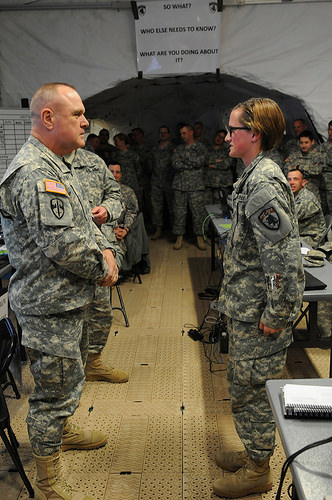
Kentucky National Guard State Command Sgt. Maj. Thomas Chumley presents Spc. Madison Witzleb, aviation operations specialist, Headquarters and Headquarters Company, 63rd Theater Aviation Brigade, with his challenge coin April 23, at Camp Atterbury, Ind. Witzleb was nominated by leadership to receive the coin for her motivation and determination to tackle every task with a positive attitude. (U.S. Army National Guard Photo by Sgt. 1st Class Gina Vaile-Nelson)
“Spc. Witzleb is constantly looking for ways to better herself and is never satisfied with just doing what she has been asked to do,” said Sgt. Maj. Kevin Wilkins, aviation operations chief for 63rd TAB. “She displays a willingness to learn as much as she can and she always has a smile on her face.
“My advice to our young Soldiers,” Wilkins said is, “display the same enthusiasm and dedication that Spc. Witzleb does.”
That passion for success is what makes Witzleb stand out in the crowd, and what landed her front and center before State Command Sgt. Maj. Thomas Chumley April 23. The 18-year-old aviation operations specialist was the first 63rd TAB Soldier to receive a coin during the unit’s annual training in support of Vibrant Response, which also happened to be her first coin ever.
“My face turned 50-shades of red,” she said, “but I was able to smile because I was on an excitement rush. I’d never received a coin before that.”
The challenge coins, a military tradition, are presented in recognition of special achievement. Witzleb was nominated by leadership to receive the coin for her professional work ethic and balanced attitude.
Witzleb said her first coin is something she will remember for a while, “the first words I said were: ‘I finally have one my dad doesn’t have!’”
Competition is in her blood. She was on her high school rifle team, plays golf, runs like the wind, and hopes that being in the Guard will help her compete with – and exceed her older brother’s physical fitness abilities.
“One day I will be able to beat him,” she said.
Besides the competition, her family is also good for inspiration, she said. Her father had a large impact on her decision to join the military, and her mother’s advice has kept her going, especially this AT when she really didn’t know what to expect.
“Coming into this (Vibrant Response) as my first exercise, it was nerve racking,” she said. “I was afraid of not being able to succeed in my tasked position.
“My mother always taught me to hold my head up high, even in a time of doubt,” she said. “I love a good challenge and this exercise holds up to its name.”
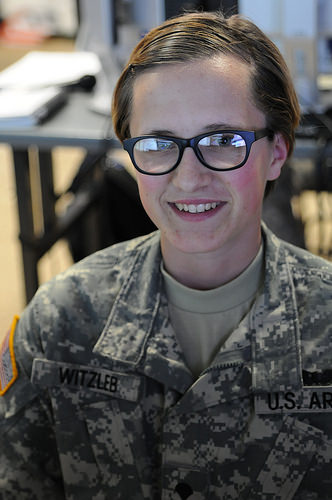
Kentucky National Guard Spc. Madison Witzleb’s smile and positive attitude keeps the 63rd Theater Aviation Brigade’s Tactical Operations Center a little less stressful during USARNORTH’s Vibrant Response 2015 exercise at Camp Atterbury, Ind. Witzleb, an aviation operations specialist assigned to Headquarters and Headquarters Company, 63rd Theater Aviation Brigade, is the newest member of the 63TAB, and said her first annual training with the brigade was challenging and fun. (U.S. Army National Guard photo by Sgt. 1st Class Gina Vaile-Nelson)
As the newest member of the 63rd TAB, Witzleb has many more challenges ahead for her Guard career. She’ll attend Morehead State University this fall to study criminology and take Reserve Officer Training Corps classes. She’s looking forward to also earning her status as a Kentucky Woman Veteran.
“Being a female veteran who can succeed in this career is an amazing accomplishment,” Witzleb said.
“I know many more have come before me, and they are providing some very large boots to fill,” she said, “but I am up for the challenge.”
Video by Sgt. 1st Class Aaron Hiler, 133rd Mobile Public Affairs Detachment
LOUISVILLE, Ky. — It is not uncommon to find National Guardsmen working alongside local law enforcement at major sporting events. However, Kentucky Guardsmen have taken the role of serving their citizens to new heights… literally!
Here’s a behind the scenes look at the work of Soldiers with the 63rd Theater Aviation Brigade at the Kentucky Derby, May 2.
Kentucky National Guard Public Affairs Staff Report
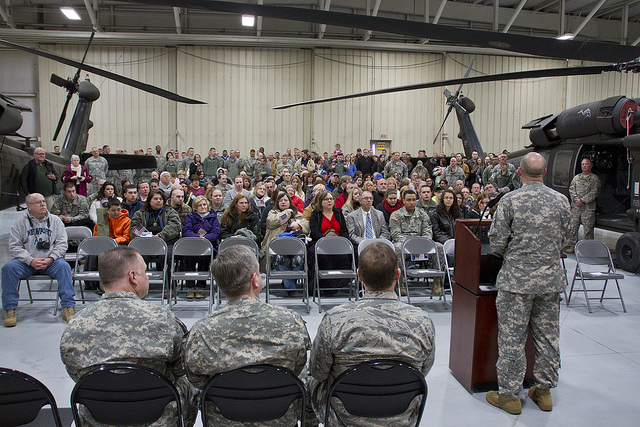
Maj. Chip St. Charles speaks to friends and family of Bravo Company, 351st Aviation Support Battalion during a departure ceremony in Frankfort, Ky., Feb. 16, 2015. The Guardsmen will deploy to the Middle East in support of Operation Spartan Shield. (U.S. Army National Guard photo by Staff Sgt. Scott Raymond)
FRANKFORT, Ky. — The Kentucky National Guard command staff honored the members of Bravo Company, 351st Aviation Support Battalion in a departure ceremony, Feb. 16.
Despite inclement weather, a large crowd of family members and friends gathered to say their last farewell.
Click here for more photos of this event.
During their deployment to the Middle East the aviation soldiers of Bravo Co. will provide aviation maintenance support to a variety of Army aircraft throughout the theater of operation for Operation Spartan Shield. They will first go to Fort Hood, Texas for pre-deployment training before heading overseas.
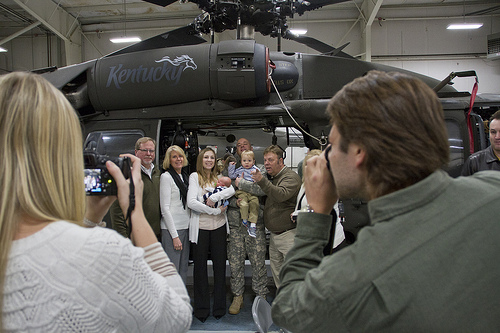
A Soldier with Bravo Company, 351st Aviation Support Battalion enjoys a family portrait during a departure ceremony in Frankfort, Ky., Feb. 16, 2015. The unit will support military operations in the Middle East for roughly one year. (U.S. Army National Guard photo by Staff Sgt. Scott Raymond)
Kentucky’s Adjutant General, Maj. Gen. Edward W. Tonini presided over the event. Tonini spoke of the unit’s readiness and the support the family members at home will receive.
“Maj. (Chip) St. Charles has prepared his Soldiers superbly, they’re ready to do this mission and ready to respond to whatever the circumstances might be overseas,” said Tonini. “For the families, our family support structure that has been honed over the past 12 years, and if you stay in communication, your needs will be met. We need to make sure you are part of our family.”
Col. Michael Stephens, commander of the 63rd Theater Aviation Brigade reminded each Soldier and family member that they are important and matter to the mission and to the organization. In describing the unit’s task, Stephens said Bravo Co. would be among the only aviation mechanics in the theater and will be vital to military operations.
“I want everyone of you Soldiers who fix these aircraft to be proud. Pilots wave their hands and get a lot of attention, but without the mechanics and crew chiefs, none of these aircraft will fly, said Stephens. “I’m proud of you for standing up and making a difference for our country.”
This is not the first deployment for the troops of the 351st, having deployed to the Middle East in 2006-2007. The unit has also served during several natural disaster missions to include Hurricane Ike wind storm in 2008 and the Winter Storm of 2009. During these extreme weather conditions, the soldiers deployed across the commonwealth providing generators, door to door health and welfare checks, traffic control, and debris removal.