Pages
Stay In Touch
More
© 2013 KentuckyGuard
Story by Staff Sgt. Vicky Spesard, 123rd Airlift Wing Public Affairs
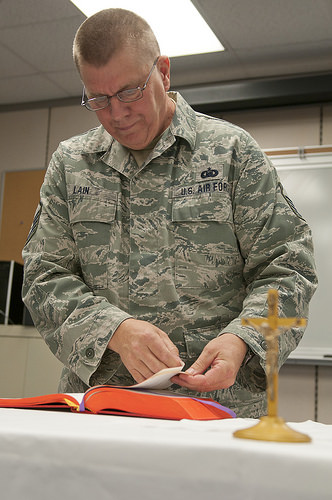
Senior Master Sgt. Billy Lain, a chaplain’s assistant with the 123ard Airlift Wing, Louisville, Kentucky, prepares for the Catholic Mass at the base November 22, 2014, as part of his normal duties. Lain, who will retire soon, is now the “chaplain” of his own church in rural Indiana. (U.S. Air National Guard photo by Staff Sgt. Vicky Spesard)
KENTUCKY AIR NATIONAL GUARD BASE, LOUISVILLE, Ky.-Senior Master Sgt. Billy Lain has been providing support to the chaplains of the 123rd Airlift Wing, Louisville, Kentucky, for the past 13 years, serving in the role of chaplains’ assistant. Now, he will have the opportunity to move from the serving side of the chapel to leading a chapel of his own.
Lain is the new pastor for the Tell City Church of Christ in Tell City, Indiana, a small town of approximately 2,000 people, where he will minister full-time upon his retirement from the Air Guard in April 2015.
Having a mechanical background in his youth, the chaplains’ corps was not Lain’s first choice of occupations in the Air Force.
“During my active duty days in 1978, I did electronic maintenance, then switched to supply during my short stint in the Army National Guard,” Lain explained. “I didn’t get to the chaplains program until after I came to the Kentucky Air Guard after an 18 year break in service.”
An occupational specialty move that Lain found challenging.
“I thought the school for this job would be a breeze compared to what I already had been through,” he said. “Boy, was I wrong.”
Lain’s duties require him to be intricately familiar with several different worship preferences recognized by the Air Force. He helps to facilitate ministry supplies needed to worship, ensures worship is accessible to Airmen and works to identify and meet the needs of the base chaplains. He has also been deployed to several different areas around the United States and overseas locations where he takes on the additional role of ensuring the safety of the chaplain he is assigned to.
“It is clearly evident how my role here has prepared me for my new job,” Lain emphasized. “My time here in the Guard has been invaluable; the life lessons, priceless.”
Invaluable service to the Guard is only one of the many reasons why Lt. Col. James Ehrman, 123rd Airlift Wing Chaplain, will miss him when Lain retires.
“Over the past years, working with Billy, we have been a team,” Ehrman said. “He has never hesitated to give support as needed. He is very humble and is ethic of service stands out. I have always thought of us as a team with a strong trust level.
“He will have no trouble going from a support role to a leadership role,” Ehrman continued. “His having been a leader here will make him a stronger leader in his church.”
Lain began his involvement in the church, which has a congregation of approximately 50 parishioners, as a volunteer, then to an elder and then into the pastoral position when the opening became available. He is currently working as the pastor now, but will completely move into the job when his duties here have ended.
“The church community has been very supportive of my role in the Air Guard and are very excited to have me come on board,” Lain explained. “I will definitely miss the involvement I have here with the people at the base, but I know there are needs on the home front as well.”
From our family to yours, the Kentucky National Guard wishes everyone a joyous and safe Thanksgiving. We count our blessings everyday and are incredibly thankful for the men and women of our organization and their families.
This year, we are especially thankful for our Soldiers and Airmen that are unable to be home for the holidays, like Bravo Company, 2nd Battalion, 147th Aviation. They sent us a group photo with all the holiday decorations they could muster overseas. Keep up the great work Renegades!
“This Thanksgiving I’m thankful for the opportunity to serve my country, and I’m extremely thankful for the family and friends that have supported me at home while I’ve been deployed,” said Spc. Logan Burton, a crew chief with the 2/147th.
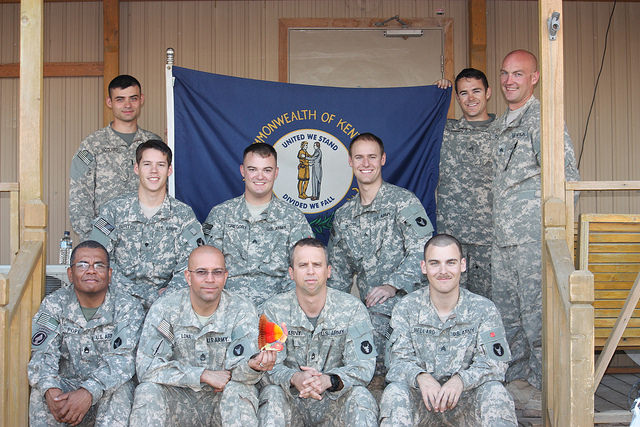
Happy Thanksgiving from Bravo Company, 2nd Battalion, 147th Aviation currently deployed to Southwest Asia in support of Operation Enduring Freedom. (U.S. Army National Guard photo by SGt. Tom Harrington)
Story by David Altom, Kentucky National Guard Public Affairs
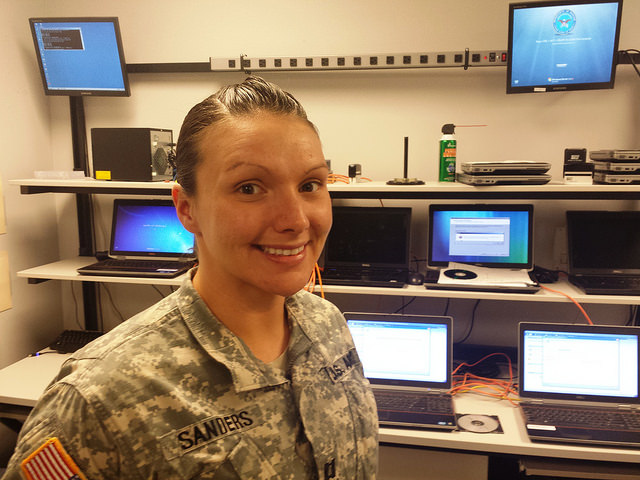
Capt. Dayna Sanders comes from a family with a strong military history. She also has a Native American legacy that goes back for generations. (Photo by David Altom, Kentucky National Guard Public Affairs)
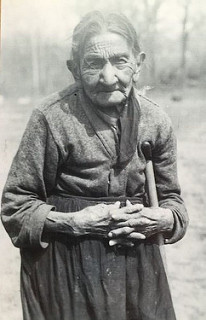
Sanders’ great grandmother, Elise Marion lived on the Turtle Mountain Indian Reservation in Belcourt, North Dakota. (Photo courtesy Capt. Dayna Sanders)
FRANKFORT, Ky. — Like so many who join the National Guard, Capt. Dayna Sanders comes from a military family. Her husband flies Army helicopters, her father deployed to Vietnam as an aerial photographer and her grandfather served during World War II. She has an aunt who was in the Women’s Army Corps and a grandmother who served during World War I.
But Sanders’ legacy goes beyond just the military. She’s also part Native American, with connections that cross the border into Canada and goes back for generations in time.
“My mother, Madonna Seelhammer (maiden name LaFromboise), was born to Elise and Joseph LaFromboise in Belcourt, North Dakota on the Turtle Mountain Indian Reservation. My grandmother and grandfather were half Chippewa - making my mother one half as well. The majority of my mother’s family still resides on the reservation today.”
Click here to find out more about National Native American Heritage Month.
“My father, Wayne Seelhammer, was born to Beverly Seelhammer (Rood) and Lyle Joseph Morrison (aka Ralph Joseph Seelhammer) in Cogswell, North Dakota. My paternal great grandfather was suspected to be a full blood member of a Sioux tribe in the area.”
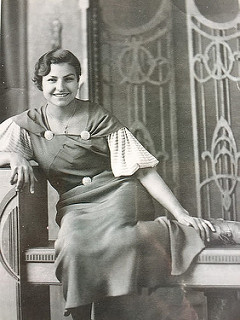
Grandmother Elise Lafromboise is the daughter of great grandmother Elise Marion. Sanders reminds us that not all Native Americans wear their hair in braids or have traditional Indian names. (Photo courtesy Capt. Dayna Sanders)
According to Sanders, the Turtle Mountain Band of Chippewa Indians was established in 1882. Two groups of Native Americans settled in the region: the Pembina Band of Chippewa Indians and Cree. The Pembina Band was originally from the Red River valley of Minnesota and North Dakota. The Cree were from Canada.
“As a child, I was active in the pow wow circuit,” said Sanders. “A pow wow is generally known as community event made up of singing, dance, and drum. I was a traditional jingle dancer. Legend has it that a dream came to a medicine man. In that dream the medicine man was shown the dress and the dance. Upon waking, the man made four dresses, one of which he gave to his wife and showed her the footwork. She then showed that with three of her friends.”
Since moving away from her hometown of South Saint Paul, Minnesota, Sanders has not been back in the pow wow circuit. She still considers her self close to the prayer rituals and medicine associated with her heritage, which she intends to share with her young daughter, Elie.
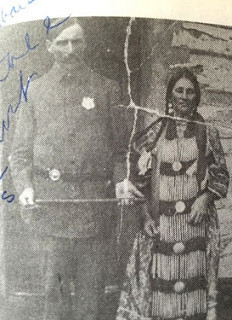
Great grandparents Joseph and Isabelle LaFromboise. Isabelle is in her traditional dress. (Photo courtesy Capt. Dayna Sanders)
“As anyone else, I have a responsibility to pass on the knowledge and traditions of my family to my children so that they are not forgotten.”
Sanders loves being in the military as much as she loves her family’s heritage. “Native Americans are as proud of Americans as any other ethnicity, culture, or group of Americans. Ethnicity has nothing to do with our willingness to service and pride in our country.”
Sanders is eager to share her culture and is open to talking about myths and misconceptions. For example, she says, “Not all Native Americans are the same. There are hundreds of tribes in the United States. The practices and religion of a tribe in North Dakota do not necessarily reflect those of a tribe in Arizona.”
As to what she’d like to be called, it’s not that hard. “Most Native Americans do not care whether or not they are called Native American, American Indian, or Indian. As long as the terminology is utilized respectfully.”
Sanders said American Indians are not necessarily easily identifiable. Not all are dark skinned, with high cheekbones, and their black hair tied up in braids. And not all Native Americans have an Indian name.
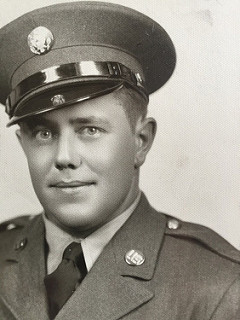
Grandpa Ralph Seelhammer was a private first class with the U.S. Army during World War II. (Photo courtesy Capt. Dayna Sanders)
“This may seem obvious,” she said, “but many people think that Native Americans are confined to reservations, live in tipi’s, and ride horses. This is definitely not true.”
Sanders has deployed twice, once to Iraq as an enlisted troop and again to Kuwait as a brand new second lieutenant. In addition to her full time job with Kentucky Army National Guard’s logistics shop, she is now the commander of the 2138th Forward Support Company. Her passion for the Guard is as strong as her pride in her culture.
“I love being a soldier,” she said. “I’m in a field that is diverse and important to the mission. But most of all I love taking care of my soldiers! My family’s influence guided me to where I am today and this is where I want to be.”
Photos by Staff Sgt. Scott Raymond, Kentucky National Guard Public Affairs Office
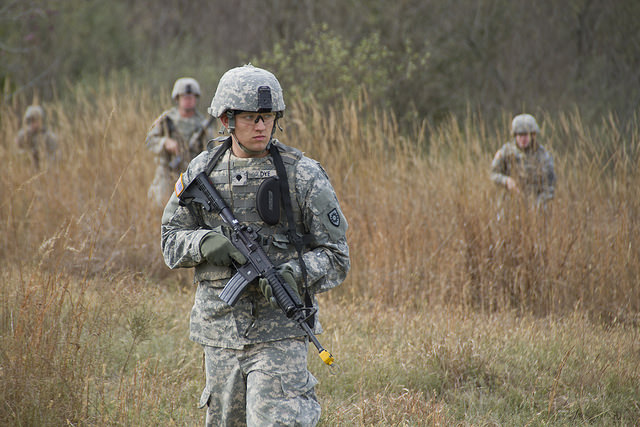
Spc. Cody Dye with the 201st Forward Support Company leads his platoon through a training exercise at the Wendell H. Ford Regional Training Center in Greenville, Ky., Nov. 4, 2014. (U.S. Army National Guard photo by Staff Sgt. Scott Raymond)
GREENVILLE, Ky. — Soldiers of the 201st Engineer Battalion extended a drill weekend to a whole week of training at the Wendell H. Ford Regional Training Center in Greenville, Nov. 1-7, 2014.
In order to focus the rest of the year on collective training events and engineering projects, the battalion travelled to Greenville to knock out annual requirements for Soldiers all in one period. According to Capt. Jonathan Gensley, Administration Officer for the battalion, the schedule not only benefits the units’ training, but the Soldiers’ personal lives as well.
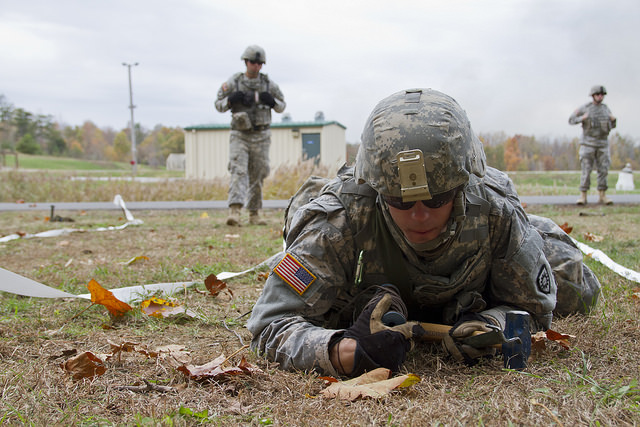
Pfc. Matthew Clay with the 577th Sapper Company low crawls to place a M18A1 Claymore mine during training at the Wendell H. Ford Regional Training Center in Greenville, Ky., Nov. 4, 2014. (U.S. Army National Guard photo by Staff Sgt. Scott Raymond)
“This extended drill allows Soldiers time off during major family-focused months of the year,” he said. “Consolidating several training events this week, we don’t drill in December, giving Soldiers more time off to be with their families during the holidays, nor do we drill in June, allowing time off for family summer vacations.”
Soldiers complete a wide variety of annual tasks, including their physical fitness test, personal health assessments and individual weapon qualifications. The week is also a chance to re-evaluate Soldiers in the required Army Warrior Tasks. Every Guardsman is expected to know the basics of Soldiering, and annually they are reminded of the tasks that may fall outside their military job.
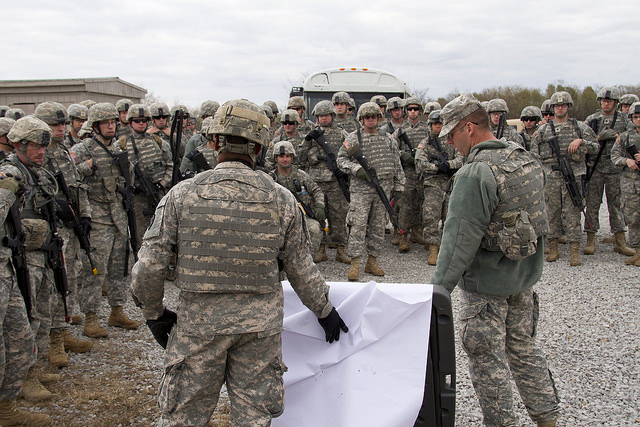
Soldiers of the 201st Engineer Battalion receive instruction on training exercises at the Wendell H. Ford Regional Training Center in Greenville, Ky., Nov. 4, 2014. (U.S. Army National Guard photo by Staff Sgt. Scott Raymond)
The 201st is made up of units spread out from from Ashland, Kentucky where it is headquartered, to Hazard, Kentucky and Cynthiana, Kentucky. With such a wide reach of units, the collective drill is a unique one for the battalion.
“This is the second year we have done this and simply, this long drill postures the 201st for success throughout the remainder of the year,” said Gensley.
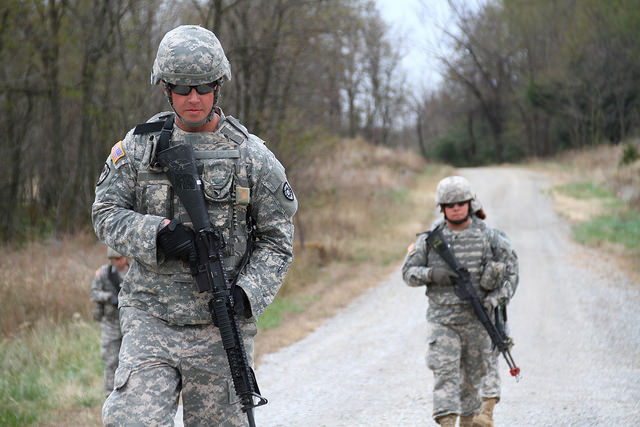
Soldiers with the 201st Engineer Battalion move through a training exercise at the Wendell H. Ford Regional Training Center in Greenville, Ky., Nov. 4, 2014. (U.S. Army National Guard photo by Staff Sgt. Scott Raymond)
For the engineers and the historical use of the battalion, little is unique to the Soldiers of the unit. Land navigation, security patrols and M18A1 Claymore training filled the Soldiers’ busy week.
Maj. John Barger, executive officer for the battalion said the Soldiers face long days during the week, but realize the benefits of their hard work. One important benefit Barger sees is the
“There’s such good interaction amongst the leadership of the unit, from the battalion commander to senior NCOs of subordinate units,” he said. “Its a rare opportunity for a mutual understanding of the commander’s intent and to foster quality leaders for the battalion’s future.”
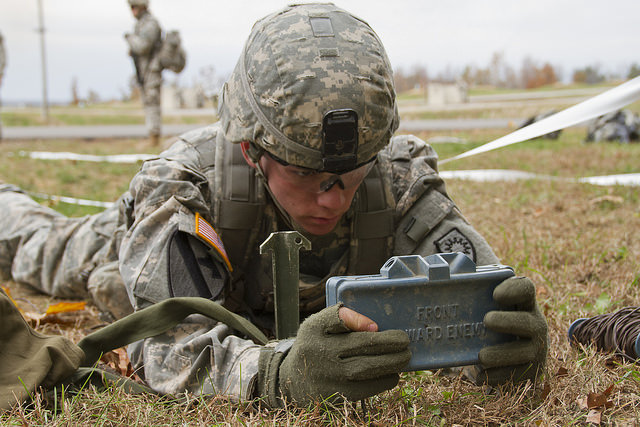
Spc. Jonathan Benham with the 577th Sapper Company places a M18A1 Claymore mine during training at the Wendell H. Ford Regional Training Center in Greenville, Ky., Nov. 4, 2014. (U.S. Army National Guard photo by Staff Sgt. Scott Raymond)
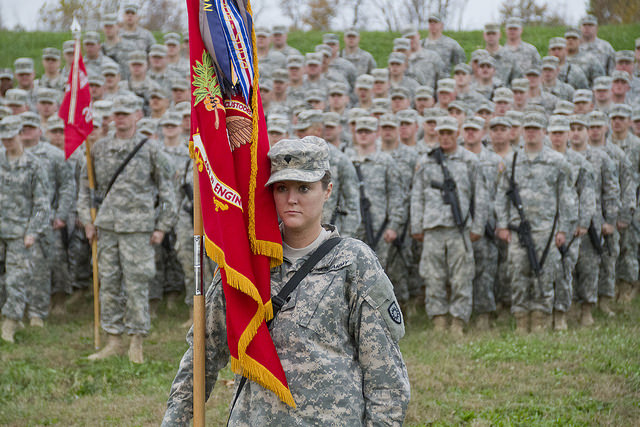
Spc. Caitlin Viera with the 201st Engineer Battalion holds the battalion colors during a formation at the Wendell H. Ford Regional Training Center in Greenville, Ky., Nov. 4, 2014. (U.S. Army National Guard photo by Staff Sgt. Scott Raymond)
Story by Chaplain (Maj.) Bill Draper and David Altom, Kentucky National Guard Public Affairs
Chaplain (Col.) David E. Graetz, Assistant to the Chief of Chaplains for the National Guard, conducts Tier 1 Post DOMA Training during the State Chaplain Training event on Sept. 26, 2014 at Boone National Guard Center, Frankfort, Ky. (Photo courtesy Chaplain (Maj.) Bill Draper)
FRANKFORT, Ky. — Like any other element of the military, the chaplain corps has to conduct training to maintain its readiness to support the mission.
On Friday, Sept. 26, 2014, the Kentucky Army National Guard’s chaplains gathered for their annual state chaplain training event.
“These events are extremely important for our chaplain corps because it allows us to conduct specific training that better equips our chaplains and chaplain assistants to provide religious support across the organization,” said State Chaplain (Col.) Yong Cho. “We are grateful for the support of our senior leaders who support this training because they too believe in its value and worth to our Guard Families.”
State Chaplain Yong Cho during predeployment training with the troops. A chaplain’s services can be needed by a soldier in the field or at home with their family. (File Photo)
During the one day training event attendees received mandatory training on Tier 1 Post-Defense of Marriage Act, along with Sexual Harassment Assault Response and Prevention refresher training. In addition, there was open discussion on other subjects dealing with everything from security clearance to suicide intervention skills and religious preference profiles.
“Chaplains have to be ready to respond to a wide range of problems, sometimes in a professional military environment, but more often on a personal level,” said Chaplain (Maj.) Bill Draper, who has twice deployed to Iraq. “It doesn’t matter if it’s on the battlefield or here at home, we are committed to helping our soldiers and their families in all facets of their lives. That’s why this training is so varied … and valuable.”
Chaplain Mark Slaughter says a prayer at a ceremony at Camp Lemonnier, Djibouti, on Oct. 18, 2012. Chaplains have to support a wide range of duties, from ceremonies to private counseling. (File photo)
One subject of importance was the Strong Bonds program, with helps Soldiers and Airmen with marriage relationships and life skills.
Click here for information on an upcoming Strong Bonds event.
Two new chaplains have come on board as well: Chaplain (Capt.) Brandon Candee, 2nd Battalion, 75th Recruiting and Retention Command and Chaplain (Capt.) Shane Blankenship for the 1st Battalion, 623rd Field Artillery.
The Kentucky Army National Guard currently has two full-time support chaplains, Chaplain Draper and Chaplain (Capt.) Phil Majcher, both of whom assist Chaplain Cho in providing administrative support and direct religious support across the state to supplement the additional 14 M-day chaplains and chaplain assistants.
For more information on the Kentucky National Guard’s chaplain corps contact Chaplain (Maj.) Draper at 502-607-1729 or email him at [email protected]
Staff Report
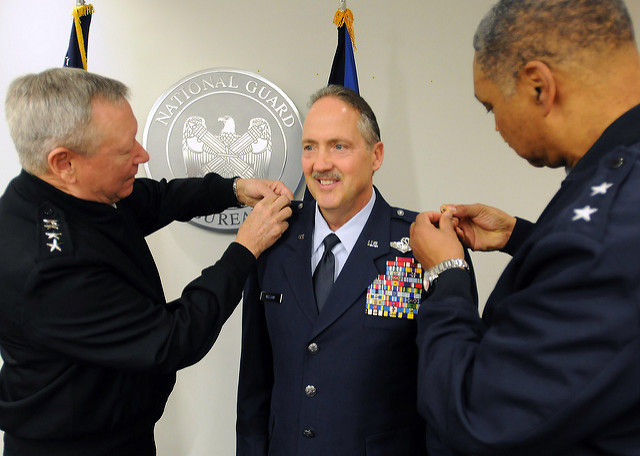
U.S. Army Gen. Frank Grass (left), chief of the National Guard Bureau, promotes Greg Nelson, vice director of Strategic Plans, Policy and International Affairs at the National Guard Bureau, to the rank of brigadier general during a ceremony at the National Guard Readiness Center in Arlington, Va., Nov. 19, 2014. Nelson served as commander of the Kentucky Air National Guard’s 123rd Airlift Wing in Louisville from 2008 to 2012. (U.S. Army National Guard photo by Staff Sgt. Michelle Gonzalez
ARLINGTON, Va. — Col. Greg Nelson, a former commander of the Kentucky Air National Guard’s 123rd Airlift Wing was promoted tot he rank of brigadier general during a ceremony at the National Guard Readiness Center in Arlington, Nov. 19, 2014. Nelson led the 123rd from 2008 - 2012. He now serves as the vice-director of Strategic Plans, Policy and International Affairs at the National Guard Bureau.
As wing commander, Nelson provided leadership and management of a very diverse tactical airlift flying unit. Working in concert with a wide variety of federal and state authorities, he was accountable for all aspects of operations, personnel, equipment and funding matters, ensuring the wing’s readiness to perform its wartime mission.
“Greg is an invaluable member of our Air Force and a huge asset to the Guard,” said Maj. Gen. Edward Tonini, adjutant general of Kentucky. “I couldn’t be more proud for Greg and his family. A promotion well-deserved.”
Nelson also served as an RF-4C weapon systems officer and C-130 instructor navigator. He has held multiple leadership and senior staff positions, most recently the Deputy Director of Mobility Forces, United States Central Command. Nelson was the Director of Strategic Plans and Programs for Joint Force Headquarters, Kentucky National Guard. He also commanded the 123rd Airlift Control Flight, was deputy command post chief, chief of logistics plans and chief of wing plans. Nelson’s military career spans more than 35 years, including nine years of enlisted service prior to his officer commissioning through the Air National Guard Academy of Military Science in 1984. During his career, Nelson has participated in Operations Desert Shield, Desert Storm, Southern Watch, Provide Promise, Joint Forge, Joint Guard, Coronet Oak, Phoenix Oak, Bright Star, Partnership For Peace, Noble Eagle, Enduring Freedom, Fundamental Justice, Iraqi Freedom, and New Dawn.
Story by Lt. Col. Kirk Hilbrecht, Kentucky National Guard Public Affairs
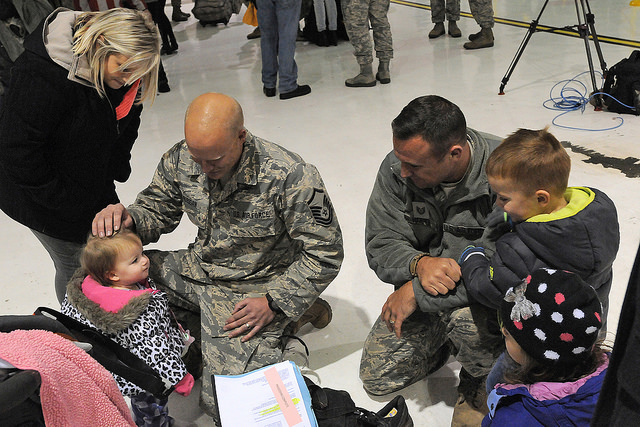
Master Sgt. Matthew Hourigan (left) and Tech Sgt. Jacob Harper greet their children in Louisville, Ky., after the Airmen returned from a deployment, Nov. 19, 2014. The Airmen with the 123rd Contingency Response Group deployed to West Africa in support of Operation United Assistance, the international effort to fight Ebola. (U.S. Army National Guard photo by Staff Sgt. Scott Raymond)
LOUISVILLE, Ky. - Approximately 40 Airmen from the Kentucky Air National Guard returned home in the early morning hours of Nov. 19 from a deployment to West Africa. The Guardsmen were based in Senegal where the 123rd Contingency Response Group established a cargo processing hub in support of Operation United Assistance, the international effort to battle Ebola.
The arrival was the first of several flights scheduled to bring the unit home. Additional members are expected arrive before the weekend.
Senior Airman Jeff Hall worked as a member of the security forces with the said the “fulfilling” experience ranks near the top in his seven-year career.
“It was my first time able to assist with a humanitarian mission, and to be a part of it was exciting and I am proud to be a part of it,” said Hall.
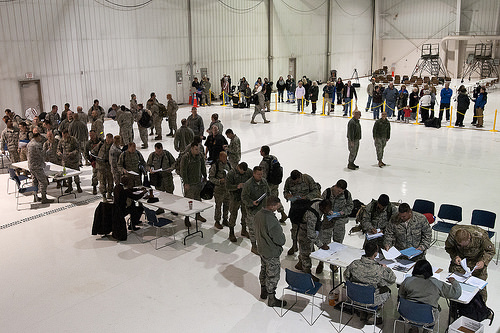
Airmen with the 123rd Contingency Response Group file through in-processing after landing at the Kentucky National Guard Air Base in Louisville, Ky., Nov. 19, 2014. After serving in an Ebola-free area of West Africa, the Airmen were not required to be quarantined or self-monitored for 21 days. (U.S. Army National Guard photo by Staff Sgt. Scott Raymond)
Even with the excitement of a gratifying mission, the worry of working near Ebola areas reached all the back home. Hall said those worries were absent overseas.
“We didn’t really think about it much. We were so busy. We knew we were in an Ebola-free zone and we have really good officers that kept us on track with our health. We looked out for each other and never felt there was a threat.”
Master Sgt. Matthew Hourigan served as the maintenance supervisor for the unit taking care of the numerous aircraft arriving with humanitarian aid in Senegal.
“This mission gave you, at the end of the day, when you put your head on the pillow, a feeling that what you are doing is providing a difference for someone else,”
With no concerns over their health, Hourigan and his wife, Rachel said its simply time to enjoy the holidays and move on like today is no different than yesterday.
“Its just a normal day, we get to start our Thanksgiving plans,” he said. “We’re going back to life and feeling a little bit more fulfillment about what we did over there.”
Click here for more photos.
The 123rd Contingency Response Group is the only unit of its kind in the Air National Guard. Conceived as an “airbase in a box,” the group acts as an early responder in the event of contingency operations worldwide. Several members of the CRG were involved in previous humanitarian missions, to include the Haiti earthquake aid in 2010. Unit members represent a broad spectrum of specialties, including airfield security, ramp and cargo operations, aircraft maintenance, and command and control.
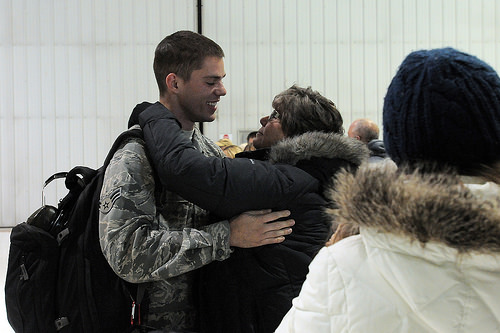
An Airman with the 123rd Contingency Response Group greets family members in Louisville, Ky., after returning home for a deployment to West Africa Nov. 19, 2014. The flight was the first of several bringing the unit home from overseas. (U.S. Army National Guard photo by Staff Sgt. Scott Raymond)
“I am so proud of the incredible job our Kentucky Guardsmen executed overseas,” said Maj. Gen. Edward W. Tonini, adjutant general for Kentucky. “Our Kentucky Air Guard members continue to show the world how we stand ready to serve and how we are responsive global neighbors who make such an important contribution to this crisis.”
The Guardsmen were stationed in Dakar, Senegal, a World Health Organization designated Ebola Virus Disease-free country approximately 800 miles from Liberia, the closest EVD-zone. As such, DoD does not require military personnel returning from an EVD-free country to conduct a 21 day quarantine, as these military personnel had no close contact to the virus or affected personnel. As an extra precautionary measure, these Kentucky troops completed symptom monitoring by healthcare providers for the duration of their
deployment.
Story by Maj. Dale Greer, JTF-PO Senegal Public Affairs
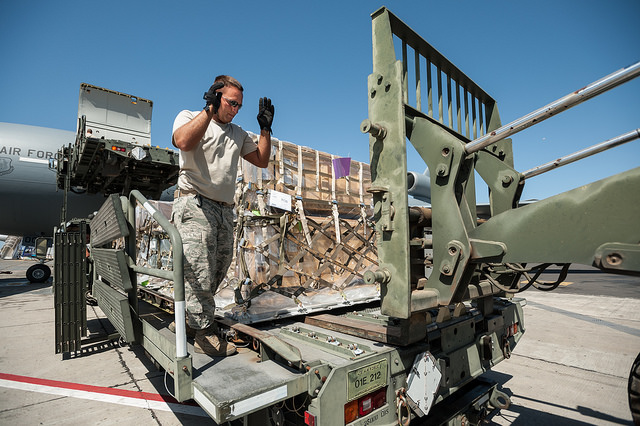
U.S. Air Force Tech. Sgt. Brian Leach, an aerial porter from the Kentucky Air National Guard’s 123rd Contingency Response Group, directs the positioning of a forklift to offload pallets of humanitarian aid from a Halverson cargo-handling vehicle at Léopold Sédar Senghor International Airport in Dakar, Senegal, Nov. 12, 2014. The cargo will be staged in Senegal before being transloaded to U.S. Air Force C-130J aircraft for delivery into Monrovia, Liberia, in support of Operation United Assistance, the U.S. Agency for International Development-led, whole-of-government effort to contain the Ebola virus outbreak in West Africa. (U.S. Air National Guard photo by Maj. Dale Greer)
DAKAR, Senegal — Airmen from the Kentucky Air National Guard’s 123rd Contingency Response Group transferred control of a humanitarian cargo hub to replacement forces Nov. 18, successfully completing their support of an Ebola-response mission that has processed more than 750 tons of relief supplies for airlift into Liberia.
While the Kentucky unit’s role is winding down as its members prepare to redeploy to the United States, the humanitarian cargo operation will continue at Léopold Sédar Senghor International Airport under the direction of the new troops — more than 70 Airmen assigned to the 787th Air Expeditionary Squadron.
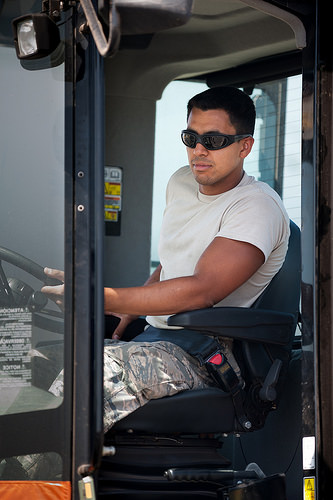
U.S. Air Force Airman 1st Class Randy Kirkland, an aerial porter from the Kentucky Air National Guard’s 123rd Contingency Response Group, uses an all-terrain forklift to offload pallets of humanitarian aid from a Halverson cargo-handling vehicle at Léopold Sédar Senghor International Airport in Dakar, Senegal, Nov. 12, 2014. The cargo will be staged in Senegal before being transloaded to U.S. Air Force C-130J aircraft for delivery into Monrovia, Liberia, in support of Operation United Assistance, the U.S. Agency for International Development-led, whole-of-government effort to contain the Ebola virus outbreak in West Africa. (U.S. Air National Guard photo by Maj. Dale Greer)
“As one of the first Air Force assets in theater, the 123rd Contingency Response Group’s mission was to open an airfield for military cargo operations, establish an Aerial Port of Debarkation, and hand off the operation to follow-on forces within 60 days,” explained David Mounkes, commander of the 123rd. “We’ve now completed that mission, and the 787th is ready to take over. I know they will do a superb job.”
Lt. Col. Michael Brock, commander of the 787th, expressed his gratitude to the men and women of the Kentucky Air Guard for their “outstanding stewardship” of the aerial port from its inception.
“I’d like to express our sincere thanks to the 123rd CRG for shaping the environment for future success,” Brock said. “Due to their exceptional professionalism, our Airmen are fully prepared to carry on this mission without missing a beat, delivering equipment and supplies to Liberia that are essential for combating an Ebola outbreak that has claimed over 5,000 lives.”
Mounkes said he was proud of his forces, which include more than 70 Air Guardsmen from Louisville, Kentucky, and seven active-duty Airmen from Travis Air Force Base, California, and Joint Base Maguire-Dix-Lakehurst, New Jersey.
Those Airmen arrived in Senegal Oct. 4 to find a bare-base facility consisting of little more than two empty buildings and a vacant lot situated next to an airport taxiway. From that, the Airmen built a fully operational aerial port in less than 24 hours, supplying their own satellite-based voice and data communications, electric power generation, airfield command-and-control capability, all-terrain forklifts, specialized cargo-handling equipment and aircraft maintenance assets.
“I could not be more pleased with what our Airmen accomplished here in a rapidly changing, dynamic environment,” Mounkes said. “They hit the ground running and never let up, getting critically important humanitarian cargo and troop-support equipment downrange to help fight the worst Ebola outbreak in history.”
That cargo, which arrived in Senegal aboard civilian 747s and U.S. Air Force C-17 and KC-10 cargo aircraft, included items like tents, latex gloves, human blood, stretchers, electric generators, and food and water. Airmen from the 123rd worked around-the-clock to offload cargo as it arrived, prioritize it for forward movement, and upload it to U.S. Air Force C-130s for final delivery in Liberia.
Click here for more photos from the 123rd’s mission.
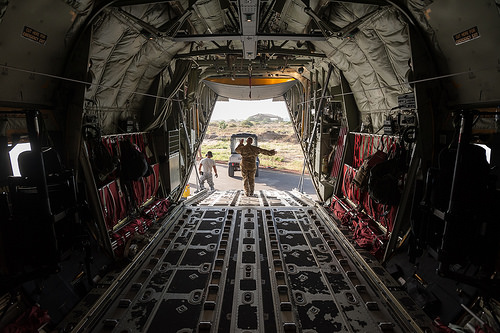
U.S. Air Force Staff Sgt. Kassondra Cline, a loadmaster for the 787th Air Expeditionary Squadron, directs the loading of a tactical vehicle onto a U.S. Air Force C-130J aircraft at Léopold Sédar Senghor International Airport in Dakar, Senegal, Nov. 11, 2014. The aircraft and crew, from Dyess Air Force Base Texas, are deployed to Senegal to fly humanitarian aid and troop-support equipment into Monrovia, Liberia, in support of Operation United Assistance, the U.S. Agency for International Development-led, whole-of-government effort to contain the Ebola virus outbreak in West Africa. (U.S. Air National Guard photo by Maj. Dale Greer)
Since beginning operations in Senegal, the Kentucky Airmen have coordinated the movements of 188 in-bound and out-bound aircraft, processed 809 passengers for airlift and handled 754.9 tons of cargo, Mounkes said.
“The U.S Government’s response to this outbreak is a massive commitment of resources from multiple federal agencies, all under the direction of the U.S. Agency for International Development,” Mounkes noted. “The Department of Defense alone has committed to deploying nearly 4,000 forces to build multiple Ebola treatment facilities in Liberia, staff medical laboratories and train local health-care workers.
“That kind of response requires a tremendous level of logistical support, and I’m proud to say that our Airmen played a central role in establishing the air bridge needed to provide it.”
Mounkes also expressed his appreciation to the people and government of Senegal for their support throughout the deployment.
“The Senegalese Military and the High Airport Authority continue to be essential partners in this effort, and their contributions have been fundamental to the success of the mission in every way,” he said.
For many of the deployed Kentucky Air Guardsmen, Operation United Assistance has been one of the high points of their careers.
“It’s really satisfying to know that all the cargo we sent to Liberia is going to help people who need it,” said Capt. Matt Skeens, the 123rd’s logistics readiness officer. “It’s been a lot of hard work, but it’s absolutely worth it when you know you’re making a direct impact on people’s lives. This mission has been one of the most rewarding things I’ve ever done.”
Master Sgt. Charles Wilding agreed.
“I think the entire CRG has done astounding things here,” said Wilding, non-commissioned officer in charge of aerial port operations. “Working with all the different entities, including the U.S. Army and the Defense Logistics Agency, has been a real pleasure. Everyone put forth maximum effort, and we all came together like a big family to deliver a lot of support downrange.
“This deployment has been, without a doubt, one of the best of my career. I will look back on this 20 years from now and be able tell people, ‘We were there — we helped make a positive difference in the world.'”
Story by Staff Sgt. Scott Raymond, Kentucky National Guard Public Affairs
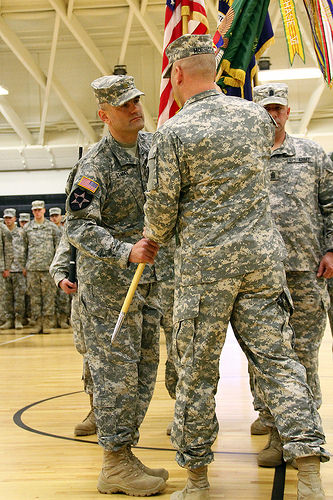
Maj. Timothy Starke receives the battalion colors from Col. Jerry Morrison, commander of the 149th Maneuver Enhancement Brigade during a change of command ceremony for the 198th Military Police Battalion in Fort Knox, Ky., Nov. 16, 2014. Starke assumed command from Lt. Col. John Treufeldt. (U.S. Army National Guard photo by Staff Sgt. Scott Raymond)
FORT KNOX, Ky. — Maj. Timothy Starke took charge of the 198th Military Police Battalion during a change of command ceremony at Fort Knox, Nov. 16, 2014. Friends, family and former MPs of the unit joined the roughly 800 Soldiers of the 198th in welcoming the new commander of Kentucky’s Thoroughbred Battalion.
“It’s such an honor to be entrusted with command of such a fine group of Soldiers,” said Starke.
He assumed command from Lt. Col. John Treufeldt who led the battalion since 2012.
Click here for more photos from this story.
“It’s just a great honor to serve with this unit and all the people here today,” said Treufeldt. “This has been the most fun I’ve ever had.”
“Its humbling to be here with former commanders and other friends of this battalion and the MP community,” he continued. Sure, we’re here for a ceremony, but its the unit that done all this great stuff. I’ve just been able to put my name on it for the past two and a half years. Maj. Starke has been here for a while and there couldn’t be a better person to give this to.”
After 31 years in uniform, Treufeldt said he plans to stay. He will move to Joint Forces Headquarters working special projects with the personnel and finance sections.
Starke, a 15-year Army Veteran previously served as the battalion’s executive officer and said the familiarity will benefit the unit during the transition.
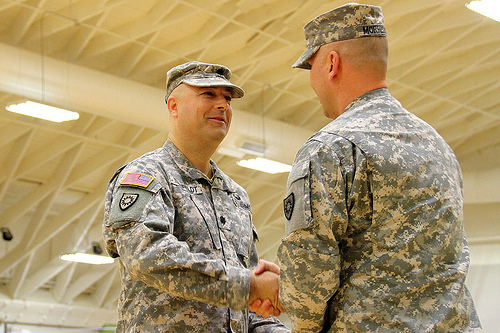
Col. Jerry Morrison presents Lt. Col. John Treufeldt with the Meritorious Service Medal during a change of command ceremony at Fort Knox, Ky., Nov. 16, 2014. Treufeldt led the 198th Military Police Battalion since 2012 and handed over command to Maj. Timothy Starke during the ceremony. (U.S. Army national Guard photo by Staff Sgt. Scott Raymond)
“Lt. Col. Treufeldt and I have worked together for years, I have a great deal of respect for him, we see things very similarly in many ways,” he said. “There is a lot of continuity in the organization, which is great for the Soldiers. They won’t see much difference in the way things are done.”
“I just want to live and enjoy each and every day and try to help these Soldiers continue the heritage and pride of this unit, and create their own legacy here,” said Starke.
Next up for the battalion, as Starke said is to “take a breath” and enjoy a family day for the holidays in December, a time he is ready to enjoy as the new commander.
“That’s when we get to get out and meet the families, that’s what I’m excited about. We can’t do this without families. We have to wrap our arms around them and let them know they are a part of this military police family.”
The MP battalion is made up of Headquarters and Headquarters Detachment, 223rd Military Police Company, the 438th MP Co., the 617th MP Co., the 940th MP Co. and the 1103rd Law and Order Detachment.
Since 2001, the units of the battalion have mobilized 13 times in support of overseas operations including Iraq, Afghanistan and Bosnia.
Story and photos by Staff Sgt. David Bolton, 133rd Mobile Public Affairs Detachment
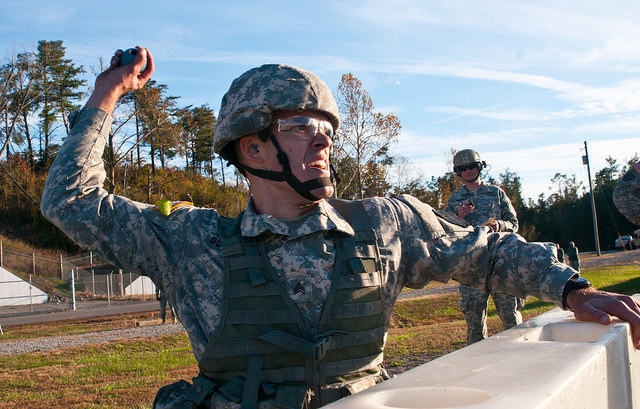
Army Sgt. Daniel Dornbusch, a recruiter with the 2/75th Recruiting and Retention Battalion, throws a dummy grenade to finish out the stress shoot event Nov. 7, 2014 at Wendall H. Ford Regional Training Center in Greenville, Kentucky. The stress shoot was one of several events administered to Soldiers of this year’s Best Warrior Competition. Other events included land navigation, rifle marksmanship, review boards and conducting Advanced Warrior Tasks. (U.S. Army National Guard photo by Staff Sgt. David Bolton)
GREENVILLE, Ky. - “The Full-Soldier Concept.” This was the theme behind the 2015 Kentucky National Guard Soldier and Non-Commissioned Officer Best Warrior Competition. The four-day competition, held Nov. 6 to Nov. 9, 2014, at Wendall H. Ford Regional Training Center in Greenville, Kentucky, saw the top Soldiers from the state’s six major commands vie for a shot at the regional competition.
But this crucible was not for the faint-hearted. Competitors were challenged in a series of events meant to test their mental, physical and emotional limits. Even before the competition began, State Command Sgt. Maj. Thomas Chumley, Jr., senior enlisted leader for the Kentucky Army National Guard, gave the Soldiers a word of caution.
“This is going to be a challenging event, this is serious stuff,” said Chumley. “If anybody wants to walk out right now, I wouldn’t hold it against you.”
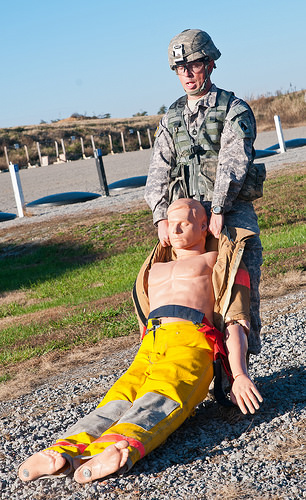
Sgt. 1st Class Jay Taheny, a Recruiting and Retention Area Supervisor with the Kentucky National Guard’s 2/75th Recruiting and Retention Battalion, drags a 200-pound dummy nearly 25 yards during a stress shoot exercise Nov. 7, 2014 at Wendall H. Ford Regional Training Center in Greenville, Kentucky. The stress shoot was part of the four-day 2015 Best Warrior Competition in which top Soldiers from across Kentucky competed for a chance to compete in the Regional competition. (U.S. Army National Guard photo by Staff Sgt. David Bolton)
No one moved.
Click here for more photos from the competition.
According to Chumley, the Best Warrior Competition provides the best Soldiers from the Kentucky Army National Guard the opportunity to prove themselves. This year, the focus of the competition was on preparing Soldiers for the regional competition and building pride in their skills as Soldiers.
“This year is focused on your basic soldiering skills,” said Chumley. “Also I’ve added more tasks to prepare for regionals like the obstacle course, the ruck march and the stress shoot, which are events at regionals. I want these Soldiers to have a sense of pride, selfless service, a sense of Esprit De Corps for their units, and just be proud of what they’re doing.”
This year’s events consisted of a written test, composing an essay, completing the Army Physical Fitness Test, negotiating an obstacle course, qualifying with an M9 pistol and M4 carbine, enduring a stress shoot, a five-mile ruck march with a 35-pound load, land navigation, a series Army Warrior Tasks and sitting through a review board.
Finishing these tasks, to standard, is one thing. But making sure the 17 competitors were able to do so safely fell to a support staff of more than 40 individuals.
“We make sure nobody gets hurt, us or them,” said Army Pfc. Lacy Bunnell, an automated logistics specialist with the 307th Component Repair Company. “In these events you really don’t think too much about safety but that really is the number one thing for these guys, we’re here to enforce that.”
“We can’t physically help them, but we can encourage them,” said Spc. James Barnes, a High Mobility Artillery Rocket System Crewman with the 623rd Field Artillery. “We provide moral support as well as physical safety so no one gets hurt.”
With such a wide variety of events to take on, competitors across the board agreed that making it to the state level was all due to solid preparation. Hitting the books is just as important as hitting the gym in a competition like this where every aspect of being a Soldier is put to the test.
“I pulled out the Field Manuals and the study guides and learned as much as I could and went over the Army Warrior Tasks to prepare myself for the higher levels,” said Army Staff Sgt. Jesse Mascoe, a fire directional specialist with Bravo Battery 1/623rd Field Artillery, and this year’s NCO of the Year winner.
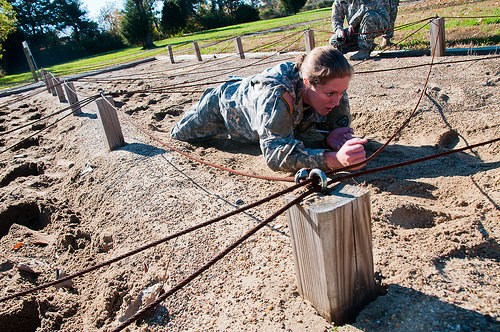
Spc. Caitlin Viera, a paralegal specialist with the 201st Headquarters and Headquarters Company, completes the low-crawl portion of the 2015 Best Warrior Competition obstacle course at Wendall H. Ford Regional Training Center in Greenville, Kentucky Nov. 7, 2014. The four-day competition tested the top Soldiers from across Kentucky in a series of mentally and physically challenging Soldier skills and board reviews. (U.S. Army National Guard photo by Staff Sgt. David Bolton)
“The boards are meant to test Soldiers in aspects other than their physical readiness or the combat aspect of being a Soldier,” said Command Sgt. Maj. Scottie Sloan, CSM for 2/75th Recruiting and Retention Battalion. “It is meant to test their ability to study, their military knowledge, their wear of uniform and appearance, and their ability to handle questions that they’re not prepared for.”
As the weekend progressed and drew to a close, the competitors were able to reflect on their experiences and what it meant for them to be able to participate on such a highly-visible stage.
“It’s a really high level of competition, not many people get to do this,” said Spc. Caitin Viera, a paralegal specialist with the Headquarters and Headquarters Company, part of the 149th Maneuver Enhancement Brigade. “It’s very humbling and very exciting. Especially as a woman, I don’t think there are many that make it this far so just being here is pretty good. I hope to win, but if not, the pride of saying that I made it here is more than enough.”
“It means a lot to represent my unit because I want to put them in the ears of the Army to say we have Soldiers, even in Field Artillery, who can send people to high positions and high places,” said Mascoe.
“So far everything has been really rewarding,” said Army Staff Sgt. Andrew Dickson, a range maintenance NCO with the Training Site Garrison Command at WHFRTC. “I’ve gotten more out of it than I thought I would and I’m getting to meet highly motivated soldiers from across the state. It’s an honor to know that I am a potential candidate to represent the state of Kentucky. I love this state, I love the Kentucky National Guard; they’ve done wonderful things for me and my family.”
“It reaffirms that if you put in the effort, the outcome can be good,” said Spc. Christopher Jones, an Infantryman with Bravo Company 1st Battalion, 149th Infantry, and Soldier of the Year winner. “It was a really great competition. The competition was stiff but everyone treated everyone else with respect and the sportsmanship was great. It is a tremendous honor.”
While most of the competitors looked to this weekend as an eye-opening experience, for the Senior NCO of the Year winner, Sgt. 1st Class Jay Taheny, a Recruiting and Retention Area Supervisor with the Kentucky Army National Guard’s 2/75th Recruiting and Retention Battalion, this competition was the defining moment of a career spanning almost 20 years.
“Personally, this is the capstone of my career, there’s not much else I could really do,” said Taheny. “It meant a lot to compete here. This is an accomplishment that can never be taken away from me and I can always consider this a really memorable achievement.”
The Soldier and NCO winners from this weekend will go on to compete in the regional Best Warrior Competition in the Virgin Islands in the spring of 2015.
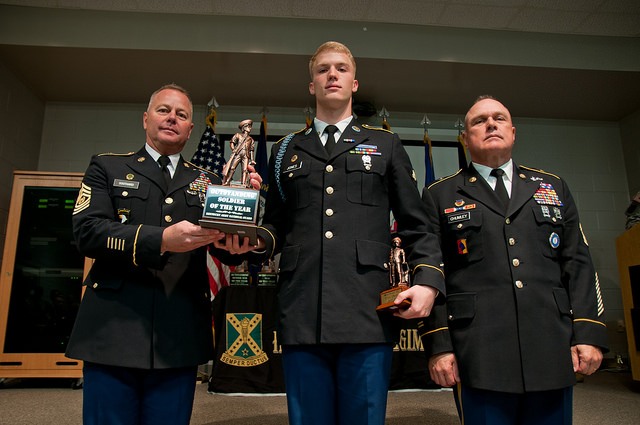
Spc. Christopher Jones, 2015 Kentucky Army National Guard Soldier of the Year. (U.S. Army National Guard photo by Staff Sgt. David Bolton)
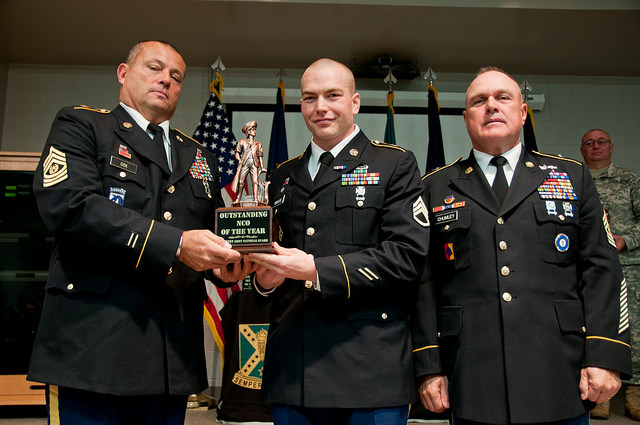
Staff Sgt. Jesse Mascoe, 2015 Kentucky Army National Guard NCO of the Year. (U.S. Army National Guard photo by Staff Sgt. David Bolton)
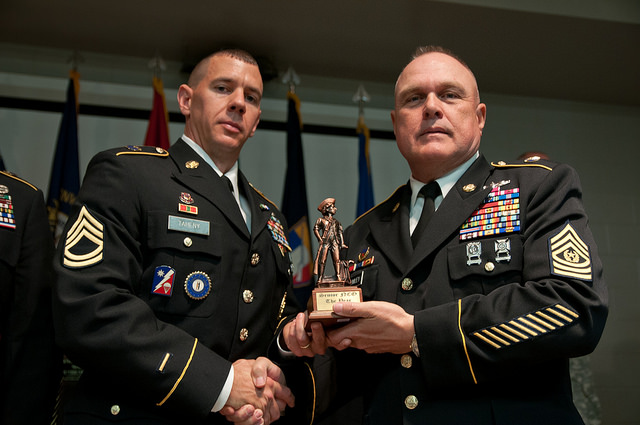
Sgt. 1st Class Jay Taheny, 2015 Kentucky Army National Guard Senior NCO of the Year. (U.S. Army National Guard photo by Staff Sgt. David Bolton)