
Pages
Stay In Touch
More
© 2013 KentuckyGuard
By Staff Sgt. Scott Raymond, Kentucky National Guard Public Affairs
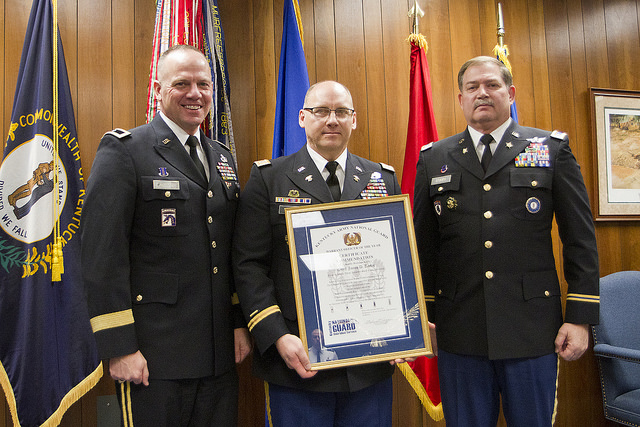
Chief Warrant Officer James Taylor (center) is named Kentucky’s Warrant Officer of the Year by Brig. Gen. Stephen Hogan (left) and State Command Chief Warrant Officer Dean Stoops (right) during a ceremony in Frankfort, Ky., Feb. 17, 2016. Taylor serves as the property book officer for the 201st Engineer Battalion and the 103rd Chemical Battalion.(U.S. Army National Guard photo by Staff Sgt. Scott Raymond)
FRANKFORT, Ky. — Annually the Kentucky Guard selects the most outstanding warrant officer. For the second year in a row, that Soldier came from the 149th Maneuver Enhancement Brigade. Chief Warrant Officer James Taylor, with the 201st Engineer Battalion earned the title for 2015.
“It is a humbling experience to be accepting this award. Nothing in my experience has prepared me for an honor like this - especially to be recognized for doing something that I so love to do,” said Taylor. “When one works in a field where every warrant officer regularly extend themselves above and beyond their duties, it is difficult to consider anything that one does as outstanding. I am blessed to have the opportunity to work with such a professional cohort of warrant officers that we have here in Kentucky. I share this award with them.”
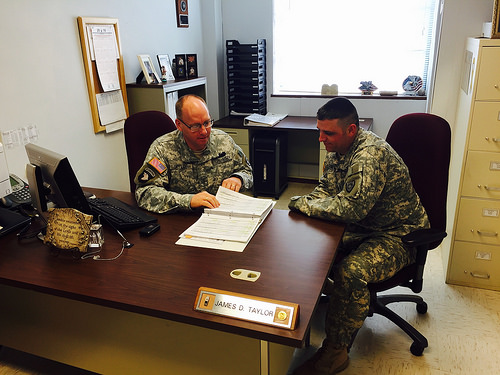
Chief Warrant Officer James Taylor discusses inventory with Staff Sgt. Danny Ison with the 201st Engineer Battalion in Richmond, Ky. Dec. 29, 2015. Taylor has served in uniform for 27 years and is known as a constant mentor and teacher, sharing his knowledge of supply with officers and enlisted Soldiers. (Courtesy photo)
Taylor serves as the property book officer for the 201st as well as for the 103rd Chemical Battalion, overseeing the inventory of nine companies and three detachments. In true warrant officer fashion, through his knowledge and work ethic, Taylor has earned the respect of many across the Kentucky Guard.
“Chief Taylor’s leadership and expertise delivers incredible results to the logistical readiness of the 201st Engineer Battalion,” said Lt. Col. Douglas Clay, commander of the 201st. “He is a proven leader and sets an excellent example through his consistent and steady performance.”
Enlisting in 1989, Taylor began his career as a combat engineer. In 2003, he switched fields into unit supply and by 2009 was the unit property book NCO. It was in 2009 that Taylor decided to become a warrant officer.
“I made the decision to become a warrant officer to expand my audience,” he said. “I wanted to share my knowledge with commanders and staff officers while continuing to lead enlisted personnel.”
And lead he does. Taylor is credited with with providing a smooth transition for force structure re-alignments with the brigade and becoming a subject matter expert on the Global Combat Support System, the Army’s newest supply standards. He singlehandedly directs and coordinates the management and control of unit equipment worth more than $150 million.
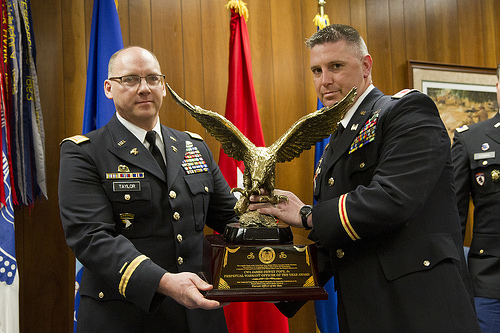
Chief Warrant Officer Buddy Barcus (right) presents the Kentucky Warrant Officer of the Year trophy to Chief Warrant Officer James Taylor in Frankfort, Ky., Feb. 17, 2015. Taylor followed Barcus as the top warrant officer in Kentucky, both from the 149th Maneuver Enhancement Brigade. (U.S. Army National Guard photo by Staff Sgt. Scott Raymond)
“We all have success and failures,” he said. “In relation to my own experience I regularly refer to the book of Philippians 4:13 ‘I can do all things through Christ which strengthens me,’ to overcome those tough assignments. I have found that over my 27 years of service the best way to influence other Soldiers to do their best is to know the standard, lead by example, and never give up. Always take the hard right over the easy wrong. The standards that we set as leaders will be the one that they use while making critical decisions.”
Taylor’s dedication extends beyond the uniform. A devout Christian, Taylor is an active member of two local churches where he has ministered for the past six years. He regularly coordinates and participates in food drives and various community service activities.
“Chief Taylor desire to serve others is continually inspiring,” said Command Chief Warrant Officer Dean Stoops. “He is always willing to travel and assist other Soldiers overwhelmed with tasks at hand. He is also adamant about inspiring others to go the extra mile.”
“He is the embodiment of the quiet professional,” said Stoops.
Story by Sgt. Brandy Mort, 133rd Mobile Public Affairs Detachment
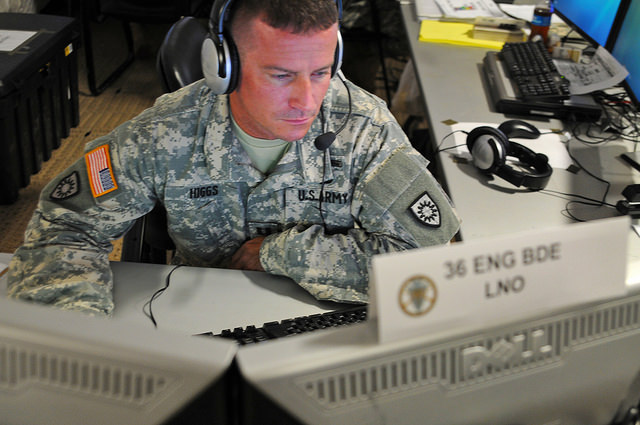
Capt. Sean Higgs, commander of the 2061st Multi-Role Bridge Company listens to a briefing during the Warfighter Exercise 15-5, May 29- June 14, at Fort Hood Mission Command Training Center, Texas. Higgs acted as a 36th Engineer Brigade’s liaison officer. (U.S. Army National Guard photo by Sgt. Brandy Mort)
FORT HOOD, Texas – If there is one thing that the Kentucky National Guard’s 201st Engineer Battalion knows, it’s how to build – whether it is a road, a bridge or a career. Although the Kentucky Guardsmen didn’t get dirty for their annual training, the battalion’s expertise was crucial to the Warfighter Exercise 15-5, May 29- June 14, at Fort Hood Mission Command Training Center, Texas.
“We are the main experts in bridging the gap,” said 1st Sgt. Aaron Lester, 2061st Multi-Role Bridge Company first sergeant.
“In this scenario, other countries depend on our troops and our Multi Role Bridge Company in order to properly maneuver across a wet gap crossing,” he said. “After the exercise, we will be able to take back what we learn and utilize the training in preparation for our company. It will be a very important contributor to our development. ”
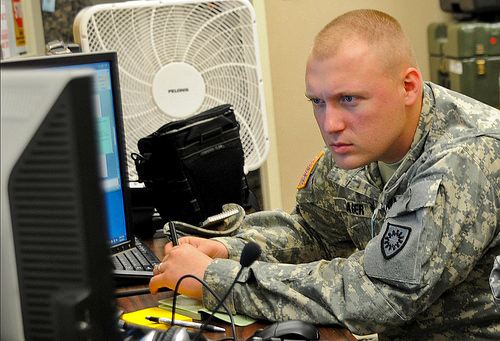
Second Lt. Bryan Sager II, intelligence officer with the 201st Engineer follows along during a briefing during the Warfighter Exercise 15-5, May 29- June 14, at Fort Hood Mission Command Training Center, Texas. During the exercise, Sager also acted as the Unit Public Affairs historian representative. (U.S. Army National Guard photo by Sgt. Brandy Mort)
The 2061st MRBC, is one of Kentucky’s newest units, so Lester said the WFX 15-5 was an opportunity for the Soldiers to understand their new role. The exercise joined together the 201st and other units from Kentucky’s 149th Maneuver Enhancement Brigade, and gave the Soldiers a first look at how the MRBC could be utilized in future contingency operations.
Warfighter exercises simulate realistic, complex scenarios that Army units must be prepared for. Like real world combat operations, they combine an array of forces from U.S. active duty, Reserve, National Guard and allied forces – in WFX 15-5, the Canadian Forces also played a role.
“The overall cooperation with the adjacent units that we’re dealing with both active, reserve, air force, multi-national components and civilian contractors, have all been a benefit to our Soldiers and our leaders moving forward,” said Lt. Col. Douglas Clay, battalion commander.
“What that is going to bring, is depth to our organization,” he said.
Clay said the restructuring of the 201st is a force multiplier not only for the National Guard in contingency operations, but also at home for disaster response. Exercises such as the WFX 15-5, test the battalion’s ability to quickly react to numerous scenarios, including building bridges to move troops and equipment from one area to another, something that would be of benefit to the Kentucky Guard during flooding seasons. Clay said he was proud of his Soldier’s success during this training exercise, even though it is the first major exercise for the battalion after its restructure.
“[Our Soldiers] may be uncomfortable operating at this level but they are going to take these skills and what they’ve learned here back to Kentucky and be able take that future operation and be able to plan and execute that to a higher extent,” he said.
The professionalism and ability to conduct a new mission to standard caught the eye of Maj. Gen. Lester Simpson, the 36th Infantry Division commander.
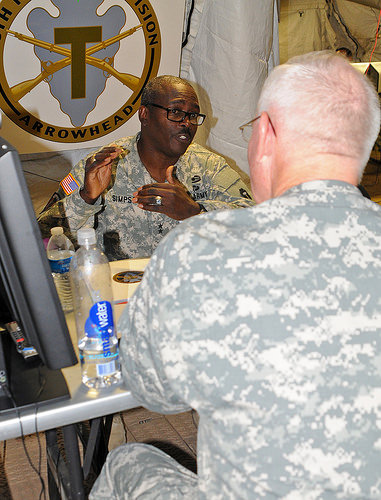
Maj. Gen. Lester Simpson, 36th Infantry Division Commander, discusses operating procedures during the Warfighter Exercise 15-5, May 29- June 14, at Fort Hood Mission Command Training Center, Texas. Simpson was very pleased with the Kentucky National Guard’s involvement with the exercise. (U.S. Army National Guard photo by Sgt. Brandy Mort)
Simpson said he was pleased with Clay and his troops’ abilities, and thanked Maj. Gen. Edward W. Tonini, adjutant general for Kentucky, for allowing the division to “utilize the 201st in such an important role.”
“The river crossing is a very key operation,” he said, “and without engineers to establish bridges we would not be able to have success and meet our training objectives.”
Simpson said the WFX is an important training tool both collectively and at the individual unit level.
“You have to work hard towards the training objectives and what you are going to get out of it,” he said. “Because if something happens and you are called up, this type of scenario helps you to work on the coordination efforts you need to be proficient at when you get there.”
Video by Spc. Cody Copper, 133rd MPAD
Story by Sgt. Brandy Mort, 133rd Mobile Public Affairs Detachment
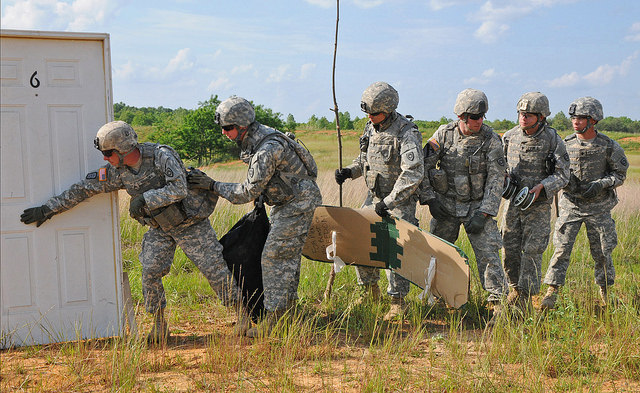
Soldiers of the 577th Sapper Company inspect a mobile door frame before attaching a silhouette charge during demolition training at Fort Knox, Ky., May 15, 2015. A silhouette charge provides a hole in a door so Soldiers can gain access into a building. (U.S. Army National Guard photo by Sgt. Brandy Mort)
FORT KNOX, Ky. – The terrain rumbled as pieces of a wooden door shot out in every direction. From the looks of the scene, you’d think a tornado had ravaged the area. Instead, it was a silhouette charge the 577th Sapper Company had attached during their demolition training.
Soldiers of the 201st Engineer Battalion, 577th Sapper Company, participated in standard demolition training at Fort Knox,Kentucky, May 15-16.
Capt. James Schmitz, 577th Sapper commander, said Sapper teams are essential for troops to advance through breached obstacles, such as a collapsed building, safely. He said this training helped when they deployed to Afghanistan in 2009.
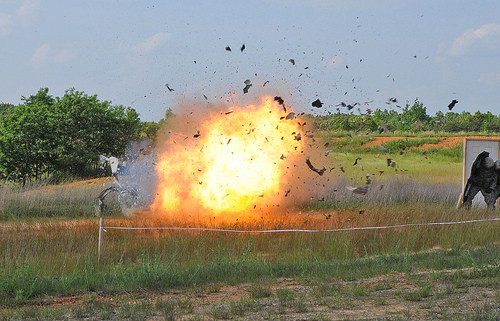
Soldiers of the 577th Sapper Company take cover during demolition training at Fort Knox, Ky., May 15-16, 2015. A C-4 charge blast takes 1.34 seconds after detonation. (U.S. Army National Guard photo by Sgt. Brandy Mort)
“Proper demolition training is very essential,” said Schmitz. “It is vital to get it right before we are tasked to do it in the future, whether it’s for our training exercise in Louisiana or a future deployment. We need to do it right, here, so we can do it right, there.”
Sgt. John Howard, Sapper non-commissioned officer, has 10 years experience in the engineers. It’s that experience, he said, that keeps the unit proficient. He said, each year leadership uses lessons learned to improve the training.
“When I was new I got vital training during this time and I use things I have learned through the years as I teach other junior enlisted to do the same,” he said.
Click here for more photos.
Traditionally Sappers are combat engineers who advance with the front-line infantry and are some of the first people sent to assess damages caused. Howard said training the younger Soldiers in their craft is similar to the role of the combat engineer sweeping the battlefield; they make sure the path is safe and clear before others go through.
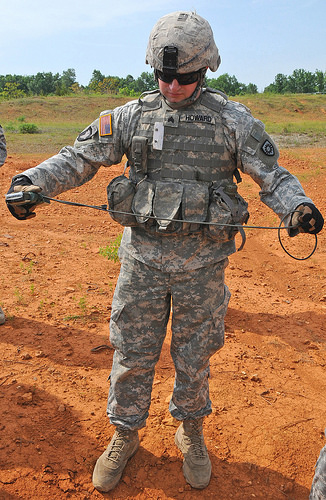
Sgt. John Howard, combat engineer with the 577th Sapper Company, unravels a C-4 charge during demolition training at Fort Knox, Ky., May 15-16, 2015. This year is Howard’s 10-year anniversary with the Kentucky National Guard’s 577th Sapper Company. (U.S. Army National Guard photo by Sgt. Brandy Mort)
“As a Sapper, we are the first people sent into the building to ensure the foundation is stable,” said Howard. “I use the same method as a platoon sergeant. If I don’t tell them the proper information, they won’t be able to be a strong foundation for their legacy.”
Staff Sgt. Aleksandr Vinogradov, a combat engineer, agrees that good leaders start from the beginning of their career.
“New Soldiers to the unit are like sponges,” said Vinogradov. “They will absorb anything you teach them. It is important to set a good example and train them the correct. We need to train for the future, not for the present.”
The team trained in various types of C-4 charges: A simulation charge, shape charges, Bangalore charges, urban breaching and mine clearing, also known as, MCLC. During urban breaching, they learned about linear door charges and silhouette charges. Sappers use what they learn in these scenarios for reforming the terrain for new structures, or to demolish existing structures.
“During urban breaching, we are able to see that different charges do different things,” said Howard. “A linear door charge will split a door in half, while a silhouette charge will create a hole in the door big enough for a person to walk through. If we don’t use the correct one in a non-training environment, we may be in trouble.”
Schmidtz said that safety and proficiency are two very important topics he focuses on at all times.
“My goal is to have everyone perform proficiently at their tasks and, most importantly, practice proper safety at all times. I have no doubt that my Soldiers will succeed in both aspects, whether in training exercises or in real-world scenarios.”
The Sapper Company is participating in this training in preparation for their annual training at the Joint Readiness Training Center in Fort Polk, Louisiana.
Photos by Staff Sgt. Scott Raymond, Kentucky National Guard Public Affairs Office
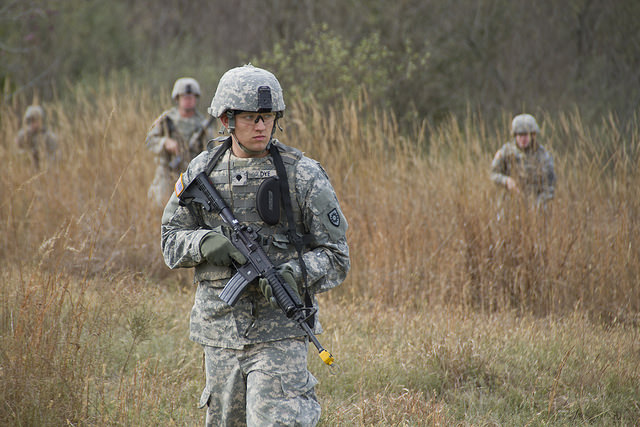
Spc. Cody Dye with the 201st Forward Support Company leads his platoon through a training exercise at the Wendell H. Ford Regional Training Center in Greenville, Ky., Nov. 4, 2014. (U.S. Army National Guard photo by Staff Sgt. Scott Raymond)
GREENVILLE, Ky. — Soldiers of the 201st Engineer Battalion extended a drill weekend to a whole week of training at the Wendell H. Ford Regional Training Center in Greenville, Nov. 1-7, 2014.
In order to focus the rest of the year on collective training events and engineering projects, the battalion travelled to Greenville to knock out annual requirements for Soldiers all in one period. According to Capt. Jonathan Gensley, Administration Officer for the battalion, the schedule not only benefits the units’ training, but the Soldiers’ personal lives as well.
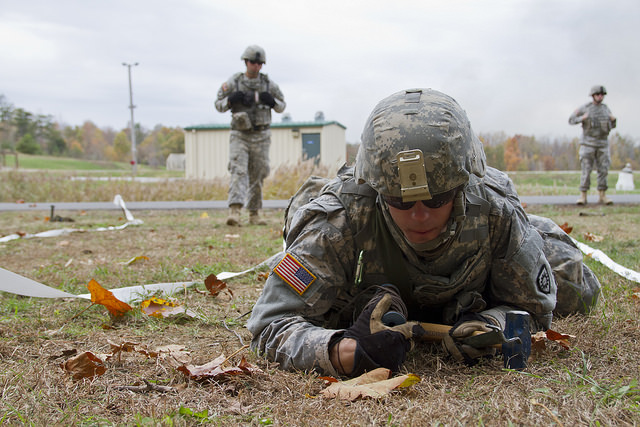
Pfc. Matthew Clay with the 577th Sapper Company low crawls to place a M18A1 Claymore mine during training at the Wendell H. Ford Regional Training Center in Greenville, Ky., Nov. 4, 2014. (U.S. Army National Guard photo by Staff Sgt. Scott Raymond)
“This extended drill allows Soldiers time off during major family-focused months of the year,” he said. “Consolidating several training events this week, we don’t drill in December, giving Soldiers more time off to be with their families during the holidays, nor do we drill in June, allowing time off for family summer vacations.”
Soldiers complete a wide variety of annual tasks, including their physical fitness test, personal health assessments and individual weapon qualifications. The week is also a chance to re-evaluate Soldiers in the required Army Warrior Tasks. Every Guardsman is expected to know the basics of Soldiering, and annually they are reminded of the tasks that may fall outside their military job.
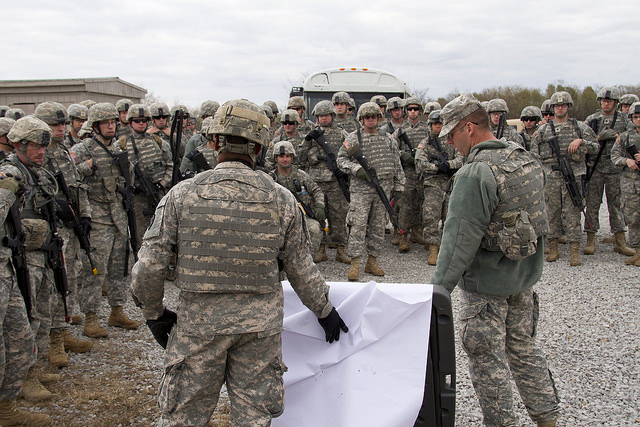
Soldiers of the 201st Engineer Battalion receive instruction on training exercises at the Wendell H. Ford Regional Training Center in Greenville, Ky., Nov. 4, 2014. (U.S. Army National Guard photo by Staff Sgt. Scott Raymond)
The 201st is made up of units spread out from from Ashland, Kentucky where it is headquartered, to Hazard, Kentucky and Cynthiana, Kentucky. With such a wide reach of units, the collective drill is a unique one for the battalion.
“This is the second year we have done this and simply, this long drill postures the 201st for success throughout the remainder of the year,” said Gensley.
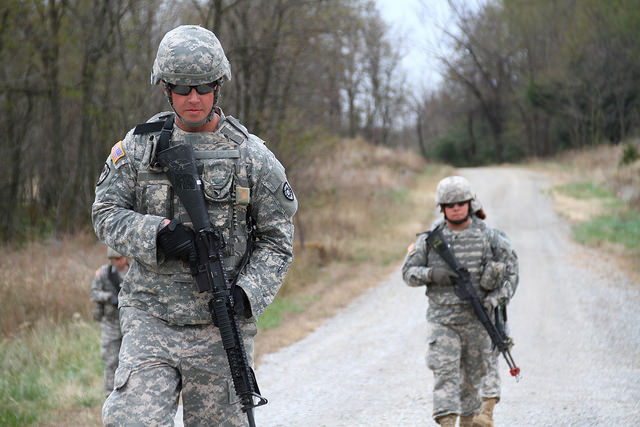
Soldiers with the 201st Engineer Battalion move through a training exercise at the Wendell H. Ford Regional Training Center in Greenville, Ky., Nov. 4, 2014. (U.S. Army National Guard photo by Staff Sgt. Scott Raymond)
For the engineers and the historical use of the battalion, little is unique to the Soldiers of the unit. Land navigation, security patrols and M18A1 Claymore training filled the Soldiers’ busy week.
Maj. John Barger, executive officer for the battalion said the Soldiers face long days during the week, but realize the benefits of their hard work. One important benefit Barger sees is the
“There’s such good interaction amongst the leadership of the unit, from the battalion commander to senior NCOs of subordinate units,” he said. “Its a rare opportunity for a mutual understanding of the commander’s intent and to foster quality leaders for the battalion’s future.”
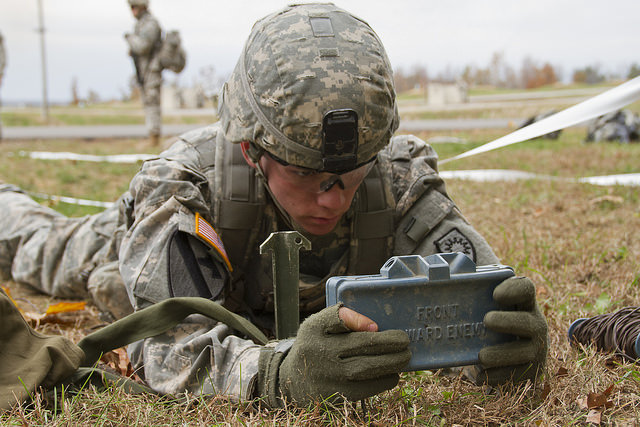
Spc. Jonathan Benham with the 577th Sapper Company places a M18A1 Claymore mine during training at the Wendell H. Ford Regional Training Center in Greenville, Ky., Nov. 4, 2014. (U.S. Army National Guard photo by Staff Sgt. Scott Raymond)
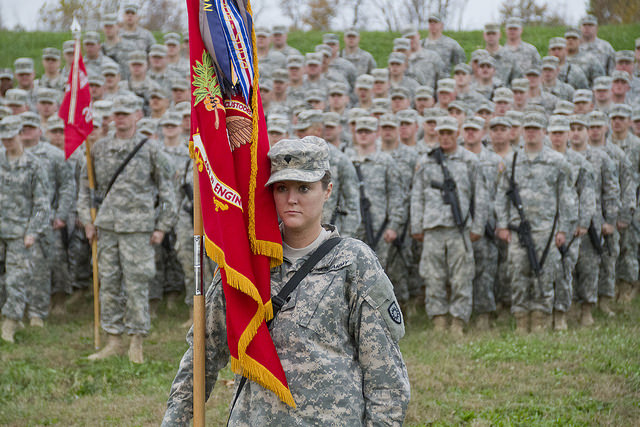
Spc. Caitlin Viera with the 201st Engineer Battalion holds the battalion colors during a formation at the Wendell H. Ford Regional Training Center in Greenville, Ky., Nov. 4, 2014. (U.S. Army National Guard photo by Staff Sgt. Scott Raymond)
Story by Staff Sgt. Scott Raymond, Kentucky National Guard Public Affairs
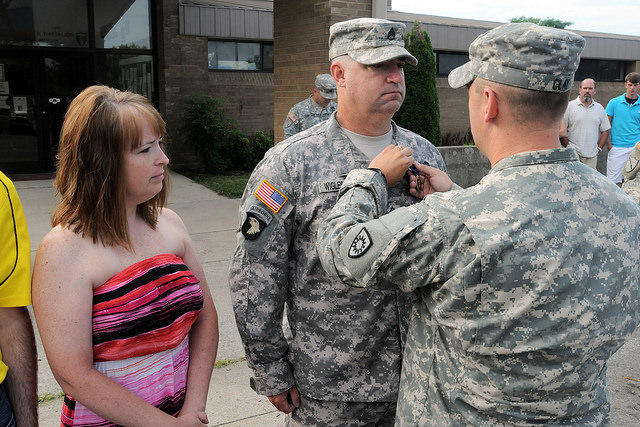
Lt. Col. Doug Clay pins the Purple Heart medal to the uniform of Staff Sgt. Andrew Wiglesworth during a ceremony in Cynthiana, Ky., July 12, 2014. Wiglesworth was injured when his vehicle struck an improvised explosive device in Afghanistan in 2009. (U.S. Army National Guard photo by Staff Sgt. Scott Raymond)
CYNTHIANA, Ky. — In January, 2009, Soldiers with Charlie Company, 201st Engineer Battalion were conducting route clearance patrols in eastern Afghanistan. Along Main Supply Route Alaska, truck Charlie 11 struck an improvised explosive device.
During a ceremony in Cynthiana, July 12, Staff Sgt. Andrew Wiglesworth received the Purple Heart for the injuries he sustained during the attack.
“This is a great feeling, I’m very honored first of all. I’m humbled and extremely proud to give my all in service to my country,” he said.
Click here to see more photos from the ceremony.
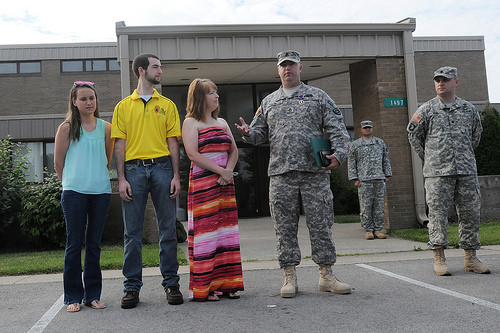
Staff Sgt. Andrew Wiglesworth, flanked by his wife and children, speaks to members of the 149th Vertical Construction Company after receiving the Purple Heart during a ceremony in Cynthiana, Ky., July 12, 2014. Wiglesworth thanked his family for their support through his two deployments including the one in 2009 where he was injured in an improvised explosive device attack in Afghanistan. (U.S. Army National Guard photo by Staff Sgt. Scott Raymond)
Wiglesworth was one of five Soldiers riding in the truck when it was hit. Both he and Spc. Todd Phillips were medically evacuated to Forward Operating Base Salerno and treated for their injuries.
Staff Sgt. Randy Morris was the truck’s commander on the mission and still serves with Wigelesworth, now with the 149th Vertical Construction Company. Morris said as the lead truck during missions, their vehicle was the first to encounter anything in the roads.
The deployment was a rough one for the engineers Morris recalled, as they were in Afghanistan during a surge of violence that saw a large increase in enemy activity and IED attacks. He said there a few Soldiers left in the unit from that deployment and that the award is good for the younger Soldiers to see, especially such a good leader like Wiglesworth.
“This is a great thing today for our unit, I’m really proud of him,” said Morris. “He’s a really good guy. No one deserves to get blown up, but I mean he definitely deserves this award.”
“It’s not that we think it’s funny, but we talk about it now and can bring a smile to our face, because we know we did the right thing and we did our job the right way so we all could come home.”
Wiglesworth agreed that the incident is not something they should think about all the time, but is glad to still have the same friends and Soldiers around him today.
“We reflect back on that day pretty often and we are extremely fortunate,” said Wiglesworth. “Our vehicle was blown in two, and we had injuries, but minor injuries. I guess the grace of God was with us that day.”
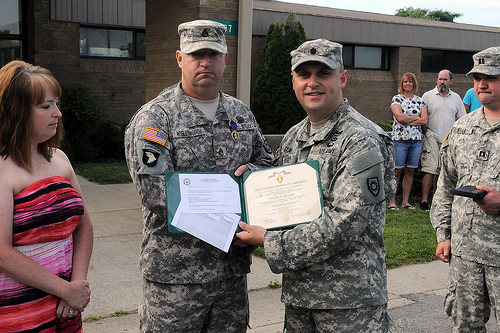
Lt. Col. Doug Clay, commander of the 201st Engineer Battalion presents Staff Sgt. Andrew Wiglesworth with the Purple Heart during a ceremony in Cynthiana, Ky., July 12, 2014. Clay called Wiglesworth an overall great person, Soldier and leader who embodies the Army Value of selfless service. (U.S. Army National Guard photo by Staff Sgt. Scott Raymond)
Lt. Col. Doug Clay, battalion commander of the 201st was on hand to present the award and called Wiglesworth a great overall person, Soldier and leader.
“It’s not everyday you get to award someone a Purple Heart,” he said. “This is such a proud organization here, a great company. One that’s just getting back from another deployment to Afghanistan, so that tells you something about him and his family. They embody the selfless service we always talk about.”
Wiglesworth has served in the Kentucky National Guard for seven years, all with the engineer battalion. He was previously an intelligence analyst for the active-duty Army from 1988-1994.
“I joined the National Guard in 2007 when I heard my hometown unit had been identified for deployment,” he said. “Even after a 13-year break in service, I felt as though I still had something to offer the military.”
Wiglesworth was awarded the Bronze Star and three Army Achievement Medals from the 149th’s recent deployment. He has lived in Cynthiana all his life outside his military service and is a lieutenant in the Cynthiana Fire Department.
Soldiers of the 201st deployed to Afghanistan in support of Operation Enduring Freedom in 2008. Before they returned home in 2009, they were credited with disposing of more than 200,000 land mines and IEDs. For their hard work and sacrifice, the 201st was awarded the Valorous Unit Award and the first Governor’s Outstanding Unit Citation.
Staff Report, photos courtesy of 201st Engineer Battalion
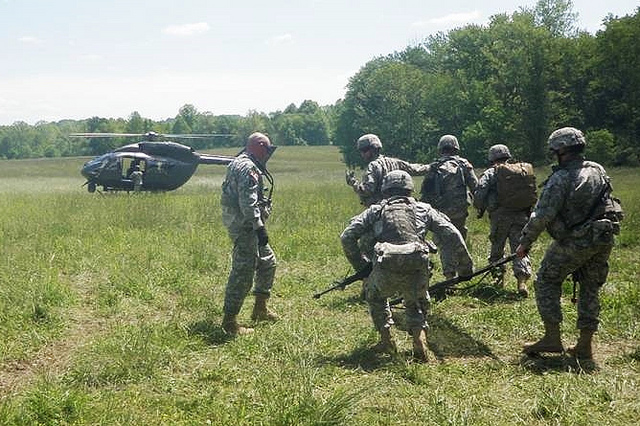
Soldiers of the 577th Sapper Company prepare to load a simulated casualty into a LUH-72 Lakota helicopter during annual training at the Harold L. Disney Training Center in Artemus, Ky., May 20, 2014. The engineer company is the Kentucky Guard’s primary emergency response force in extreme Eastern Kentucky. (Photo courtesy of 201st Engineer Battalion)
FRANKFORT, Ky. — Soldiers of the 201st Engineer Battalion were out in force for annual training this past May. More than 500 Guardsmen will have put their skills to the test at the conclusion of the training cycle in July. Across Eastern Kentucky, the engineers assembled to continue construction projects at Hidden Valley Training Site in Powell County, Kentucky and the Wendell H. Ford Regional Training Center out west in Greenville, Kentucky.
“The 201st is known as the Workhorse Battalion,” said Maj. John Barger, operations officer for the battalion. “We strive to conduct tough, realistic training in austere environments, and the 2014 training year has been no exception.”
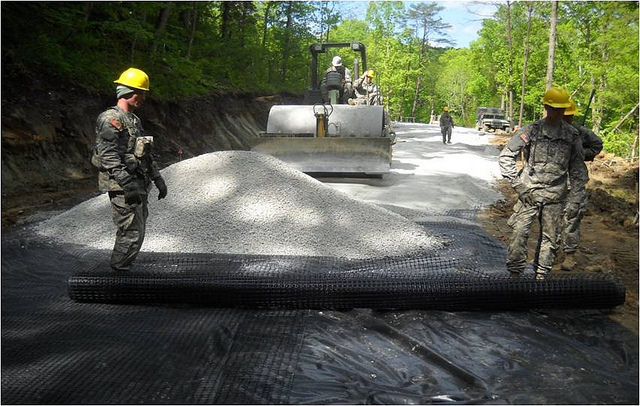
Soldiers of the 207th Horizontal Construction Company lay Geotextile Grid during road improvements at Hidden Valley Training Center in Powell County, Ky., May 2014. (Photo courtesy of 201st Engineer Battalion)
At Hidden Valley, road improvements were the primary tasks. Gravel was delivered by the 118th Haul Platoon and laid down by Soldiers with the 207th Horizontal Engineer Company. According to the units, this year’s work opened up hundreds of acres of the site to future training.
“We can’t give enough accolades to our Warhammer and Land Shark (207th and 118th) Soldiers,” said Staff Sgt. Adam Spencer, Training NCO, Det 1 207th and Squad Leader, 3rd Platoon, 207th. “They’ve worked so hard for the last two annual training periods on this road project…closing the loop on this road is one of the biggest successes achieved solely by our units.”
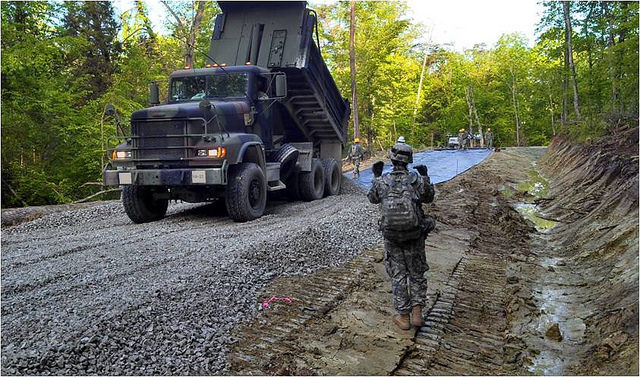
Soldiers with the 118th Haul Platoon unload gravel for road improvements at Hidden Valley Training Center in Powell County, Ky., May 22, 2014. (Photo courtesy of 201st Engineer Battalion)
In Southern Kentucky at the Harold L. Disney Training Site in Artemus, members of the 577th Sapper Company prepared for a scheduled three-week rotation at Fort Polk, Louisiana next year. The combat engineers conducted a variety of training exercises to improve their overall effectiveness as a unit.
“We have finally put it all together and working well as a team,” said Pvt. Gregory Bowen, a Soldiers new to the unit. “Our teamwork, communications, and even our marksmanship, all of it ties into one. It’s a lot of information to take in and it’s a lot of movements to bring together. It started off really slow, but by the end of it, we all finally came together as a team.”
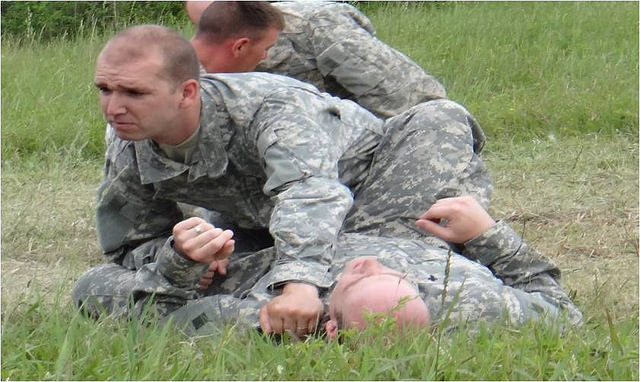
Spc. Brian Church practices a combatives move during annual training at Hidden Valley Training Center in Powell County, Ky., May 2014. (Photo courtesy of 201st Engineer Battalion)
Barger said the continued mission of the engineers in Eastern Kentucky to ensure they are ready for any response locally or nationally.
“The 201st has proven its worth in many local & national emergency response missions to include the West Liberty storm damage, Hurricane Katrina, and many other emergency response missions,” he said. “These projects have increased engineer experience with all manner of vertical & horizontal maintenance & construction, and increased our readiness to provide proficient engineer troop construction capabilities when called to support disaster & emergency response missions in our communities, the commonwealth, and region.”
Story by Staff Sgt. Scott Raymond, Kentucky National Guard Public Affairs
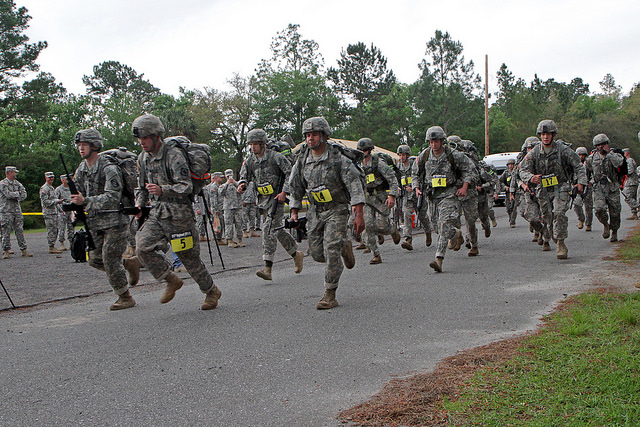
Sgt. Christopher DeLeon (#14) and Staff Sgt. Nicholas Anglin (#4) begin a six-mile road march as part of the 2014 National Guard Region III Best Warrior Competition at Camp Blanding, Fla., April 15, 2014. The two Guardsmen represented Kentucky amongst Soldiers from nine other states and territories. (U.S. Army National Guard photo by Staff Sgt. Scott Raymond)
CAMP BLANDING, Fla. — Kentucky’s Soldier and non-commissioned officer of the year competed with the top Guardsmen of the Southeast in the 2014 National Guard Region III Best Warrior Competition at Camp Blanding, Fla., April 14-17.
After winning the state competition last November, Staff Sgt. Nicholas Anglin of the 201st Engineer Battalion and Sgt. Christopher DeLeon from the 2123rd Transportation Company represented the commonwealth at the next level. The Kentuckians were pitted against other Guardsmen from states and territories in Region III of the National Guard (Alabama, Florida, Georgia, Mississippi, North Carolina, Puerto Rico, South Carolina, Tennessee and the Virgin Islands) in a four-day, event-filled contest, fitting of the “Best Warrior” title.
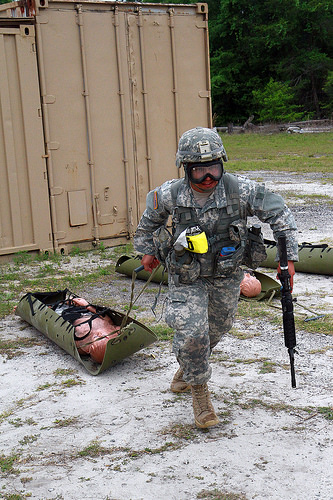
Sgt. Christopher DeLeon drags a simulated casualty during an urban operations exercise as part of the 2014 Region III Best Warrior Competition at Camp Blanding, Fla., April 14, 2014. The exercise tested the Soldiers’ skills in room clearing, use of grenades, casualty treatment and radio communication. (U.S. Army National Guard photo by Staff Sgt. Scott Raymond)
“This week has been exciting, it’s been stressful, uplifting, encouraging, just everything you think it would be,” said Anglin. “It pushes you to your limits and how far you can push yourself mentally and physically.”
Click here to see more photos from the competition.
Competitors were met with a grueling schedule of events kicking off before the sun rose to well into the evenings with few rest periods in between. Challenging events such a six-mile ruck march, air assault obstacle course and two-mile stress shoot were unique tasks mixed with the more practical Army physical fitness test and land navigation course. All part of a competition much different than the Soldiers won at the state-level.
Anglin said a highlight for him was running his fastest two-mile run time during the Army Physical Fitness Test, but said his favorite event was the stress shoot which combined endurance, skill and marksmanship, all over a diverse two-mile course.
“My most memorable moment is this feeling right now, that I survived the week,” he said. “I have a sense of pride knowing that I was able to accomplish these tasks and get through everything. I may not have been the best, but I finished and that is a sense of accomplishment for me.”
DeLeon agreed that the week was beneficial to him as a person and future leader of Soldiers. He enjoys more physical training, but said the best feeling was the relaxation of finishing.
“I feel like that was the most stressful week of my life,” he said. “I feel honored to represent the 2123rd and the whole state. I’d do it again, but I think another Soldier should experience this type of competition, and I’ll be back as a sponsor to train and guide them through it.”
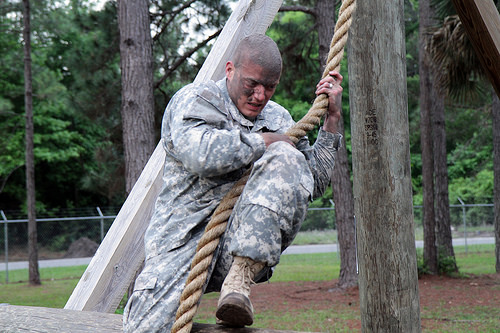
Staff Sgt. Nicholas Anglin balances on a rope swing of the air assault obstacle course during the Region III Best Warrior Competition at Camp Blanding, Fla., April 15, 2014. The obstacle course was part of a four-day event that brought the best Soldier and non-commissioned officer from each of the ten states and territories in the Southeast. (U.S. Army National Guard photo by Staff Sgt. Scott Raymond)
Anglin and DeLeon both were accompanied by a sponsor, another Soldier from their unit who acted as a battle buddy who helped them study and prepare for each event. Sgt. 1st Class David Adams and Sgt. James Ford were at Anglin and DeLeon’s side respectively, keeping them motivated throughout the week.
The competitors ruined a couple uniforms, slept little, lost a few pounds and learned a lot of what they are made of. They dusted off the dirt and covered the scratches and bruises with their Army Service Uniform for the culminating board appearances and banquet that wrapped up the week. Each competitor was congratulated by the state command sergeant major of each state and territory in attendance.
Command Sgt. Maj. Thomas Chumley, Kentucky’s State Command Sergeant Major travelled with the pair to Florida to help cheer them on.
While the trophies went to the top Soldiers, both from the Mississippi National Guard, Chumley was in awe of the Kentuckians every step of the way.
“These Soldiers have done outstanding, I’m proud of them,” said Chumley. “They went far beyond what I expected, they gave 110 percent.”
“I want them to know that their units, their sergeants major, their first sergeants ought to be proud of them, they represented Kentucky well.”
Story and photos by Staff Sgt. Paul Evans, KY ADT 4 Unit Public Affairs and Historian Representative
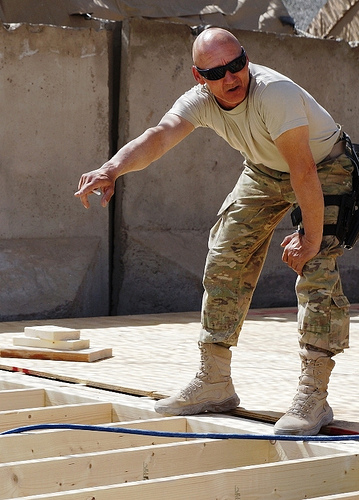
Spc. Michael Hilario, a member of the Kentucky National Guard’s Agribusiness Development Team 4 who resides in Lexington, Ky. looks over floor being built on May 3, 2012 in southern Afghanistan. Hilario was helping build hardened structures to make life more comfortable for ADT 4, and eventually ADT 5 as well. (U.S. Army photo by Staff Sgt. Paul Evans/Released)
FORWARD OPERATING BASE PASAB, Afghanistan— “No matter what we have to go through and the hard things we have to deal with, to be able to know that you’re here to help others, it’s a way of life just because it’s the way I was raised,” said Spc. Michael Hilario, a 47-year-old Virginia Beach, Va., native, who resides in Lexington, Ky. Hilario is currently deployed with the Kentucky National Guard’s Agribusiness Development Team 4 in Afghanistan.
Back in Kentucky, Hilario has served as an electrician with the Army National Guard’s 149th Vertical Engineering Detachment, 201st Engineer Battalion in Cynthiana, Ky. since joining the Guard after leaving the Navy Reserves in 2008. During his ten years with the Navy, Hilario deployed to Iraq twice as a SeaBee, spent two years active, earning the prestigious Seabee Combat Warfare device and Fleet Marine Force ribbon.
As a Seabee, Hilario was part of a Navy construction battalion from 1998 to 2008 that is well-known within the military for their ability to build just about anywhere in the world.
“I was active for right at two years. I was on the USS Kittyhawk for a little bit and the USS Antietam out west in California, (then) I was out of the service for a very short period of time and wanted to get back into the Seabees for my skills… I’ve been an electrician for over 18 years,” Hilario recalled.
“I’m a general contractor. That’s what I do best, so I got with the Seabees and went to Ramadi, Fallujah, Baghdad…we built airstrips, medevac hospitals, schools. It’s quite a good feeling to know you can go over and help people like that,” Hilario said.
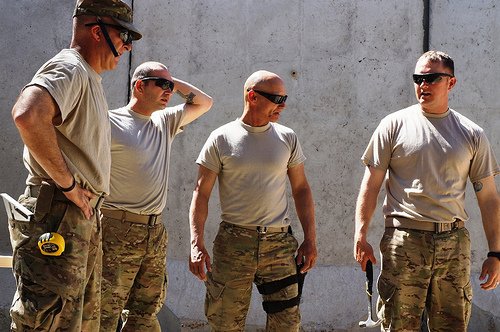
Pictured left to right: Master Sgt. John Black of Frankfort, Ky.; Spc. Russell Woosley of Smithfield, Ky.; Spc. Michael Hilario of Lexington, Ky.; and Staff Sgt. Mark Arnold of Harrodsburg, Ky. assess their next step constructing a building (not pictured) in southern Afghanistan on May 3, 2012. The four were helping build hardened structures to make life more comfortable for ADT 4, and eventually ADT 5 as well. (U.S. Army photo by Staff Sgt. Paul Evans/Released)
In Afghanistan, Hilario has put his past as a Seabee to good use by helping with ADT 4’s construction projects and serving as a liaison with the Seabees at FOB Pasab.
“Things that we’ve needed, I’ve been able to go over and obtain,” Hilario noted. “The things that they’ve needed, I’ve been able to help them as well. It’s brotherhood taking care of brotherhood here. It’s all family.”
“Just having prior service and knowing how when you get on the FOB, you’re very limited on resources. I guess just the Seabee experience that I’ve had… I’ve always been able to find a way to obtain some things, you know, anything that we need. Sometimes you’ve just got to look at the resources you have on the FOB and use everything you have,” Hilario explained.
“It’s helped our way of life here on FOB Pasab,” Hilario said. “That’s what it’s all about. I believe in helping others. That’s the way I was raised.”
“It’s pretty evident that he knows how to do electric work pretty good,” said Master Sgt. John Black, a 45-year-old Lawrenceburg, Ky. resident. Black works as a supervisor to Hilario on ADT 4’s ongoing construction projects. “He’s (also) a jack-of-all-trades.”
“My goal on this mission is… about helping others. I can help those that are less fortunate than I. That’s what it’s truly all about, that’s why I’m in the service now,” Hilario said.
“My dad’s a retired (Navy) Chief, my grandfather a retired (Navy) Master Chief, and on down the line,” he said. “To help others is not about myself. My goals of being are just to help others, that’s my personal goal. I wanted to be a part of the Agribusiness Development Team because I knew they were doing some good things here.”
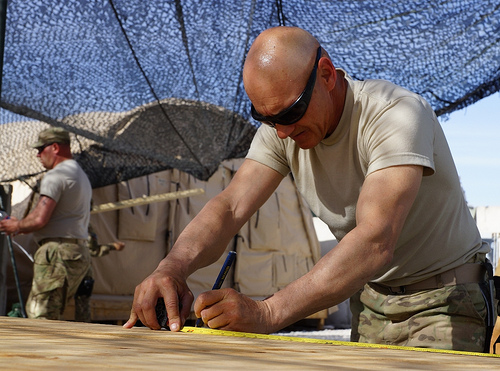
Spc. Michael Hilario, a member of the Kentucky National Guard’s Agribusiness Development Team 4 who resides in Lexington, Ky. measures wood before cutting it on May 3, 2012 in southern Afghanistan. Hilario was helping build hardened structures to make life more comfortable for ADT 4, and eventually ADT 5 as well. (U.S. Army photo by Staff Sgt. Paul Evans/Released)
Hilario has three children at home, two whom he says have learned to deal with him deploying.
“My oldest two, Britney, 21, Michael, 18, they’ve been through it a couple of times. They know it’s hard, but they’re military children,” Hilario said. “It’s gotten hard the first couple of times, but now they’re understanding how things are, what we’re here for, what we’re here to do, and they know this is part of daddy’s life as well as theirs.”
“The youngest, he’s getting ready to turn three, and he’s not really aware. I’m sure the video I sent him made him aware, let him know where dad’s going. He’ll look back on it in the years to come. We’ll sit down and we’ll talk about it too.”
“After Afghanistan, I’ll probably go home for a couple months and probably kind of a take it easy for a little bit. If they need me back, I’d go back again. I wouldn’t hesitate.”
“This is a family tradition here, and there’s no amount of money that can ever replace the feeling that you get when you’re able to help out people in your community and your country,” said Hilario. “There’s nothing like the feeling of going and helping people.”
Story and Photos by Sgt. Scott Raymond, Kentucky National Guard Public Affairs Office
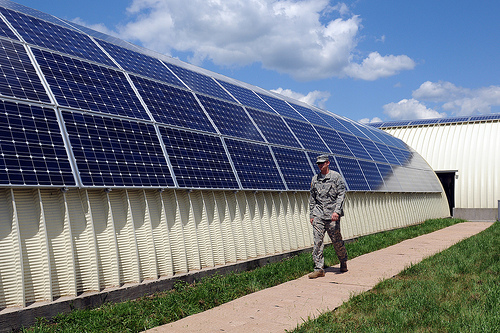
Sgt. Joseph Mattingly of Charlie Co., 1st Battalion, 376th Aviation walks between barrack buildings at the Harold L. Disney Training Center in Artemus, Ky., June 7, 2012. Solar panels installed on the buildings at the center are responsible for producing all the energy needed to power the buildings for use by units training at the site. (Kentucky National Guard photo by Sgt. Scott Raymond/Released)
ARTEMUS, Ky. — Nestled in the mountains of Eastern Kentucky, an array of blue, glass-like panel covered buildings sparkle in the afternoon sun. And the more the sun shines, the greater the benefit to the area. The panels harness the power of the sun and produce electricity for the Kentucky National Guard’s Harold L. Disney Training Center.
Located near Barbourville, Ky., the buildings at the site are unique and may even be considered an oddity as they sit in the middle of Kentucky’s coal country. But the 851 solar panels at the training center represent a positive impact the Guard is making for the Commonwealth and the environment.
The 550-plus acre training center is the first of its kind in the Kentucky National Guard to become a net-zero site. The term “net-zero” means that more energy is produced at a site than the site uses to sustain itself. Daily electrical operation of the Disney Training Center now comes from the skyward facing panels.
Along with the reduction of energy used, there is also a financial advantage for Kentucky. Capt. Joseph Sloan, Designs and Programs Manager for the Kentucky National Guard said the energy production could produce a surplus of energy, giving the Guard a credit toward their monthly energy costs.
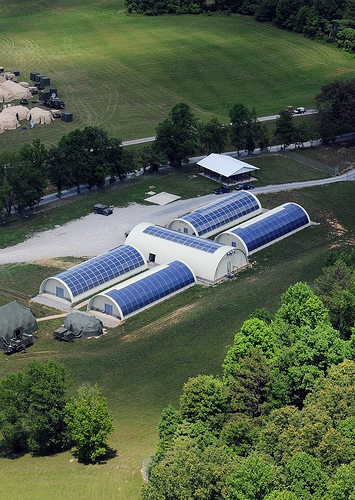
Aerial view of solar panels installed on the buildings of the Harold L. Disney Training Center in Artemus, Ky, June 7, 2012. The solar panel installation has effectively reduced the site’s energy usage to net-zero, meaning the site produces more energy than it uses. (Kentucky National Guard photo by Sgt. Scott Raymond/Released)
“We’re managing the budget, so this helps supplement the utility bill,” said Sloan. “But it’s also the right thing to do for the environment. It’s the responsible thing to do.”
According to the National Guard Bureau in Washington, D.C., Kentucky currently ranks first in the entire National Guard in energy reduction, and third in energy production.
Sloan said this achievement is not only because of the solar panel installation, but also in conjunction with an ongoing “energy audit”. Sloan and his office conduct this review in all armories and training sites in Kentucky.
“Everywhere, we’re checking windows, lighting, insulation and improving what we can, based on balancing the need and getting the greatest bang for the buck,” he said.
The usage of Disney Training Center dictated more buildings, and an opportunity for solar energy installation presented itself according to Sloan. Last year, for example, site officials said they accommodated more than 15,000 Soldiers, police officers, boy scouts and athletic teams for training.
Soldiers with Kentucky’s 201st Engineer Battalion constructed the buildings and the Guard partnered with Third Sun Solar, an Athens, Ohio based clean energy company, to install the panels.
Sloan said plans for more of the energy-absorbing panels are in the works, spreading the benefits through different regions of Kentucky. Installation is currently scheduled for the newest readiness centers, one recently completed in Owensboro, and the future site in Burlington, in Northern Kentucky. Work to add more panels also continues at Wendell H. Ford Regional Training Center in Greenville.
The solar panel additions will continue the Kentucky Guard’s effort to shrink its environmental footprint across the Commonwealth.
The Kentucky National Guard’s progress in solar energy recently attracted the attention of the international publication, Photon Magazine, who sent representatives to visit the state in June. Matthew Hirsch, associate editor with the San Francisco based magazine said the visit was part of a monthly series called PV (photovoltaic) Coast to Coast. Hirsch said the visit to the Bluegrass was enjoyable and a nice entry to their documentation of the solar market.
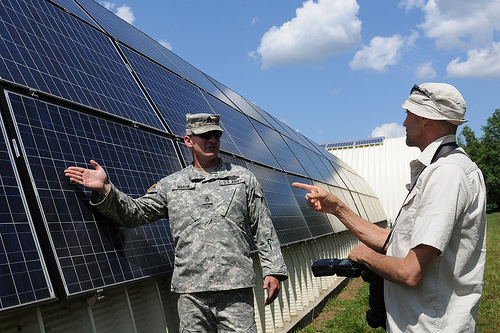
Sgt. 1st Class Chaz Martin, the non-commissioned officer in charge of the Harold L. Disney Training Center discusses solar panel installation at the site in Artemus, Ky., with a representative of Photon Magazine, June 7, 2012. Photon Magazine visited areas in Kentucky to collect information on solar energy efforts in the Commonwealth. (Kentucky National Guard photo by Sgt. Scott Raymond/Released)
“Our trip has been great,” he said. “We have met a lot of people here that are passionate, knowledgeable and interacting in growing solar energy.”
The fact that the Disney Center was the first net-zero site comes with some bragging rights in the Guard, but also the beginning of a consistency of clean energy used by Kentucky’s Citizen-Soldiers.
“This showcases us here in Artemus,” said Sgt. 1st Class Chaz Martin, non-commissioned officer in charge of training at the center. “National media even get to see that we are part of the Guard team here in Kentucky. We’re going green, saving energy and not costing the government as much.”
“This is a beautiful location, a place Soldiers have been coming to get their training since 1979,” said Martin. “And now that we are net-zero, we’re making that much bigger of an impact on the Kentucky Guard.”
Story and photos by Sgt. Sandra Fariss, 206th Engineer Battalion Unit Public Affairs Historian Representative
NOTE: Each week kentuckyguard.com publishes stories by or about Kentucky National Guard unit public affairs historian representatives, also known as UPAHRs. This is an additional duty taken on by a Soldier or Airmen with the intent of telling their unit’s story. This is one such story ….
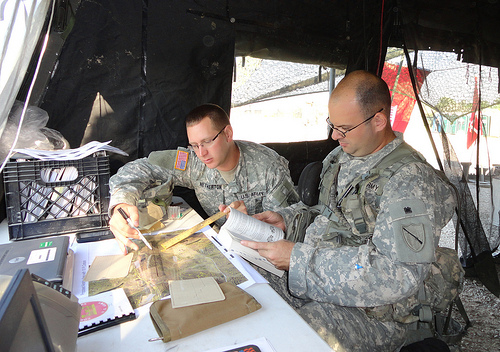
2nd Lt. Cory Netherton and Spc. Thomas Drury, both of the 206th Engineer Battalion, discuss cut and fill estimates for a recommended air strip during annual training, May 18, 2012, at Wendell H. Ford Regional Training Center in Greenville, Ky. (Photo by Sgt. Sandra Fariss, 206th Engineer Battalion Unit Public Affairs Historian Representative)
GREENVILLE, Ky. -For the first time in their history, the 206th Engineer Battalion, based in Owensboro, Ky., and the 201st Engineer Battalion from Ashland, Ky., joined forces at Wendell H. Ford Regional Training Center, Greenville, Ky., for their annual training May 12, 2012.
In a joint effort, Detachment 1, 149th Vertical Engineer Company from Olive Hill, Ky., assembled sea-huts; horizontal construction engineers of the 207th Horizontal Engineer Company from Hazard, Ky., and heavy equipment operators from Walton, Ky.’s 118th Haul Platoon moved dirt to build an access road and landing strip at the new Contingency Operations Location (COL) at Wendell H. Ford Regional Training Center.
To see more photos from this story, click here
Engineers of the 206th completed cut and fill estimates for a recommended air strip that will be expected to land military aircraft, potentially including Boeing C-17 Globemasters. If approved, the airstrip will be used for rapid strategic and tactical airlifts located near the new Contingency Operations Location.
Soldiers used the engineer field data manual to formulate calculations from topographic data at the proposed elevation located at the proposed air strip site.
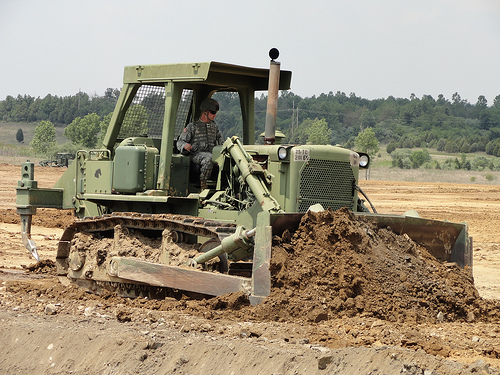
Spc. Donald Pace of the 207th Horizontal Engineer Company operates a D7 Dozer to move dirt in efforts to build a new Contingency Operations Location (COL) at Wendell H. Ford Regional Training Center in Greenville, Ky., during annual training, May 15, 2012. (Photo by Sgt. Sandra Fariss, 206th Engineer Battalion Unit Public Affairs Historian Representative)
“The mission is time consuming but the completed project will be beneficial to future operations and serve as a tremendous asset to this training area,” said 2nd Lt. Cory Netherton, combat engineer officer with the 206th.
The 206th and 201st also managed fuel operations and log pack exercise missions to the Contingency Operations Location at the Combat Training Command Post during annual training.
Battalion Commander Lt. Col. Dean R. Gosney of the 201st, said with excitement as he overlooked the project going on at the new Contingency Operations Location, “Great things are happening here and years from now these Soldiers will look back with pride and say, ‘I built that’!”