
Pages
Stay In Touch
More
© 2013 KentuckyGuard
Story by Sgt. Brandy Mort, 133rd Mobile Public Affairs Detachment
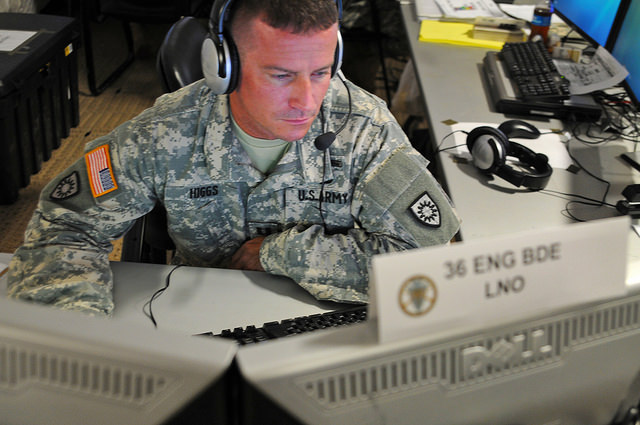
Capt. Sean Higgs, commander of the 2061st Multi-Role Bridge Company listens to a briefing during the Warfighter Exercise 15-5, May 29- June 14, at Fort Hood Mission Command Training Center, Texas. Higgs acted as a 36th Engineer Brigade’s liaison officer. (U.S. Army National Guard photo by Sgt. Brandy Mort)
FORT HOOD, Texas – If there is one thing that the Kentucky National Guard’s 201st Engineer Battalion knows, it’s how to build – whether it is a road, a bridge or a career. Although the Kentucky Guardsmen didn’t get dirty for their annual training, the battalion’s expertise was crucial to the Warfighter Exercise 15-5, May 29- June 14, at Fort Hood Mission Command Training Center, Texas.
“We are the main experts in bridging the gap,” said 1st Sgt. Aaron Lester, 2061st Multi-Role Bridge Company first sergeant.
“In this scenario, other countries depend on our troops and our Multi Role Bridge Company in order to properly maneuver across a wet gap crossing,” he said. “After the exercise, we will be able to take back what we learn and utilize the training in preparation for our company. It will be a very important contributor to our development. ”
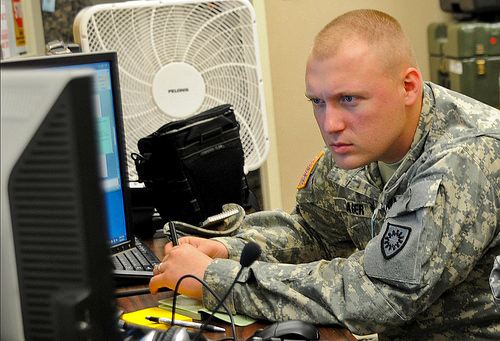
Second Lt. Bryan Sager II, intelligence officer with the 201st Engineer follows along during a briefing during the Warfighter Exercise 15-5, May 29- June 14, at Fort Hood Mission Command Training Center, Texas. During the exercise, Sager also acted as the Unit Public Affairs historian representative. (U.S. Army National Guard photo by Sgt. Brandy Mort)
The 2061st MRBC, is one of Kentucky’s newest units, so Lester said the WFX 15-5 was an opportunity for the Soldiers to understand their new role. The exercise joined together the 201st and other units from Kentucky’s 149th Maneuver Enhancement Brigade, and gave the Soldiers a first look at how the MRBC could be utilized in future contingency operations.
Warfighter exercises simulate realistic, complex scenarios that Army units must be prepared for. Like real world combat operations, they combine an array of forces from U.S. active duty, Reserve, National Guard and allied forces – in WFX 15-5, the Canadian Forces also played a role.
“The overall cooperation with the adjacent units that we’re dealing with both active, reserve, air force, multi-national components and civilian contractors, have all been a benefit to our Soldiers and our leaders moving forward,” said Lt. Col. Douglas Clay, battalion commander.
“What that is going to bring, is depth to our organization,” he said.
Clay said the restructuring of the 201st is a force multiplier not only for the National Guard in contingency operations, but also at home for disaster response. Exercises such as the WFX 15-5, test the battalion’s ability to quickly react to numerous scenarios, including building bridges to move troops and equipment from one area to another, something that would be of benefit to the Kentucky Guard during flooding seasons. Clay said he was proud of his Soldier’s success during this training exercise, even though it is the first major exercise for the battalion after its restructure.
“[Our Soldiers] may be uncomfortable operating at this level but they are going to take these skills and what they’ve learned here back to Kentucky and be able take that future operation and be able to plan and execute that to a higher extent,” he said.
The professionalism and ability to conduct a new mission to standard caught the eye of Maj. Gen. Lester Simpson, the 36th Infantry Division commander.
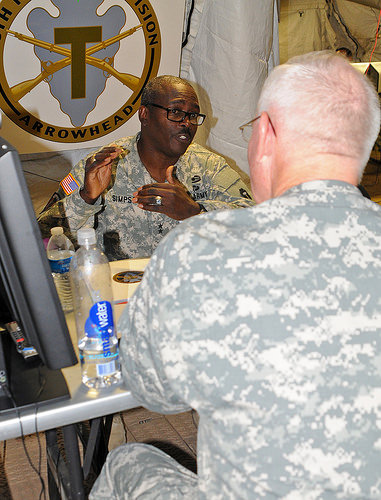
Maj. Gen. Lester Simpson, 36th Infantry Division Commander, discusses operating procedures during the Warfighter Exercise 15-5, May 29- June 14, at Fort Hood Mission Command Training Center, Texas. Simpson was very pleased with the Kentucky National Guard’s involvement with the exercise. (U.S. Army National Guard photo by Sgt. Brandy Mort)
Simpson said he was pleased with Clay and his troops’ abilities, and thanked Maj. Gen. Edward W. Tonini, adjutant general for Kentucky, for allowing the division to “utilize the 201st in such an important role.”
“The river crossing is a very key operation,” he said, “and without engineers to establish bridges we would not be able to have success and meet our training objectives.”
Simpson said the WFX is an important training tool both collectively and at the individual unit level.
“You have to work hard towards the training objectives and what you are going to get out of it,” he said. “Because if something happens and you are called up, this type of scenario helps you to work on the coordination efforts you need to be proficient at when you get there.”
Video by Spc. Cody Copper, 133rd MPAD
Story by Sgt. Kayla Benson, 96th Sustainment Brigade
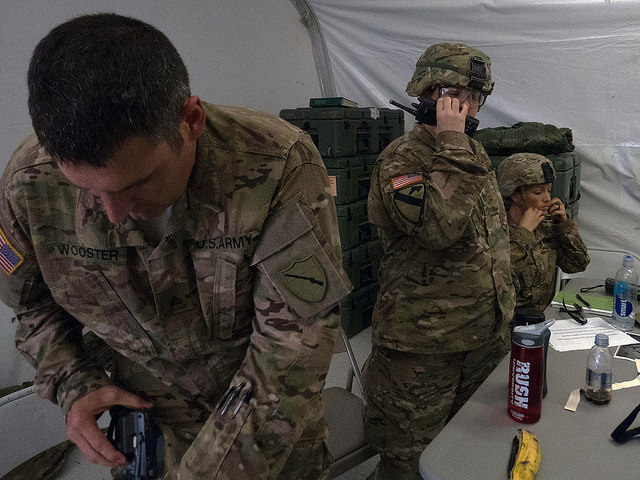
Staff Sgt. Becky Schneider, a combat medic with the 1163rd Area Support Medical Company, receives a simulated emergency call during a premobilization training exercise in North Fort Hood, Texas, May 30, 2015. The unit is scheduled to deploy to Afghanistan to work as an emergency response team. (U.S. Army photo by Sgt. Kayla F. Benson)
FORT HOOD, Texas — A female Soldier sits on a bench along the inside of a green Army ambulance. Even though it is mid-day, it is almost pitch black in the confined space of the ambulance.
Light from a small window between the front seat and the trunk silhouettes her enough to make out short blonde hair framing her round face. She is wearing an Army combat helmet, eye protection and has a large, red emergency response bag at her side.
Staff Sgt. Becky Schneider, with the Kentucky National Guard’s 1163rd Area Support Medical Company, has been a combat medic for over seven years.
She calls up to the driver, a fellow medic, through the small window. They go back and forth, discussing possible injuries and best practices before the vehicle comes to an abrupt stop. The back door opens and she is on the ground and assessing the scene in only seconds.
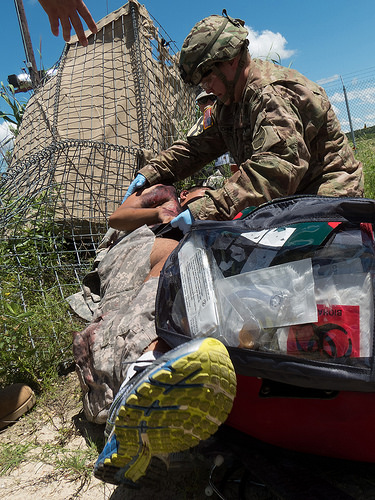
Staff Sgt. Becky Schneider, a combat medic with the 1163rd ASMC, evaluates and treats a simulated casualty during a pre-mobilization training exercise at North Fort Hood May 30. The unit is scheduled to deploy to Afghanistan in support of contingency operations and will work as an emergency response team. (U.S. Army photo by Sgt. Kayla F. Benson)
Schneider and her team member, Sgt. Duncan Wooster, also a combat medic with the 1163rd ASMC, were participating in a pre-mobilization training exercise here, May 30, in preparation for an upcoming deployment to Afghanistan.
The team received its order: load into the ambulances and treat role players as if they were real-world casualties.
“It’s hectic and it’s crazy and you kind of come out at the end of it like, ‘I just forgot to breath for 40 minutes,’” Schneider said.
After assessing the scene, Schneider quickly approaches a role player on the ground with simulated burns and possible shrapnel wounds, surrounded by tall grass and a coiled metal fence. Wooster rushes to another role player with similar injuries underneath an observation tower. They call back up to address additional casualties.
“It’s problem solving,” She explained. “At the end of the day, you’re helping people and that’s what I really like to do. I like the puzzle of, ‘How do I put this back together again?’”
The scene is chaotic and loud. Several role players surround the medics, attempting to use their medical gear and bombarding them with questions.
Backup arrives and the casualties are moved onto stretchers and into the ambulances. Schneider jumps back into the ambulance next to her patients. As they speed back to the emergency response treatment area, she continues to assess and care for the two Soldiers on either side of her, pulling various medical gear from the many pockets of her bag and verbalizing each action.
Moments later, the ambulance stops: end exercise. She removes her helmet to reveal hair drenched in sweat. Once deployed, this scenario would only make up one hour of her 24-hour shift.
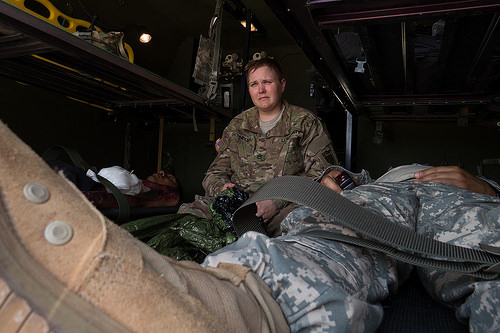
Staff Sgt. Becky Schneider, a combat medic with the 1163rd Area Support Medical Company, receives feedback from an Observer Coach/Trainer after a premobilization training exercise in North Fort Hood, Texas, May 30, 2015. The unit is scheduled to deploy to Afghanistan to work as an emergency response team. (U.S. Army photo by Sgt. Kayla F. Benson)
“The training itself had very realistic patients, very realistic situations,” Schneider said. “It gives me a very real understanding of, ‘OK, in a 24-hour shift what am I going to have to do? How can I better take care of my people?’”
Her face looks tired and she allows her shoulders to sink a little as she listens to feedback from the observer coach/trainer regarding her team’s actions in the day’s exercise. Overall, her team did well and the event was a success.
“You’re constantly evolving, constantly learning, trying to build on every single run you make,” Schneider said. “You’re always trying to get just a little bit better.”
Story and photos by Spc. Matthew Dornbusch, 1204th Aviation Support Battalion
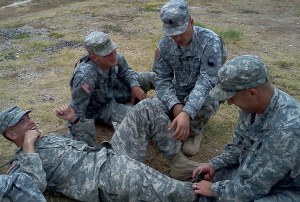
Spc. Adam Stoppplewerth (right) teaches how to make an improvised tourniquet using a cravat and a stick on Pvt. Brian Hall while Staff Sgt. Dennis Deatly supervises. (photo by Spc. Matthew Dornbusch, 1204th Aviation Support Battalion)
FORT HOOD, Tx. – Before deploying in support of Operation New Dawn members of the Kentucky Army National Guard’s 1204th Aviation Support Battalion received some very special training.
A combat lifesaver is a non-medical Soldier trained to provide advanced first aid and lifesaving procedures beyond the level of self-aid or buddy-aid. This definition however doesn’t stress the importance of these Soldiers’ new role.
“The combat lifesaver is one of the most important soldiers on the battlefield today, as they are typically the first soldiers to respond to casualties,” said 1st Lt. Robert White, 1204th Aviation Support Battalion physician assistant.
The combat lifesaver course — taught to the 1204th troops at Fort Hood, Tx., Oct. 8-9 — included a wide range of techniques ranging from how to control bleeding with tourniquets to moving a casualty without causing further damage.
Sgt. Jon Krull demonstrates how to apply and properly place a tourniquet on the arm of Spc. Marcus Evans during a combat lifesaver course at Fort Hood, Tx. (Photo by Spc. Matthew Dornbusch, 1204th Aviation Support Battalion)
“The right medical intervention at the right time is how medics save lives. Treatment with tourniquets to stop major bleeding from extremities has reduced the number of preventable deaths significantly,” said Sgt. Jon Krull. “Teaching the combat lifesaver students the correct steps will help sustain the casualty until they can receive proper medical treatment.”
“It is vital that combat lifesavers know how to treat the four most common preventable causes of death on the battlefield today, bleeding, tension pneumothorax, airway complications, and hypothermia,” said Staff Sgt. Dennis Deatly, the battalion’s treatment non-commissioned officer.
Combat lifesavers can be the link between life and death. Medics can’t always be present, a fact that the Army has come to realize. Combat lifesaver training is unique, proficient, and yields results.
keh
Story by Capt. Stephen Martin, Kentucky National Guard Public Affairs
Photos by Maj. Ben Singleton, 63rd Theater Aviation Brigade Public Affairs Officer
See more pictures of the ceremony at: Click here for more photos

INDEPENDENCE, Ky--Friends and family cheer on Kentucky's 1204th Combat Aviation Battalion as they prepare to deploy to Iraq in support of Operation New Dawn.
INDEPENDENCE, Ky. — The Kentucky National Guard honored the 1204th Aviation Support Battalion with a departure ceremony as they left for Iraq today from the Northern Kentucky University Campus in Highland Heights, Ky.
“Our morale is very high,” said Command Sgt. Major Tim Walton. “We’ve been training for this day since December of 2009 and we’re ready to go accomplish this mission.”
Based in Independence, Ky., the 1204th ASB will provide logistical, maintenance and signal support for the 29th combat aviation brigade in support of Operation New Dawn, the U.S. Forces withdrawal from Iraq.
Spc. Matt Dornbusch, who’s been in the Kentucky Guard since 2007, has been supporting the unit in a full-time capacity for the last 18 months, helping to prepare the Soldiers for the deployment.
“I’m eager to finally get to do the mission we’ve worked so hard to prepare for,” said Dornbusch. “My wife is sad and excited for me at the same time.”
Dornbusch and his wife Katie Elizabeth got married less than a month ago and plan on taking their honeymoon after the deployment.
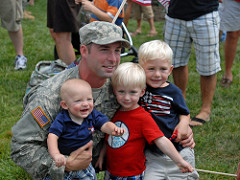
INDEPENDENCE, Ky--A Soldier from the 1204th Aviation hugs his kids goodbye at the departure ceremony.
Katie also has a brother, Spc. Adam Stoppelwerth, who will deploy with the 1204th as well.
The 1204th is made up of nearly 600 Soldiers from Kentucky, Alabama, Florida and Maryland, with approximately 325 from the Commonwealth.
The unit reports to Fort Hood, Tx. for an additional four to six weeks of training prior to departing the country.
Lt. Col. Tom Roach is the battalion commander for the 1204th ASB and has prepared the unit for their task ahead.
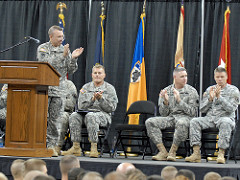
INDEPENDENCE, Ky--Lt. Col. Tom Roach, commander of Kentucky's 1204th Aviation Battalion, asks attendees at the departure ceremony to applaud the families and supporters of the Soldiers.
“It’s an uncertain environment right now in Iraq,” said Lt. Col. Roach, “but one of the great things about our robust, flexible organization is that we’re ready and adaptable to do our job where ever we’re asked to serve.”
Since 9/11, nearly 14,000 Kentucky National Guard Soldiers and Airmen have deployed in support of the Global War on Terror. The Kentucky National Guard currently has more than 1,450 troops deployed worldwide.
See more pictures of the ceremony at: Click here for more photos
