Pages
Stay In Touch
More
© 2013 KentuckyGuard
Story by Staff Sgt. Scott Raymond, 133rd Mobile Public Affairs Detachment
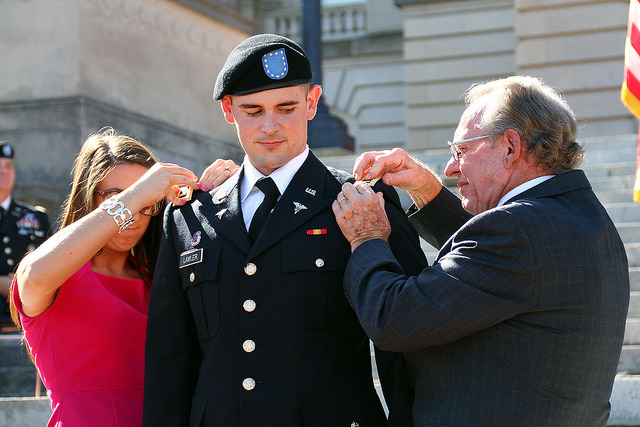
Second Lt. Dakota Lawler is pinned by his fiancee, Ashley Holley and grandfather, Neil Lawler during a commissioning ceremony in Frankfort, Ky., Sept. 27, 2014. Lawler and 15 other Soldiers were commissioned as the newest officers in the Kentucky Guard, while 14 other Guardsmen were honored as recent graduates as the newest warrant officers. (U.S. Army National Guard photo by Staff Sgt. Scott Raymond)
FRANKFORT, Ky. – Eyes of the Kentucky National Guard were focused on 30 individual Soldiers who became the Commonwealth’s newest commissioned officers during a ceremony on the Capitol steps, Sept. 27.
After completing a rigorous 18-month training program with Kentucky’s Officer Candidate School, including a final phase at Fort McClellan, Alabama, 16 Guardsmen earned their second lieutenant gold bars and swore in as commissioned officers.
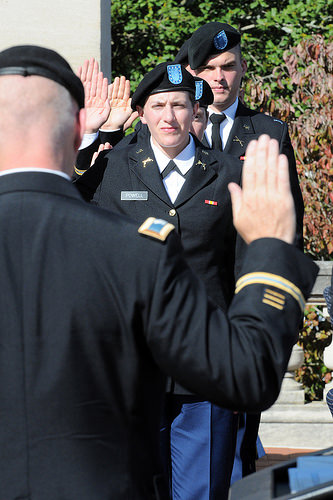
Second Lt. Sarah Powell is given the oath of office by Col. Hal Lamberton during a commissioning ceremony for the newest officers in the Kentucky Guard. Powell enlisted into the Guard in 2013 and will become a platoon leader with the 940th Military Police Company. (U.S. Army National guard photo by Staff Sgt. Scott Raymond)
The remaining 14 Soldiers were recognized after their recent graduation as warrant officers. Kentucky’s Warrant Officer Candidate School is a five-month program that has produced technical experts for the Kentucky Guard since 2011.
Click here for more photos from the ceremony.
Kentucky’s newest officers’ experience spans from decades of enlisted service to just a few short months wearing the uniform. Warrant Officer Stephen Plouvier from Hodgenville, Kentucky entered the military in 1985, while Fort Thomas, Kentucky-native, 2nd Lt. Sarah Powell enlisted in 2012.
Regardless of their time in service, the new leaders said their role leading Citizen-Soldiers of the Commonwealth is a challenge they are up to accepting.
“This was the next step for me to continue serving, I enjoy serving the Kentucky Guard,” said Plouvier, who felt he had progressed as far as he could as an enlisted Soldier. “Becoming a warrant was the best choice for my personal growth, to become that technical expert and to mentor young Soldiers and non-commissioned officers.”
For others such as Powell, personal growth started with raising her hand to join the Kentucky National Guard, and the commitment she made herself to get to where she is today.
“I worked really hard to prove that I could overcome obstacles and to challenge myself to become a better person,” said Powell.
Maj. Gen. Edward W. Tonini, adjutant general for Kentucky presided over the event held at the state capitol. Tonini congratulated the Soldiers and expressed his pride in which he called the “ready, reliable and accessible leaders of the future.”
“My charge to you is to lead our Guard forces with the resilience, the patience, the passion and the fervor you have shown to get you to this point,” said Tonini. “You are ready, now do it. You are our future.”
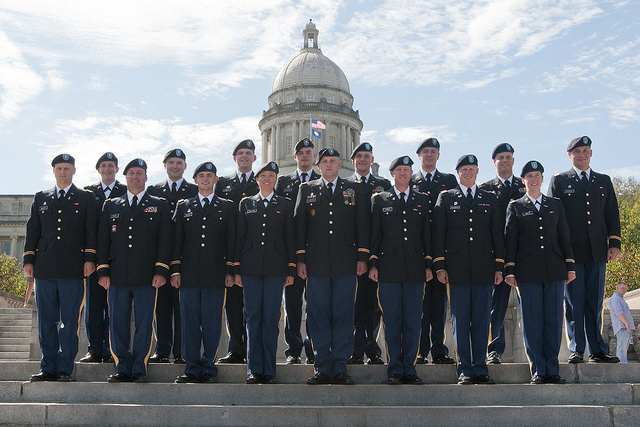
The newly commissioned officers of Officer Candidate School Class 56-14. (U.S. Army National Guard photo by Staff Sgt. Scott Raymond)
The newly commissioned officers of class 56-14 included:
2nd Lt. Seth Ryan Frost (Mount Juliet, Tenn.) – Kentucky National Guard Training Center
2nd Lt. Zachary Joel Hahn (Lexington, Ky.) – 103rd Brigade Support Battalion
2nd Lt. Thomas D. Hobbs (Hardinsburg, Ky.) – 1st Battalion, 149th Infantry
2nd Lt. David B. Holobaugh (Louisville, Ky.) – 1123rd Engineer Company
2nd Lt. David Douglas Keeven (Versailles, Ky.) – 103rd Brigade Support Battalion
2nd Lt. Taylor Curtis Carter Landsdale (Mt. Sterling, Ky.) – 2nd Battalion, 138th Field Artillery
2nd Lt. Dakota Neil Lawler (Paducah, Ky.) – 63rd Theater Aviation Brigade
2nd Lt. Cassandra Jo Mullins (Hindman, Ky.) – 149th Signal Company
2nd Lt. Bradley Michael Osbourne (Louisville, Ky.) – 2nd Battalion, 138th Field Artillery
2nd Lt. Christopher T. Porter (Morgantown, Ky.) – 149th Brigade Support Battalion
2nd Lt. Sarah Ashley Powell (Fort Thomas, Ky.) – 940th Military Police Company
2nd Lt. Hope Alexa Smith (Lexington, Ky.) – Bravo Company, 351st Aviation
2nd Lt. Sebastian Harrison Stanley (Glasgow, Ky.) – 1st Battalion, 149th Infantry
2nd Lt. Constantine Joseph Sztendera (Campbellsville, Ky.) – 299th Chemical Company
2nd Lt. Joseph Lynn Tucker (Frankfort, Ky.) – 2nd Battalion, 138th Field Artillery
2nd Lt. Andrew McDaniel Wilson (Lexington, Ky.) – 1204th Aviation Support Battalion
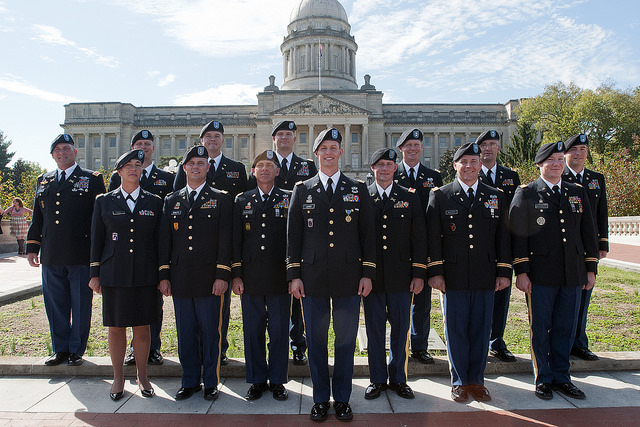
The newly graduated warrant officers of Warrant Officer Candidate School Class 14-001. (U.S. Army National Guard photo by Staff Sgt. Scott Raymond)
The newly commissioned warrant officers of class 14-001 included:
Warrant Officer Jonathan Marcus Bailey (Lexington, Ky.)
Warrant Officer David Benjamin Chandler (Radcliff, Ky.)
Warrant Officer William Martin Cottrell (Louisville, Ky.)
Warrant Officer Brandon Wade DeArmond (Penrod, Ky.)
Warrant Officer Dustin Cade Lewis (Mount Washington, Ky.)
Warrant Officer Jessica Ann Peel (Harrodsburg, Ky.)
Warrant Officer Stephen Edward Plouvier (Hodgenville, Ky.)
Warrant Officer Orbin Scott Rudd (Frenchburg, Ky.)
Warrant Officer Robert Wayne Sewell (Verona, Ky.)
Warrant Officer Jeffrey T. Valentine (Barbourville, Ky.)
Warrant Officer Matthew Daniel Vincent (Owensboro, Ky.)
Warrant Officer Ronald James Wamsley (Denver, Colo.)
Warrant Officer Lawrence Shannon Webb (Louisville, Ky.)
Warrant Officer Jess Marius Willard (Portland, Tenn.)
Story by 2nd Lt. James W. Killen, 123rd Airlift Wing Public Affairs
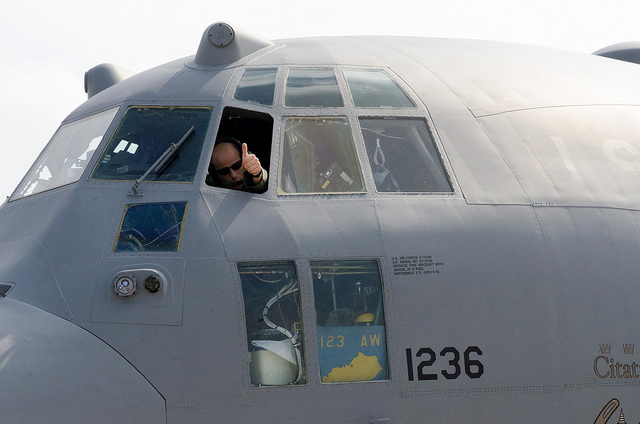
Air Force Lt. Col. Charles Hans, an aircraft commander with the Kentucky Air National Guard’s 123rd Airlift Wing, communicates with ground crews from the cockpit of his C-130 Hercules aircraft after returning from an airdrop mission in the Baltic region on Sept. 8, 2014, during Operation Saber Junction. The 123rd participated in the training exercise along with five other Air Guard units and troops from 17 NATO countries. (U.S. Air National Guard photo by 2nd Lt. James W. Killen)
RAMSTEIN AIR BASE, GERMANY — Airmen from the Kentucky Air National Guard’s 123rd Airlift Wing successfully completed two NATO training exercises here Sept. 10, moving more than 107 tons of cargo and 300 passengers aboard two Kentucky C-130 aircraft as part of Operations Saber Junction and Steadfast Javelin II.
The 123rd joined with five other Air Guard units to play a key role in the exercises, which were designed to enhance the security of Eastern Europe, according to Col. Robert E. Culcasi, a Delaware Air National Guardsman who served as commander of the Air Guard contingent.
“Ask any one of the Army folk, (and they’ll tell you) it is the Air National Guard that provided the aircraft in order to get this mission done,” Culcasi said. “If they did not have Air National Guard assets on station, they would not have been able to conduct the air drops or the follow-on land missions that were scheduled for the exercise.”
The 123rd completed 19 missions, flying NATO troops and cargo more than 23,000 miles while maintaining high aircraft capability rates, according to Lt. Col. Charles Hans, an aircraft commander and chief of training for Kentucky’s 165th Airlift Squadron.
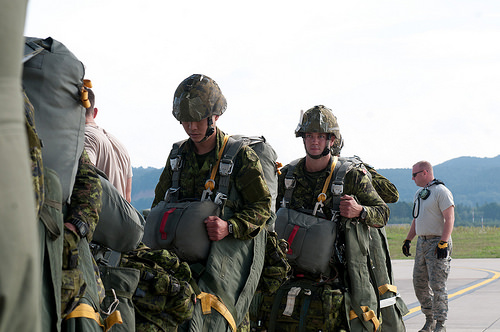
Air Force Tech. Sgt. Matthew Killen (right), a crew chief with the Kentucky Air National Guard’s 123rd Airlift Wing, performs a final debris check before a Kentucky C-130 Hercules takes off from Ramstein Air Base, Germany, on Sept. 5, 2014, carrying NATO paratroopers in support of Operation Saber Junction. The 123rd participated in the training exercise along with five other Air Guard units and troops from 17 NATO countries. (U.S. Air National Guard photo by 2nd Lt. James W. Killen)
“Our C-130Hs performed admirably under the quick-turn conditions and the minimum number of maintainers we brought,” Hans said. “That was a testament to our maintenance program and the dedication of our maintainers, who worked a 24-hour operation with a crew meant for 12-hour operations.”
The maintenance crew, composed of nine Airmen from the 123rd Aircraft Maintenance Squadron, worked long hours over the course of the exercise to keep the planes flying, said Chief Master Sgt. Jeff Brown, the senior enlisted crewmember and loadmaster supervisor.
“Once again maintenance and operations came together to ensure this NATO exercise was a success,” he said. “With multiple units and countries participating, there were a lot of obstacles to overcome, but the dedication and professionalism of the 123rd Airlift Wing provided us a safe and successful exercise.”
In addition to the maintenance effort, aircrews from the 123rd performed at an exceptional level, according Lt. Col. Catherine Newell, aircraft commander for the 165th Airlift Squadron.
“This was a great experience for our aircrews, scaling up from our small, single-unit, local training formations to a multi-unit, international formation,” Newell said. “We had a number of aircrew members who had never participated in either the planning or execution of a mission this size, and it was gratifying to them to realize that they had all the tools they needed to succeed.”
Newell said the exercise was an outstanding opportunity for the Kentucky Air Guard because it added a healthy dose of realism to the unit’s routine training regimen.
“The 123rd flew large formations with other Guard units through four different countries and airdropped troops from three different nations on an unfamiliar drop-zone at night,” Newell said. “Everyone felt a fair amount of pressure given the international scope of the mission.”
Operations Saber Junction and Steadfast Javelin II were conducted as part of Operation Atlantic Resolve, a joint commitment of NATO allies to the security of Eastern Europe. The exercises were designed to prepare U.S. troops, NATO Allies and European security partners to conduct joint, offensive, defensive and stabilization operations, and to sustain cooperative efforts with partner nations.
The Kentucky Air Guard deployed more than 20 Airmen for the exercises, which began Aug. 31.
The Kentucky National Guard Public Affairs Office is posting a three-part series regarding Kentucky’s ESGR program and the opportunities it helps create for Kentucky Guardsmen and fellow veterans.
Staff Report
FRANKFORT, Ky. — Employer Support of the Guard and Reserve (ESGR) is the lead Defense Department agency promoting cooperation and understanding between civilian employers and their National Guard and Reserve employees.
Kentucky’s ESGR seeks career opportunities to unite employers with Service members throughout the Commonweath.
Upcoming Career Events in October include:
Manufacturer and Employee of the Year Awards Luncheon
When: October 3, 2014 — 11:30 a.m. – 1:30 p.m. Where: The Seelbach Hilton, Louisville
Speakers: Lt. Governor Jerry Abramson, Mayor Greg Fischer 16 Oct Military to Manufactures luncheon
Military to Manufacturing: Get Skills to Work in Kentucky
When: October 16, 2014
Where: Gateway Community & Technical College Convening Center, Boone Campus, Florence
Speakers: Heather French Henry, Commissioner, Kentucky Department of Veterans Affairs, Major General (Retired) D. Allen Youngman
Co-presented by KAM, the Employer Support of the Guard and Reserve and Gateway Community & Technical College, this extended luncheon event focuses on our military veterans rising to fulfill the needs of manufacturers who have opportunities for engineers, managers, and production careers. This disciplined, mature and “work-ready” workforce is a natural solution to having an ample talent pipeline for the future.
Click here for more information regarding manufacturing career opportunities and venues.
Established in 1972, ESGR operates within the Office of the Assistant Secretary of Defense for Reserve Affairs. The agency’s responsibilities fall into three categories: Increasing awareness of the Uniformed Services Employment and Reemployment Rights Act, recognizing outstanding support of employers for their Guard and Reserve employees, and resolving workplace conflict through mediation.
ESGR seeks to foster a culture in which all employers support and value the employment and military service of members of the National Guard and Reserve. For more information about ESGR, go to: http://www.esgr.mil.
Story by David Altom, Kentucky National Guard Public Affairs
FRANKFORT, Ky. — If Uncle Sam and the state of Kentucky have their way, the image of the cigar chomping, cigarette smoking GI will soon be a thing of the past.
In an expanded tobacco-free order announced by Governor Steve Beshear on September 4, 2014, all state buildings, grounds, and fleet will become free of all tobacco products and e-cigarettes, effective on this year’s American Cancer Society’s Great American Smokeout Day, November 20, 2014.
Guard members and employees should note that this affects most Kentucky National Guard armories, readiness centers, training and maintenance facilities. Our three training centers will go completely tobacco-free indoors, but tobacco usage will be allowed outdoors. Those Kentucky Guard facility operations on federal owned or leased properties such as Fort Knox, Bluegrass Depot and the Kentucky Air National Guard base in Louisville are not affected. Bluegrass Station is also exempt.
While all armories will go to tobacco free indoors, outdoor tobacco use will be permitted during special events when the facility is rented by a third party.
Smoking cessation isn’t just a state thing. The Army’s message focuses on mission readiness, with the message of “Using tobacco impairs your mission readiness. By quitting smoking you can begin improving your performance right away. Do it for yourself, do it for your battle buddies, because you are a role model and important part of the United States Military.”
“Smoking is absolutely detrimental to the resilience of our Service Members,” said Savannah Caceres, Alcohol and Drug Control Officer for the Kentucky National Guard. “Research has shown that tobacco use is a no win. The immediate health benefits of quitting smoking are substantial, especially with your heart rate and blood pressure, which are abnormally high while smoking.”
Caceres explained that the benefits of not smoking are substantial. “Within a few hours of giving up smoking, the level of carbon monoxide in the blood begins to decline,” she said. “Carbon monoxide reduces the blood’s ability to carry oxygen. Also, within a few weeks, people who quit smoking have improved circulation, produce less phlegm, and don’t cough or wheeze as often.”
Caceres added that within several months of quitting, people can expect substantial improvements in lung function
“Another benefit is that people who quit smoking will have an improved sense of smell, and food will taste better,” she said.
Significant events in smoking cessation
RESOURCES
Nicotine Anonymous (www.nicotine-anonymous.org) is a non-profit 12 step fellowship of men and women helping each other live nicotine-free lives. Nicotine Anonymous welcomes all seeking freedom from nicotine addiction, including those using cessation programs and nicotine withdrawal aids.
Quit Tobacco – Make Everyone Proud (http://www.ucanquit2.org/) is an educational campaign for the U.S. military, sponsored by the U.S. Department of Defense. Launched in February of 2007, the mission of the campaign website is to help U.S. service members quit tobacco—for themselves and for the people they love.
Tobacco Free Kentucky (https://tobacco-free.ky.gov/Pages/default.aspx) has been created to support the initiative and offers answers to frequently asked questions, select state building property boundary maps, and resources for quitting.
For more information on how to stop smoking contact:
Savannah Caceres - Alcohol & Drug Control Officer, 502- 607-1062
E-mail: [email protected]
Shannon Horn – Prevention Coordinator, 502-607-1062
E-mail: [email protected]
By Master Sgt. Charles Delano, 165th Airlift Wing Public Affairs, Georgia Air National Guard
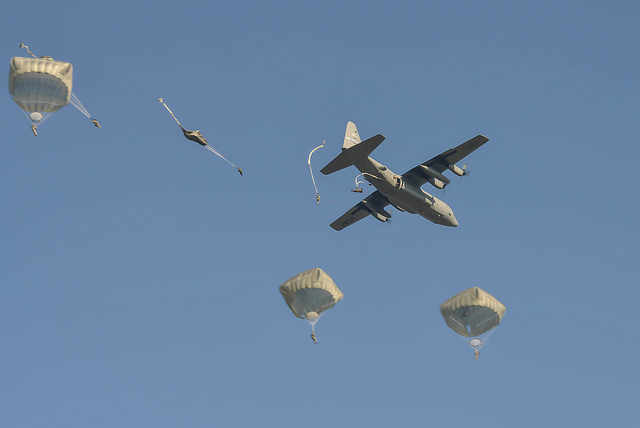
U.S., British, Dutch and Polish troops parachute from a Kentucky Air National Guard C-130 near Groesbeek, Netherlands, Sept. 18, 2014, as part of the 70th-anniversary re-enactment of Operation Market Garden. The historic World War II mission was, at the time, the largest airborne assault ever conducted. (U.S. Air National Guard photo by Master Sgt. Charles Delano)
EINDHOVEN, Holland – Four C-130H Hercules aircraft assigned to the 165th Airlift Wing, Georgia Air National Guard, and the 123rd Airlift Wing, Kentucky Air National Guard, air-dropped a mix of 360 U.S., British, Dutch and Polish paratroopers over fields near Groesbeek, Netherlands, Sept. 18 to commemorate the 70th Anniversary of Operation Market Garden, a record-setting Allied mission that deployed more than 30,000 airborne troops and additional ground forces in a massive attempt to crush Germany during World War II.
“It is our privilege to provide the airborne portion of this commemoration,” said Lt. Col. Chris Davis, mission commander for the 165th Airlift Wing, which is the lead C-130 unit. “It is our wish that every World War II veteran, past and present, be honored by this reenactment, and to thank the ‘Greatest Generation’ for their acts of valor.”
Among the jumpers were four Georgia Air National Guard joint terminal attack controllers from the 165th Air Support Operations Squadron and six Georgia Army National Guard soldiers from the 108th Cavalry Regiment, who jumped as part of a reenactment of the September 1944 airborne assault by 82nd Airborne Division paratroopers on Drop Zone Tango.
“It was a great experience to jump with the British, Dutch and Polish paratroopers on a drop zone that had not been jumped since the DZ was active in 1944,” said Maj. Roger Brooks, a joint terminal attack controller from the 165th. “After the jump, I was honored by the reception of the town mayor and local citizens. They were thankful for the liberation of the Netherlands by allied forces.”
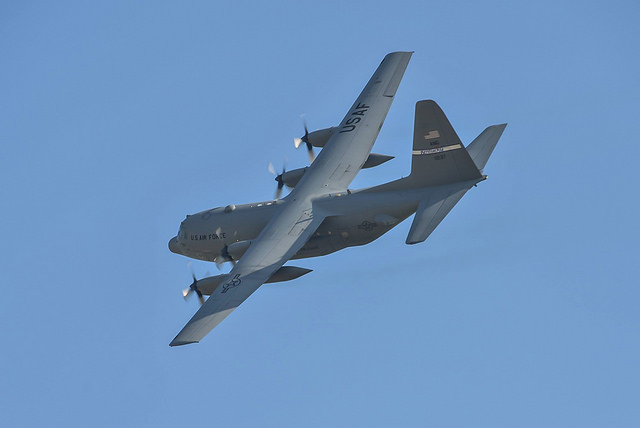
A Kentucky Air National Guard C-130 banks over Groesbeek, Netherlands, Sept. 18, 2014, after deploying U.S., British, Dutch and Polish paratroopers as part of the 70th-anniversary re-enactment of Operation Market Garden. The historic World War II mission was, at the time, the largest airborne assault ever conducted. (U.S. Air National Guard photo by Master Sgt. Charles Delano)
A larger re-enactment involving more than 1,000 troops is scheduled for Sept. 20.
Photos by Maj. Dale Greer, 123rd Airlift Wing Public Affairs
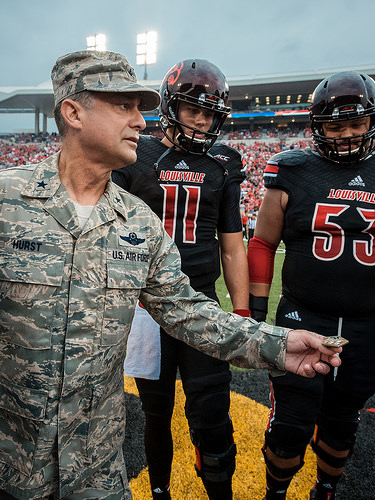
Air Force Brig. Gen. Warren Hurst, the Kentucky National Guard’s assistant adjutant general for Air and commander of the Kentucky Air National Guard, executes the coin toss at Papa John’s Cardinal Stadium in Louisville, Ky., to begin the University of Louisville – Murray State football game Sept. 6, 2014. The game was billed as Military Appreciation Day. (U.S. Air National Guard photo by Maj. Dale Greer/Released)
LOUISVILLE, Ky. — The University of Louisville honored servicemembers during the U of L-Murray State football game at Papa John’s Cardinal Stadium in Louisville, Sept. 6. The game, billed as Military Appreciation Day, started with a coin toss executed by Air Force Brig. Gen. Warren Hurst, the Kentucky National Guard’s assistant adjutant general for Air and commander of the Kentucky Air National Guard. Recruiters from the Kentucky Army and Air Guard also set up booths featuring displays of military equipment and answered questions posed by hundreds of fans.
The Cardinals defeated the Racers 66-21.
Click here to see more photos.
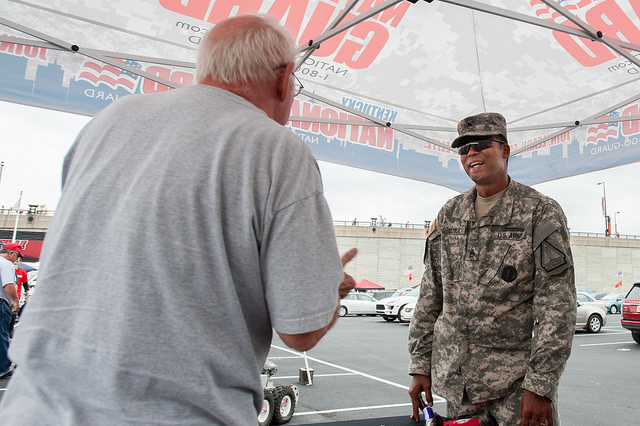
Army Staff Sgt. Michael Oliver, a recruiter for the Kentucky Army National Guard, speaks with a football fan outside Papa John’s Cardinal Stadium in Louisville, Ky., prior to the University of Louisville – Murray State football game Sept. 6, 2014. The game, billed as Military Appreciation Day, began with a coin toss executed by Air Force Brig. Gen. Warren Hurst, the Kentucky National Guard’s assistant adjutant general for Air and commander of the Kentucky Air National Guard. (U.S. Air National Guard photo by Maj. Dale Greer/Released)
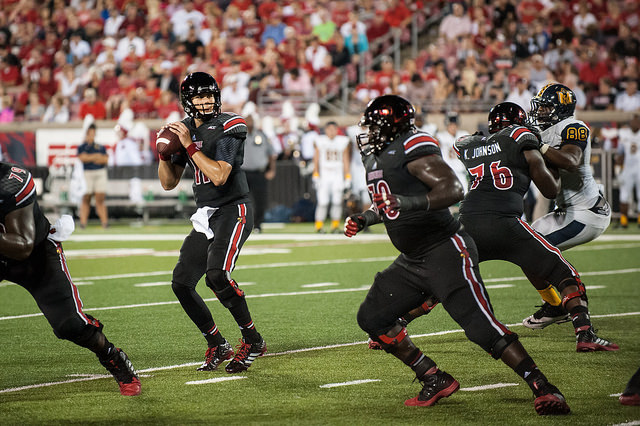
The University of Louisville took on Murray State University at Papa John’s Cardinal Stadium in Louisville, Ky., Sept. 6, 2014. Louisville won 66-21. (U.S. Air National Guard photo by Maj. Dale Greer/Released)
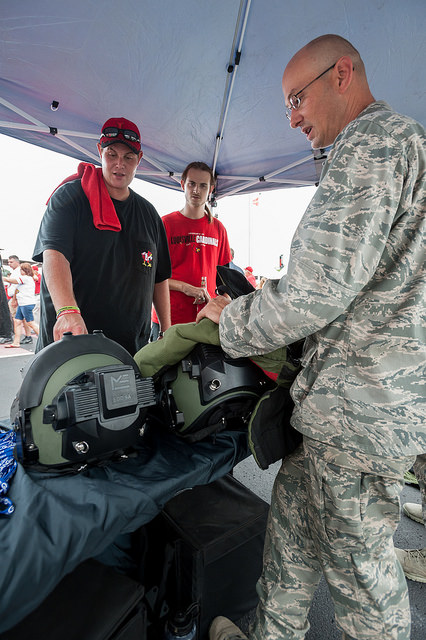
Air Force Maj. Keith Smith, commander of the Kentucky Air National Guard’s 123rd Explosive Ordnance Disposal Flight, displays EOD protective equipment to a football fan outside Papa John’s Cardinal Stadium in Louisville, Ky., prior to the University of Louisville – Murray State football game Sept. 6, 2014. The game, billed as Military Appreciation Day, began with a coin toss executed by Air Force Brig. Gen. Warren Hurst, the Kentucky National Guard’s assistant adjutant general for Air and commander of the Kentucky Air National Guard. (U.S. Air National Guard photo by Maj. Dale Greer/Released)
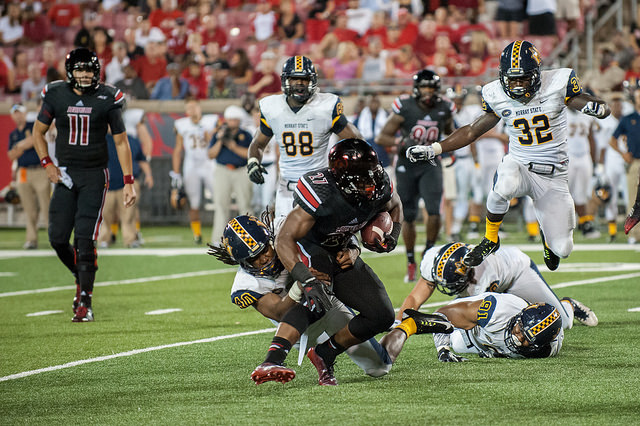
The University of Louisville football team in action against Murray State University at Papa John’s Cardinal Stadium in Louisville, Ky., Sept. 5, 2014. (U.S. Air National Guard photo by Maj. Dale Greer)
Story by Staff Sgt. Scott Raymond, Kentucky National Guard Public Affairs
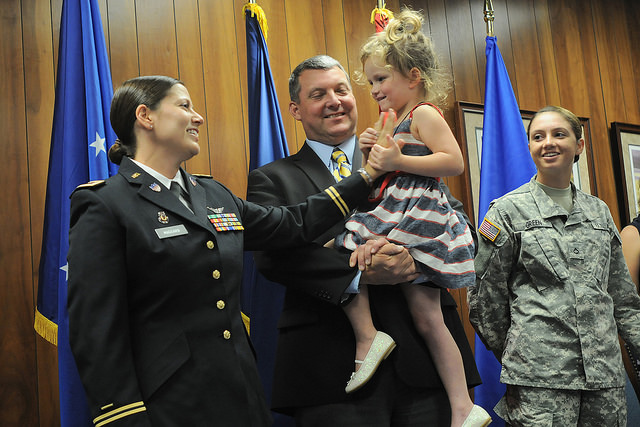
Chief Warrant Officer Jennifer Maggard shares a moment with her daughter and husband, Freddie Maggard, as her sister, Pfc. Logan Green looks on during Maggard’s promotion ceremony in Frankfort, Ky., Sept. 12, 2014. Following the promotion, Maggard swore her sister into the Kentucky Guard. (U.S. Army National Guard photo by Staff Sgt. Scott Raymond)
FRANKFORT, Ky. — When the Kentucky National Guard describes itself as a family organization, it has the proof to back it up. Chief Warrant Officer Jennifer Maggard’s story is a prime example.
Sept. 12, 2014 will remain a special date for the family as Maggard was promoted to chief warrant officer three in front of friends and family, just before she swore her younger sister Logan Green into the Kentucky Guard.
“I am very proud to have my sister serving with me in uniform,” said Maggard. “She has always been an enthusiastic determined young lady, not letting anyone tell her she couldn’t do something. She moved to Florida when she was three, so I have missed a lot of the special events in her life. I hope now I can be of more support to her and watch her grow into a young leader for the Kentucky Guard as well as in life.”
“Growing up I watched my sister do so much in the Kentucky Guard,” said Logan. “I watched her go to flight school and do so many other things, so I look forward to seeing where my career can take me, what I can do and the things I can do to make myself better through the Kentucky Guard.”
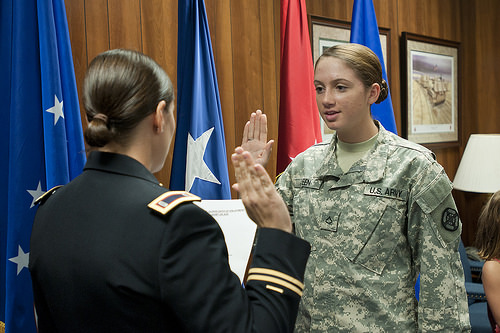
Pfc. Logan Green is sworn into the Kentucky National Guard by her sister, Chief Warrant Officer Jennifer Maggard during a ceremony in Frankfort, Ky., Sept. 12, 2014. Green transferred for the Florida National Guard and will attend the University of Kentucky. (U.S. Army National Guard photo by Staff Sgt. Scott Raymond)
Logan is a freshman at the University of Kentucky, where she plans to major in the medical field. She’s also joined their Army ROTC program. She will simultaneously serve in the Kentucky Guard as a multiple-launch rocket system specialist as she works toward becoming an Army officer after graduation.
Maggard has served in the Kentucky Guard since 1998, enlisting as a junior in high school, which Logan did as well. Maggard he currently works as a resource manager for the Recruiting and Retention command. She is also married to former Guardsman Freddie Maggard, who serves as the Kentucky Guard’s Community Relations Liaison.
“When I first joined the Guard I was just a family member who served in the Guard,” said Maggard. “Joined now by my husband who served, my brother and now sister who both serve, we are a true Guard family and happy to call the Kentucky National Guard home.”
The brother of the family, Spc. Doug Green works as an aviation mechanic with Bravo Company, 2nd Battalion, 147th Aviation in Frankfort. He thinks it’s an honor for the siblings to be able to represent the military as well as they can as family.
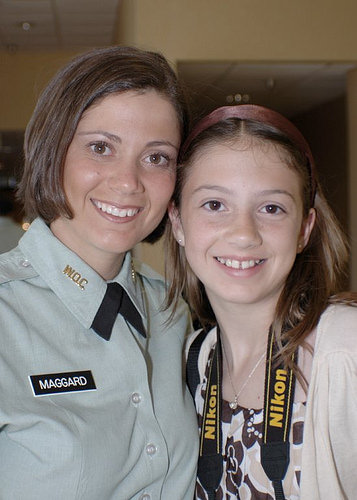
Warrant Officer Jennifer Maggard hugs her sister Logan Green during Maggard’s graduation from warrant officer candidate school in 2008. (Courtesy photo)
“I am very proud to be the older brother of these two,” Doug said. “It’s great that Logan was able to transfer up here and that all three of us are together here now in the Guard.”
“On of them already outranks me, and in a few years the other will as well,” he said. “You have to be proud of that.”
Chief Warrant Officer Dean Stoops, Kentucky’s command chief warrant officer was on hand to help promote Maggard and to welcome her sister. Stoops mentored Maggard as a young warrant officer and helped guide her into flight school. He also started his own career in artillery, like Logan, and said he feels a kinship with the family.
“It’s great to able to participate not only in an official ceremony such as this, but one that is such a family affair and in particular, one that the Guard is such a big part of it,” said Stoops.
Logan said the day began a new chapter of her relationship with her sister, and recalled times spent apart.
“We didn’t grow up together, but we’re still very close and it’s nice to know that we can look forward to the memories we’re going to make now that I’m closer. I think the connection I have with my brother and sister will just get a lot closer and stronger.”
“Some of my greatest memories I have with my sister is going to get our nails done and hanging out and being sisters and having that one-on-one time that we didn’t always have when we were growing up.”
Maggard said she look forward to the day when she has to salute her little sister, but until then she wants Logan to learn from Maggard’s experiences and build upon the basic principles of family.
“This is her career and it will be what she makes of it; she can be as successful or unsuccessful as she wants to be. Know that someone is always watching even when she thinks they are not. Most importantly to always believe in herself and know she is surrounded by family and friends who believe in her, support her, are proud of her and love her.”
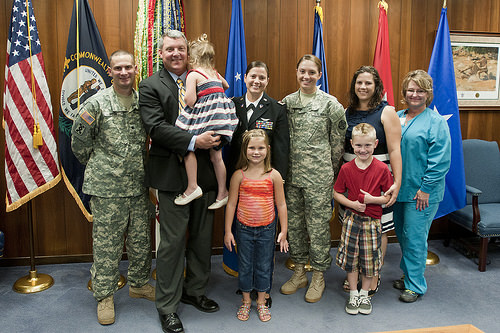
Chief Warrant Officer Jennifer Maggard (center) gathers her family for a group photo following her promotion and sister, Pfc. Logan Green’s swearing in into the Kentucky National Guard in Frankfort, Ky., Sept. 12, 2014. (U.S. Army National Guard photo by Staff Sgt. Scott Raymond)
Logan remembered that she wanted to enlist in the military since she was four-years-old, after watching her sister leave for basic training. Both sisters recalled the Disney movie “Mulan” and how it had an underlying theme of their relationship. Appropriate that a story of a strong, independent and self-sufficient girl who goes on to become a warrior is a favorite of the two.
Both shared memorable stories of seeing each other graduate from different Army schools, but this day will certainly rank high on their lists for years to come.
“I was excited that the timeline worked out that I could be to watch my sister’s big moment and be a part of it for her,” said Logan. “And excited about my other sister coming up and my brother’s here, so all four of us are together again.”
“My own family got to introduce me to the larger family of the Kentucky National Guard. It’s such a great support system and I’m so glad to be a part of it now.”
Story by Staff Sgt. Debralee Best, 412th Theater Engineer Command
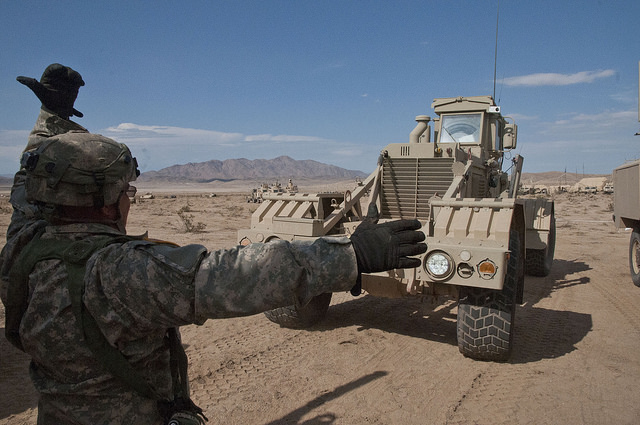
Sgt. John Gibbs, a Standard Army Maintenance System-Enhanced clerk with Kentucky National Guard’s 1123rd Engineer Company (Sapper) from Drakesboro, Ky., ground guides vehicles returning from situation exercise lanes. The 1123rd and a platoon from the U.S. Army Reserve’s 441st Engineer Company, route clearance, came together as one unit at National Training Center rotation 14-09 in Fort Irwin, Calif., Aug. 2-22. (U.S. Army photo by Staff Sgt. Debralee Best)
FORT IRWIN, Calif. – Reserve and National Guard Soldiers usually train one weekend a month and two weeks a year. This training is normally not done side-by-side, but two units integrated this year for their extended combat training.
The Kentucky National Guard’s 1123rd Engineer Company, (Sapper), and a platoon from the U.S. Army Reserve’s 441st Engineer Company, route clearance, came together as one unit at National Training Center rotation 14-09 at Fort Irwin, California, Aug. 2 to 22.
“We actually had planned to have three [route clearance packages]. They were going to be the third one,” said Capt. Robert, McWhorter, 1123rd Engineer Company commander. ”They were going to bring 34 folks here, but ended up only able to bring 21 so our mission had to change and this is the neat part: we integrated them with us.”
The 441st combat engineer Soldiers we integrated into two packages as drivers and gunners. The mechanics and medics were also assigned within the 1123rd in their respective areas.
McWhorter said the change of mission was good for the 1123rd.
“For us it’s good because the 21 people they had basically get pushed into our two RCPs and that actually benefits everybody so we get to work side-by-side by them instead of mission-by-mission,” he said.
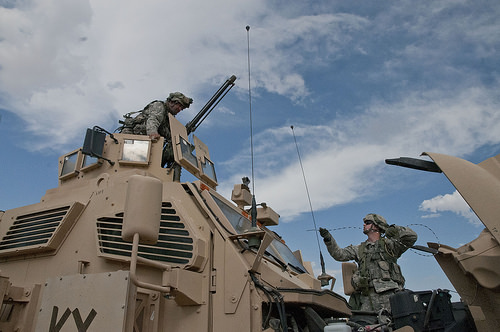
Spc. James McCarty (right), with the Kentucky National Guard’s 1123rd Engineer Company (Sapper) from Elizabethtown, Ky., asks Spc. William Wilson, 441st Engineer Company, route clearance, from Memphis, Tenn., about the fluid levels in their vehicle. The combat engineers worked together at the National Training Center rotation 14-09 in Fort Irwin, Calif., Aug. 2-22. (U.S. Army photo by Staff Sgt. Debralee Best)
The 441st Soldiers said they felt accepted by the 1123rd.
“It’s a little interesting. I’ve never actually worked with National Guard, but they welcomed us with open arms from the get-go,” said U.S. Army Reserve Sgt. 1st Class Timothy Waters, 441st Engineer Company, platoon sergeant from Harrison, Arkansas. “What I like about them is they said, ‘I don’t want you to feel like the misfits because they’ve been in that situation themselves before.’”
Not only did the 441st feel accepted, but they saw the efforts made by the 1123rd for their integration.
“They accepted us with open arms. As soon as we got boots-on-ground in the box they put us in like they were one of theirs,” said U.S. Army Reserve Spc. Matthew Cooper, Field Maintenance Platoon, 441st Engineer Company, mechanic and vehicle recovery specialist, from Brighton, Tennessee. “I can’t complain. Capt. McWhorter is doing his best to make us feel at home and so are the [noncommissioned officers].”
McWhorter said he isn’t surprised the 441st was able to integrate so well. He attributes it to the cordiality of his Soldiers.
“We’re from Kentucky so that’s like hospitality 101,” he said. “They’re just honing skills they already had.”
While the units integrated well, they did have some growing pains while on missions.
“The question we had asked is, ‘hey, guys, how’s it going?’ and I think because it was [so early in the training], they said, ‘well, we’re still working it out. It’s still confusing who belongs to who, who is doing what.’ I think that makes sense. You have to build muscle memory,” said McWhorter. “When they actually showed up we had drawn 90 percent of the equipment. We were already there for a whole day and then they show up. We’re like, ‘alright, cool, all of our minds are blown. Let’s just go to sleep.’ Then we wake up and are trying to meld. So coming out here, having the couple days to set, I’d say if I asked the question again it would be a little more straight-forward to say, ‘we’re not confused because we’ve been on route clearance missions, we know who each other are now.’”
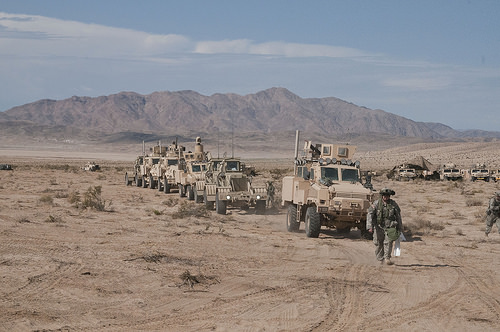
One of two route clearance packages consisting of Soldiers from the Kentucky National Guard’s 1123rd Engineer Company, (Sapper), and a platoon from the U.S. Army Reserve’s 441st Engineer Company, route clearance, return from a situational exercise lane at National Training Center rotation 14-09 in Fort Irwin, Calif., Aug. 2 to 22. (U.S. Army photo by Staff Sgt. Debralee Best)
After a few missions, the units did work out the kinks.
“I think they’re becoming a team,” said Waters. “They’ve been out running mission and it always takes a few days to get to know people, understand where they’re coming from. There is always that concern your going to butt heads with people at certain points, but I haven’t seen a whole lot of that. From what I’ve seen, they work pretty decent together.”
While becoming a team is important, the training received is essential because the units need the experience.
“You’ve got two companies where 40 percent of the experienced people left. Now you’ve got 60 percent of the folks who, including me and most of my lieutenants, are new,” said McWhorter. “So, I think that’s actually a great place for us to be because we’re all learning together.”
Not only will this training help prepare the inexperienced units, but it is also helps the units learn to work with other components and other services.
“I think it’s beneficial to work with National Guard, active duty, Marines, other coalition forces, because you don’t know who you’re going to be integrated with, especially in an RCP,” said Waters. “You’ve got to be able to understand and develop relationships with all different types of military units.”
McWhorter said he also believes building relationships is important, but he thinks the Soldiers of the 441st who didn’t attend the training at NTC will be disappointed they didn’t build those relationships and attend the training during this exercise.
“What I’m looking forward to is seeing the training value of this place because I’ve heard it’s great, I’ve heard stories about it. We are at the end of a long road. I think both these units are going walk away a lot better,” said McWhorter. “Then for 441st when they go home they’re going to have a really strong RCP platoon and they’re going to benefit and the others are going to wish they went.”
But, Waters has been so impressed by the training that he is already planning to try to bring the rest of company to NTC.
“I know these guys are getting good training out here. It’s going to be good for the unit when we get back. What I’m hoping for is that we bring this training back to the 441st Engineer Company and bring back some different ideas we’ve gathered from the 1123rd and we can move forward in getting prepared for a deployment,” said Waters. “Getting better prepared for actually deployment, then hopefully within a couple years, maybe we can bring the company out here as a whole.”
Story by Sgt. 1st Class Gina Vaile-Nelson, 133rd Mobile Public Affairs Detachment
This is part III of a three-part series on the Kentucky National Guard’s Resiliency Training Assistant Course conducted for Guardsmen returning from deployment.
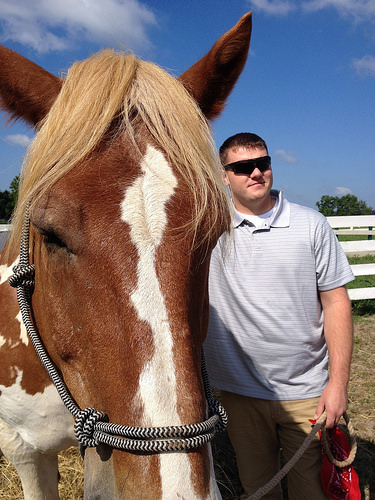
Sgt. Gary Fosyth II, a carpentry masonry sergeant assigned to the 149th Maneuver Enhancement Brigade, gets to know Sargent, an American Draft Horse during Resilience Trainer Assistant training Aug. 13, at the Central Kentucky Riding for Hope barn in Lexington, Kentucky. (U.S. Army National Guard photo by Sgt. 1st Class Gina Vaile-Nelson)
LEXINGTON, Ky.-When Sgt. Gary Forsyth II was given orders to attend the Kentucky National Guard’s Resilience Trainer Assistant course at the Central Kentucky Riding for Hope’s barn in Lexington, Kentucky, he was nervous. The thought of working with an animal seven times his size was intimidating. Not to mention, he wasn’t thrilled about talking about his feelings and he already had his mind made up, he was resilient enough.
“I don’t usually spend time around horses,” Forsyth said. “I was put off by it at first. I know now that I would not have liked the training any other way.”
The week-long course was developed by the University of Pennsylvania and adopted by the Army Resilience Program.
“Being around the horses helped me personally relax and get comfortable with the training principles,” he said, “and with the horses in general.”
For Forsyth, getting comfortable has been somewhat of a struggle since his return from Afghanistan in December 2013. While deployed, he was a carpentry masonry sergeant with the 149th Vertical Construction Company.
“When I returned to my employer after my deployment to Afghanistan, I was assigned to a different division with a new product line,” he said.
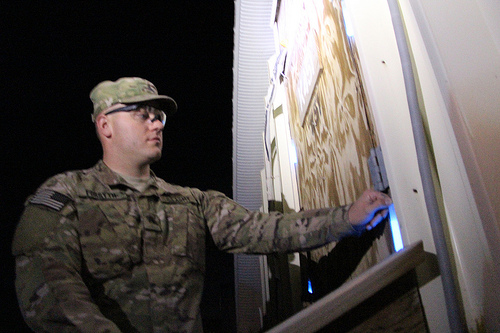
Sgt Gary Forsyth a vertical engineer with the149th hangs blue lights outside of his living quarters in Afghanistan to show support for daughter Norah, and for the “Light it up Blue” campaign raising awareness for autism. (U.S. Army National Guard photo by Spc. John Rader)
Forsyth said it was hard to stay on task or even stay positive about the move.
“My previous position was so fulfilling, I was disappointed with the new assignment,” he said.
Like people do, every day, Forsyth began focusing on the negative. Things won’t change. They moved me ‘cause I was gone too long. They don’t want me here. I don’t work hard enough for them. I’m never going to be happy with my work and career. To top it all off, I go home to Gena and the kids and I can’t fix their problems either. It’s hard watching your child struggle with Autism. I can’t bring this stuff home too. Life’s not fair. It’s really got something out for me.
Forsyth was deep in thinking traps, he was catastrophizing.
This toxic spiral is what senior Army leaders hope to combat with Soldiers across the ranks. For decades, physicians have concluded that combat is a major stressor, but daily life struggles also wear on the mind, which is the Soldier’s most important feature. This toxic spiral is exactly what the Kentucky Guard’s RTA program helps attendees and leaders recognize.
No leader is more of a champion for the RTA than Capt. Rob Cooley, Kentucky’s program coordinator.
“This training has the potential to be life changing,” Cooley said.
“I’ve had the pleasure of reading more than 600 end of course surveys,” he said. “I lost count of how many Soldiers have added comments to the effect of: ‘this course has made my life better.’
“My goal is to get this training to as many of our Soldiers, Airmen and Family members as possible,” Cooley said.
The training, according to Forsyth, isn’t about being happy and staying happy. It’s unrealistic, he said, to think that an individual has no problems that weigh on their mind.
“I recognized the thinking traps and patterns that promoted the negative attitude I had during work,” he said.
“It helps you recognize activating events, what they are and how they affect you,” he said.
Sgt. Ronald Forsyth II was killed in a motor vehicle accident in 2012. (Courtesy photo)
One of those events was the death of his cousin, Sgt. Ronald Forsyth II, a fellow Kentucky Guardsman killed in a car accident in Devils Lake, North Dakota September 13, 2012.
“The training helped me see the loss and instead of letting it control my behaviors, actions or attitude, I can put it into perspective and still have a positive day,” he said. “I highly recommend this training for any Soldier who experienced a loss.”
Over the last month, since attending the RTA course, Forsyth said his attitude has changed. It’s skills he’s able to use at home and at work to make his day better – but most importantly, lessons he can use with his subordinates and peers in his unit.
“I think every leader at all levels needs to go through this training,” he said. “If anyone questions whether or not this helps Soldiers, they will know that it certainly does.”
Story by 2nd Lt. James W. Killen, 123rd Airlift Wing Public Affairs Office
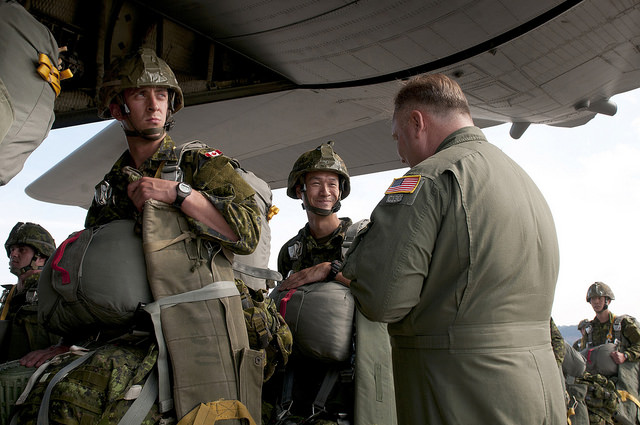
Air Force Master Sgt. Wayne Reeser (right), a loadmaster from the 123rd Airlift Wing, talks with a paratrooper from the Royal Canadian Regiment at Ramstein Air Base, Germany, just before a Kentucky C-130 Hercules aircraft transports the paratroopers and other NATO forces into the Baltic region Sept. 5, 2014, as part of Operation Sabre Junction.. The Kentucky Air National Guard is participating in the operation along with five other Air National Guard Units and forces from 17 NATO countries. (U.S. Air National Guard photo by 2nd Lt. James W. Killen/Released)
RAMSTEIN AIR BASE, Germany – The 123rd Airlift Wing is demonstrating its airlift capabilities during Operation Saber Junction, a NATO exercise being conducted here with 5,800 troops from 17 NATO countries.
More than 20 Kentucky Airmen arrived at Ramstein Aug. 31 and will support daily flight operations with two Kentucky C-130 Hercules aircraft through Sept. 9.
“Saber Junction is a great way to demonstrate the interoperability of NATO forces and a great opportunity to work and train with our NATO Allies” said Lt. Col. Kathryn Newell, aircraft commander for the Kentucky Air National Guard. “It is a privilege to take part in such a crucial exercise.”
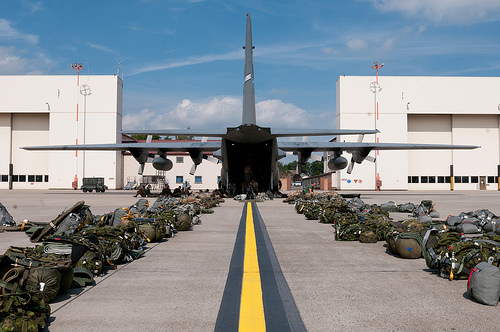
A Kentucky Air National Guard C-130 Hercules aircraft from the 123rd Airlift Wing sits on the flight line at Ramstein Air Base, Germany, awaiting the paratroopers it will carry to the Baltic region Sept. 5, 2014, in support of Operation Saber Junction. The U.S. and 16 other NATO allies are participating in the operation, designed to strengthen the partnerships and interoperability of NATO forces. (U.S. Air National Guard photo by 2nd Lt. James W. Killen/Released)
Saber Junction 14 prepares U.S. troops, NATO Allies and European security partners to conduct joint, offensive, defensive and stabilization operations, and to sustain cooperative efforts with partner nations.
Air National Guard units from Kentucky, California, Delaware, Illinois and Missouri are providing personnel and equipment air drops in support of airfield-seizure and forcible entry operations, Newell said.
Master Cpl. Chris Leedham, weapons detachment commander for Mike Company, 3rd Battalion, Royal Canadian Regiment, said he was pleased to be participating in an operation that builds such strong partnerships between allies.
“This experience of interoperability with such a capable international fighting force is professionally spectacular,” he said.
Leedham made that comment just before he parachuted out of a Kentucky Air National Guard C-130 Hercules aircraft as part of airfield-seizure training in the Baltics.
Leedham and the Royal Canadian Regiment were accompanied by U.S. Army Airborne paratroopers from the 173rd Infantry Brigade Combat Team, based in Vicenza, Italy, and paratroopers from the Italian Army’s 186th Parachute Regiment.
All U.S. efforts in support of NATO partners in Europe, including Saber Junction, fall under the umbrella of Operation Atlantic Resolve. Saber Junction is taking place in the Baltic nations of Estonia, Latvia and Lithuania, and serves to demonstrate the effectiveness of U.S. and allied forces to achieve their objectives in a dynamic training environment, officials said.