Pages
Stay In Touch
More
© 2013 KentuckyGuard
By Olivia Burton, Kentucky National Guard Family Programs

Staff Sgt. Cade Shackelford with his girlfriend Erin Diaz and their 7 month old daughter Isabella outside their new home. Home Builders Care, the nonprofit arm of The Home Builders Association of Lexington dedicated the “Home for a Veteran” to Shackelford and his new family Jan. 25, 2016 in Lexington, Ky. (Photo Credit: HBA, HBC)]
LEXINGTON, Ky. — On a cold January day in Lexington, a Kentucky veteran and his family felt nothing but warmth as they stepped into their brand new home. Staff Sgt. Cade Shackelford with his girlfriend Erin Diaz and their 7-month-old daughter Isabella were chosen for the “Home for a Veteran” building project.
Spearheading the effort was Home Builders Care, a non-profit arm of the Home Builders Association of Lexington. With immense community support, donated labor and materials, a veteran and his family earned the low-mortgage home to honor his service to the United States Military.
City council members, volunteers and friends took part in a dedication ceremony to present this new home to Shackelford and his family.
“It’s hard to believe that we broke ground on this new home on the hottest day of the year last summer and here we are today after a sizeable snow storm,” said David Briggs, President of the Home Builders Association of Lexington. “We are truly honored to provide this home to Cade and his family.”
Shackelford is an active member of the Kentucky National Guard who served in several overseas tours in the Middle East. He is currently serving as a military police officer with the 940th Military Police Company and plans to remain in service until his retirement.
“Saying thank you sometimes you just can’t put into words,” he said. “What everybody has done, what time they’ve donated, what materials they’ve donated, I just can’t express the amount of gratitude that me and my family have for you guys. From the bottom of my heart, from my family to yours, thank you.”
Click here to watch the dedication ceremony in its entirety.
Photos of the dedication event and the home can be found here.
Kentucky National Guard Public Affairs Staff Report
Summary of the Kentucky National Guard in the Persian Gulf War 1990-91
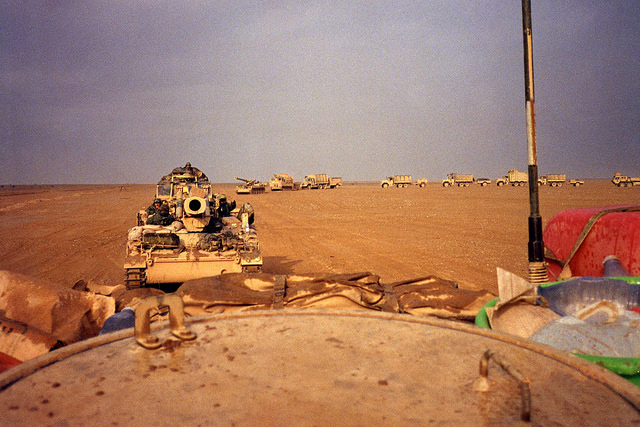
Soldiers with the 1st Battalion, 623rd Field Artillery move supplies and equipment along the Iraqi border during Operation Desert Storm, Feb. 27, 1991. As one of the few National Guard combat arms units deployed to the theater, the 623rd provided fire support for coalition forces during the conflict. (Kentucky National Guard historical photo)
It’s been 25 years since the United States first went to war in the Persian Gulf. Aug. 2, 1990 saw the invasion of Kuwait by neighboring Iraq, an event that both shocked and outraged the world. Spearheading a 21-member United Nations coalition, the United States initiated Operation Desert Shield, the largest military buildup since the Vietnam War.
On Jan. 17, 1991, Americans at home watched as Operation Desert Shield turned into a Desert Storm. A six-week air campaign preceded what came to be known as “The One-Hundred Hour War,” leading to the swift liberation of Kuwait.
Click here for more historical photos.
Once again Kentuckians found themselves on the forefront of the assault. From Fort Campbell came the 101st Airborne Division, the 160th Special Operations Aviation Regiment, and the 5th Special Forces Group. Fort Knox sent elements of its 194th Separate Armor Brigade. Together, the two bases sent 21,500 men and women into battle.
Because of the size and intensity of the planned offensive, reserve components from all over Kentucky were called to duty, performing such diverse missions as ensuring the transportation and accountability of equipment and supplies, providing direct fire support, battlefield medical support and refugee relief, water purification, film and video documentation of military actions, security and handling of prisoners of war. Some reservists served as replacements for active duty units called to action.
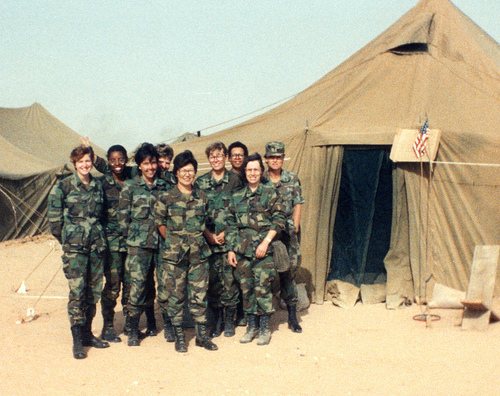
Members of the 475th Mobile Army Surgical Hospital (MASH) stand outside their tent in Saudi Arabia during Operation Desert Storm, 1991. (Courtesy photo)
Kentucky can be especially proud of the 1078 Kentucky Army National Guardsmen and women who went to the desert and performed valiantly during Desert Storm.
They were Soldiers with the following units: 137th Transportation Det., 217th Quartermaster Det., 2123rd Transportation Co., 475th Mobile Army Surgical Hospital (MASH), 133rd Public Affairs Det., 223rd and 438th Military Police Companies.
Batteries of Kentucky’s 1st Battalion, 623rd Field Artillery served as one of the few National Guard combat arms units activated.
Nearly 400 National Guard units were activated with nearly 40,000 Guardsmen serving in theater.
During the offensive, Kentucky Guard artillery was given the mission of providing fire support for the coalition forces while heavy equipment transportation traveled as far as the Euphrates carrying the load for the advancing troops. Military police personnel processed thousands of enemy prisoners of war and our Mobile Army Surgical Hospital cared for the ill and injured during a post-war humanitarian relief effort.
Back home the C-130’s of the 123rd Tactical Airlift Wing moved personnel and equipment throughout the U.S. in support of Desert Storm, while our engineers assisted in a variety of state and local projects.
U.S. Army Reserve units deployed from Kentucky included the 100th Division, the 807th Mobile Army Surgical Hospital, the 888th Medical Detachment, and the 5010th Army Hospital.
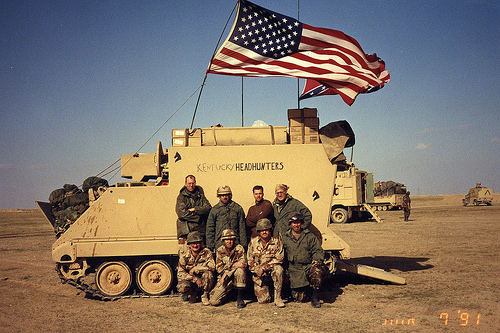
Soldiers of the Kentucky National Guard’s 1st Battalion, 623rd Field Artillery deployed to the Persian Gulf for Operation Desert Storm, Jan-April, 1991. The artillery unit was one of eight Kentucky units activated for service during the conflict. (Kentucky National Guard historical photo)
In all, 23,210 Kentucky Service members from both the active and reserve forces served in Southwest Asia.
“Serving in Operation Desert Shield and Desert Storm was a very rewarding experience for me as a young officer in the Kentucky National Guard,” said Lt. Col. Allen Boone, who served as a lieutenant with the 623rd at the time.” In less than three years after joining the nationally recognized 623rd Field Artillery, I found myself halfway around the world with some of the finest men in the United States Armed Forces.”
“It was an honor for me to serve in operations which proved to be one of the greatest examples of military power by U.S. Armed Forces in the history of our nation. The years of strategic planning, followed by equipping and properly training personnel for military operations was executed with effective precision in the first 100 hours of ground combat.”
“The motto of the 623rd is “Seize the Opportunity” and it’s Soldiers who served in the Civil War through Iraq and Afghanistan continue a legacy of professional service to our nation at home and around the world.”
PERSIAN GULF WAR TIMELINE (May 1990 – April 1991)
1990 - May 28-30: Iraqi president Saddam Hussein says that oil overproduction by Kuwait and United Arab Emirates is “economic warfare” against Iraq.
July 15: Iraq accuses Kuwait of stealing oil from Rumaylah oil field near the Iraqi-Kuwaiti border and warns of military action.
July 22: Iraq begins deploying troops to the Iraqi-Kuwaiti border and building a massive military buildup.
August 2: About 100,000 Iraqi troops invade Kuwait. Kuwait is in Iraqi control by the end of the day.
August 6: The U.N. Security Council imposes a trade embargo on Iraq in a 13-0 vote, with Cuba and Yemen abstaining. President George H. W. Bush orders the deployment of U. S. armed forces to defend Saudi Arabia in an operation named OPERATION DESERT SHIELD.
August 7: First U.S. troops arrive in Saudi Arabia.
August 8: Saddam Hussein proclaims the annexation of Kuwait.
August 9: U. N. declares Iraqi annexation of Kuwait void.
August 10: Hussein declares a “jihad” or holy war against the U. S. and Israel.
August 12: Naval blockade of Iraq begins. All shipments of Iraqi oil halted.
August 28: Iraq declares Kuwait as its 19th province and renames Kuwait City as al-Kadhima.
September 14-15: United Kingdom and France announce the deployment of 10,000 troops to Saudi Arabia.
December 17: The United Nations sets a deadline for Iraq to withdraw from Kuwait before January 15, 1991, or face military action. Hussein rejects all U. N. resolutions.
1991 - January 9: Talks in Geneva, Switzerland, between U.S. Secretary of State James Baker and Iraqi Foreign Minister Tariq Aziz end with no progress.
January 12: Congress grants President Bush authority to wage war.
January 16: The White House announced the commencement of OPERATION DESERT STORM: offensive action against the forces of Iraq under the provisions of U.N. Security Council/U.S. Congressional resolutions.
January 17: The war begins at 2:38 a.m. Baghdad time when AH-64 Apache attack helicopters destroy Iraqi radar sites, later F-117 Nighthawk Stealth Fighters bomb Baghdad and Iraqi forces. Operation Desert Storm begins.
January 18: Iraq strikes with Soviet-made SCUD missiles on Israel. The U.S. deploys Patriot missiles to Israel and Saudi Arabia.
January 22: Iraqi troops begin blowing up Kuwaiti oil wells.
January 25: Iraqi troops begin “environmental war” by dumping millions of gallons of crude oil into the Persian Gulf.
January 29: Iraqi forces invade the town of Khafji in Saudi Arabia. Iraqi forces are soon engaged by Saudi Arabian and Qatari troops with U.S. Marine artillery.
January 31: Iraqi forces capture Melissa Rathbun-Nealy, the first female Prisoner of War since World War II.
February 1: Iraqi forces are driven out of Saudi Arabia. Allied Forces win the Battle of Khafji. Secretary of Defense Richard Cheney warns U. S. will retaliate if Iraq uses chemical or unconventional weapons.
February 8: Total U. S. troop strength in the Gulf over a half million.
February 12-13: A bombing raid by U.S. forces against Baghdad kills 400 Iraqi civilians in an air raid shelter, and three major bridges.
February 19: Soviet-Iraqi peace plan rejected by President Bush. Oil spill in Gulf now estimated at 1.5 million barrels.
February 22: Pres. Bush issues a 24-hour ultimatum: Iraq must withdraw from Kuwait to avoid start of a ground war.
February 24: Allied Forces invade Iraq and Kuwait at around 4 a.m. Baghdad time. The U.S. Army is the first to enter Iraqi territory.
February 25: An Iraqi SCUD missile hits U.S. barracks near Dhahran, Saudi Arabia, killing 28 U.S. troops.
February 26: Saddam Hussein orders the Iraqi withdrawal from Kuwait. About 10,000 retreating Iraqi troops are killed when Allied aircraft bomb them, it is called the “Highway of Death.”
February 27: U.S. Marines and Saudi Arabian troops enter Kuwait City. The U.S. Army’s 1st Armored Division engages the Iraqi Republican Guard in the Battle of Medina Ridge in Iraq. President Bush declares Kuwait liberated.
February 28: By Presidential order all Coalition offensive operations ceased at 0800 local time.
March 1: The cease-fire plan is negotiated in Safwan, Iraq.
March 17: First U.S. troops arrive home.
April 11: The U.N. Security Council declared a formal cease-fire, ending the Gulf War.
By Sgt. David Cox, 63rd Theater Aviation Brigade
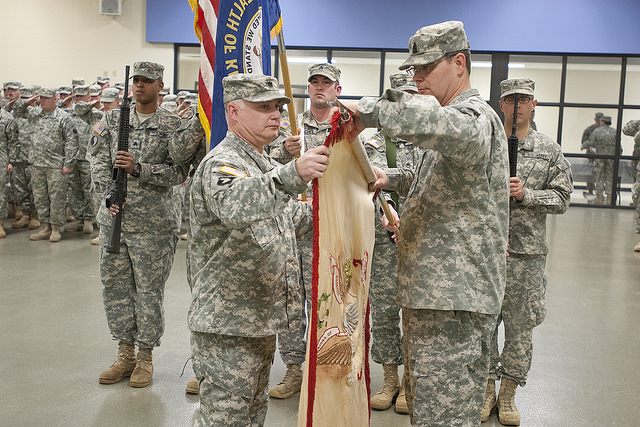
Lt. Col. Mark Brozak, commander of the 1204th Aviation Support Battalion furls the unit’s colors with help from Command Sgt. Maj. Scott Foster during an inactivation ceremony in Burlington, Ky., Jan. 10, 2016. After nearly 10 years of service to the Nation and commonwealth, the unit was stood down due to Army force structure changes. (U.S. Army National Guard photo by Sgt. David Cox)
BURLINGTON, Ky. — Soldiers with 1204th Aviation Support Battalion furled their battalion colors for the last time during an inactivation ceremony Jan. 10, at the National Guard Readiness Center in Burlington, Ky.
The unit of nearly 300 has been inactivated in accordance the Army’s force structure realignment.
Activated in 2006, the 1204th played a vital role in disaster recovery operations during the 2009 Ice Storm and deployed to Iraq in 2011 in support of Operation New Dawn .
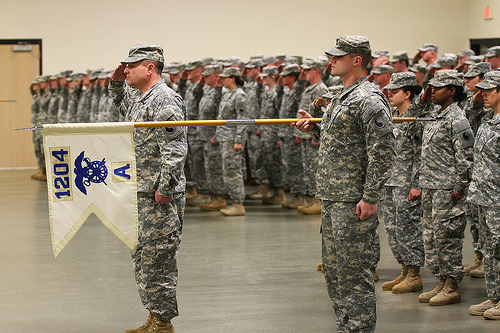
Soldiers of the 1204th Aviation Support Battalion salute during an inactivation ceremony in Burlington, Ky., Jan. 10, 2016. Activated in 2006, the unit was home to nearly 300 Soldiers. (U.S. Army National Guard photo by Staff Sgt. Scott Raymond)
“From 2006 to today, this unit has probably done more as an ASB than the other 12 currently in the force,” said Brig. Gen. Benjamin F. Adams, III, Chief of the Joint Staff. “Being able to deploy as a battalion to five different countries during a time of war says a great deal about the unit and its personnel.”
Click here for more photos.
Lt. Col. Mark Brozak, commander of the 1204th ASB, said “that although the colors are cased, the soldiers of the unit will continue to serve the nation and the commonwealth of Kentucky.”
The 1204th’s mess section finished their service to the unit as recipients of the Connelly Award. The award recognizes food service Soldier that exceed Army standards and operate at a level that showcases teamwork, professionalism, quality and service.
Soldiers expressed a bittersweet satisfaction with what they accomplished while being a part of the unit’s history.
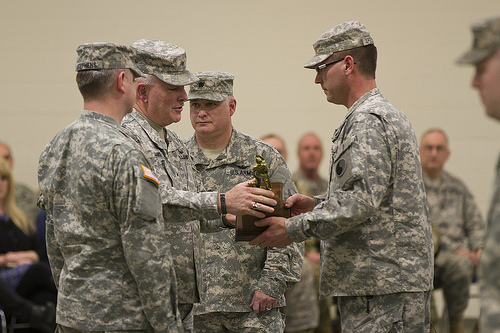
Brig. Gen. Benjamin Adams III presents the Connelly Award to Soldiers of the 1204th Aviation Support Battalion during an inactivation ceremony in Burlington, Ky., Jan. 10, 2016. The Connelly Award recognizes food service units and sections that exceed Army standards of food preparation and promote teamwork. (U.S. Army National Guard photo by Staff Sgt. Scott Raymond)
“I’ve been in almost 18 years and this is home to me,” said Staff Sgt. Bill Hyatt, supply noncommissioned officer with Headquarters Support Company, 1204th ASB. “It’s going to be a big culture shock to me because aviation is where I’ve been since I’ve been in the Kentucky Army National Guard and now I’m going to a transportation company.”
“I’m going to be the first person to arrive to the 1204th and the last person to leave.”
The Burlington Readiness Center, home of the 1204th, will continue to be utilized by the Kentucky Guard. Two new units, the 2061st Multi-Role Bridge Company and the 2112th Transportation Company will be stood up this year to operate out the state-of-the-art armory.
See local news coverage here: WLWT 5, WKRC Local 12.
By 123rd Airlift Wing Public Affairs
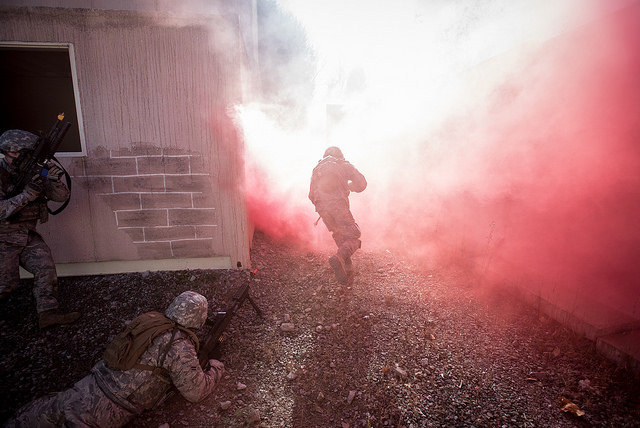
Fire Team members from the Kentucky Air National Guard’s 123rd Security Forces Squadron conduct training to recover a downed pilot inside a simulated Afghan Village at Fort Knox, Ky., Oct. 20, 2015. The Airmen were required to execute a coordinated search while defending their positions and engaging hostile enemy forces. (U.S. Air National Guard photo by Maj. Dale Greer)
FORT KNOX, Ky. — Fire Team members from the Kentucky Air National Guard’s 123rd Security Forces Squadron conducted a field training exercise here Oct. 20 that was designed to enhance their ability to operate in a combat environment.
Unit members were evaluated on their ability to extract a downed pilot from a simulated Afghan village and defend a military outpost in the Afghan countryside.
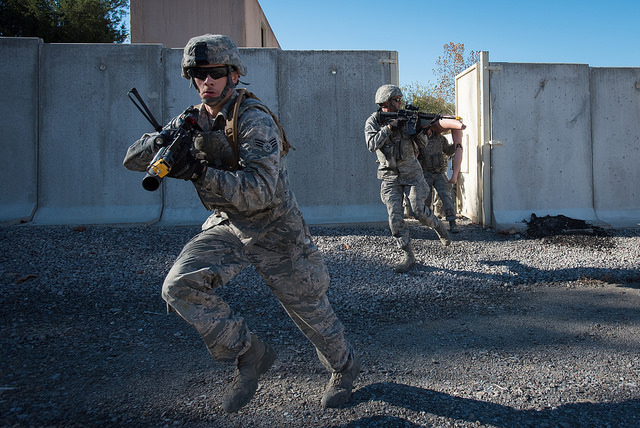
Fire Team members from the Kentucky Air National Guard’s 123rd Security Forces Squadron conduct training to recover a simulated downed pilot inside a mock Afghan Village at Fort Knox, Ky., Oct. 20, 2015. The Airmen were required to execute a coordinated search while defending their positions and engaging hostile enemy forces. (U.S. Air National Guard photo by Maj. Dale Greer)
Click here for more photos.
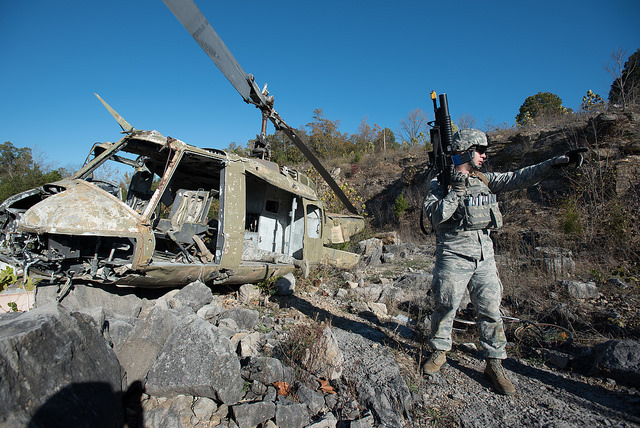
Senior Airman Randy Roberts, a Fire Team leader from the Kentucky Air National Guard’s 123rd Security Forces Squadron, directs efforts to recover a simulated downed pilot inside a mock Afghan Village at Fort Knox, Ky., Oct. 20, 2015. Roberts and his fellow Airmen were required to execute a coordinated search while defending their positions and engaging hostile forces. (U.S. Air National Guard photo by Maj. Dale Greer)
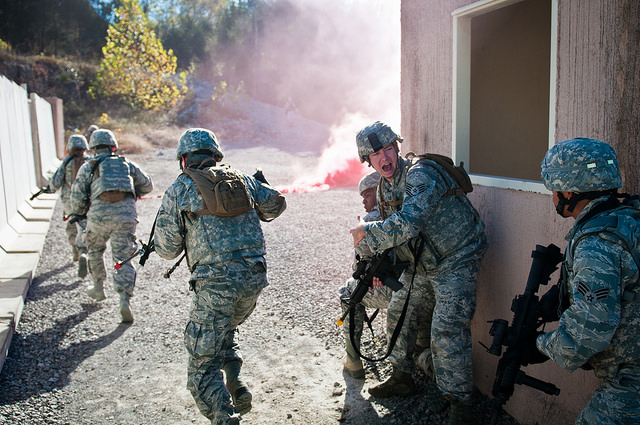
Tech. Sgt. Julien Borchert, a squad leader for the Kentucky Air National Guard’s 123rd Security Forces Squadron, shouts commands during a field training exercise at Ft. Knox, Ky., Oct. 20, 2015. Unit members were being evaluated on their ability to extract a downed pilot from a simulated Afghan village. (Kentucky Air National Guard photo by Master Sgt. Phil Speck)
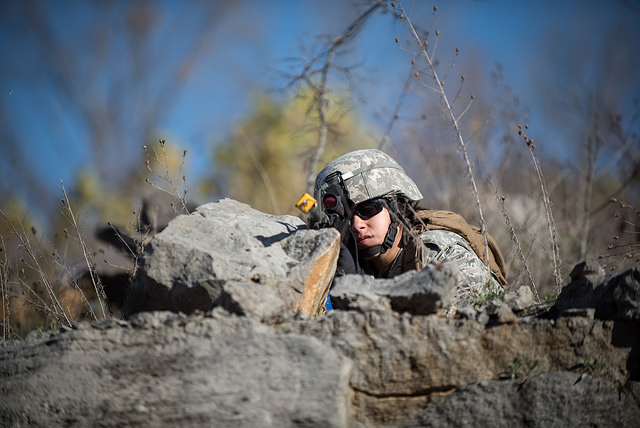
A Fire Team member from the Kentucky Air National Guard’s 123rd Security Forces Squadron provides cover as his teammates search for a simulated downed pilot inside a mock Afghan Village at Fort Knox, Ky., Oct. 20, 2015. The Airmen were required to execute a coordinated search while defending their positions and engaging hostile forces. (U.S. Air National Guard photo by Maj. Dale Greer)