Pages
Stay In Touch
More
© 2013 KentuckyGuard
Kentucky National Guard Public Affairs Staff Report
Summary of the Kentucky National Guard in the Persian Gulf War 1990-91
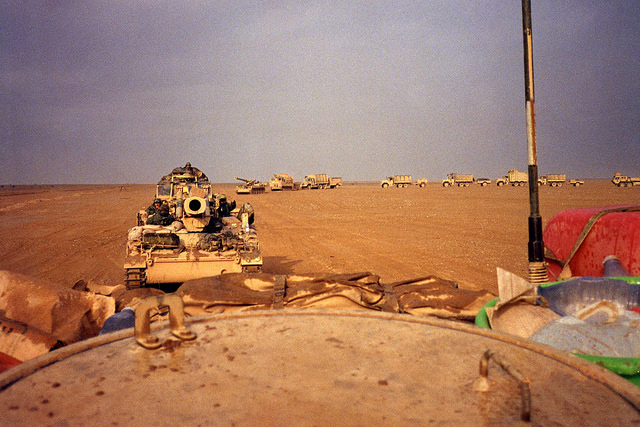
Soldiers with the 1st Battalion, 623rd Field Artillery move supplies and equipment along the Iraqi border during Operation Desert Storm, Feb. 27, 1991. As one of the few National Guard combat arms units deployed to the theater, the 623rd provided fire support for coalition forces during the conflict. (Kentucky National Guard historical photo)
It’s been 25 years since the United States first went to war in the Persian Gulf. Aug. 2, 1990 saw the invasion of Kuwait by neighboring Iraq, an event that both shocked and outraged the world. Spearheading a 21-member United Nations coalition, the United States initiated Operation Desert Shield, the largest military buildup since the Vietnam War.
On Jan. 17, 1991, Americans at home watched as Operation Desert Shield turned into a Desert Storm. A six-week air campaign preceded what came to be known as “The One-Hundred Hour War,” leading to the swift liberation of Kuwait.
Click here for more historical photos.
Once again Kentuckians found themselves on the forefront of the assault. From Fort Campbell came the 101st Airborne Division, the 160th Special Operations Aviation Regiment, and the 5th Special Forces Group. Fort Knox sent elements of its 194th Separate Armor Brigade. Together, the two bases sent 21,500 men and women into battle.
Because of the size and intensity of the planned offensive, reserve components from all over Kentucky were called to duty, performing such diverse missions as ensuring the transportation and accountability of equipment and supplies, providing direct fire support, battlefield medical support and refugee relief, water purification, film and video documentation of military actions, security and handling of prisoners of war. Some reservists served as replacements for active duty units called to action.
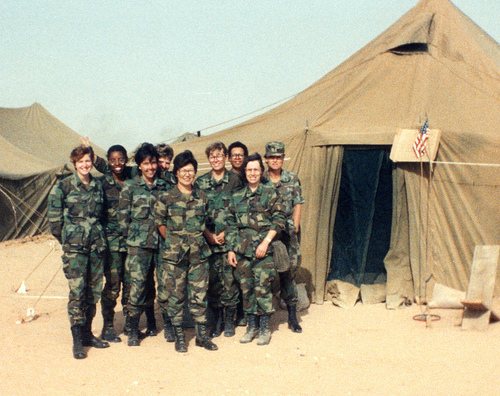
Members of the 475th Mobile Army Surgical Hospital (MASH) stand outside their tent in Saudi Arabia during Operation Desert Storm, 1991. (Courtesy photo)
Kentucky can be especially proud of the 1078 Kentucky Army National Guardsmen and women who went to the desert and performed valiantly during Desert Storm.
They were Soldiers with the following units: 137th Transportation Det., 217th Quartermaster Det., 2123rd Transportation Co., 475th Mobile Army Surgical Hospital (MASH), 133rd Public Affairs Det., 223rd and 438th Military Police Companies.
Batteries of Kentucky’s 1st Battalion, 623rd Field Artillery served as one of the few National Guard combat arms units activated.
Nearly 400 National Guard units were activated with nearly 40,000 Guardsmen serving in theater.
During the offensive, Kentucky Guard artillery was given the mission of providing fire support for the coalition forces while heavy equipment transportation traveled as far as the Euphrates carrying the load for the advancing troops. Military police personnel processed thousands of enemy prisoners of war and our Mobile Army Surgical Hospital cared for the ill and injured during a post-war humanitarian relief effort.
Back home the C-130’s of the 123rd Tactical Airlift Wing moved personnel and equipment throughout the U.S. in support of Desert Storm, while our engineers assisted in a variety of state and local projects.
U.S. Army Reserve units deployed from Kentucky included the 100th Division, the 807th Mobile Army Surgical Hospital, the 888th Medical Detachment, and the 5010th Army Hospital.
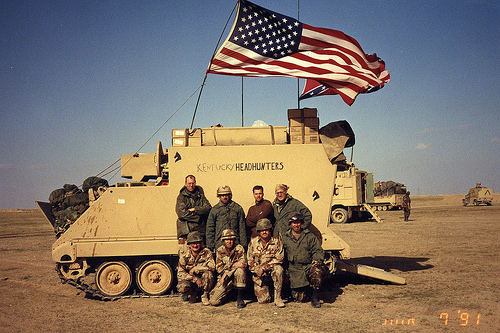
Soldiers of the Kentucky National Guard’s 1st Battalion, 623rd Field Artillery deployed to the Persian Gulf for Operation Desert Storm, Jan-April, 1991. The artillery unit was one of eight Kentucky units activated for service during the conflict. (Kentucky National Guard historical photo)
In all, 23,210 Kentucky Service members from both the active and reserve forces served in Southwest Asia.
“Serving in Operation Desert Shield and Desert Storm was a very rewarding experience for me as a young officer in the Kentucky National Guard,” said Lt. Col. Allen Boone, who served as a lieutenant with the 623rd at the time.” In less than three years after joining the nationally recognized 623rd Field Artillery, I found myself halfway around the world with some of the finest men in the United States Armed Forces.”
“It was an honor for me to serve in operations which proved to be one of the greatest examples of military power by U.S. Armed Forces in the history of our nation. The years of strategic planning, followed by equipping and properly training personnel for military operations was executed with effective precision in the first 100 hours of ground combat.”
“The motto of the 623rd is “Seize the Opportunity” and it’s Soldiers who served in the Civil War through Iraq and Afghanistan continue a legacy of professional service to our nation at home and around the world.”
PERSIAN GULF WAR TIMELINE (May 1990 – April 1991)
1990 - May 28-30: Iraqi president Saddam Hussein says that oil overproduction by Kuwait and United Arab Emirates is “economic warfare” against Iraq.
July 15: Iraq accuses Kuwait of stealing oil from Rumaylah oil field near the Iraqi-Kuwaiti border and warns of military action.
July 22: Iraq begins deploying troops to the Iraqi-Kuwaiti border and building a massive military buildup.
August 2: About 100,000 Iraqi troops invade Kuwait. Kuwait is in Iraqi control by the end of the day.
August 6: The U.N. Security Council imposes a trade embargo on Iraq in a 13-0 vote, with Cuba and Yemen abstaining. President George H. W. Bush orders the deployment of U. S. armed forces to defend Saudi Arabia in an operation named OPERATION DESERT SHIELD.
August 7: First U.S. troops arrive in Saudi Arabia.
August 8: Saddam Hussein proclaims the annexation of Kuwait.
August 9: U. N. declares Iraqi annexation of Kuwait void.
August 10: Hussein declares a “jihad” or holy war against the U. S. and Israel.
August 12: Naval blockade of Iraq begins. All shipments of Iraqi oil halted.
August 28: Iraq declares Kuwait as its 19th province and renames Kuwait City as al-Kadhima.
September 14-15: United Kingdom and France announce the deployment of 10,000 troops to Saudi Arabia.
December 17: The United Nations sets a deadline for Iraq to withdraw from Kuwait before January 15, 1991, or face military action. Hussein rejects all U. N. resolutions.
1991 - January 9: Talks in Geneva, Switzerland, between U.S. Secretary of State James Baker and Iraqi Foreign Minister Tariq Aziz end with no progress.
January 12: Congress grants President Bush authority to wage war.
January 16: The White House announced the commencement of OPERATION DESERT STORM: offensive action against the forces of Iraq under the provisions of U.N. Security Council/U.S. Congressional resolutions.
January 17: The war begins at 2:38 a.m. Baghdad time when AH-64 Apache attack helicopters destroy Iraqi radar sites, later F-117 Nighthawk Stealth Fighters bomb Baghdad and Iraqi forces. Operation Desert Storm begins.
January 18: Iraq strikes with Soviet-made SCUD missiles on Israel. The U.S. deploys Patriot missiles to Israel and Saudi Arabia.
January 22: Iraqi troops begin blowing up Kuwaiti oil wells.
January 25: Iraqi troops begin “environmental war” by dumping millions of gallons of crude oil into the Persian Gulf.
January 29: Iraqi forces invade the town of Khafji in Saudi Arabia. Iraqi forces are soon engaged by Saudi Arabian and Qatari troops with U.S. Marine artillery.
January 31: Iraqi forces capture Melissa Rathbun-Nealy, the first female Prisoner of War since World War II.
February 1: Iraqi forces are driven out of Saudi Arabia. Allied Forces win the Battle of Khafji. Secretary of Defense Richard Cheney warns U. S. will retaliate if Iraq uses chemical or unconventional weapons.
February 8: Total U. S. troop strength in the Gulf over a half million.
February 12-13: A bombing raid by U.S. forces against Baghdad kills 400 Iraqi civilians in an air raid shelter, and three major bridges.
February 19: Soviet-Iraqi peace plan rejected by President Bush. Oil spill in Gulf now estimated at 1.5 million barrels.
February 22: Pres. Bush issues a 24-hour ultimatum: Iraq must withdraw from Kuwait to avoid start of a ground war.
February 24: Allied Forces invade Iraq and Kuwait at around 4 a.m. Baghdad time. The U.S. Army is the first to enter Iraqi territory.
February 25: An Iraqi SCUD missile hits U.S. barracks near Dhahran, Saudi Arabia, killing 28 U.S. troops.
February 26: Saddam Hussein orders the Iraqi withdrawal from Kuwait. About 10,000 retreating Iraqi troops are killed when Allied aircraft bomb them, it is called the “Highway of Death.”
February 27: U.S. Marines and Saudi Arabian troops enter Kuwait City. The U.S. Army’s 1st Armored Division engages the Iraqi Republican Guard in the Battle of Medina Ridge in Iraq. President Bush declares Kuwait liberated.
February 28: By Presidential order all Coalition offensive operations ceased at 0800 local time.
March 1: The cease-fire plan is negotiated in Safwan, Iraq.
March 17: First U.S. troops arrive home.
April 11: The U.N. Security Council declared a formal cease-fire, ending the Gulf War.
By Staff Sgt. Scott Raymond, Kentucky National Guard Public Affairs, with contributions by Kentucky State Police Public Affairs
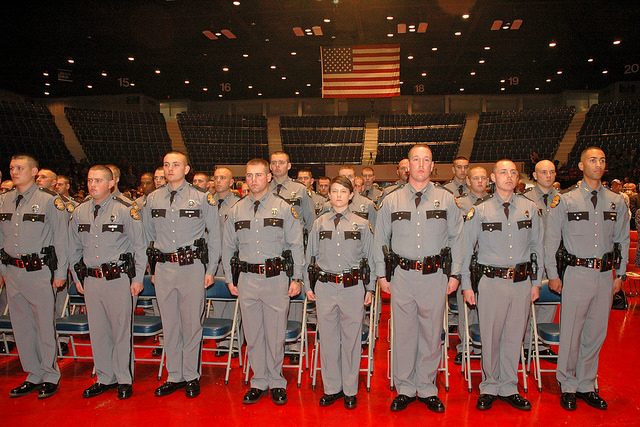
The Kentucky State Police Academy presented diplomas to 45 new troopers at ceremonies held in Frankfort on Oct. 29. Among the new Troopers were three Kentucky Guardsmen. (Photo courtesy of Kentucky State Police)
FRANKFORT, Ky. — The Kentucky State Police Academy presented diplomas to 45 new troopers at ceremonies held in Frankfort, Oct.29. Their addition to the force brings the agency’s strength to a total of 880 troopers serving the citizens of the Commonwealth.
Of those 45 new troopers three are all too familiar with wearing a common uniform and standing for something bigger than themselves. They are also Kentucky National Guardsmen.
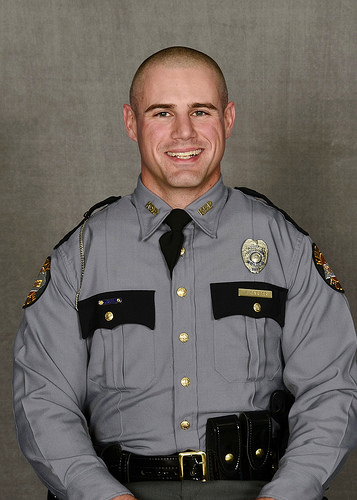
Staff Sgt. Jordan Carter with the 1st Battalion, 623rd Field Artillery graduated from the Kentucky State Police Academy Oct. 29, 2015. (Photo courtesy of Kentucky State Police)
Staff Sgt. Jordan Carter with the 1st Battalion, 623rd Field Artillery, 1st Lt. Jacobe Farmer with Bravo Company, 1st Battalion, 149th Infantry and Sgt. Michael Jacobs from the 2123rd Transportation Company each accepted a new role and responsibility to the commonwealth.
“The National Guard had taught me numerous skills and values that helped me as a soldier,” said Jacobs. “However, I wanted a new challenge with similar interests that would help me adapt to a civilian career that I would enjoy.”
“I always wanted to be a Trooper. I figured that joining the Guard would help me obtain that goal,” said Carter. “Plus I like helping people so it provided a great opportunity.”
The new troopers are part of the agency’s 93rd cadet class. They reported for duty on May 24, 2015 in a class that consisted of 70 cadets.
The training included more than 1,000 hours of classroom and field study in subjects such as constitutional law, juvenile and traffic law, use of force, weapons training, defensive tactics, first aid, high speed vehicle pursuit, criminal investigation, computer literacy, hostage negotiations, evidence collection, radio procedures, search and seizure, crash investigation, drug identification, traffic control, crowd control, armed robbery response, land navigation, electronic crimes, sex crimes, hate crimes, domestic violence, bomb threats and hazardous materials.
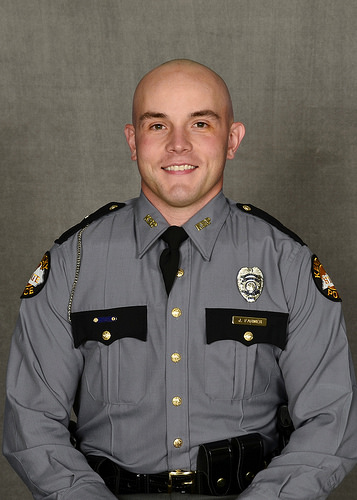
1st Lt. Jacobe Farmer with Bravo Company, 1st Battalion, 149th Infantry graduated from the Kentucky State Police Academy Oct. 29, 2015. (Photo courtesy of Kentucky State Police)
Each Guardsman expressed a true desire to help others, the same thought that inspired them to join the military.
All three also are grateful for the training they have received in the Guard, which helped them through the Kentucky State Police Academy.
“Joining the guard prepared me in numerous ways and instilled in me the seven Army values which should be something that everyone lives by,” said Carter. “Being a Trooper involves so much and the seven Army values aren’t just “valued” by the Army. They are incorporated in the daily life of a Trooper as well.”
“Multi-tasking and attention to detail go hand and hand with what I have picked up from being in the Guard and my military training towards my career field in law enforcement,” said Farmer. “As a Trooper I will deal with a variety of events and at times they will be one after another and/or all together and for me to be able to handle many tasks at once while not leaving out important details is essential in my field.”
Lt. Col. L. Allen Joiner, commander of the 1/623rd said the unit is proud of Carter and their decisions of selfless service in multiple uniforms, a benefit he has seen first hand.
“Serving both on the State Police force and in the Kentucky National Guard, these individuals are able to acquire knowledge and experience that saves lives during Kentucky natural disasters and emergencies when these organizations are working side by side,” said Joiner. “An example is during the 2009 ice storm, one of our Soldiers, who was also a State Police officer was able to use his civilian position resources to provide current road conditions to our military units across Western Kentucky.”
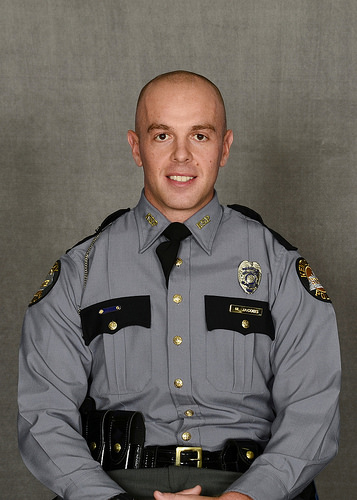
Sgt. Michael Jacobs from the 2123rd Transportation Company graduated from the Kentucky State Police Academy Oct. 29, 2015. (Photo courtesy of Kentucky State Police)
Carter will be assigned to Post 3 in Bowling Green and Jacobs Post 16 in Henderson. Farmer joins Post 4 in Elizabethtown alongside Indiana National Guardsman Brad Holloman.
“Joining the KSP is not for the weak-hearted or weak-minded and it takes a special person to be a Kentucky State Trooper,” said Farmer “The training academy to many people would be the most physically enduring thing they have done, but in the end you are a part of the KSP family and the honor, respect, and tradition that it has and upholds.”
“Being a Trooper will benefit my military career in regards to maintaining discipline, staying vigilant, and performing at a higher standard,” said Jacobs. “I look forward to learning in both roles as a Soldier and Trooper to be the best I can be for the Commonwealth of Kentucky.”
By, Maj. Jimmie Warinner, 1st Battalion, 623rd Field Artillery
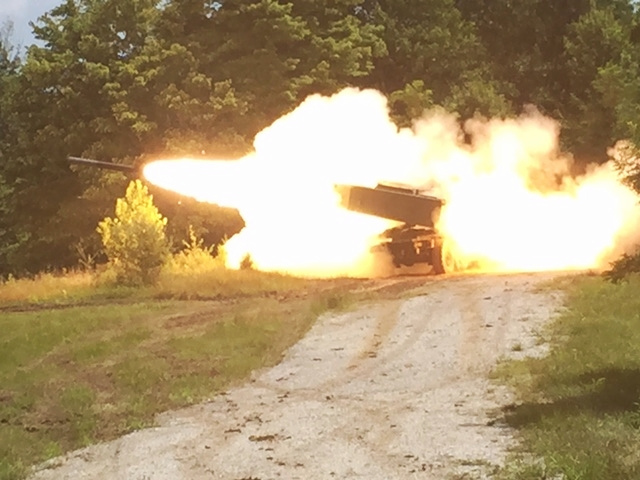
A M142 High Mobility Rocket Launcher (HIMARS) from the 1st Battalion, 623rd Field Artillery fires during training at Camp Atterbury, Ind., July 21, 2015. The launch was the first live fire exercise conducted at Camp Atterbury. (U.S. Army National Guard photo by Maj. Jimmie Warriner)
CAMP ATTERBURY, Ind. — Soldiers of the 1st Battalion 623rd Field Artillery recently completed an innovative and successful annual training at Camp Atterbury, Indiana. The key training event for AT 2015 was a seven day field training exercise that concluded July 24 with all crews in the battalion conducting multiple live fires with the M142 High Mobility Artillery Rocket System (HIMARS).
This was the first Multiple Launch Rocket System (MLRS) or HIMARS live fire ever conducted at Camp Atterbury, and was made possible through close coordination with the 1/623rd and Camp Atterbury’s Range Control personnel. Not only did this coordination allow Morgan’s Men to successfully complete crew certifications, but it also demonstrated an increased training capability for Camp Atterbury confirming that they can support future live fire training for both MLRS and HIMARS units.
This was only one of three “firsts” that Morgan’s Men accomplished during this annual training.
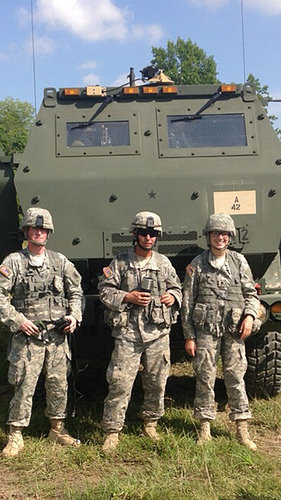
Spc. Michael Fosso, Staff Sgt. Norman Schwartz, and Spc. Logan Green with the 1st Battalion, 623rd Field Artillery stand in front of their HIMARS vehicle, “Rebel 42” during their live fire exercise during annual training July 21, 2015 at Camp Atterbury, Ind. Green is the first female crew member with the 1/623rd. (U.S. Army National Guard photo by Maj. Jimmie Warriner)
Among the crew members sending rockets roaring downrange was Spc. Logan Green, the first female MLRS Crewman to ever fire a rocket for the 1/623rd. With more combat arms military occupational specialties opening to women, females now have the option of becoming MLRS Crewmen (13M) or Fire Direction Control Operators (13P) within HIMARS units.
A HIMARS crew consists of a Gunner, Driver, and Launcher Chief. Green is the driver for Alpha Battery’s HIMARS nicknamed “Rebel 42”. She grew up in Florida and joined the Kentucky National Guard because she always wanted to be in the military and it allowed her to fund her college education.
“I am proud and excited to be the first female to live fire the HIMARS in the 1-623d and I want to set a good example for other Soldiers, males and females, who serve with me”. Green, a 2015 recipient of the Minuteman Scholarship, plans on continuing her military career by pursuing a commission as a Field Artillery officer through the University of Kentucky’s ROTC program.
Click here to read about Green’s enlistment into the Kentucky Guard.
The final “first” completed during Annual Training 2015 was support of a MLRS Crewmen (13M30) Advanced Leadership Course (ALC) conducted by 1st Battalion 238th Regiment. Nine Soldiers, including seven from the 1/623rd completed the first week of the 13M30 course at the Wendell H. Ford Regional Training Center in Greenville, Kentucky before traveling to Camp Atterbury to complete week two in the field. For the culminating event of the course, the ALC students were certified by the battalion’s Master Gunner and then participated in a HIMARS live fire.
This was the first time that a HIMARS live fire has been part of a MLRS crewman course, but something that Regional Training Institutes throughout the country are considering implementing as part of their course of instruction. The partnership between the 1/623rd and 1/238th proved that this concept of training is viable, allowing Soldiers to complete ALC while also participating in valuable training exercises with their assigned units and crews. This cooperative effort also resulted in the Soldiers completing the course with very little additional cost to the Kentucky Army National Guard beyond that of a normal annual training.
With Annual Training 2015 completed, Morgan’s Men are now preparing for future training operations and more “firsts” such as a planned training event with the Kentucky Air National Guard.
To learn more about Morgan’s Men and the great things they’re doing, follow them on Facebook.
Story and photos by Sgt. Bryan Ploughe, 1st Battalion, 623rd Field Artillery Unit Public Affairs Historian Representative
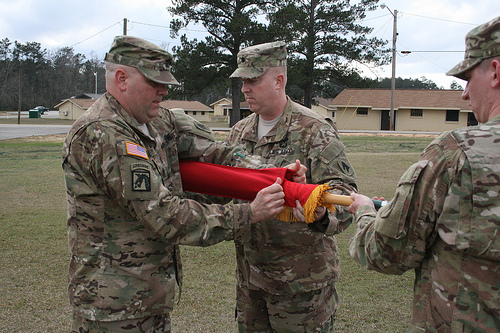
Sgt. Maj. Robert Neathery and Lt. Col. Timothy Fanter case the 623d Battalion colors during a ceremony at Camp Shelby, Miss., Jan. 28, 2013. The unit finished their pre-mobilization training at the site and prepared for deployment in support of Operation Enduring Freedom. (Kentucky National Guard photo by Sgt. Bryan Ploughe)
CAMP SHELBY, Miss. — On a sloping grassy area in Camp Shelby, Miss. the nearly 200 deploying members of the 1st Battalion, 623d Field Artillery gathered in formation, broken down by their perspective firing battery with the 623d battalion colors leading the front of the formation. The battalion commander, Lt. Col. Timothy Fanter, and Sgt. Maj. Robert Neathery, took to the front of the formation and began the official ceremony.
The casing of the colors is an Army tradition that symbolizes the movement of a unit to a new theater of operation. At a ceremony at Camp Shelby Miss. the tradition and legacy of the 1/623d was carried out once again as Morgan’s Men prepare to move to Jordan. Once the battalion officially replaces the unit that is there now, the colors will be uncovered to represent their area of operation.
“This casing ceremony is as symbolic as it is historic,” said Col. Brian Wertzler, Brigade Commander of the 138th Fires Brigade. “The Colors of the 1/623rd Battalion have been home in Kentucky for more than 20 years since their last deployment, always standing ready to protect the Nation that it proudly serves.”
“As the Colors are furled and covered, the professionalism and high morale of the Soldiers is indicative of the successes that 1/623rd FA Battalion will attain when the Colors are unfurled and fly proudly in Jordan.”
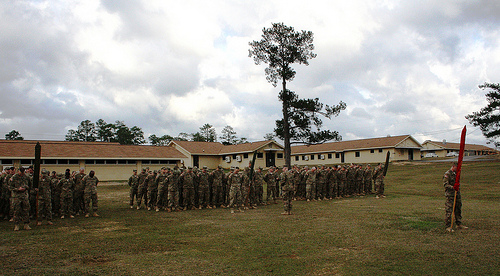
Soldiers of the 1st Battalion, 623rd Field Artillery stand in formation during a color casing ceremony at Camp Shelby, Miss., Jan. 28, 2013. The colors of the battalion were cased until the unit arrives overseas for their scheduled nine-month deployment. (Kentucky National Guard photo by Sgt. Bryan Ploughe)
As the colors began to become encased, each firing battery that was represented followed suit simultaneously. After all colors had were encased, Fanter and Neathery spoke a little about the history of the battalion as well as hit upon the expectations of the Soldiers for this mission they were about to embark upon.
“To the best of our recent memory, this is only the third time that the battalion colors have gone forward to fly on foreign soil,” said Neathery. “They include the Korean War, Desert Storm and now with Operation Enduring Freedom. Some of these Soldiers don’t realize it now, but they are making an impact of this battalion’s history because of this fact.”
To carry the battalion colors to foreign soil is a history making event. Although the firing battery guidons have gone forward in support many other times, for example in 2003 when the Unit mobilized and then again in 2005 when they deployed, this is only the third time for the battalion colors.
Story and photos by Spc. David Dixon, 1st Battalion, 623d Field Artillery Unit Public Affairs Historian Representative
NOTE: Each week kentuckyguard.com publishes stories by Kentucky National Guard unit public affairs historian representatives, also known as UPAHRs. This is an additional duty taken on by a Soldier or Airmen with the intent of telling their unit’s story. This is one such story ….
Lt. Col. Timothy A. Fanter receives the 1st Battalion, 623d Field Artillery colors from 138th Fires Brigade Commander Col. Rondal Turner in a ceremony that transfers responsibilities and honors to the incoming commander in Glasgow, Ky., Oct. 16.
GLASGOW, Ky. — (October 16, 2011) Soldiers from the 1st Battalion, 623rd Field Artillery and the 203rd Forward Support Company assembled at the Glasgow Armory to honor the outgoing battalion commander Lt. Col. Jeffery S. Hughes and welcome a new commander, Lt. Col. Timothy A. Fanter.
“This battalion consists of over 400 hundred of the most dedicated, hard working and loyal Soldiers that a commander could ask for,” said Hughes. “This is a bittersweet moment, this battalion is my home and it is the best battalion in the United States Army.”
Fanter expressed excitement about his new responsibility and outlined three goals as the incoming commander.
Lt. Col. Timothy A. Fanter addresses his newly assigned battalion and family, friends and distinguished guests at the 1st Battalion 623rd Field Artillery Change of Command in Glasgow, Ky., Oct. 16.
“We will continue to take care of our Soldiers and their Families, continue to develop our troops to be strong leaders and to train for whatever mission we may be given,” said Fanter. “Whether it is serving and assisting our citizens in this great Commonwealth or defending freedom on a larger scale.”
The 623rd was originally organized on May 22, 1846 as the first Kentucky Volunteer Cavalry Regiment. It has fought in the Mexican War, Civil War, Spanish–American War, World War l, World War II, Korean War, Desert Storm, Operation Enduring Freedom and Operation Iraqi Freedom.
It now has 46 battle streamers to include the Presidential Unit Citation and the Navy Unit Citation during the Korean War. During Operation Iraqi Freedom, two of the battalion’s batteries (units) received the Meritorious Unit Commendation as well.
Story and photos by Sgt. Bryan Ploughe, 1st Battalion, 623d Field Artillery Unit Public Affairs Historian Representative
NOTE: Each week kentuckyguard.com publishes stories by Kentucky National Guard unit public affairs historian representatives, also known as UPAHRs. This is an additional duty taken on by a Soldier or Airmen with the intent of telling their unit’s story. This is one such story ….
Standing over the completed concrete landmark of the 623d are pictured from left to right is Sgt. 1st Class Donald Jones, Sgt. 1st Class James Flickinger, Johnothan Booth, Sgt. Jeffery Reece, Staff Sgt. Dusty Cook, Lt. Col. Jeffery Hughes, 1st Lt. Sammy Firkins, Staff Sgt. Steven Gibson, Sgt. Marcus Thurman and Sgt. 1st Class David Page. (Photo by Sgt. Bryan Ploughe, 1/623rd Field Artillery Unit Public Affairs Historian Representative)
Glasgow, Ky. (October 16, 2011) – It’s no secret that the Kentucky Army National Guard’s 1st Battalion, 623rd Field Artillery has a long standing tradition of giving to the surrounding communities. In addition to their wartime duties, Citizen-Soldiers have served during ice storms, floods and tornadoes, whenever local citizens were in need. The tables were recently turned when they received a token of thanks from a local business during some improvements at the National Guard Armory in Glasgow.
The full time members of the 623d take great pride in their armory’s appearance. When they had noticed an erosion issue at in one areas of the campus, they tried without reseeding without much success. Several ideas were discussed as to how to fix it, and they finally came to a conclusion that they would like to have a concrete pad made in the image of the battalion horsehead patch.
1st Lt. Sammy Firkins and Sgt. 1st Class David Page contacted Booth Concrete in Glasgow for some professional guidance. Business owner Joe Booth jumped at the idea and offered to take on the project free of charge.
“We wanted to be a part of this improvement to the Armory, because just like the 623d has always supported their community, this was a chance for us to show a bit of gratitude,” said Booth. “As a small business owner we wanted to be able to show our support to the men and women of our military, for all of the sacrifices and commitment they have made to serve our country.”
This concrete horsehead landmark was created by Booth Concrete in Glasgow for the men and women of Kentucky Army National Guard’s 1st Battalion, 623d Field Artillery. (Photo by Sgt. Bryan Ploughe, 1/623rd Field Artillery Unit Public Affairs Historian Representative)
Lt. Col. Jeffery Hughes, commander of the 1/623rd, takes great pride in the collaboration between the Guard members and Booth Concrete.
“Just as this pad of concrete is strong and will withstand the test of time and all conditions it is given, so will the Soldiers of this battalion,” said Hughes.
“This is a fine representation of this battalion,” said Firkins. “We are like no other unit in this great Commonwealth. It is only fitting to have such a great focal point on our grounds. This is something that no other unit has.”