Pages
Stay In Touch
More
© 2013 KentuckyGuard
Kentucky National Guard Public Affairs Staff Report
Summary of the Kentucky National Guard in the Persian Gulf War 1990-91
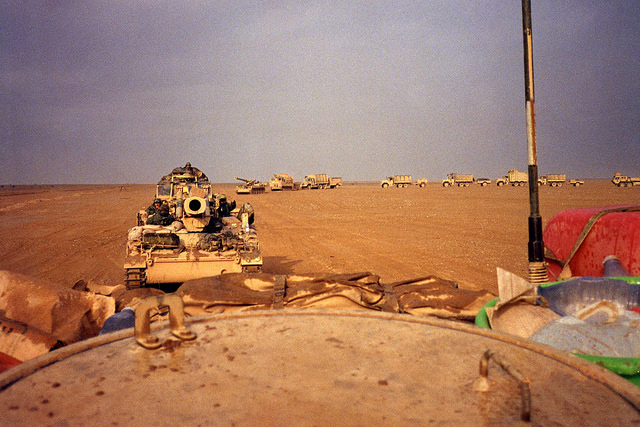
Soldiers with the 1st Battalion, 623rd Field Artillery move supplies and equipment along the Iraqi border during Operation Desert Storm, Feb. 27, 1991. As one of the few National Guard combat arms units deployed to the theater, the 623rd provided fire support for coalition forces during the conflict. (Kentucky National Guard historical photo)
It’s been 25 years since the United States first went to war in the Persian Gulf. Aug. 2, 1990 saw the invasion of Kuwait by neighboring Iraq, an event that both shocked and outraged the world. Spearheading a 21-member United Nations coalition, the United States initiated Operation Desert Shield, the largest military buildup since the Vietnam War.
On Jan. 17, 1991, Americans at home watched as Operation Desert Shield turned into a Desert Storm. A six-week air campaign preceded what came to be known as “The One-Hundred Hour War,” leading to the swift liberation of Kuwait.
Click here for more historical photos.
Once again Kentuckians found themselves on the forefront of the assault. From Fort Campbell came the 101st Airborne Division, the 160th Special Operations Aviation Regiment, and the 5th Special Forces Group. Fort Knox sent elements of its 194th Separate Armor Brigade. Together, the two bases sent 21,500 men and women into battle.
Because of the size and intensity of the planned offensive, reserve components from all over Kentucky were called to duty, performing such diverse missions as ensuring the transportation and accountability of equipment and supplies, providing direct fire support, battlefield medical support and refugee relief, water purification, film and video documentation of military actions, security and handling of prisoners of war. Some reservists served as replacements for active duty units called to action.
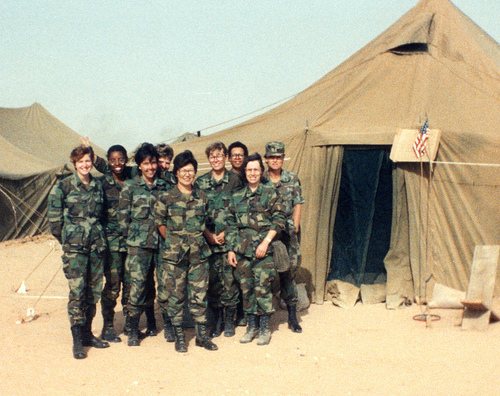
Members of the 475th Mobile Army Surgical Hospital (MASH) stand outside their tent in Saudi Arabia during Operation Desert Storm, 1991. (Courtesy photo)
Kentucky can be especially proud of the 1078 Kentucky Army National Guardsmen and women who went to the desert and performed valiantly during Desert Storm.
They were Soldiers with the following units: 137th Transportation Det., 217th Quartermaster Det., 2123rd Transportation Co., 475th Mobile Army Surgical Hospital (MASH), 133rd Public Affairs Det., 223rd and 438th Military Police Companies.
Batteries of Kentucky’s 1st Battalion, 623rd Field Artillery served as one of the few National Guard combat arms units activated.
Nearly 400 National Guard units were activated with nearly 40,000 Guardsmen serving in theater.
During the offensive, Kentucky Guard artillery was given the mission of providing fire support for the coalition forces while heavy equipment transportation traveled as far as the Euphrates carrying the load for the advancing troops. Military police personnel processed thousands of enemy prisoners of war and our Mobile Army Surgical Hospital cared for the ill and injured during a post-war humanitarian relief effort.
Back home the C-130’s of the 123rd Tactical Airlift Wing moved personnel and equipment throughout the U.S. in support of Desert Storm, while our engineers assisted in a variety of state and local projects.
U.S. Army Reserve units deployed from Kentucky included the 100th Division, the 807th Mobile Army Surgical Hospital, the 888th Medical Detachment, and the 5010th Army Hospital.
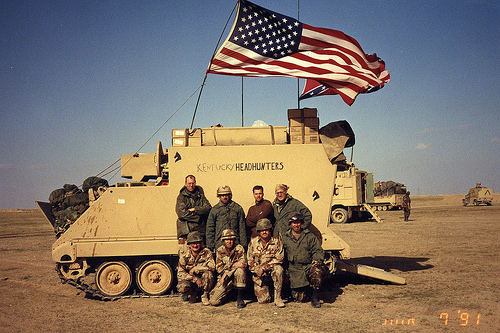
Soldiers of the Kentucky National Guard’s 1st Battalion, 623rd Field Artillery deployed to the Persian Gulf for Operation Desert Storm, Jan-April, 1991. The artillery unit was one of eight Kentucky units activated for service during the conflict. (Kentucky National Guard historical photo)
In all, 23,210 Kentucky Service members from both the active and reserve forces served in Southwest Asia.
“Serving in Operation Desert Shield and Desert Storm was a very rewarding experience for me as a young officer in the Kentucky National Guard,” said Lt. Col. Allen Boone, who served as a lieutenant with the 623rd at the time.” In less than three years after joining the nationally recognized 623rd Field Artillery, I found myself halfway around the world with some of the finest men in the United States Armed Forces.”
“It was an honor for me to serve in operations which proved to be one of the greatest examples of military power by U.S. Armed Forces in the history of our nation. The years of strategic planning, followed by equipping and properly training personnel for military operations was executed with effective precision in the first 100 hours of ground combat.”
“The motto of the 623rd is “Seize the Opportunity” and it’s Soldiers who served in the Civil War through Iraq and Afghanistan continue a legacy of professional service to our nation at home and around the world.”
PERSIAN GULF WAR TIMELINE (May 1990 – April 1991)
1990 - May 28-30: Iraqi president Saddam Hussein says that oil overproduction by Kuwait and United Arab Emirates is “economic warfare” against Iraq.
July 15: Iraq accuses Kuwait of stealing oil from Rumaylah oil field near the Iraqi-Kuwaiti border and warns of military action.
July 22: Iraq begins deploying troops to the Iraqi-Kuwaiti border and building a massive military buildup.
August 2: About 100,000 Iraqi troops invade Kuwait. Kuwait is in Iraqi control by the end of the day.
August 6: The U.N. Security Council imposes a trade embargo on Iraq in a 13-0 vote, with Cuba and Yemen abstaining. President George H. W. Bush orders the deployment of U. S. armed forces to defend Saudi Arabia in an operation named OPERATION DESERT SHIELD.
August 7: First U.S. troops arrive in Saudi Arabia.
August 8: Saddam Hussein proclaims the annexation of Kuwait.
August 9: U. N. declares Iraqi annexation of Kuwait void.
August 10: Hussein declares a “jihad” or holy war against the U. S. and Israel.
August 12: Naval blockade of Iraq begins. All shipments of Iraqi oil halted.
August 28: Iraq declares Kuwait as its 19th province and renames Kuwait City as al-Kadhima.
September 14-15: United Kingdom and France announce the deployment of 10,000 troops to Saudi Arabia.
December 17: The United Nations sets a deadline for Iraq to withdraw from Kuwait before January 15, 1991, or face military action. Hussein rejects all U. N. resolutions.
1991 - January 9: Talks in Geneva, Switzerland, between U.S. Secretary of State James Baker and Iraqi Foreign Minister Tariq Aziz end with no progress.
January 12: Congress grants President Bush authority to wage war.
January 16: The White House announced the commencement of OPERATION DESERT STORM: offensive action against the forces of Iraq under the provisions of U.N. Security Council/U.S. Congressional resolutions.
January 17: The war begins at 2:38 a.m. Baghdad time when AH-64 Apache attack helicopters destroy Iraqi radar sites, later F-117 Nighthawk Stealth Fighters bomb Baghdad and Iraqi forces. Operation Desert Storm begins.
January 18: Iraq strikes with Soviet-made SCUD missiles on Israel. The U.S. deploys Patriot missiles to Israel and Saudi Arabia.
January 22: Iraqi troops begin blowing up Kuwaiti oil wells.
January 25: Iraqi troops begin “environmental war” by dumping millions of gallons of crude oil into the Persian Gulf.
January 29: Iraqi forces invade the town of Khafji in Saudi Arabia. Iraqi forces are soon engaged by Saudi Arabian and Qatari troops with U.S. Marine artillery.
January 31: Iraqi forces capture Melissa Rathbun-Nealy, the first female Prisoner of War since World War II.
February 1: Iraqi forces are driven out of Saudi Arabia. Allied Forces win the Battle of Khafji. Secretary of Defense Richard Cheney warns U. S. will retaliate if Iraq uses chemical or unconventional weapons.
February 8: Total U. S. troop strength in the Gulf over a half million.
February 12-13: A bombing raid by U.S. forces against Baghdad kills 400 Iraqi civilians in an air raid shelter, and three major bridges.
February 19: Soviet-Iraqi peace plan rejected by President Bush. Oil spill in Gulf now estimated at 1.5 million barrels.
February 22: Pres. Bush issues a 24-hour ultimatum: Iraq must withdraw from Kuwait to avoid start of a ground war.
February 24: Allied Forces invade Iraq and Kuwait at around 4 a.m. Baghdad time. The U.S. Army is the first to enter Iraqi territory.
February 25: An Iraqi SCUD missile hits U.S. barracks near Dhahran, Saudi Arabia, killing 28 U.S. troops.
February 26: Saddam Hussein orders the Iraqi withdrawal from Kuwait. About 10,000 retreating Iraqi troops are killed when Allied aircraft bomb them, it is called the “Highway of Death.”
February 27: U.S. Marines and Saudi Arabian troops enter Kuwait City. The U.S. Army’s 1st Armored Division engages the Iraqi Republican Guard in the Battle of Medina Ridge in Iraq. President Bush declares Kuwait liberated.
February 28: By Presidential order all Coalition offensive operations ceased at 0800 local time.
March 1: The cease-fire plan is negotiated in Safwan, Iraq.
March 17: First U.S. troops arrive home.
April 11: The U.N. Security Council declared a formal cease-fire, ending the Gulf War.
By Sgt. David Cox, 63rd Theater Aviation Brigade
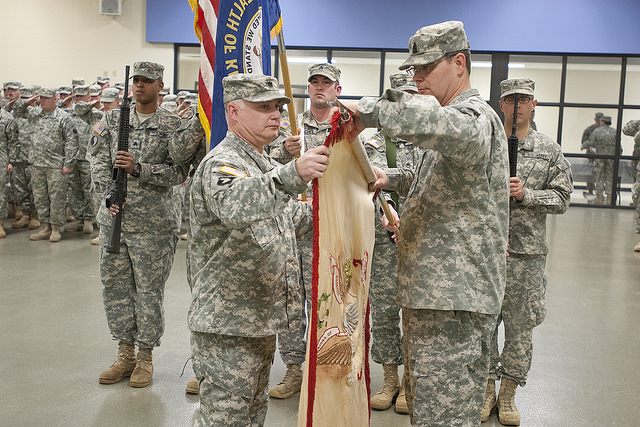
Lt. Col. Mark Brozak, commander of the 1204th Aviation Support Battalion furls the unit’s colors with help from Command Sgt. Maj. Scott Foster during an inactivation ceremony in Burlington, Ky., Jan. 10, 2016. After nearly 10 years of service to the Nation and commonwealth, the unit was stood down due to Army force structure changes. (U.S. Army National Guard photo by Sgt. David Cox)
BURLINGTON, Ky. — Soldiers with 1204th Aviation Support Battalion furled their battalion colors for the last time during an inactivation ceremony Jan. 10, at the National Guard Readiness Center in Burlington, Ky.
The unit of nearly 300 has been inactivated in accordance the Army’s force structure realignment.
Activated in 2006, the 1204th played a vital role in disaster recovery operations during the 2009 Ice Storm and deployed to Iraq in 2011 in support of Operation New Dawn .
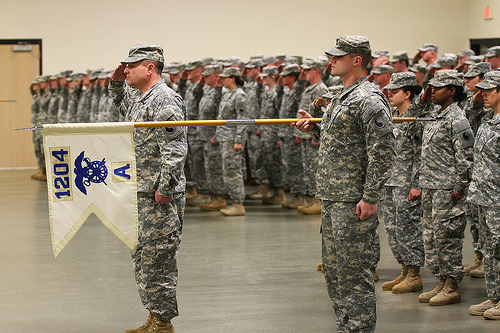
Soldiers of the 1204th Aviation Support Battalion salute during an inactivation ceremony in Burlington, Ky., Jan. 10, 2016. Activated in 2006, the unit was home to nearly 300 Soldiers. (U.S. Army National Guard photo by Staff Sgt. Scott Raymond)
“From 2006 to today, this unit has probably done more as an ASB than the other 12 currently in the force,” said Brig. Gen. Benjamin F. Adams, III, Chief of the Joint Staff. “Being able to deploy as a battalion to five different countries during a time of war says a great deal about the unit and its personnel.”
Click here for more photos.
Lt. Col. Mark Brozak, commander of the 1204th ASB, said “that although the colors are cased, the soldiers of the unit will continue to serve the nation and the commonwealth of Kentucky.”
The 1204th’s mess section finished their service to the unit as recipients of the Connelly Award. The award recognizes food service Soldier that exceed Army standards and operate at a level that showcases teamwork, professionalism, quality and service.
Soldiers expressed a bittersweet satisfaction with what they accomplished while being a part of the unit’s history.
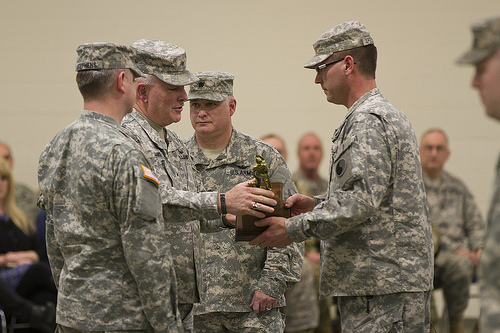
Brig. Gen. Benjamin Adams III presents the Connelly Award to Soldiers of the 1204th Aviation Support Battalion during an inactivation ceremony in Burlington, Ky., Jan. 10, 2016. The Connelly Award recognizes food service units and sections that exceed Army standards of food preparation and promote teamwork. (U.S. Army National Guard photo by Staff Sgt. Scott Raymond)
“I’ve been in almost 18 years and this is home to me,” said Staff Sgt. Bill Hyatt, supply noncommissioned officer with Headquarters Support Company, 1204th ASB. “It’s going to be a big culture shock to me because aviation is where I’ve been since I’ve been in the Kentucky Army National Guard and now I’m going to a transportation company.”
“I’m going to be the first person to arrive to the 1204th and the last person to leave.”
The Burlington Readiness Center, home of the 1204th, will continue to be utilized by the Kentucky Guard. Two new units, the 2061st Multi-Role Bridge Company and the 2112th Transportation Company will be stood up this year to operate out the state-of-the-art armory.
See local news coverage here: WLWT 5, WKRC Local 12.
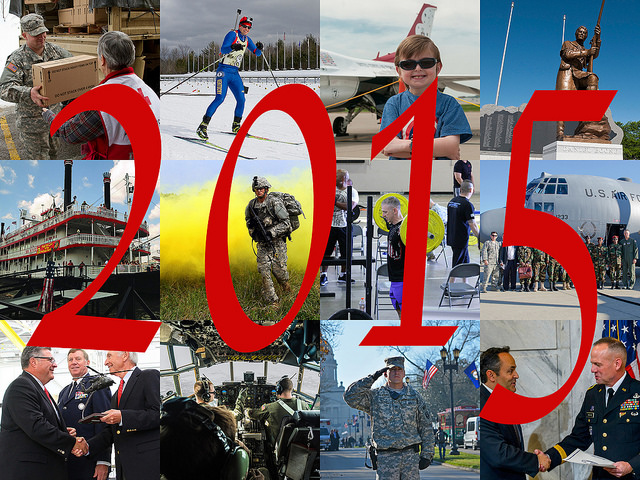 Another year’s in the books, with more pages to document the service of the Kentucky National Guard. Around the commonwealth and across the globe, our Guardsmen once again have displayed what we call unbridled service. Below are a few of our favorite stories of duty and accomplishment.
Thanks to all our friends, families for allowing us to make 2015 another successful year of service to Kentucky and the Nation.
Guard activated for winter storm response
Guardsmen compete in biathlon finals
Air Guard welcomes 9-year-old fighting cancer
Kentucky dedicates Guard memorial
Four million pounds for a purpose
Kentucky hosts Djibouti delegation
Kentucky Guard cuts ribbons on new facilities
123rd Airlift Wing named top airlift unit
Guardsmen support Gubernatorial Inauguration
Kentucky National Guard Public Affairs Staff Report
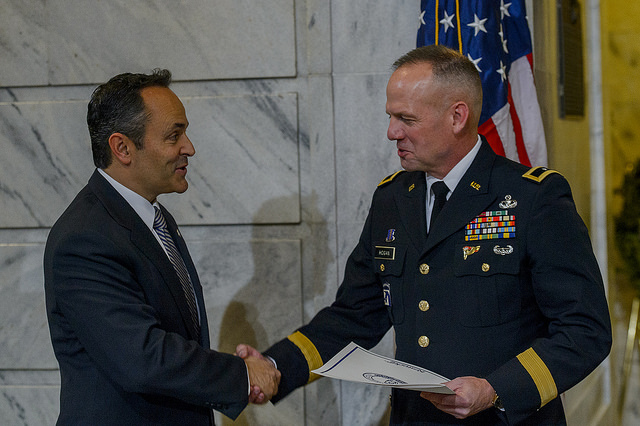
Governor Matt Bevin congratulates Brig. Gen. Stephen R. Hogan following Hogan’s swearing in at the State Capitol in Frankfort, Ky., Dec. 8, 2015. Bevin selected Hogan as the 52nd adjutant general, commanding the Kentucky National Guard. (Photo by Marvin Young)
FRANKFORT, Ky. — Retired Brig. Gen. Stephen Hogan, who served more than 30 years in the Kentucky National Guard and active duty Army is the state’s next adjutant general, Governor-elect Matt Bevin announced Dec. 7.
Hogan was sworn into office shortly after midnight, Dec. 8, succeeding Maj. Gen. Edward W. Tonini who has served in the role since 2007.
Hogan said he will be taking charge of a National Guard organization that is among the best in the nation. Hogan was officially introduced to members of the Kentucky Guard during a welcome ceremony at the Boone National Guard Center following the inauguration.
“This is a wonderful feeling to be before you today,” said Hogan to those in attendance. “I am very honored and humbled to be back in uniform for an organization that I have a great deal of confidence in.”
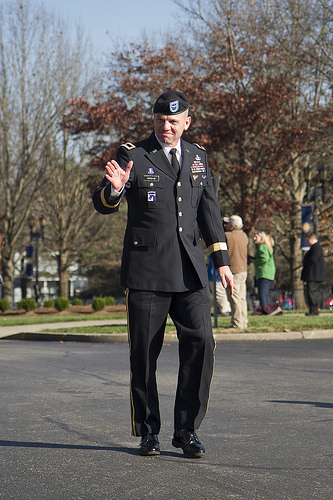
Brig. Gen. Stephen R. Hogan, Kentucky’s adjutant general walks in the Inaugural parade in Frankfort, Ky., Dec. 8, 2015. Hogan was selected by newly-elected Governor Matt Bevin to lead the Kentucky National Guard. (U.S. Army National Guard photo by Staff Sgt. Scott Raymond)
Click here for more photos.
As Kentucky’s 52nd adjutant general, Hogan will command the nearly 8,000 military members of the Kentucky Army and Air National Guard. He will also oversee the statewide Department of Military Affairs, Kentucky Emergency Management, the Appalachian and Bluegrass Challenge Academies and Bluegrass Station in Avon, Kentucky.
The cabinet-level post administers an annual budget of approximately $170 million to support operations at 56 armories, three major training sites and the Air National Guard base at Louisville International Airport.
Hogan brings a wealth of experience to the job, formerly serving as assistant adjutant general for the Kentucky Army National Guard. In that role, he was responsible for balancing the requirements of readiness, modernization, force structure and sustainment of the National Guard for mobilization and domestic missions. He oversaw specified units that provided wide ranging support to the National Guard’s federal and state mission sets, as well as those units that provided specialized support to civil authorities.
Hogan was commissioned through the Reserve Officer Training Corps program at Morehead State University in 1985. He earned a Master of Strategic Studies from the U.S. Army War College in 2008. In 2010 and 2013 he completed the U.S. Northern Command Joint Task Force Command Course and U.S. Northern Command Joint Dual Status Commander’s Course.
Hogan’s significant active duty assignments included tours with the 101st Airborne Division (Air Assault), Fort Campbell, Kentucky; 6th Infantry Division Light, Fort Richardson, Alaska; The Army Operations Center at the Pentagon, Washington, D.C., and Multi-National Corps Iraq, Baghdad, Iraq. When not serving on federal active duty, Hogan served in the Kentucky Army National Guard as an active duty Guardsman with the State’s Counter-Drug Unit, from June 1993 to February 2011.
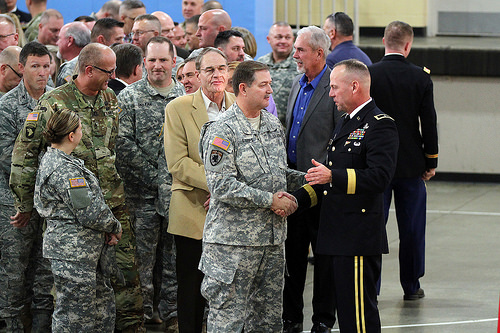
Command Chief Warrant Officer Dean Stoops congratulates Brig. Gen. Stephen R. Hogan on becoming Kentucky’s newest adjutant general during an introduction ceremony in Frankfort, Ky., Dec. 8, 2015. Hogan was officially introduced to members of the Kentucky Guard following the gubernatorial inauguration. (U.S. Army National Guard photo by Staff Sgt. Scott Raymond)
Hogan rode in the Inaugural parade through downtown Frankfort to the Capitol to attend Bevin’s public swearing in. Bevin praised Hogan’s service and expressed his trust in Hogan’s future as the leader of the Kentucky Guard.
“It is my pleasure to name Brigadier General Stephen R. Hogan as adjutant general for the Commonwealth of Kentucky,” said Bevin. “We owe our freedom and safety to the men and women of our military. General Hogan has served our country and our commonwealth with honor and distinction and understands first hand, the critical importance of the Citizen-Soldier. I have absolute confidence that he will be an excellent Commanding General.”
By Sgt. Brandy Mort, 133rd Mobile Public Affairs Detachment
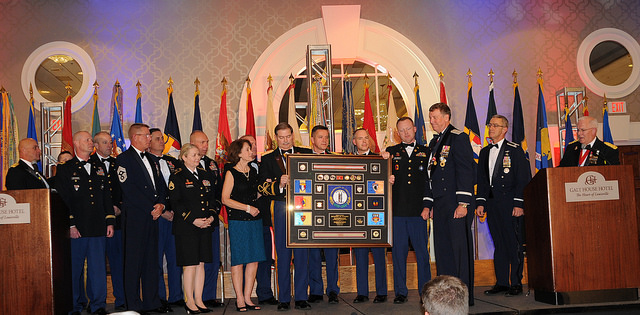
Members of the Kentucky National Guard command staff present Maj. Gen. Edward W. Tonini a framed collection of memorabilia from Kentucky units during a retirement ceremony in Louisville, Ky., Nov. 21, 2015. (U.S. Army National Guard photo by Sgt. Brandy Mort)
LOUISVILLE, Ky. — Maj. Gen. Edward W. Tonini doesn’t officially retire until Dec. 7, 2015. Representatives of the Kentucky Army and Air National Guard, distinguished guests, along with friends and family members gathered to honor Tonini’s legacy during a retirement ceremony in Louisville, Nov. 21.
After nearly 47 years of service, Tonini leaves behind an unprecedented legacy, not only to the service members he’s led and citizens of the commonwealth of Kentucky, but also to those he’s served alongside.
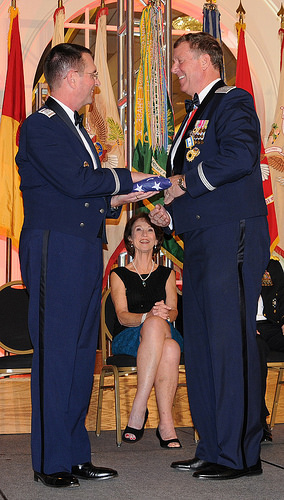
Lt. Gen. Joseph Lengyel, Vice Chief of the National Guard Bureau presents a flag to Maj. Gen. Edward Tonini as a token of appreciation from NGB during a retirement ceremony for Tonini in Louisville, Ky., Nov. 21, 2015. (U.S. Army National Guard photo by Sgt. Brandy Mort)
“On behalf of the Chief of the National Guard Bureau and the other adjutants general not in attendance, we owe you a great deal of gratitude, we thank you for your distinguished service, both in the state and National level,” said Lt. Gen. Joseph L. Lengyel, Vice Chief of the National Guard Bureau.
“On behalf of us all, thank you for all that you have done and will continue to do.”
Click here for more photos.
It was an emotional event for Tonini as countless amounts of awards, gifts, and tokens of gratitude were bestowed. As he stood at the podium in the ballroom, he couldn’t help but to pause before addressing the crowd.
“I am so spectacularly proud of what my units, both Army and Air have been able to accomplish. When you talk about Kentucky, I guarantee you they are at the top of any list. I want to look around this room and look upon every single one of your faces and say…” With tears in his eyes he said, “Thank you all.”
After first retiring in 2003 following a stint as the director of the National Guard’s “Your Defenders of Freedom” program at the Pentagon, Tonini was chosen as the 51st adjutant general of the Kentucky Guard.
Just a year later Tonini provided the decisiveness and effectiveness the commonwealth needed to respond to a catastrophic ice storm in 2009. The storm was the largest call-up of Kentucky Guardsmen in state history and it set the tone for the operational tempo of Kentucky’s Soldiers and Airmen.
Thousands of Kentuckians would deploy overseas and remain fully committed to the needs of the commonwealth. Under Tonini’s watch, a new emergency operations center was built, business was expanded at Bluegrass Station and numerous facilities’ construction projects were completed, all benefiting the Guard and the state.
Tonini took on the responsibility of multiple national-level positions during his tenure including president of the Adjutant General Association of the United States where he testified before government officials as a staunch advocate and defender of the National Guard.
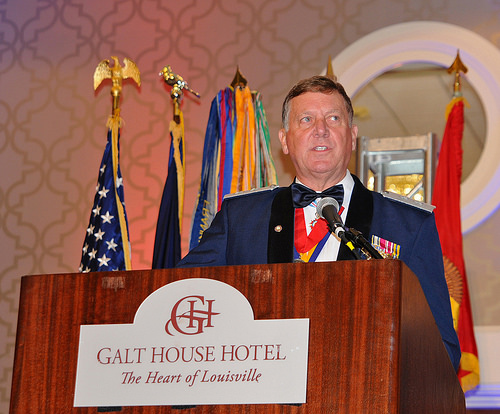
Maj. Gen. Edward W. Tonini speaks during his retirement ceremony in Louisville, Ky., Nov. 21, 2015. Tonini concluded his 47-year career by stating that he will always be a Guardsman. (U.S. Army National Guard photo by Sgt. Brandy Mort)
While it’s hard to summarize a such a long military career, the Kentucky Guard ensured Tonini received the gratitude of a state for eight years of dedication.
“Forty seven years is a long time and I can tell you this is incredibly difficult for me,” said Tonini. “I can promise you I will stay engaged in the best interest of the Kentucky National Guard, because I will always be a Guardsman.”
By Sgt. 1st Class Aaron Hiler, 133rd Mobile Public Affairs Detachment
By Sgt. Lerone Simmons, 133rd Mobile Public Affairs Detachment
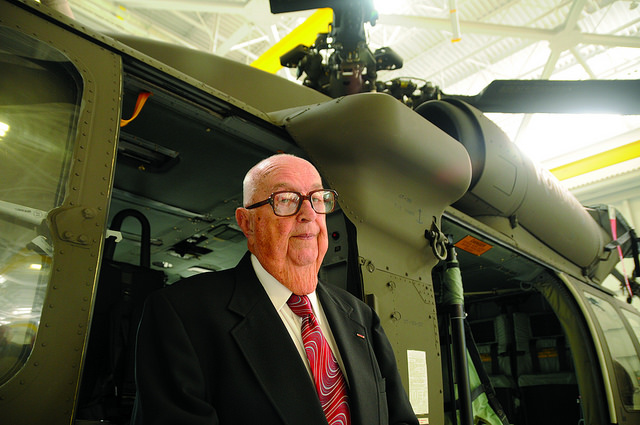
Retired Chief Warrant Officer William H. Canon, former shop foreman assigned to the 2113th Transportation Aircraft Maintenance Company, poses with a new UH-60M Black Hawk helicopter after a ribbon cutting ceremony for Kentucky’s new Army Aviation Support Facility and introduction of a new fleet of UH-60M’s, Boone National Guard Center, Frankfort, Ky., Oct. 14, 2015. Canon gave thirty five years of his life to providing maintenance to Kentucky’s aircraft. (U.S. Army National Guard photo by Sgt. Lerone Simmons)
FRANKFORT, Ky. - Sitting in a new multi-million dollar facility, retired Chief Warrant Officer William Canon Jr., reminisced about providing maintenance to the Kentucky National Guard’s aircraft in high winds, pouring rain, freezing cold and summer heat.
“When I first joined, our pilots had recently flown in World War II,” he said. “Our equipment was old and we didn’t have adequate places to work.
“We had to park trucks around the helicopters to make sure the wind didn’t hit them directly,” said Canon. “The elements are one of the worst things when it comes to properly maintaining aircraft.”
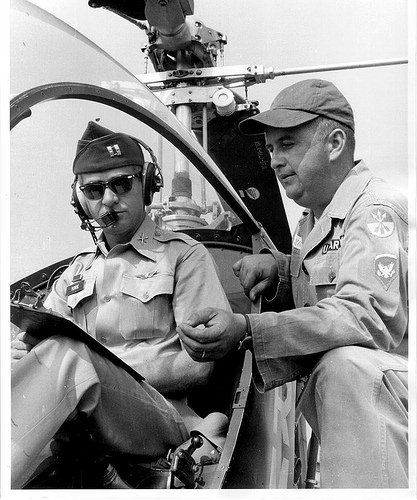
Capt. Yancey York confers with SPEC5 William H. Canon as he prepares for a flight in a OH-13E, circa 1960. (Photo courtesy Chief Warrant Officer(R) Harold Canon)
Click here for more photos.
Canon enlisted in the Army in 1950 and retired in 1990. He would join a fledgling aviation program in 1955.
In 1959, the Kentucky aviation assets found a new home in Frankfort, Kentucky, at the Capital City Airport. Then, 18-or-so-years later in 1971, Canon witnessed a state-of-the-art facility erected at Boone National Guard Center – the Army Aviation Support Facility. A hangar for the helicopters assigned to Kentucky. During his tenure, Canon rose to the level of shop foreman, assigned to the 2113th Transportation Aircraft Maintenance Company, and retired out of the old AASF.
But on Oct. 14, he joined hundreds of other current and former Kentucky National Guardsmen as the ribbon was cut, ceremoniously showing off the Kentucky National Guard’s newest AASF at Boone National Guard Center. He also got to view, sit in, and touch the new UH-60M, the Army’s newest in the Blackhawk fleet.
The new AASF is 126,000 square feet and uses geo-thermal heating and cooling, solar power, 80 kilowatts photovoltaic solar power, high efficiency lighting, daylight harvesting technology, and radiant floor heating. It holds several offices for staff, classrooms, a gym and plenty of space.
“We come from a time where we didn’t always have a climate controlled area or lots of space,” said Canon’s old company commander, retired Lt. Col. Willoughby S. Goin III, a former pilot with 12,000 flying hours.
“This will help allow the Guard to be able to deploy troops to any affected areas in a timely manner,” he said, “at times when ice storms, tornados and floods can destroy roads, the Guard can then utilize the air from this facility.”
Kentucky Gov. Steve Beshear, Maj. Gen. Edward W. Tonini, adjutant general for Kentucky and other special guests honored Canon in their remarks during the building’s dedication. The Kentucky Guard’s aviation safety record was also bragged upon during the remarks.
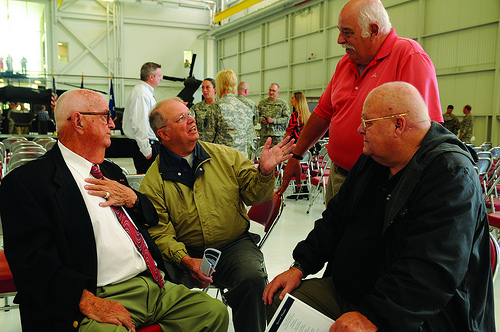
Sitting from left to right, retired Army Chief Warrant Officer William H. Canon, former shop foreman who was assigned to the 2113th Transportation Aircraft Maintenance Company, retired Army Lt. Col. Jere Roche, former commander of the 441st Medical Detachment, and retired Army Lt. Col. Willoughby S. Goin III, former commander of the 2113th Transportation Aircraft Maintenance Company, carry on a conversation after a ribbon cutting ceremony for Kentucky’s new Army Aviation Support Facility in Frankfort, Ky., Oct. 14, 2015. (U.S. Army National Guard photo by Sgt. Lerone Simmons)
Kentucky hasn’t had any major accidents or loss of life for the span of the last 250,000 flying hours, which Tonini said boils down to a huge feat of great maintenance and outstanding flying. He added that the Kentucky Guard has flown at least 15 missions over the Commonwealth during times of disaster, also while supporting the Joint Support Operations counterdrug efforts and overseas contingency operations.
For the many aviation retirees and current Guardsmen who maintain the Commonwealth’s air assets, the day was a reunion and a celebration of moving forward.
“What I’ve seen is outstanding,” said Canon. “I’m proud the progress we’ve made.”
By Maj. Dale Greer, 123rd Airlift Wing Public Affairs
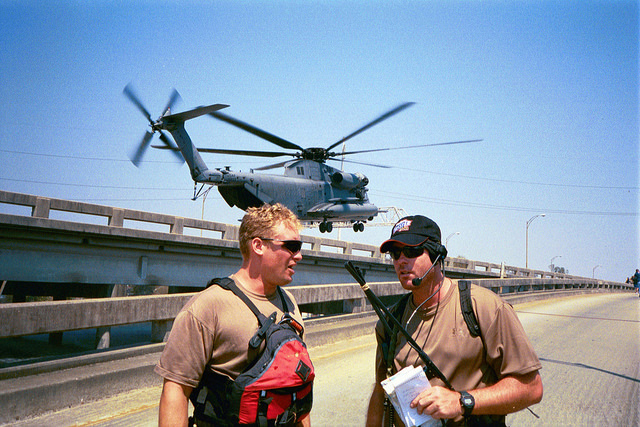
Two Kentucky Air National Guard Special Tactics troops confer as an Air Force MH-53 helicopter lands on Interstate 610 to evacuate New Orleans residents following Hurricane Katrina Sept. 4, 2005. (U.S. Air National Guard photo)
LOUISVILLE, Ky. — Chief Master Sgt. Pat Malone had seen a lot in his 23 years as a pararescueman for the U.S. military, including dicey combat extractions in Iraq and Afghanistan and more than a decade’s worth of civilian search-and-rescue missions in Alaska. But none of it prepared him for the devastation he saw firsthand when he and 21 fellow Kentucky Air National Guardsmen deployed to New Orleans Naval Air Station 10 years ago today as part of efforts to evacuate the victims of Hurricane Katrina and the ensuing flood.
“This was, by and large, the worst site of devastation I have ever seen in my entire career,” said Malone, who was chief enlisted manager for the Kentucky Air Guard’s 123rd Special Tactics Squadron in 2005 and retired from the service in 2012. “The sheer magnitude of it — and the conditions that our guys worked in — was the most horrific I’d seen in 23 years of service.” Chief Master Sgt. Jon Rosa, a Kentucky combat controller who also deployed with the 123rd Special Tactics Squadron and retired in 2009, concurred.
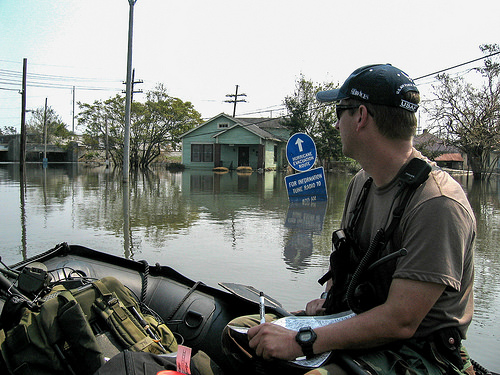
A Kentucky Air National Guard combat controller searches for stranded residents during a search-and-rescue mission in New Orleans following Hurricane Katrina Sept. 5, 2005. (U.S. Air National Guard photo)
“New Orleans is usually a place of such revelry,” said Rosa, then the squadron’s superintendent of combat controllers. “But it was like a scene out of ‘The Twilight Zone’ to be in downtown New Orleans and hear total silence except for the sloshing of flood waters. I just couldn’t believe this was America.”
But it was America, and thousands of New Orleaneans were stranded without provisions amid a sea of sewage- and chemical-laced water covering nearly 80 percent of the city.
Rosa, Malone and 20 other Kentucky special tactics troops were among the first military search-and-rescue troops to arrive in the stricken city and begin extracting trapped citizens starting Aug. 31.
The Kentucky forces joined up with about 25 other special tactics troops from across the Air National Guard, including Alaska’s 212th Rescue Squadron, California’s 131st Rescue Squadron, New York’s 102nd Rescue Squadron and Oregon’s 125th Special Tactics Squadron.
Patrolling the city in Zodiac motorboats and other vehicles, the Kentucky-led contingent rescued 1,292 people, sometimes by cutting through roofs to extract trapped residents.
“We had the ability to go through the city and conduct searches where no one else could reach at the time,” Malone said. “We launched from four to 14 boats a day, running about 14-hour shifts in the water.”
Once evacuees climbed aboard the Zodiacs, they were transported to makeshift helicopter landing zones set up along portions of the interstate highway system that weren’t submerged by flood waters.
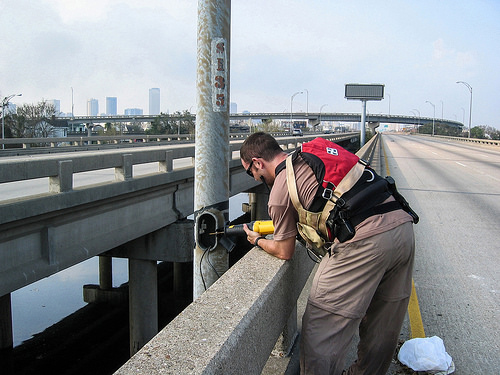
A special tactics troop from the Kentucky Air National Guard cuts down street light poles along Interstate 610 in New Orleans following Hurricane Katrina Sept. 3, 2005, to clear the way for a helicopter landing zone. (U.S. Air National Guard photo)
The landing zones were cleared by saw-wielding combat controllers who cut down light poles to remove obstructions and then marked the spots with spray paint so information like communications frequencies would be visible from the air, Rosa said.
After an LZ was established, combat controllers would make radio contact with any of the three airborne controlling authorities — entities like an Air Force AWACS plane — and advise that evacuees were ready for transport.
As helicopters began to roll in, the controllers would direct their safe flight into and out of the landing zones using the communications gear they carried on their backs.
One particularly productive LZ became so active that a new helicopter was landing every 50 seconds for 48 straight hours, Rosa said.
“For a while, I would imagine it was the busiest airport on the face of the earth,” he noted.
By the time the Kentucky Airmen returned home Sept. 7, the Air Guard special tactics contingent had controlled the flights of 3,179 sorties responsible for the evacuation of 11,927 people.
Working conditions were challenging, to say the least. Most troops got less than six hours of sleep a night, and the constant exposure to contaminated water caused rashes and minor chemical burns on some of the Airmen, Malone said.
“These guys were working in a giant cesspool contaminated with any chemical in anyone’s garage, oil, gas, deceased animals and sewage,” he said. “It was a giant petri dish. But they knew that what they were doing was important. They chose to be totally selfless and help fellow citizens of the United States. They’re the biggest heroes on the planet as far as I’m concerned.”
Rosa noted that many New Orleans residents seemed to agree.
“All the folks we rescued down there were so thankful,” he said. “I had about 20 people come up and hug me while I was trying to control helicopter landings. That’s very self-satisfying.”
By Staff Sgt. Scott Raymond, Kentucky National Guard Public Affairs
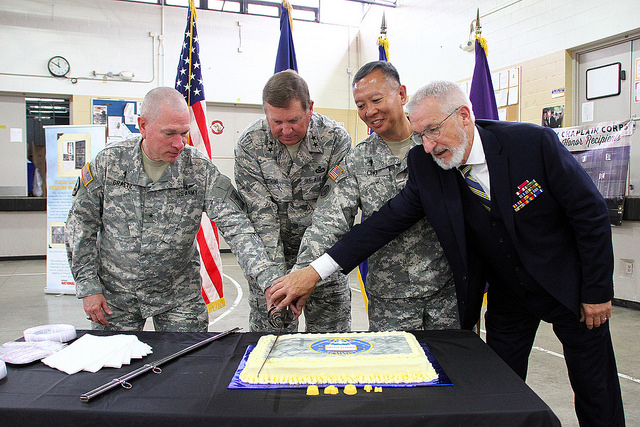
Brig. Gen. David Graetz, assistance chief of chaplains for the National Guard, Maj. Gen. Edward W. Tonini, Kentucky’s adjutant general, Chaplain (Col.) Yong Cho, state chaplain and retired Col. James Dill, former state chaplain, cut a cake celebrating 240 years of the U.S. Army Chaplain Corps during a ceremony in Frankfort, Ky., July 29, 2015. There are more than 1,200 chaplains serving today in the National Guard and Army Reserves. (U.S. Army National Guard photo by Staff Sgt. Scott Raymond)
FRANKFORT, Ky. — The U.S. Army Chaplain Corps is one of the oldest and smallest branches of the Army and their impact on Soldiers is immeasurable. On the 240th birthday of the Chaplain Corps, the Kentucky National Guard family gathered to pay tribute to those whose faith is their mightiest weapon.
Maj. Gen. Edward W. Tonini, Kentucky’s adjutant general joined Brig. Gen. David Graetz, the assistant chief of chaplains for the Army National Guard, Guardsmen, and friends and family for a birthday celebration in Frankfort, Ky., July 29, 2015.
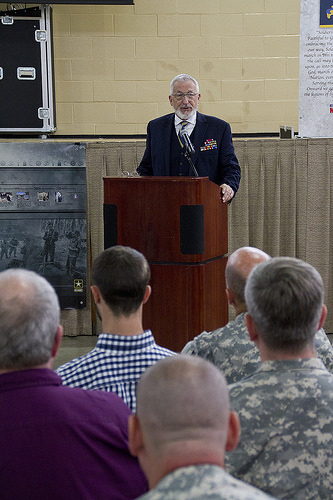
Retired Col. James DIll, former senior Army chaplain for the Kentucky National Guard speaks during a ceremony in Frankfort, Ky., celebrating 240 years of the U.S. Army Chaplain Corps, July 29, 2015. (U.S. Army National Guard photo by Staff Sgt. Scott Raymond)
“Our chaplains are an invaluable resource to commanders and Soldiers alike,” said Tonini. “I encourage all our Guardsmen to get to know their chaplains, tell them what you need and discover for yourself the vast resource he or she can bring to the mission.”
There are 20 chaplains serving the Kentucky Guard with 10 chaplain assistants to reach the more than 8,000 Citizen-Soldiers across the commonwealth. There are roughly 1,200 chaplains in the Army’s reserve components and 1,300 in the active duty, representing five major faiths (Catholic, Protestant, Jewish, Muslim and Buddhist) and more than 120 denominations.
“The 240th United States Army Chaplain Birthday celebration highlights the service, sacrifice, and diversity of our Corps,” said Chaplain (Col.) Yong Cho, state chaplain for Kentucky. “I am proud of our Kentucky Army National Guard Chaplain Corps for their outstanding ministry. I am equally proud of the support we have from Maj. Gen. Tonini and the entire senior leadership. I believe our senior leaders are committed in caring for the religious needs of all service members.”
Spc. Cheyenne Jennings serves as a religious affairs specialist and has for five years. She shares Tonini’s opinion of the chaplain corps being a valuable resource.
“It is an honor to serve alongside one of the best entities in the military,” she said. “I get to support those who support the welfare and well being of this country’s armed forces.”
In addition to a brief history of the Chaplain Corps, which dates back to Gen. George Washington’s forces during the Revolution, several displays were set up to show the reach and impact of chaplains. From religious war relics of past wars to information on the Strong Bonds program, which chaplains arrange and conduct, Kentucky’s chaplains ensured those in attendance were educated and entertained by the role of the faith-guided Soldiers of the Kentucky National Guard.
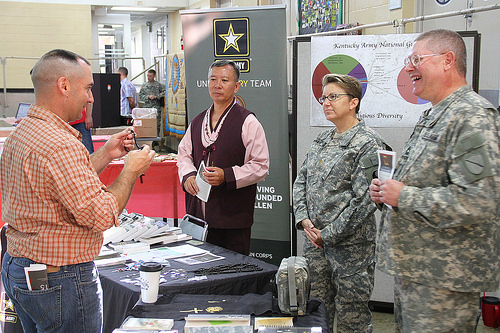
Chaplains with the Kentucky National Guard discuss religious diversity with Guardsmen during the Kentucky National Guard’s Diversity Day in Frankfort, Ky., Aug. 1, 2015. (U.S. Army National Guard photo by Staff Sgt. Scott Raymond)
“This was our first attempt of recognizing the United States Army Chaplain Corps Birthday,” said Chaplain (Maj.) Bill Draper. “I am glad the event was well attended and supported. It is important to share the story of the Chaplain Corps because it reminds Soldiers of a unique support system in place to protect their individual freedom of the free exercise of religion.”
“On behalf of the Kentucky Army National Guard Chaplain Corps, we are proud to serve America’s best. We are especially proud of our families who enable our service. May God bless each of you and may God continue to bless the United States of America.”
Staff Report
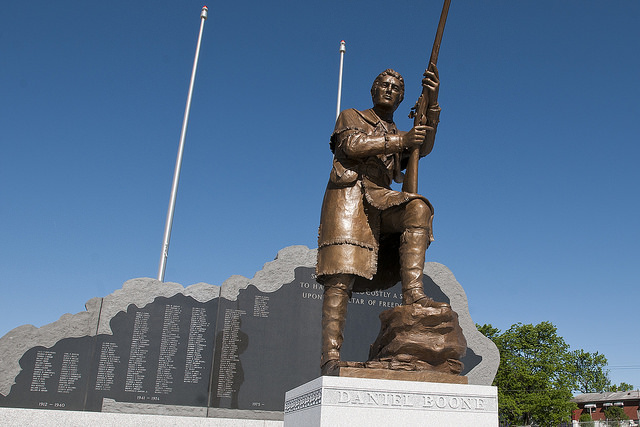
A statue of Daniel Boone keeps watch over the new Kentucky National Guard Memorial in Frankfort, Ky. The monument with the inscribed names of more than 230 Kentucky Guardsmen will be dedicated this Memorial Day. (U.S. Army National Guard photo by Staff Sgt. Scott Raymond)
FRANKFORT, Ky. — On a Memorial Day unlike those gone by, the Kentucky Guard stands proud before a fitting monument to those Citizen-Soldiers who gave the last full measure of devotion for their home and Nation. The dedication of the Kentucky National Guard Memorial has been a long time in the making. But as we present it to the world, Guardsmen are reminded, and will be everyday henceforth, ‘What Memorial Day mean to me?’
“Memorial Day is a day that is set aside to remember and honor those who served and gave their lives so that we may live and continue to live in this country freely. Not only is it a day to reflect on the sacrifices made by the Service members, but in my opinion it is also a day to hold those ones close who have lost a father, mother, child, brother, sister or a friend, while they were selflessly serving and defending our Country.”
Spc. Stacy Pesut, 103rd
“Memorial Day is a day to reflect for me. Having been born in a different country, under a different political system, I am acutely aware that America is the greatest country in the world; and Memorial Day is a day when I can reflect and show reverence to the men and women of our armed forces who gave their life in order to ensure it stays that way.”
1st. Lt. Marlon Jones, 2nd Battalion, 138th Field Artillery
“Memorial Day is a day I take time to remember my fallen brothers I knew, who served with my unit once upon a time.”
Staff Sgt. Dana Stringer, 149th Maneuver Enhancement Brigade
“I don’t think you’d have to call it Memorial Day, nor do I think it matters what you call it. We need an occasion annually to gather together and remember our fallen brothers and sisters, because it is through that fellowship that we heal and through that fellowship that the fallen live on in our memories. We call it Memorial Day, but that’s not what’s important.”
Col. Michael Abell, Director, G1
“It is a day when we should all pause to honor the Service members that paid the ultimate sacrifice defending our freedoms, rights and liberties. It should also be a day that we recommit ourselves to maintaining vigilance over those freedoms so that their sacrifices are not wasted and that our children and future generations have the same rights and opportunities.”
Command Sgt. Maj. Michael Rowan, 198th Military Police Battalion
“This day is a standstill moment in time for us to stop what we’re doing, remember the fallen and what the words honor and duty actually mean. We need to celebrate and appreciate what we have, because many lost everything to give us the freedom to choose who we are and the ability to live life to the fullest.”
Sgt. 1st Class Rebecca Wood, 149th Maneuver Enhancement Brigade
“For most people Memorial Day represents the beginning of summer, a time for picnics, beach trips, boating and vacations. Some feel this is shallow and inappropriate, but I’ve come to think otherwise: It is because of the sacrifices of those who fell in defense of our nation and our unique American way of life that we can have the freedom to do all of these things. So celebrate, America, party on! Go four-wheeling and hiking and skiing and have a wonderful time. And as you gather around the barbeque at the end of your Memorial Day and watch the setting sun, be sure to raise a glass in honor of those who made this all possible, our honored fallen, for they are surely looking down upon us with pride … and more than a little envy.”
Staff Sgt. (ret.) David Altom, Public Affairs Office