Pages
Stay In Touch
More
© 2013 KentuckyGuard
Story and photos by Capt. Stephen D. Martin, Kentucky National Guard Public Affairs
[flickr video=6555432291 secret=fc017c5384 w=400 h=225]
(The above video shows the 201st Engineer Battalion being honored on the floor of Rupp Arena during the UK vs. Loyola Game Dec. 22, when Gov. Steve Beshear and Adjutant General, Maj. Gen. Edward W. Tonini presented the Valorous Unit Award in honor of the unit’s actions in Afghanistan in 2008. Video by Lt. Col. Kirk Hilbrecht, Kentucky National Guard Public Affairs)
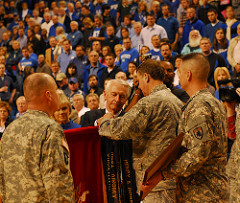
Gov. Steve Beshear and Adjutant General, Maj. Gen. Edward W. Tonini presented the Valorous Unit Award to the 201st Engineer Battalion in recognition of the unit's actions in Afghanistan in 2008. The 201st Engineers were honored on the floor of Rupp Arena during the UK vs. Loyola Game Dec. 22.(photo by Capt. Stephen Martin, Kentucky National Guard Public Affairs)
LEXINGTON, Ky.– Governor Steve Beshear joined Adjutant General Edward W. Tonini and thousands of University of Kentucky basketball fans in the presentation of a valorous unit award streamer to the Soldiers of the Kentucky Army National Guard’s 201st Engineer Battalion at half-time during the game between UK and Loyola at Rupp Arena on Dec. 22.
“Today is a very special day to be recognized as a Kentucky Guardsmen,” said Maj. Gen. Tonini. “These Soldiers from the 201st did us proud in Afghanistan and continue to show Kentucky’s Unbridled Service in everything they do for our Nation and Commonwealth.”
The 201st headquarters is in Ashland, with the detachments and companys in Cynthiana, Hazard, Jackson, Olive Hill, Pikeville and Prestonsburg. The unit was mobilized in March 2008 to conduct route reconnaissance and area clearance operations in support of Operation Enduring Freedom. More than 500 members of the “Workhorse Battalion” were credited for disposing of more than 200,000 landmines and improvised explosive devices in Afghanistan, clearing over a million square meters of terrain.
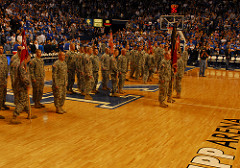
The 201st Engineer Battalion was honored on the floor of Rupp Arena during the UK vs. Loyola Game Dec. 22, when Gov. Steve Beshear and Adjutant General, Maj. Gen. Edward W. Tonini presented the Valorous Unit Award in honor of the unit's actions in Afghanistan in 2008. (photo by Capt. Stephen Martin, Kentucky National Guard Public Affairs)
“I had a chance to visit the Soldiers of the 201st with then-commander Mike Ferguson while they were in Afghanistan,” said Tonini. “These engineers truly earned this valorous unit award, as they put themselves in harm’s way — every day — to protect our fellow service members as they traversed all throughout Afghanistan.”
Other accomplishments during the 201st deployment to Afghanistan include:
* 65 percent of the Battalion was in direct contact with the enemy earning the 201st Engineer Battalion the Combat Action Unit Streamer.
* 413 Combat Action Badges were awarded to Soldiers for direct contact with the enemy.
* 44 Soldiers received the Purple Heart for injuries sustained from combat.
* 21 Bronze Star Medals for Valor and 32 Army Commendation Medals for Valor were earned for actions while engaging the enemy.
* 9 Combat Medical Badges earned by medical personnel giving aid during active combat.
The 201st lost one Soldier during its service in Afghanistan. 27 year-old Sgt. Daniel Wallace, of Dry Ridge, Grant County, Ky. was killed Oct. 31, 2008 when his unit was attacked by enemy forces while conducting a route clearing mission to remove IEDs in West Paktika Province, Afghanistan.
Story by Senior Airman Maxwell Rechel, 123rd Airlift Wing Public Affairs
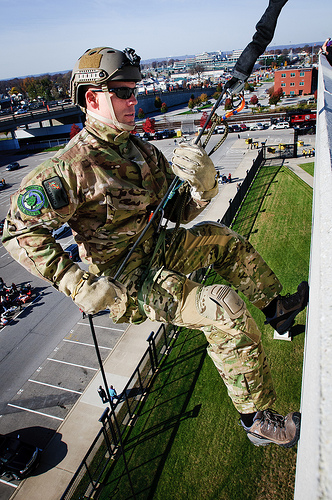
Staff Sgt. Adam Becker, a pararescueman from the Kentucky Air National Guard’s 123rd Special Tactics Squadron, rappels down the side of University of Louisville Cardinal Stadium in Louisville, Ky., prior to the school’s football match with Pittsburgh Nov. 12, 2011. The tactical demonstration was part of the school’s annual Military Appreciation Day. (U.S. Air Force photo by Senior Airman Maxwell Rechel)
Click here to view the photo gallery.
LOUISVILLE, Ky. — Members of the Kentucky Air National Guard’s 123rd Special Tactics Squadron rappelled down the side of University of Louisville Cardinal Stadium Nov. 12 in a public demonstration of their tactical capabilities.
The demonstration, held just prior to kickoff for the Cardinal’s football match-up with Pittsburgh, helped raise public awareness of the pararescue mission, which centers on the recovery of downed personnel any time, under any conditions, anywhere around the world, according to Staff Sgt. David Covell.
It was one of several events offered by military units in the area Nov. 12 as part of the university’s annual Military Appreciation Day.
“This was a great opportunity for the squadron to show the public some of our capabilities,” said Covell, a pararescueman assigned to the 123rd. “Being a college student at U of L, I’m really happy to be able to support both my school and my unit.”
The squadron also set up static displays of equipment, including all-terrain vehicles and parachute gear. Recruiters from the Kentucky Air and Army National Guard staffed displays at the event as well.
Story by Capt. Stephen Martin, Kentucky National Guard Public Affairs
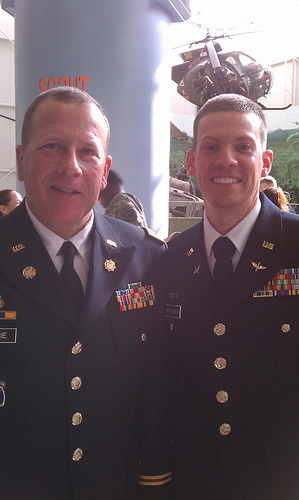
Warrant Officers One Mark Cerrie and Andrew Waggoner graduate from Warrant Officer Candidate School at Fort Rucker, Ala Dec. 14. (photo submitted)
FORT RUCKER, Ala. — The Kentucky Guard recently welcomed into their ranks two new warrant officers, Mark Cerrie and Andrew Waggoner, who graduated from Fort Rucker’s strenuous Warrant Officer Candidate School Dec. 14.
Newly appointed Warrant Officer One Cerrie joined the military nearly 29 years ago in Jan of 1983 and has served in the New York, West Virginia and Indiana National Guard before finally landing in Kentucky.
“I owe a debt of gratitude to Chief Warrant Officer 2 Bernie Caldwell for getting me started on this journey,” said Cerrie. “He is a great mentor and a man you can count on.”
Caldwell is the training officer for the 138th Fires Brigade and serves as a Warrant Officer mentor for the unit.
State Command Chief Warrant Officer Jim Simms attended the graduation ceremony at Fort Rucker.
“In today’s army, the role of a Warrant Officer is constantly evolving because we’re asking more and more of our leaders,” said Simms. “The demands that these two Soldiers will face require highly trained, highly motivated leaders and both Mark and Andrew, I know, are up for the challenge.”
Warrant Officer 1 Mark Cerrie (middle) at Camp Victory with other members of the 69th Infantry. (photo submitted)
Cerrie has quite a bit to offer his new position due to serving in multiple jobs in the military as a non-commissioned officer before becoming a warrant officer. He’s picked up experience in Armor, Transportation, Infantry and the Engineer branches.
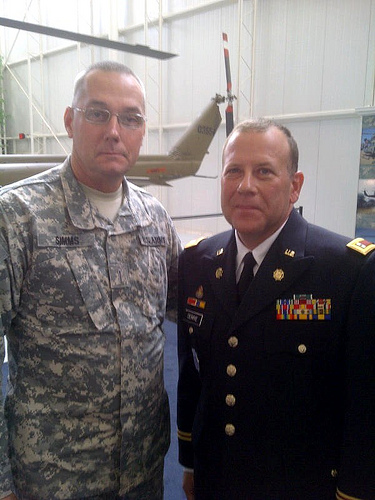
State Command Chief Warrant Officer 5 Jim Simms attends Warrant Officer 1 Mark Cerrie's graduation ceremony from Warrant Officer Candidate School at Fort Rucker, Ala Dec. 14. (photo submitted)
Cerrie is currently assigned as the mobility officer for the 138th Fires Brigade.
Owning his own business, ‘GI Joe Landscaping,’ keeps Cerrie extremely busy. He was also recently hired on full-time for the Kentucky National Guard as the Traffic Coordinator in the Defensive Movement Office.
Said Cerrie, “I’m excited to start on this path and look forward to making a lasting difference in this organization and in the people I get to serve with.”
Andrew Waggoner wore his Warrant Officer Candidate rank for nearly a “year” before getting the chance to attend WOC school. Tune in next week to read more on Waggoner…
Story and photo by David Altom, Kentucky National Guard Public Affairs
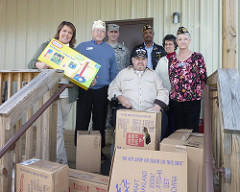
The giving keeps on coming -- Members of the Disabled American Veterans bringing a load of bicycles to Operation Military Cheer. Pictured are Cindy Culver, Ken Jones, Capt. Bryan Combs, Don Sheckels, DAV Commander Danny Jones, Brenda Jones and DAV Auxiliary Commander Jeanne Sheckels.
FRANKFORT, Ky. — To paraphrase the song, all gave some, some gave all … and still others keep on giving.
The Disabled American Veterans is a unique organization. For instance, did you know that the DAV The DAV was founded in 1920 by disabled veterans returning from World War I? And that the DAV was chartered by Congress in 1932 as the official voice of the nation’s wartime disabled veterans?
Today the DAV represents more than 1.2 million disabled veterans and their families. Their relevance in the wake of the wars in Afghanistan and Iraq is just as powerful as it was following “the war to end all wars.”
“We are here to support our returning troops,” said Jeanne Sheckles, DAV Lexington Chapter #1 Auxiliary Commander. “That’s what we love to do. If anyone has issues with their claims or need information on filing claims for potential disabilities we have national service officers available to help them.”
Sheckles was part of a DAV team visiting the Family Assistance Center at Boone National Guard Center, dropping off bicycles and toys for Operation Military Cheer, the Kentucky National Guard Family Programs annual toy drive. It’s a holiday ritual the DAV has supported for many years.
“This is a good way to give back to the National Guard families that have been serving in Iraq and Afghanistan for the past several years,” said Sheckels. “We know what a strain these deployments can be on families, and the downturn of the economy has put an even stronger burden on the families. This is how we give back to our troops and show them that we support them and the mission they do for us all.”
The DAV also offers services to military spouses, parents and children of service members who need help.
“Sometimes our veterans need a little ‘poke’ to get their claims filed. We’re happy to help them get motivated.”
Sheckles said returning female Service Members are a concern for her. “If any females veterans need assistance and aren’t comfortable talking with our male veterans, I’m ready to help them out.”
Next January the DAV is opening an information office in Lexington that will be open five days a week. Scheckels said help isn’t limited to office hours, however.
“We’re available 24/7 if our veterans need us,” she said.
To contact the Lexington DAV Chapter #1 call 859-221-5305 or the Auxiliary at 859-333-8576.
Click here to reach the Lexington Chapter #1 DAV website.
Click here for general information on the DAV.
Click here to find a DAV chapter near you.
Story and photos by Sgt. Tamkia Dillard, International Security Assistance Force Headquarters Public Affairs
U.S. Army Capt. David Licciardello, of Orange County, Va., administers vaccinations to a local farmer’s goat Dec. 3 in Parwan province. Approximately 70 percent of Afghanistan is dependent upon agriculture, while most of their food base is dependent upon livestock, animal care and health. If the Afghan people do not have healthy livestock they are forced to look at other alternatives to survive.
PARWAN PROVINCE, Afghanistan – As Soldiers rode down this narrow dirt road, food shops to the right of them and clothing shops to the left of them, villagers from both sides of the street greeted these troops with large smiles as they waved peace signs back and forth.
The Soldiers parked their large fighting vehicles in a single file line; the bodies of these large machines nearly covered the dirt path the villagers call roads.
This day, the Soldiers they see often roaming through their villages were not just passing through; they were making village calls in the small remote village of Jabbulsaraj, Dec. 3 in Parwan Province.
As the troops climbed out of their trucks, they were immediately surrounded by hundreds of village children, grabbing them by the hand as if to guide them while asking in English how their day was going.
Some Soldiers stayed behind to talk to the local Afghan children, while one headed to the village para-veterinarian to restock the village’s vaccination supply and assist him in vaccinating the village’s livestock.
In the small village of Jabbulsaraj, the Kentucky Army National Guard Agribusiness Development Team is working to improve the lives of farmers and connect them with their government through simple agricultural projects and outreach.
“Our mission is to employ the locals to do preventative medicines on their animals so the local Afghans see that their veterinarians are taking the lead,” said U.S. Army Capt. David Licciardello, the KYADT veterinarian. “We want the people of Afghanistan to know we are behind them by supplying them with the necessary advice, medication and care they need.”
Approximately 70 percent of Afghanistan is dependent upon agriculture, while most of their food base is dependent upon livestock, animal care and health. If the Afghan people do not have healthy livestock they are forced to look at other alternatives to surviving.
“If we teach the Afghan people how to properly take care of their livestock they will not have to turn to drugs or harming themselves or others,” said Licciardello. “They are learning if they follow the guidance we provide to them, their livestock can produce not only milk and food but healthy coats, wools and in some cases transportation.”
According to the U.S. Agency for International Development website, more animals are surviving at a much higher rate thanks to a USAID program that brings veterinary services to Afghanistan’s remote areas. Throughout Afghanistan, USAID and the Dutch Committee for Afghanistan have trained more than 200 veterinary workers to care for the region’s flocks and have constructed 35 veterinary field clinics. The clinics are supplied with medications, vaccines and motorcycles, which are used to reach outlying communities. Together, the animal healthcare workers vaccinate an average of 50,000 animals each month.
“The supplies we receive for the different areas come from the Dutch Committee for Afghanistan,” said Licciardello. “They have a co-op of current and good quality vaccines they provide at reduced fees and in turn we would provide it at a low cost or no cost to the local veterinarians.”
Licciardello added that providing the vaccines at little to no cost gives the locals an incentive to treat their livestock. Otherwise the local herdsmen will not vaccinate their animals, causing a flock of sheep or herd of cattle to potentially die very quickly.
Diseases that are common in this area are foot-and-mouth disease, PPR, clostridium, endo-toxemia. These types of disease can be detrimental to a farmer who’s very dependent upon his livestock.
“The foot-and-mouth disease is a severe plague for animal farming,” said Licciardello.
It is highly infectious and can spread by infected animals through aerosols, contact with contaminated farming equipment, vehicles, clothing or feed, and by domestic and wild predators. Its containment demands considerable efforts in vaccination, strict monitoring, trade restrictions and quarantines, and occasionally the elimination of millions of animals, he adds.
Over the past six months, Licciardello has completed multiple missions throughout Panjshir, Parwan and Kapisa provinces, educating farmers about the importance of vaccinations and he loves the progress that’s been made so far. To date he has been involved in administering more than 140,000 vaccines to well over 35,000 animals.
“It is great knowing we have made so many farmers realize the importance of vaccinating their animals,” said the Orange County, Va., native. “When they look at their animals now and see they are healthy and stronger, they realize the true value in keeping up with the health of their herds.”
The lifelong veterinarian is set to redeploy early next year to return home to his five kids: his cat Dave, and four dogs Bill, Billy, Milly and New Guy.
Story by David Altom, Kentucky National Guard Public Affairs
Photos by J.C. Newton, Kentucky National Guard Recruiting Command
The Interlink Counseling Services color guard leads their family of Veterans during the 2011 Veteran’s Day parade in downtown Louisville. Some Kentucky National Guard troops donated their old uniforms to make sure the color guard was properly equipped.
LOUISVILLE, Ky. — Holiday spirit is expressed in many forms. Sometimes it comes with ribbons, sometimes with tags. Sometimes it comes in packages, boxes, and bags.
And sometimes it comes in camouflage.
Rick Waddell is interviewed by the local TV station about “Operation Homeland” an initiative to deliver nearly 2,000 backpack survival kits to Louisville area homeless veterans.
Members of the Kentucky National Guard recently gathered together to help out their brothers and sisters in need through donations to Interlink Counseling Services, a reintegration center that supports homeless veterans.
“We’ve been around since 1993, ” said Rick Waddell, director of the center. “Our mission is to seek out Veterans in distress and guide them along the healing process. We try to address all their needs, physical, psychological, social, and spiritual, and find the resources to help them.”
Interlink features a long term treatment center with 100 beds. Veterans can stay for up to two years while receiving treatment and support to get back on their feet.
“We average about 350-400 Veterans coming through our center every year,” said Waddell. “The average stay is about nine months.”
This year Kentucky Guard members donated nearly 2,000 backpacks containing toiletry items, toothbrushes, hats, gloves, ponchos and food — whatever could be used to make life a little more comfortable for living on the street.
Soldiers even donated their old uniforms so the veterans could have a proper color guard during this year’s Veterans Day Parade.
“When we visited the facility we knew we wanted to help in some manner,” said JC Newton, a retired NCO who currently works with the 2nd Battalion 75th Recruiting Command. “Our troops stepped up and pitched in with their contributions.”
“We were especially happy to see them wear their uniforms during the Veterans Day parade,” he said. “This is a mission that really touched our hearts.”
Community Outreach National Coordinator Freddie W. Maggard helped coordinate the donations.
“We were honored to assist in this project,” said Maggard. “As a former Soldier, you can’t help but feel strongly about helping our Veterans in time of need.”
Maggard said that Hope Community Church of Frankfort and Lawrenceburg played a valuable role in gathering up the donations. He also praised Frankfort Dentist Dr. Patrick Peters, who donated hundreds of tooth brushes, tooth paste, and other dental hygiene items for the back packs.
“We only wish we could do more.”
“We are really grateful for all that the Kentucky Guard has done for us,” said Waddell. “We’re also getting support from Fort Knox and Campbell, and we’re thankful to them as well.”
Waddell says the average age of homeless Veterans has dropped about eight years, due in large part to the recent wars in Afghanistan and Iraq.
“Unemployment is the main issue, of course, stemming from post traumatic stress disorder and mental health issues. Our focus in 2012 is to concentrate on mental health issues that lead to alcohol and drug abuse.”
For more information on Interlink Counseling Services call 502-964-7147 or visit www.interlinkservices.org.
By Tech. Sgt. Jason Ketterer, 123rd Airlift Wing Public Affairs
Click here to view a photo gallery for this story.
Click here to view a video report of this story.
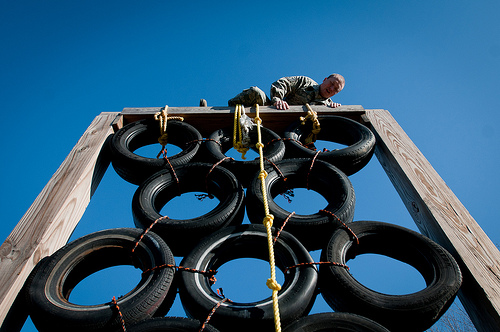
Master Sgt. Josh Devine, a member of the Kentucky Air National Guard’s 123rd Security Forces Squadron, climbs over a tire tower at Southern High School in Louisville, Ky., Dec. 10, 2011. Airmen from the 123rd SFS were at the high school to use the Junior ROTC obstacle course for a team-building exercise as part of Wingman Day activities. (U.S. Air Force photo by Senior Airman Maxwell Rechel)
LOUISVILLE, Ky. — Members of the Kentucky Air National Guard’s 123rd Security Forces Squadron spent Dec. 10 navigating an obstacle course at Louisville’s Southern High School as part of a team-building exercise held in conjunction with Wingman Day.
Wingman Day is an annual event designed to promote resilience and focus attention on the physical, spiritual, social and psychological health of Airmen while building esprit de corps, said Master Sgt. Larry Bristow, 123rd Security Forces Squadron unit training manager.
The idea is for Airmen to learn the importance of taking care of themselves and their fellow troops — a goal which made the obstacle course a natural choice for Wingman Day activities, Bristow said.
He came up with the idea of using the obstacle course — maintained by Southern’s Army Junior ROTC program — while attending his son’s soccer game at the campus last year.
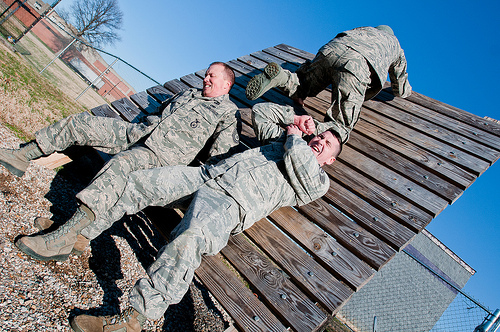
Staff Sgt. Ed Nooning and Master Sgt. Josh Devine, members of the Kentucky Air National Guard’s 123rd Security Forces Squadron, help Tech. Sgt. Jesse Smith over an obstacle at Southern High School in Louisville, Ky., on December 10, 2011. Airmen from the 123rd SFS were at the high school to use the Junior ROTC obstacle course for a team-building exercise as part of Wingman Day activities. (U.S. Air Force photo by Senior Airman Maxwell Rechel)
“When Wingman Day came around, we thought this would be a good event for the whole squadron to work together and become more familiar with each other,” he said.
Maj. Grant Simpson, commander of the 123rd Security Forces Squadron, said the course was a welcome change of pace from normal training at the Air Guard Base, which typically focuses on security patrols or other solitary activity.
“We get so sequestered in our computer training and everything else that a lot of times when you come to drill, you don’t get a chance to interact with people on another fire team or a different group,” he said.
The course features an un-anchored rope climb, low crawl, tower climb, tightrope, and 10-foot vertical wall.
“I think everybody did real well,” Simpson added, chuckling. “But they’re going to be hurting tomorrow.”
Story and Photos by Capt. Stephen Martin, Kentucky National Guard Public Affairs
Chief Warrant Officer Don Harlan's family waits anxiously to welcome him home from Iraq. The Headquarters Co. of the 149th Maneuver Enhancement Brigade were honored at a welcome home ceremony in Louisville today. (photo by Capt. Stephen Martin, Kentucky National Guard Public Affairs)
LOUISVILLE, Ky. — Task Force Legion’s Commander, Col. Scott Campbell, and approximately 53 Kentucky Army National Guard Soldiers from the 149th Headquarters Company were honored at a welcome home ceremony at the Louisville Fairgrounds Armory today.
“We effectively transitioned operations from U.S. control to Iraqi control this month,” said Campbell. “I was a little nervous, but it went extremely well because of the professionalism of the Soldiers of the 149th.”
Anna hugs her husband, Sgt. Scott Raper after several months away serving in Iraq. The Headquarters Co. of the 149th Maneuver Enhancement Brigade were honored at a welcome home ceremony in Louisville today. (photo by Capt. Stephen Martin, Kentucky National Guard Public Affairs)
The 149th Maneuver Enhancement Brigade comprised the largest element of Task Force Legion which deployed more than 1,300 Soldiers to Iraq last June. The Soldiers of “Task Force Legion” were instrumental in enacting the withdrawal of troops in Iraq, conducting security force, base defense and convoy security operations throughout the United States Forces-Iraq area of responsibility. The deployment of this unit was part of the largest mobilization of Kentucky National Guard troops since World War II.
“To the Soldiers of 149th and Task Force Legion, we all owe you much for your service,” said Brig. Gen. John Heltzel, Deputy Commander for the Kentucky National Guard. “In most ways, we cannot repay you for what you have done.”
After a 7-month deployment to Iraq, the Headquarters Co. of the 149th Maneuver Enhancement Brigade were honored at a welcome home ceremony in Louisville today. (photo by Capt. Stephen Martin, Kentucky National Guard Public Affairs)
Headquarters Company, 149th MEB deployed with 100 Soldiers, many of whom have been sent to their home units already in other communities.
Since 9/11, nearly 14,000 Kentucky National Guard Soldiers and Airmen have mobilized in support of the Global War on Terror.
Story by Sgt. 1st Class Michael Oliver, Kentucky National Guard Public Affairs Office
Kentucky Guardsmen Staff Sgt. Robert Peavler and Sgt. Robert Moore, Combined Service Maintenance Shop, backs up a High Mobility Multipurpose Wheeled Vehicle during a chilly morning at Boone National Guard Center in Frankfort, Ky. (photo by Sgt. 1st Class Michael Oliver, Kentucky National Guard Public Affairs Office)
FRANKFORT, Ky. – There’s tingling in your toes, your hands are numb and Jack Frost is nipping at your nose. Grab your “snivel gear” because winter is finally here!
Proper awareness and a course of action are important in preventing cold weather injuries. Leaders must remember to use weather data when planning cold weather missions. Knowing the hazards allows for more informed and effective mission planning.
“You’ve got to respect the impact of varying weather conditions and plan accordingly,” said 2nd Lt. Joshua Witt, Kentucky National Guard Safety and Occupational Health manager.
Cold weather injuries often present more subtle signs than hot weather injuries. Hypothermia and frostbite can easily catch up with Guardsmen unless precautions are taken.
Articles of clothing should be worn loose and in layers so they can be vented at the neck. Tight fitting garments restrict circulation and reduce insulation and ventilation which can increase the risk of injury.
Changing socks and wearing proper foot gear is also important in the prevention of cold weather injuries. Additionally, Soldiers should wear gloves with inserts and cold weather caps to prevent heat loss.
“It’s tough to work outside in the cold because you are so bundled up, but it is part of your job and the mission must go on,” said Sgt. Robert Moore, Kentucky National Guard Combined Support Maintenance Shop mechanic.