Pages
Stay In Touch
More
© 2013 KentuckyGuard
By Staff Sgt. Scott Raymond, Kentucky National Guard Public Affairs
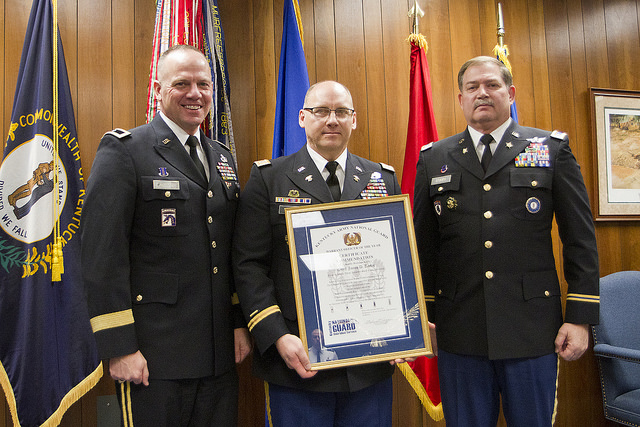
Chief Warrant Officer James Taylor (center) is named Kentucky’s Warrant Officer of the Year by Brig. Gen. Stephen Hogan (left) and State Command Chief Warrant Officer Dean Stoops (right) during a ceremony in Frankfort, Ky., Feb. 17, 2016. Taylor serves as the property book officer for the 201st Engineer Battalion and the 103rd Chemical Battalion.(U.S. Army National Guard photo by Staff Sgt. Scott Raymond)
FRANKFORT, Ky. — Annually the Kentucky Guard selects the most outstanding warrant officer. For the second year in a row, that Soldier came from the 149th Maneuver Enhancement Brigade. Chief Warrant Officer James Taylor, with the 201st Engineer Battalion earned the title for 2015.
“It is a humbling experience to be accepting this award. Nothing in my experience has prepared me for an honor like this - especially to be recognized for doing something that I so love to do,” said Taylor. “When one works in a field where every warrant officer regularly extend themselves above and beyond their duties, it is difficult to consider anything that one does as outstanding. I am blessed to have the opportunity to work with such a professional cohort of warrant officers that we have here in Kentucky. I share this award with them.”
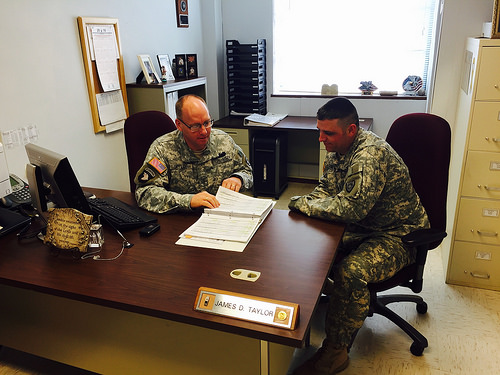
Chief Warrant Officer James Taylor discusses inventory with Staff Sgt. Danny Ison with the 201st Engineer Battalion in Richmond, Ky. Dec. 29, 2015. Taylor has served in uniform for 27 years and is known as a constant mentor and teacher, sharing his knowledge of supply with officers and enlisted Soldiers. (Courtesy photo)
Taylor serves as the property book officer for the 201st as well as for the 103rd Chemical Battalion, overseeing the inventory of nine companies and three detachments. In true warrant officer fashion, through his knowledge and work ethic, Taylor has earned the respect of many across the Kentucky Guard.
“Chief Taylor’s leadership and expertise delivers incredible results to the logistical readiness of the 201st Engineer Battalion,” said Lt. Col. Douglas Clay, commander of the 201st. “He is a proven leader and sets an excellent example through his consistent and steady performance.”
Enlisting in 1989, Taylor began his career as a combat engineer. In 2003, he switched fields into unit supply and by 2009 was the unit property book NCO. It was in 2009 that Taylor decided to become a warrant officer.
“I made the decision to become a warrant officer to expand my audience,” he said. “I wanted to share my knowledge with commanders and staff officers while continuing to lead enlisted personnel.”
And lead he does. Taylor is credited with with providing a smooth transition for force structure re-alignments with the brigade and becoming a subject matter expert on the Global Combat Support System, the Army’s newest supply standards. He singlehandedly directs and coordinates the management and control of unit equipment worth more than $150 million.
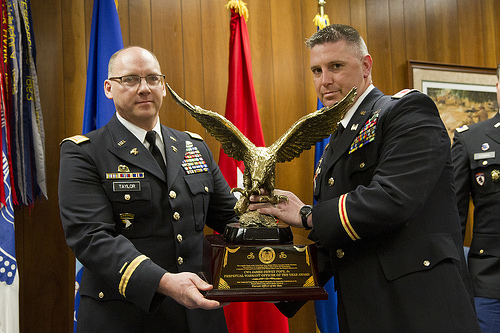
Chief Warrant Officer Buddy Barcus (right) presents the Kentucky Warrant Officer of the Year trophy to Chief Warrant Officer James Taylor in Frankfort, Ky., Feb. 17, 2015. Taylor followed Barcus as the top warrant officer in Kentucky, both from the 149th Maneuver Enhancement Brigade. (U.S. Army National Guard photo by Staff Sgt. Scott Raymond)
“We all have success and failures,” he said. “In relation to my own experience I regularly refer to the book of Philippians 4:13 ‘I can do all things through Christ which strengthens me,’ to overcome those tough assignments. I have found that over my 27 years of service the best way to influence other Soldiers to do their best is to know the standard, lead by example, and never give up. Always take the hard right over the easy wrong. The standards that we set as leaders will be the one that they use while making critical decisions.”
Taylor’s dedication extends beyond the uniform. A devout Christian, Taylor is an active member of two local churches where he has ministered for the past six years. He regularly coordinates and participates in food drives and various community service activities.
“Chief Taylor desire to serve others is continually inspiring,” said Command Chief Warrant Officer Dean Stoops. “He is always willing to travel and assist other Soldiers overwhelmed with tasks at hand. He is also adamant about inspiring others to go the extra mile.”
“He is the embodiment of the quiet professional,” said Stoops.
Story by Sgt. 1st Class Rebecca Wood, 149th Maneuver Enhancement Brigade
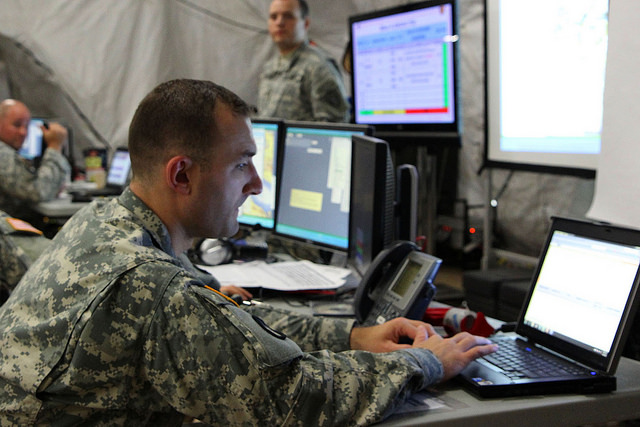
First Lt. Samuel Boulet, a battle captain in the 149th Maneuver Enhancement Brigade main tactical operations center, monitors reports and email during a 72-hour Command Post Exercise June 21-23 at Camp Atterbury, Indiana. (U.S. Army National Guard photo by Sgt. First Class Rebecca Wood)
CAMP ATTERBURY, Ind. — Soldiers of the 149th Maneuver Enhancement Brigade conducted a 72-hour Command Post Exercise (CPX) from June 21-23 at Camp Atterbury, Indiana. The units participating in the CPX were the Headquarters Company, 206th Engineer Battalion, 198th Military Police Battalion, 149th Battle Support Brigade and the 129th Signal Company. The main portion of the brigade started training on June 11 for the actual exercise.
The 198th MP Battalion’s operation officer, Maj. Brandon McNeese, was in charge of the battalion’s tactical operation center. He said the 198th also conducted main supply route patrols and convoy security for other elements in the brigade; but the main takeaway was to get back to the field craft training the Army was skilled at before 9/11.
“The overall mission was to come into a theater to set up operations in an austere environment,” said McNeese. “Years ago, before 9/11, we had training like this, but with a lot less assets. It was supposed to be like the beginning of a war, where there is nothing set up and we are initially moving in. We have gotten used to rolling into a forward operations base with established command posts and living areas, and cover down on equipment from other units.”
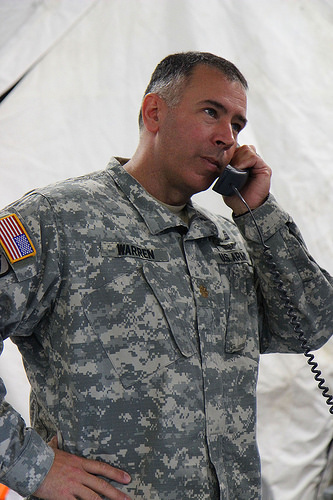 McNeese said this training was very helpful, especially to his soldiers who weren’t around before the War on Terror.
“For some of the newer soldiers, this is a very new experience because they never trained like this,” said McNeese, “but they have adapted very well. We had several shortfalls, but their morale and motivation kept them going and we pushed through and accomplished the mission.
“That’s not me,” said 1st Lt. Samuel Boulet, a current operations battle captain for the CPX, while looking around the TOC for the source of the ringing he heard. “Where is that phone?” Boulet barely had a moment to himself, while reports were populating on the Command Post of the Future (CPOF) and phones were ringing off the hook.
As a battle captain, Boulet’s job was to direct the flow of information and resources from the ground and the different sections in the brigade. He said this exercise was to test the brigade’s staff functions and prepare the Soldiers for a warfighter training exercise scheduled in 2016.
“It’s very energizing,” said Boulet. “You feel very plugged into everything that is going on around you.”
On a deployment to Iraq in 2010, Boulet actually worked as a battle captain on a company and battalion level, but he said he learned a lot from this CPX training.
“We did a large bridge gap of knowledge as a team, executing battle drills, tracking info and reports, communicating through missions, and mitigating crises when they happened,” said Boulet. “I wish I had this training before that deployment.”
One administrative specialist, Spc. Brooklynd Decker has been in the 206th Engineer Battalion for five years and was the sole human resources rep for the battalion’s operations center during the CPX. She said she was nervous to be in charge of her section, but felt honored to take on such an important role.
“It meant a lot to me and it was really good for morale, because everyone was important to the operation and had a serious job to do. Sometimes it was difficult to make quick decisions when the pressure was on and I had to communicate with my battle captain on a lot of things,” said Decker. “But overall I felt comfortable in my position, and I knew it was meant to be a learning experience -and I learned a lot.”
Decker and her peers were also enthusiastic about learning battle-tracking systems like CPOF and Joint Combat and Tactical Simulation, because of how they streamline communication between the battalion and the brigade.
“The battalion was so involved in brigade operations, more then we have ever experienced in the past and it gave us all a view of the bigger picture,” said Decker.
“The quality of this training could not have been captured in a short drill weekend. The timing for this type of exercise was perfect and I feel like we should do more exercises like this in the future.”
Story by David Altom, Kentucky National Guard Public Affairs
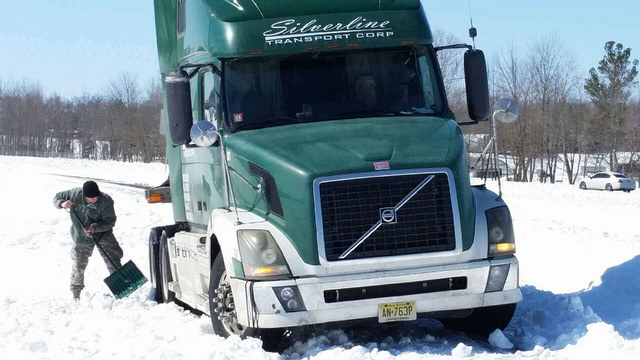
Staff Sgt. Steve Musgrave helps a truck driver along I-24 in McCracken County. Musgrave is one of the soldiers from the Kentucky National Guard’s Co. A, 149th Brigade Support Battalion assisting motorists stranded during Winter Storm Thor. (Photo by Spec. Jeriel Clark, Kentucky National Guard)
FRANKFORT, Ky. — In arguably the worst winter since 2009, Kentucky National Guard troops recently played a crucial role in protecting the health, safety and welfare of their fellow citizens. In the wake of heavy snows that began on March 5, hundreds of accidents and impassable conditions stranded an estimated 600 vehicles along I-24 and I-65 in Central Kentucky. More than 150 Kentucky Guard soldiers were called out over a two day period to support relief efforts, clearing traffic and rendering aid to stranded motorists.
“We were given the mission of getting traffic going,” said Sgt. 1st Class Sherman McCoy with the 223rd Military Police Company. “We helped a few motorists who were trying to get off the expressway and got stuck, digging them out and getting them off the road. We also helped numerous tractor trailers that were stuck and we got them on their way.”
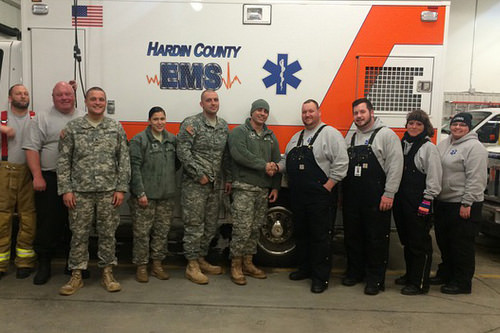
Soldiers with the 2061st Multi-role Bridge Company assisted Hardin County Emergency Medical Services in providing man power assistance with patient and paramedic transport and ambulance recovery missions during the winter storm, March 5-7, 2015. The 2061st Team traveled in tandem with Hardin County EMS to numerous 911 Emergencies to ensure freedom of maneuver for EMS throughout Hardin County. (Courtesy photo)
“We’re not used to quite this much snow,” he said, “but it’s been a good mission. We enjoy helping others.”
1st Sgt. Chris Jeter, 149th Brigade Support Battalion, said his troops worked to ensure travelers were safe and provided assistance to those whose vehicles were stuck in mounding snow.
“Short of hooking tow straps to our military vehicles, we have done everything possible to assist them,” he said of their efforts.
Visit our flickr page for more photos.
In addition to responding state wide to these areas, local teams also assisted local emergency medical services, helping to reach patients not accessible by ambulance.
“We have been responding with paramedics to these areas, carrying them to the residence once they have gotten as far as they can go,” Jeter said adding that they are using Humvees and “good old foot power,” even helping to carry patients and paramedics back to the ambulance.
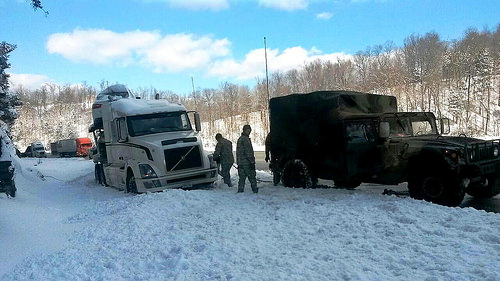
Soldiers from the Kentucky National Guard’s Charlie Battery, 2nd Battalion 138th Field Artillery hook a Humvee to a semi-truck to pull it back onto I-65 March 6, 2015. Roughly 150 Guardsmen were activated to assist local authorities along Insertstates 24 and 65. (Kentucky National Guard photo by 1st Lt. Holdun Reed)
Troops also used Humvees to deliver food, water and gasoline to stranded motorists, and in some cases transported chilled travelers to warming shelters. It was reported that some motorists were stranded up to nearly 24 hours.
“The Soldiers did it again,” said Col. Jerry Morrison, commander of the 149th Maneuver Enhancement Brigade. “Soldiers received alert phone calls as early as 0330 hours and began digging out of their own driveways to respond to citizens in I-65 and I-24. Over 120 Soldiers of the 149th Maneuver Enhancement Brigade from Benton, Murray, Paducah, Bowling Green, Louisville, Elizabethtown, and Richmond were on duty by the time snow quit falling that afternoon.”
“We alerted, mobilized, executed our mission, and de-mobilized Soldiers in a 96 hour period. I am extremely proud of our leaders and units. Their response shows the requirement for the National Guard to remain in the home towns across America to provide immediate assistance to the Governor in times of crisis.”
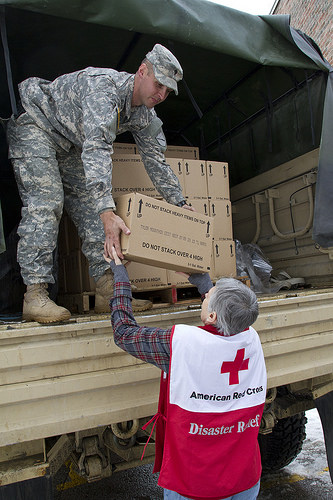
Spc. James Harmon, with the 1st Battalion, 149th Infantry hands a case of water to Anne Cockley, a Red Cross volunteer at Green Hills Elementary School in Bledsoe, Ky., Feb. 24, 2015. The Soldiers assisted with water deliveries throughout Harlan County in response to a water shortage caused by a recent winter storm. (U.S. Army National Guard photo by Staff Sgt. Scott Raymond)
This is the second such mission for the Kentucky National Guard in the past few weeks. Earlier in February more than 100 troops were mobilized in response to the sub-zero temperatures and icy conditions that plagued Eastern Kentucky. Soldiers cleared public roads, provided emergency transportation to hospitals and long term care medical facilities. They also delivered several thousand gallons of water to communities suffering a water shortage brought about by damaged water systems.
In 2009 more than 4,000 soldiers and airmen were brought on duty when a state wide ice storm triggered wide spread power blackouts. Troops delivered food and water to stranded residents, conducted door to door wellness checks and supported local authorities as needed. The 2009 winter storm is considered one of the worst domestic natural disasters in the Kentucky National Guard’s history.
Story by Sgt. Cody Stagner, 133rd Mobile Public Affairs Detachment
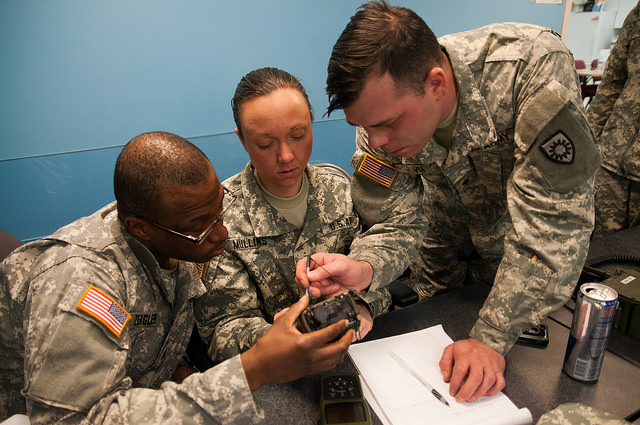
Spc. Christopher Via, a signal specialist with the 149th Signal Company, provides instruction on data transfer devices to Capt. Damien Zeigler, of the 206th Engineer Battalion, and 2nd Lt. Cassandra Mullins, of the 149th Signal Co., during signal training at Boone National Guard Center in Frankfort, Ky., Jan. 10, 2015. The 149th Signal Co. hosted the event to provide instruction for signal operators in the brigade. (U.S. Army National Guard photo by Sgt. Cody J. Stagner)
FRANKFORT, Ky. - The 149th Signal Company hosted their first-ever leader development workshop for the 149th Maneuver Enhancement Brigade at Boone National Guard Center in Frankfort, Jan. 10-11, 2015.
Col. Jerry Morrison, commander of the 149th MEB, had the vision to provide train-the-trainer instruction that would allow leaders from all five battalions to go back to their units and teach their Soldiers and operators on the ground.
“Across the brigade, as far as communication is concerned, we found a need to sync everybody together,” said 1st Sgt. Craig E. Anderson, the first sergeant for 149th Signal Company. “So this concept gets everybody in the same room to say, ‘hey, here are some strengths and weaknesses,’ and the signal company is taking the lead because we are nothing but communications.”
For more photos, visit our flickr site here.
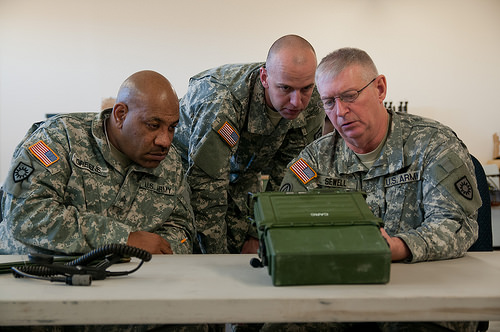
Sgt. Mark Greene, Sgt. Brian Bingham and Sgt. 1st Class Gerald Sewell discuss the operation of a signal radio during the 149th Signal Company’s career workshop in Frankfort, Ky., Jan. 10, 2015. As a signal-specific unit, the company has training resources and specialists for instruction on data transfer and communication instruments. (U.S. Army National Guard photo by Sgt. Cody Stagner)
As a signal-specific unit, the company has training resources and specialists for instruction on data transfer and communication instruments. These courses can be given over the course of a single drill weekend.
“It is not an in-depth training,” said Anderson, a coordinator who helped in the overall concept and design of the training program. “But you get to see the faces to your right and to your left. That makes you a stronger team; knowing who is in your brigade, working together to make sure others have the same capabilities you might have, and coming together for an overall stronger brigade.”
In order to build a stronger brigade, the signal company had to deal with the technical challenge of how to set up a relay station between separate units or battalions during annual training. To do this, the unit uses the Defense Advanced GPS Receiver and Single Channel Ground and Airborne Radio System.
“Let’s say two units are running different frequencies and need to communicate,” said Spc. Jessica Garner, a trainer in the 149th Signal Company. “After using a DAGR to set the atomic time of all SINCGARS radios, it may take a separate vehicle and connections shared with both units to relay that important message.”
Beyond synergy and basic radio skills, the company has included training on the brigade’s newly fielded Joint Capabilities Release, a friendly-forces tracking device that also allows secure messaging and data transfer.
“We are just getting into the cycle of using this platform,” said Capt. Joe Fontanez, commander for the 149th Signal Company and lead coordinator. “There are tasks involved that we’ve never really had to do before because it went from an unclassified system to classified. So we are trying to get people hands-on training to really understand this system a little better.”
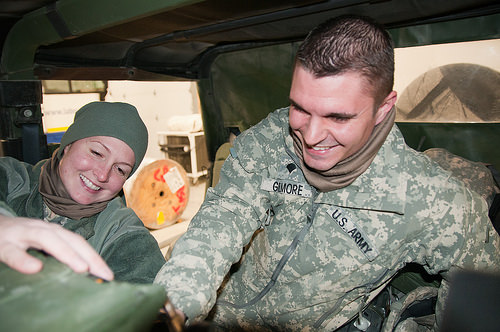
Spc. Jessica Garner and Spc. Tadd Gilmore, with the 149th Signal Company prepare a Single Channel Ground and Airborne Radio System at Boone National Guard Center in Frankfort, Ky., Jan. 10, 2015. Members of the 149th Signal Co. provided signal training during this two-day event. (U.S. Army National Guard photo by Sgt. Cody J. Stagner)
Bringing in occupation-specific Soldiers created an opportunity worth exploiting for the brigade. Instructors had the chance to give the attendees insight into Army career-advancing schools needed and how to progress through the ranks by taking charge of one’s own career.
“We all manage our own careers,” said Fontanez. “It’s really important for Soldiers to understand that and know how to progress through the organization to meet their goals.”
According to Fontanez, the unique training successfully promoted synergy, networking, career progression, camaraderie and profession of arms among the brigade’s signal corps.
Story by Spc. Vincent Willingham, 149th BSB Unit Public Affairs Historian Representative
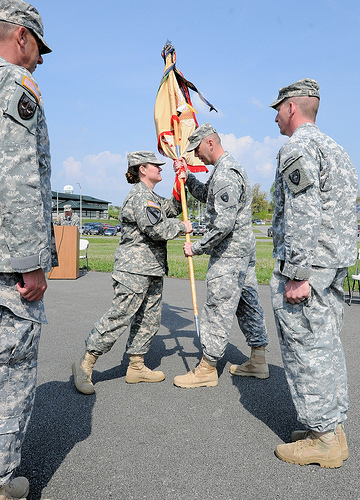
Lt. Col. Ruth Graves passes the battalion colors to Lt. Col. Jerry Morrison, commander of the 149th Maneuver Enhancement Brigade to relinquish her command of the 149th Brigade Support Battalion during a change of command ceremony at the Wendell H. Ford Regional Training Center in Greenville, Ky., April 27, 2014. Maj. Kent Cavallini assumed command of the unit. (U.S. Army National Guard photo by Staff Sgt. Scott Raymond)
GREENVILLE, Ky. — Members of the 149th Brigade Support Battalion and distinguished guests witnessed the change of command ceremony occur between outgoing commander Lt. Col. Ruth Graves and new commander, Maj. Kent Cavallini at the Wendell H. Ford Regional Training Center in Greenville, Kentucky, April 27, 2014.
As the 149th Brigade Commander Lt. Col. Jerry L. Morrison passed the Battalion colors from Graves to Cavallini, the change of command was official. Morrison said both commanders have worked hard to ready the unit for its intense upcoming training schedule.
“Lt. Col. Graves was instrumental preparing the unit for collective training after returning from Operation New Dawn in Iraq. Her leadership was pivotal to the successful transition and preparation,” he said.
“Maj. Cavallini assumes command with a focus on unit readiness and leader development. He takes over as the operational tempo increases supporting a brigade training event this training year, a brigade warfighter exercise, and an externally evaluated Brigade training event in 2016.”
“Maj. Cavallini is an outstanding officer with impeccable values and is very deserving this opportunity to lead and train Soldiers,” said Morrison.
Click here for more photos from the ceremony.
During the ceremony on April 27, 2014, red roses were presented to Graves’ husband, signifying the loving concern he has shown the battalion over the last two years. Yellow rosebuds were presented to Mrs. Cavallini. The yellow rosebuds signify the blossoming relationship she will form with the Soldiers and families of the battalion.
When asked about her most memorable experience as battalion commander, Graves summed it up by saying that in “building relationships over her career has made all the difference.”
She has been able to form bonds with people that “you can’t get any other way.” A key piece of advice Graves wanted to leave with the battalion was to “not just meet the standard, but always exceed it to get ahead.”
Story by Maj. David page, Kentucky National Guard Public Affairs
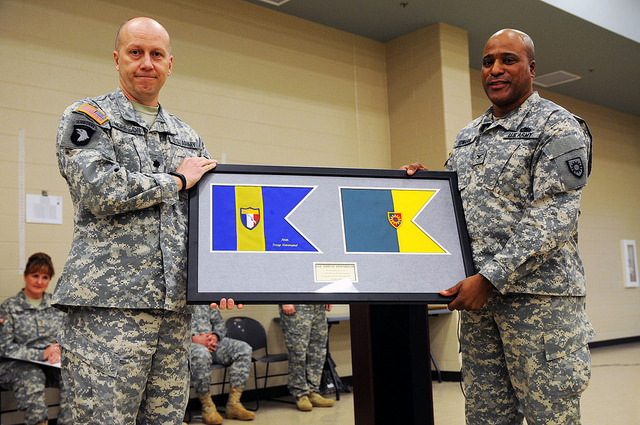
Lt. Col. Jerry Morrison (left) presents Col. John Edwards framed guidons during a change of command ceremony in Richmond, Ky., Feb. 2, 2014. The two guidons represent Edwards’ service as the commander of both the 75th Troop Command and the 149th Maneuver Enhancement Brigade. (U.S. Army National Guard photo by Spc. Brandy Mort)
RICHMOND, Ky. — To command at a brigade-level unit is an honor for which most officers can only dream, but for Col. John H. Edwards, he has now lived that opportunity twice.
In 2011, Edwards was placed in command of the 75th Troop Command in Richmond, where he served with distinction. Then in August 2013, he was tapped again to help with the reorganization and move of the 149th Maneuver Enhancement Brigade.
“My staff and I helped conduct a re-stationing initiative for the 149th Maneuver Enhancement Brigade,” said Edwards. “It was an honor and privilege to do it. And, if given the chance, I would do it all over again.”
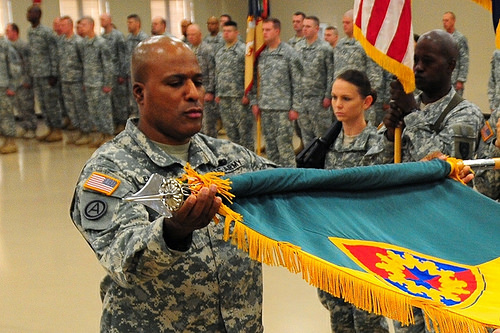
Col. John H. Edwards Jr. unfurls the colors of the 149th Maneuver Enhancement Brigade during an uncasing ceremony in Richmond, Ky., Nov. 1, 2013. Edwards played a pivotal role in the major realignment of the brigades leading up to the transition. (U.S. Army National Guard photo by Staff Sgt. Scott Raymond)
Not only did he and his team move the headquarters from Louisville to Richmond, they also reorganized units, which meant losing units like the 751st Troop Command but gaining units like the 198th Military Police Battalion.
“I am proud that we took the brigade from less than 100 percent strength to now 103 percent. And, we moved from 80 percent MOS (Military Occupational Specialty) qualified personnel to now over 91 percent,” he said.
It should not be of any surprise that Edwards has had the honor of commanding two separate brigades. His prior leadership positions, which ranged through platoon leader through battalion command, as well as awards such as the Bronze Star Medal awarded during his deployment to Kuwait in 2005-2006 as the Camp Victory commander, are testament to his ability and the faith the Kentucky National Guard leadership has bestowed on him.
“I have been successful because of the influence of my mother,” said Edwards. As a single parent, his mother instilled in him the drive to achieve and study hard. Her influence is evident in his education. He holds an Associates in Science in Engineering from Georgia Military College, a Bachelor of Science in Occupation Training and Development from the University of Louisville, a master’s degree in strategic studies from the U.S. Army War College, and he is working on a second master’s degree in clinical psychology from Capella University.
But Edwards also recognizes the importance his military mentors have played in his life and ultimately his military career. “I have had numerous military mentors along the way who helped me learn and grow as an officer,” he said. “I encourage every young Soldier to seek out strong mentors.”
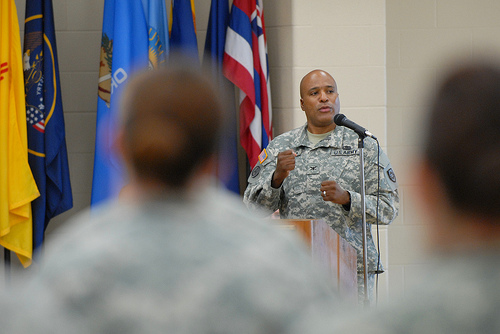
Col. John Edwards Jr. speaks to the Soldiers of the 149th Maneuver Enhancement Brigade during an uncasing ceremony in Richmond, Ky., Nov. 1, 2013. In both brigades Edwards has commanded, he has always asked his Soldiers to give nothing less than 110 percent both in uniform and out. (U.S. Army National Guard photo by Staff Sgt. Scott Raymond)
On Feb. 2, Edwards relinquished command of the 149th Maneuver Enhancement Brigade to Lt. Col. Jerry Morrison. With this change of command, Edwards now becomes the director of the J-7, in charge of joint doctrine, joint operations and joint training concepts.
When asked what enduring mark he hoped he left with his Soldiers at the 149th MEB , Edwards said, “I hope I left my Soldiers with two things: one, every Soldier in the Brigade plays an important role in the success of the unit. Be proud of what you do in the military and represent you and your unit with distinction and honor, both in and out of uniform. Two, education is key, whether military or civilian. Every day you can learn something new so always strive to grow yourself.”
As February is Black History Month, Edwards was asked what advice he would you give to young minority Soldiers in today’s National Guard.
“Regardless of what anybody tells you, you can be whatever you desire to be,” he said. “Don’t let anyone persuade you or tell you what you can or cannot do. You do what is in your heart. If you give it 110 percent, you will accomplish your desires, aspirations and dreams.”
Story by Spc. Brandy Mort, 133rd Mobile Public Affairs Detachment
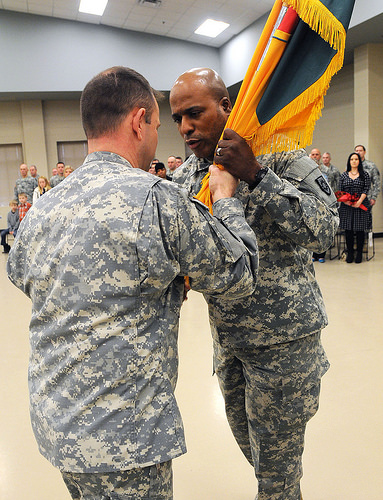
Col. John Edwards Jr., outgoing commander of the 149th Maneuver Enhancement Brigade, receives the brigade colors to begin the symbolic passing of the flag in a Change of Command Ceremony held in Richmond, Ky., Feb. 2. (US Army National Guard photo by Spc. Brandy Mort)
RICHMOND, Ky. — Kentucky’s largest National Guard Brigade embraced more changes as Col. John Edwards Jr. passed the 149th Maneuver Enhancement Brigade colors to Lt. Col. Jerry L. Morrison during a change of command ceremony held at the Armed Forces Reserve Center in Richmond Ky. Feb. 2.
Edwards relinquished command after serving as commander of the 75th Troop Command and the 149th MEB. He has high hopes for Morrison and knows that he will continue to go forward and continue to command the 149th with honor. He also touched on what was next for him.
“This is not the last you’ve seen of me,” said Edwards, “I will continue to do spectacular things for the state of Kentucky.”
To see more photos for the change of command, click here.
Morrison accepts command after serving as the brigade executive officer. As he takes command he is focused on two things, training to gear up for future missions at home and overseas, and leadership development.
“We must maintain and share the lessons we’ve learned,” said Morrison, “And make sure our junior leaders carry on what we’ve taught them. I am focusing on values that they will use within the next couple years and beyond.”
Morrison as the new commander the newest change in the recent evolution of the brigade. The 149th recently moved its headquarters from Louisville, Ky., to Richmond and is adapting to a realignment of units within the brigade. The 149th also welcomed a new brigade command sergeant major as Command Sgt. Maj. Jesse Withers accepted the position earlier this year. Along with Morrison, he hopes to train the junior enlisted and new non-commissioned officers to highlight theses changes and benefit the brigade and the Kentucky Guard.
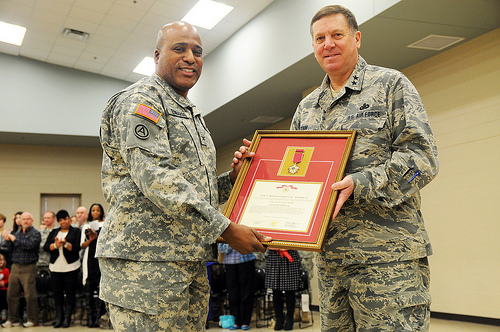
Col. John Edwards Jr., outgoing commander of the 149th Maneuver Enhancement Brigade, receives the Legion of Merit award from Maj. Gen. Edward W. Tonini, adjutant general for Kentucky, during a Change of Command Ceremony held in Richmond, Ky., Feb. 2. (US Army National Guard photo by Spc. Brandy Mort)
“Reorganizations come and go,” said Withers. “What we need to focus on is future leadership. It is not the leaders, it is the individual Soldier willing and wanting to do their job that makes a strong unit. Our goal is to instill the right values and skills for those Soldiers.”
Keynote speaker for the event, Kentucky’s Adjutant General, Maj. Gen. Edward Tonini, also focused on the development of the lower enlisted Soldiers as a vital priority for the newly refreshed unit.
“I want to salute the new 149th MEB,” said Tonini. “You are all part of a great organization. I know you will carry on the legacy of those before you. “Overall, the success of our junior leaders should be our focus. What we do today reflects the standards set by those who came before us.”
The 149th plans to gear up for two major trainings in the next two years. Morrison says that if it weren’t for the help of his non-commissioned officers, he feels that he wouldn’t be in the position that he is today.
Morrison and Withers look forward to seeing what the unit will accomplish within the upcoming months to exemplify the brigade motto, “Strength and Honor.”
Story by Staff Sgt. Sidney Hoffmann, 149th MEB Unit Public Affairs Historian Representative
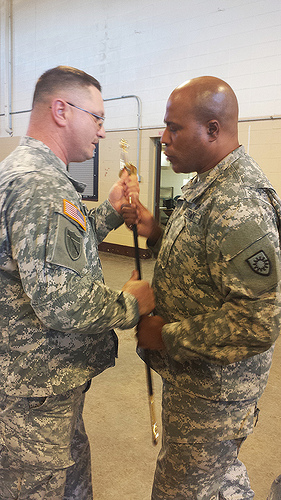
Command Sgt. Maj. Nathan Tolliver presents the noncommissioned officer sword to Col. John Edwards during a change of responsibility ceremony for the 149th Maneuver Enhancement Brigade in Richmond, Ky., Jan. 12, 2014. (U.S. Army National Guard photo by Staff Sgt. Sidney Hoffmann)
RICHMOND, Ky. — One element of life in the military that is always constant is change. As change comes, Service members must be fluid. As for the 149th Maneuver Enhancement Brigade, there have been many changes since last year. If you have never been in an MEB unit before, you come to realize a few things. The longer you have been in, the more likely you are to know a majority of the officers and NCOs among your ranks, and the abundance of knowledge and experience walking around the drill hall floor.
The brigade’s command sergeant major, Command Sgt. Maj. Sgt. Maj. Nathan Tolliver has worn the uniform for 28 years and is preparing to retire. For the sake of beginning new traditions, the brigade conducted a “Change of Responsibility” ceremony in Richmond, Ky., Sunday, Jan 12, 2014. Command Sgt. Major Jesse Withers assumed the role as the senior enlisted Soldier of the brigade.
The ceremony is optional for units but has nearly as much significance as the Change of Command ceremony. Instead of the colors, there is a sword which symbolizes the authority of the Non-commissioned Officer being passed from one command sergeant major to the other.
“This might not be the typical practice, but it is important for the NCO’s to see what an honor it is to serve in such an elite position and that their service to the country and the team is very important and respected,” said Tolliver.
“There is nothing that compares to wearing the uniform and becoming the sergeant major of one of the largest brigades in the state,” he said to the entire brigade. “It is a tremendous achievement, and I have been fortunate to have worked with so many great people.”
Within the last few months, the Soldiers of 149th MEB have been getting to know one another’s skills, who needs what training, and what place they have within such a large brigade.
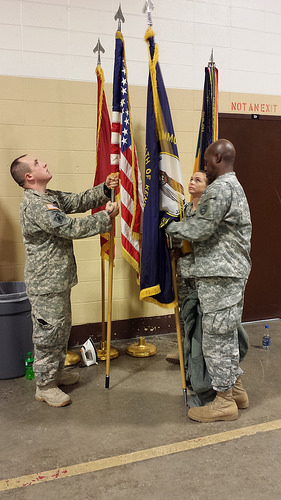
Soldiers of the Color guard for the 149th Maneuver Enhancement Brigade prepare the flags for a change of responsibility ceremony in Richmond, Ky., Jan. 12, 2014. (U.S. Army National Guard photo by Staff Sgt. Sidney Hoffmann)
“We could not be luckier,” Lt. Col. Douglas Clay stated. “We have a great team already and with the new command coming in means we are going to have it made. With new command means we are also losing leadership that have contributed to shaping this brigade thus far.”
1st Sgt. Daniel Truex has taken the position as the senior NCO and embraces it as a huge opportunity for him to experience a brigade life style. As a prior service Marine, Truex had met a captain in the National Guard that got him interested and eventually enlisted. His career began in 223rd Military Police Company and has climbed the ranks through the 617th MP Co.
“Being in a line company is certainly my comfort zone, but I already have an immense amount of respect for the Service members here and can tell there is an extreme amount of experience that walks around me,” Truex said. “My hope is we can all learn from each other and share our knowledge to make this the most effective brigade in the state.”
The drill weekend was long and challenging with many moving parts for the brigade. As most Soldiers know, sensitive items inventories and service checks on equipment are extremely tedious. However, what makes time go by quickly is the help of your team members. People were welcoming and were genuinely interested in their new unit members as well as reuniting with old comrades and sharing stories from previous deployments. Overall, the positive vibe throughout the troops is already ringing with promise of a successful year.
Story by Staff Sgt. Scott Raymond, Kentucky National Guard Public Affairs
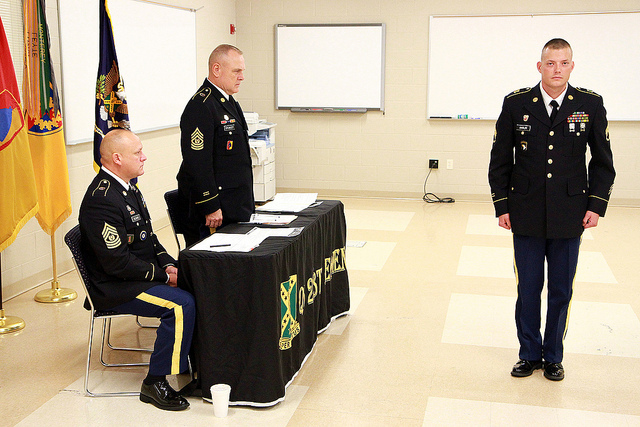
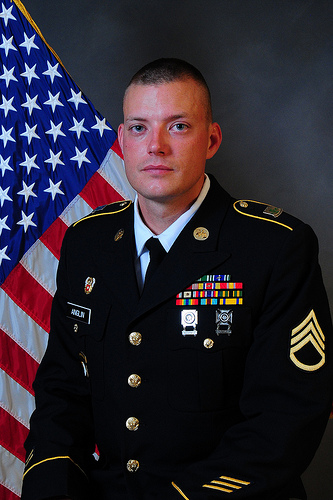
Staff Sgt. Nicholas Anglin with the 201st Engineer Battalion appears before the board during the 2014 Kentucky National Guard Soldier of the Year competition in Greenville, Ky., Nov. 17, 2013. In addition to the board, Anglin and 13 fellow Guardsmen competed in such events as weapons qualification and land navigation over the three-day weekend. (U.S. Army National Guard photo by Staff Sgt. Scott Raymond)
GREENVILLE, Ky. — Many basic Soldier skills are not always your everyday tasks; fieldstripping an M-16, searching a detainee, details of drill and ceremony. This knowledge is part of what should be in every Soldier’s toolbox and to a select few each year, these tasks become a competition. All combined, the proficiency of such tasks, along with marksmanship and physical fitness, push some to become the best of the best.
On the track, at the range and in the fields of the Wendell H. Ford Regional Training Center, 14 Kentucky National Guardsmen put their skills to the test in the 2014 Soldier of the Year competition, Nov. 15-17.
To see more photos from the event, click here.
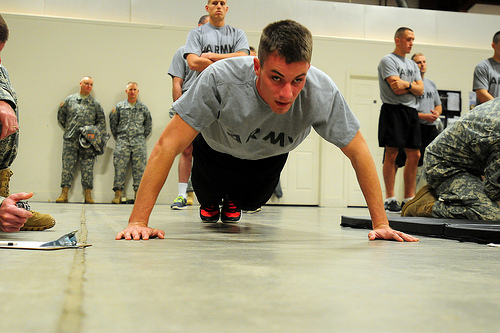
Spc. Benjamin Joynt prepares to begin his push-ups during an Army Physical Fitness Test as part of the 2014 Kentucky National Guard Soldier of the Year competition in Greenville, Ky., Nov. 16, 2013. The APFT began an event-filled day for the competitors that took them from the gym to the range to the fields to the classrooms of the Wendell H. Ford Regional Training Center. (U.S. Army National Guard photo by Staff Sgt. Scott Raymond)
“Getting back to the basics of soldiering, that’s what the Soldier of the Year Competition is all about,” said State Command Sgt. Maj. Thomas Chumley Jr., who oversaw his first competition as the State Command Sergeant Major.
“I wanted to challenge them, I wanted to challenge them mentally, physically and spiritually. When they leave here, I wanted them to feel like they’ve earned something,” he added.
From the moment competitors arrived, the pressure was on. Soldiers, NCOs and Senior NCOs alike were forced to rely on their training and experience as the weekend tested their abilities as an American Soldier.
The Guardsmen first sat down for the written tests and essay questions to start the weekend out quietly on Friday evening. But before the sun rose on Saturday, the quiet was gone as each Soldier completed the Army Physical Fitness Test, then were off to the range for individual weapon qualifications. When the last round was fired, they traded their rifles for compasses and maps and negotiated the Muhlenburg County terrain in a challenging land navigation exercise.
While in the field, a variety of Army Warrior Tasks awaited each Soldier to test other skills.
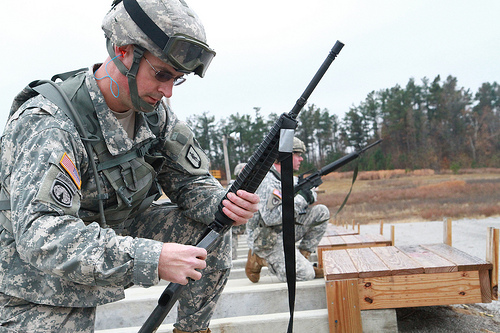
Sgt. 1st Class Joseph Gray with the 238th Regiment loads a magazine into his M-16 during the 2014 Kentucky National Guard Soldier of the Year competition in Greenville, Ky., Nov. 16, 2013. (U.S. Army National Guard photo by Staff Sgt. Scott Raymond)
“The weekend was jammed packed for sure,” said Owenton, Ky., native, Staff Sgt. Nicholas Anglin with the 201st Engineer Battalion who was named NCO of the Year for the competition.
Spc. Christopher DeLeon with the 2123rd Transportation Company from Richmond, Ky., was the runner-up in 2012. After a year of working hard, studying and increasing his PT, DeLeon returned to capture the Soldier of the Year title this year.
“I feel accomplished, like I didn’t let anyone down,” he said. “I made them proud and I’m proud of myself. This feels great, it’s an awesome feeling.”
“I will take everything I have learned from Soldier of the Year and apply it to my 2123rd Soldiers and maybe be a sponsor for another Soldier to come here next year and train him to keep the reign of the 2123rd,” he added.
Chumley said he has been involved with similar competitions at various levels in his career and that the Soldiers inspire him each time. This year’s Soldier of the Year competition was just another reason why he loves doing his job.
“This weekend has been outstanding,” said Chumley. “The Soldiers here inspire me with their life stories and how the Kentucky National Guard has set them up with a good foundation and solid leadership skills. I’m just amazed every time we have one of these.”
2014 Soldier of the Year winners:
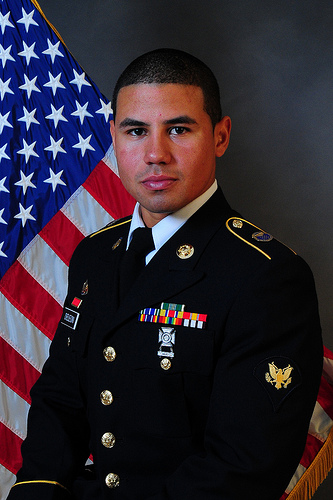
Soldier of the Year – Spc. Christopher DeLeon, 2123rd Transportation Co. from Richmond, Ky.
NCO of the Year – Staff Sgt. Nicholas Anglin, HSC 201st Engineers from Owenton, Ky.
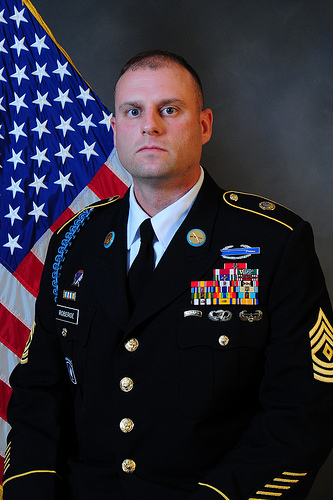
Senior NCO of the Year – 1st Sgt. Matthew Roberge, 1/149th Infantry from Nicholasville, Ky.
By Staff Sgt. Scott Raymond, Kentucky National Guard Public Affairs
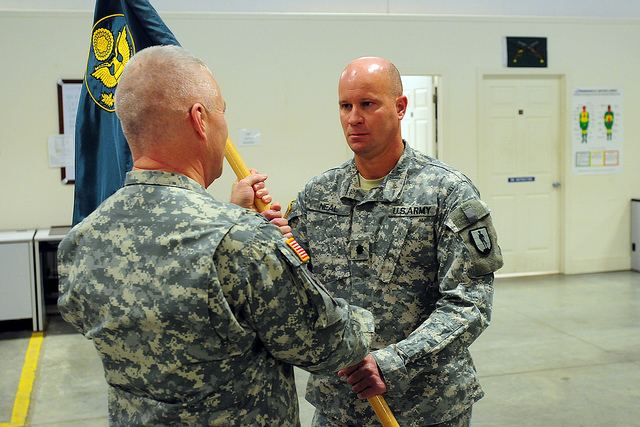
Lt Col. Todd Neal receives the battalion guidon from Col. Hal Lamberton during a change of command ceremony at the Wendell H. Ford Regional Training Center in Greenville, Ky., Nov. 15, 2013. Neal assumed command of the 2nd Modular Training Battalion of the 238th Regiment. (U.S. Army National Guard photo by Staff Sgt. Scott Raymond)
GREENVILLE, Ky. — Lt. Col. Todd Neal assumed command of the 2nd Modular Training Battalion, 238th Regiment during a change of command ceremony at the Wendell H. Ford Regional Training Center in Greenville, Ky., Nov. 15, 2013.
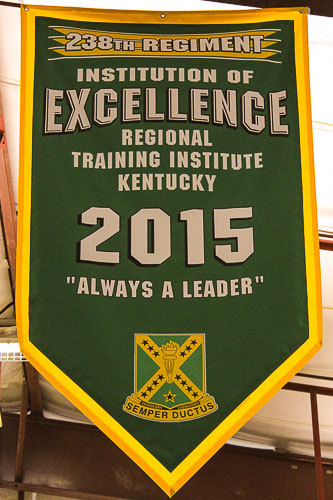
Lt. Col. David Roche relinquished command, a position he has held for the past two years. Col. Hal Lamberton, the regimental commander said Roche was a pivotal part of the 238th Regional Training Institute being named an Institution of Excellence for 2012. Lamberton also awarded Roche the Meritorious Service Medal for his leadership of the 2/238th.
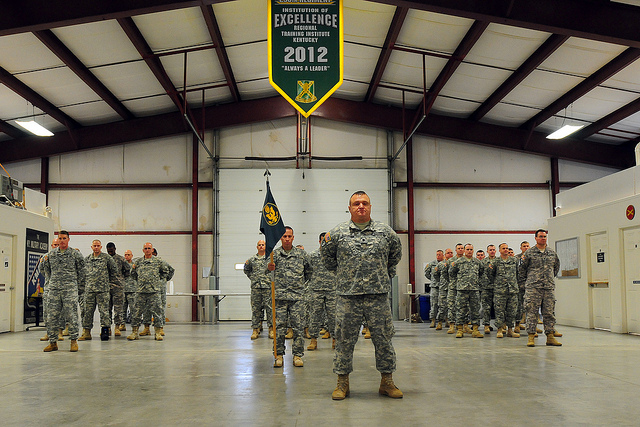
Soldiers of the 238th Regiment stand in formation during a change of command ceremony at the Wendell H. Ford Regional training Center in Greenville, Ky., Nov. 15, 2013. The regiment is is made up of the 1st Field Artillery Battalion, the 2nd Modular Training Battalion and the Regimental Headquarters. (U.S. Army National Guard photo by Staff Sgt. Scott Raymond)
Neal comes to the unit from the 149th Maneuver Enhancement Brigade where he spent several years in the brigade’s plans and operations section. Neal said taking command of a battalion should be on every officer’s list of goals in their careers. He thanked several Soldiers and mentors who have helped him along the way to this highlight of his time in uniform.
“As a young officer, there are two or three things you look to do. You want to be a successful platoon leader and get a company command, but most guys look at the pinnacle of their careers being a brigade or battalion commander,” said Neal. ” This is a step I fortunately been able to take and I look forward to the challenge and doing a good job for the organization and the leadership and improve on what is already in place.”
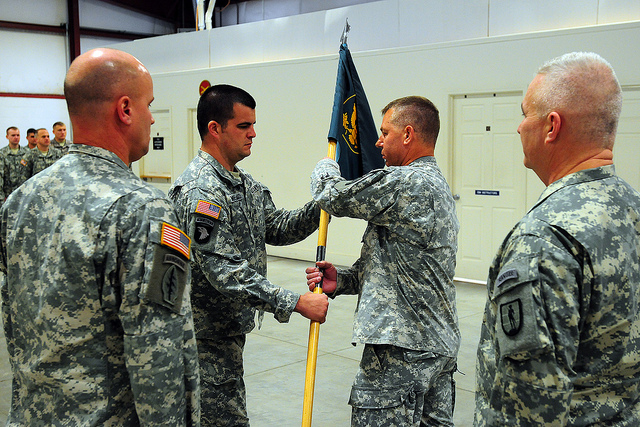
Lt. Col. Daivd Roche receives the battalion guidon from Master Sgt. Benzie Timberlake during a change of command ceremony at the Wendell H. Ford Regional Training Center in Greenville, Ky., Nov. 15, 2013. Roche relinquished command of the 2nd Modular Training Battalion to Lt. Col. Todd Neal (left). (U.S. Army National Guard photo by Staff Sgt. Scott Raymond)
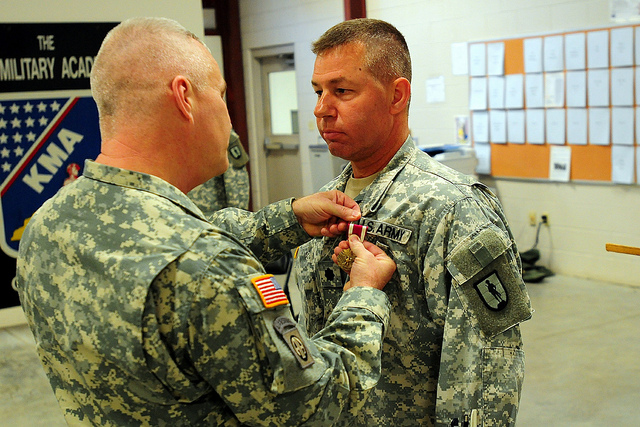
Col. Hal Lamberton, commander of the 238th Regiment pins the Meritorious Service Medal to the uniform of Lt. Col. David Roche following a change of command ceremony in Greenville, Ky. Lamberton cited Roche as a key figure in the 238th receiving the distinction of becoming an institution of excellence in 2012. (U.S. Army National Guard photo by Staff Sgt. Scott Raymond)