
Pages
Stay In Touch
More
© 2013 KentuckyGuard
Story by Sgt. Cody Stagner, 133rd Mobile Public Affairs Detachment
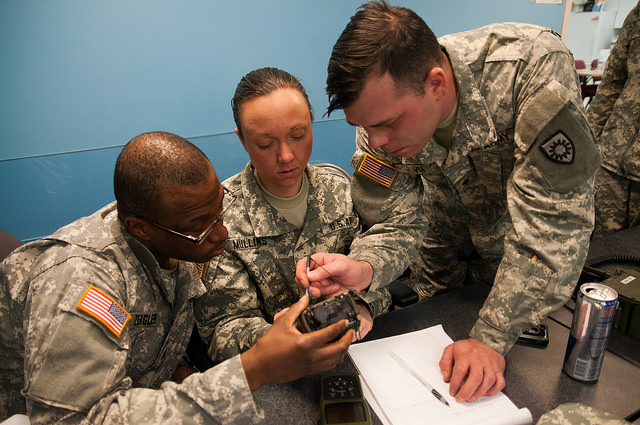
Spc. Christopher Via, a signal specialist with the 149th Signal Company, provides instruction on data transfer devices to Capt. Damien Zeigler, of the 206th Engineer Battalion, and 2nd Lt. Cassandra Mullins, of the 149th Signal Co., during signal training at Boone National Guard Center in Frankfort, Ky., Jan. 10, 2015. The 149th Signal Co. hosted the event to provide instruction for signal operators in the brigade. (U.S. Army National Guard photo by Sgt. Cody J. Stagner)
FRANKFORT, Ky. - The 149th Signal Company hosted their first-ever leader development workshop for the 149th Maneuver Enhancement Brigade at Boone National Guard Center in Frankfort, Jan. 10-11, 2015.
Col. Jerry Morrison, commander of the 149th MEB, had the vision to provide train-the-trainer instruction that would allow leaders from all five battalions to go back to their units and teach their Soldiers and operators on the ground.
“Across the brigade, as far as communication is concerned, we found a need to sync everybody together,” said 1st Sgt. Craig E. Anderson, the first sergeant for 149th Signal Company. “So this concept gets everybody in the same room to say, ‘hey, here are some strengths and weaknesses,’ and the signal company is taking the lead because we are nothing but communications.”
For more photos, visit our flickr site here.
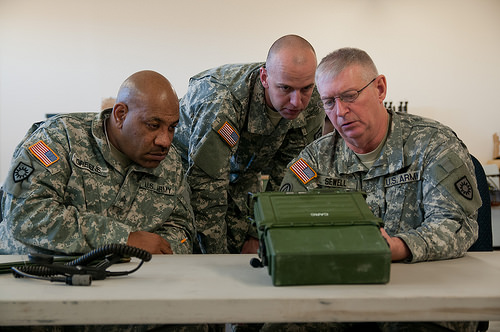
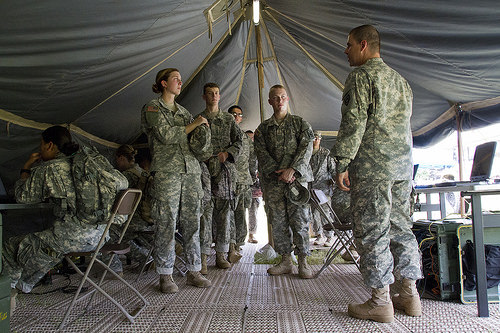
Sgt. Mark Greene, Sgt. Brian Bingham and Sgt. 1st Class Gerald Sewell discuss the operation of a signal radio during the 149th Signal Company’s career workshop in Frankfort, Ky., Jan. 10, 2015. As a signal-specific unit, the company has training resources and specialists for instruction on data transfer and communication instruments. (U.S. Army National Guard photo by Sgt. Cody Stagner)
As a signal-specific unit, the company has training resources and specialists for instruction on data transfer and communication instruments. These courses can be given over the course of a single drill weekend.
“It is not an in-depth training,” said Anderson, a coordinator who helped in the overall concept and design of the training program. “But you get to see the faces to your right and to your left. That makes you a stronger team; knowing who is in your brigade, working together to make sure others have the same capabilities you might have, and coming together for an overall stronger brigade.”
In order to build a stronger brigade, the signal company had to deal with the technical challenge of how to set up a relay station between separate units or battalions during annual training. To do this, the unit uses the Defense Advanced GPS Receiver and Single Channel Ground and Airborne Radio System.
“Let’s say two units are running different frequencies and need to communicate,” said Spc. Jessica Garner, a trainer in the 149th Signal Company. “After using a DAGR to set the atomic time of all SINCGARS radios, it may take a separate vehicle and connections shared with both units to relay that important message.”
Beyond synergy and basic radio skills, the company has included training on the brigade’s newly fielded Joint Capabilities Release, a friendly-forces tracking device that also allows secure messaging and data transfer.
“We are just getting into the cycle of using this platform,” said Capt. Joe Fontanez, commander for the 149th Signal Company and lead coordinator. “There are tasks involved that we’ve never really had to do before because it went from an unclassified system to classified. So we are trying to get people hands-on training to really understand this system a little better.”
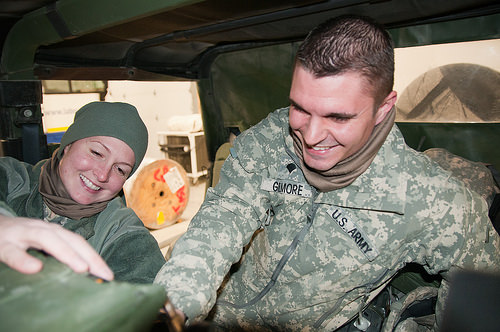
Spc. Jessica Garner and Spc. Tadd Gilmore, with the 149th Signal Company prepare a Single Channel Ground and Airborne Radio System at Boone National Guard Center in Frankfort, Ky., Jan. 10, 2015. Members of the 149th Signal Co. provided signal training during this two-day event. (U.S. Army National Guard photo by Sgt. Cody J. Stagner)
Bringing in occupation-specific Soldiers created an opportunity worth exploiting for the brigade. Instructors had the chance to give the attendees insight into Army career-advancing schools needed and how to progress through the ranks by taking charge of one’s own career.
“We all manage our own careers,” said Fontanez. “It’s really important for Soldiers to understand that and know how to progress through the organization to meet their goals.”
According to Fontanez, the unique training successfully promoted synergy, networking, career progression, camaraderie and profession of arms among the brigade’s signal corps.
Story by Staff Sgt. Scott Raymond, Kentucky National Guard Public Affairs
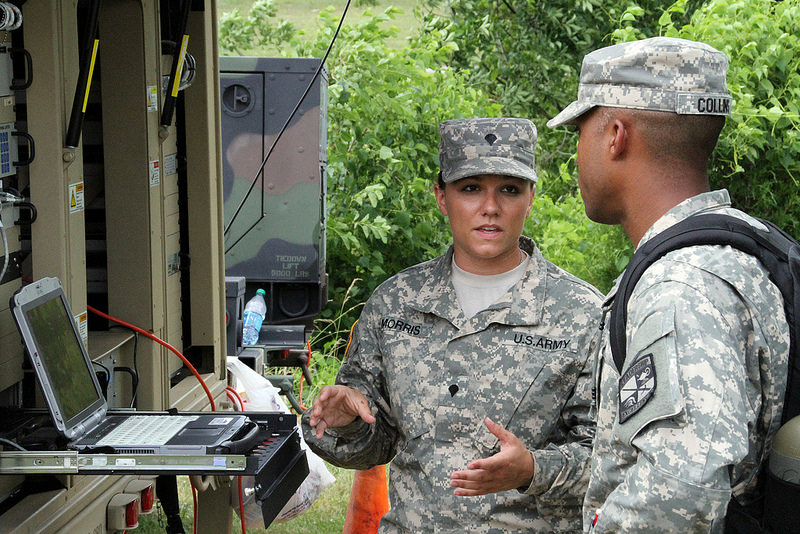
Spc. Jennifer Morris with the 149th Signal Company shares her knowledge of a Satellite Transportable Terminal with a ROTC cadet at Fort Knox, Ky., June 20, 2014. Morris and other members of the Kentucky National Guard were on hand to showcase various career fields for the cadets to pursue when they graduate. (U.S. Army National Guard photo by Staff Sgt. Scott Raymond)
FORT KNOX, Ky. — Each year thousands of Army ROTC cadets attend the Leadership Development and Assessment Course to help determine where and how they will serve in the Army. This 28-day event is considered a centerpiece of the ROTC program and historically has been held at Joint Base Lewis-McChord in Washington. For 2014, the LDAC was held at its new home alongside the U.S. Army’s Cadet Command at Fort Knox.
More than 8,000 cadets filtered through the grounds of Fort Knox during the summer for LDAC, formerly known as Advanced Camp. The course is a series of evaluations for each cadet in various leadership positions. A small portion of the event called Branch Orientation allows the cadets a taste of each branch of the Army they can request to be commissioned into. In addition to active duty units, Army National Guard and U.S. Army Reserve units played a role in representing each speciality, such as infantry, transportation, armor and aviation.
Spc. Nathan Hamilton with the 149th Signal Company discusses the advantages of being a signal officer with ROTC cadets at Fort Knox, Ky., June 20, 2014. Thousands of cadets took in their future opportunities during branch orientation as part of their annual Leadership Development and Assessment Course. (U.S. Army National Guard photo by Staff Sgt. Scott Raymond)
Soldiers of Kentucky’s 149th Signal Company were on hand to demonstrate the highlights of the Signal Corps and what being a signal officer would be like.
“It’s an honor to have the opportunity to share my passion for communications with future signal officers,” said Spc. Nathan Hamilton, a multi-channel transmission system operator with the 149th. “Hopefully I can provide some of my knowledge to them for a few to be as excited about communications as I am.”
Soldiers from the unit set up a Satellite Transportable Terminal, STT with full communication operability, provided a brief run-down of what signal is about and even gave cadets the chance to get on-line to check an email or two.
Sgt. 1st Class Matthew Mathesius, Readiness NCO for the 149th Signal said the unit was requested by the Army’s signal headquarters in Fort Gordon, Georgia to support the branch orientation. He believed their set up would attract cadets to the Signal Corps because of the unique mission and equipment the job requires.
“Thousands of cadets will have the opportunity to see the best signal company in the Army National Guard in action,” he said.
“Our static display differs from other branches because it is not just a piece of equipment on display. It is a functioning satellite terminal trailer and command post node that provides data and voice capability to demonstrate what we do. This showcases our ability to provide communication access anywhere, anytime.”
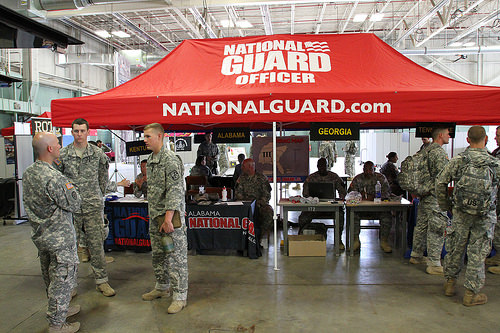
Chief Warrant Officer Greg Scott speaks with ROTC cadets at a National Guard display at Fort Knox, Ky., June 20, 2014. National Guard Soldiers and Reservists played a large role in the U.S. Army ROTC’s annual Leadership Development and Assessment Course. (U.S. Army National Guard photo by Staff Sgt. Scott Raymond)
In addition to the signal Soldiers, Kentucky Guardsmen from the 2nd Battalion, 138th Field Artillery showed up with one of their M109 Howitzers to draw cadets into artillery. Soldiers from Kentucky’s 198th Military Police Battalion also attended to provide the information for those interested in military law enforcement.
According to Chief Warrant Officer Greg Scott, Kentucky Army National Guard Liaison to the cadet command, around 50 percent of each year’s graduating classes become officers in the reserve components which is why it is important for National Guard and Reserve units to have such a presence at LDAC.
“This year the Army National Guard and the Reserves played a major role in executing the seven branch orientation events,” said Scott. “Every state and territory is invited to participate to inform interested cadets of what their state has to offer.”
“The goal, with the idea that we are all one team, is to broadcast what your branch has to offer and to talk about the benefits of the Guard in every state. Each component is out here to find the best of the best as their future leaders.”
While budgetary constraints played a part also, using local units close to Fort Knox, Scott said the LDAC’s move to Kentucky will be a benefit to the Kentucky National Guard.
“It only makes sense that we try to take the lead on this. Moving forward, this could be a major opportunity for the Kentucky National Guard to play a big role in the summer training that is conducted in our own backyard.”
