
Pages
Stay In Touch
More
© 2013 KentuckyGuard
Story by David Altom, Kentucky National Guard Public Affairs
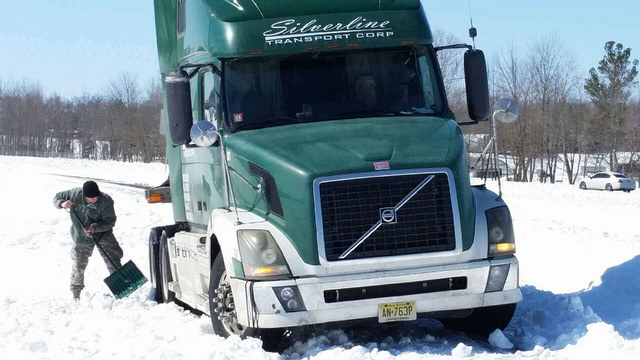
Staff Sgt. Steve Musgrave helps a truck driver along I-24 in McCracken County. Musgrave is one of the soldiers from the Kentucky National Guard’s Co. A, 149th Brigade Support Battalion assisting motorists stranded during Winter Storm Thor. (Photo by Spec. Jeriel Clark, Kentucky National Guard)
FRANKFORT, Ky. — In arguably the worst winter since 2009, Kentucky National Guard troops recently played a crucial role in protecting the health, safety and welfare of their fellow citizens. In the wake of heavy snows that began on March 5, hundreds of accidents and impassable conditions stranded an estimated 600 vehicles along I-24 and I-65 in Central Kentucky. More than 150 Kentucky Guard soldiers were called out over a two day period to support relief efforts, clearing traffic and rendering aid to stranded motorists.
“We were given the mission of getting traffic going,” said Sgt. 1st Class Sherman McCoy with the 223rd Military Police Company. “We helped a few motorists who were trying to get off the expressway and got stuck, digging them out and getting them off the road. We also helped numerous tractor trailers that were stuck and we got them on their way.”
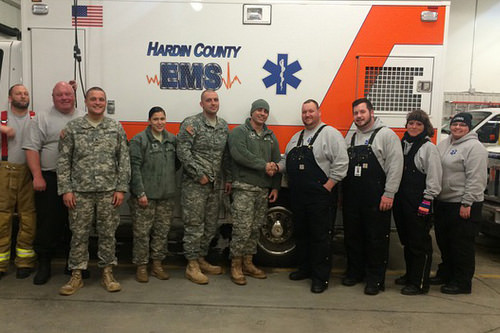
Soldiers with the 2061st Multi-role Bridge Company assisted Hardin County Emergency Medical Services in providing man power assistance with patient and paramedic transport and ambulance recovery missions during the winter storm, March 5-7, 2015. The 2061st Team traveled in tandem with Hardin County EMS to numerous 911 Emergencies to ensure freedom of maneuver for EMS throughout Hardin County. (Courtesy photo)
“We’re not used to quite this much snow,” he said, “but it’s been a good mission. We enjoy helping others.”
1st Sgt. Chris Jeter, 149th Brigade Support Battalion, said his troops worked to ensure travelers were safe and provided assistance to those whose vehicles were stuck in mounding snow.
“Short of hooking tow straps to our military vehicles, we have done everything possible to assist them,” he said of their efforts.
Visit our flickr page for more photos.
In addition to responding state wide to these areas, local teams also assisted local emergency medical services, helping to reach patients not accessible by ambulance.
“We have been responding with paramedics to these areas, carrying them to the residence once they have gotten as far as they can go,” Jeter said adding that they are using Humvees and “good old foot power,” even helping to carry patients and paramedics back to the ambulance.
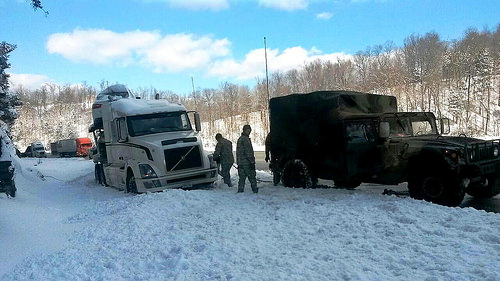
Soldiers from the Kentucky National Guard’s Charlie Battery, 2nd Battalion 138th Field Artillery hook a Humvee to a semi-truck to pull it back onto I-65 March 6, 2015. Roughly 150 Guardsmen were activated to assist local authorities along Insertstates 24 and 65. (Kentucky National Guard photo by 1st Lt. Holdun Reed)
Troops also used Humvees to deliver food, water and gasoline to stranded motorists, and in some cases transported chilled travelers to warming shelters. It was reported that some motorists were stranded up to nearly 24 hours.
“The Soldiers did it again,” said Col. Jerry Morrison, commander of the 149th Maneuver Enhancement Brigade. “Soldiers received alert phone calls as early as 0330 hours and began digging out of their own driveways to respond to citizens in I-65 and I-24. Over 120 Soldiers of the 149th Maneuver Enhancement Brigade from Benton, Murray, Paducah, Bowling Green, Louisville, Elizabethtown, and Richmond were on duty by the time snow quit falling that afternoon.”
“We alerted, mobilized, executed our mission, and de-mobilized Soldiers in a 96 hour period. I am extremely proud of our leaders and units. Their response shows the requirement for the National Guard to remain in the home towns across America to provide immediate assistance to the Governor in times of crisis.”
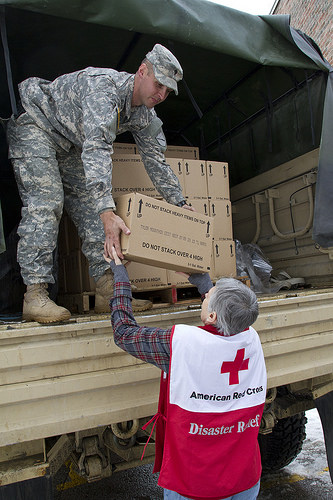
Spc. James Harmon, with the 1st Battalion, 149th Infantry hands a case of water to Anne Cockley, a Red Cross volunteer at Green Hills Elementary School in Bledsoe, Ky., Feb. 24, 2015. The Soldiers assisted with water deliveries throughout Harlan County in response to a water shortage caused by a recent winter storm. (U.S. Army National Guard photo by Staff Sgt. Scott Raymond)
This is the second such mission for the Kentucky National Guard in the past few weeks. Earlier in February more than 100 troops were mobilized in response to the sub-zero temperatures and icy conditions that plagued Eastern Kentucky. Soldiers cleared public roads, provided emergency transportation to hospitals and long term care medical facilities. They also delivered several thousand gallons of water to communities suffering a water shortage brought about by damaged water systems.
In 2009 more than 4,000 soldiers and airmen were brought on duty when a state wide ice storm triggered wide spread power blackouts. Troops delivered food and water to stranded residents, conducted door to door wellness checks and supported local authorities as needed. The 2009 winter storm is considered one of the worst domestic natural disasters in the Kentucky National Guard’s history.
Story by Staff Sgt. Scott Raymond, Kentucky National Guard Public Affairs
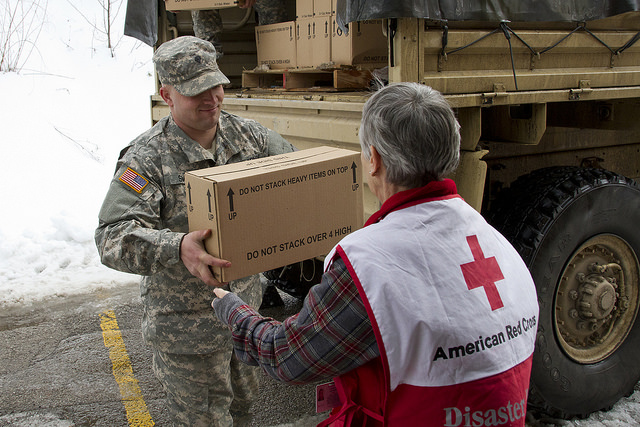
Spc. Timothy Smith with the 1st Battalion, 149th Infantry hands a case of water to Anne Cockley, a Red Cross volunteer at Green Hills Elementary School in Bledsoe, Ky., Feb. 24, 2015. The Soldiers assisted with water deliveries throughout Harlan County in response to a water shortage caused by a recent winter storm. (U.S. Army National Guard photo by Staff Sgt. Scott Raymond)
HARLAN, Ky. — More than 100 Kentucky Guardsmen were activated this week to assist local communities following a devastating winter storm.
Snowfall totals in excess of two feet along with bitterly cold temperatures pushed counties in Eastern and Southern Kentucky to the brink. With 93 of Kentucky’s 120 counties declaring emergencies, Gov. Steve Beshear issued a state of emergency Feb. 16, opening the door for the Guard to assist.
Soldiers with the 201st Engineer Battalion helped clear more than 70 miles of roads in Lee County alone. Trucks from the 138th Field Artillery Brigade and 149th Maneuver Enhancement Brigade moved palletized water from Louisville to staging areas.
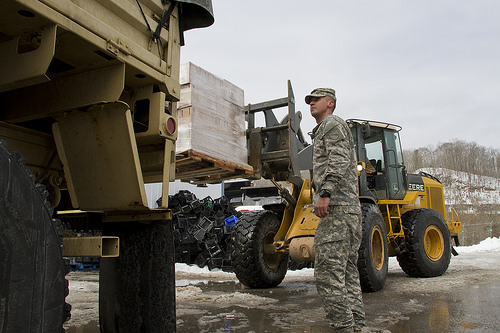
Spc. James Harmon with Alpha Company, 1st Battalion, 149th Infantry helps guide a pallet of water into a vehicle for distribution in Harlan, Ky., Feb. 24, 2015. The Guardsmen were able to supply distribution points across Harlan County to get the water closer to those in need. (U.S. Army National Guard photo by Staff Sgt. Scott Raymond)
In Harlan County, Soldiers with Alpha Company, 1st Battalion, 149th Infantry transported pallets of water to distribution points throughout the county following water system failures.
“We have the equipment to do the job,” said Staff Sgt. Terry Brock with Alpha Co. “We’ve been delivering water, clearing roads, shoveling driveways, helping people get to doctors, just helping out wherever we can.”
Brock, who lives in Harlan County, even had to deliver water to his own family on one of the unit’s runs. “It was good to help them out and to be in a spot to help out the whole county of Harlan too.”
Visit our flickr site for more photos.
Frozen lines and pump failures knocked out the water to an estimated 45,000 households in Eastern Kentucky. Together with the snow, the rural mountain communities were impacted much worse than other parts of the state.
Harlan County Judge Executive Dan Mosley said he has requested a lot of local and state resources throughout this process and finds it encouraging to find so many willing to help.
“The Guard has helped us out in a big way,” he said. “We would not have been able to set up so many distribution points if it wasn’t for the National Guard, the Red Cross and Operation UNITE. There would be a lot of people without water in their homes if it wasn’t for the Kentucky National Guard units doing what they’re doing here.”
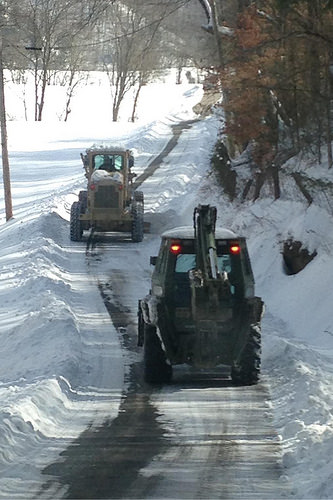
Soldiers with the 201st Engineer Battalion work to remove snow from a road in Lee County, Ky., Feb. 19, 2015. The unit cleared more than 70 miles of snow following the winter storm that impacted much of Kentucky. (Photo courtesy of 201st Engineer Battalion)
According to Spc. James Harmon with Alpha Co., the unit was responsible for the delivery of more than 7,000 gallons of water. In coordination with the Red Cross, the Guardsmen supplied designated distribution points that were closer for citizens to pick up the water. Each run became similar to a wellness check as the Citizen-Soldiers recognized familiar faces and were able to judge the situation based upon the words of their own friends and locals they knew.
“I grew up here in Harlan, it’s a great community of people,” said Harmon. “I just helped deliver water to my old elementary school in Bledsoe. It’s why I enjoy being a part of the National Guard. We serve our Nation, but are also here to help our neighbors get back on their feet.”
Soldiers in the are also provided transportation assistance to emergency personnel, ensuring doctors, nurses and health care staff made it to work.
With more than 30 vehicles in use across the Commonwealth, the Guardsmen are expected to continue each mission through the week.
Check out some video of the Harlan County response mission below:
Story by David Altom, Kentucky National Guard Public Affairs
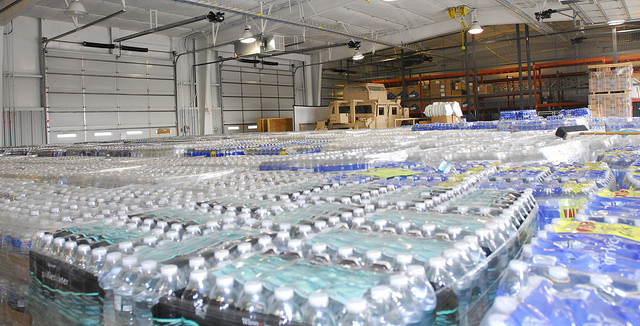
Logistical Support Areas provide over two million bottles of water and supplies to the citizens of Kentucky during the state’s severe ice storm. (U.S. Army photo by Sgt. Fredrick P. Varney)
FRANKFORT, Ky. — The Kentucky Army National Guard has been recognized for the top Army emergency management operation in the nation, according to a report from the Army National Guard headquarters in Washington, D.C.
The report, which comes five years after the winter storm of 2009, is seen as a benchmark for the Kentucky Guard’s readiness to respond to natural disasters and emergencies on the domestic front. In January of 2009 more than 100 counties declared states of emergency, necessitating the mobilization of the entire Kentucky National Guard. More than 4,000 troops were deployed across the state, delivering water, food and fuel during freezing temperatures and hazardous conditions. Guard members also conducted door to door wellness checks to ensure the safety and welfare of local citizens.
Click here to see more photos of the Kentucky Guard’s response to the 2009 winter storm.
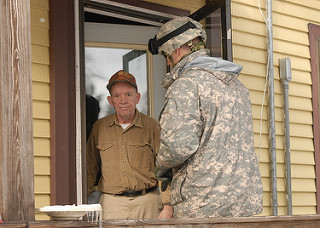
A Kentucky National Guard Soldier conducts a wellness check following the winter storm of 2009. (Photo by Spc. Ellie Waters, 133rd Mobile Public Affairs Detachment)
“This is good feedback that we’re doing the right thing,” said Warrant Officer Charlie Harris, an emergency management coordinator for the Kentucky Guard. “We’ve worked hard to make sure that the Guard can respond effectively and efficiently in a time of crisis.””We have to take care of ourselves so we can take of our communities. The winter storm of 2009 was a wakeup call in that regard.”
By regulation, the Army Emergency Management Program “serves as the single integrated emergency management program for the planning, execution, and management of response efforts … to mitigate the effects of an all-hazard incident, to include but not limited to, natural, manmade, and technological disasters, chemical, biological, radiological, nuclear, and high-yield explosive (CBRNE) incidents and accidents on or affecting Army installations, facilities, and/or activities….”
In other words, if there’s trouble, the Kentucky National Guard has to be ready to respond. This means Guard facilities must have plans and redundancies in place to minimalize the effects of a disaster or incident, allowing the troops to focus on the local community instead of itself. For example, armory generators have to be ready to go and vehicles pre-placed for rapid deployment when needed. This in addition to training Soldiers on what they are expected to do.
“We have the plans in place, we conduct our exercises, and we’re able to get back to those mission essential items as soon as possible because people are depending on us,” said Harris. “Our program is so good other states are asking for help. And we’re helping them.
“This is something we take very seriously.”
Story by David Altom, Kentucky National Guard Public Affairs
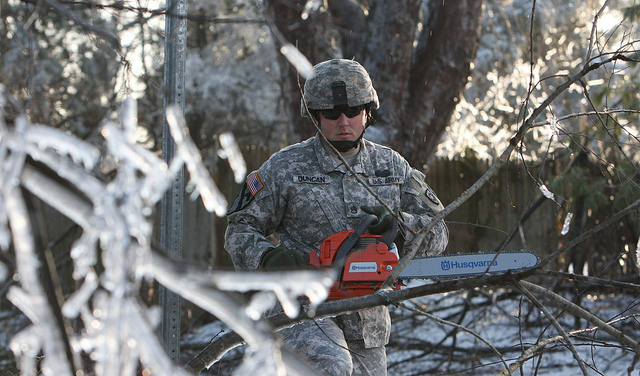
Ice-covered branches provide a fitting background as Staff Sgt. Erick Duncan, Company A, 149th Brigade Support Battalion, walks down a street in Mayfield, Ky., Friday, Jan. 30, 2009 during a road clearing mission. The Soldiers used chainsaws to cut up branches lying near the city streets. Fellow Soldiers moved the branches off the street. (Kentucky National Guard photo)
FRANKFORT, Ky — In January 2009 Kentucky experienced what Gov. Steve Beshear described as “the worst natural disaster in Kentucky’s history.” Twenty mph wind gusts drove the wind chill to sub-zero levels and 10 inches of snow fell on top of three inches of ice, a recipe for catastrophe from Pikeville to Paducah. Water lines burst and power lines snapped, leaving nearly 800,000 customers without electricty — and life stustaining heat. More than 100 counties declared states of emergency and FEMA declared the entire state a disaster zone. Experts would later say that the 2009 winter storm surpassed all aspects of Hurriane Ike.
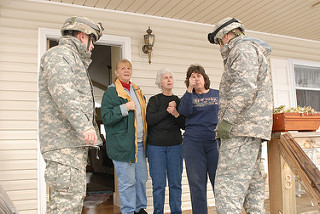
Army Spc. Harold Hoskins (l) and Sgt. Joshua White (r) of the 206th Engineer Battalion talk with residents of Leitchfield, Ky. as part of a door-to-door health and welfare visit program conducted by members of the Kentucky National Guard.
On January 31 Governor Steve Beshear directed Kentucky’s adjutant general, Maj. Gen. Edward W. Tonini, to order the unprecedented activation of all Kentucky Army National Guard units, along with selected portions of the Kentucky Air National Guard. This was the largest state call up of Kentucky National Guard forces in the history of the Commonwealth. It represented the strongest possible effort to relieve human suffering and ensure the safety and well-being of our citizens. The order placed 4,600 troops (nearly 3,700 Army Guard Soldiers and 320 Air Guard members) into the effort to address the needs of the people of the Commonwealth during this winter storm.
In comparison, more than 800 Kentucky Guard Soldiers and Airmen were deployed in support of Operations Iraqi Freedom, Enduring Freedom and Noble Eagle. The state activation exceeded troop levels for the 1997 flood (1,600 troops) and Kentucky’s support of recovery efforts following Hurricane Katrina in 2005 (approximately 2,000). The order did not include Guard members who were college students or who had not completed basic training.
Joint Task Force Kentucky was formed to coordinate the massive Army and Air National Guard effort, establishing command and control in five subordinate task forces arrayed across the Commonwealth. Restoration of electric power to water plants, communications facilities, shelters and homes were the top priority across the state. Troops worked with state and local crews in clearing road and creating access to damaged power transmission lines.At one point Kentucky Guard officials announced the delivery of more than 450,000 meals to local communities, along with a schedule to bring in 285,000 meals every day until the crisis was over. In addition to the meals, nearly a million bottles of water were handed out in regions where residents have no access to clean water, with a half million bottles of water coming in on a daily basis.
The bulk of the Guard’s mission eventually moved west of I-75, with an emphasis on Benton, Leitchfield, Greenville, Madisonville, Paducah, and communities in between. Troops focused on the restoration of electric power to water plants, communications facilities and homes. Using chainsaws and elbow grease they cleared routes for emergency response vehicles as well as helped utility crews gain access to damaged power transmission lines.
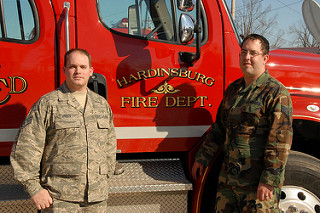
Staff Sgt. Thomas Moses and Staff Sgt. Jason Scharf identifed the two carbon monoxide poisoning victims today during wellness checks conducted in conjuction with Darren Voyles, a firefighter with the Hardinsburg City Fire Department. (Photo by Tech. Sgt. Dennis Flora / KyANG)
Ten deaths were attributed to carbon monoxide poisoning from the use of generators and fire in homes. Guard members assisted local civilian authorities with life-saving wellness checks. Two Airmen from the Kentucky Air National Guard who, along with local authorities, were credited with saving an elderly couple from carbon monoxide poisoning during the a door-to-door wellness check in Breckenridge County. The couple were treated at a local hospital and released.Click here to read about Guard “wellness check” saves couple from carbon monoxide poisoning
“This is indeed a monumental effort,” declared Maj. Gen. Tonini. “Never before have we mobilized so many troops for such an important cause. From Hazard to Paducah, Kentucky has been dealt a major blow with this winter storm and it caught a lot of people unprepared. Indeed, the very safety and welfare of our fellow Kentuckians is at stake and we will be here until the end.”
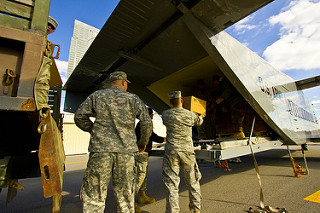
Soldiers of the 307th Component Repair Company prepare to transfer MREs from a C-23 Sherpa to a 2.5-ton truck for transport to the distribution facility at Wendell H. Ford Regional Training Center in Greenville, Ky. on Mon., Feb. 2, 2009. The Kentucky National Guard is distributing its stock of MREs to residents who have lost power due to the winter storm that has ravaged the state.
Establishment of shelters and points of distribution for essential supplies were also prime missions for Guard Soldiers and Airmen. The newly constructed Armed Forces Readiness Center in Paducah was transformed into a way-station for equipment and supplies brought in by FEMA.
Other states joined Kentucky in the winter storm relief effort. Members of the West Virginia National Guard sent 50 engineers and their equipment to assist in debris removal. The Florida National Guard contributed a communications unit and several truckloads of equipment to help state and local official bridge communications shortfalls in West Kentucky. The Florida Guard team joined Kentucky Guard communications experts to establish operations in 10 locations throughout western Kentucky. Other out of state resources also include 180 humvees on loan from Guard units in Indiana, Ohio and Tennessee. A Kentucky Air National Guard C-130 ferried more than 100 troops to Rickenbacker Air Force Base near Columbus to receive Ohio’s portion of the vehicles.
It is now five years later and the Kentucky National Guard’s relevance lives on at home and abroad. Soldiers and Airmen continue to aid their fellow Kentuckians hit by floods, tornadoes and winter storms. Add to that the more than 16,000 troops have deployed overseas since 9/11. And yet the 2009 winter storm remains the largest single call up of troops in our state’s history.
On a foot note, later that same year the Kentucky Guard adopted the slogan “Unbridled Service.” A fitting tribute to the men and women who worked so hard for their fellow citizens.
