
Pages
Stay In Touch
More
© 2013 KentuckyGuard
Story by Sgt. 1st Class Rebecca Wood, 149th Maneuver Enhancement Brigade Public Affairs
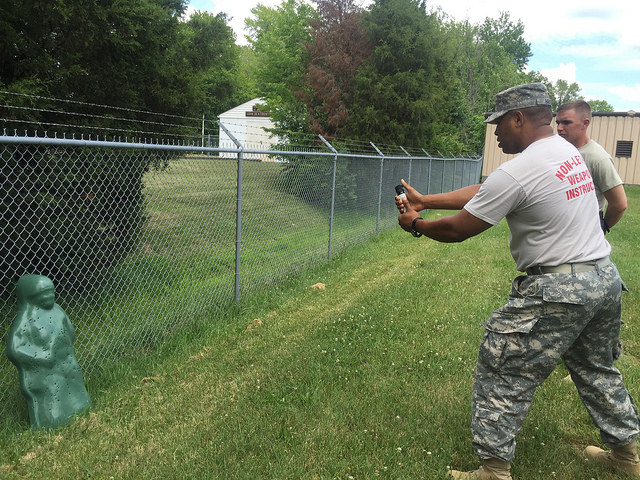
Sgt. 1st Class Jacque Hayes, an instructor from the 198th Military Police Battalion, demonstrates the proper use of oleoresin capsicum spray as part of the law enforcement certification. Hayes conducted OC spray certification and contamination on all of the 1103rd MP DET Soldiers so they can meet the Law Enforcement Council requirements. (U.S. Army National Guard Photo by Sgt. First Class Emily Cooper)
RICHMOND, Ky. – The Kentucky National Guard’s 198th Military Police Battalion conducted annual training in June at three vastly different training areas in an effort to maintain its legacy as a highly skilled and trained fighting force.
According to Maj. Tim Starke, battalion commander of the Louisville, Kentucky-based unit, each of the six companies trained at the platoon level to ensure overall readiness to conduct mobility support, policing and detention operations.
“It’s important for Soldiers to know field-craft and to not only survive, but also successfully conduct their mission while living out of their trucks and rucksacks,” said Starke. “The return to self-sufficiency in the field using organic military assets versus (units) relying on built-up infrastructure and contractor support results in Soldiers who can overcome adversity caused by inclement weather, sleep deprivation and continuous operations.”
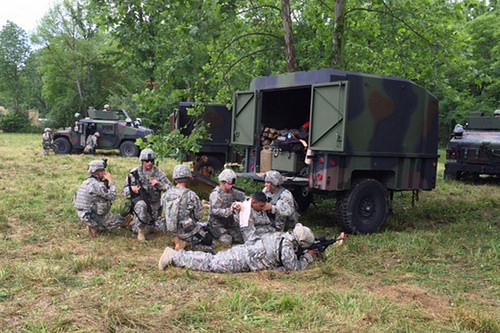
Medics under the 617th Military Police Company conducts first aid at a Casualty Collection Point while under attack during a training exercise at Camp Atterbury, Indiana. This type of training conveys the concept of tactically immersed training for the Soldiers (Photo courtesy of 198th Military Police Battalion)
Mission Command
Headquarters and Headquarters Detachment, 198th MP, 223rd MP Company, 617th MP Company and 940th MP Company conducted command support and mobility operations at Camp Atterbury, Indiana.
The exercise simulated theater-opening operations, where platoons and squads focused on: route reconnaissance, route signing, convoy security, operating hasty detainee holding areas and conducting access control and base defense without support from a forward operating base.
This was 1st Lt. Christopher Mostek’s first AT with the 223rd MPs, and as a brand new platoon leader, he said the training “forced me out of my comfort zone.”
“It empowered me as a new platoon leader and helped me to get to know my Soldiers,” he said.
Mostek said the high intensity training and sleep deprivation made the training even more austere and realistic.
“When you are training like that, it pushes you to that point of exhaustion, but you keep going because you are part of a team,” he said. “My Soldiers maintained a positive attitude despite some tremendous adversity.”
Mother Nature didn’t cooperate with the MPs, dumping rain on the exercise for nearly a week.
“This is the first AT we’ve had where, for six-plus days, you only have your truck or a cover to sleep in,” said Spc. Alex Huesman, 2nd Platoon, 940th MP Company. “It rained almost every day so we were constantly facing the elements. I was miserable but it was great training.”
Huesman said the realistic scenarios – including the opposing forces (OPFOR) – added to the overall experience.
“The environment was realistic,” he said, “with legit ECP (entry control points) spots, OPFOR raids breaking through our ECPs in the middle of the night (and) 360-degree security.
“We had really good leadership involved in our training,” he said. “They were out there in the elements with us; and immediately after every mission we did a platoon or company-wide after action review. It made me feel real confident in my unit.”
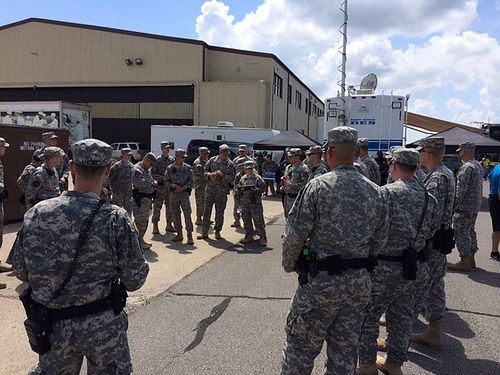
Soldiers from the 1103rd Military Police Detachment receive a mission brief before they pull security for the annual Fort Knox Morale, Welfare and Recreation Concert on June 13, 2015. This mission, working side by side with active duty MPs, will certify them to work in a Law and Order capacity if activated (Photo courtesy of 1103rd Military Police Detachment)
Law and Order
The Louisville-based 1103rd MP Company’s law and order mission requires law enforcement certifications regularly. The Kentucky Guardsmen partnered with the 34th Military Police Detachment and the Fort Knox Department of Emergency Services to validate certifications.
“When you initially enlist as a MP, this is what you think you will be doing –traffic stops, enforcing the law, things a police officer does but on a base,” said Spc. Dakota Dockery. “So the best thing about this training is actually going out with the active duty Fort Knox MPs. It is a great learning experience.”
An active-shooter scenario provided some of the 1103rd’s leaders, who are also civilian law enforcement officers when not drilling with the Guard, the ability to teach younger Soldiers the best practices for responding to active shooters.
“I personally liked moving through different scenarios in this closed-down school armed with paint rounds,” said Dockery. “It was awesome responding to the different situations and seeing how they played out.”
Detention Operations
The Murray, Kentucky-based 438th MP Company also worked side-by-side with its active duty counterparts at Fort Leavenworth, Kansas. More than 100 Soldiers joined the 15th MP Brigade to conduct military corrections operations inside the United States Disciplinary Barracks.
The 438th MP Company’s first platoon leader, 2nd Lt. Hallie Freeman was one of the liaisons between the company and the Fort Leavenworth MP trainers.
“We tried to make it more of a right seat left seat,” said Freeman, “so that our less experienced Soldiers could see what it would be like to work detainee operations, how the guards and inmates interact, understand the struggles and hardships of being a guard and to see proper reaction times of situations that happen in the prison.”
Freeman said the Soldiers rotated through and shadowed the active duty guards while conducting random searches, observing the prison’s activities through the control room, and operating switches and video cameras; they also got experience monitoring the housing units, control points, individual cells and work details such as the barbershop or woodshop. After watching her Soldiers gain confidence in their training, she said there is a tremendous difference in their abilities.
“Before AT and if a deployment came up, I would say we weren’t ready,” said Freeman, “but after me and my guys worked at this facility, I would say now we are 100 percent ready to go.”
Conclusion
Starke said while the battalion doesn’t have the time or funding to train all units on each discipline every year during AT, they do have the ability to cross-train units using their subject-matter experts on each discipline and its associated tasks during drill weekends.
“We plan to leverage our junior NCOs and junior officers to build knowledge and capabilities across the battalion,” said Starke.
Starke also said they definitely plan on doing more ATs like this in the future.
“Soldiers of the Thoroughbred Battalion were fully engaged every minute of the AT period doing what they signed up to do—work within their MOS, whether that be MP, Cook, Mechanic, Admin Clerk or Medic,” said Starke. “Despite some difficult conditions, morale was high and leaders were far more proficient at the end than they were on first day of AT.”
Story by Sgt. 1st Class Gina Vaile-Nelson, 133rd Mobile Public Affairs Detachment
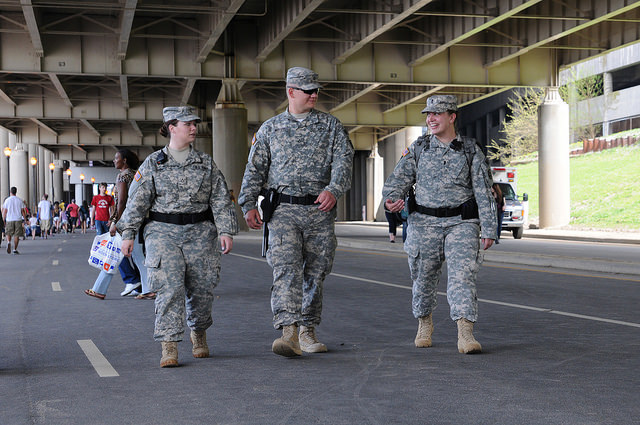
Pfc. Allison Shontz, Pvt. 1st Class Dillion Morvel and 1st Lt. Maria Burns, military police assigned to the 223rd Military Police Company patrol River Road from Seventh Street to Ninth Street April 18, in support of Thunder Over Louisville security detail. More than 1,200 Law Enforcement Officers and 140 military policemen patrolled the Riverfront to ensure crowd safety. (U.S. Army National Guard photo by Sgt. 1st Class Gina Vaile-Nelson)
LOUISVILLE, Ky. - Before sending the Louisville Metro Police officers and Soldiers from the Kentucky National Guard’s 223rd Military Police Company out on foot patrol, Louisville’s mayor, Greg Fischer and Metro Police Chief Steve Conrad had two important messages: stay safe and keep Louisville safe.
“I thank you LMPD and Kentucky Guard,” Fischer said, “we can’t do this without you.”
More than 1,200 officers made up the combined force of LMPD, Kentucky Guard, Jefferson County Sheriff’s Office, Kentucky State Police and federal law enforcement agencies. LMPD and the Guardsmen conducted foot patrols that roved the waterfront from 4 p.m., until the last spectators receded from the downtown area.
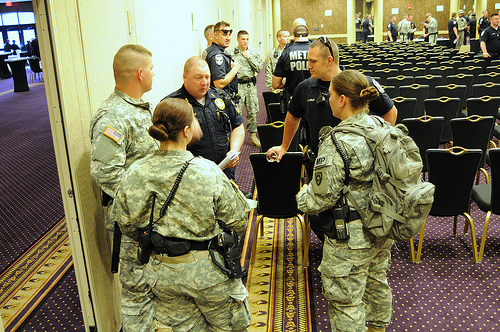
Soldiers assigned to the 223rd Military Police Company receive a patrol plan from the Louisville Metro Police prior to hitting the streets April 18, in support of Thunder Over Louisville. More than 1,200 Law Enforcement Officers and 140 military policemen patrolled the Riverfront to ensure crowd safety (U.S. Army National Guard photo by Sgt. 1st Class Gina Vaile-Nelson)
“We are very grateful for what the National Guard provides us,” said Sgt. Phil Russell, Louisville Metro Police commander of media, public relations.
“With a half-million people in downtown Louisville, we absolutely need the support of the National Guard. We are grateful for the extra set of eyes and the partnership that we hope continues,” he said.
The partnership comes easy for the Louisville-based 223rd MPs. While unit leadership didn’t have an exact number of Soldiers employed by LMPD, their network of police contacts is extensive. Several Soldiers are employed by civilian police departments, and are familiar with the way civilian departments operate.
“We conduct training for events like this when we get our field time,” said 1st Sgt. Mike Ochs, 223rd MP Company first sergeant. “We get briefings from the mayor and police chief, and they always comment on how critical the support of the Kentucky Army National Guard is.
“It’s good for our Soldiers to hear that, it really puts everything into perspective as far as what our role is. We always have good camaraderie with LMPD during Thunder and Derby support; there is never any animosity that this is their turf, we work as one.”
Ochs said the law enforcement presence is important for the attendees to feel safe and secure during Louisville’s largest party. But he said all Soldiers representing the Guard is an important mission as well.
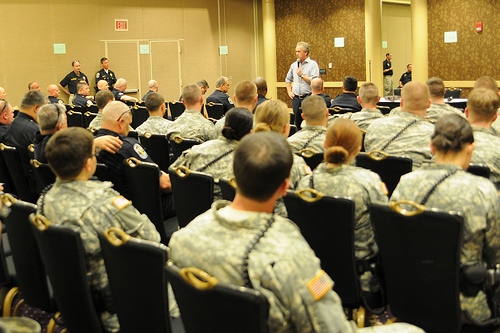
Louisville Mayor Greg Fischer thanks Louisville Metro Police Department and the Kentucky National Guard’s Louisville-based 223rd Military Police Company for their support to Thunder Over Louisville security April 18, in Louisville. More than 1,200 Law Enforcement Officers and 140 military policemen patrolled the Riverfront to ensure crowd safety. (U.S. Army National Guard photo by Sgt. 1st Class Gina Vaile-Nelson)
“When you are here, and in the uniform, you are an ambassador for the United States military, but especially the Kentucky Guard,” he said.
The 223rd MPs had more than 140 Soldiers supporting LMPD and representing the Guard.
First platoon leader, 1st Lt. Maria Burns, was one of those foot-Soldiers, logging miles between a three-block radius on River Road, from Seventh Street to Ninth.
“This is my third year working Thunder,” Burns said. “We mingle, talk to people and just show them that we are here if they need us.”
Burns said there was one incident two years ago where her team assisted LMPD with dispersing a crowd at the Louisville Skate Park after firecrackers were set off.
“This year, I don’t think we’re going to see anything like that here, this crowd looks pretty happy.”
Story by Sgt. 1st Class Gina Vaile-Nelson, 133rd Mobile Public Affairs Detachment
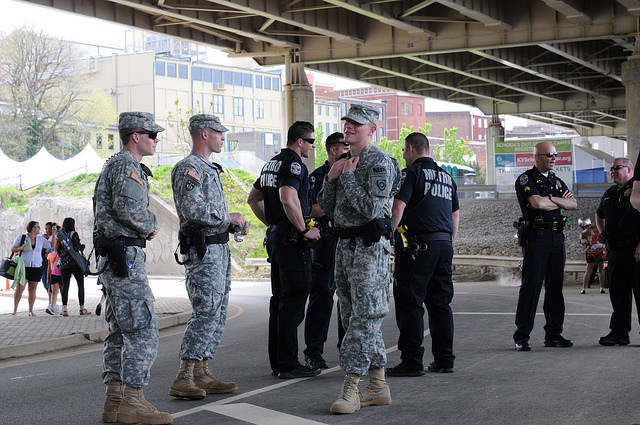
Soldiers assigned to the 223rd Military Police Company and Louisville Metro Police officers man a safety point at Sixth Street and River Road April 18, in support of Thunder security operations. More than 1,200 Law Enforcement Officers and 140 military policemen patrolled the Riverfront to ensure crowd safety. (U.S. Army National Guard photo by Sgt. 1st Class Gina Vaile-Nelson)
LOUISVILLE, Ky. - It literally takes an Army, specifically the Kentucky Army National Guard, to ensure the two-week party in Louisville, aka the Kentucky Derby Festival (KDF), goes off without a hitch.
Whether its traffic enforcement, security patrols, entertaining the crowd with give-aways and obstacles, or starting events with a cannon, the Kentucky Guard plays a huge role in Thunder Over Louisville, the kick-off to Derby Festival. The Soldiers and Airmen operate right alongside the KDF as well as local, state and federal agencies to ensure festival patrons have an explosive time, without incident.
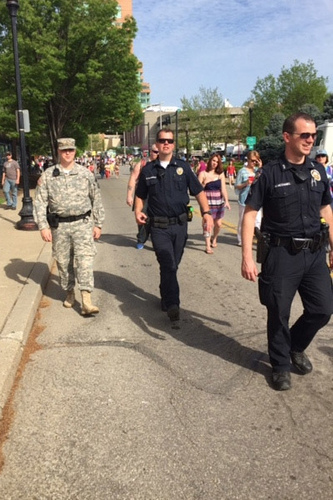
The Kentucky National Guard’s 223rd Military Police and Louisville Metro Police officers coordinated patrols to keep Thunder-goers safe April 18, in Louisville. More than 1,200 Law Enforcement Officers and 140 military policemen patrolled the Riverfront to ensure crowd safety. (U.S. Army National Guard photo by Sgt. 1st Class Gina Vaile-Nelson)
“We are very grateful for what the National Guard provides us,” said Sgt. Phil Russell, Louisville Metro Police commander of media, public relations.
Approximately 250 Kentucky Guardsmen supported the 25th Thunder. The Guard has participated in the annual event in some capacity since its conception in 1990.
“When you are here, and in the uniform, you are an ambassador for the United States military; but especially the Kentucky Guard,” said 1st Sgt. Mike Ochs, 223rd Military Police Company first sergeant.
“It’s good for the crowd to see us, and the public is always wonderful to us,” he said.
Sgt. 1st Class Nick Vinson, a Guard recruiter, has helped coordinate the Kentucky Recruiting and Retention Battalion’s partnership with the KDF since 2008, and has worked everything from the Guard’s rock wall to the command center.
“Thunder emphasizes what the Guard does for Kentucky,” Vinson said. “It’s not only the largest event within this area of the state, but for our recruiters and our community relations personnel; this is the largest single-day event of the year. We impact as many people at Thunder as we do in a week at the State Fair.”
On the bridge, Soldiers assigned to the 138th Field Artillery Brigade know their cannons are not just a staple of Thunder, but something that many viewers look forward to hearing, and feeling. But their own experience is something they said they don’t take for granted.
“It was exciting to be part of Thunder Over Louisville,” said Spc. Tiffany Dirolf, supply specialist, 138th Field Artillery Brigade. “I am normally in a room all the time and today I had one of the best seats in the house.”
Whether patrolling the busy streets or loading the cannons, the Kentucky Army National Guard is always ready to make each Thunder better than the last.
Story by David Altom, Kentucky National Guard Public Affairs
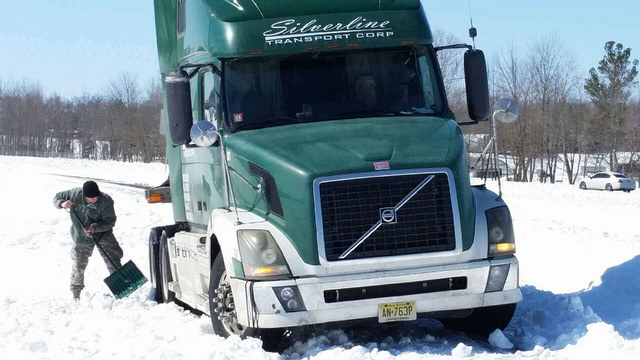
Staff Sgt. Steve Musgrave helps a truck driver along I-24 in McCracken County. Musgrave is one of the soldiers from the Kentucky National Guard’s Co. A, 149th Brigade Support Battalion assisting motorists stranded during Winter Storm Thor. (Photo by Spec. Jeriel Clark, Kentucky National Guard)
FRANKFORT, Ky. — In arguably the worst winter since 2009, Kentucky National Guard troops recently played a crucial role in protecting the health, safety and welfare of their fellow citizens. In the wake of heavy snows that began on March 5, hundreds of accidents and impassable conditions stranded an estimated 600 vehicles along I-24 and I-65 in Central Kentucky. More than 150 Kentucky Guard soldiers were called out over a two day period to support relief efforts, clearing traffic and rendering aid to stranded motorists.
“We were given the mission of getting traffic going,” said Sgt. 1st Class Sherman McCoy with the 223rd Military Police Company. “We helped a few motorists who were trying to get off the expressway and got stuck, digging them out and getting them off the road. We also helped numerous tractor trailers that were stuck and we got them on their way.”
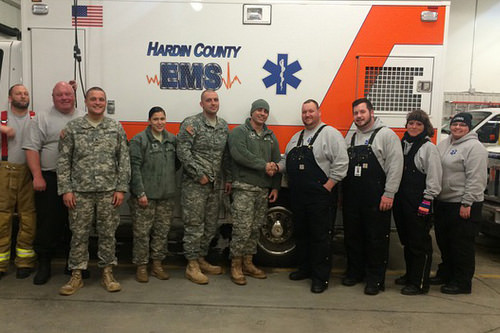
Soldiers with the 2061st Multi-role Bridge Company assisted Hardin County Emergency Medical Services in providing man power assistance with patient and paramedic transport and ambulance recovery missions during the winter storm, March 5-7, 2015. The 2061st Team traveled in tandem with Hardin County EMS to numerous 911 Emergencies to ensure freedom of maneuver for EMS throughout Hardin County. (Courtesy photo)
“We’re not used to quite this much snow,” he said, “but it’s been a good mission. We enjoy helping others.”
1st Sgt. Chris Jeter, 149th Brigade Support Battalion, said his troops worked to ensure travelers were safe and provided assistance to those whose vehicles were stuck in mounding snow.
“Short of hooking tow straps to our military vehicles, we have done everything possible to assist them,” he said of their efforts.
Visit our flickr page for more photos.
In addition to responding state wide to these areas, local teams also assisted local emergency medical services, helping to reach patients not accessible by ambulance.
“We have been responding with paramedics to these areas, carrying them to the residence once they have gotten as far as they can go,” Jeter said adding that they are using Humvees and “good old foot power,” even helping to carry patients and paramedics back to the ambulance.
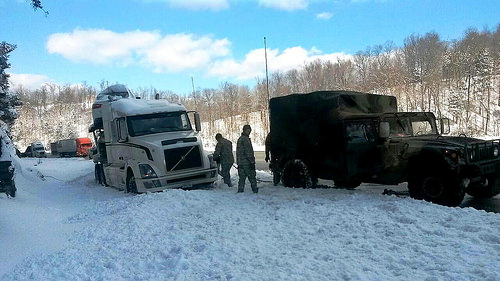
Soldiers from the Kentucky National Guard’s Charlie Battery, 2nd Battalion 138th Field Artillery hook a Humvee to a semi-truck to pull it back onto I-65 March 6, 2015. Roughly 150 Guardsmen were activated to assist local authorities along Insertstates 24 and 65. (Kentucky National Guard photo by 1st Lt. Holdun Reed)
Troops also used Humvees to deliver food, water and gasoline to stranded motorists, and in some cases transported chilled travelers to warming shelters. It was reported that some motorists were stranded up to nearly 24 hours.
“The Soldiers did it again,” said Col. Jerry Morrison, commander of the 149th Maneuver Enhancement Brigade. “Soldiers received alert phone calls as early as 0330 hours and began digging out of their own driveways to respond to citizens in I-65 and I-24. Over 120 Soldiers of the 149th Maneuver Enhancement Brigade from Benton, Murray, Paducah, Bowling Green, Louisville, Elizabethtown, and Richmond were on duty by the time snow quit falling that afternoon.”
“We alerted, mobilized, executed our mission, and de-mobilized Soldiers in a 96 hour period. I am extremely proud of our leaders and units. Their response shows the requirement for the National Guard to remain in the home towns across America to provide immediate assistance to the Governor in times of crisis.”
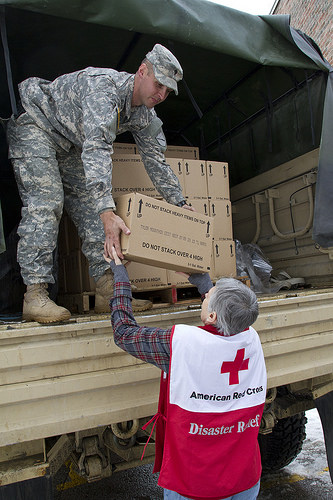
Spc. James Harmon, with the 1st Battalion, 149th Infantry hands a case of water to Anne Cockley, a Red Cross volunteer at Green Hills Elementary School in Bledsoe, Ky., Feb. 24, 2015. The Soldiers assisted with water deliveries throughout Harlan County in response to a water shortage caused by a recent winter storm. (U.S. Army National Guard photo by Staff Sgt. Scott Raymond)
This is the second such mission for the Kentucky National Guard in the past few weeks. Earlier in February more than 100 troops were mobilized in response to the sub-zero temperatures and icy conditions that plagued Eastern Kentucky. Soldiers cleared public roads, provided emergency transportation to hospitals and long term care medical facilities. They also delivered several thousand gallons of water to communities suffering a water shortage brought about by damaged water systems.
In 2009 more than 4,000 soldiers and airmen were brought on duty when a state wide ice storm triggered wide spread power blackouts. Troops delivered food and water to stranded residents, conducted door to door wellness checks and supported local authorities as needed. The 2009 winter storm is considered one of the worst domestic natural disasters in the Kentucky National Guard’s history.
dwa
Story and photos by: Staff Sgt. Fredrick P. Varney, 133rd Mobile Public Affairs Detachment

Kentucky Army National Guard Spc. Kyle P. Alexander, 223rd Military Police Company based in Louisville, provides security during the Kentucky Oaks at Churchill Downs May 6. (Kentucky National Guard photo by Staff Sgt. Fredrick P. Varney, 133rd Mobile Public Affairs Detachment)
Click here for more photos on this story.
LOUISVILLE, Ky. (May 6, 2011) – For most people the month of May typically serves as a friendly reminder that summer is just around the corner. On the other hand, for Kentuckians it means unleashing some “Unbridled Spirit” within the Commonwealth.
Every year during the first week of May thousands of people flock to Churchill Downs in Louisville to watch some of the greatest horse racing on the planet.
So much time and effort goes into making the Kentucky Oaks and Kentucky Derby a success. Because security is the number one priority, multiple agencies must work closely together to accomplish one common goal.

Staff Sgt. Jacque S. Hayes, military police instructor, 238th Regiment, directs traffic using proper hand and arm signals May 6 during the Kentucky Oaks at Churchill Downs. (Kentucky National Guard photo by Spc. Alexa E. Becerra, Headquarters Company 138th Fires Brigade )
This year Kentucky National Guard Soldiers from the 75th Troop Command and 198th Military Police Battalion worked alongside the Louisville Metro Police Department by providing security and directing traffic outside the confines of Churchill Downs.
The 75th Troop Command was called upon to provide security inside the winner’s circle while the 198th Military Police Battalion directed traffic control.
“Our unit is here to augment the Louisville Metro Police Department by providing personnel to work traffic posts around Churchill Downs, while also serving as additional security forces on the ground to make this a safe environment for the citizens of the Commonwealth,” said Capt. Gregory W. Jefferson, Training Officer, 198th Military Police Battalion.
Due to the high volume of spectators, the Kentucky Oaks can cause both logistical and security nightmares for law enforcement officials.

Kentucky Army National Guard Pvt. Justin A. Downey, 223rd Military Police Company based in Louisville, directs traffic May 6. during the Kentucky Oaks at Churchill Downs. (Kentucky National Guard photo by Spc. Alexa E. Becerra, Headquarters Company 138th Fires Brigade)
“Our Soldiers are happy to assist the city of Louisville,” said Sgt. Jeremy S. Adams, Team Leader, 1103rd Military Police Detachment based in Harrodsburg, Ky. “The Louisville Metro Police Department does an excellent job of keeping our streets safe, so this is our way of returning the favor.”
Staff Sgt. Jacque S. Hayes, military police instructor for the 238th Regiment, said the Kentucky Guard continues to shine by lending a helping hand within our local communities.
“Being visible allows our citizens to know we are strong and fully committed to our profession,” said Hayes. “I am proud to be a member of the Kentucky National Guard and this event provides us with an opportunity to show the public just how special our organization truly is.”
-30-
dwa
The 475th Mobile Army Surgical Hospital was just one of several Kentucky National Guard units to deploy in support of Operations Desert Shield and Desert Storm.
FRANKFORT, Ky. - The latest addition to the Kentucky National Guard eMuseum is a new book by Kentucky National Guard Command Historian John Trowbridge titled “Kentucky National Guard in the Persian Gulf War 1990-91.”
“Time and events have shown us that we need to remain vigilant in that region of the world, not only for our interests and safety, but that of the entire world,” said Trowbridge. “This book reflects the overall story of the Kentucky National Guard’s involvement in the First Persian Gulf War. ”
Staff Sgt. William Hurt and Pvt. 1st Class Cleta Boswell, 137th Transportation Detachment, in Saudi Arabia. Women played an unprecdented role in the Persian Gulf War.
“A number of firsts occurred for the Kentucky National Guard and the US military,” said Trowbridge. ” This was the first time we saw female troops put in harm’s way performing a variety of military occupational specialties such as transportation and military police. Prior to the Persian Gulf War only female nurses were near the front lines. ”
Trowbridge’s hope is that the book captures the dedication of Citizen-Soldier showed at that time to the people of our nation and the Commonwealth of Kentucky.
“These brave men and women had the expertise to complete their mission and a great compassion for the people of Iraq, friend or foe,” he said. “And when they returned home to their families and friends, they were welcomed with ceremonies not seen since the return of our World War II veterans.”
The publication is available for viewing or download at the KYNG eMuseum site at this address: http://www.kynghistory.ky.gov/NR/rdonlyres/52E8D13A-A917-4347-9A50-A1372F6A0C08/0/KYNGinPGW.pdf. The document is a PDF and is 9.8 MB
—————————————————————-
Summary of the Kentucky National Guard in the Persian Gulf War 1990-91
August 2, 1990 saw the invasion of Kuwait by neighboring Iraq, an event that both shocked and outraged the world. Spearheading a twenty-one member United Nations coalition, the United States initiated Operation Desert Shield, the largest military buildup since the Vietnam War.
On January 17, 1991, Americans at home watched as Operation Desert Shield turned into a Desert Storm. A six-week air campaign preceded what came to be known as “The One-Hundred Hour War,” leading to the swift liberation of Kuwait.
Once again Kentuckians found themselves on the forefront of the assault. From Fort Campbell came the 101st Airborne (Air Assault) Division, the 160th Special Operations Aviation Regiment, and the 5th Special Forces Group. Fort Knox sent elements of its 194th Separate Armor Brigade. Together, the two bases sent 21,500 men and women into battle.
Because of the size and intensity of the planned offensive, reserve components from all over Kentucky were called to duty, performing such diverse missions as ensuring the transportation and accountability of equipment and supplies, providing direct fire support, battlefield medical support and refugee relief, water purification, film and video documentation of military actions, security and handling of prisoners of war. Some reservists served as replacements for active duty units called to action.
U.S. Army Reserve units deployed from Kentucky included the 100th Division (TNG), the 807th Mobile Army Surgical Hospital, the 888th Medical Detachment, and the 5010th Army Hospital.
Kentucky can be especially proud of the 1078 Kentucky Army National Guard men and women who went to the desert and performed so valiantly during Desert Storm . . . the soldiers of the 137th Transportation Detachment . . . the 217th Quartermaster Detachment . . . the 2123rd Transportation Company . . . the 475th Mobile Army Surgical Hospital (MASH) . . . the 133rd Public Affairs Detachment . . . the 1/623rd Field Artillery Battalion . . . and the 223rd and 438th Military Police Companies.1 During the offensive our artillery battalion was given the mission of providing fire support for the coalition forces while our heavy equipment transportation company traveled as far as the Euphrates carrying the load for the advancing troops. Our military police processed thousands of enemy prisoners of war and our Mobile Army Surgical Hospital cared for the ill and injured during a post-war humanitarian relief effort.
Back home the C-130’s of the 123rd Tactical Airlift Wing moved personnel and equipment throughout the U.S. in support of Desert Storm, while our engineers assisted in a variety of state and local projects.
Of the 23,210 Kentucky service members from both the active and reserve forces who served in Southwest Asia, only six lost their lives. For that we must be thankful.
—————————————————————-
PERSIAN GULF WAR TIMELINE (May 1990 – April 1991)
1990
May 28-30: Iraqi president Saddam Hussein says that oil overproduction by Kuwait and United Arab Emirates is “economic warfare” against Iraq.
July 15: Iraq accuses Kuwait of stealing oil from Rumaylah oil field near the Iraqi-Kuwaiti border and warns of military action.
July 22: Iraq begins deploying troops to the Iraqi-Kuwaiti border and building a massive military buildup.
August 2: About 100,000 Iraqi troops invade Kuwait. Kuwait is in Iraqi control by the end of the day.
August 6: The U.N. Security Council imposes a trade embargo on Iraq in a 13-0 vote, with Cuba and Yemen abstaining. President George H. W. Bush orders the deployment of U. S. armed forces to defend Saudi Arabia in an operation named, OPERATION DESERT SHIELD.
August 7: The United States launches Operation Desert Shield. First U.S. troops arrive in Saudi Arabia.
August 8: Saddam Hussein proclaims the annexation of Kuwait.
August 9: U. N. declares Iraqi annexation of Kuwait void.
August 10: Hussein declares a “jihad” or holy war against the U. S. and Israel.
August 12: Naval blockade of Iraq begins. All shipments of Iraqi oil halted.
August 28: Iraq declares Kuwait as its 19th province and renames Kuwait City as al-Kadhima.
September 14-15: United Kingdom and France announce the deployment of 10,000 troops to Saudi Arabia.
December 17: The United Nations sets a deadline for Iraq to withdraw from Kuwait before January 15, 1991, or face military action. Hussein rejects all U. N. resolutions.
1991 January 3: U. S. Defense Department censors war reporting by the press.
January 9: Talks in Geneva, Switzerland, between U.S. Secretary of State James Baker and Iraqi Foreign Minister Tariq Aziz end with no progress.
January 12: Congress grants President Bush authority to wage war.
Kentucky National Guard troops showed compassion throughout their deployment in support of the Persian Gulf War.
January 16: The White House announced the commencement of OPERATION DESERT STORM: offensive action against the forces of Iraq under the provisions of U.N. Security Council/U.S. Congressional resolutions.
January 17: The war begins at 2:38 a.m. Baghdad time when AH-64 Apache attack helicopters destroy Iraqi radar sites, later F-117 Nighthawk Stealth Fighters bomb Baghdad and Iraqi forces. Operation Desert Storm begins.
January 18: Iraq strikes with Soviet-made SCUD missiles on Israel. The U.S. deploys Patriot missiles to Israel and Saudi Arabia.
January 22: Iraqi troops begin blowing up Kuwaiti oil wells.
January 25: Iraqi troops begin “environmental war” by dumping millions of gallons of crude oil into the Persian Gulf.
January 29: Iraqi forces invade the town of Khafji in Saudi Arabia. Iraqi forces are soon engaged by Saudi Arabian and Qatari troops with U.S. Marine artillery.
January 31: Iraqi forces capture Melissa Rathbun-Nealy, the first female Prisoner of War since World War II.
February 1: Iraqi forces are driven out of Saudi Arabia. Allied Forces win the Battle of Khafji. Secretary of Defense Richard Cheney warns U. S. will retaliate if Iraq uses chemical or unconventional weapons. February 8: Total U. S. troop strength in the Gulf over a half million.
February 12-13: A bombing raid by U.S. forces against Baghdad kills 400 Iraqi civilians in an air raid shelter, and three major bridges.
February 19: Soviet-Iraqi peace plan rejected by President Bush. Oil spill in Gulf now estimated at 1.5 million barrels.
February 22: U.S. President George H. W. Bush issues a 24-hour ultimatum: Iraq must withdraw from Kuwait to avoid start of a ground war.
February 24: Allied Forces invade Iraq and Kuwait at around 4 a.m. Baghdad time. General Schwarzkopf implements the Gulf War’s critical “left hook” maneuver as conceived by General Grant’s 1863 Civil War campaign at Vicksburg. The U.S. Army is the first to enter Iraqi territory.
February 25: An Iraqi SCUD missile hits U.S. barracks near Dhahran, Saudi Arabia, killing 28 U.S. troops.
February 26: Saddam Hussein orders the Iraqi withdrawal from Kuwait. About 10,000 retreating Iraqi troops are killed when Allied aircraft bomb them, it is called the “Highway of Death.”
February 27: U.S. Marines and Saudi Arabian troops enter Kuwait City. The U.S. Army’s 1st Armored Division engages the Iraqi Republican Guard in the Battle of Medina Ridge in Iraq. President Bush declares Kuwait liberated.
February 28: By Presidential order all Coalition offensive operations ceased at 0800 local time.
March 1: The cease-fire plan is negotiated in Safwan, Iraq.
March 17: First U.S. troops arrive home.
April 11: The U.N. Security Council declared a formal cease-fire, ending the Gulf War.
###
