
Pages
Stay In Touch
More
© 2013 KentuckyGuard
Kentucky National Guard Public Affairs Staff Report
Summary of the Kentucky National Guard in the Persian Gulf War 1990-91
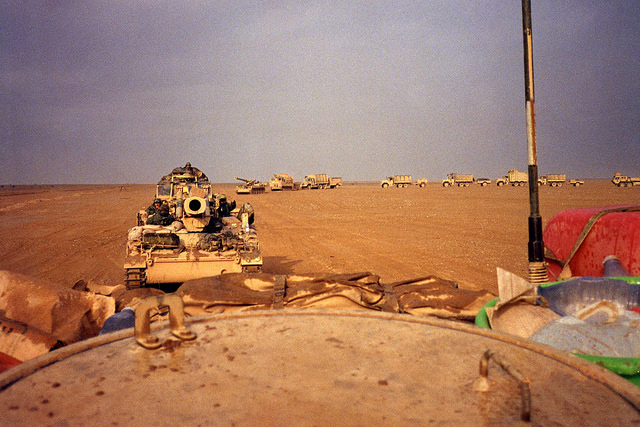
Soldiers with the 1st Battalion, 623rd Field Artillery move supplies and equipment along the Iraqi border during Operation Desert Storm, Feb. 27, 1991. As one of the few National Guard combat arms units deployed to the theater, the 623rd provided fire support for coalition forces during the conflict. (Kentucky National Guard historical photo)
It’s been 25 years since the United States first went to war in the Persian Gulf. Aug. 2, 1990 saw the invasion of Kuwait by neighboring Iraq, an event that both shocked and outraged the world. Spearheading a 21-member United Nations coalition, the United States initiated Operation Desert Shield, the largest military buildup since the Vietnam War.
On Jan. 17, 1991, Americans at home watched as Operation Desert Shield turned into a Desert Storm. A six-week air campaign preceded what came to be known as “The One-Hundred Hour War,” leading to the swift liberation of Kuwait.
Click here for more historical photos.
Once again Kentuckians found themselves on the forefront of the assault. From Fort Campbell came the 101st Airborne Division, the 160th Special Operations Aviation Regiment, and the 5th Special Forces Group. Fort Knox sent elements of its 194th Separate Armor Brigade. Together, the two bases sent 21,500 men and women into battle.
Because of the size and intensity of the planned offensive, reserve components from all over Kentucky were called to duty, performing such diverse missions as ensuring the transportation and accountability of equipment and supplies, providing direct fire support, battlefield medical support and refugee relief, water purification, film and video documentation of military actions, security and handling of prisoners of war. Some reservists served as replacements for active duty units called to action.
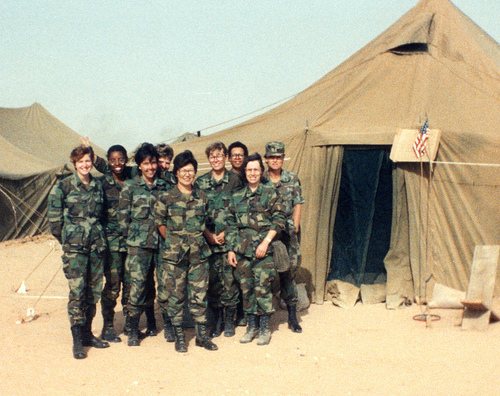
Members of the 475th Mobile Army Surgical Hospital (MASH) stand outside their tent in Saudi Arabia during Operation Desert Storm, 1991. (Courtesy photo)
Kentucky can be especially proud of the 1078 Kentucky Army National Guardsmen and women who went to the desert and performed valiantly during Desert Storm.
They were Soldiers with the following units: 137th Transportation Det., 217th Quartermaster Det., 2123rd Transportation Co., 475th Mobile Army Surgical Hospital (MASH), 133rd Public Affairs Det., 223rd and 438th Military Police Companies.
Batteries of Kentucky’s 1st Battalion, 623rd Field Artillery served as one of the few National Guard combat arms units activated.
Nearly 400 National Guard units were activated with nearly 40,000 Guardsmen serving in theater.
During the offensive, Kentucky Guard artillery was given the mission of providing fire support for the coalition forces while heavy equipment transportation traveled as far as the Euphrates carrying the load for the advancing troops. Military police personnel processed thousands of enemy prisoners of war and our Mobile Army Surgical Hospital cared for the ill and injured during a post-war humanitarian relief effort.
Back home the C-130’s of the 123rd Tactical Airlift Wing moved personnel and equipment throughout the U.S. in support of Desert Storm, while our engineers assisted in a variety of state and local projects.
U.S. Army Reserve units deployed from Kentucky included the 100th Division, the 807th Mobile Army Surgical Hospital, the 888th Medical Detachment, and the 5010th Army Hospital.
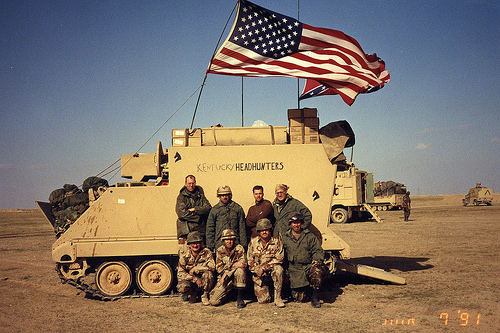
Soldiers of the Kentucky National Guard’s 1st Battalion, 623rd Field Artillery deployed to the Persian Gulf for Operation Desert Storm, Jan-April, 1991. The artillery unit was one of eight Kentucky units activated for service during the conflict. (Kentucky National Guard historical photo)
In all, 23,210 Kentucky Service members from both the active and reserve forces served in Southwest Asia.
“Serving in Operation Desert Shield and Desert Storm was a very rewarding experience for me as a young officer in the Kentucky National Guard,” said Lt. Col. Allen Boone, who served as a lieutenant with the 623rd at the time.” In less than three years after joining the nationally recognized 623rd Field Artillery, I found myself halfway around the world with some of the finest men in the United States Armed Forces.”
“It was an honor for me to serve in operations which proved to be one of the greatest examples of military power by U.S. Armed Forces in the history of our nation. The years of strategic planning, followed by equipping and properly training personnel for military operations was executed with effective precision in the first 100 hours of ground combat.”
“The motto of the 623rd is “Seize the Opportunity” and it’s Soldiers who served in the Civil War through Iraq and Afghanistan continue a legacy of professional service to our nation at home and around the world.”
PERSIAN GULF WAR TIMELINE (May 1990 – April 1991)
1990 - May 28-30: Iraqi president Saddam Hussein says that oil overproduction by Kuwait and United Arab Emirates is “economic warfare” against Iraq.
July 15: Iraq accuses Kuwait of stealing oil from Rumaylah oil field near the Iraqi-Kuwaiti border and warns of military action.
July 22: Iraq begins deploying troops to the Iraqi-Kuwaiti border and building a massive military buildup.
August 2: About 100,000 Iraqi troops invade Kuwait. Kuwait is in Iraqi control by the end of the day.
August 6: The U.N. Security Council imposes a trade embargo on Iraq in a 13-0 vote, with Cuba and Yemen abstaining. President George H. W. Bush orders the deployment of U. S. armed forces to defend Saudi Arabia in an operation named OPERATION DESERT SHIELD.
August 7: First U.S. troops arrive in Saudi Arabia.
August 8: Saddam Hussein proclaims the annexation of Kuwait.
August 9: U. N. declares Iraqi annexation of Kuwait void.
August 10: Hussein declares a “jihad” or holy war against the U. S. and Israel.
August 12: Naval blockade of Iraq begins. All shipments of Iraqi oil halted.
August 28: Iraq declares Kuwait as its 19th province and renames Kuwait City as al-Kadhima.
September 14-15: United Kingdom and France announce the deployment of 10,000 troops to Saudi Arabia.
December 17: The United Nations sets a deadline for Iraq to withdraw from Kuwait before January 15, 1991, or face military action. Hussein rejects all U. N. resolutions.
1991 - January 9: Talks in Geneva, Switzerland, between U.S. Secretary of State James Baker and Iraqi Foreign Minister Tariq Aziz end with no progress.
January 12: Congress grants President Bush authority to wage war.
January 16: The White House announced the commencement of OPERATION DESERT STORM: offensive action against the forces of Iraq under the provisions of U.N. Security Council/U.S. Congressional resolutions.
January 17: The war begins at 2:38 a.m. Baghdad time when AH-64 Apache attack helicopters destroy Iraqi radar sites, later F-117 Nighthawk Stealth Fighters bomb Baghdad and Iraqi forces. Operation Desert Storm begins.
January 18: Iraq strikes with Soviet-made SCUD missiles on Israel. The U.S. deploys Patriot missiles to Israel and Saudi Arabia.
January 22: Iraqi troops begin blowing up Kuwaiti oil wells.
January 25: Iraqi troops begin “environmental war” by dumping millions of gallons of crude oil into the Persian Gulf.
January 29: Iraqi forces invade the town of Khafji in Saudi Arabia. Iraqi forces are soon engaged by Saudi Arabian and Qatari troops with U.S. Marine artillery.
January 31: Iraqi forces capture Melissa Rathbun-Nealy, the first female Prisoner of War since World War II.
February 1: Iraqi forces are driven out of Saudi Arabia. Allied Forces win the Battle of Khafji. Secretary of Defense Richard Cheney warns U. S. will retaliate if Iraq uses chemical or unconventional weapons.
February 8: Total U. S. troop strength in the Gulf over a half million.
February 12-13: A bombing raid by U.S. forces against Baghdad kills 400 Iraqi civilians in an air raid shelter, and three major bridges.
February 19: Soviet-Iraqi peace plan rejected by President Bush. Oil spill in Gulf now estimated at 1.5 million barrels.
February 22: Pres. Bush issues a 24-hour ultimatum: Iraq must withdraw from Kuwait to avoid start of a ground war.
February 24: Allied Forces invade Iraq and Kuwait at around 4 a.m. Baghdad time. The U.S. Army is the first to enter Iraqi territory.
February 25: An Iraqi SCUD missile hits U.S. barracks near Dhahran, Saudi Arabia, killing 28 U.S. troops.
February 26: Saddam Hussein orders the Iraqi withdrawal from Kuwait. About 10,000 retreating Iraqi troops are killed when Allied aircraft bomb them, it is called the “Highway of Death.”
February 27: U.S. Marines and Saudi Arabian troops enter Kuwait City. The U.S. Army’s 1st Armored Division engages the Iraqi Republican Guard in the Battle of Medina Ridge in Iraq. President Bush declares Kuwait liberated.
February 28: By Presidential order all Coalition offensive operations ceased at 0800 local time.
March 1: The cease-fire plan is negotiated in Safwan, Iraq.
March 17: First U.S. troops arrive home.
April 11: The U.N. Security Council declared a formal cease-fire, ending the Gulf War.
Story By: Spc Matthew Dornbusch, 1204th Aviation Support Battalion Unit Public Affairs Historian Representative
Photos by Sgt. 1st Class Gary Moriarty, 1204th Aviation Support Battalion
Click here for more photos on the story.
NOTE: Each week kentuckyguard.com publishes stories by Kentucky National Guard unit public affairs historian representatives, also known as UPAHRs. This is an additional duty taken on by a Soldier or Airmen with the intent of telling their unit’s story. This is one such story ….
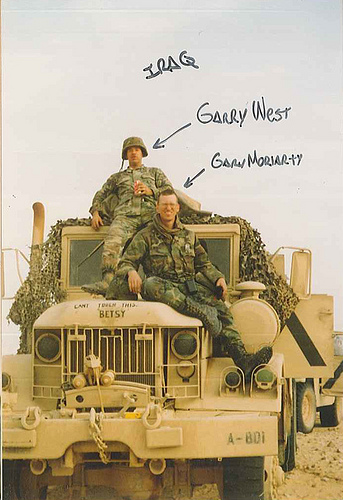
Spc. Gary Moriarty and battle buddy more than 20 years ago during Operation Desert Storm. Moriarty is now a sergeant first class with the Kentucky Army National Guard's 1204th Aviation Support Battalion deployed as part of Operation New Dawn.
Iraq – Operation Desert Storm, commonly referred to as the Gulf War, or now the First Gulf War, officially began January 17th 1991. Its preparation was quick; a few months prior Soldiers were trained and mobilized, ready to help liberate the small nation of Kuwait. At 3 A.M on that January morning, the U.S. led attack on Saddam’s forces began with its air campaign. Thirty-eight days later on February 24th, ground forces moved into Kuwait and liberated Kuwait City in only three days. It would only be a few weeks later that coalition forces moved into Iraq and an official cease fire was reached.
With the shadow of the current operations in Iraq, Operation Desert Storm is hardly talked about any longer. Most of the younger Soldiers hardly even know the events that lead up to the conflict, let alone what happened in the conflict itself. Maybe it was because it ended so quick, or maybe because the casualty rate was so low. Whatever the reasons, there is a small group of the Soldiers within Headquarters Company, 1204th Aviation Support Battalion who have not forgotten. These Kentucky Army National Guard Soldiers, twenty years after their deployment and return home from the First Gulf War, are once again in the Middle East. Their legacy was as the first soldiers in, and now, twenty years later, they will be potentially the last ones out.
Sgt. 1st Class Dean Regester was stationed at Ft. Knox, Kentucky in 1990 when he was mobilized for Operation Desert Storm. He deployed overseas with the 19th Engineers as a lightweight vehicle mechanic. Regester compared what he did then with what route clearance teams do now.
“Back then there were no roads,” he said. “The engineers I was with made the roads.”
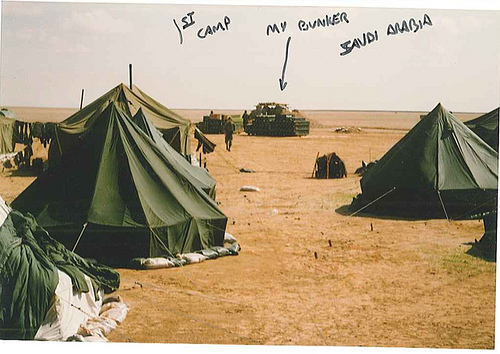
"FOB? We didn't have FOBs!" Ground forces during the Persian Gulf War were always on the move, negating the need for fixed installations.
Sgt. 1st Class Stephen Leasgang was only nineteen when his unit, 4-8 CAV with the 3rd Armored Division, was called into action. He departed from Germany where he was stationed, moved through Saudi Arabia and into Iraq. With the MOS 19K — a M1 Abrams Tank Operator — Leasgang has already been redeployed to the Middle East and compared the two wars.
“FOBs?” he said, referring to “forward operating bases. “We didn’t have FOBs. The only thing we had then were assembly areas for vehicles. That’s where we slept.”
2nd Lt. Greg Slater was a twenty year old specialist when he entered theater during Operation Desert Shield. He was with the 2nd Armored Cavalry Regiment, a rapid deployment unit. They could be deployed to any part of the world in a very short amount of time. Slater was a crew chief at the time.
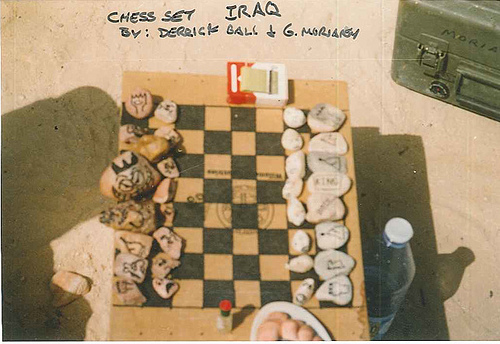
Improvise, adapt and overcome: Long before the advent of 3D digital video games and Facebook, troops during the Persian Gulf War had to come up with their own entertainment.
“I’ll never forget when we crossed the berm into Iraq and a Blackhawk flew overhead. He dropped his flares and fired his rockets.”
Sgt. 1st Class Kevin Ireland was also a specialist with the 2nd ACR back in 1990. Prior to then he spent four years in Germany as a high frequency radio operator.
When asked about his most memorable moment Ireland immediately laughed and said, “March 2, 1991. We were taking sniper fire from a quarry. I was going on almost four days of no sleep when my captain jumped into the hole I had dug to tell me my son had been born. I was so excited I forgot about the sniper fire and started running around telling everyone about my son.”
Staff Sgt. Kelly Darland had just finished special forces selection, but was still formally with the 101st Pathfinders. He was pulled, however, to go with the 5th Group Special Forces team. He was put on Personal Security Detail and assigned to guard the officer in charge of the security force that personally watched over the prince of Kuwait.
Sgt. Larry Watkins was a Petty Officer 3rd Class with the United States Navy serving aboard the U.S.S. America. He was in the Red Sea when his ship was ordered to move off the coast of Kuwait. Watkins worked with aviation ordnance and loaded bombs onto aircraft. This was an around the clock operation and helped the United States keep air superiority over Iraq.
Sgt. John Amburgey was a lance corporal with 2nd Marine Division 2nd Amphibious Assault Vehicle Battalion in Alpha Company. He was stationed at Courthouse Bay located within Camp Lejeune, North Carolina.
“We were already to go on a NATO float to Europe,” said Amburgey. “The next morning Cpt. Wagner, our commanding officer, told us since we were already gearing up, we were probably going to go [to the Middle East].”
Sgt. 1st Class Gary Moriarty was a specialist in 1990 stationed in Schwabach, Germany. He was assigned to the 6/3 Air Defense, whose slogan was “If it flies it dies!”
“The individual resiliency of the soldiers was amazing,” said Moriarty. “Everybody did everything.”
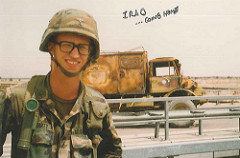
Mission accomplished, headed home – The goal of every deployed Soldier, past, present and future.
Moriarty related a story about a moment that still sticks out in his mind – he saw a line of tanks at night while he wore a pair of night vision goggles. The tanks fired their rounds and explosions went off in the distance.
“It was devastating, it was chaos, it was war,” said Moriarty.
The experiences of all these me were completely different, but have tied together as Kentucky Army National Guard Soldiers. Where they once helped liberate a country from a tyrant, they are now helping bring the current operations to a close. They have seen the people of Iraq evolve from being ruled by dictatorship to now running an emerging democratic nation. This, they hope, is not the proverbial end to the U.S. book of involvement in Iraq, but the beginning for a country headed in the right direction.
dwa
Click here to access the original story.
Click here for more history of the Kentucky National Guard.
FRANKFORT, Ky. — A new painting commemorating the 20th anniversary of the Persian Gulf War has been posted on the Kentucky National Guard eMuseum website.
The Road to War, by artist Michael Goettner, honors the Kentucky National Guard troops that took part in Operation Desert Shield / Storm - 25 February 1991 in Southern Iraq.
The painting was commissioned by the 138th Fires Brigade in 2011 for a limited edition of signed and numbers prints of the original painting. The painting features the 1st Battalion, 623rd Field Artillery Battalion who mobilized on 10 December 1990 and returned in May 1991.
The battalion was commanded by Maj. John Wayne Smith with subordinate units from Glasgow, Tompkinsville, Campbellsville, Monticello and Springfield, Kentucky. While deployed they were assigned to the 196th Field Artillery Brigade, 24th Infantry Division, XVIII Corps; 1st Cavalry Division, VII Corps. Their mission was to provide fire support in Saudi Arabia, Iraq, and Kuwait.
During the deployment the 1/623rd worked with the 101st and XVIII Airborne Corps as well as VII Corps; given mission to provide fire support to six coalition divisions.
The concept for the artwork is taken from a photograph taken by Lt. John Dooley of A Battery.
###
dwa
The 475th Mobile Army Surgical Hospital was just one of several Kentucky National Guard units to deploy in support of Operations Desert Shield and Desert Storm.
FRANKFORT, Ky. - The latest addition to the Kentucky National Guard eMuseum is a new book by Kentucky National Guard Command Historian John Trowbridge titled “Kentucky National Guard in the Persian Gulf War 1990-91.”
“Time and events have shown us that we need to remain vigilant in that region of the world, not only for our interests and safety, but that of the entire world,” said Trowbridge. “This book reflects the overall story of the Kentucky National Guard’s involvement in the First Persian Gulf War. ”
Staff Sgt. William Hurt and Pvt. 1st Class Cleta Boswell, 137th Transportation Detachment, in Saudi Arabia. Women played an unprecdented role in the Persian Gulf War.
“A number of firsts occurred for the Kentucky National Guard and the US military,” said Trowbridge. ” This was the first time we saw female troops put in harm’s way performing a variety of military occupational specialties such as transportation and military police. Prior to the Persian Gulf War only female nurses were near the front lines. ”
Trowbridge’s hope is that the book captures the dedication of Citizen-Soldier showed at that time to the people of our nation and the Commonwealth of Kentucky.
“These brave men and women had the expertise to complete their mission and a great compassion for the people of Iraq, friend or foe,” he said. “And when they returned home to their families and friends, they were welcomed with ceremonies not seen since the return of our World War II veterans.”
The publication is available for viewing or download at the KYNG eMuseum site at this address: http://www.kynghistory.ky.gov/NR/rdonlyres/52E8D13A-A917-4347-9A50-A1372F6A0C08/0/KYNGinPGW.pdf. The document is a PDF and is 9.8 MB
—————————————————————-
Summary of the Kentucky National Guard in the Persian Gulf War 1990-91
August 2, 1990 saw the invasion of Kuwait by neighboring Iraq, an event that both shocked and outraged the world. Spearheading a twenty-one member United Nations coalition, the United States initiated Operation Desert Shield, the largest military buildup since the Vietnam War.
On January 17, 1991, Americans at home watched as Operation Desert Shield turned into a Desert Storm. A six-week air campaign preceded what came to be known as “The One-Hundred Hour War,” leading to the swift liberation of Kuwait.
Once again Kentuckians found themselves on the forefront of the assault. From Fort Campbell came the 101st Airborne (Air Assault) Division, the 160th Special Operations Aviation Regiment, and the 5th Special Forces Group. Fort Knox sent elements of its 194th Separate Armor Brigade. Together, the two bases sent 21,500 men and women into battle.
Because of the size and intensity of the planned offensive, reserve components from all over Kentucky were called to duty, performing such diverse missions as ensuring the transportation and accountability of equipment and supplies, providing direct fire support, battlefield medical support and refugee relief, water purification, film and video documentation of military actions, security and handling of prisoners of war. Some reservists served as replacements for active duty units called to action.
U.S. Army Reserve units deployed from Kentucky included the 100th Division (TNG), the 807th Mobile Army Surgical Hospital, the 888th Medical Detachment, and the 5010th Army Hospital.
Kentucky can be especially proud of the 1078 Kentucky Army National Guard men and women who went to the desert and performed so valiantly during Desert Storm . . . the soldiers of the 137th Transportation Detachment . . . the 217th Quartermaster Detachment . . . the 2123rd Transportation Company . . . the 475th Mobile Army Surgical Hospital (MASH) . . . the 133rd Public Affairs Detachment . . . the 1/623rd Field Artillery Battalion . . . and the 223rd and 438th Military Police Companies.1 During the offensive our artillery battalion was given the mission of providing fire support for the coalition forces while our heavy equipment transportation company traveled as far as the Euphrates carrying the load for the advancing troops. Our military police processed thousands of enemy prisoners of war and our Mobile Army Surgical Hospital cared for the ill and injured during a post-war humanitarian relief effort.
Back home the C-130’s of the 123rd Tactical Airlift Wing moved personnel and equipment throughout the U.S. in support of Desert Storm, while our engineers assisted in a variety of state and local projects.
Of the 23,210 Kentucky service members from both the active and reserve forces who served in Southwest Asia, only six lost their lives. For that we must be thankful.
—————————————————————-
PERSIAN GULF WAR TIMELINE (May 1990 – April 1991)
1990
May 28-30: Iraqi president Saddam Hussein says that oil overproduction by Kuwait and United Arab Emirates is “economic warfare” against Iraq.
July 15: Iraq accuses Kuwait of stealing oil from Rumaylah oil field near the Iraqi-Kuwaiti border and warns of military action.
July 22: Iraq begins deploying troops to the Iraqi-Kuwaiti border and building a massive military buildup.
August 2: About 100,000 Iraqi troops invade Kuwait. Kuwait is in Iraqi control by the end of the day.
August 6: The U.N. Security Council imposes a trade embargo on Iraq in a 13-0 vote, with Cuba and Yemen abstaining. President George H. W. Bush orders the deployment of U. S. armed forces to defend Saudi Arabia in an operation named, OPERATION DESERT SHIELD.
August 7: The United States launches Operation Desert Shield. First U.S. troops arrive in Saudi Arabia.
August 8: Saddam Hussein proclaims the annexation of Kuwait.
August 9: U. N. declares Iraqi annexation of Kuwait void.
August 10: Hussein declares a “jihad” or holy war against the U. S. and Israel.
August 12: Naval blockade of Iraq begins. All shipments of Iraqi oil halted.
August 28: Iraq declares Kuwait as its 19th province and renames Kuwait City as al-Kadhima.
September 14-15: United Kingdom and France announce the deployment of 10,000 troops to Saudi Arabia.
December 17: The United Nations sets a deadline for Iraq to withdraw from Kuwait before January 15, 1991, or face military action. Hussein rejects all U. N. resolutions.
1991 January 3: U. S. Defense Department censors war reporting by the press.
January 9: Talks in Geneva, Switzerland, between U.S. Secretary of State James Baker and Iraqi Foreign Minister Tariq Aziz end with no progress.
January 12: Congress grants President Bush authority to wage war.
Kentucky National Guard troops showed compassion throughout their deployment in support of the Persian Gulf War.
January 16: The White House announced the commencement of OPERATION DESERT STORM: offensive action against the forces of Iraq under the provisions of U.N. Security Council/U.S. Congressional resolutions.
January 17: The war begins at 2:38 a.m. Baghdad time when AH-64 Apache attack helicopters destroy Iraqi radar sites, later F-117 Nighthawk Stealth Fighters bomb Baghdad and Iraqi forces. Operation Desert Storm begins.
January 18: Iraq strikes with Soviet-made SCUD missiles on Israel. The U.S. deploys Patriot missiles to Israel and Saudi Arabia.
January 22: Iraqi troops begin blowing up Kuwaiti oil wells.
January 25: Iraqi troops begin “environmental war” by dumping millions of gallons of crude oil into the Persian Gulf.
January 29: Iraqi forces invade the town of Khafji in Saudi Arabia. Iraqi forces are soon engaged by Saudi Arabian and Qatari troops with U.S. Marine artillery.
January 31: Iraqi forces capture Melissa Rathbun-Nealy, the first female Prisoner of War since World War II.
February 1: Iraqi forces are driven out of Saudi Arabia. Allied Forces win the Battle of Khafji. Secretary of Defense Richard Cheney warns U. S. will retaliate if Iraq uses chemical or unconventional weapons. February 8: Total U. S. troop strength in the Gulf over a half million.
February 12-13: A bombing raid by U.S. forces against Baghdad kills 400 Iraqi civilians in an air raid shelter, and three major bridges.
February 19: Soviet-Iraqi peace plan rejected by President Bush. Oil spill in Gulf now estimated at 1.5 million barrels.
February 22: U.S. President George H. W. Bush issues a 24-hour ultimatum: Iraq must withdraw from Kuwait to avoid start of a ground war.
February 24: Allied Forces invade Iraq and Kuwait at around 4 a.m. Baghdad time. General Schwarzkopf implements the Gulf War’s critical “left hook” maneuver as conceived by General Grant’s 1863 Civil War campaign at Vicksburg. The U.S. Army is the first to enter Iraqi territory.
February 25: An Iraqi SCUD missile hits U.S. barracks near Dhahran, Saudi Arabia, killing 28 U.S. troops.
February 26: Saddam Hussein orders the Iraqi withdrawal from Kuwait. About 10,000 retreating Iraqi troops are killed when Allied aircraft bomb them, it is called the “Highway of Death.”
February 27: U.S. Marines and Saudi Arabian troops enter Kuwait City. The U.S. Army’s 1st Armored Division engages the Iraqi Republican Guard in the Battle of Medina Ridge in Iraq. President Bush declares Kuwait liberated.
February 28: By Presidential order all Coalition offensive operations ceased at 0800 local time.
March 1: The cease-fire plan is negotiated in Safwan, Iraq.
March 17: First U.S. troops arrive home.
April 11: The U.N. Security Council declared a formal cease-fire, ending the Gulf War.
###