
Pages
Stay In Touch
More
© 2013 KentuckyGuard
By Staff Sgt. Scott Raymond, Kentucky National Guard Public Affairs, with contributions by Kentucky State Police Public Affairs
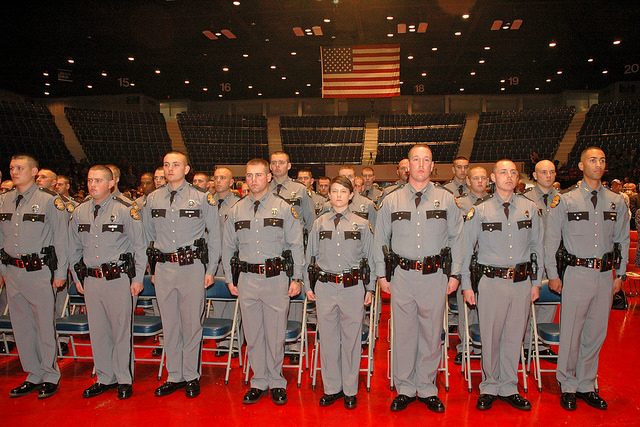
The Kentucky State Police Academy presented diplomas to 45 new troopers at ceremonies held in Frankfort on Oct. 29. Among the new Troopers were three Kentucky Guardsmen. (Photo courtesy of Kentucky State Police)
FRANKFORT, Ky. — The Kentucky State Police Academy presented diplomas to 45 new troopers at ceremonies held in Frankfort, Oct.29. Their addition to the force brings the agency’s strength to a total of 880 troopers serving the citizens of the Commonwealth.
Of those 45 new troopers three are all too familiar with wearing a common uniform and standing for something bigger than themselves. They are also Kentucky National Guardsmen.
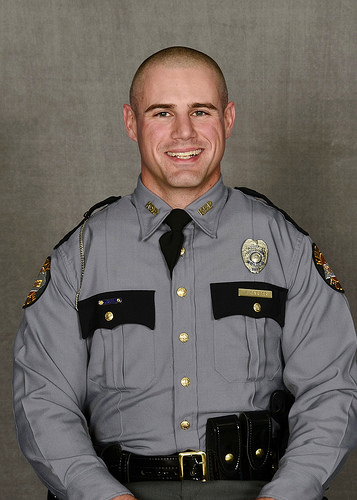
Staff Sgt. Jordan Carter with the 1st Battalion, 623rd Field Artillery graduated from the Kentucky State Police Academy Oct. 29, 2015. (Photo courtesy of Kentucky State Police)
Staff Sgt. Jordan Carter with the 1st Battalion, 623rd Field Artillery, 1st Lt. Jacobe Farmer with Bravo Company, 1st Battalion, 149th Infantry and Sgt. Michael Jacobs from the 2123rd Transportation Company each accepted a new role and responsibility to the commonwealth.
“The National Guard had taught me numerous skills and values that helped me as a soldier,” said Jacobs. “However, I wanted a new challenge with similar interests that would help me adapt to a civilian career that I would enjoy.”
“I always wanted to be a Trooper. I figured that joining the Guard would help me obtain that goal,” said Carter. “Plus I like helping people so it provided a great opportunity.”
The new troopers are part of the agency’s 93rd cadet class. They reported for duty on May 24, 2015 in a class that consisted of 70 cadets.
The training included more than 1,000 hours of classroom and field study in subjects such as constitutional law, juvenile and traffic law, use of force, weapons training, defensive tactics, first aid, high speed vehicle pursuit, criminal investigation, computer literacy, hostage negotiations, evidence collection, radio procedures, search and seizure, crash investigation, drug identification, traffic control, crowd control, armed robbery response, land navigation, electronic crimes, sex crimes, hate crimes, domestic violence, bomb threats and hazardous materials.
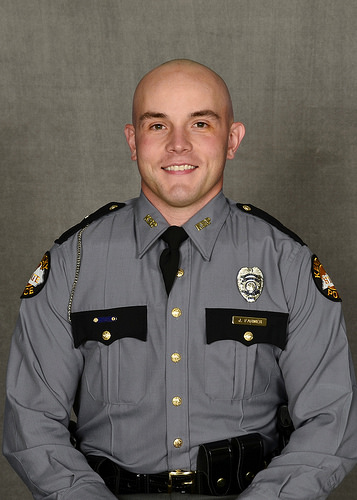
1st Lt. Jacobe Farmer with Bravo Company, 1st Battalion, 149th Infantry graduated from the Kentucky State Police Academy Oct. 29, 2015. (Photo courtesy of Kentucky State Police)
Each Guardsman expressed a true desire to help others, the same thought that inspired them to join the military.
All three also are grateful for the training they have received in the Guard, which helped them through the Kentucky State Police Academy.
“Joining the guard prepared me in numerous ways and instilled in me the seven Army values which should be something that everyone lives by,” said Carter. “Being a Trooper involves so much and the seven Army values aren’t just “valued” by the Army. They are incorporated in the daily life of a Trooper as well.”
“Multi-tasking and attention to detail go hand and hand with what I have picked up from being in the Guard and my military training towards my career field in law enforcement,” said Farmer. “As a Trooper I will deal with a variety of events and at times they will be one after another and/or all together and for me to be able to handle many tasks at once while not leaving out important details is essential in my field.”
Lt. Col. L. Allen Joiner, commander of the 1/623rd said the unit is proud of Carter and their decisions of selfless service in multiple uniforms, a benefit he has seen first hand.
“Serving both on the State Police force and in the Kentucky National Guard, these individuals are able to acquire knowledge and experience that saves lives during Kentucky natural disasters and emergencies when these organizations are working side by side,” said Joiner. “An example is during the 2009 ice storm, one of our Soldiers, who was also a State Police officer was able to use his civilian position resources to provide current road conditions to our military units across Western Kentucky.”
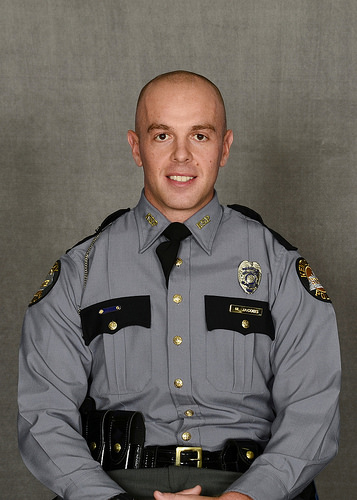
Sgt. Michael Jacobs from the 2123rd Transportation Company graduated from the Kentucky State Police Academy Oct. 29, 2015. (Photo courtesy of Kentucky State Police)
Carter will be assigned to Post 3 in Bowling Green and Jacobs Post 16 in Henderson. Farmer joins Post 4 in Elizabethtown alongside Indiana National Guardsman Brad Holloman.
“Joining the KSP is not for the weak-hearted or weak-minded and it takes a special person to be a Kentucky State Trooper,” said Farmer “The training academy to many people would be the most physically enduring thing they have done, but in the end you are a part of the KSP family and the honor, respect, and tradition that it has and upholds.”
“Being a Trooper will benefit my military career in regards to maintaining discipline, staying vigilant, and performing at a higher standard,” said Jacobs. “I look forward to learning in both roles as a Soldier and Trooper to be the best I can be for the Commonwealth of Kentucky.”
By Staff Sgt. Christopher Barton, 1st Battalion, 149th Infantry
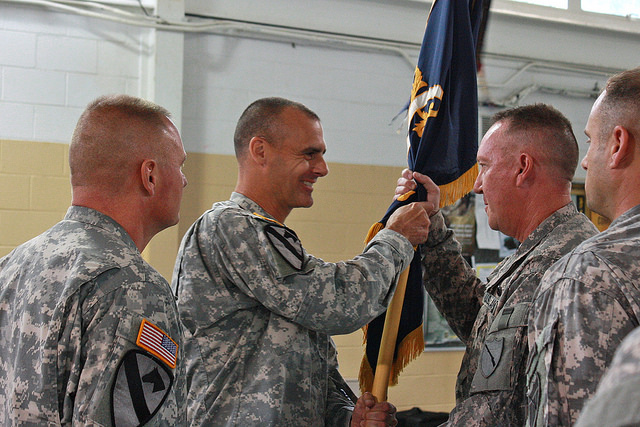
Col. Bryan Howay, commander of the 75th Troop Command passes the colors of the 1st Battalion, 149th Infantry to Lt. Col. Thomas Black during a change of command ceremony in Barbourville, Ky., Oct. 3, 2015. Black took charge from Lt. Col. Joseph Lear who led the battalion since 2013. (U.S. Army National Guard photo by Staff Sgt. Christopher Barton)
BARBOURVILLE, Ky. — Lt. Col. Thomas Black took charge of of the 1st Battalion, 149th Infantry during a change of command ceremony in Barbourville, Oct. 3. Black succeeded Lt. Col. Joseph Lear who has led the battalion since 2013.
Brig. Gen. Charles Jones, Kentucky’s deputy adjutant general, joined friends, family members and Soldiers of the battalion in welcoming Black and congratulating Lear on a successful run as the unit commander. In addition, five former battalion commanders and one former command sergeant major of the unit were in attendance, a testament to the legacy of the Mountain Warriors within the Kentucky Guard and the commonwealth.
Click here for more photos.
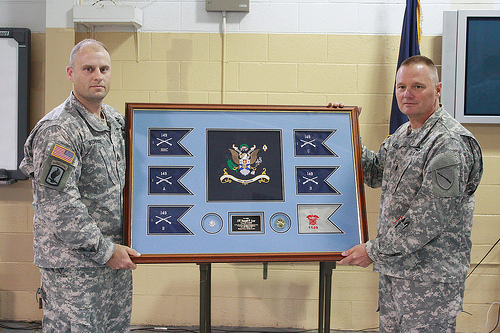
Command Sgt. Maj. Matthew Roberge presents Lt. COl. Joseph Lear with a framed collection of the guidons of the 1st Battalion,, 149th Infantry during a change of command ceremony in Barbourville, Ky., Oct. 3, 2015. Lear commanded the unit since 2013. (U.S. Army National Guard photo by Staff Sgt. Christopher Barton)
“Being here in this moment at this place is nothing short of surreal,” said Black. “I couldn’t help but be reminded of the leadership over the past 3 decades that I have been blessed with, the history I have shared with this battalion, and the heritage that at this very moment I am inheriting.”
Black has served in the Kentucky Guard for more than 30 years, most recently as the operations and planning officer for the 75th Troop Command. As a traditional Guardsman, Black owns and operates a real estate firm in Southern Kentucky.
Lear, who called the chance to lead the battalion the best job he’s ever had, will move to the 75th TC as an operations officer. Black said the battalion has a legacy of great leadership and the last two years were indicative of the same under Lear.
“This battalion is the best combat arms battalion in the Army National Guard. It will remain that way and continue to lead the way. We will emphasize our efforts on near term challenges, constantly evaluating who we are, where we are with respect of who we want to be and where we want to be in respect to long term goals.”
Col. Bryan Howay, commander of the 75th TC called Black a very diverse leader, considering his roles as a Soldier, the father of a Soldier and a local businessman, “there’s nothing he can’t relate to.”
“My most honorable character is being a Dad, my 2nd most honorable character is being a Untied States Army Infantry officer proudly serving in the Kentucky Guard,” said Black. “And now my most honored position while wearing this uniform is commander of the 1st Battalion, 149th Infantry.”
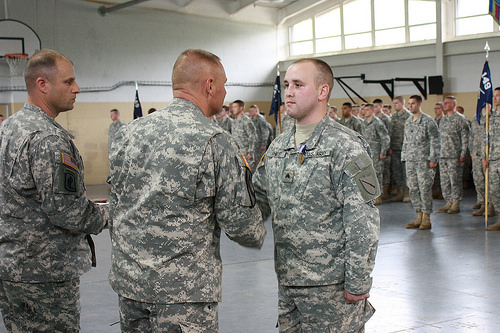
Lt. Col. Joseph Lear presents Sgt. Daniel White with the Soldier’s Medal in Barbourville, Ky., Oct. 3, 2015. White received the award for his actions in saving a motorist’s life in an automobile accident in Frankfort, Ky., in 2014. (U.S. Army National Guard photo by Staff Sgt. Christopher Barton)
In addition to the change of command, the Mountain Warriors also celebrated one of their own with a prestigious honor. Sgt. Daniel White was presented the Soldier’s medal for his actions in helping to save the life of a motorist involved in a fiery automobile accident in January of 2014.
“This means a lot to me, to be recognized for the award,” said White. “It’s not the recognition that any of us were looking for though, the main priority was that Mr. Burdett was out of harm’s way and we did everything that we could do for him. We were lucky enough to be in the right place to put our training in effect and do what anybody in that situation would have done.”
Kentucky National Guard Staff Report
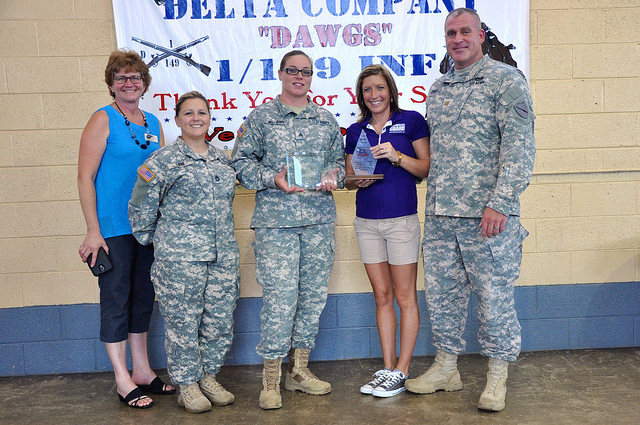
Jennifer Hatfield (second from right) is presented with the National Guard Bureau’s Youth Development Volunteer Award in Middlesboro, Ky., Aug. 23, 2015. Maj. Bryan Combs, Family Programs Director (far right) presented Hatfield with the award for her work as the Family Readiness Group leader for Delta Co. !st Battalion, 149th Infantry. (Kentucky National Guard photo by Olivia Burton)
FRANKFORT, Ky. — “Sometimes you do things not looking for someone to say thank you,” said Jennifer Hatfield, Family Readiness Leader for Delta Company, 1st Battalion, 149th Infantry.
But recently, the National Guard Bureau did say thank you to Hatfield, presenting her with the Youth Development Volunteer Award.
Hatfield received the award during the unit’s family day in Middlesboro, Kentucky, Aug. 23.
“If we had more Jennifer Hatfields in the world, the world would be a better place,” said Maj. Bryan Combs, Kentucky’s Family Programs director.
The award is given to those who have positively impacted Guard Family Readiness Groups and key volunteer efforts.
Hatfield has been the FRG leader since 2012 and her leadership skills contributed to the success of two military child events in 2013 and 2014. Her personal community involvement included Middlesboro Youth League Cheerleading Coach, Coordinator for 5K for Our Hometown Hero’s, Gymnastics Instructor in Middlesboro, and Middlesboro T-Ball. She was instrumental in building and strengthening community relationships that have benefitted both the area and the Kentucky Guard.
“We certainly want to recognize one of our own on both a national and local scale,” said Combs. “The dedication and time that she takes for the 149th Infantry is outstanding, and her support is
through her own accord, her own time, and her own energy.”
“What I can tell you from a state level is we do everything we can to support families so our Soldiers can train, but we can’t do that without people like Jennifer. The ground roots level is where it’s at. It’s that person like Jennifer that meets face to face, who knows what our soldiers needs are, what the families and kids are going through that makes us strong.”
Combs said she has played a key role in the FRG to build trust and continuity within the unit and family members. A tough task that has been successful for Hatfield and the 1/149th and it all started with her raising her hand to help and recognizing military children.
“I started Month of the Military Child Appreciation Day because there was a need here for our kids here in this area,” she said. “It started out small and it’s grown tremendously over the years. I do it because I feel our military children need to be involved just as much as the families. They’re just as important as everyone else. I couldn’t do it without the help of the guys here in the unit.”
“Sometimes I do feel like no one sees what I do, so receiving this award feels really good.”
Kentucky infantrymen conduct largest air assault exercise in six years
By Staff Sgt. Scott Raymond, Kentucky National Guard Public Affairs
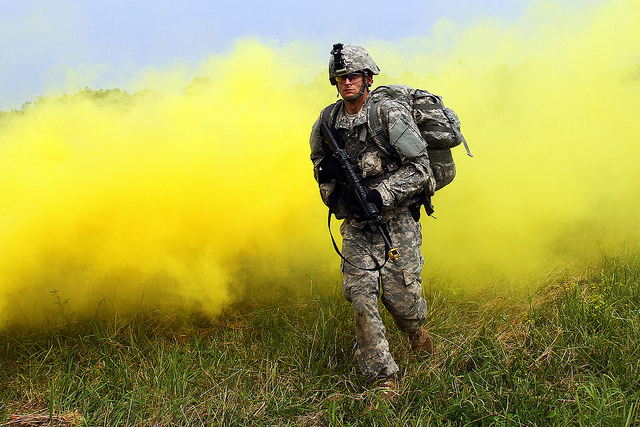
Spc. Robert Satterfield with Bravo Company, 1st Battalion, 149th Infantry exits a landing zone during an air assault exercise at Muscatatuck Urban Training Center in Butlerville, Ind., July 26, 2015. Three companies of infantrymen participated in one of the largest training exercises for the battalion in six years. (U.S. Army National Guard photo by Staff Sgt. Scott Raymond)
BUTLERVILLE, Ind. — In terms of basic Soldier skills, the infantry is arguably the hardest training unit in the Kentucky Guard. But it’s not everyday Soldiers of the 1st Battalion, 149th Infantry get to put all that training into a full-spectrum exercise. As a culminating event to this year’s two-week annual training for the unit, the Mountain Warriors conducted a multi-day air assault mission at the Muscatatuck Urban Training Center near Butlerville, Ind., July 24-27.
“Stuff like this is phenomenal, it’s great training,” said Spc. David Woodford with Alpha Company, 1/149th. “This kind of training will keep me in uniform.”
Soldiers with Alpha and Bravo Co., 1/149th loaded their gear and flew by UH-60 Blackhawks to the landing zone at Muscatatuck, compliments of the U.S. Army Reserves’ 11th Theater Aviation Command out of Fort Knox, Ky. Each Soldier carried their weapon and everything they needed for the three-day mission on their backs. Many of the Guardsmen flew on their first helicopter ride. And at the end of it, they had to get themselves, their gear and their fellow Soldiers out of the aircraft as quickly and as organized as possible.
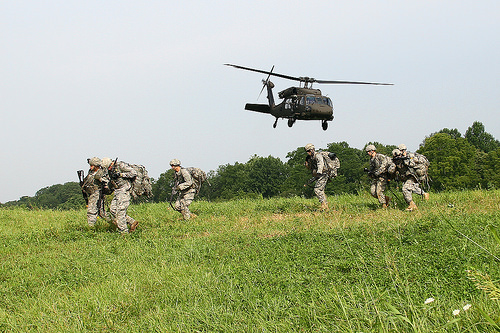
Soldiers with the 1st Battalion, 149th Infantry conduct an air assault exercise at Muscatatuck Urban Training Center in Butlerville, Ind., July 26, 2015. Aviators from the 11th Theater Aviation Command at Fort Knox, Ky., provided eight UH-60 Blackhawk helicopters to transport the infantrymen to the training site. (U.S. Army National Guard photo by Staff Sgt. Scott Raymond)
Click here for more photos.
From the landing zone, the 1/149th was tasked with assaulting and securing a building complex occupied by members of Charlie Company, simulating an opposition forces. The three companies of infantrymen then had to hold their position and establish relations with locals.
In advance of the air assault, a small platoon of scouts paved the way for the main body attack. For those scouts, the mission was a couple days longer as they infiltrated the area two days prior to the battalion’s arrival. They were the eyes and ears of the attack. A job they said they wouldn’t trade for any other in the battalion.
“This is as high as you can get as far as training value,” said Staff Sgt. Nicholas Combs with Headquarters, Headquarters Company, 1/149th. “No one here would want any other job during this training. When this mission is all said and done, only good stories will come out of it.”
From boarding and egressing a helicopter, moving as a fire team and even kicking in doors, the Mountain Warriors checked off a number of mission essential tasks they must train for each year. Lt. Col. Joseph Lear, commander of the 1/149th said the AT provided an excellent chance for each section of the battalion to not only train, but to put their job specialities to the test.
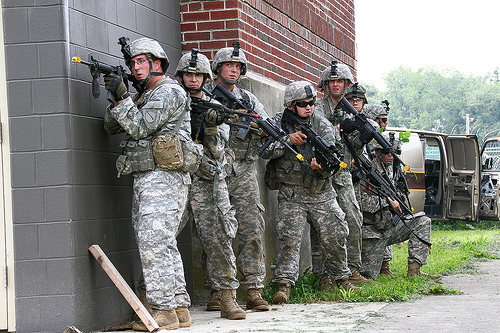
Soldiers with the 1st Battalion, 149th Infantry stack on a wall during a training exercise at the Muscatatuck Urban training Center in Butlerville, Ind., July 26, 2015. The unit conducted an air assault mission to seize a building complex and hold their position against a simulated enemy force. (U.S. Army National Guard photo by Staff Sgt. Scott Raymond)
“Conducting an air assault is one of our primary tasks,” said Lear. “This enabled us to do something we haven’t done since 2009 as a battalion. It’s a tremendous training multiplier for us, to be able to do that kind of mission at that scale, we are grateful to have the opportunity.”
Members of Delta Company provided the ground assault and convoyed by Humvees to the site. In reserve was the 1149th Forward Support Company, whose job is to ensure the infantry can do their job. Chief Warrant Officer Melissa Propes with the 1149th said the annual training was also an invaluable training opportunity for her Soldiers as well.
“I love seeing these Soldiers get experience in what they do, and they got to do that here. Not only did they get good training, it made a difference to the infantry. And that is absolutely what the 1149th FSC is supposed to do,” she said. “Everybody from the infantryman to the mess section, to distro to maintenance, everybody has an essential piece of the puzzle, or they wouldn’t be here. And we’re just happy to contribute.”
Leading up to the assault mission, Soldiers of the unit trained in a variety of squad and platoon-sized drills at Camp Atterbury, Indiana, to hone their skills and prepare for the final mission.
Pvt. Scottie Pace is a cook with the 1149th FSC and attended his first annual training.
“When I first enlisted, I had no idea what to expect on an AT,” he said. “Now, I feel like knowing that I can do my job and help the unit is a great thing to prepare me for future training and makes me a better Soldier.”
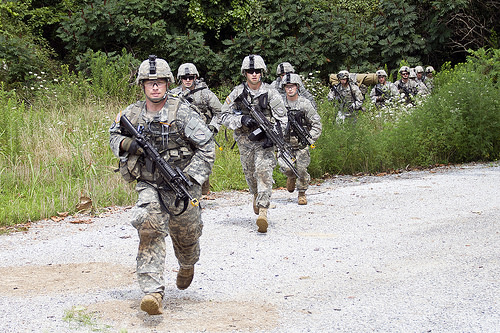
Soldiers with the 1st Battalion, 149th Infantry advance across a road during a training exercise at the Muscatatuck Urban Training Center in Butlerville, Ind., July 26, 2015. The exercise was the culminating event of the unit’s two-week annual training period. (U.S. Army National Guard photo by Staff Sgt. Scott Raymond)
More than 550 Soldiers of the battalion were on hand for the training period. Platoon leaders and company commanders agreed their Soldiers greatly benefitted from the unique training and the boost in morale.
“There’s nothing like training in the field,” said Spc. Joseph Hill from Alpha Co. “You’re really able to do your job and refresh your skills. It’s hard to find a bad part of this AT.”
Battalion leadership were pleased with the effort put forth by their Soldiers and the chance to put them in the field and participants and witnesses to the unique energy of the infantry.
“This type of training is also why people enlist,” said Lear. “They don’t join to stand a drill hall and get briefs. These troops will talk about this air assault for years.”
“That’s how this type of training leads to retention, which leads to strength, which leads to funding, which leads to more quality training. That’s the impact this has on this battalion.”
Story by Capt. Ryan Hubbs, 1st Battalion, 149th Infantry
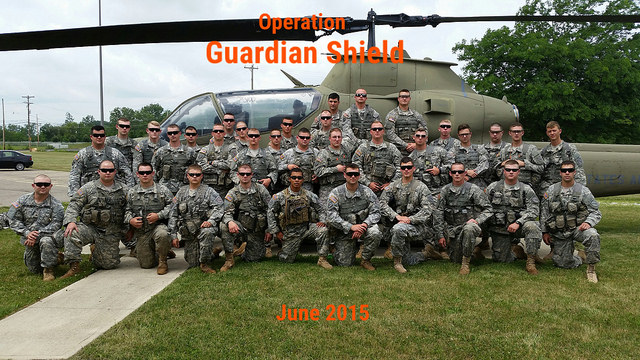
Soldiers from Bravo Company 1-149th Infantry participated in one of the largest regional, multi-agency exercise in the history of the Kentucky Guard at Camp Sherman, Ohio, June 16-18, 2015. Acting as the Quick Reaction Force for a Special Focus Event known as Operation Guard Shield, members of Bravo Co. quickly assembled at their home station, loaded their equipment, and deployed to the exercise site in less than 7 hours. (U.S. Army National Guard photo by Capt. Ryan Hubbs)
Camp Sherman, Ohio — “GAS, GAS, GAS!” What would you do if you had to respond to a Chemical, Biological, Radiological, or Nuclear (CBRN) threat? For members of Bravo Company 1st Battalion, 149th Infantry, they were about to find out…
With the focus of the National Guard’s efforts over the last 14 years, centered on the War on Terror, it is important as Soldiers in the National Guard to be able to respond domestic events as well.
Soldiers from Bravo Co. participated in one of the largest regional, multi-agency exercise in the history of the Kentucky Guard June 16-18. Acting as the Quick Reaction Force for a Special Focus Event known as Operation Guardian Shield, the infantrymen quickly assembled at their home station, loaded their equipment, and deployed to the exercise site in less than 7 hours.
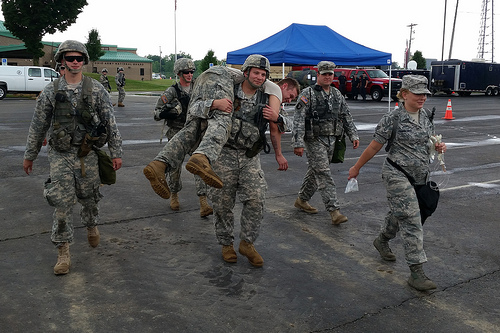
Soldiers from Bravo Company 1-149th Infantry escort a simulated casualty during a training exercise at Camp Sherman, Ohio, June 17, 2015. Acting as the Quick Reaction Force for Operation Guard Shield, members of Bravo Co. quickly assembled at their home station, loaded their equipment, and deployed to the exercise site in less than 7 hours. (U.S. Army National Guard photo by Capt. Ryan Hubbs)
In conducting this full scale exercise event, the 40 participants flew from London, Kentucky to Rickenbacker Air National Guard Base, Ohio in a C-130 provided by the Ohio National Guard. The soldiers then conducted a quick Joint Reception, Staging, Onward Movement, and Integration (JRSOI) briefing describing the situation on the ground. From there the Bravo Co. participants loaded up onto four UH-60 Blackhawk Helicopters and departed for Camp Sherman, Ohio were they would begin their exercise.
The scene at the incident site was a train derailment caused by a domestic terrorist organization (for exercise purposes only). The train was carrying hazardous materials which were in theory released into the air. Bravo Co.’s job worked with the incident manger, local law enforcement, local fire departments, and the CBRN Enhanced Response Force (CERF) to provide security to the site, help evacuate casualties, and prevent decontaminated personnel from entering into the contaminated zone and vice versa.
Staff Sgt. David Olszewski, Platoon Sergeant for 2nd Platoon, Bravo Co. discussed the benefits of training for the mission prior to executing. “Luckily, we have trained with our protective masks so it was not a complete shock to the system; however, it was still difficult to communicate while wearing them. Having trained with masks previously allowed us as Soldiers to not only have confidence in our equipment, but also provided us the stress inoculation necessary to remain calm and collected while wearing the mask.”
Rubble and debris from the derailment site could be seen everywhere. Role players were hired to act as casualties, on lookers, family members searching for loved ones, and members of the media to make the scenario more realistic.
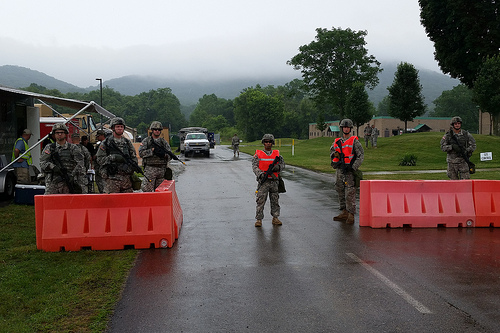
Soldiers from Bravo Company 1-149th Infantry man a tactical control point during a training exercise at Camp Sherman, Ohio, June 17, 2015. The exercise, Operation Guard Shield, brought National Guardsmen from at least eight states together with a variety of civilian organizations to respond to a simulated domestic incident. (U.S. Army National Guard photo by Capt. Ryan Hubbs)
Throughout the day Bravo Co. established and manned a tactical control point, provided litter assistance for casualties who had undergone the decontamination process, conducted a wide area search for survivors, and treated multiple simulated casualties for a variety of injuries all while wearing their protective gas masks and equipment.
With such a large-scale event involving a variety of organizations, interagency communication was difficult but vital to the exercise.
“The most challenging aspect of the operation was coordinating across multiple agencies including military, law enforcement, and emergency management,” explained Olszewski. “Agencies use different communication systems, pro-words, acronyms, and command structures so it can be a challenge to determine the most effective and efficient means of sending and receiving information.”
Along with Soldiers from the Kentucky Guard, Operation Guardian Shield included Soldiers and Airmen from Indiana, Illinois, Pennsylvania, Georgia, West Virginia, Ohio, and National Guard Bureau. Also, representatives and agents from the Department of Homeland Security, FBI, FEMA, Civil Air Patrol, Red Cross, and Ohio Emergency Management were all on the scene. This made the need for coordinated communications extremely important.
At the conclusion of the exercise, all 40 Bravo Company participants loaded up onto to the UH-60s, returned to the air base, loaded onto a C-130 and returned to London where they officially ended their mission.
“We hope to continue to participate in high profile exercises such as this,” said Capt. Ryan Hubbs commander of Bravo Co. “This event allowed us to complete a full spectrum of mission essential tasks and practice our most important mission which is to protect the citizens of our nation. It was great to be able to shift the focus onto a domestic response event, and give us broader perspective of what our duties as members of the National Guard entails.”
Story by Staff Sgt. Scott Raymond, Kentucky National Guard Public Affairs
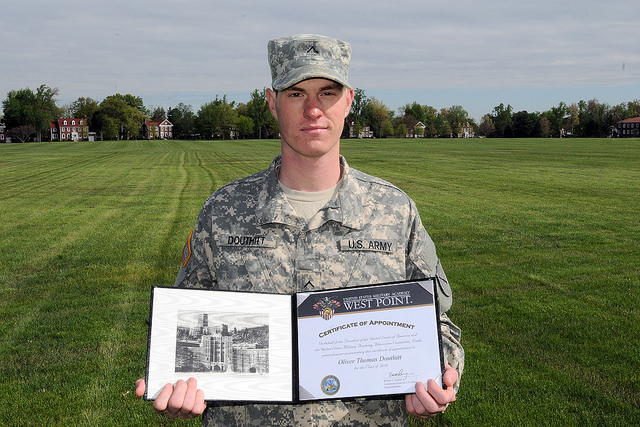
Pvt. Oliver Douthitt with Alpha Company, 1st Battalion, 149th Infantry received an appointment to the United States Military Academy during a ceremony at Fort Knox, Ky., April 26, 2015. A member of the Kentucky Guard for only 14 months, Douthitt said the training he has received will help him be successful in his new Army career. (U.S. Army National Guard photo by Staff Sgt. Scott Raymond)
FORT KNOX, Ky. — A Kentucky Guardsman is taking the next step in his military career to the United States Military Academy. Pvt. Oliver Douthitt, an infantryman with Alpha Company, 1st Battalion, 149th Infantry accepted an appointment to West Point at a small ceremony on Brooks Field in Fort Knox, April 26.
Surrounded by family and fellow infantrymen, Douhitt was presented an official certificate by Brig. Gen. (Retired) Charles B. Skaggs.
“It means a lot to get the opportunity to go to West Point, not a whole lot of people get to do that,” said Douthitt. “My unit has been very supportive the whole time and I really appreciate everything they have done so far.”
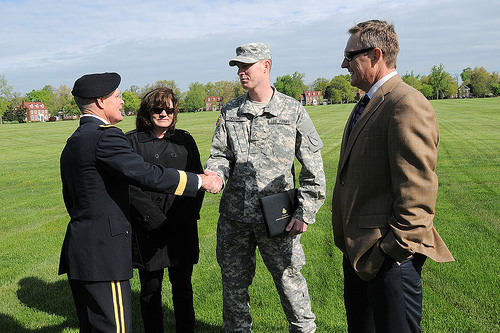
Brig. Gen. (Retired) Charles Skaggs congratulates Pvt. Oliver Douthitt on his acceptance into the United States Military Academy following a ceremony at Fort Knox, Ky., April 26, 2015. Douthitt, a member of Alpha Company, 1st Battalion, 149th Infantry, will report to West Point in June. (U.S. Army National Guard photo by Staff Sgt. Scott Raymond)
The Paducah, Kentucky native is currently a geology major at the University of Kentucky, but decided to push re-start on his future and attend West Point. Enlisting in the Guard in 2014 for the education benefits, Douthitt gives credit to the Kentucky Guard for helping him lay the groundwork for his future.
“The Guard has given me the opportunity to go to school and get plenty of military training, so I was able to do two things at once to prepare me for what is ahead.”
“I’ve only been in 14 months, but I feel like my enlisted service will be very beneficial when I get up there.”
Click here for more photos.
Skaggs, a 1975 West Point graduate and Hopkinsville, Kentucky native said the history of the military academy is like the history of our country. He noted that more than 12,000 apply each year and roughly 1,200 are accepted, a fact he knows Douthitt is proud to be a part of.
“Admission to West Point is equivalent to a college scholarship valued at approximately $280,000,” said Skaggs. “It give me great pleasure to present this appointment to the West Point class of 2019 to Private Douthitt.”
Douthitt’s parents beamed with excitement and joy for their son. Mother and father both were happy he enlisted in the Guard, which has helped prepare them as well.
“We’re proud first that he’s a Soldier, then we will be even more proud when he’s an officer,” said Oliver’s father, Jeff Douthitt. “Joining the Guard has made it easy for us to know what to expect with a son in the military.”
According to Douthitt’s battalion commander, Lt. Col. Joseph Lear, it’s been at least seven years since the last Kentucky Guardsman accepted an appointment to West Point. He remembers because it one of his Soldiers then too.
“It’s really a testament to the mettle of the Soldier we have in the battalion and the Kentucky Guard attracts,” said Lear. “The process shows the fortitude, his drive and his character that he will enhance as he grows as a leader.”
“I look forward to getting all the opportunities presented to me for going to a place like West Point,” said Douthitt. “I would consider coming back to the Guard though, I have loved my time serving here.”
With a final handshake and battalion coin, Lear congratulated Douthitt one last time, with a simple reminder, “Don’t forget where you came from.”
Story by Staff Sgt. Scott Raymond, Kentucky National Guard Public Affairs
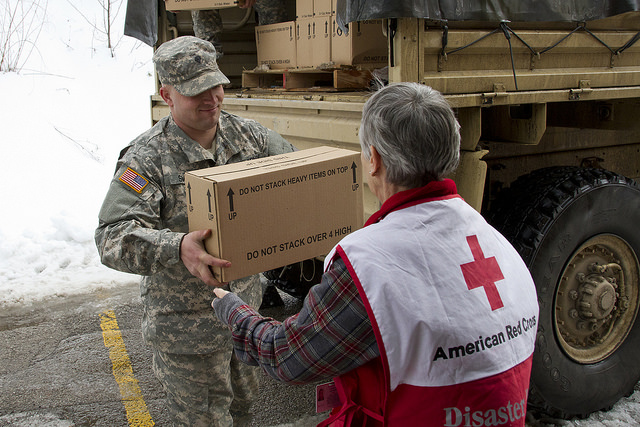
Spc. Timothy Smith with the 1st Battalion, 149th Infantry hands a case of water to Anne Cockley, a Red Cross volunteer at Green Hills Elementary School in Bledsoe, Ky., Feb. 24, 2015. The Soldiers assisted with water deliveries throughout Harlan County in response to a water shortage caused by a recent winter storm. (U.S. Army National Guard photo by Staff Sgt. Scott Raymond)
HARLAN, Ky. — More than 100 Kentucky Guardsmen were activated this week to assist local communities following a devastating winter storm.
Snowfall totals in excess of two feet along with bitterly cold temperatures pushed counties in Eastern and Southern Kentucky to the brink. With 93 of Kentucky’s 120 counties declaring emergencies, Gov. Steve Beshear issued a state of emergency Feb. 16, opening the door for the Guard to assist.
Soldiers with the 201st Engineer Battalion helped clear more than 70 miles of roads in Lee County alone. Trucks from the 138th Field Artillery Brigade and 149th Maneuver Enhancement Brigade moved palletized water from Louisville to staging areas.
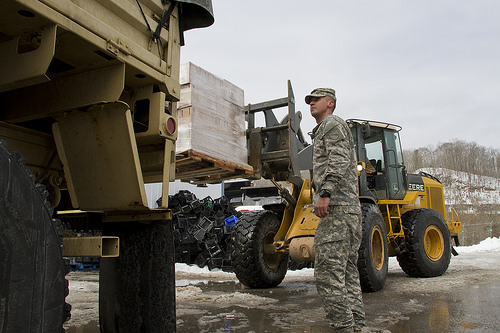
Spc. James Harmon with Alpha Company, 1st Battalion, 149th Infantry helps guide a pallet of water into a vehicle for distribution in Harlan, Ky., Feb. 24, 2015. The Guardsmen were able to supply distribution points across Harlan County to get the water closer to those in need. (U.S. Army National Guard photo by Staff Sgt. Scott Raymond)
In Harlan County, Soldiers with Alpha Company, 1st Battalion, 149th Infantry transported pallets of water to distribution points throughout the county following water system failures.
“We have the equipment to do the job,” said Staff Sgt. Terry Brock with Alpha Co. “We’ve been delivering water, clearing roads, shoveling driveways, helping people get to doctors, just helping out wherever we can.”
Brock, who lives in Harlan County, even had to deliver water to his own family on one of the unit’s runs. “It was good to help them out and to be in a spot to help out the whole county of Harlan too.”
Visit our flickr site for more photos.
Frozen lines and pump failures knocked out the water to an estimated 45,000 households in Eastern Kentucky. Together with the snow, the rural mountain communities were impacted much worse than other parts of the state.
Harlan County Judge Executive Dan Mosley said he has requested a lot of local and state resources throughout this process and finds it encouraging to find so many willing to help.
“The Guard has helped us out in a big way,” he said. “We would not have been able to set up so many distribution points if it wasn’t for the National Guard, the Red Cross and Operation UNITE. There would be a lot of people without water in their homes if it wasn’t for the Kentucky National Guard units doing what they’re doing here.”
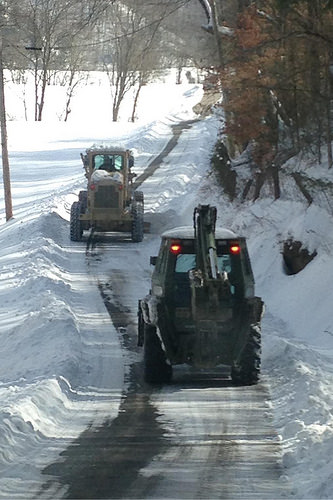
Soldiers with the 201st Engineer Battalion work to remove snow from a road in Lee County, Ky., Feb. 19, 2015. The unit cleared more than 70 miles of snow following the winter storm that impacted much of Kentucky. (Photo courtesy of 201st Engineer Battalion)
According to Spc. James Harmon with Alpha Co., the unit was responsible for the delivery of more than 7,000 gallons of water. In coordination with the Red Cross, the Guardsmen supplied designated distribution points that were closer for citizens to pick up the water. Each run became similar to a wellness check as the Citizen-Soldiers recognized familiar faces and were able to judge the situation based upon the words of their own friends and locals they knew.
“I grew up here in Harlan, it’s a great community of people,” said Harmon. “I just helped deliver water to my old elementary school in Bledsoe. It’s why I enjoy being a part of the National Guard. We serve our Nation, but are also here to help our neighbors get back on their feet.”
Soldiers in the are also provided transportation assistance to emergency personnel, ensuring doctors, nurses and health care staff made it to work.
With more than 30 vehicles in use across the Commonwealth, the Guardsmen are expected to continue each mission through the week.
Check out some video of the Harlan County response mission below:
Commentary by Maj. Robert Andersen, 1st Battalion, 149th Infantry
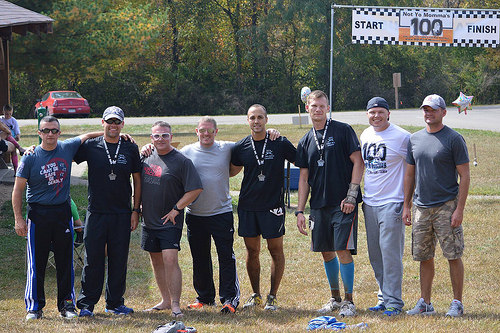
From left to right, Spc. Eddie Sparks, Staff Sgt. Brandon Hobbs, Staff Sgt. David Spahn, Anthony Motta, Capt. Jason Mendez, Maj. Robert Andersen, Capt. Jacob Lee, and Capt. Josh Futrell get together for a group photo after the Not Yo Momma’s 100 Miler race in Chillicothe, Ohio, Sept. 27, 2014. (Courtesy photo)
CHILLICOTHE, Ohio — Several Kentucky Guardsmen gathered in Great Seal State Park in Chillicothe Ohio for a real test of our physical endurance. It was 5:30 in the morning, Sept. 27, 2014. Anthony Motta, Spc. Eddie Sparks, Staff Sgt. Brandon Hobbs, Capt. Jacob Lee, Capt. Josh Futrell, Capt. Jason Mendez, and I were standing at the start line, anticipating the sound of the horn that signaled the start of a much anticipated race.
The challenge, complete the “Not Yo Momma’s” 100 Miler / 100 Km race in under 32 hours or 24 hours. Hobbs and Sparks took on the challenge of 100 Km (62 miles). All others came to complete the 100 Miler; a seemingly insurmountable distance when considering it all still lay ahead.
Ohio is not known for its hills. But for some reason, God decided to swipe his finger across a 16 mile loop that had virtually nothing but. The 100 Miler course included six 16-mile loops preceded by one 4-mile loop. The 100 km runners would run just shy of four 16-mile loops. Throughout this closed circuit the terrain was notoriously tricky. We had no choice but to pay attention the entire time rather than allowing us to drift away in thought, doing so would greatly increase the chances of injury.
The agreement had been made months ago. Everyone was exited and eager to get started with the rigorous training plans. In April it started for most. The long journey began in preparing the body for something, most would say, it was never meant to undertake. Despite the slow and steady train up, some times life just got in the way and not everyone was able to stay as disciplined as they wished they had in the months leading to the big day. Where training lacked, our ego took the place to make sure we showed up confidently come race day.
Injury unfortunately also plagued some of us. Futrell was stubborn enough to take on the 100 Miler with a bum shoulder, an injury he had sustained during annual training with the 198th Military Police Battalion. Nevertheless grit and sheer determination led him through 52 miles of the race before he finally had to take a knee.
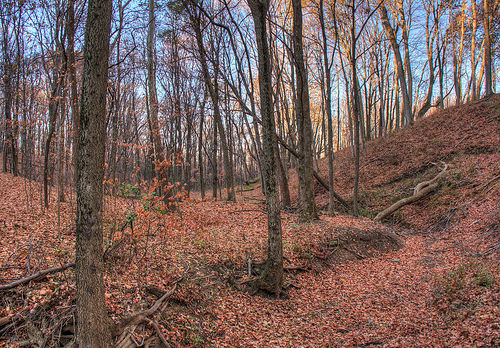
Ultra marathon trail in Great Seal State Park, Chillicothe, Ohio. (Photo courtesy of ultrasignup.com)
The terrain was extremely challenging. Made up of almost exclusively hiking trails across a very rugged environment the risks of falling, tripping, or rolling an ankle was virtually unavoidable. Lee, also from the 198th decided to join the crew last minute and was surprised at the layout of the course. A strength guy by nature and wearing a pair of low profile running shoes he had trouble getting used to the paths the first 10 miles of the race. After 36 miles of course behind him and many hours on his feet he decided to end risking further injury and forfeited the rest of the laps.
Motta, a Nashville resident and high school track and wrestling coach is a good friend of Mendez. This had always been their thing; pick a challenging race and then go do it. Motta was determined to have a good time throughout the entire event as well though. He blasted out from the start line and found himself in the top three spots for the first 10 miles or so. But then an Iliotibial band injury got the better of him and he had to cut this challenge short after only 36 miles in. Despite having plenty left in the tank he made the smart choice. Regardless of what he did, his leg kept on getting worse. Motta spent the rest of his time at the base camp cheering on the rest of us and motivating everyone to carry on.
Hobbs and Sparks, both from the 1st Battalion, 149th Infantry went out confidently and maintained a great mile per average, one lap after the other. Due to the difference in conditioning they eventually broke off from one another to tried to maintain their individual pace throughout the latter parts of the race.
Sparks ran into the night but eventually the rocks, stumps, ups and downs of the trails proved to be too much for his feet to bear. They eventually became so sore and tender that he had no choice but to bow out. He finished 52 miles; so close to his end goal but still a lofty distance considering that sheer willpower had carried him through the last twenty miles with blisters the size of silver dollars and hotspots around the toes and balls of his feet.
Hobbs started feeling the impacts of the terrain early. Cramps were his enemy; mainly to his thighs and lower legs. He trained hard and wouldn’t stop. Mendez and I ran into him a couple of times during the race. He gave himself only one option; finish the race! He completed his run in just over 25 hours. He was absolutely drained of energy, exhausted from the physical and emotional strain he had just put his body through. At the end, however, he was overpowered by absolute joy and feeling of accomplishment.
Jason and I had been training together from the very beginning. We were lucky enough to avoid any major setbacks (injury or other) the six months prior and tried to stay disciplined in logging the miles week by week. We were both adamant about sticking together throughout the entire race which proved to be invaluable as we heavily relied on each other during the long hours.
When you hit a “wall” it takes time to feel your way around it. It’s good to have a buddy there by you guiding you through your troubles. Our lows came at different times throughout the event, but we stayed patient and tried to keep our mind on the finish line as much as possible.
We both felt great finishing the fourth lap; this meant we were passed the halfway mark with roughly 48 miles left. The last three laps proved to be all that we could handle. Dull pain crept to the forefront leading to practically nothing else on my mind. Jason became so tired he started hallucinating, pointing at branches telling me to watch the animals. We were between mile 60 and 62 where I made my biggest mistake; I sat down to gain my strength. This proved to be a poor choice as my body instantly locked up. It took me about 5 miles to undo and to gain some sort of range of motion again.
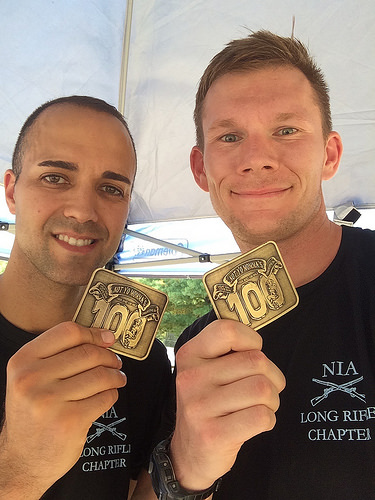
Capt. Jason Mendez and Maj. Robert Andersen show off their buckles, awarded for finishing the Not Yo Momma’s 100 Miler race in Chillicothe, Ohio, Sept. 27, 2014. (Courtesy photo)
The run through the night was the hardest. We would switch off taking lead. The trailing team member droning behind trying to place his feet exactly where the point man had put them. Jason had battled stomach issues for much of the course, which left us no choice but to walk an entire 16 mile loop so we could muster up the strength needed to finish. Arguably the lowest point in our journey was when we finished the fifth lap. We were exhausted, in pain, and mentally drained. It was about two in the morning when we headed out for our second to last loop. As we hit the tree line heading into the woods, we heard the horn sound at the finish line. This signaled that the first runner had finished the 100-mile race; a crushing blow to our confidence as we realized we still had 32 miles left to go.
Finally, the finishing lap was all that was left to concur. The sun rose again on day two and we both found ourselves with a jolt of energy that carried us into what would prove to be our second fastest lap throughout the race. “Stand at Sunrise” is what a fellow runner told us prior to the event kicking off. Ali was his name and he assured us that we would find what we needed to finish as long as we made it to the second dawn.
Jason’s ailments subsided. He felt great. I needed that for the final lap because my body had expended all that it could. In the last 10 hours of the race I found myself taking 400 milligrams of Ibuprofen every two hours. Eventually nothing masked the pain that had built itself up in my limbs. Jason was patient as he talked me through some of the tough spots. He started chatting about random things just to keep my mind off the aching and throbbing in my feet. It worked. We came out of the wood line with less than a mile before the finish, reminiscing about the challenging journey that was about to come to a close. Months of training, a no fail mindset, and a battle buddy is what proved to be the key ingredients for success.
We crossed the finish line together. Total time 30 hours 46 minutes of non-stop running.
Our family and friends met us at the finish. They had been supporting us throughout the entire occasion. Our very own pit crew for the lack of the better word. There is no doubt that this event would have been substantially tougher if it hadn’t been for our loved ones cheering us on every lap, telling us to keep going and reassuring us with love and positive reinforcement.
“So it was dark and we started running. The sun came up. The sun went down. The sun came back up. And a few hours later we stopped running,” Jason sent me in a text after.
I am extremely proud of everyone that showed up that day. All of my friends and those we came to know throughout the countless miles.
Out of 28 Runners that started the 100 Miler only 10 finished. Without a doubt, this was the hardest physical and mental challenge I had ever put my body through. No matter how far I ran during training, the concept of running 100 miles never added up in my mind. Only after taking on that very first lap did I truly appreciate what daunting test I would put my body through.
Totally Worth It!
Story by Staff Sgt. Scott Raymond, Kentucky National Guard Public Affairs
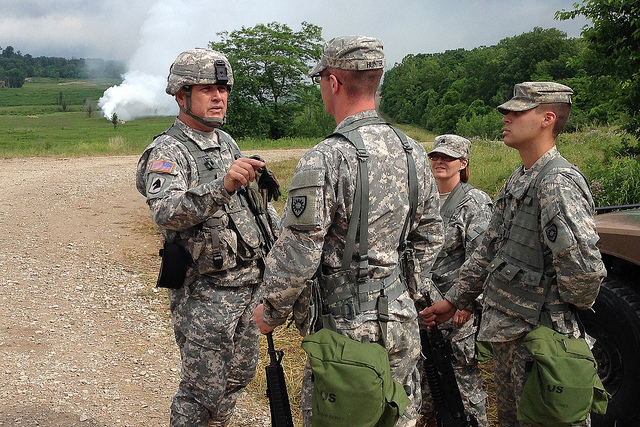
Command Sgt. Maj. Thomas Chumley speaks with Soldiers of the 103rd Chemical Battalion during a training exercise at Camp Atterbury, Ind., June 18, 2014. As the state command sergeant major, Chumley said it is his job to get out to see the troops and check on their well-being. (U.S. Army National Guard photo by Staff Sgt. Adam Rients)
CAMP ATTERBURY, Ind. — Kentucky Guardsmen went about their usual routines during annual training periods this spring and summer in a variety of places. Soldiers and units use this time to ensure they are up to the task of doing their specific job.
For State Command Sgt. Maj. Thomas Chumley, it is also an opportunity to ensure those Soldiers are doing the right thing and are being taken care of by the Kentucky National Guard.
“Visiting Soldiers during annual training and any other training event gives me the opportunity to talk to and observe Soldiers at their best and address any issue they may have,” he said. “It is also to let them know the senior leadership is proud of what they are doing, and appreciate the sacrifices they and their families make.”
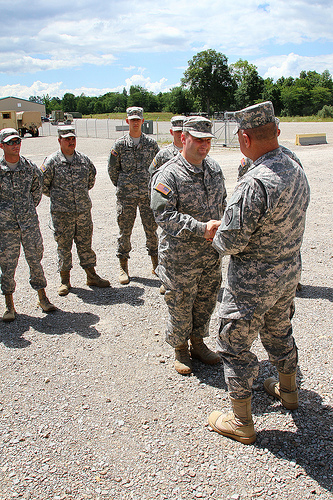
State Command Sgt. Maj. Thomas Chumley coins Spc. Hoskins with the 1149th Forward Support Company at Camp Atterbury, Ind., July 16, 2014. Chumley asked units to point out Soldiers that were excelling within their units for recognition. (U.S. Army National Guard photo by Staff Sgt. Scott Raymond)
Chumley said there were times in the past that Soldiers never saw their command sergeant major or even knew who he or she was. He refuse to go back to that time, because put simply, it’s his job. As the Kentucky Army Guard’s top enlisted advisor to the adjutant general, that job is an important one for the nearly 6,000 enlisted Soldiers serving in the commonwealth.
“I am their eyes and ears in Frankfort, I represent them to the leadership of this organization, and I cannot do it without getting out here and talking to them.”
Click here for more photos from this story.
Annual training periods provide the ideal chance for command visits and Chumley visits as many as the schedule allows. From Kentucky’s Wendell H. Ford Regional Training Center to Camp Atterbury, the 42-year military Veteran is out asking what the Soldiers think of the food, if they are up to date on their training requirements and if they take advantage of the benefits available to them. He said it is his chance to find ways to improve the Kentucky Army National Guard.
The visits are well received as Soldiers gather to visit with Chumley, meet a member of the command staff and share their feelings about training and the Kentucky Guard..
“I think its great that the sergeant major comes out to see us, check on us and show that he cares,” said Pfc. Lawless with the 1st Battalion, 149th Infantry. “It tells us leadership just doesn’t sit at a desk somewhere, they come out here and learn from us like we’re supposed to learn from them. It shows good leadership and I appreciate that.”
Chumley often asks how many of the Soldiers would consider giving more than 40 years to their country. Not that he expects very many to raise their hands, he knows he’s talking to a future command sergeant major and the future of the Kentucky Guard.
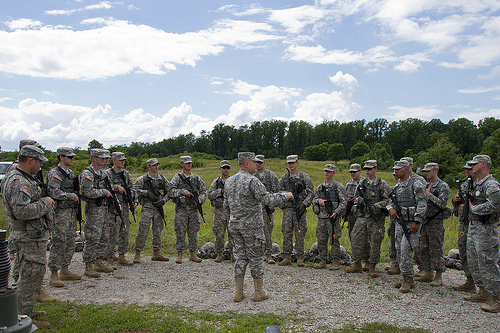
State Command Sgt. Maj. Thomas Chumley speaks to Soldiers with the 1st Battalion, 149th Infantry during annual training at Camp Atterbury, Ind., July 16, 2014. During his visit, Chumley spoke to as many Soldiers as possible to thank them for their dedication and hard work. (U.S. Army National Guard photo by Staff Sgt. Scott Raymond)
“One of the things I like most about coming out here is that I get to tell them how proud I am of them and thank them for what they do. Every time I get around these young Soldiers it reenergizes me and reminds me that I am here for them, and because of them.”
Staff Report with contributions from Capt. Ryan Hubbs
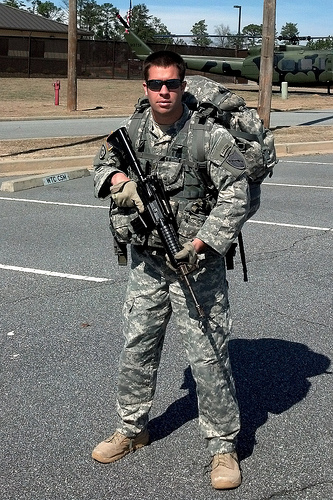
Capt. Ryan Hubbs prepares to begin a practice road march at Fort Benning, Ga., in preparation for the 2014 Best Ranger Competition. (Courtesy photo)
FORT BENNING, Ga. — As the weeks dwindle down to the 2014 Best Ranger Competition, training and preparation only intensify for the participants. Capt. Ryan Hubbs, a Kentucky Guardsman from the 1st Battalion, 149th Infantry keeps his eyes on the prize of raising his own Colt pistol in the air if he is named the Best Ranger.
Hubbs, along with other competitors are currently at Fort Benning, Ga., making the most of each day they have preparing for the April event.
“It is important to understand that just being the most physically fit will not guarantee victory, it will only separate you into the next tier. Practicing, strategizing, and rehearsing your techniques are what will separate those competitors at the top.”
“No time is wasted here. Even in our hotel rooms at night we practice rigging our ruck sacks for airborne operations, studying Ranger History, and tying knots for time. The rest of our down time is spent recovering, doing stretches, foam rolling out the knots in our legs, and taking ice baths, followed by Epsom salt baths.”
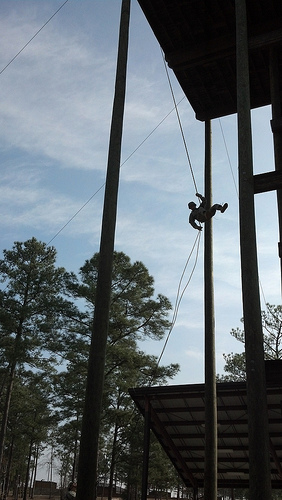
Capt. Ryan Hubbs rappels down from a 60 feet high tower at Fort Benning, Ga., during practice for the 2014 Best Ranger Competition. (Courtesy photo)
Hubbs said the competitors are training 10-14 hours per day, dedicating themselves to the event. He estimates that they run and average of 20-30 miles per week, 4000-5000 meters in the pool and more than 20 miles on road marches. And the mileage only increases each week.
“Each competitor down here is extremely competitive. Everything we do is timed and measured and no one wants a loose a single event. It is a very interesting environment where everyone is extremely encouraging and helpful to each other until it is time to compete and then we all try our best to crush our competition.”
Soldiers from active-duty Ranger units and Special Operations Command teams also compete in the prestigious event. Fo several years, members of the National Guard have competed and have finished well, but Hubbs believes that more Guardsmen will finish strong this year.
“I suspect by the start of Best Ranger the National Guard will have the most physically fit and technically proficient Soldiers in the competition.”
