Pages
Stay In Touch
More
© 2013 KentuckyGuard
Kentucky infantrymen conduct largest air assault exercise in six years
By Staff Sgt. Scott Raymond, Kentucky National Guard Public Affairs
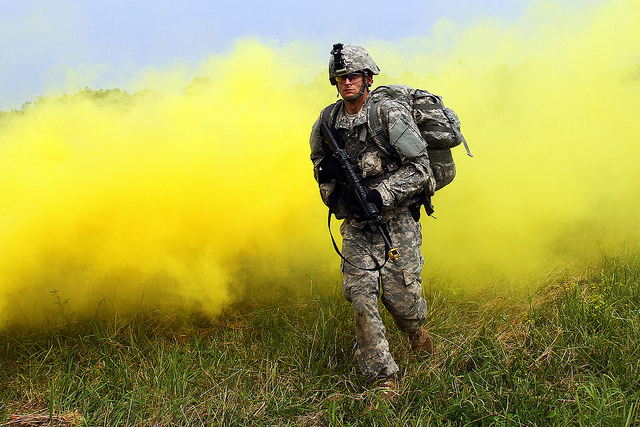
Spc. Robert Satterfield with Bravo Company, 1st Battalion, 149th Infantry exits a landing zone during an air assault exercise at Muscatatuck Urban Training Center in Butlerville, Ind., July 26, 2015. Three companies of infantrymen participated in one of the largest training exercises for the battalion in six years. (U.S. Army National Guard photo by Staff Sgt. Scott Raymond)
BUTLERVILLE, Ind. — In terms of basic Soldier skills, the infantry is arguably the hardest training unit in the Kentucky Guard. But it’s not everyday Soldiers of the 1st Battalion, 149th Infantry get to put all that training into a full-spectrum exercise. As a culminating event to this year’s two-week annual training for the unit, the Mountain Warriors conducted a multi-day air assault mission at the Muscatatuck Urban Training Center near Butlerville, Ind., July 24-27.
“Stuff like this is phenomenal, it’s great training,” said Spc. David Woodford with Alpha Company, 1/149th. “This kind of training will keep me in uniform.”
Soldiers with Alpha and Bravo Co., 1/149th loaded their gear and flew by UH-60 Blackhawks to the landing zone at Muscatatuck, compliments of the U.S. Army Reserves’ 11th Theater Aviation Command out of Fort Knox, Ky. Each Soldier carried their weapon and everything they needed for the three-day mission on their backs. Many of the Guardsmen flew on their first helicopter ride. And at the end of it, they had to get themselves, their gear and their fellow Soldiers out of the aircraft as quickly and as organized as possible.
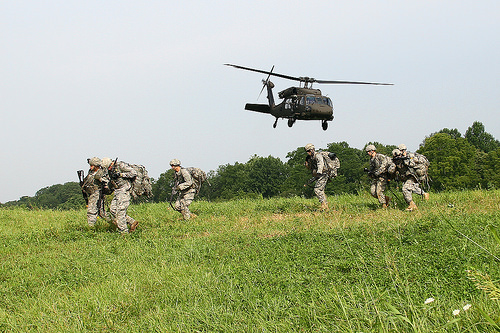
Soldiers with the 1st Battalion, 149th Infantry conduct an air assault exercise at Muscatatuck Urban Training Center in Butlerville, Ind., July 26, 2015. Aviators from the 11th Theater Aviation Command at Fort Knox, Ky., provided eight UH-60 Blackhawk helicopters to transport the infantrymen to the training site. (U.S. Army National Guard photo by Staff Sgt. Scott Raymond)
Click here for more photos.
From the landing zone, the 1/149th was tasked with assaulting and securing a building complex occupied by members of Charlie Company, simulating an opposition forces. The three companies of infantrymen then had to hold their position and establish relations with locals.
In advance of the air assault, a small platoon of scouts paved the way for the main body attack. For those scouts, the mission was a couple days longer as they infiltrated the area two days prior to the battalion’s arrival. They were the eyes and ears of the attack. A job they said they wouldn’t trade for any other in the battalion.
“This is as high as you can get as far as training value,” said Staff Sgt. Nicholas Combs with Headquarters, Headquarters Company, 1/149th. “No one here would want any other job during this training. When this mission is all said and done, only good stories will come out of it.”
From boarding and egressing a helicopter, moving as a fire team and even kicking in doors, the Mountain Warriors checked off a number of mission essential tasks they must train for each year. Lt. Col. Joseph Lear, commander of the 1/149th said the AT provided an excellent chance for each section of the battalion to not only train, but to put their job specialities to the test.
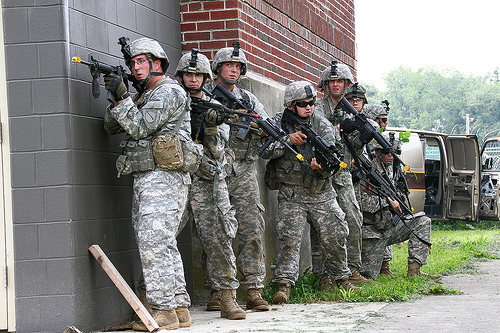
Soldiers with the 1st Battalion, 149th Infantry stack on a wall during a training exercise at the Muscatatuck Urban training Center in Butlerville, Ind., July 26, 2015. The unit conducted an air assault mission to seize a building complex and hold their position against a simulated enemy force. (U.S. Army National Guard photo by Staff Sgt. Scott Raymond)
“Conducting an air assault is one of our primary tasks,” said Lear. “This enabled us to do something we haven’t done since 2009 as a battalion. It’s a tremendous training multiplier for us, to be able to do that kind of mission at that scale, we are grateful to have the opportunity.”
Members of Delta Company provided the ground assault and convoyed by Humvees to the site. In reserve was the 1149th Forward Support Company, whose job is to ensure the infantry can do their job. Chief Warrant Officer Melissa Propes with the 1149th said the annual training was also an invaluable training opportunity for her Soldiers as well.
“I love seeing these Soldiers get experience in what they do, and they got to do that here. Not only did they get good training, it made a difference to the infantry. And that is absolutely what the 1149th FSC is supposed to do,” she said. “Everybody from the infantryman to the mess section, to distro to maintenance, everybody has an essential piece of the puzzle, or they wouldn’t be here. And we’re just happy to contribute.”
Leading up to the assault mission, Soldiers of the unit trained in a variety of squad and platoon-sized drills at Camp Atterbury, Indiana, to hone their skills and prepare for the final mission.
Pvt. Scottie Pace is a cook with the 1149th FSC and attended his first annual training.
“When I first enlisted, I had no idea what to expect on an AT,” he said. “Now, I feel like knowing that I can do my job and help the unit is a great thing to prepare me for future training and makes me a better Soldier.”
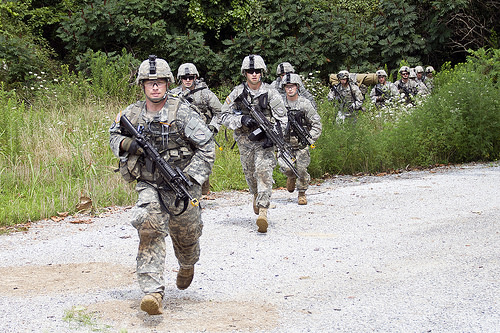
Soldiers with the 1st Battalion, 149th Infantry advance across a road during a training exercise at the Muscatatuck Urban Training Center in Butlerville, Ind., July 26, 2015. The exercise was the culminating event of the unit’s two-week annual training period. (U.S. Army National Guard photo by Staff Sgt. Scott Raymond)
More than 550 Soldiers of the battalion were on hand for the training period. Platoon leaders and company commanders agreed their Soldiers greatly benefitted from the unique training and the boost in morale.
“There’s nothing like training in the field,” said Spc. Joseph Hill from Alpha Co. “You’re really able to do your job and refresh your skills. It’s hard to find a bad part of this AT.”
Battalion leadership were pleased with the effort put forth by their Soldiers and the chance to put them in the field and participants and witnesses to the unique energy of the infantry.
“This type of training is also why people enlist,” said Lear. “They don’t join to stand a drill hall and get briefs. These troops will talk about this air assault for years.”
“That’s how this type of training leads to retention, which leads to strength, which leads to funding, which leads to more quality training. That’s the impact this has on this battalion.”
Story by Spc. Lerone Simmons, 133rd Mobile Public Affairs Detachment
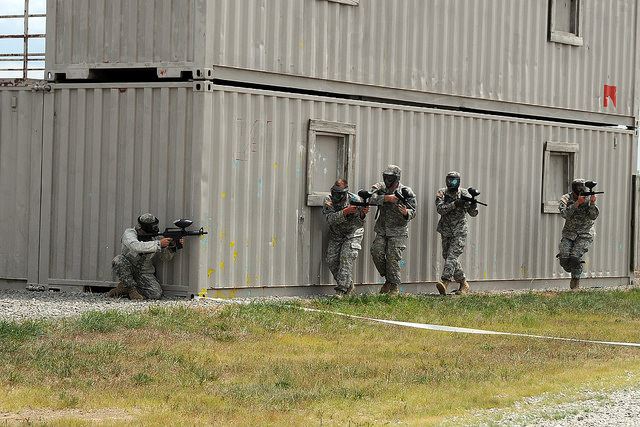
Soldiers assigned to Charlie Battery, 2nd Battalion,138th Field Artillery Brigade, move as a fire team and conduct a Military Operation in Urban Terrain as part of their annual training at Wendell. H. Ford Regional Training Center, July 30, 2014. The 138th focused on Soldier training that helps with individual communication and movement during their reset year after completing a deployment to the Horn of Africa last year. (U.S. Army National Guard photo by Spc. Lerone Simmons)
GREENVILLE, Ky. — Soldiers assigned to the Kentucky Army National Guard’s 138th Field Artillery Brigade carried out their annual two-week training at Wendell H. Ford Regional Training Center in Greenville, during the last two weeks of July.
For a large number of the brigade’s Soldiers, it was their first annual training since deploying to the Horn of Africa in 2012-2013. The unit served as security forces for Camp Lemmonier in Djibouti and assisted in multi-national military training in the region.
“This is a reset year for us, so this AT was focused heavily on individual Soldier training, and has been quite successful,” said Sgt. Maj. Rob Hughes, brigade operations sergeant major.
Hughes mentioned how much time went into planning for an event of this large scale, ushering approximately 800 Soldiers through training.
“From first plans to execution, it took about three years to see this become a reality,” he said. “I’m impressed with the way our leadership kept track and carried out the training as well as our Soldiers who are meeting every task placed in front of them to standard.”
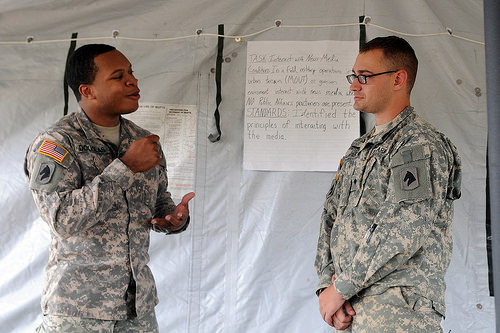
Spc. Tyler Douglas, a fire direction controller assigned to Charlie Battery, 2nd Battalion,138th Field Artillery Brigade, interviews Spc. Christopher Plummer, a petroleum and resupply specialist, assigned to 2/138 Forward Support Company, during a mock “Interacting with Media” exercise during their annual training at Wendell. H. Ford Regional Training Center, July 30, 2014. The 138th focused on individual Soldier training during their reset year after completing a deployment to the Horn of Africa last year. (U.S. Army National Guard photo by Spc. Lerone Simmons)
One of the main priorities of individual Soldier training was completing the Army’s Self Structured Development training, which is a requirement for specialists to master sergeant for promotion.
“The training is designed to be continuous throughout a Soldier’s career, geared to expand the individual Soldier’s knowledge base, self-awareness, and situational awareness,” he said. “So far we have almost 100 percent of those who required the training, completed.”
Soldiers also learned the very important role they play as ambassadors for the Kentucky National Guard and the Army during media engagement training.
“We were briefed on how to properly interact with media,” said Spc. Christopher Plummer, a petroleum & resupply specialist assigned to the 2nd Battalion, 138th Forward Support Company.
“I wouldn’t be surprised if an interview popped up at any time, but now I’m more confident knowing that I have this training to fall back on,” he said.
Aside from theu classroom and computer-based instruction, Soldiers also conducted military operations in urban terrain (MOUT) training. According to 1st Lt. Sean C. Jones, fire direction officer for Charlie Battery, 2nd Battalion, 138th FA, the MOUT training was productive and a good reminder that the unit must work as a team.
“The MOUT training served as a valuable communication tool for our Soldiers, and also gave our junior non commissioned officers more opportunities to lead,” he said.
The training allowed unit leaders to rate the Soldier’s proficiency with the Army warrior tasks also refreshed the teams on important security procedures they may face again in future operations.
“MOUT training requires Soldiers to work as a fire team under small arms fire while moving through an urban environment,” Jones said. “We also train on how to properly conduct a search on an individual to ensure safety and security.”
“Completing individual Soldier training was our mission for this AT and I’m proud of leadership and the Soldiers who carried it out,” said Jones. But the unit is also excited, he said, to “shooting our cannons.”
Story by Staff Sgt. Scott Raymond, Kentucky National Guard Public Affairs
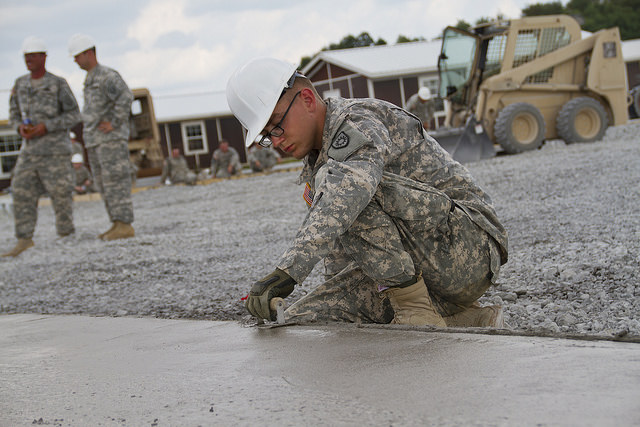
Spc. Aaron Elliott with the 149th Vertical Construction Company smoothes the edge of a freshly poured concrete slab at the Wendell H. Ford Regional Training Center in Greenville, Ky., July 22, 2014. (U.S. Army National Guard photo by Staff Sgt. Scott Raymond)
GREENVILLE, Ky. — A year ago, Soldiers of the 149th Vertical Construction Company called Bagram, Afghanistan home. The engineers spent nearly a year deployed in support of Operation Enduring Freedom helping to teach Afghans how to rebuild their country.
Since their arrival back in the commonwealth this past December, the 149th has taken the methodical steps to reintegrate back into typical Guard life. With that in mind, leadership of the unit decided they would offer the first annual training period as a volunteer only option. They didn’t have to, but 70 Soldiers said yes and donned their ACUs and travelled to the Wendell H. Ford Regional Training Center in Greenville, July 12-26.
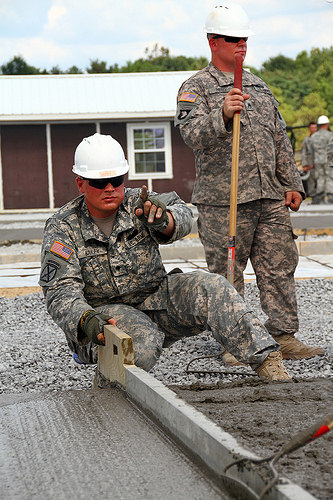
Spc. Adam Bailey works to smooth freshly poured concrete with a screen board during a construction project at the Wendell H. Ford Regional Training Center in Greenville, Ky., July 22, 2014. (U.S. Army National Guard photo by Staff Sgt. Scott Raymond)
“This sure beats Afghanistan,” said Spc. Adam Bailey. “We are doing some of the same things here we did over there, but it sure feels good to be in Kentucky.”
Bailey and other Soldiers were back in familiar territory at the training site as well. The 149th has been primarily responsible for the construction of the training site’s new Contingency Operation Location (COL). Over the years, the unit has constructed buildings, ran plumbing and wired electric to the training area. According to the project officer in charge, Chief Warrant Officer Jacob Lewis, the goal for the annual training was for the Soldiers to make several enhancements to the COL including the pouring of new concrete tent pads.
“This mission was certainly an overall success,” said Lewis. “These Soldiers exceeded the expectations by far. They were given a construction task of eight pads, they completed 12, pouring more than 144 cubic yards of concrete.”
“For an all volunteer AT after coming back from a deployment, the turnout was extraordinary,” said Lewis. “Doing a mission like this after the variety of different ones we had over there is very relevant for us. The pace was fairly steady and at times very demanding both here and abroad, but as Citizen-Soldiers, that is our duty.”
The Guardsmen are scheduled to return to Greenville on several occasions this year for more improvements to the COL as well as to assist in other construction projects for the Kentucky Guard.
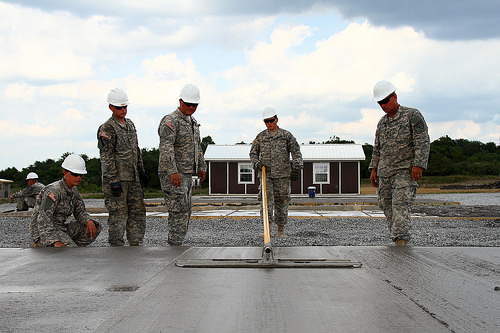
Pvt. Evan Bump is supervised using a bull float to smooth concrete during a construction project at the Wendell H. Ford Regional Training Center in Greenville, Ky., July 22, 2014. (U.S. Army National Guard photo by Staff Sgt. Scott Raymond)
Lewis said the unit worked extremely hard during the annual training and should be proud of the work they have continued. Moving forward, it seems to be the mutual agreement amongst the 149th that they are ready to transition back into a valuable and constant resource for the Guard and the commonwealth.
“This AT can be viewed as the newest chapter for us,” Lewis said. “We are engineers, we rise to the occasion and lead from the front.”
Story by Staff Sgt. Scott Raymond, Kentucky National Guard Public Affairs
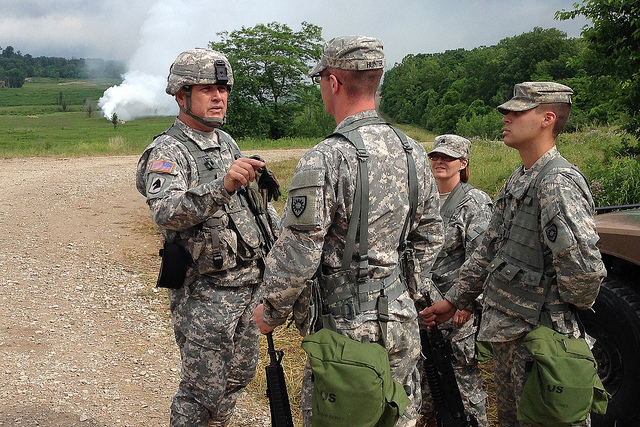
Command Sgt. Maj. Thomas Chumley speaks with Soldiers of the 103rd Chemical Battalion during a training exercise at Camp Atterbury, Ind., June 18, 2014. As the state command sergeant major, Chumley said it is his job to get out to see the troops and check on their well-being. (U.S. Army National Guard photo by Staff Sgt. Adam Rients)
CAMP ATTERBURY, Ind. — Kentucky Guardsmen went about their usual routines during annual training periods this spring and summer in a variety of places. Soldiers and units use this time to ensure they are up to the task of doing their specific job.
For State Command Sgt. Maj. Thomas Chumley, it is also an opportunity to ensure those Soldiers are doing the right thing and are being taken care of by the Kentucky National Guard.
“Visiting Soldiers during annual training and any other training event gives me the opportunity to talk to and observe Soldiers at their best and address any issue they may have,” he said. “It is also to let them know the senior leadership is proud of what they are doing, and appreciate the sacrifices they and their families make.”
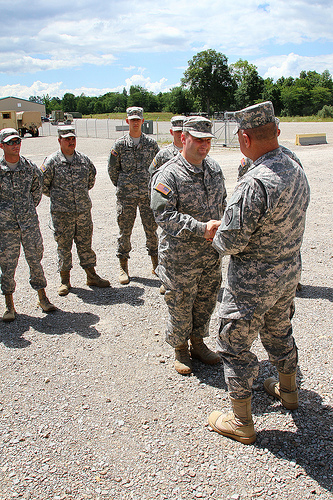
State Command Sgt. Maj. Thomas Chumley coins Spc. Hoskins with the 1149th Forward Support Company at Camp Atterbury, Ind., July 16, 2014. Chumley asked units to point out Soldiers that were excelling within their units for recognition. (U.S. Army National Guard photo by Staff Sgt. Scott Raymond)
Chumley said there were times in the past that Soldiers never saw their command sergeant major or even knew who he or she was. He refuse to go back to that time, because put simply, it’s his job. As the Kentucky Army Guard’s top enlisted advisor to the adjutant general, that job is an important one for the nearly 6,000 enlisted Soldiers serving in the commonwealth.
“I am their eyes and ears in Frankfort, I represent them to the leadership of this organization, and I cannot do it without getting out here and talking to them.”
Click here for more photos from this story.
Annual training periods provide the ideal chance for command visits and Chumley visits as many as the schedule allows. From Kentucky’s Wendell H. Ford Regional Training Center to Camp Atterbury, the 42-year military Veteran is out asking what the Soldiers think of the food, if they are up to date on their training requirements and if they take advantage of the benefits available to them. He said it is his chance to find ways to improve the Kentucky Army National Guard.
The visits are well received as Soldiers gather to visit with Chumley, meet a member of the command staff and share their feelings about training and the Kentucky Guard..
“I think its great that the sergeant major comes out to see us, check on us and show that he cares,” said Pfc. Lawless with the 1st Battalion, 149th Infantry. “It tells us leadership just doesn’t sit at a desk somewhere, they come out here and learn from us like we’re supposed to learn from them. It shows good leadership and I appreciate that.”
Chumley often asks how many of the Soldiers would consider giving more than 40 years to their country. Not that he expects very many to raise their hands, he knows he’s talking to a future command sergeant major and the future of the Kentucky Guard.
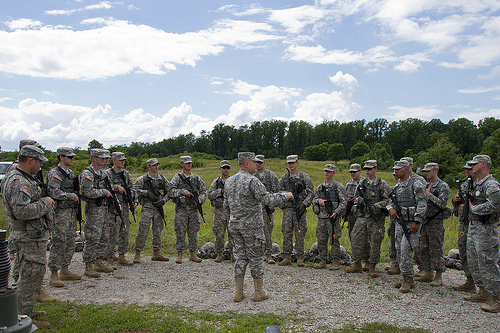
State Command Sgt. Maj. Thomas Chumley speaks to Soldiers with the 1st Battalion, 149th Infantry during annual training at Camp Atterbury, Ind., July 16, 2014. During his visit, Chumley spoke to as many Soldiers as possible to thank them for their dedication and hard work. (U.S. Army National Guard photo by Staff Sgt. Scott Raymond)
“One of the things I like most about coming out here is that I get to tell them how proud I am of them and thank them for what they do. Every time I get around these young Soldiers it reenergizes me and reminds me that I am here for them, and because of them.”
Staff Report, photos courtesy of 201st Engineer Battalion
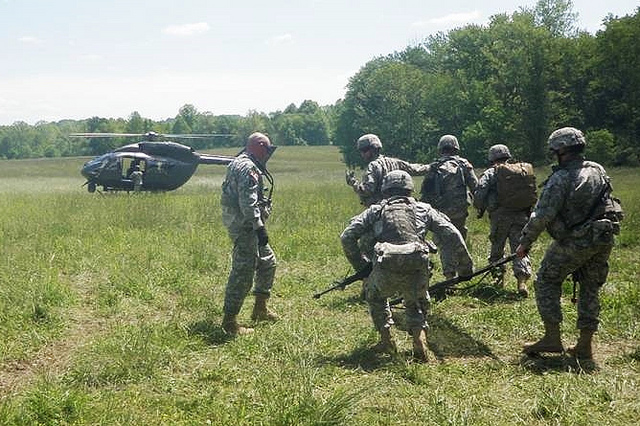
Soldiers of the 577th Sapper Company prepare to load a simulated casualty into a LUH-72 Lakota helicopter during annual training at the Harold L. Disney Training Center in Artemus, Ky., May 20, 2014. The engineer company is the Kentucky Guard’s primary emergency response force in extreme Eastern Kentucky. (Photo courtesy of 201st Engineer Battalion)
FRANKFORT, Ky. — Soldiers of the 201st Engineer Battalion were out in force for annual training this past May. More than 500 Guardsmen will have put their skills to the test at the conclusion of the training cycle in July. Across Eastern Kentucky, the engineers assembled to continue construction projects at Hidden Valley Training Site in Powell County, Kentucky and the Wendell H. Ford Regional Training Center out west in Greenville, Kentucky.
“The 201st is known as the Workhorse Battalion,” said Maj. John Barger, operations officer for the battalion. “We strive to conduct tough, realistic training in austere environments, and the 2014 training year has been no exception.”
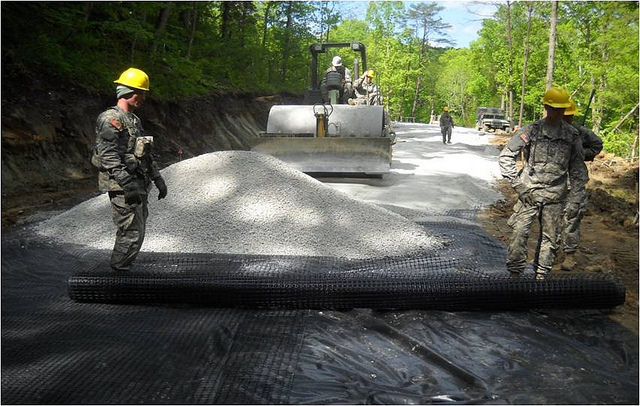
Soldiers of the 207th Horizontal Construction Company lay Geotextile Grid during road improvements at Hidden Valley Training Center in Powell County, Ky., May 2014. (Photo courtesy of 201st Engineer Battalion)
At Hidden Valley, road improvements were the primary tasks. Gravel was delivered by the 118th Haul Platoon and laid down by Soldiers with the 207th Horizontal Engineer Company. According to the units, this year’s work opened up hundreds of acres of the site to future training.
“We can’t give enough accolades to our Warhammer and Land Shark (207th and 118th) Soldiers,” said Staff Sgt. Adam Spencer, Training NCO, Det 1 207th and Squad Leader, 3rd Platoon, 207th. “They’ve worked so hard for the last two annual training periods on this road project…closing the loop on this road is one of the biggest successes achieved solely by our units.”
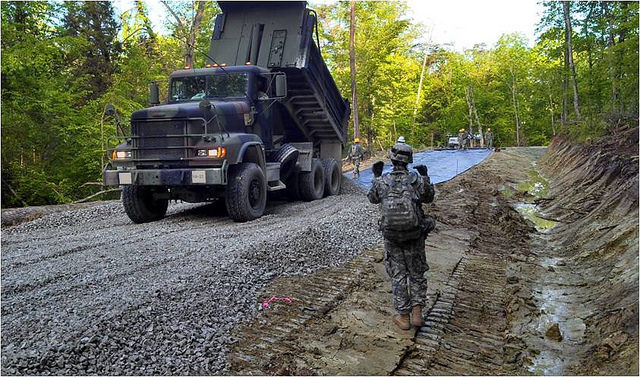
Soldiers with the 118th Haul Platoon unload gravel for road improvements at Hidden Valley Training Center in Powell County, Ky., May 22, 2014. (Photo courtesy of 201st Engineer Battalion)
In Southern Kentucky at the Harold L. Disney Training Site in Artemus, members of the 577th Sapper Company prepared for a scheduled three-week rotation at Fort Polk, Louisiana next year. The combat engineers conducted a variety of training exercises to improve their overall effectiveness as a unit.
“We have finally put it all together and working well as a team,” said Pvt. Gregory Bowen, a Soldiers new to the unit. “Our teamwork, communications, and even our marksmanship, all of it ties into one. It’s a lot of information to take in and it’s a lot of movements to bring together. It started off really slow, but by the end of it, we all finally came together as a team.”
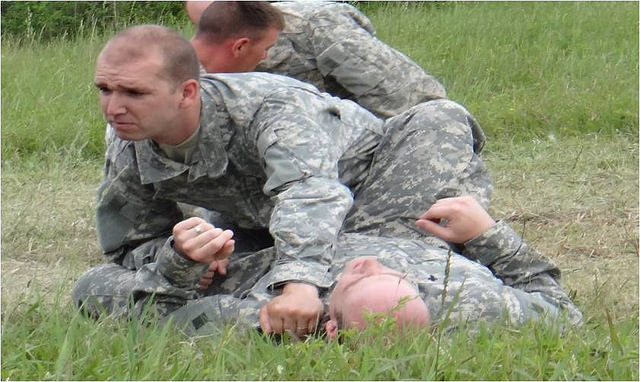
Spc. Brian Church practices a combatives move during annual training at Hidden Valley Training Center in Powell County, Ky., May 2014. (Photo courtesy of 201st Engineer Battalion)
Barger said the continued mission of the engineers in Eastern Kentucky to ensure they are ready for any response locally or nationally.
“The 201st has proven its worth in many local & national emergency response missions to include the West Liberty storm damage, Hurricane Katrina, and many other emergency response missions,” he said. “These projects have increased engineer experience with all manner of vertical & horizontal maintenance & construction, and increased our readiness to provide proficient engineer troop construction capabilities when called to support disaster & emergency response missions in our communities, the commonwealth, and region.”
Photos by Sgt. Shanna Rice, 2123rd Transportation Company
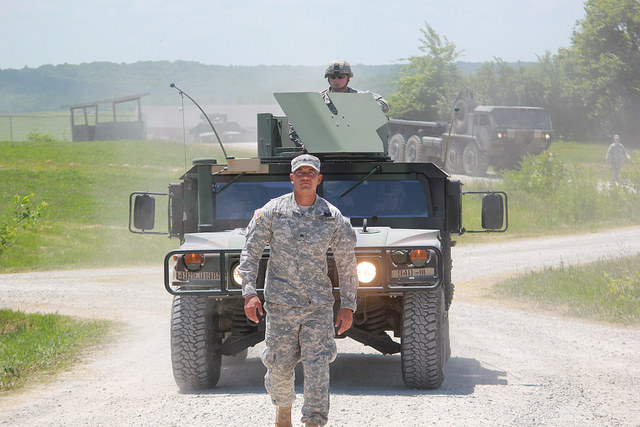
Sgt. Terrell Turner with the 2123rd Transportation Company ground guides a scout vehicle back in a training area after an exercise at Camp Atterbury, Ind. (U.S. Army National Guard photo by Sgt. Shanna Rice)
CAMP ATTERBURY, Ind. — Soldiers of the Kentucky Guard’s 2123rd Transportation Company conducted the unit annual training at Camp Atterbury Joint Maneuver Training Center May 27 - June 11, 2014. Driving in more than 25 company vehicles, the Richmond, Kentucky-based unit also continued its recycling work of transporting recycled materials from Bluegrass Army Depot in Richmond to a recycling center in Bedford, Indiana.
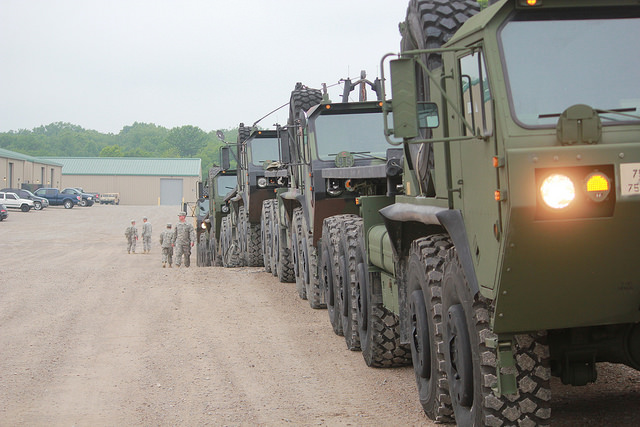
Soldiers of the 2123rd Transportation Company prepare for convoy operations during annual training at Camp Atterbury, Ind. (U.S. Army National Guard photo by Sgt. Shanna Rice)
First Sgt. Allen Christie said the combination of a real-world mission and quality training at Camp Atterbury made for a beneficial AT for the unit as a whole.
“The mission allowed our Soldiers to drive more than 20,000 collective miles and haul more than 70,000 pounds of cargo. Missions like these give them the opportunity to gain valuable experience in piloting these large vehicles.”
“I’m extremely proud of our Soldiers. We had lots of new faces and Soldiers in leadership roles for the first time, and we came out a better-trained and more cohesive unit.”
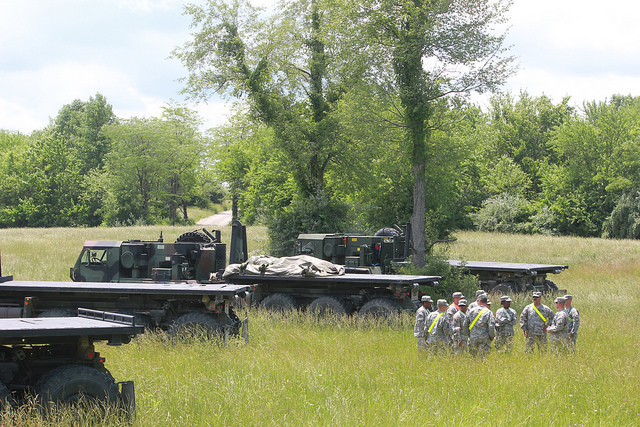
Soldiers with the 2123rd Transportation Company gather for convoy instruction during a short halt on a training mission during the unit’s annual training at Camp Atterbury, Ind. (U.S. Army National Guard photo by Sgt. Shanna Rice)
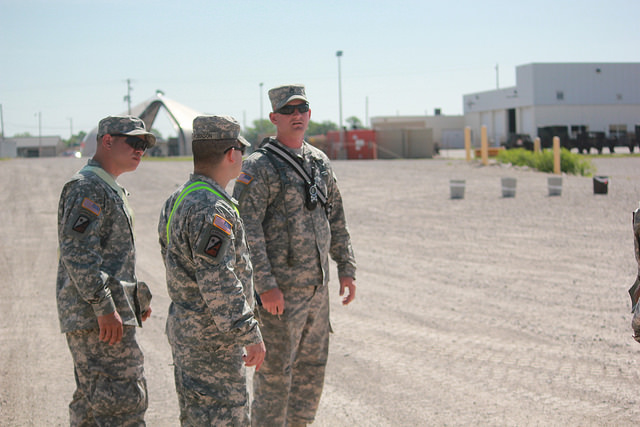
(L-R) Charles Scroggins, Spc. Cole Robinson, and Staff Sgt. Jarred Turner observe basic driver’s training during the 2123rd Transportation Company annual training at Camp Atterbury, Ind. (U.S. Army National Guard photo by Sgt. Shanna Rice)
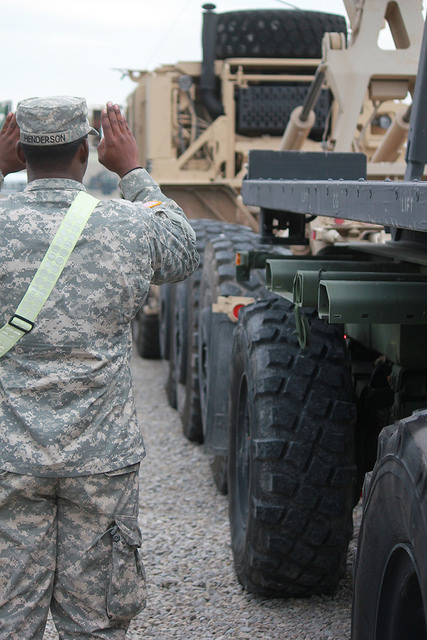
Pfc. Darrell Henderson gives clear hand and arm signals to his driver during driver’s training at Camp Atterbury, Ind. (U.S. Army National Guard photo by Sgt. Shanna Rice)
Story by Capt. Gustave LaFontaine, 133rd Mobile Public Affairs Detachment
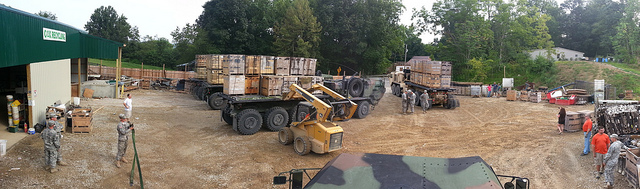
Soldiers of the 2123rd Transportation Company unload recycling materials from their trucks as part of the unit’s annual training in Irvine, Ky., Aug.7, 2013. The unit convoyed more than 60,000 miles during their missions and successfully transported more than 675 tons of recyclables in Kentucky and Indiana. (U.S. Army National Guard photo by 2nd Lt. Carson Gregory)
RICHMOND, Ky. — Train as you fight! This is a common battle cry among Citizen Soldiers as they hone their skills as a Soldier. It is used to inspire and motivate Soldiers to approach their training with the same focus that they would approach a real-world mission. And creative leaders find ways to make training as realistic as possible for the benefit of their units.
The leadership of the Kentucky Guard’s 2123rd Transportation Company discovered a way to train their Soldiers and also make a genuine contribution to the community.
To see more photos from this story, click here.
Richmond, Ky. is home to the 2123rd and also the Bluegrass Army Depot. The Depot’s Qualified Recycling Program diverts recyclable waste from the site to various recycling facilities in the region. For two years, the 2123rd has used their annual training to assist the Depot and their recycling efforts.
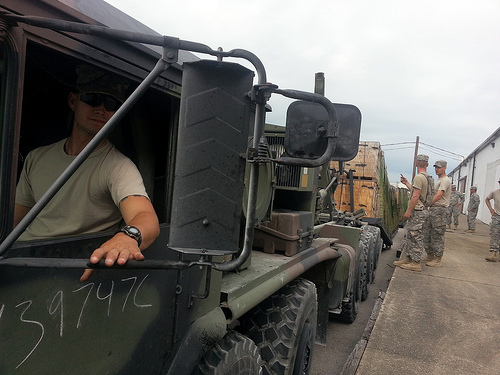
Soldiers of the 2123rd Transportation Company prepare to unload their trucks of recyclable materials in Irvine, Ky., Aug. 6, 2013. The unit transported the materials from Bluegrass Army Depot to local recycling facilities as part of their annual training. (U.S. Army National Guard photo by 2nd Lt. Carson Gregory)
Capt. Nelson Anglin has commanded the 2123rd during both of these missions. He outlined the impact this mission had on the community and his Soldiers.
“As a result of this partnership, our Soldiers have convoyed more than 60,000 miles and transported almost 2 millions pounds of recyclables to nearby recycling facilities.”
The training is especially valuable for 2123rd because they have a large number of new Soldiers. According to Anglin, 60 percent of the company is completing their first annual training with the unit. The 2123rd readiness NCO, Sgt. 1st Class Chad Bailey, said the training has been invaluable for their new Soldiers.
“The new Soldiers in the unit got a look into what a Citizen Soldier is. They got to see what the Guard does for the community.”
In addition to performing a great service for the community, Soldiers got to train in a real-world mission.
“Not only did they get to a lot of drive time but they received experience in strap down procedures on different types of materials,” said Bailey.
“Our Soldiers were motivated and eager to experience realistic training. It was important for our new Soldiers to identify their role and how their mission supported the overall mission of the 2123rd Transportation Company,” said Anglin.
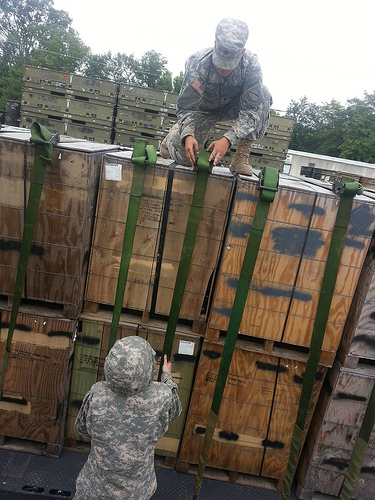
Soldiers of the 2123rd Transportation Company secure load straps on their trucks in Irvine, Ky., Aug. 6, 2013. Missions during the unit’s annual training provided on-the-job training and real-world experience for the Soldiers. (U.S. Army National Guard photo by 2nd Lt. Carson Gregory)
To execute this mission, Soldiers completed two convoys per day to recycling centers in Bedford, Ind. and Irvine, Ky. Their efforts have been a valuable service to the Bluegrass Army Depot and the United States Army. Typically, recyclables are sent from the Depot via commercial transport at a significant cost to the Army. With the assistance of the 2123rd, the Bluegrass Army Depot was able to cut costs by more than $50,000 and divert funding back to the Depot and the Army.
Jason Brandenburg is in charge of the Depot’s Qualified Recycling Program and was impressed with the actions and motivation of the Soldiers of the 2123rd.
“When the crops hit the ground the Soldiers were loading, strapping and getting stuff done,” he said. “Everyone was on a mission and they just took care of it.”
With the success of the past two years behind them, Anglin indicated that there are plans to execute this mission again in years to come.
“With budget cuts and sequestration, training opportunities in the future are going to require creative training plans. The collaborative effort between the Bluegrass Army Depot and our unit is a win win for the Army.”
“Training as you fight proved to be a valuable experience for the 2123rd Transportation Company,” concluded Bailey. “It instilled some pride for them and their unit.”
NOTE: As often as we can kentuckyguard.com publishes stories by or about Kentucky National Guard unit public affairs historian representatives, also known as UPAHRs. This is an additional duty taken on by a Soldier or Airmen with the intent of telling their unit’s story. This is one such story ….
Story by Sgt. 1st Class Steven Baker, 202nd Unit Public Affairs Historian Representative
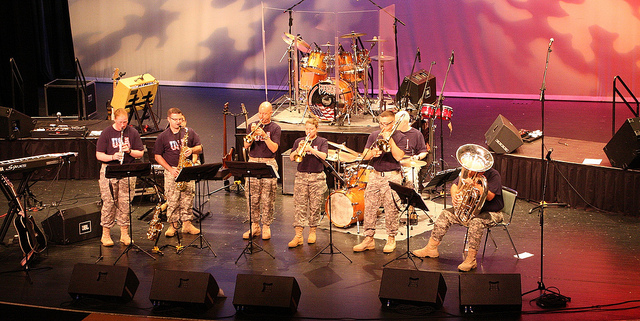
Soldiers of the 202nd Army Band perform as part of the unit’s annual training in Somerset, Ky., July 11, 2013. The unit spent their two-week training period performing a variety of concerts in south central Kentucky. (U.S. Army National Guard photo by Sgt. 1st Class Steven Baker)
SOMERSET, Ky. — The 202nd Army Band of the Kentucky National Guard has completed their Annual Training which was held from June 29 - July 13. The band was based out of Somerset, KY. and consisted of several performances and continual musical training for the various Musical Performance Teams (MPT).
The 202nd’s mission is to provide music throughout the spectrum of military operations to instill in our forces the will to fight and win, foster the support of our citizens, and to promote our national interests at home and abroad. While past ATs have taken the band around the country, like last year to Fort Eustis, Va., staying close to home was a nice change for members of the unit, including several new Soldiers on their first annual training.
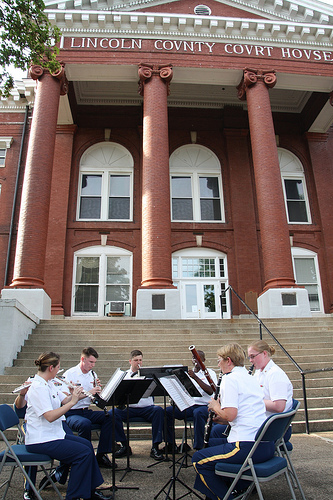
Members of the 202nd Army Band perform in front of the Lincoln County Courthouse in Stanford, Ky., July9, 2013. (U.S. Army National Guard photo by Sgt. 1st Class Steven Baker)
“The 2013 AT provided an opportunity to get to know all the members of the unit,” said Spc. Anthony Nolan. “I wholeheartedly believe that this is a phenomenal unit with a considerable amount of talent within.”
Spc. Ariel Supinger enjoyed her first AT, and said every member of the unit gave her a warm welcome. Supinger also had the opportunity to learn from other Soldiers who are in the musical field outside of uniform.
“Quite a few people in the unit are band directors which is what I am in college training to be so I get to hear a lot about it which is nice.” Supinger said.
“I always liked the idea of the military, but didn’t know they had a MOS that I would be happy in until I heard about the band. The unit plays because it’s something they love to do.”
“My experience at this year’s AT was very positive,” said Spc. Catherine Strobel. “It was refreshing to be able to eliminate a lot of distractions and to focus on making music.”
“I am encouraged and inspired by the level of accountability and camaraderie we share and feel privileged to be apart of such a special group.”
The band’s current Musical Performance Teams are:
The musical mission performances consisted of:
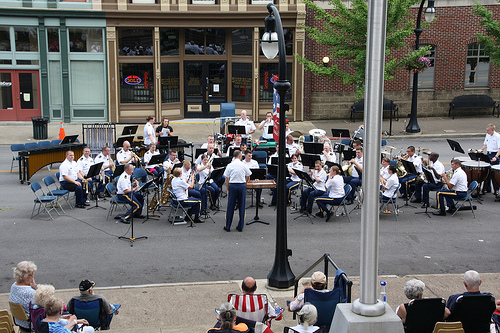
Soldiers of the 202nd Army Band perform as part of the unit’s annual training in Stanford, Ky., July 9, 2013. (U.S. Army National Guard photo by Sgt. 1st Class Steven Baker)
“Every performance by the full band was filled with artistic integrity, dedication to our art form and a desire to please our audiences,” said Nolan.
The 202nd’s leadership found the two weeks to be a successful test for the unit to find new ways of performing their jobs and operating as Soldiers.
“I felt the unit cooperated well when given challenging circumstances and leadership opportunities,” said 1st Sgt. Chris Gillstrap. “I wanted to share a lot more knowledge with the Soldiers but found that time was a larger obstacle than expected. I feel that the band is steadily changing their focus to developing innovative ways to entertain their audience. Overall, annual training was an enjoyable opportunity to plant new ideas and develop a legacy for current and future Soldiers.”
The 202nd Army Band is actively recruiting now and looking for a trombone, euphonium, saxophone and keyboard players. It’s a great opportunity for a young person to serve their country, get world class training, have college tuition covered and play music.
For additional information please contact Sgt. 1st Class Angela Wilkins at 502-607-5331.
NOTE: As often as we can, kentuckyguard.com publishes stories by Kentucky National Guard unit public affairs historian representatives, also known as UPAHRs. This is an additional duty taken on by a Soldier or Airmen with the intent of telling their unit’s story. This is one such story ….
Story by Spc. Vincent Willingham, 149th BSB Unit Public Affairs Historian Representative
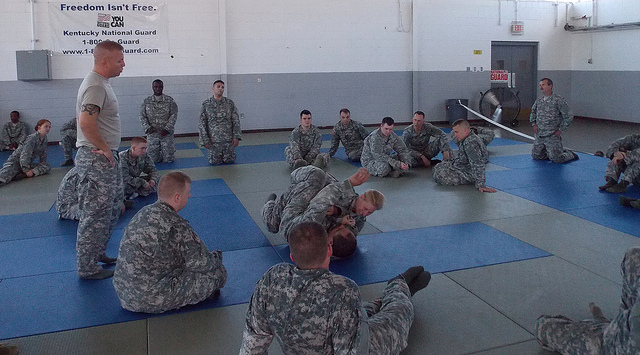
Sgt. 1st Class Amy Parker demonstrates a combatives move as other members of HHC, 149th BSB look on during Restorative Physical Training Saturday, June 29 2013, in Bowling Green, Ky. Soldiers conduct RPT, part of the Modern Army Combatives Program, in order to improve overall physical readiness and to prepare for additional instruction during Annual Training. (U.S. Army National Guard photo by Spc. Vincent Wilingham)
BOWLING GREEN, Ky. — Members of the Headquarters and Headquarters Company (HHC), 149th Brigade Support Battalion conducted Restorative Physical Training (RPT) June 29th, 2013, at the National Guard Armory in Bowling Green, Ky. Staff Sgt. Kevin Borders, HHC Readiness NCO, led the PT session Saturday morning.
“The Modern Army Combatives Training Program (MACP), or simply combatives, involves strength, conditioning, stretching, and flexibility to a degree that can cause injury with improper training. RPT is a series of conditioning drills designed to greatly reduce the chance of injury,” said Borders.
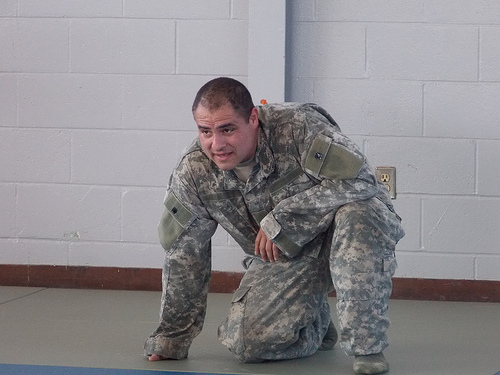
Staff Sgt. James Davis catches his breath during a break from Restorative Physical Training Saturday, June 29 2013, in Bowling Green, Ky. Soldiers conduct RPT, part of the Modern Army Combatives Program, in order to improve overall physical readiness and to prepare for additional instruction during Annual Training. (U.S. Army National Guard photo by Spc. Vincent Willingham)
Beginning at 8 AM, Soldiers conducted a series of stretching exercises to loosen up. The stretches were followed by an intense, nearly two our physical training session designed to toughen the body and mind. Physically exhausted, but better prepared for situations involving hand to hand combat, the Soldiers were released to get cleaned up and to prepare for the rest of the training day.
Combatives training is an intensive, hands-on experience that will instill confidence in Soldiers and greatly improve the desired level of physical fitness Soldiers are expected to maintain. Borders believes that Combatives training is important because it is used to instill the Warrior Ethos in all Soldiers.
“Combatives allows Soldiers to close the distance, gain a dominant position, and finish the fight,” he said.
Story and photos by Sgt. 1st Class Steven Baker, 202nd Band Unit Public Affairs Historian Representative
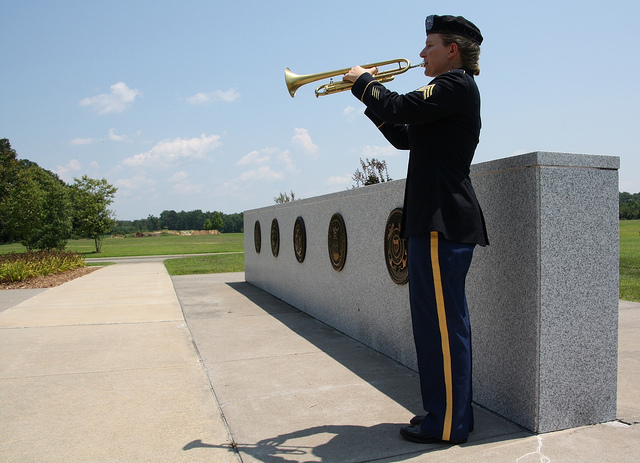
Sgt. Jennifer Bowling plays taps during a ceremony at Fort Eustis, Va., July 2012. (Kentucky National Guard photo by Sgt. 1st Class Steve Baker)
NOTE: Each week kentuckyguard.com publishes stories by or about Kentucky National Guard unit public affairs historian representatives, also known as UPAHRs. This is an additional duty taken on by a Soldier or Airmen with the intent of telling their unit’s story. This is one such story ….
FORT EUSTIS, Va. — Army band mission statement - The mission of Army bands is to provide music throughout the spectrum of military operations to instill in our forces the will to fight and win, foster the support of our citizens, and to promote our national interests at home and abroad.
The 202nd Army Band did just that this summer during their annual training at Fort Eustis, Va.
“Annual Training at Ft. Eustis demonstrated the 202nd Army Band’s ability to backfill for one of America’s outstanding military musical units, the TRADOC band,” said 1st Sgt. James Wallace. “Our soldiers performed every mission required in an exemplary manner and excelled in their Mobilization Readiness Evaluation. Great training. Great troops.”
The purpose of the training was to focus on back-filling the TRADOC (Training and Doctrine Command) Band while fellow musician soldiers of that unit were on block leave. This mission is not only a requirement for National Guard bands but allows the unit to train for continual support of the regular Army bands in the event of deployment or need.
To see more photos from the 202nd’s annual training, click here
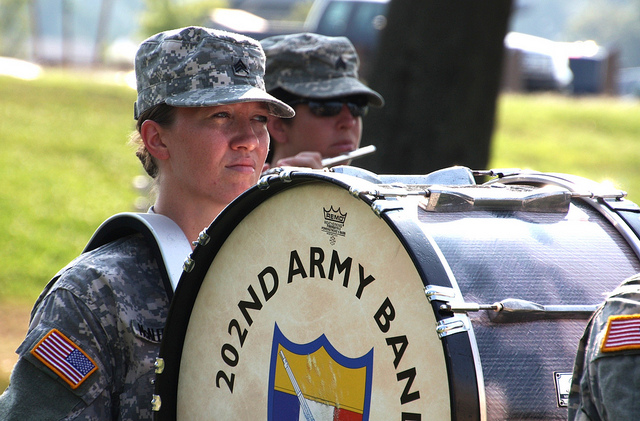
Sgt. Emily McAleeseJergins prepares for rehearsal during annual training in Fort Eustis, Va., July, 2012. (Kentucky National Guard photo by Sgt. 1st Class Steve Baker)
Sgt. Jennifer Bowling, a trumpet player, has had the opportunity to not only perform with the concert band, ceremonial band, Dixieland and brass MPTs but has performed as the bugler for military funerals.”Taps honors members of the Armed Forces in a way words can’t express,” said Bowling. “As the great granddaughter of an Army trumpet player, performing taps for military funerals holds special meaning for me because it allows me to give honors to the men and women who served as he did.”
Scheduled missions and events included: lunchtime “Bach’s lunch” performances by the woodwind quintet; Jazz Combo and Dixieland band performances for a command reception; two Thursday evening performances, one by the Rock Band “Fallout” and one by concert band at the “Music Under the Stars” concert series held in Magnolia Park. Additionally, the 202nd provided marching performances for two Change of Command ceremonies with inspections of the troops.
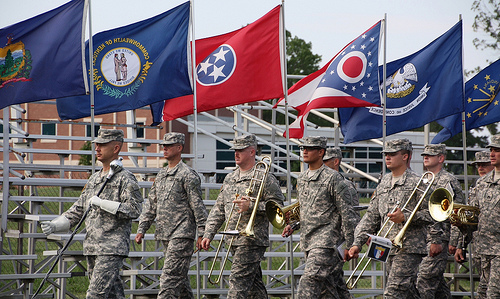
The 202nd Band marches during a Change of Command ceremony at Fort Eustis, Va., July 20, 2012. (Kentucky National Guard photo by Sgt. 1st Class Steve Baker)
“As a member of the 202nd Army Band with 14 years of service, I have had the opportunity to play taps many times and I feel fortunate to be able to contribute in a special way that honors our soldiers.”Chief Warrant Officer 4 Greg Stepp, Commander of the 202nd, said the annual training was but another chance for the unit to showcase their talents and continue to excel as a group and for individual members to grow as musicians and as Soldiers.
“As the 202nd moves through personnel transitions, the opportunity to develop new leaders in a real world training environment was invaluable, he said. “New challenges were provided for soldiers to develop their leadership abilities and musical abilities while providing musical support for Ft. Eustis and TRADOC.”
“The opportunity to support TRADOC in their public outreach mission is of great significance, said Stepp. “The 202nd again established themselves as mission capable earning all “T’s” (Trained) during their EXEVAL at Ft. Eustis.”
The 202nd is actively recruiting and looking for trombonists, euphonium, French horn, oboe and keyboard performers. It’s a great opportunity for a young person to serve his or her country, get world-class training and have college costs covered.
For additional information about the 202nd Army Band please contact Sgt. 1st Class Angela Wilkins at 502-607-5331.