
Pages
Stay In Touch
More
© 2013 KentuckyGuard
Story by Capt. Desiree Dillehay, 206th Engineer Battalion
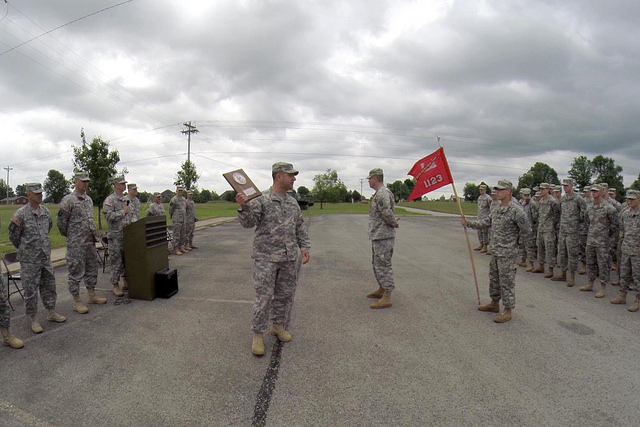
Capt. Robert McWhorter, former commander of the 1123rd Engineer Company, compliments Soldiers of the unit during their annual training at Camp Atterbury, Ind. June 25, 2015. The unit was named the best engineer company in the Army National Guard for 2014, earning them the Itschner Award. (U.S. Army National Guard photo by SGt. Sandra Fariss)
FRANKFORT, Ky. — The Kentucky National Guard’s 1123rd Sapper Company was named Most Outstanding Engineer Company of the Year for 2014.
The Itschner Plaque is an award given to the most outstanding engineer company each year. First awarded in 1960, the award is named in honor of Army Lt. Gen. Emerson C. Itschner. In 1974, the competition for the Itschner Award was broadened to include the Army National Guard and the Army Reserve.
With hard work and dedication to the mission, to the 206th Engineer Battalion, the 149th Maneuver Enhancement Brigade, and to the Kentucky Army National Guard, the 1123rd received the Itschner Award for the fiscal training year 2014.
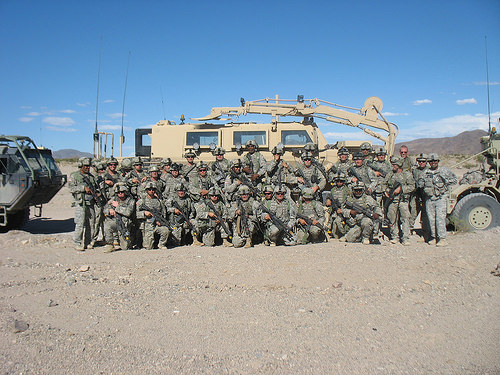
Soldiers of the 112rd Engineer Company gather for a group photo at the National Training Center in Fort Irwin, Calif., Aug. 21, 2014. The three-week rotation at NTC was the culminating event of a hard year of training for the unit. (Photo courtesy of the 1123rd Engineer Co.)
The level of proficiency that this company achieved during the evaluated period has inspired the unit’s leadership, who said the award serves as a testament to the Soldiers’ unwavering motivation, dedication to their unit, and their ability to learn, adapt and overcome any obstacle. Given the many hurdles National Guard units inherently face with training continuity between drill weekends, this unit’s Non Commissioned Officers and Officers are exceptionally outstanding.
“Winning the Itschner Award speaks of the caliber of Soldiers within the 1123rd Sapper,” said Lt. Col. James Richmond, commander of the 206th Engineer Battalion. “The unit is only eight years old and to have achieved superior achievements in strength, training, and performance in such a short time and against such a complex mission set is simply incredible.”
Richmond also added that few know what Sappers are in the military. “He is the Swiss Army Knife of Soldiers, in essence an infantryman who specializes in laying or clearing minefields,
demolitions, field defenses and general construction, as well as road and airfield construction and repair.”
Click here for more photos of the 1123rd.
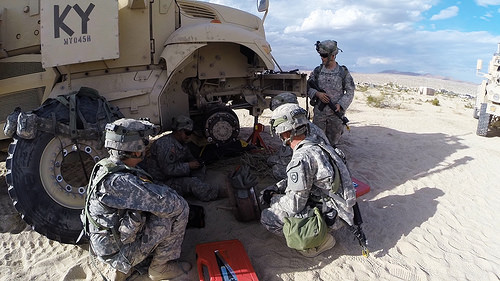
Engineers with the 1123rd Sapper Company change a tire on an armored vehicle during a training exercise at Fort Irwin, Calif., Aug. 15, 2014. The unit’s hard work at NTC earned them respect from a variety of training supervisors and Reserve and active duty units. (Photo courtesy of 1123rd Engineer Co.)
For the 1123rd, a 20 day rotation at the National Training Center in Fort Irwin, California was the culmination of a rigorous six month journey. Originally, the 1123rd was considered to serve as a component of the Opposing Force (OPFOR), but the focus shifted and the Sappers had an opportunity to serve as a Brigade Special Troops Battalion (BSTB) enabler in order to perform route clearance missions. This assignment required a dramatic change in the unit’s task organization, moving from three Sapper platoons and a headquarters platoon to two Route Clearance Packages, one Company Intelligence Support Team and a headquarters platoon. The 1123rd had 14 training days from March to July to prepare for NTC. The pace of training became very intense and success hinged on detailed planning, commitment to excellence and, most importantly, leveraging the knowledge of experienced route clearance personnel to increase training efficiencies without compromising quality.
The Sappers executed their strenuous training plan and completed the NTC rotation with remarkable results. Competence, adaptability and readiness for any mission was proudly displayed throughout the exercise. The 1123rd received accolades from a variety of training supervisors and both reserve and active duty counterparts. The predominant theme conveyed during the course of training was the unit’s willingness and desire to learn and better themselves. A high level of motivation and a productive and professional culture was demonstrated to every Soldier in the company.
The 1123rd was given professional development and networking opportunities that would not have been available without a rotation at NTC. These opportunities allowed the 1123rd leadership to collaborate with their active duty counterparts and higher headquarters in order to establish the unit’s relevance and credibility. This paid dividends as the 1123rd maintained an active voice in their utilization and had the opportunity to contribute to missions for the battalion in addition to route clearance.
The 1123rd has gained an incredible amount of experience this year and is fully prepared to carry out its engineer mission, only now with the title of “the best.”
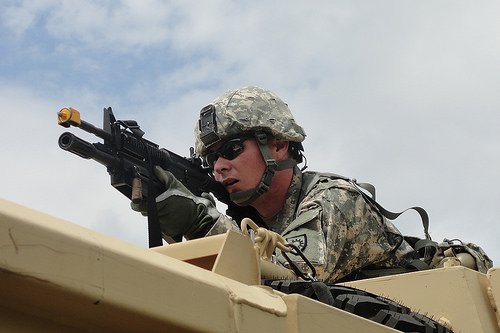
A Soldier with the 1123rd Engineer Company takes up a defensive position during a training exercise at Camp Atterbury, Ind., June 21, 2015. (U.S. Army National Guard photo by Spc. Brooklynd Decker)
“The Soldiers are truly honored to receive this award,” said Sgt. 1st Class Thomas Elmore, readiness NCO for the 1123rd. “This unit went from standing up the 1123rd in 2009 to the best National Guard engineer unit in the country in 2014. Don’t know how else to put it except they are proud to be the BEST.”
However, the 1123rd Sapper Company is not just an operational machine. In addition to their rigorous training schedules, they incorporated time to give back to their community. The 1123rd is broken into two armories located in Leitchfield and Marion, Kentucky. Both locations have long been and continue to be involved with their respective communities. During the 2014 training year the two armories actively contributed to several community events, either during scheduled drill or by Soldiers volunteering outside of normal duty periods. The 1123rd participated by marching in the Christmas and Labor Day parades, provided speakers and representatives to three Veterans’ Day events and a Memorial Day ceremony. Additionally, they collaborated with the local American Legion for military funeral honors for veterans upon their family’s request.
“The level of proficiency that this company has achieved during the evaluated period is truly remarkable and serves as a testament to their unwavering motivation, dedication to their unit and their ability to learn, adapt and overcome any obstacle through Unbridled Service,” said Elmore.
The Soldiers of the 1123rd are revered throughout the 206th Engineer Battalion for always maintaining a high level of motivation in any training environment and with every mission; this training year they have raised the bar. Engrained into this company is a true sense of ownership and pride, where each Soldier maintains a stake in its success and proactively works to improve the unit.
Story by Sgt. Brandy Mort, 133rd Mobile Public Affairs Detachment
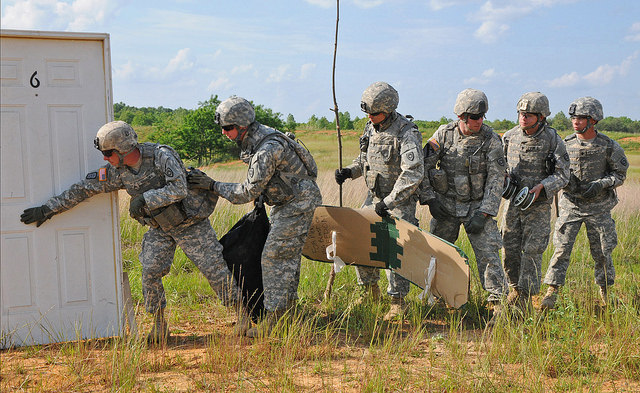
Soldiers of the 577th Sapper Company inspect a mobile door frame before attaching a silhouette charge during demolition training at Fort Knox, Ky., May 15, 2015. A silhouette charge provides a hole in a door so Soldiers can gain access into a building. (U.S. Army National Guard photo by Sgt. Brandy Mort)
FORT KNOX, Ky. – The terrain rumbled as pieces of a wooden door shot out in every direction. From the looks of the scene, you’d think a tornado had ravaged the area. Instead, it was a silhouette charge the 577th Sapper Company had attached during their demolition training.
Soldiers of the 201st Engineer Battalion, 577th Sapper Company, participated in standard demolition training at Fort Knox,Kentucky, May 15-16.
Capt. James Schmitz, 577th Sapper commander, said Sapper teams are essential for troops to advance through breached obstacles, such as a collapsed building, safely. He said this training helped when they deployed to Afghanistan in 2009.
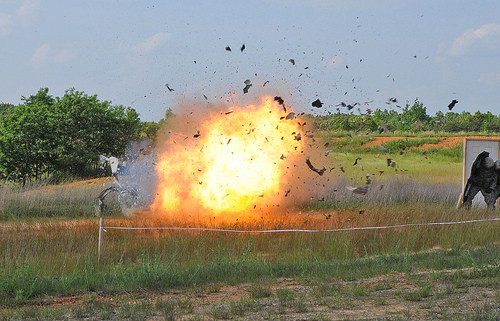
Soldiers of the 577th Sapper Company take cover during demolition training at Fort Knox, Ky., May 15-16, 2015. A C-4 charge blast takes 1.34 seconds after detonation. (U.S. Army National Guard photo by Sgt. Brandy Mort)
“Proper demolition training is very essential,” said Schmitz. “It is vital to get it right before we are tasked to do it in the future, whether it’s for our training exercise in Louisiana or a future deployment. We need to do it right, here, so we can do it right, there.”
Sgt. John Howard, Sapper non-commissioned officer, has 10 years experience in the engineers. It’s that experience, he said, that keeps the unit proficient. He said, each year leadership uses lessons learned to improve the training.
“When I was new I got vital training during this time and I use things I have learned through the years as I teach other junior enlisted to do the same,” he said.
Click here for more photos.
Traditionally Sappers are combat engineers who advance with the front-line infantry and are some of the first people sent to assess damages caused. Howard said training the younger Soldiers in their craft is similar to the role of the combat engineer sweeping the battlefield; they make sure the path is safe and clear before others go through.
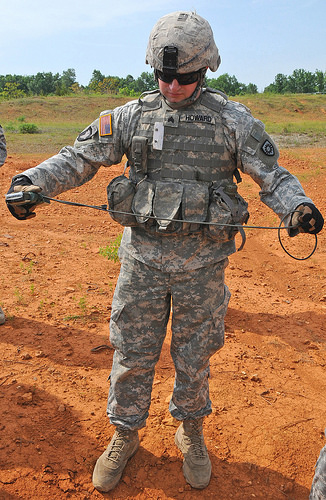
Sgt. John Howard, combat engineer with the 577th Sapper Company, unravels a C-4 charge during demolition training at Fort Knox, Ky., May 15-16, 2015. This year is Howard’s 10-year anniversary with the Kentucky National Guard’s 577th Sapper Company. (U.S. Army National Guard photo by Sgt. Brandy Mort)
“As a Sapper, we are the first people sent into the building to ensure the foundation is stable,” said Howard. “I use the same method as a platoon sergeant. If I don’t tell them the proper information, they won’t be able to be a strong foundation for their legacy.”
Staff Sgt. Aleksandr Vinogradov, a combat engineer, agrees that good leaders start from the beginning of their career.
“New Soldiers to the unit are like sponges,” said Vinogradov. “They will absorb anything you teach them. It is important to set a good example and train them the correct. We need to train for the future, not for the present.”
The team trained in various types of C-4 charges: A simulation charge, shape charges, Bangalore charges, urban breaching and mine clearing, also known as, MCLC. During urban breaching, they learned about linear door charges and silhouette charges. Sappers use what they learn in these scenarios for reforming the terrain for new structures, or to demolish existing structures.
“During urban breaching, we are able to see that different charges do different things,” said Howard. “A linear door charge will split a door in half, while a silhouette charge will create a hole in the door big enough for a person to walk through. If we don’t use the correct one in a non-training environment, we may be in trouble.”
Schmidtz said that safety and proficiency are two very important topics he focuses on at all times.
“My goal is to have everyone perform proficiently at their tasks and, most importantly, practice proper safety at all times. I have no doubt that my Soldiers will succeed in both aspects, whether in training exercises or in real-world scenarios.”
The Sapper Company is participating in this training in preparation for their annual training at the Joint Readiness Training Center in Fort Polk, Louisiana.
Photos by Staff Sgt. Scott Raymond, Kentucky National Guard Public Affairs Office
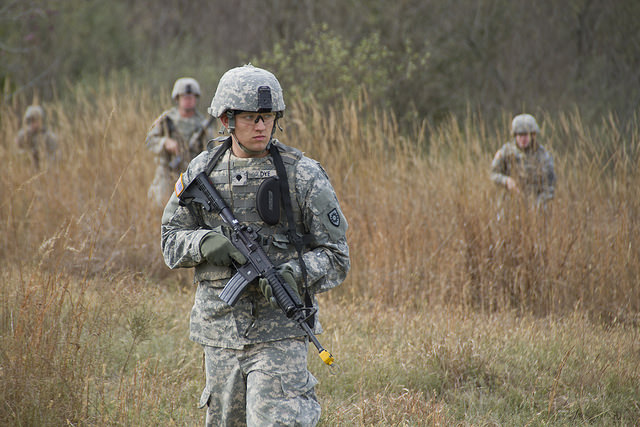
Spc. Cody Dye with the 201st Forward Support Company leads his platoon through a training exercise at the Wendell H. Ford Regional Training Center in Greenville, Ky., Nov. 4, 2014. (U.S. Army National Guard photo by Staff Sgt. Scott Raymond)
GREENVILLE, Ky. — Soldiers of the 201st Engineer Battalion extended a drill weekend to a whole week of training at the Wendell H. Ford Regional Training Center in Greenville, Nov. 1-7, 2014.
In order to focus the rest of the year on collective training events and engineering projects, the battalion travelled to Greenville to knock out annual requirements for Soldiers all in one period. According to Capt. Jonathan Gensley, Administration Officer for the battalion, the schedule not only benefits the units’ training, but the Soldiers’ personal lives as well.
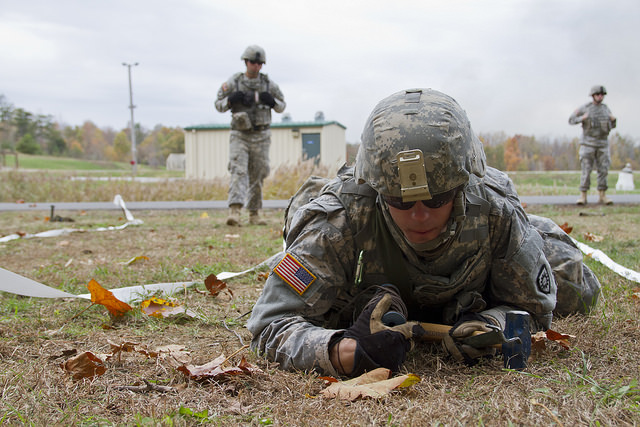
Pfc. Matthew Clay with the 577th Sapper Company low crawls to place a M18A1 Claymore mine during training at the Wendell H. Ford Regional Training Center in Greenville, Ky., Nov. 4, 2014. (U.S. Army National Guard photo by Staff Sgt. Scott Raymond)
“This extended drill allows Soldiers time off during major family-focused months of the year,” he said. “Consolidating several training events this week, we don’t drill in December, giving Soldiers more time off to be with their families during the holidays, nor do we drill in June, allowing time off for family summer vacations.”
Soldiers complete a wide variety of annual tasks, including their physical fitness test, personal health assessments and individual weapon qualifications. The week is also a chance to re-evaluate Soldiers in the required Army Warrior Tasks. Every Guardsman is expected to know the basics of Soldiering, and annually they are reminded of the tasks that may fall outside their military job.
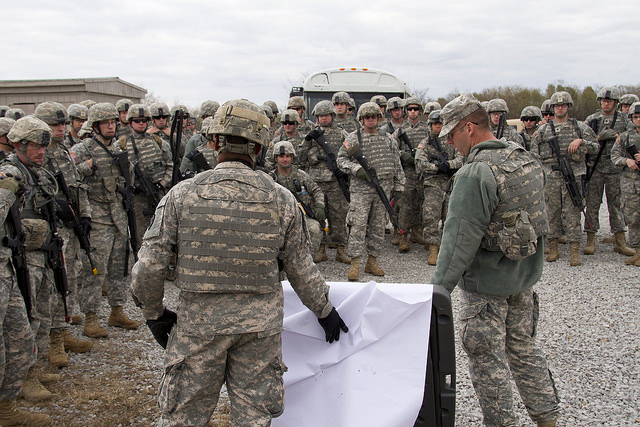
Soldiers of the 201st Engineer Battalion receive instruction on training exercises at the Wendell H. Ford Regional Training Center in Greenville, Ky., Nov. 4, 2014. (U.S. Army National Guard photo by Staff Sgt. Scott Raymond)
The 201st is made up of units spread out from from Ashland, Kentucky where it is headquartered, to Hazard, Kentucky and Cynthiana, Kentucky. With such a wide reach of units, the collective drill is a unique one for the battalion.
“This is the second year we have done this and simply, this long drill postures the 201st for success throughout the remainder of the year,” said Gensley.
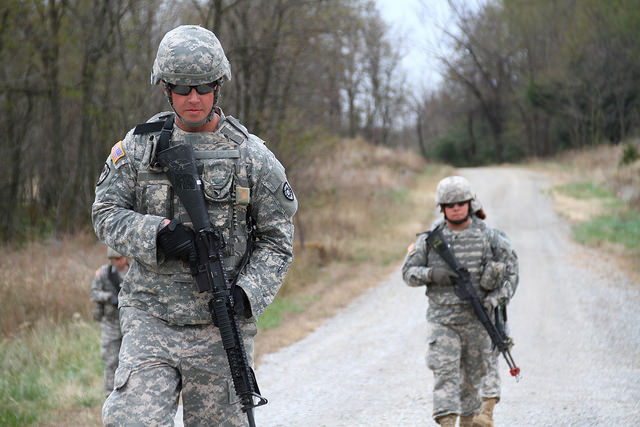
Soldiers with the 201st Engineer Battalion move through a training exercise at the Wendell H. Ford Regional Training Center in Greenville, Ky., Nov. 4, 2014. (U.S. Army National Guard photo by Staff Sgt. Scott Raymond)
For the engineers and the historical use of the battalion, little is unique to the Soldiers of the unit. Land navigation, security patrols and M18A1 Claymore training filled the Soldiers’ busy week.
Maj. John Barger, executive officer for the battalion said the Soldiers face long days during the week, but realize the benefits of their hard work. One important benefit Barger sees is the
“There’s such good interaction amongst the leadership of the unit, from the battalion commander to senior NCOs of subordinate units,” he said. “Its a rare opportunity for a mutual understanding of the commander’s intent and to foster quality leaders for the battalion’s future.”
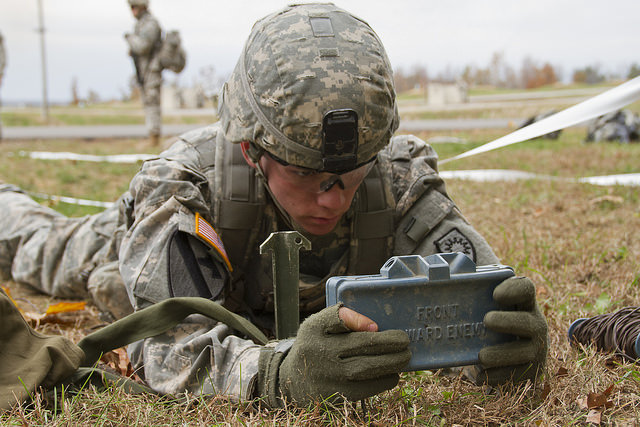
Spc. Jonathan Benham with the 577th Sapper Company places a M18A1 Claymore mine during training at the Wendell H. Ford Regional Training Center in Greenville, Ky., Nov. 4, 2014. (U.S. Army National Guard photo by Staff Sgt. Scott Raymond)
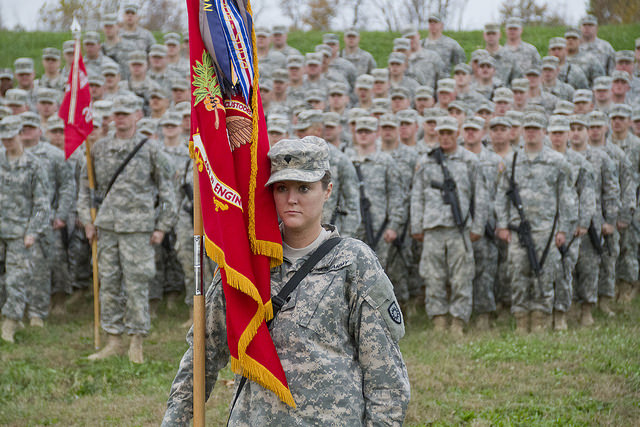
Spc. Caitlin Viera with the 201st Engineer Battalion holds the battalion colors during a formation at the Wendell H. Ford Regional Training Center in Greenville, Ky., Nov. 4, 2014. (U.S. Army National Guard photo by Staff Sgt. Scott Raymond)
Story by Staff Sgt. Scott Raymond, Kentucky National Guard Public Affairs
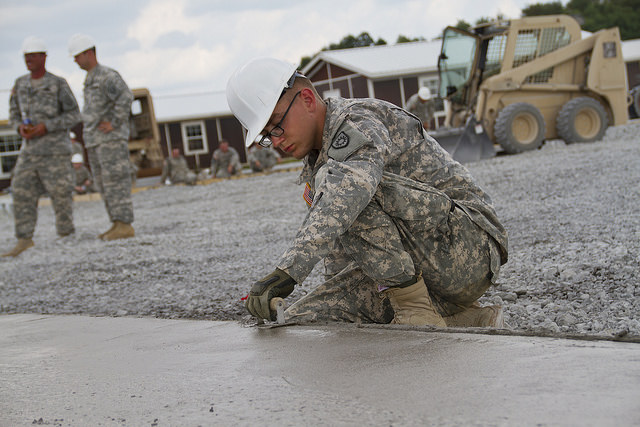
Spc. Aaron Elliott with the 149th Vertical Construction Company smoothes the edge of a freshly poured concrete slab at the Wendell H. Ford Regional Training Center in Greenville, Ky., July 22, 2014. (U.S. Army National Guard photo by Staff Sgt. Scott Raymond)
GREENVILLE, Ky. — A year ago, Soldiers of the 149th Vertical Construction Company called Bagram, Afghanistan home. The engineers spent nearly a year deployed in support of Operation Enduring Freedom helping to teach Afghans how to rebuild their country.
Since their arrival back in the commonwealth this past December, the 149th has taken the methodical steps to reintegrate back into typical Guard life. With that in mind, leadership of the unit decided they would offer the first annual training period as a volunteer only option. They didn’t have to, but 70 Soldiers said yes and donned their ACUs and travelled to the Wendell H. Ford Regional Training Center in Greenville, July 12-26.
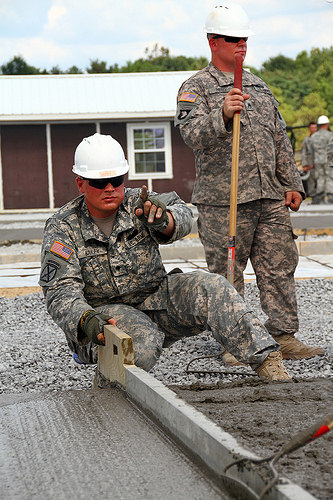
Spc. Adam Bailey works to smooth freshly poured concrete with a screen board during a construction project at the Wendell H. Ford Regional Training Center in Greenville, Ky., July 22, 2014. (U.S. Army National Guard photo by Staff Sgt. Scott Raymond)
“This sure beats Afghanistan,” said Spc. Adam Bailey. “We are doing some of the same things here we did over there, but it sure feels good to be in Kentucky.”
Bailey and other Soldiers were back in familiar territory at the training site as well. The 149th has been primarily responsible for the construction of the training site’s new Contingency Operation Location (COL). Over the years, the unit has constructed buildings, ran plumbing and wired electric to the training area. According to the project officer in charge, Chief Warrant Officer Jacob Lewis, the goal for the annual training was for the Soldiers to make several enhancements to the COL including the pouring of new concrete tent pads.
“This mission was certainly an overall success,” said Lewis. “These Soldiers exceeded the expectations by far. They were given a construction task of eight pads, they completed 12, pouring more than 144 cubic yards of concrete.”
“For an all volunteer AT after coming back from a deployment, the turnout was extraordinary,” said Lewis. “Doing a mission like this after the variety of different ones we had over there is very relevant for us. The pace was fairly steady and at times very demanding both here and abroad, but as Citizen-Soldiers, that is our duty.”
The Guardsmen are scheduled to return to Greenville on several occasions this year for more improvements to the COL as well as to assist in other construction projects for the Kentucky Guard.
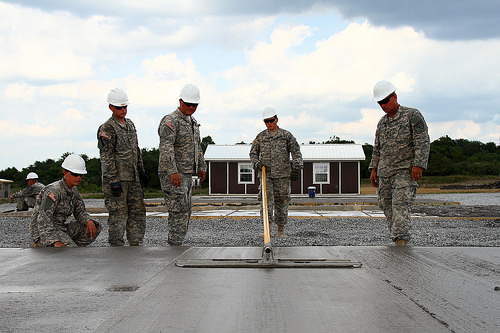
Pvt. Evan Bump is supervised using a bull float to smooth concrete during a construction project at the Wendell H. Ford Regional Training Center in Greenville, Ky., July 22, 2014. (U.S. Army National Guard photo by Staff Sgt. Scott Raymond)
Lewis said the unit worked extremely hard during the annual training and should be proud of the work they have continued. Moving forward, it seems to be the mutual agreement amongst the 149th that they are ready to transition back into a valuable and constant resource for the Guard and the commonwealth.
“This AT can be viewed as the newest chapter for us,” Lewis said. “We are engineers, we rise to the occasion and lead from the front.”
Staff Report, photos courtesy of 201st Engineer Battalion
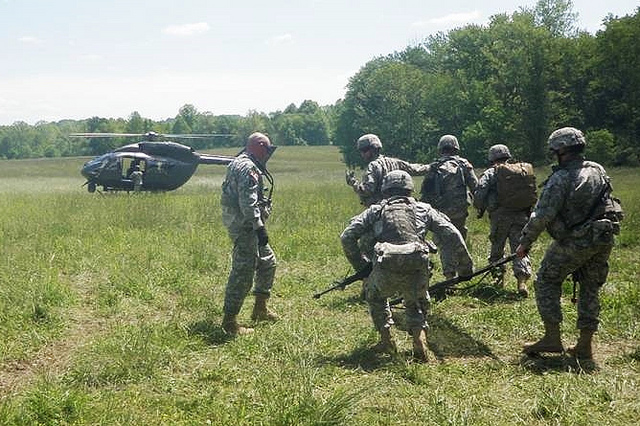
Soldiers of the 577th Sapper Company prepare to load a simulated casualty into a LUH-72 Lakota helicopter during annual training at the Harold L. Disney Training Center in Artemus, Ky., May 20, 2014. The engineer company is the Kentucky Guard’s primary emergency response force in extreme Eastern Kentucky. (Photo courtesy of 201st Engineer Battalion)
FRANKFORT, Ky. — Soldiers of the 201st Engineer Battalion were out in force for annual training this past May. More than 500 Guardsmen will have put their skills to the test at the conclusion of the training cycle in July. Across Eastern Kentucky, the engineers assembled to continue construction projects at Hidden Valley Training Site in Powell County, Kentucky and the Wendell H. Ford Regional Training Center out west in Greenville, Kentucky.
“The 201st is known as the Workhorse Battalion,” said Maj. John Barger, operations officer for the battalion. “We strive to conduct tough, realistic training in austere environments, and the 2014 training year has been no exception.”
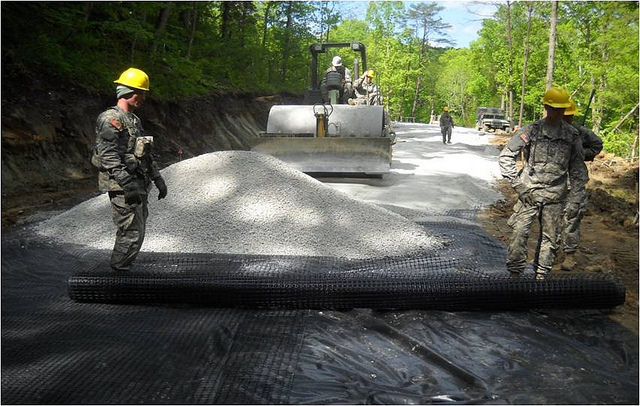
Soldiers of the 207th Horizontal Construction Company lay Geotextile Grid during road improvements at Hidden Valley Training Center in Powell County, Ky., May 2014. (Photo courtesy of 201st Engineer Battalion)
At Hidden Valley, road improvements were the primary tasks. Gravel was delivered by the 118th Haul Platoon and laid down by Soldiers with the 207th Horizontal Engineer Company. According to the units, this year’s work opened up hundreds of acres of the site to future training.
“We can’t give enough accolades to our Warhammer and Land Shark (207th and 118th) Soldiers,” said Staff Sgt. Adam Spencer, Training NCO, Det 1 207th and Squad Leader, 3rd Platoon, 207th. “They’ve worked so hard for the last two annual training periods on this road project…closing the loop on this road is one of the biggest successes achieved solely by our units.”
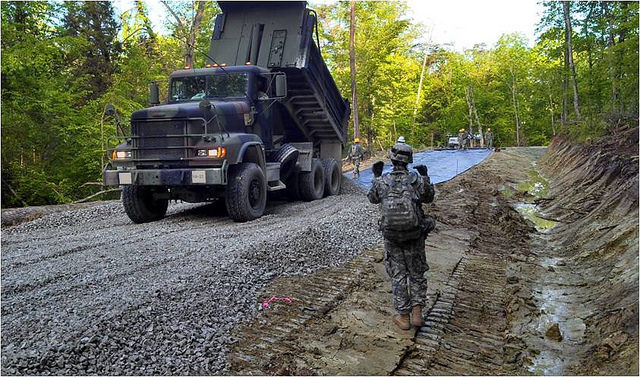
Soldiers with the 118th Haul Platoon unload gravel for road improvements at Hidden Valley Training Center in Powell County, Ky., May 22, 2014. (Photo courtesy of 201st Engineer Battalion)
In Southern Kentucky at the Harold L. Disney Training Site in Artemus, members of the 577th Sapper Company prepared for a scheduled three-week rotation at Fort Polk, Louisiana next year. The combat engineers conducted a variety of training exercises to improve their overall effectiveness as a unit.
“We have finally put it all together and working well as a team,” said Pvt. Gregory Bowen, a Soldiers new to the unit. “Our teamwork, communications, and even our marksmanship, all of it ties into one. It’s a lot of information to take in and it’s a lot of movements to bring together. It started off really slow, but by the end of it, we all finally came together as a team.”
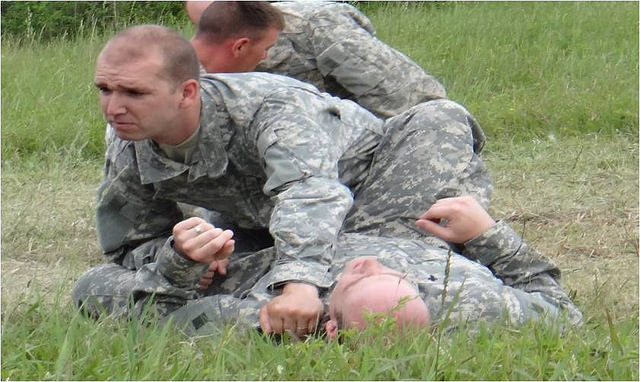
Spc. Brian Church practices a combatives move during annual training at Hidden Valley Training Center in Powell County, Ky., May 2014. (Photo courtesy of 201st Engineer Battalion)
Barger said the continued mission of the engineers in Eastern Kentucky to ensure they are ready for any response locally or nationally.
“The 201st has proven its worth in many local & national emergency response missions to include the West Liberty storm damage, Hurricane Katrina, and many other emergency response missions,” he said. “These projects have increased engineer experience with all manner of vertical & horizontal maintenance & construction, and increased our readiness to provide proficient engineer troop construction capabilities when called to support disaster & emergency response missions in our communities, the commonwealth, and region.”
Story by Staff Sgt. Scott Raymond, Kentucky National Guard Public Affairs
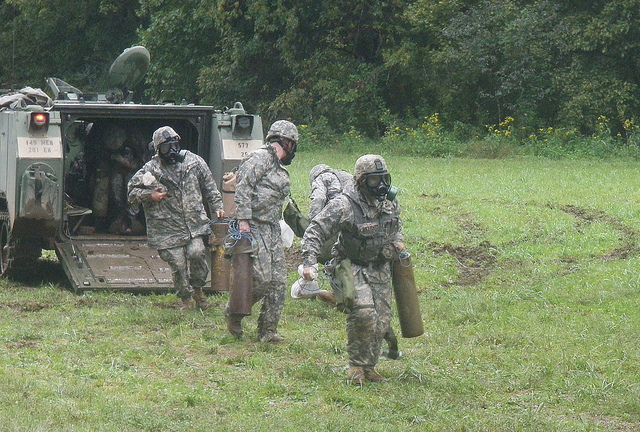
Soldiers of the 577th Sapper Company exit an armored personnel carrier during a training exercise at the Harold L. Disney Training Center in Artemus, Ky., Sept. 22, 2013. Part of the Soldiers traininig included the placement of simulated shaped charges to create crater obstacles. (U.S. Army National Guard photo by Cadet Brian Hicks)
ARTEMUS, Ky. — As a steady rain fell in the hills of Eastern Kentucky, Soldiers in rain gear, combat helmets and gas masks trudged through the muddy terrain of the Harold L. Disney Training Center in Artemus, Ky. Holes were easily dug in the ground for placement of simulated charges, and armored tracked vehicles cruised the fields loading and unloading Soldiers here and there, leaving torn up grass and soil behind.
And Ricky French loves it. He said the all the havoc created is a benefit to the environment.
And just how does armored personnel carriers (APC) benefit the land, you might ask?
It’s all about the grass. According to French, environmental officer for the Kentucky National Guard, the APCs were used as part of the Natural Resource Program.
To see more photos form the training, click here.
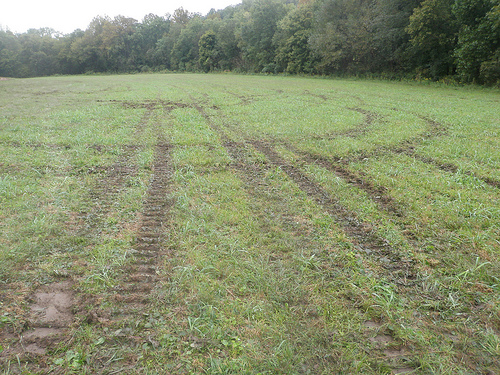
Tracks from an armored personnel carrier streak the fields of the Harold L. Disney Training Center in Artemus, Ky., Sept. 22, 2013. The APCs were used by Soldiers of the 577th Sapper Company as a natural resource tool to assist the root systems of native grasses. (U.S. Army National Guard photo by Cadet Brian Hicks)
“The Natural Resource Program is an ideal situation for blending the needs of training with the stewardship of the land,” said French.
French said native grasses in Kentucky have adapted to build stronger root systems the more they are disturbed. Military training and the use of the APCs were considered a natural resource tool, as they were used in the right location.
This type of disturbance not only supports the growth of native species but helps control non-native species using a mechanical control. Native species thrive with these kinds of disturbances and trampling while the non native species are unable to establish strong root systems.
“Re-establishing native grasses is essential to wildlife habitat and soil stabilization, which also improves and supports the military and environmental mission of the Kentucky Army National Guard,” said French.
Soldiers of the 577th Sapper Company were in the field to conduct platoon, squad and individual training, as part of demolitions training required as part of an engineer company. Soldiers said the exercise was more interesting and motivating with the tracked Armored Personnel Carrier (APC) as part of the training. for some it was a one-of-a-kind experience.
“We usually have to prevent or minimize the damage caused by our tracks, which limits the realism of our training,” said Capt. James Schmitz, commander of the 577th. “Having areas where our drivers can perform full speed combat maneuvers while improving the local environment is a big win for both us and the Disney Training Center.”
“It was one of my first times operating a track during a mock combat operation,” said Pfc. Sonny Ward. “I just recently got my license on the vehicle, and it really helped me develop an appreciation for them.”
Spc. Alexander Weber said the APCs were key to a great training weekend and being able to operate them on grass without worrying about leaving tracks.
“I think it’s cool that we get to get out to use equipment that a lot of National Guard guys never get to see,” said Pfc. David Drummer. “They’re excellent training aids, and let’s be honest: it was just fun getting to tear up some grass in those machines.”
[flickr video=9936999584 secret=d5ac98a612 w=400 h=300]
Story by Sgt. 1st Class Thomas Elmore, 1123rd Sapper Company, Operations NCO
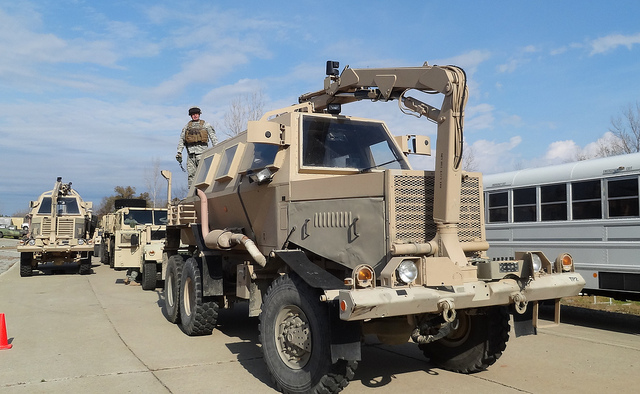
Soldiers of the 1123rd Engineer Company train on the Buffalo Surrogate Vehicle as part of their train-up for Route Clearance operations in Afghanistan. The Buffalo is a Mine Resistant Ambush Protected Vehicle with a hydraulic arm used to interrogate suspected Improvised Explosive Devices.(KYNG photo by Sgt. Kelly Burch, 1123rd Unit Public Affairs Historian Representative)
FORT KNOX, Ky — The 1123rd Engineer Sapper Company of Leitchfield, Kentucky had the opportunity to receive some practical hands on training at Fort Knox, Ky., Nov. 3, 2012. The 1123rd continually trains to remain proficient on demolition, obstacle emplacement and reduction as well as mobility and counter-mobility operations.
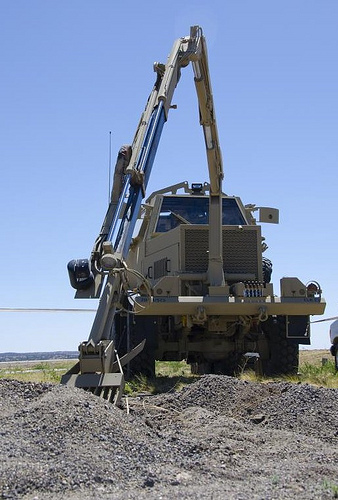
Soldiers of the 1123rd Engineer Company train on the Buffalo Surrogate Vehicle as part of their train-up for Route Clearance operations in Afghanistan. The Buffalo is a Mine Resistant Ambush Protected (MRAP) Vehicle with a hydraulic arm used to interrogate suspected improvised explosive devices.(KYNG photo by Sgt. Kelly Burch, 1123rd Unit Public Affairs Historian Representative)
The training mission of the 1123rd was to conduct route clearance operations during the training. The Soldiers received vital training and experience by being able to, for the first time, use recently acquired Buffalo armored vehicles or MRAP (Mine-Resistant Ambush Protected). The Buffalo was built for protection from IEDs and up to 45 pound landmine explosion under any wheel.
“As a sapper company this was the first time we’ve had a chance to focus collective training solely on route clearance missions,” said Sgt. 1st Class Geoffrey Gleitz. “From task organization to planning and then to the execution of our mission, all focused around route clearance. As a platoon we were able to start developing SOPs based off of our training, previous experiences and current TTPs.”
According to Soldiers of the unit, the sappers’ aggressive nature allows them to adapt to any mission the Army hands out. Only a handful of the Soldiers in the 1123rd had any experience in route clearance. They relied on their leadership, embedded expertise, and natural drive for success to complete the training.
This was the first time the 1123rd had the opportunity to incorporate the Buffalo for training on a training weekend. Individually, Soldiers were instructed by members of Counter IED Integration Cells on hand held detection systems. Soldiers also received several briefs that were supported by Kentucky’s Pre-deployment Training and Assistance Element.
The 1123rd is gearing up for a potential deployment to Afghanistan in 2013.
“Continued mission focused training like this will allow us to develop as we prepare for future operations,” said Gleitz.
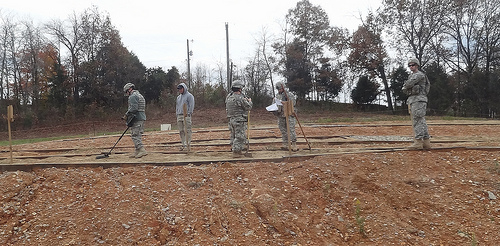
Soldiers of the 1123rd Engineer Company soldiers are instructed by members of Counter IED Integration Cells on hand held detection systems at Fort Knox, Ky., Nov. 2, 2012.(KYNG photo by Sgt. Kelly Burch, 1123rd Unit Public Affairs Historian Representative)
dwa
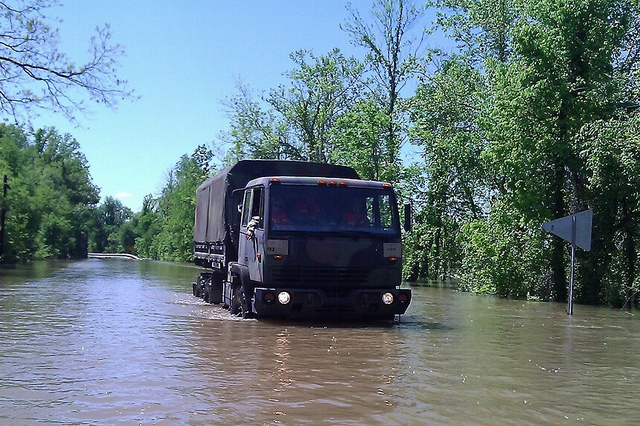
"Landsharks" to the rescue: A Kentucky Army National Guard medium tactical vehicle en route to evacuate a stranded family in Livingston County negotiates hazardous floodwaters. A team from the 118th Engineer Support Platoon - the "Landshark Platoon" - performed the mission. (Photo by Spc. Mark Call, Kentucky National Guard Unit Public Affairs/Historian Representative)
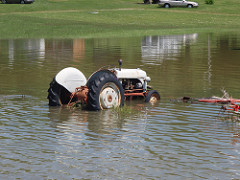
A tractor flooded by the Ohio River in Livingston County. Kentucky National Guard troops have helped evacuate numerous families stranded by the historic floodwaters. (Photo by Spc. Mark Call, Kentucky National Guard Unit Public Affairs/Historian Representative)
SMITHLAND, Ky. (May 8, 2011) – A team of Kentucky National Guard combat engineers were asked to take a break from their sandbagging operations during their flood relief mission in Livingston County near Smithland, Ky. Local law enforcement had a high priority assignment for the Citizen-Soldiers: evacuate an elderly couple and their 55-year old wheelchair bound child under siege by flood waters.
“We were pretty excited to do something different than the sandbag mission,” said Spc. Mark Call, 118th Engineer Support Platoon, also known as the “Landshark Platoon.” “We wanted to see more of the flood and how it was affecting local citizens, so we were glad to go.”
Call and his teammates had to negotiate water hazards along the way, often walking ahead of their tactical vehicle to ensure it did not fall into an unseen sinkhole under the treacherous waters.
The Soldiers’ initial excitement, however, turned into something else upon seeing the family’s plight.
“They were some very nice people who couldn’t get out of that situation without assistance,” said Call. “Our Soldiers were all proud to help them out and we were very grateful that the family did make it all back all right.”
The “Landsharks” took the family to a relative’s home where they would be safe and dry.
Call’s only regret was not getting more pictures of the mission.
“I had my hands full,” he said. “The mission came first.”
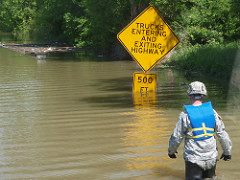
Kentucky Army National Guard Sgt. Ronnie Demorest, of the 118th "Landshark Platoon" wades through flooded waters to help evacuate citizens of Livingston County, Ky. (Photo by Spc. Mark Call, Kentucky National Guard Unit Public Affairs/Historian Representative)
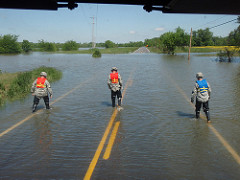
Pfc. Joshua Altman, Pfc. Brandon Walton and Sgt. Ronnie Demorest, of the Kentucky Army National Guard's 118th Engineer Support Platoon, enter a flooded roadway to guide their tactical vehicle through the water. (Photo by Spc. Mark Call, Kentucky National Guard Unit Public Affairs/Historian Representative)
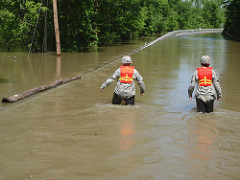
Pfc. Joshua Altman and Pfc. Brandon Walton Wade through a flooded roadway to help evacuate citizens of Livingston County, Ky. The two Citizen-Soldiers - part of the Kentucky Army National Guard's 118th Engineer Support Platoon, also known as the "Landshark Platoon" - were checking the road for sinkholes and erosion that would endanger their medium tactical vehicle. (Photo by Spc. Mark Call, Kentucky National Guard Unit Public Affairs/Historian Representative)
dwa
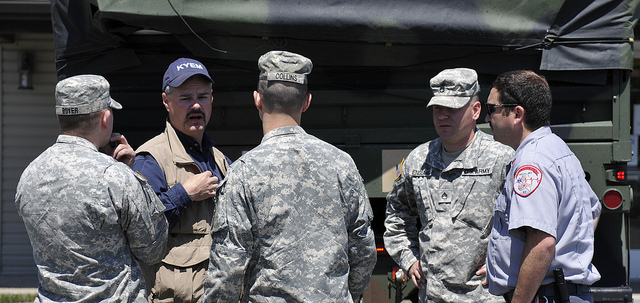
Jerry Rains, Regional Response Manager for Kentucky Emergency Management, talks with members of the Kentucky National Guard about the flooding situation in the Grand Rivers area on May 5, 2011. KYEM personnel and Guardsmen are currently deployed to multiple locations across Western Kentucky. (U.S. Air Force photo by Tech. Sgt. Dennis Flora, Kentucky Air National Guard)
FRANKFORT, Ky. (May 6, 2011) — Here are some photos and video shot by Kentucky National Guard photographers of the flood relief effort in Western Kentucky.
Click here for more Kentucky National Guard images.
[flickr video=5690476648 secret=800d0b824c w=400 h=225]
[flickr video=5689937101 secret=98e600f451 w=400 h=225]
[flickr video=5690640858 secret=4e916bae1e w=400 h=225]
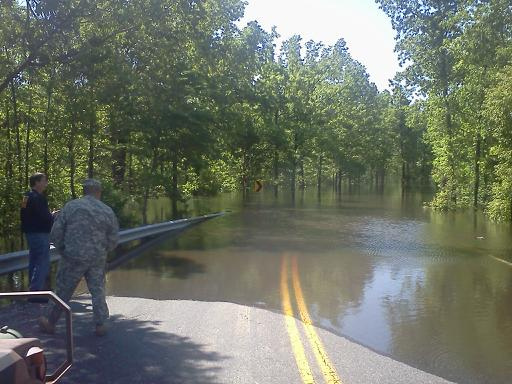
Staff Sgt. Jedadiah Cossel and McCracken County Emergency Management member, John Colson, assess the current water level on a McCracken County highway that serves as a major artery for the county. (Photo by Sgt. Chad Massingale, Alpha Battery, 1st Battalion, 623rd Field Artillery)
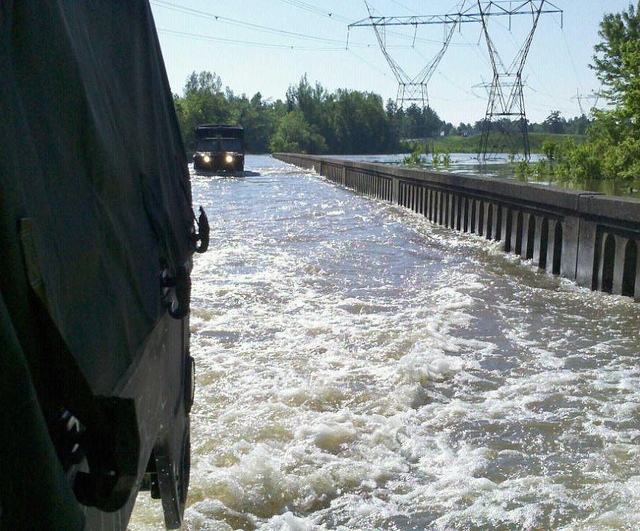
Kentucky National Guard Soldiers in humvees assist Kentucky Emergency Management officials in flood damage assessment surveys in McCracken County. (Photo by Pfc. Justin Lindsey, Alpha Battery, 1st Battalion 623rd Field Artillery)

On May 5, 2011, the Army Corps of Engineers detonated a levee located on the Mississippi River near Hickman, Ky. to relieve stress that was causing additional flooding to surrounding communities. (Photo by Sgt. Bryan Ploughe, 1st Battalion, 623rd Field Artillery Unit Public Affairs Historian Representative.)
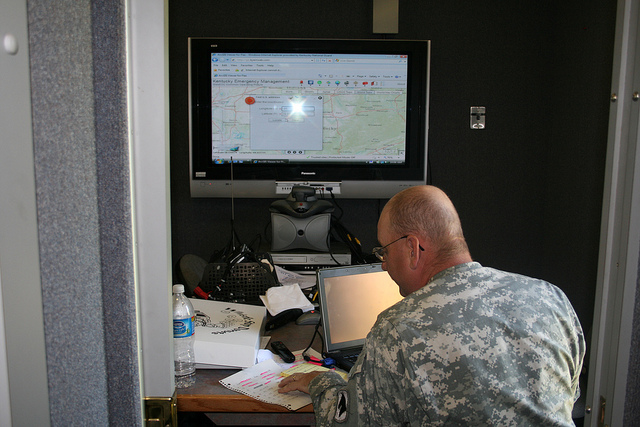
Spc. John Wilson with A Battery, 1st Battalion, 623d Field Artillery, carefully plots road blockages in Livingston Co.(Grand Rivers) Ky. while helping support flood relief efforts with Kentucky Division of Emergency Management in the mobile emergency response center. (Photo by Sgt. Bryan Ploughe, 1st Battalion, 623rd Field Artillery Unit Public Affairs/Historian Representative.)
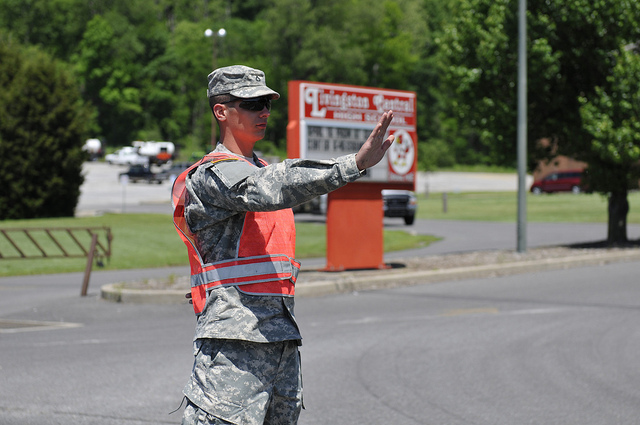
Pfc. Jacob Manning, 1123rd Sapper Company, Kentucky National Guard out of Leitchfield, Ky, stops traffic at an entry control point leading into the city of Smithland, Ky. on May 5, 2011. The entry control points help protect the community from looting and unauthorized entry from non-residents. Guardsmen are currently deployed to six counties locations across Western Kentucky. (U.S. Air Force photo by Tech. Sgt. Dennis Flora, Kentucky Air National Guard)
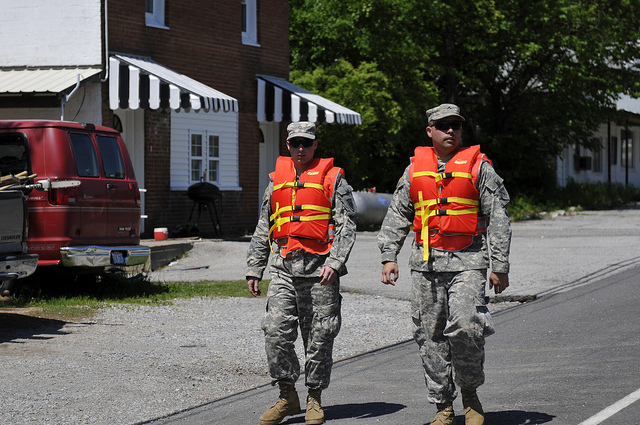
Pvt. Dustin Girten and Pfc. Chad Frank of the 1123rd Sapper Company patrol by foot along the levee in Smithland, Kentucky on May 5, 2011. Guardsmen are currently deployed to multiple locations across Western Kentucky, including Hickman and Smithland. (U.S. Air Force photo by Tech. Sgt. Dennis Flora, Kentucky Air National Guard)
dwa
Photos by Spc. David Bolton, 133rd Mobile Public Affairs Detachment, Kentucky National Guard
Members of the 206th Engineer Battalion and 130th Engineer Support Company use heavy equipment to fill and load sandbags for transportation for use around the Henderson, Ky. area April 27 where recent rain storms have caused massive flooding. The Soldiers will use the sandbags to prevent damage to radio structures used by the Kentucky State Police for retransmission. Photo by Army Spc. David Bolton, 133rd Mobile Public Affairs Detachment, Kentucky National Guard
HENDERSON, Ky. (April 27, 2011) – The Kentucky National Guard currently has 125 Guardsmen supported by 24 tactical vehicles providing support to civil authorities in response to flooding along the Ohio River. Troops are conducting water barrier and sandbagging operations in Ballard, Ohio, and Livingston Counties and completed a sandbagging mission in Daviess County today.
Army Spc. Robert R. Mason Jr. a 40 year-old equipment operator and radio technician assigned to the 130th Heavy Combat Support Company surveys a broadcast radio tower in Henderson, Ky. April 27 used by public television KET and the Kentucky State Police as a retransmission point to ensure the rising waters have had no effect on the radio tower’s capabilities and internal hardware. Photo by Army Spc. David Bolton, 133rd Mobile Public Affairs Detachment, Kentucky National Guard
Soldiers are also providing support to local law enforcement in Henderson County and are expected to stand up a law enforcement support mission in Fulton County tomorrow.
More updates will be posted as the situation changes.
Army Sgt. Ernest D. Modlin a 37 year-old heavy equipment operator with the 130th Engineer Support Company from Madisonville, Ky. directs and coordinates the loading of sandbag packing machinery onto a flatbed trailer on April 27 to be transported for use in preventing further water damage from recent flash floods. Photo by Army Spc. David Bolton, 133rd Mobile Public Affairs Detachment, Kentucky National Guard
Soldiers from the 130th Engineer Support Company and 206th Engineer Battalion in Owensboro, Ky. move sandbag packing equipment on to a lift to be transported for use around the area where recent rain storms have caused massive flooding. The Soldiers will use the sandbags to prevent damage to radio structures used by the Kentucky State Police. Photo by Army Spc. David Bolton, 133rd Mobile Public Affairs Detachment
Air conditioners vital to the cooling system of a broadcast radio tower in Henderson, Ky. April 27 used by public television KET and the Kentucky State Police are carefully monitored by members of the 206th Engineer Battalion stationed in Owensboro, Ky. The engineers placed sand bags all around the station in an attempt to keep rising flood waters from shorting out the ventilation units and thus causing a shutdown of the radio tower. Photo by Army Spc. David Bolton, 133rd Mobile Public Affairs Detachment, Kentucky National Guard
