Pages
Stay In Touch
More
© 2013 KentuckyGuard
Story by Capt. Desiree Dillehay, 206th Engineer Battalion
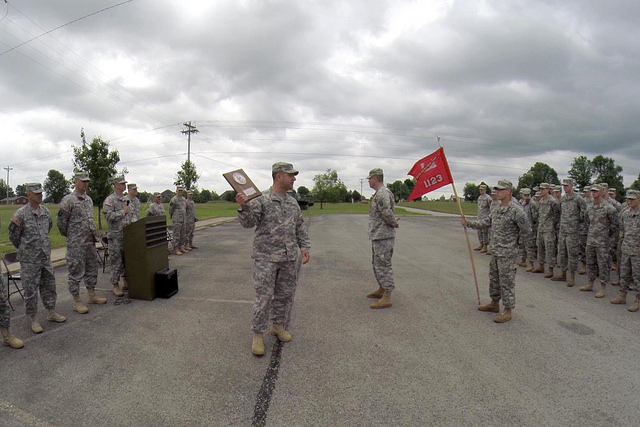
Capt. Robert McWhorter, former commander of the 1123rd Engineer Company, compliments Soldiers of the unit during their annual training at Camp Atterbury, Ind. June 25, 2015. The unit was named the best engineer company in the Army National Guard for 2014, earning them the Itschner Award. (U.S. Army National Guard photo by SGt. Sandra Fariss)
FRANKFORT, Ky. — The Kentucky National Guard’s 1123rd Sapper Company was named Most Outstanding Engineer Company of the Year for 2014.
The Itschner Plaque is an award given to the most outstanding engineer company each year. First awarded in 1960, the award is named in honor of Army Lt. Gen. Emerson C. Itschner. In 1974, the competition for the Itschner Award was broadened to include the Army National Guard and the Army Reserve.
With hard work and dedication to the mission, to the 206th Engineer Battalion, the 149th Maneuver Enhancement Brigade, and to the Kentucky Army National Guard, the 1123rd received the Itschner Award for the fiscal training year 2014.
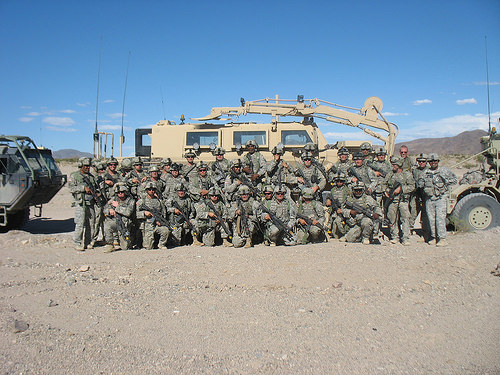
Soldiers of the 112rd Engineer Company gather for a group photo at the National Training Center in Fort Irwin, Calif., Aug. 21, 2014. The three-week rotation at NTC was the culminating event of a hard year of training for the unit. (Photo courtesy of the 1123rd Engineer Co.)
The level of proficiency that this company achieved during the evaluated period has inspired the unit’s leadership, who said the award serves as a testament to the Soldiers’ unwavering motivation, dedication to their unit, and their ability to learn, adapt and overcome any obstacle. Given the many hurdles National Guard units inherently face with training continuity between drill weekends, this unit’s Non Commissioned Officers and Officers are exceptionally outstanding.
“Winning the Itschner Award speaks of the caliber of Soldiers within the 1123rd Sapper,” said Lt. Col. James Richmond, commander of the 206th Engineer Battalion. “The unit is only eight years old and to have achieved superior achievements in strength, training, and performance in such a short time and against such a complex mission set is simply incredible.”
Richmond also added that few know what Sappers are in the military. “He is the Swiss Army Knife of Soldiers, in essence an infantryman who specializes in laying or clearing minefields,
demolitions, field defenses and general construction, as well as road and airfield construction and repair.”
Click here for more photos of the 1123rd.
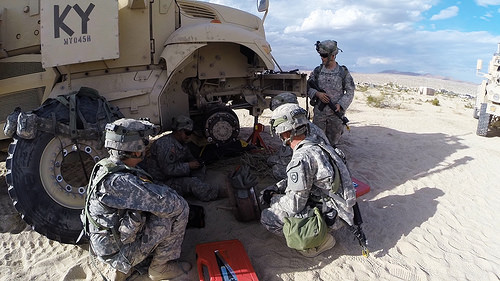
Engineers with the 1123rd Sapper Company change a tire on an armored vehicle during a training exercise at Fort Irwin, Calif., Aug. 15, 2014. The unit’s hard work at NTC earned them respect from a variety of training supervisors and Reserve and active duty units. (Photo courtesy of 1123rd Engineer Co.)
For the 1123rd, a 20 day rotation at the National Training Center in Fort Irwin, California was the culmination of a rigorous six month journey. Originally, the 1123rd was considered to serve as a component of the Opposing Force (OPFOR), but the focus shifted and the Sappers had an opportunity to serve as a Brigade Special Troops Battalion (BSTB) enabler in order to perform route clearance missions. This assignment required a dramatic change in the unit’s task organization, moving from three Sapper platoons and a headquarters platoon to two Route Clearance Packages, one Company Intelligence Support Team and a headquarters platoon. The 1123rd had 14 training days from March to July to prepare for NTC. The pace of training became very intense and success hinged on detailed planning, commitment to excellence and, most importantly, leveraging the knowledge of experienced route clearance personnel to increase training efficiencies without compromising quality.
The Sappers executed their strenuous training plan and completed the NTC rotation with remarkable results. Competence, adaptability and readiness for any mission was proudly displayed throughout the exercise. The 1123rd received accolades from a variety of training supervisors and both reserve and active duty counterparts. The predominant theme conveyed during the course of training was the unit’s willingness and desire to learn and better themselves. A high level of motivation and a productive and professional culture was demonstrated to every Soldier in the company.
The 1123rd was given professional development and networking opportunities that would not have been available without a rotation at NTC. These opportunities allowed the 1123rd leadership to collaborate with their active duty counterparts and higher headquarters in order to establish the unit’s relevance and credibility. This paid dividends as the 1123rd maintained an active voice in their utilization and had the opportunity to contribute to missions for the battalion in addition to route clearance.
The 1123rd has gained an incredible amount of experience this year and is fully prepared to carry out its engineer mission, only now with the title of “the best.”
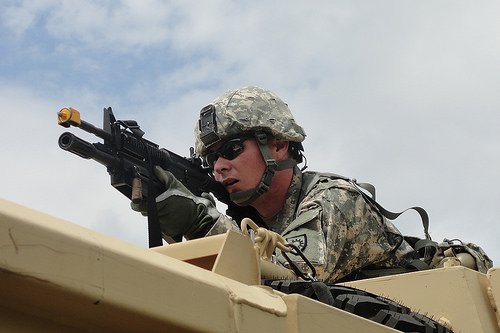
A Soldier with the 1123rd Engineer Company takes up a defensive position during a training exercise at Camp Atterbury, Ind., June 21, 2015. (U.S. Army National Guard photo by Spc. Brooklynd Decker)
“The Soldiers are truly honored to receive this award,” said Sgt. 1st Class Thomas Elmore, readiness NCO for the 1123rd. “This unit went from standing up the 1123rd in 2009 to the best National Guard engineer unit in the country in 2014. Don’t know how else to put it except they are proud to be the BEST.”
However, the 1123rd Sapper Company is not just an operational machine. In addition to their rigorous training schedules, they incorporated time to give back to their community. The 1123rd is broken into two armories located in Leitchfield and Marion, Kentucky. Both locations have long been and continue to be involved with their respective communities. During the 2014 training year the two armories actively contributed to several community events, either during scheduled drill or by Soldiers volunteering outside of normal duty periods. The 1123rd participated by marching in the Christmas and Labor Day parades, provided speakers and representatives to three Veterans’ Day events and a Memorial Day ceremony. Additionally, they collaborated with the local American Legion for military funeral honors for veterans upon their family’s request.
“The level of proficiency that this company has achieved during the evaluated period is truly remarkable and serves as a testament to their unwavering motivation, dedication to their unit and their ability to learn, adapt and overcome any obstacle through Unbridled Service,” said Elmore.
The Soldiers of the 1123rd are revered throughout the 206th Engineer Battalion for always maintaining a high level of motivation in any training environment and with every mission; this training year they have raised the bar. Engrained into this company is a true sense of ownership and pride, where each Soldier maintains a stake in its success and proactively works to improve the unit.
Story by Sgt. Sandra K. Fariss, 206th Engineer Battalion
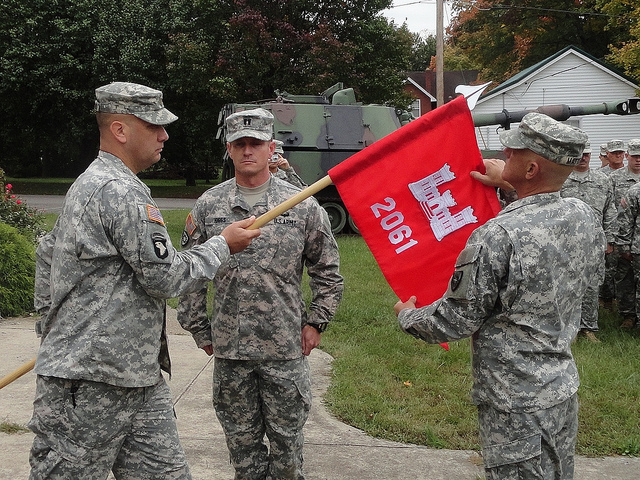
Maj. James B. Richmond, 206th Engineer Battalion Commander and Command Sgt. Maj. Vince Matteini uncase the new 2061st Multi-Role Bridge Company (MRBC) guidon at the Elizabethtown Armory, Oct. 18, 2014. Capt. Sean Higgs, middle, assumed command of the new unit. (Photo by Staff Sgt. Jason B. Brown, 2061st Multi-Role Bridge Company)
ELIZABETHTOWN, Ky. — On Oct. 18, 2014 Maj. James B. Richmond, 206th Engineer Battalion Commander and Command Sgt. Maj. Vince Matteini uncased the new 2061st Multi-Role Bridge Company guidon at the Elizabethtown Armory. The guidon was then passed to Capt. Sean Higgs, who assumed command of the unit. The 2061st will be headquartered in the new Burlington Readiness Center with a detachment in Elizabethtown, Ky. The unit is a rare one that can conduct both wet and dry gap crossings in support of mobility operations. Its capabilities are critical to both Federal and State missions.
When deployed, the 2061st is capable of bridging the gap over both dry and wet gaps using a myriad of equipment such as the Dry Support Bridge (DSB), Ribbon Bridge, and the Mabey-Johnson Bridge. The DSB is a rigid bridge used to span across dry gaps, whereas the Ribbon Bridge is a floating bridge held in place by bridge erection boats in order to span wet gaps. The MRBC can also support flood rescue operations using the lightweight Zodiac inflatable boats. These capabilities enable Kentucky to better adhere to disasters.
“The unit can be very helpful in a situation such as seismic events on the New Madrid fault line,” said Richmond. “Many bridges may be damaged which would make relief efforts to the western portion of the state difficult. The MRBC could bridge damaged supply routes and allow relief efforts to better flow into the area.”
The 206th Engineer Battalion is no stranger to this kind of unit. The 206th has commanded this type of unit before: Echo Company 206th Engineer Battalion was a Ribbon Bridge Company that was stationed in Morehead, Kentucky. back in the 1990s and deployed to Falmouth, Kentucky in 1997. During that time it played a critical role in the flood relief.
“It is a distinct honor and privilege to be your first commander,” said Higgs. “I look forward to working with each of you to build this fine unit, but remember that this is your unit, so take pride in it!”
Story and photos by Staff Sgt. Paul Evans, KY ADT 4 Unit Public Affairs and Historian Representative
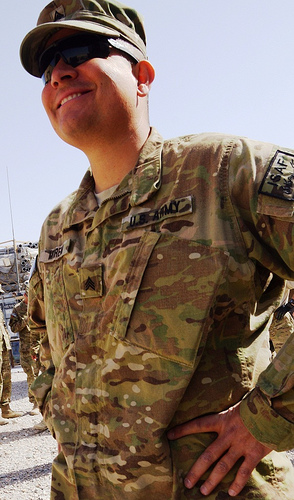
Kentucky Agribusiness Development Team 4’s Sgt. Nikko Moreno of Bowling Green, Ky. smiles in southern Afghanistan on March 14, 2012. The Danville, Calif. native now serves with ADT 4’s Security Platoon, helping provide protection for the mission of educating local farmers. (U.S. Army photo by Staff Sgt. Paul Evans)
FORWARD OPERATING BASE PASAB, Afghanistan—“When I lost my job, that was really hard for me,” recalled Sgt. Nikko Moreno, a 39-year-old Danville, Calif. native now residing in Bowling Green, Ky. “I’d worked so hard for so many years and built up to have nothing.”
Moreno has come a long way in the past few years since his journey began in California. There, he suddenly found himself unemployed from his job in Construction Management by the recession. To fully understand Moreno’s journey and how he ended up in Afghanistan, however, the story gets a little longer.
Before rejoining the military in the Kentucky Army National Guard’s 3123rd Engineer Detachment, 206th Engineer Battalion in Madisonville, Moreno spent about seven years on Active Duty as a combat engineer. While there, he served in Korea, Germany, Bosnia, Ft. Lewis, Wash. and even attended the prestigious Sapper school at Ft. Leonard Wood, Mo.
“When I initially joined (the Army), I joined the Reserves, and I was at the reserves for a very short time,” Moreno recalled. “They said that the unit was being deactivated, so I had a choice to either go Active Duty or to get out.”
“So I decided to go Active, and the first place they sent me was Korea. After that…I was shipped up to Ft. Lewis, Wash., and I was there for a couple years,” he continued.
“Then I was deployed to Bosnia with 1st Armored Division, and was there for all of ’96, and then came back, was home in Germany,” Moreno noted. “We went back in ’98, then I was home in ’99, and when my time came up for reenlistment, they were going to Kosovo. I just, I had a lot on my plate, a lot of directions I wanted to go. I chose to get out.”
After leaving Active Duty Army life behind, Moreno returned to California.
“After I got out, I went home and started dating my now wife, Shannon, and started working,” he recalled. “I finished college, but while I was in college, I started working in construction, and what I did, I was doing a Network Engineering degree-and I just didn’t really find that it was what I liked to do, and I ended up going back to construction.”
“I liked the way it was hands on and detail-oriented, outside,” Moreno noted. “You know, we did the whole thing for like the first nine years of our marriage. We bought a house, she (Shannon) got established in her career, I got established in mine, and then when the recession kind of hit California, it hit construction really hard.”
“I was laid off from my first job, I was able to pick up a second job as a Superintendent with another company that I’d worked with, and after three months, I got laid off from that one just because there was no work,” he said.
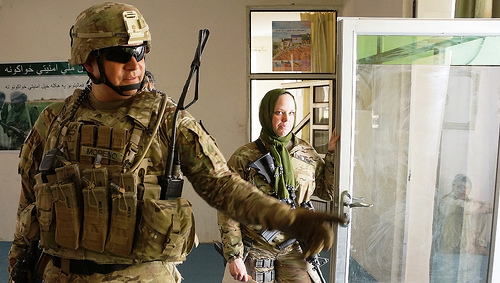
Kentucky Agribusiness Development Team 4’s Sgt. Nikko Moreno of Bowling Green, Ky. conducts security checks during a mission in southern Afghanistan on May 8, 2012. The Danville, Calif. native now serves with ADT 4’s Security Platoon, helping provide protection for the mission of educating local farmers. (U.S. Army photo by Staff Sgt. Paul Evans)
“We’re the type of couple, that on weekends, we like to get out and explore. My father-in-law owned a house in Kentucky,” Moreno continued. “He came up to us and said, well why don’t you go check out Kentucky. I kind of laughed it off as a joke.”
“But given my experience on going a lot of different places with the military, a lot of the places I thought I wouldn’t like I ended up liking,” Moreno reflected. “So I went to my wife and said ‘well, why don’t we give it a try.’ We flew out in August (2009), stayed for a week, and we fell in love.”
“We loved the people, we loved the area,” he described. “It was beautiful, it was green, there was a lot of things to do, and it really was the people. They were very courteous and very welcoming.”
“It’s such a contrast to California, where people can be so rude and so focused on their job or time or money, and it wore us out,” Moreno noted. “We left California Halloween and arrived at the house in November (2009).”
“I ended up joining the Guard because I always-I guess, at that point in my life, the military was the only thing that made sense to me,” Moreno said. “I really believed in what it stood for, I believed in how I felt wearing the uniform, and I just kind of wanted to get just kind of control of my life again.”
After joining, Moreno took advantage of an opportunity to deploy southern Afghanistan as part of the Kentucky National Guard’s Agribusiness Development Team 4, where he now serves.
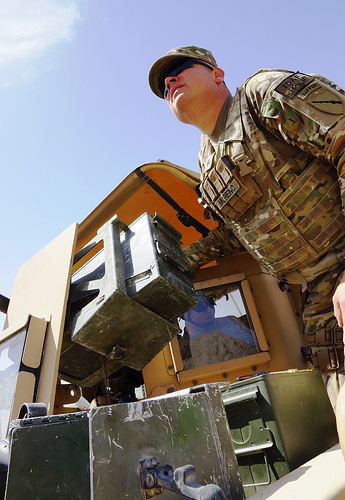
Kentucky Agribusiness Development Team 4’s Sgt. Nikko Moreno of Bowling Green, Ky. coaches a Soldier during weapons training in southern Afghanistan on April 2, 2012. The Danville, Calif. native now serves with ADT 4’s Security Platoon, helping provide protection for the mission of educating local farmers. (U.S. Army photo by Staff Sgt. Paul Evans)
“It was kind of nice to have the chance to be a part of the humanitarian side of a military mission…to kind of go out and help somebody that wants to make something of their lives,” Moreno described. “I am accomplishing my goals for coming on this mission. You know, I will have participated in something that makes a difference for people.”
“I think we’re making a difference to the right people,” Moreno noted. “There are people that are taking what we’re giving them and doing positive things. Of course there’s corruption, there’s that stuff too-but someone told me one time that even if you make a difference in one person’s life, it’s making a difference. So I do think we’re making a difference.”
Moreno offered some insights to the surprises of coming to Afghanistan.
“There’s actually a lot of green,” he noticed. “It’s actually a fertile place. I was completely ignorant about Afghanistan…but coming here I expected desert and I’m finding kind of fertile areas that congregate around a river valley.”
“Ignorance breeds hate, and I was ignorant about it. And now I see that not everybody is bad, some people are just like you and I. They just want to get on with their lives peacefully, and it’s enjoyable to watch these people and how resourceful they are to just kind of like work what they have.”
“They don’t have trellises for grapes or high-speed areas to process their stuff—they make everything they have,” he observed. “A bridge across the water isn’t some concrete pillars and planks. It’s roots and mud, it’s sticks and stuff. They’re very ingenious, and they’re very resourceful.”
“To be honest, my previous military experience was a lot different from this,” Moreno observed. “When we rolled into Bosnia, there was nothing established. We rolled into a muddy field, set up concertina wire, filled sandbags, built bunkers, built towers, we were really self-sufficient. We did everything pretty much on our own. It prepared me in that I was prepared for how bad it could be.”
“Here, it was kind of like coming to a catered party,” Moreno described. “There’s no mud, we have air conditioned and heated tents, there isn’t really a lot of suffering involved in the day-to-day stuff that we’re doing here.”
Family and friends back home have been supportive, according to Moreno.
“My family has been exceptionally supportive,” he noted. “For my wife, it’s new. We weren’t married when I was in the military before, so she’s learning. She’s really smart, my wife. She is able to adapt really quickly to what a situation requires—she kind of knows what to and what not to listen to.”
“My mom, you know, a mom’s a mom. She’s definitely worried for her son and the rest of us, and sees any war as negative, and wants us all home,” Moreno continued.
“Oh my gosh, they send me packages,” Moreno added with an excited smile. “That’s another new thing…the difference between my active experience and this is the technology, and care packages and things like that.”
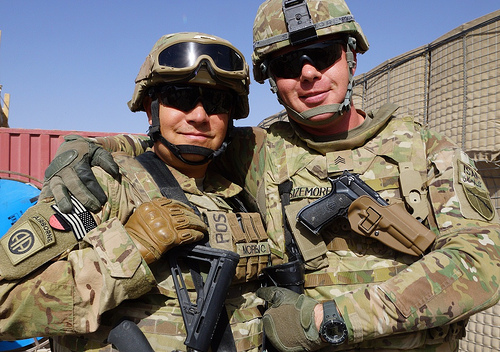
Kentucky Agribusiness Development Team 4’s Sgt. Nikko Moreno (left) of Bowling Green, Ky. spends quality time with Lawrenceburg, Ky.’s Sgt. Bobby Sizemore (right) before a mission in southern Afghanistan on April 1, 2012. The Danville, Calif. native now serves with ADT 4’s Security Platoon, helping provide protection for the mission of educating local farmers. (U.S. Army photo by Staff Sgt. Paul Evans)
“Before, I didn’t really get care packages. I’d get letters and stuff, and it was nice to get letters,” he recalled. “Now I get care packages, and I don’t get letters very much. They have Skype, phones, and they have Facebook, and all these internet media that we really didn’t back then.”
Moreno reflected on how his peers have helped him get through the deployment so far.
“That’s one thing I love about the military is that you always have brothers no matter what,” he said. “And it’s always diverse. If I’m feeling vulnerable, there’s a person I’ll go talk to that I know won’t put me down or take advantage of the fact that I’m like ‘hey man, I’m feeling weak.’ Or if there’s someone I want to joke around with, he’s there. There’s always a multitude of people and personalities you can go and talk to.”
“Being with this hodge-podge group, there’s a lot of stories that you can get to know people and find out where they came from and who they are. I really like that, too-just learning about people and what they’ve come up through,” Moreno continued.
“I met him (Moreno) at our very first drill,” said Lawrenceburg, Ky.’s Sgt. Bobby Sizemore. “My first impression of him was that he was a little different.”
“He wasn’t exactly the type of guy that I’m used to because I know he’s got a lot of vast experience,” Sizemore described. “Since then, we just started to click, so we’ve become good friends.”
“Before we left, me and my wife, Moreno and his wife—we also had Sergeant Randy Sewell and his wife, we all went out to dinner together,” Sizemore continued. “We were actually able to bond, our wives were able to meet, and that has created that support back home. Our wives stayed in touch, so it was just a good thing. They all get along really good.”
“Moreno’s very, very, very goal oriented,” Sizemore observed. “Once he sets his mind to something, he goes after it, and that’s inspiring. There’s so many people today that give up so easy when they don’t get what they want. I admire him for never giving up.”
“He’s got a big heart, and he cares for people,” Sizemore added. “That’s another inspiring feature about Sergeant Moreno, is just that he’s a good person overall.”
“Me and him, we’ve shared so much that he’s like a brother to me now,” Sizemore said. “He’s one of those guys that when you’re having a bad day, you can go to and talk to, and more times than most, he’s going to put a smile on your face.”
“He’ll be a lifelong friend. We’ve shared a lot of good things, a lot of bad times,” Sizemore added.
From California to Kentucky and Afghanistan, one could say the complicated journey continues for Sgt. Moreno and his many trades.
Story and photos by Staff Sgt. Paul Evans, KY ADT 4 Unit Public Affairs and Historian Representative
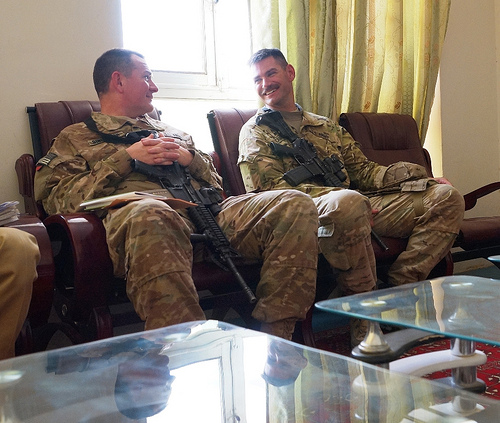
Master Sgt. Chris Campbell (right) of Nicholasville, Ky. and Maj. Ben Singleton (left) of Lakeside Park, Ky. attend a meeting during a site visit in southern Afghanistan on May 8, 2012. Campbell, a member of Kentucky National Guard’s Agribusiness Development Team 4, has spent 23 years serving in the military between the National Guard, Navy, and Navy Reserves. This is his second deployment overseas. (Photo by U.S. Army Staff Sgt. Paul Evans/Released)
FORWARD OPERATING BASE PASAB, Afghanistan—“I learn every day that we’ve got a lot to be thankful for back home,” said Master Sgt. Chris Campbell, a 41-year-old native and resident of Nicholasville, Ky. “We have a lot to be thankful for as a nation, actually.”
Campbell, who spent four years apiece with the Navy and Navy Reserves before serving in the Kentucky Army National Guard for the past 15 years, is a Soldier assigned to the Kentucky National Guard’s Agribusiness Development Team 4. As a member of ADT 4, he serves a Project Manager for the Kandahar Province’s Zharay and Maiwand District teams.
“At the same time, we have a lot of responsibility, not only as Americans, but also as Soldiers to be good stewards,” he said. “Our mission is really tied in with that focus of being good stewards. We need to make sure that we do the right thing, the right projects, and we don’t waste money.”
Back in Kentucky, Campbell is a combat engineer with Madisonville, Ky.’s 130th Engineer Support Co., 206th Engineer Battalion. He previously deployed to Kuwait from 2004 to 2005 with Headquarters and Headquarters Co., 206th Engineer Battalion, which was then based out of Harrodsburg, Ky. The 206th has since been relocated to Owensboro, Ky.
As a civilian, Campbell said he has worked as a lieutenant for the Nicholasville Fire Department since 1997.
To see more photos from this story, click here
“I don’t have too much civilian experience I need to use here, because usually that means someone’s in trouble,” Campbell said. “But it has helped. I think that Guardsmen in general are kind of a different breed. That helps to facilitate the mission, because there’s folks on our team that have many skill sets, and we use those.”
“Patience is a big thing that I’ve learned through my military career. I’m not the most patient person, but I understand here, I’m not only dealing with the Army and contracting side of it, but also dealing with Afghans and how they perceive life,” Campbell said. “Patience has been key. That’s something the Army has kind of helped me learn.”
Campbell described what Afghanistan has been like so far.
“It’s kind of what I expected it to be. But it’s something that you can’t really appreciate till you get here or actually see it with your own eyes,” he said. “So it’s been interesting.”
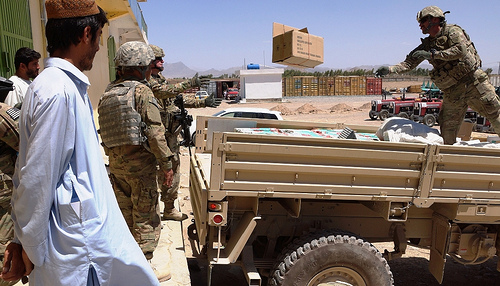
Master Sgt. Chris Campbell (right) of Nicholasville, Ky. passes a box of supplies for local farmers to Maj. Ben Singleton (left) of Lakeside Park, Ky. during a site visit in southern Afghanistan on May 26, 2012. Campbell, a member of Kentucky National Guard’s Agribusiness Development Team 4, has spent 23 years serving in the military between the National Guard, Navy, and Navy Reserves. This is his second deployment overseas. (Photo by U.S. Army Staff Sgt. Paul Evans/Released)
“You know, I think it surprised me, just the attitude of the Afghans that we’ve dealt with so far,” Campbell said. “A lot of them are really good people. And I think I might have perceived them a little bit differently because of our training regimen. The fact that we’ve been working with them and had the opportunity to have a close relationship with some of these folks, I think it’s helped. And it surprised me a little bit, but it’s also been very rewarding,” he added.
There have been some challenges so far, both personally and as a unit, as Campbell described them.
We’re an enabler, not a battle-focused (unit), as far as we don’t go out there and shoot folks. That’s not our job,” he said. “We’re an enabler for the Army in order to reach out to the agricultural community and kind of help those folks.”
“I think the first challenge for everybody was the same, trying to get used to this new hodge-podge kind of unit thrown together, get used to everybody,” Campbell recalled. “Also, coming over here and working with a combat arms unit, I think that’s been a challenge for all of us. It’s been something that we’ve kind of had to get adjusted to.”
“The only difference I see that’s more sobering is the fact of being closer to the front line, I think,” Campbell said. “It’s more challenging. You go into some of these TOCs (tactical operations centers), these other units, and you see the pictures on the wall of Soldiers like our own that have died here doing their mission.”
“It’s sobering…I’m very humbled by that.”
For most of Campbell’s family, this is their second time dealing with him being gone.
“It’s been difficult. My wife kind of knew what to expect,” he said. “My youngest son, who’s six didn’t. So, it’s been troubling for him. My teenagers, they went through it as children, but it’s hard for them too. I think it causes more stress than what I know.”
“My oldest son, he actually joined up into the National Guard, joined while I was gone. I think it affected him to the point that I think he decided he wanted to try and serve too. I’m thankful for that,” Campbell added.
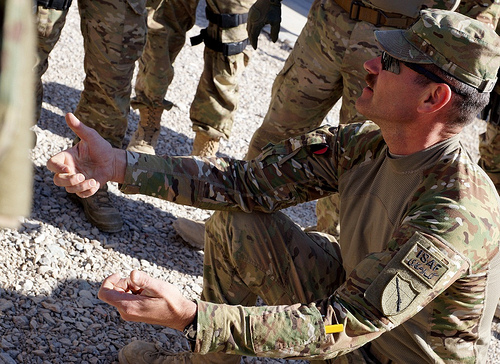
Master Sgt. Chris Campbell of Nicholasville, Ky. explains the sandbag filling process to Soldiers and Airmen with the Kentucky National Guard’s Agribusiness Development Team 4 in southern Afghanistan on March 1, 2012. Back in Kentucky, Campbell is a Combat Engineer with Madisonville, Ky.’s 130th Engineer Support Co., 206th Engineer Battalion. (Photo by U.S. Army Staff Sgt. Paul Evans/Released)
Thinking about ADT 4’s ability to make a difference in southern Afghanistan, Campbell looked towards the future.
“I think we will, but I don’t think it’s something that’s going to be readily apparent in any of our lifetimes,” he observed. “I think the influence that we have here with these folks is going to stretch out over into the little kids that we see now.”
“When they become adults, and they’re running this country, that’s when we’re going to see that influence…it may not be that they are a democracy, but it may be that they are able to sustain their families better,” Campbell said.
“Maybe this country won’t be one of the poorest in the world, but it may be a developing economy where they can do something for their children,” he hoped.
As the old saying goes: only time will tell.
Story and photos by Sgt. Sandra Fariss, 206th Engineer Battalion Unit Public Affairs Historian Representative
NOTE: Each week kentuckyguard.com publishes stories by or about Kentucky National Guard unit public affairs historian representatives, also known as UPAHRs. This is an additional duty taken on by a Soldier or Airmen with the intent of telling their unit’s story. This is one such story ….
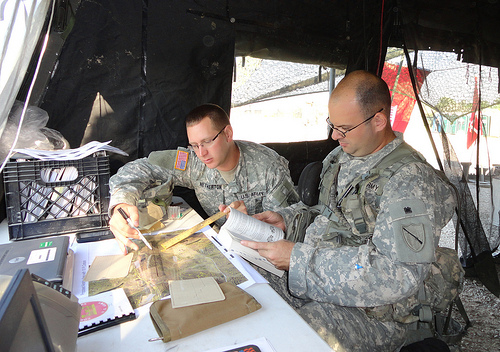
2nd Lt. Cory Netherton and Spc. Thomas Drury, both of the 206th Engineer Battalion, discuss cut and fill estimates for a recommended air strip during annual training, May 18, 2012, at Wendell H. Ford Regional Training Center in Greenville, Ky. (Photo by Sgt. Sandra Fariss, 206th Engineer Battalion Unit Public Affairs Historian Representative)
GREENVILLE, Ky. -For the first time in their history, the 206th Engineer Battalion, based in Owensboro, Ky., and the 201st Engineer Battalion from Ashland, Ky., joined forces at Wendell H. Ford Regional Training Center, Greenville, Ky., for their annual training May 12, 2012.
In a joint effort, Detachment 1, 149th Vertical Engineer Company from Olive Hill, Ky., assembled sea-huts; horizontal construction engineers of the 207th Horizontal Engineer Company from Hazard, Ky., and heavy equipment operators from Walton, Ky.’s 118th Haul Platoon moved dirt to build an access road and landing strip at the new Contingency Operations Location (COL) at Wendell H. Ford Regional Training Center.
To see more photos from this story, click here
Engineers of the 206th completed cut and fill estimates for a recommended air strip that will be expected to land military aircraft, potentially including Boeing C-17 Globemasters. If approved, the airstrip will be used for rapid strategic and tactical airlifts located near the new Contingency Operations Location.
Soldiers used the engineer field data manual to formulate calculations from topographic data at the proposed elevation located at the proposed air strip site.
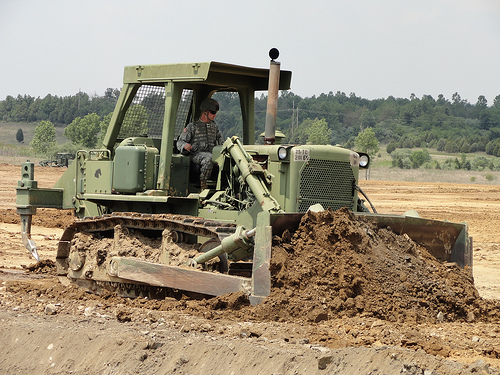
Spc. Donald Pace of the 207th Horizontal Engineer Company operates a D7 Dozer to move dirt in efforts to build a new Contingency Operations Location (COL) at Wendell H. Ford Regional Training Center in Greenville, Ky., during annual training, May 15, 2012. (Photo by Sgt. Sandra Fariss, 206th Engineer Battalion Unit Public Affairs Historian Representative)
“The mission is time consuming but the completed project will be beneficial to future operations and serve as a tremendous asset to this training area,” said 2nd Lt. Cory Netherton, combat engineer officer with the 206th.
The 206th and 201st also managed fuel operations and log pack exercise missions to the Contingency Operations Location at the Combat Training Command Post during annual training.
Battalion Commander Lt. Col. Dean R. Gosney of the 201st, said with excitement as he overlooked the project going on at the new Contingency Operations Location, “Great things are happening here and years from now these Soldiers will look back with pride and say, ‘I built that’!”
Story by Spc. Marty W. Herndon, Unit Public Affairs, Historian Representative, Det 1-1123rd Sapper Co.
NOTE: Each week kentuckyguard.com publishes stories by or about Kentucky National Guard unit public affairs historian representatives, also known as UPAHRs. This is an additional duty taken on by a Soldier or Airmen with the intent of telling their unit’s story. This is one such story ….
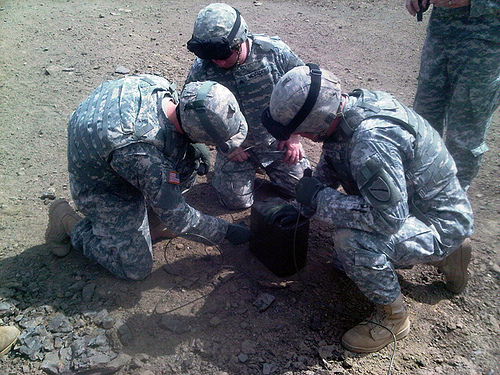
Spc. Matthew Winder(left), Sgt. Jonathan T. McMackin(center), and Sgt. 1st Class Edwin J. Bayer (right) of the 206th Engineer Battalion prime a C4 charge while supporting the validation of the new Light Demolition Range located at Wendell H. Ford Regional Training Center. The exercise was the first of its kind at the site. (Kentucky National Guard photo by Master Sgt. Micheal Sims, 206th Engineer Battalion/Released)
GREENVILLE, Ky. — Soldiers from the 206th Engineer Battalion and 1123rd Sapper Company conducted the first test fires of demolitions at Wendell H. Ford Regional Training Center in Greenville, April 3-5, 2012. The test included 1-10 lb charge, 1-25 lb charge and 2-32 ½ lb charges.
“This will allow engineers to conduct demo training for the first time at the Wendell H. Ford Regional Training Center and for some of these Soldiers it was their first time to initiate a charge,” said Master Sgt. Micheal E. Sims, Operations Sergeant for the 206th Engineer Battalion.
The test was conducted to determine the blast shock wave. The decibel level was measured by civilian agencies to determine the capacity of charge to stay within state requirements. The tests were a part of the necessary steps to validate the range for future explosive use. Once the range officially passes these tests, it will receive the green light for further demolition training.
“The demo test went well,” said Lt. Col. Ruth Graves, Training Site Manager. “The initial test data results show that blast activities at the demolition range comply with all safety and noise regulations.”
Sgt. 1st Class Edwin Bayer, Readiness NCO for Headquarters, Headquarters Company, 206th said nine Soldiers participated in the test, but knows more will follow with this new opportunity.
“It’s going to be a great benefit to be able to go down there for training,” Bayer said. “It will benefit the entire engineer community in the state.”
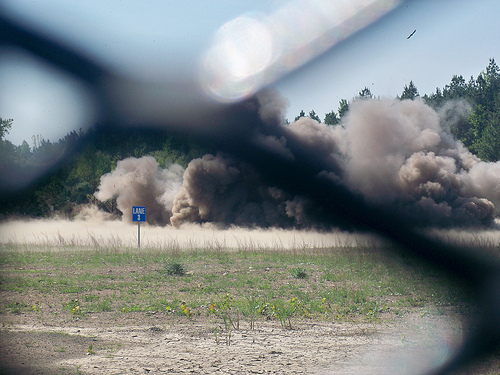
A C4 blast ignited by the 206th Engineer Battalion sends debris into the air at the new Light Demolition Range located at Wendell H. Ford Regional Training Center. The 206th assisted with the validation of the site to be used for future demolition training. (Kentucky National Guard photo by Lt. Col. Ruth Graves, Wendell H. Ford Regional Training Center/Released)
When asked about the quality of the training, Bayer said that each Soldier feels the same, ‘every opportunity to detonate explosives, is a good day for an engineer’.
The range is expected to host a good amount of training for Kentucky engineers, and the location is one of the greatest advantages. Bayer said previous training had to be scheduled and conducted at Fort Knox or Fort Campbell, but now the Kentucky Guard has its own demolition range.
Following the initial tests, the 201st Engineers were the first to use the range during an annual training period in May. The 1123rd is scheduled to use the range in the fall for demolition certification.
“Our biggest chunk of training is there and we will certainly get a great deal of use out of it,” said Bayer.
Story by David Altom, Kentucky National Guard Public Affairs
Photos by Tech. Sgt. Jason Ketterer, Kentucky National Guard J6 Visual Information
Click here to read the Owensboro Messenger-Inquirer story.
Click here to see the WFIE video story.
Click here to see more photos from this story.
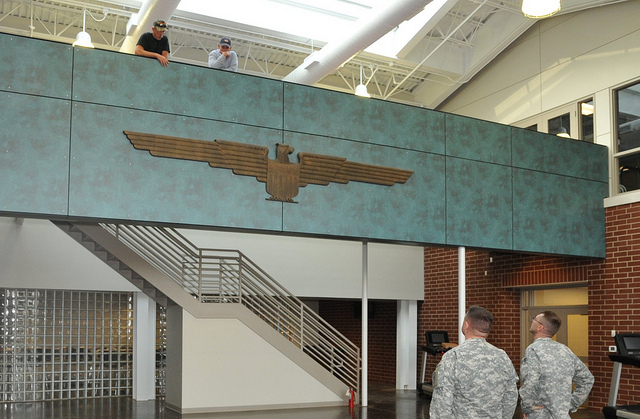
OWENSBORO, Ky. — With just days away from the ribbon cutting of the new Kentucky National Guard Readiness Center in Owensboro, officials gave a sneak preview of the facility to local media.
Kentucky National Guardsman Maj. Jason Aliff, 206th Engineer Battalion, speaks with Jasmine Edwards, Channel 14 News, about the new Owensboro Readiness Center in Owensboro, Ky. on March 29. (Photo by Tech. Sgt. Jason Ketterer)
The $14 million facility, built on land adjacent to the Owensboro-Daviess County Regional Airport, is the Kentucky Guard’s flagship readiness center in the region. With more than 35,000 square feet of offices, classrooms, drill halls and storage, the center will function as a home for the 206th Engineer Battalion.
The winter storm of 2009 demonstrated the importance of a modern facility said Maj. Jason Aliff, operations officer for the 206th Engineers.
“During that mission the soldiers were actually living out of the armory because of power outages,” he said. “This is a much larger facility, providing office space separate from potential living quarters that we could use here. And by being located at the airport supplies can be flown in now and we can have a much quicker reaction time and be able to distribute goods.”
The center will also serve as a center for community activities, said Aliff.
“The space can be rented out for birthday parties and things that a community based organization could use this facility, just like we did at our older facility. This new center is a representation of the community.
According to said Capt. Joe Sloan, the Guard’s design and project manager, three factors were taken into consideration when putting together the new center: security, operational support and energy efficiency.
Capt. Joseph Sloan, design and project manager for the Kentucky National Guard, speaks with Jasmine Edwards, Channel 14 News, about the new Owensboro Readiness Center in Owensboro, Ky. on March 29. (Photo by Tech. Sgt. Jason Ketterer)
“Every decision we make in a building, be it the location of a door or what the construction materials are made of, come back to those three items,” he said.
Sloan explained that the green features of the facility aren’t just environmentally sound, but are fiscally responsible.
“It’s became part of regulation for efficiency in government spending and we feel like it’s the right thing to do environmentally to give back. A lot of the decisions come down to finances, especially in this economy, so green initiatives help us preserve funds that go toward energy and focus that back towards training and our mission.”
Sloan says the greening of the facility will continue. “We’re currently working through methods and approvals to get solar panels added to the building so that we actually have a zero effect as far as energy bills.”
A ribbon cutting ceremony for the new readiness center is currently scheduled for 2:30 Central Daylight Time April 19.
dwa
Story by Sgt. Sandra Fariss, 206th Engineer Battalion Unit Public Affairs Historian Representative
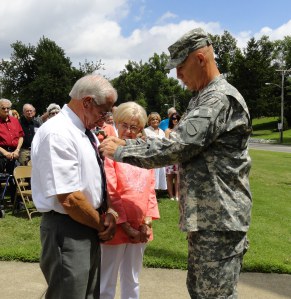
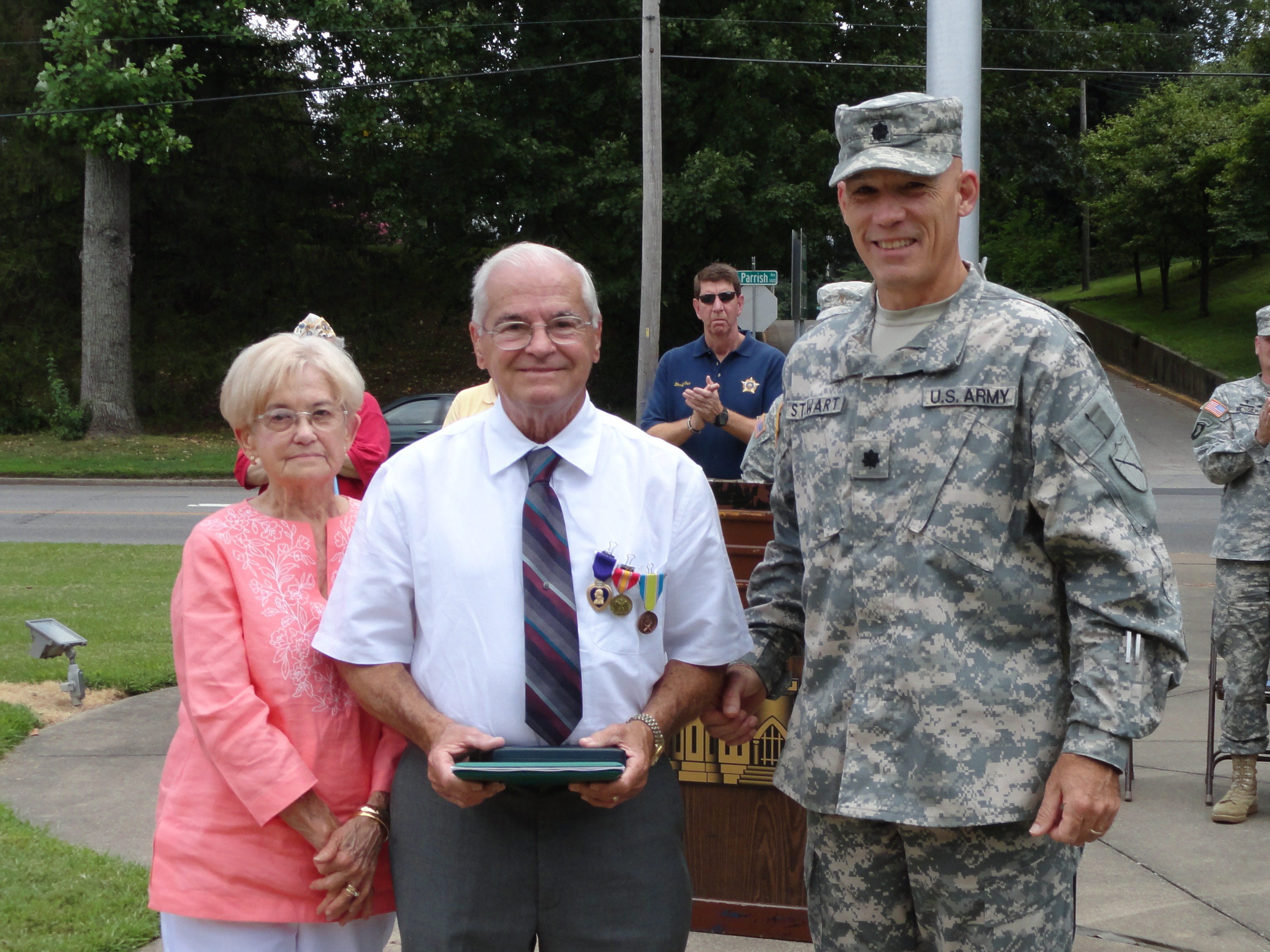
James Christian receives the Purple Heart Medal from Kentucky National Guard Lt. Col. Alexander C. Stewart II, 206th Engineer Battalion Commander. Christian was wounded in action during the Korean War while tending to the injuries of a fellow Soldier. (Photo by Sgt. Sandra Fariss, 206th Engineer Battalion Unit Public Affairs Historian Representative)
NOTE: Each week kentuckyguard.com publishes stories by Kentucky National Guard unit public affairs historian representatives, also known as UPAHRs. This is an additional duty taken on by a Soldier or Airmen with the intent of telling their unit’s story. This is one such story ….
OWENSBORO, Ky. — On August 14th, 2011 in a ceremony on the lawn of the Owensboro Armory, the 206th Engineer Battalion had the honor of presenting the Purple Heart to Mr. James Christian.
A life-long resident of Owensboro, Christian served on the front lines of the Korean War with the United States Army. He was only 21-years old when 0n February 24, 1954 he was struck by shrapnel from a nearby mortar round that exploded. Christian was caring for another Soldier who was more seriously wounded and wasn’t concerned about his wounds.
“I was doing what needed to be done,” he said.
After finishing his tour, Christian thought nothing of his missing award. It was through the joint efforts of the 206th Engineers and the local Disabled American Veterans Association that at the age of 78, nearly 58 years after the incident, that he finally received recognition for his injuries under fire.
“It was an honor to have been a part of the ceremony with Mr. Christian and his family,” said Kentucky National Guard Lt. Col. Alexander C. Stewart II, 206th Engineer Battalion Commander. “We believe that the Army, through the National Guard, will always try to do the right thing no matter how long it takes.”
“This was the right thing,” he added.
dwa
Story and photos by Staff Sgt. Michael J. Oliver, Kentucky National Guard Public Affairs Office
Click here to view more photos
Kentucky Guardsman Sgt. Michael Gabbard, 207th Engineer Company, 201st Engineer Battalion, operates unit's new 966H wheel loader during a training exercise at Boone National Guard Center in Frankfort, Ky. (Photo by Staff Sgt. Michael J. Oliver, Kentucky National Guard Public Affairs Office)
FRANKFORT, Ky. – Kentucky National Guard combat engineers at Boone National Guard Center in Frankfort, Ky. are doing more than just training on their new equipment. They are leaving behind a little bit of themselves … and creating a legacy for the organization.
Troops from the 201st and 206thEngineer Battalions are currently conducting an collaborative annual training project that will improve their wartime skill sets and laid the groundwork for future construction at BNGC.
“These projects give us the opportunity to do their road test and make sure they have all the necessary training to be licensed our unit’s equipment,” says Capt. Jon Gensley, 207thEngineer Co., 201st Engineer Battalion. “The biggest training benefit is we can orchestrate and put all these moving pieces together to execute a mission.”
Kentucky Guardsmen Pvt. John Law, 130th Engineer Support Co., 206th Engineer Battalion gives the hand and arm signal to the dozer operator while Spc. Sarah Setser and Joshua Smith of the 207th Horizontal Engineer Construction Co., 201st Engineer Battalion pushes a pile of rubble into the bucket at a training exercise in Boone National Guard Center in Frankfort, Ky. (Photo by Staff Sgt. Michael J. Oliver, Kentucky National Guard Public Affairs Office)
One of the unit’s equipment is a new 966H wheel loader that has an auto level for the bucket and air conditioning in the cab.
“The backup camera and the automatic system make our work a lot easier,” says Sgt. Michael Gabbard, who was 207th‘s non-commission officer of the year. “I really like the fact our guys can use this military training to help with getting civilian construction work.”
The training includes correcting drainage and soil erosion problems with an improved culvert outside the gate. They’re also prepping the land around the entrance for a new lane which will help with safety and security.
“It’s great seeing two battalions working together and everybody has a good moral about our project,” said Staff Sgt. Jason Coldiron, 207th Engineer Company. “I’m really glad my guys are part of this project and their thumb print will be left here on whatever they decide to put here.”
Click here to view more photos