
Pages
Stay In Touch
More
© 2013 KentuckyGuard
Story by Capt. Desiree Dillehay, 206th Engineer Battalion
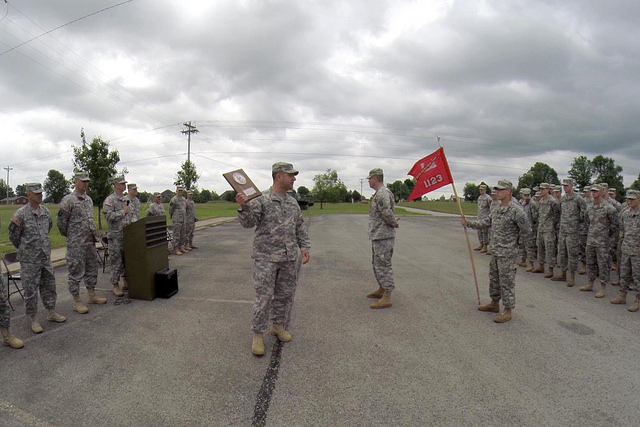
Capt. Robert McWhorter, former commander of the 1123rd Engineer Company, compliments Soldiers of the unit during their annual training at Camp Atterbury, Ind. June 25, 2015. The unit was named the best engineer company in the Army National Guard for 2014, earning them the Itschner Award. (U.S. Army National Guard photo by SGt. Sandra Fariss)
FRANKFORT, Ky. — The Kentucky National Guard’s 1123rd Sapper Company was named Most Outstanding Engineer Company of the Year for 2014.
The Itschner Plaque is an award given to the most outstanding engineer company each year. First awarded in 1960, the award is named in honor of Army Lt. Gen. Emerson C. Itschner. In 1974, the competition for the Itschner Award was broadened to include the Army National Guard and the Army Reserve.
With hard work and dedication to the mission, to the 206th Engineer Battalion, the 149th Maneuver Enhancement Brigade, and to the Kentucky Army National Guard, the 1123rd received the Itschner Award for the fiscal training year 2014.
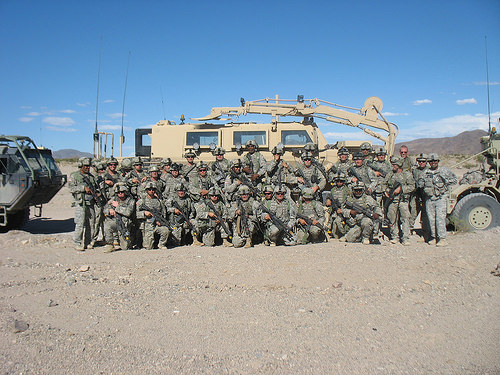
Soldiers of the 112rd Engineer Company gather for a group photo at the National Training Center in Fort Irwin, Calif., Aug. 21, 2014. The three-week rotation at NTC was the culminating event of a hard year of training for the unit. (Photo courtesy of the 1123rd Engineer Co.)
The level of proficiency that this company achieved during the evaluated period has inspired the unit’s leadership, who said the award serves as a testament to the Soldiers’ unwavering motivation, dedication to their unit, and their ability to learn, adapt and overcome any obstacle. Given the many hurdles National Guard units inherently face with training continuity between drill weekends, this unit’s Non Commissioned Officers and Officers are exceptionally outstanding.
“Winning the Itschner Award speaks of the caliber of Soldiers within the 1123rd Sapper,” said Lt. Col. James Richmond, commander of the 206th Engineer Battalion. “The unit is only eight years old and to have achieved superior achievements in strength, training, and performance in such a short time and against such a complex mission set is simply incredible.”
Richmond also added that few know what Sappers are in the military. “He is the Swiss Army Knife of Soldiers, in essence an infantryman who specializes in laying or clearing minefields,
demolitions, field defenses and general construction, as well as road and airfield construction and repair.”
Click here for more photos of the 1123rd.
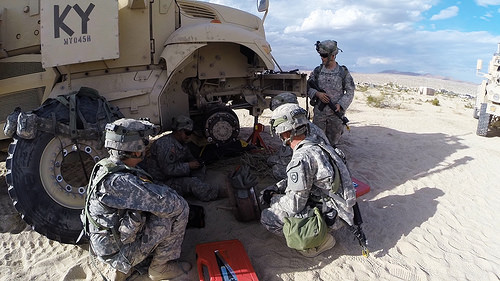
Engineers with the 1123rd Sapper Company change a tire on an armored vehicle during a training exercise at Fort Irwin, Calif., Aug. 15, 2014. The unit’s hard work at NTC earned them respect from a variety of training supervisors and Reserve and active duty units. (Photo courtesy of 1123rd Engineer Co.)
For the 1123rd, a 20 day rotation at the National Training Center in Fort Irwin, California was the culmination of a rigorous six month journey. Originally, the 1123rd was considered to serve as a component of the Opposing Force (OPFOR), but the focus shifted and the Sappers had an opportunity to serve as a Brigade Special Troops Battalion (BSTB) enabler in order to perform route clearance missions. This assignment required a dramatic change in the unit’s task organization, moving from three Sapper platoons and a headquarters platoon to two Route Clearance Packages, one Company Intelligence Support Team and a headquarters platoon. The 1123rd had 14 training days from March to July to prepare for NTC. The pace of training became very intense and success hinged on detailed planning, commitment to excellence and, most importantly, leveraging the knowledge of experienced route clearance personnel to increase training efficiencies without compromising quality.
The Sappers executed their strenuous training plan and completed the NTC rotation with remarkable results. Competence, adaptability and readiness for any mission was proudly displayed throughout the exercise. The 1123rd received accolades from a variety of training supervisors and both reserve and active duty counterparts. The predominant theme conveyed during the course of training was the unit’s willingness and desire to learn and better themselves. A high level of motivation and a productive and professional culture was demonstrated to every Soldier in the company.
The 1123rd was given professional development and networking opportunities that would not have been available without a rotation at NTC. These opportunities allowed the 1123rd leadership to collaborate with their active duty counterparts and higher headquarters in order to establish the unit’s relevance and credibility. This paid dividends as the 1123rd maintained an active voice in their utilization and had the opportunity to contribute to missions for the battalion in addition to route clearance.
The 1123rd has gained an incredible amount of experience this year and is fully prepared to carry out its engineer mission, only now with the title of “the best.”
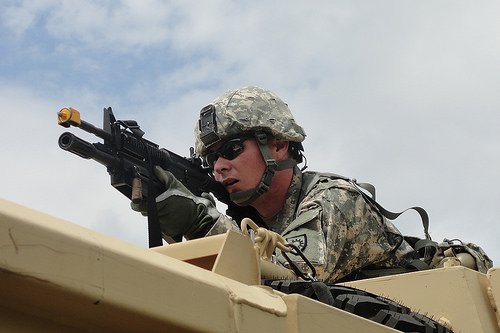
A Soldier with the 1123rd Engineer Company takes up a defensive position during a training exercise at Camp Atterbury, Ind., June 21, 2015. (U.S. Army National Guard photo by Spc. Brooklynd Decker)
“The Soldiers are truly honored to receive this award,” said Sgt. 1st Class Thomas Elmore, readiness NCO for the 1123rd. “This unit went from standing up the 1123rd in 2009 to the best National Guard engineer unit in the country in 2014. Don’t know how else to put it except they are proud to be the BEST.”
However, the 1123rd Sapper Company is not just an operational machine. In addition to their rigorous training schedules, they incorporated time to give back to their community. The 1123rd is broken into two armories located in Leitchfield and Marion, Kentucky. Both locations have long been and continue to be involved with their respective communities. During the 2014 training year the two armories actively contributed to several community events, either during scheduled drill or by Soldiers volunteering outside of normal duty periods. The 1123rd participated by marching in the Christmas and Labor Day parades, provided speakers and representatives to three Veterans’ Day events and a Memorial Day ceremony. Additionally, they collaborated with the local American Legion for military funeral honors for veterans upon their family’s request.
“The level of proficiency that this company has achieved during the evaluated period is truly remarkable and serves as a testament to their unwavering motivation, dedication to their unit and their ability to learn, adapt and overcome any obstacle through Unbridled Service,” said Elmore.
The Soldiers of the 1123rd are revered throughout the 206th Engineer Battalion for always maintaining a high level of motivation in any training environment and with every mission; this training year they have raised the bar. Engrained into this company is a true sense of ownership and pride, where each Soldier maintains a stake in its success and proactively works to improve the unit.
Story by Sgt. Brandy Mort, 133rd Mobile Public Affairs Detachment
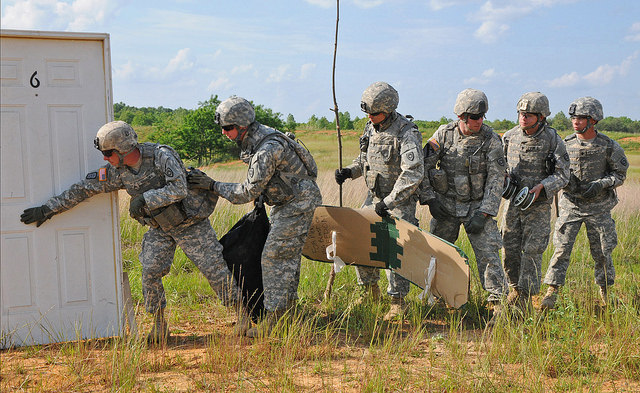
Soldiers of the 577th Sapper Company inspect a mobile door frame before attaching a silhouette charge during demolition training at Fort Knox, Ky., May 15, 2015. A silhouette charge provides a hole in a door so Soldiers can gain access into a building. (U.S. Army National Guard photo by Sgt. Brandy Mort)
FORT KNOX, Ky. – The terrain rumbled as pieces of a wooden door shot out in every direction. From the looks of the scene, you’d think a tornado had ravaged the area. Instead, it was a silhouette charge the 577th Sapper Company had attached during their demolition training.
Soldiers of the 201st Engineer Battalion, 577th Sapper Company, participated in standard demolition training at Fort Knox,Kentucky, May 15-16.
Capt. James Schmitz, 577th Sapper commander, said Sapper teams are essential for troops to advance through breached obstacles, such as a collapsed building, safely. He said this training helped when they deployed to Afghanistan in 2009.
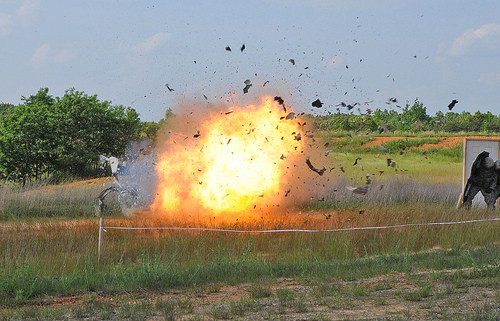
Soldiers of the 577th Sapper Company take cover during demolition training at Fort Knox, Ky., May 15-16, 2015. A C-4 charge blast takes 1.34 seconds after detonation. (U.S. Army National Guard photo by Sgt. Brandy Mort)
“Proper demolition training is very essential,” said Schmitz. “It is vital to get it right before we are tasked to do it in the future, whether it’s for our training exercise in Louisiana or a future deployment. We need to do it right, here, so we can do it right, there.”
Sgt. John Howard, Sapper non-commissioned officer, has 10 years experience in the engineers. It’s that experience, he said, that keeps the unit proficient. He said, each year leadership uses lessons learned to improve the training.
“When I was new I got vital training during this time and I use things I have learned through the years as I teach other junior enlisted to do the same,” he said.
Click here for more photos.
Traditionally Sappers are combat engineers who advance with the front-line infantry and are some of the first people sent to assess damages caused. Howard said training the younger Soldiers in their craft is similar to the role of the combat engineer sweeping the battlefield; they make sure the path is safe and clear before others go through.
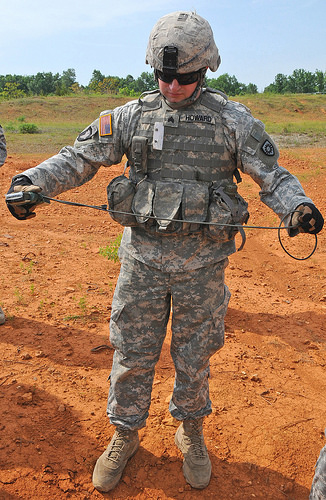
Sgt. John Howard, combat engineer with the 577th Sapper Company, unravels a C-4 charge during demolition training at Fort Knox, Ky., May 15-16, 2015. This year is Howard’s 10-year anniversary with the Kentucky National Guard’s 577th Sapper Company. (U.S. Army National Guard photo by Sgt. Brandy Mort)
“As a Sapper, we are the first people sent into the building to ensure the foundation is stable,” said Howard. “I use the same method as a platoon sergeant. If I don’t tell them the proper information, they won’t be able to be a strong foundation for their legacy.”
Staff Sgt. Aleksandr Vinogradov, a combat engineer, agrees that good leaders start from the beginning of their career.
“New Soldiers to the unit are like sponges,” said Vinogradov. “They will absorb anything you teach them. It is important to set a good example and train them the correct. We need to train for the future, not for the present.”
The team trained in various types of C-4 charges: A simulation charge, shape charges, Bangalore charges, urban breaching and mine clearing, also known as, MCLC. During urban breaching, they learned about linear door charges and silhouette charges. Sappers use what they learn in these scenarios for reforming the terrain for new structures, or to demolish existing structures.
“During urban breaching, we are able to see that different charges do different things,” said Howard. “A linear door charge will split a door in half, while a silhouette charge will create a hole in the door big enough for a person to walk through. If we don’t use the correct one in a non-training environment, we may be in trouble.”
Schmidtz said that safety and proficiency are two very important topics he focuses on at all times.
“My goal is to have everyone perform proficiently at their tasks and, most importantly, practice proper safety at all times. I have no doubt that my Soldiers will succeed in both aspects, whether in training exercises or in real-world scenarios.”
The Sapper Company is participating in this training in preparation for their annual training at the Joint Readiness Training Center in Fort Polk, Louisiana.
dwa
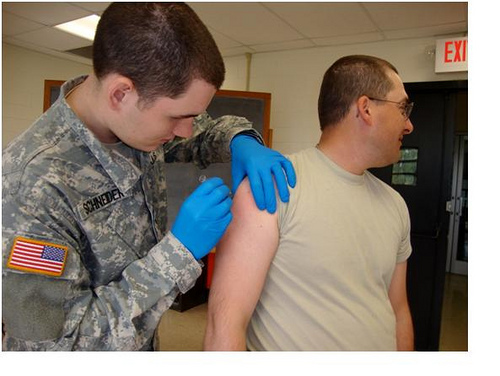
Sgt. Ernest Modlin, 130th Engineer Support Company, receives an immunization shot from Spc. Jacob Schneider, the unit's medic, for precautionary measures against exposure to contaminated flood water. (photo by Staff Sgt. Kitty Wu and Sgt. Sandra Fariss, 206th Engineer Battalion)
FRANKFORT, Ky. (May 9, 2011) - Kentucky Army National Guard combat engineers have been a driving force in fighting flood waters across Western Kentucky. Here are some of the images captured by the Soldiers in those units.
For more photos on this and other Kentucky National Guard stories visit our Flickr site.
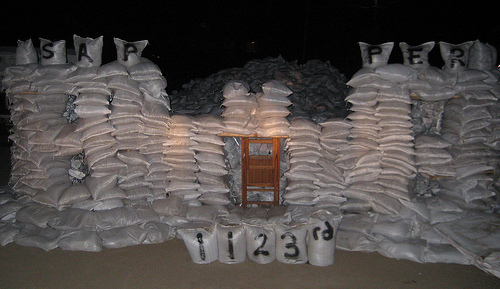
What better way to store your reserve of sandbags than in the shape of the combat engineer castle? (Photo by 1st Sgt. Shane Parrott, 1123rd Sapper Company)
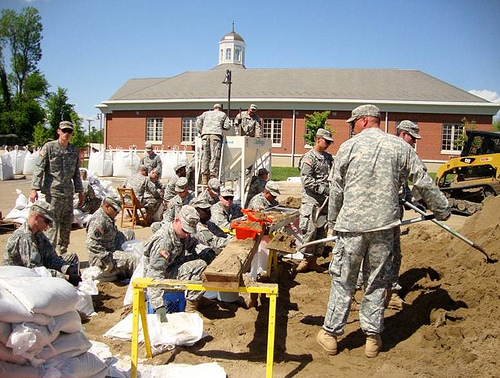
Kentucky Guardsmen from 206th Engineer Battalion fill sandbags for flood relief mission along the Cumberland River in Livingston County Ky. (photo by Staff Sgt. Kitty Wu and Sgt. Sandra Fariss, 206th Engineer Battalion)
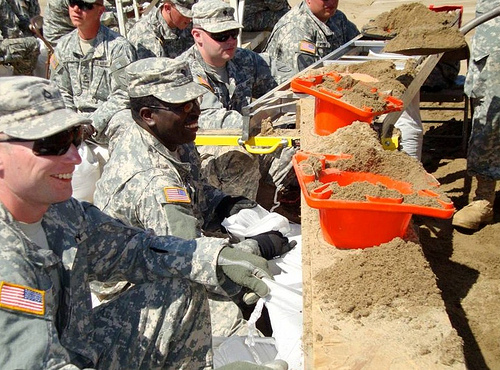
Kentucky Guard Soldiers from the 206th Engineer Battalion fill sandbags for flood relief mission along the Cumberland River in Livingston County Ky. (photo by Staff Sgt. Kitty Wu and Sgt. Sandra Fariss, 206th Engineer Battalion)
###
