
Pages
Stay In Touch
More
© 2013 KentuckyGuard
story by: Capt. Stephen Martin, Kentucky National Guard Public Affairs
STURGIS, Ky. — Former Kentucky Guardsman, Staff Sgt. David Holeman was re-awarded his military medals by Col. Benny Richardson and Maj. Bobbie Mayes at the Sturgis Municipal Airport in Union County, Ky. Apr. 2, 2014.
To see all the photos and video from this event, please click HERE.
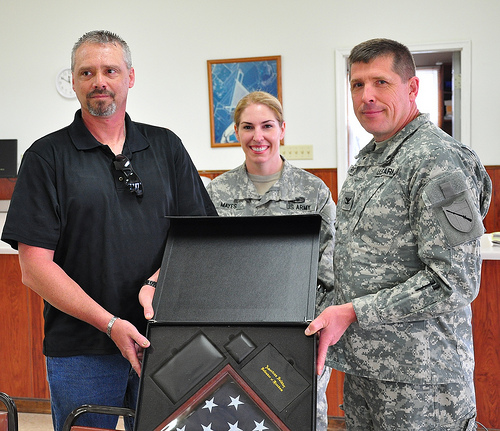
Former Kentucky Guardsman, Staff Sgt. David Holeman was re-awarded his military medals by Col. Benny Richardson and Maj. Bobbie Mayes at the Sturgis Municipal Airport in Union County, Ky., Apr. 2, 2014. Holeman lost all of his awards in a house fire Dec. 6th and the Kentucky National Guard personnel office was able to procure replacements for the Soldier. (U.S. Army National Guard photo by Capt. Stephen Martin)
Holeman lost all of his awards in a house fire Dec. 6th and Staff Sgt. Carl Cooper from the Kentucky National Guard personnel office was able to procure replacements for the Soldier.
“We’re a family,” said Richardson as he presented Holeman’s medals to him. “I’m sorry that this has happened to you, but I know that you and your family will persevere. That’s the kind of person you are.”
Holeman deployed with Richardson and Mayes on the Agribusiness Development Team two mission to Afghanistan during 2010-2011.
“I can’t believe you found and brought me these medals,” replied Holeman. “It truly is an honor to have you come all this way.”
“I can attest that the Guard really is family.”
Story by Staff Sgt. Sidney Hoffmann, ADT 5 Unit Public Affairs Historian Representative
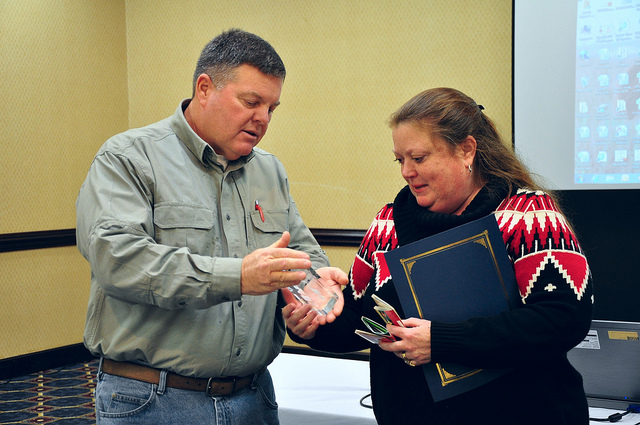
Col. Bob Hayter, commander of Kentucky’s Agribusiness Development Team 5 presents Ginger Munden the Family Readiness Award during the unit’s Yellow Ribbon Program in Louisville, Ky., Dec. 14, 2013. (U.S. Army National Guard photo by Staff Sgt. Sidney Hoffmann)
LOUISVILLE, Ky. — Just like the Soldiers and Airmen in the Kentucky National Guard, a Family Readiness Group is a unit. The FRG’s mission is to provide support not only to the deploying troops, but unto themselves. Families unite together for meetings and workshops that focus on addressing stress, issues regarding finances or children, or just coming together to talk about the good things and make morale packages for the Soldiers.
Ginger Munden served as the Family Readiness Group leader for Kentucky’s Agribusiness Development Team 5 during the unit’s deployment to Afghanistan in 2012-2013. ADT 5’s leadership presented her with the Family Readiness Award during the unit’s Yellow Ribbon ceremony, Dec. 15, 2013.
Members of the unit returned home in September, but due to logistical issues the Soldiers and Airmen arrived at different times and locations. The scattered return didn’t detract from the families awaiting them at the gates of the airports.
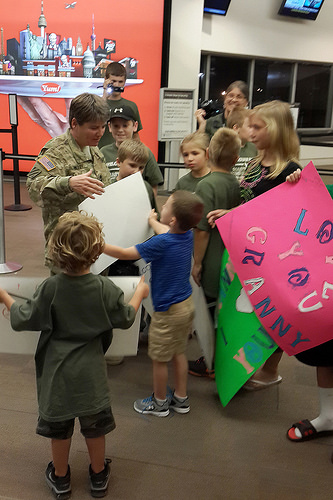
Master Sgt. Connie Gwinn is greeted by her grandchildren at Louisville International Airport upon her return home from Afghanistan, Sept. 6, 2013. Members of Kentucky’s Agribusiness Development Team 5 spent nearly a year in Afghanistan and is the last scheduled ADT for the Kentucky Guard(U.S. Army National Guard photo by Staff Sgt. Sidney Hoffmann)
“It feels good to know I have such an amazingly supportive family. I was proud of being a part of a great team, but I am definitely glad to be home now,” said Master Sgt. Connie Gwinn, who was met with an entourage of family members.
Supportive families have said to be the key to a successful deployment for military units and Munden wanted just that for the men, women and families of ADT 5 in running the FRG
“FRG teaches families they are not alone and are aware of the benefits available, share in frustrations and life changes, and group events like Red Cross training,” she said. “It was a great experience, and I could not have done it without the support and help of the Service members’ families.”
Col. Bob Hayter and Lt. Col. Dallas F. Kratzer presented Ginger with an etched glass memento containing the iconic National Guard minuteman figure.
Hayter praised the efforts of Ginger and the families by saying, “The FRG was the full-time connection to home. With the morale packages the FRG team had put together, it made the deployment more manageable and served as a reminder we were well thought of in our absence.”
Other family members were recognized as well for their efforts and participation in events such as Ralene Kratzer, Heather Steele and their three children, and Lynn and Sarah Fox.
Unfortunately, Sgt. Maj. Munden was away for training in Texas for his newly acquired position with the Wounded Warrior Transition Unit at Fort Knox. However, the ceremony was ended with his signature slow but strong clap by the entire unit, noting the profound respect the team had for him and his wife, Ginger.
ADT 5 was a joint operation consisting of both Air and Army National Guard members. During the nine months they were able to rebuild relationships between the people and their government by implementing programs such as the Youth Agriculture program and strengthened the current veterinary services. Among those programs, local farmers increased their management and marketing skills to be able to bring in more money for their community.
“Our team members served with honor, discipline, and integrity,” said Sgt. Maj. Munden prior to the ceremony. “Their performance was outstanding and their efforts brought hope to the people of Afghanistan. I am very proud to have been a member of this team.”
Story by Staff Sgt. Sidney Hoffmann, ADT 5 Unit Public Affairs Historian Representative
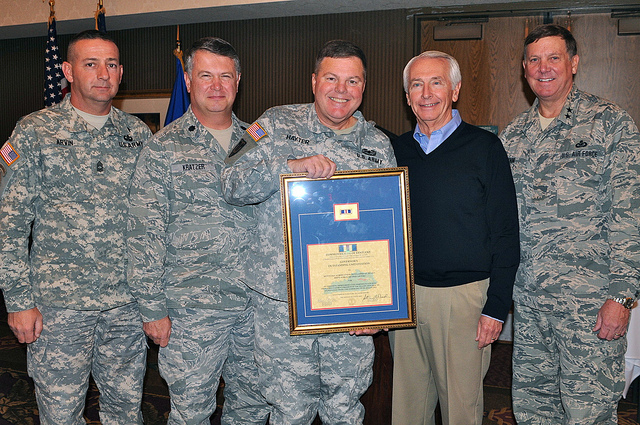
Kentucky Governor Steve Beshear presents Kentucky’s Agribusiness Development Team 5 with the Governor’s Outstanding Unit Citation during the Joint Force Headquarters’ Christmas dinner held at the Capital Plaza hotel in Frankfort, Ky., Dec. 7. ADT5 was rewarded for their outstanding meritorious unit performance during their deployment to Afghanistan in support of Operation Enduring Freedom. (U.S. Army National Guard photo by Spc. Brandy Mort, 133rd Mobile Public Affairs Detachment)
LOUISVILLE, Ky. — The Kentucky National Guard has sent five agriculture development teams to Afghanistan since 2007. In support of Operation Enduring Freedom, the teams strived to improve the capabilities of local farmers across Afghanistan with a unique approach to the civilians in a country at war. The Soldiers and Airmen took knowledge of irrigation, food preservation and veterinary medicine to the people. Skills that would prove just as important as the Service members’ military training.
In October of 2013, that mission came to an end as the final Kentucky ag team safely returned from their deployment.
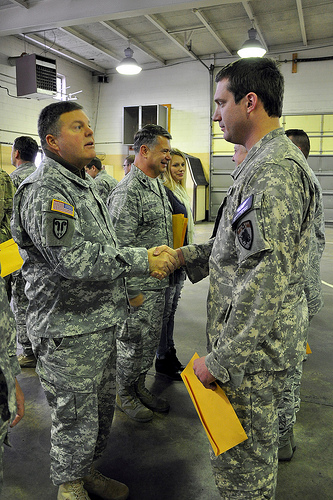
Col. Bob Hayter presents Capt. Forrest Holdsworth of Agribusiness Development Team 5 the Governor’s Outstanding Unit Citation in Louisville, Ky., Dec. 13, 2013. Each member of the unit received the awards which was presented by Governor Steve Beshear a week earlier. (U.S. Army National Guard photo by Staff Sgt. Sidney Hoffmann)
In recognition of the team’s lasting work in Afghanistan, Agribusiness Development Team 5 was awarded the Governor’s Outstanding Unit Citation Dec. 7, 2013. Governor Steve Beshear presented the unit commander, Col. Bob Hayter with the award during the governor’s annual Christmas luncheon with military families in Frankfort.
One week later, Hayter shared the award with the 38 other members of the ADT 5 at the unit’s Yellow Ribbon event in Louisville, Dec. 15.
“It was a great tour for me and is a tremendous honor to be recognized for what we were able to accomplish in Afghanistan,” said Hayter. “I am thankful and fortunate to have been a part of this mission as my last deployment before I retire. If the team takes anything away from this mission, it was a combination of leadership, division, correction and execution that made us a success.”
To see more photos from the award ceremony, click here.
ADT 5 is only the second unit to received the citation since its inception in 2007. The 201st Engineers received the first in 2012.
The award was established to acknowledge a unit’s contribution to the mission for which they were deployed. ADT 5 certainly fit the bill as they were able to build a veterinary clinic, establish a youth agribusiness program and provide long lasting skills and resources to continue to expand and enrich many surrounding communities in Afghanistan.
Master Sgt. Zakiya Taylor, an Air National Guardsman from Louisville served as a project manger for ADT 5. She said the award validates the hard work of the unit.
“The deployment was a rewarding experience,” she said. “I was able to work with some amazing young people who were in charge of their villages, but were hungry for knowledge and skills. Receiving this award brings the meaning of our mission to life by Governor Beshear’s acknowledgement.”
Story by Staff Sgt. Sidney Hoffmann, ADT 5 Unit Public Affairs Historian Representative
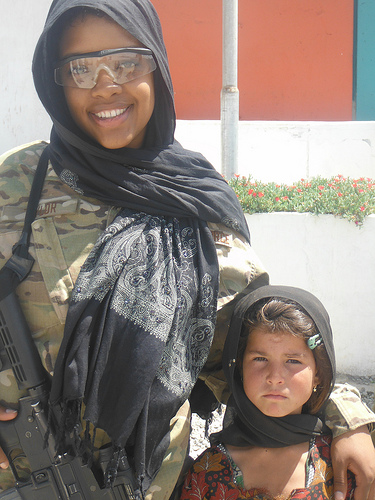
Master Sgt. Zakiya Taylor with Kentucky’s Agribusiness Development Team 5 stands with the daughter of a woman attending a canning class in Zaharay District, Afghanistan. The class, facilitated by U.S. Service members was a refresher course for local women to preserve foods for their families. (U.S. Army National Guard photo by Staff Sgt. Sidney Hoffmann)
ZAHARAY DISTRICT, Afghanistan — Kentucky Agribusiness Development Team 5 has completed many projects with this humanitarian mission here in Regional Command South, Afghanistan. One project they became a part of was a canning class facilitated by a U.S. Army Female Engagement Team from Fort Bliss, Texas.
The FET coordinated the location and ensured the information got out to the local women about the class. Master Sgt. Zakiya Taylor of ADT 5 provided the instructor from Kandahar City and distributed the supplies, which included the steam pot, funnels, ladles, jars, jar lifters, and sealers.
“With the supplies, we were able to provide approximately 40 local Afghan women with the tools and knowledge necessary to begin canning fruits and vegetables in their own homes,” said Taylor, ADT 5’s food preservation specialist.
Reinforcing the idea of Afghans teaching Afghans, the team contracted with a young Afghan woman, Laila Afag, from Kandahar City to teach the classes. A successful business woman in her own right, Afag co-owns three canning factories in the city and is an expert in teaching canning techniques for fruits and vegetables. Additionally, six of the women were teachers in the local area and would be able to pass along what they had learned in the class to others. Interestingly, one of the local teachers is a fifteen year old girl from Zharay, she was one of the few that could read, write and understand the material. The teachers were excited to display their educational skills and Afag allowed the teachers to assist her in presenting to the class.
“The canning supplies we were able to provide will be for home use and the demonstration classes given by Laila Afag will help the women preserve their produce,” said Taylor. “This makes them not only marketable in the future, but a sustainable tool to pass down to future generations.”
Since refrigeration and cold storage is not readily available in many of the local homes here, being able to store foods for longer periods of time is essential for the survival of the people.
Afag was highly motivated and proud she could extend her knowledge and services to this project.
“It is an easy craft; one they can pass down from one generation to the next,” she said. “They will be able to can and preserve a large variety of food if done correctly. The knowledge is there, because it is popular in this area.”
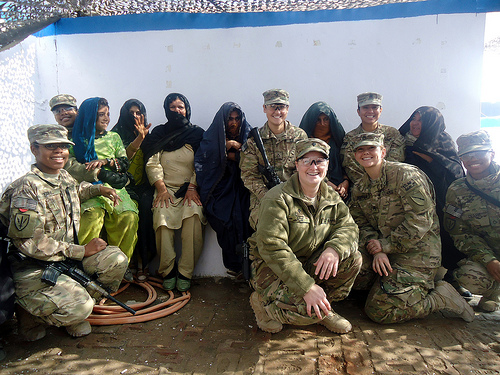
Female Soldiers with Kentucky’s Agribusiness Development Team 5 gather for a group photo with women and children in the Zaharay District, Afghanistan. The Afghan women attended a canning class while some Soldiers helped with a children’s class. (Courtesy photo)
It is important to note these women are familiar with the process; however, the value-added is having the proper tools and focusing on sanitary techniques.
The class included the process of paste canning, pickling and fruits preserving. Each woman was provided a handout to follow along with during the presentation. The material was presented at a very basic level, which provided beginners a jumpstart on making quality preserves without studying the science of preserving. The women were very interested in participating and learning about the canning process. Afterward, many women stated they felt confident and certain they could effectively implement these techniques at home.
A high note of the event was when the Zharay District Governor, Sayeed Ashina Agha, and Director Bismullah Khan, District Education Representative, came on the last day of training to recognize the women and give them encouragement and support for their participation. Even though the Taliban threats occur and transportation is not always an option to get to Forward Operating Base Pasab, these women truly risk their lives to take advantage of the programs provided for them.
“There is nothing like seeing their smiling faces and knowing the team has done something these women will take with them for the rest of their lives,” said Taylor.
Story by 1st Lt. Dwight Bushong and Sgt. Jamie Pungirum, ADT 5
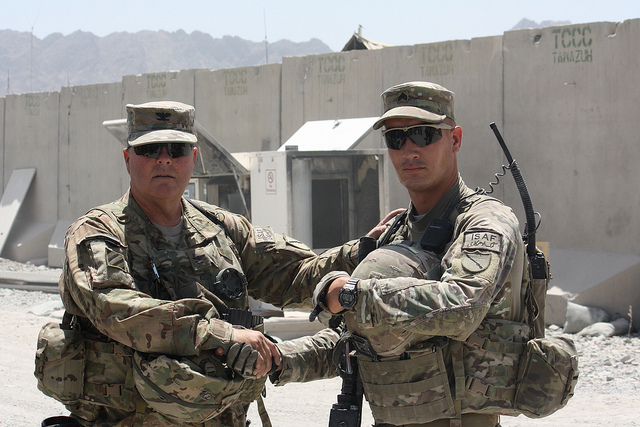
Col. Bob Hayter, left, commander of Kentucky’s Agribusiness Development Team 5 congratulates Sgt. Zachary Leidecker at Forward Operating Base Pasab, Afghanistan, following the completion of Leidecker’s 100th combat mission in country, July, 2013. (U.S. Army National Guard photo by Sgt. Jamie Pungirum)
FORWARD OPERATING BASE PASAB, Afghanistan — It was a day like every other, with the blazing sun searing down on the arid earth below causing temperatures to soar to one hundred and eight degrees. For Sgt. Zackery Leidecker of Kentucky’s Agribusiness Development Team 5, the day marked a great accomplishment and success for not only him, but for the entire team.
On this day, Leidecker was the first member of the ADT 5 to complete his 100th combat patrol in Kandahar Province of Southern Afghanistan. The unit as a whole conducted more than 190 missions while in the country.
Leidecker served in multiple positions during his tour of duty that included truck commander, gunner, dismount security, and personal security detachments.
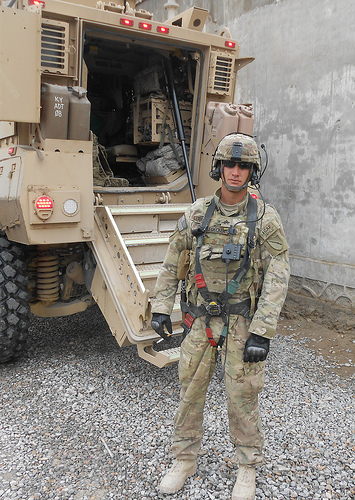
Sgt. Zachary Leidecker with Agribusiness Development Team 5 pauses behind his vehicle prior to a mission in the Kandahar Province, Afghanistan, July, 2013. Leidecker participated in more than half the unit’s combat mission while deployed, serving as driver, gunner and security. (U.S. Army National Guard photo by Sgt. Jamie Pungirum)
“As the platoon leader, I cannot be more proud of his accomplishments while on the team,” said 1st Lt. Dwight Bushong. “He is a Soldier that is always taking the first step forward to get the mission accomplished, no matter the task.”
To see more photos from this story, click here.
“In my eyes as an Army officer and a leader of Soldiers, I see a bright future for this young non-commissioned officer,” said Bushong. “I look forward to seeing his continued success in the Kentucky Army National Guard. I would gladly have him as part of my combat team any day.”
When asked about how he feels about this day, Leidecker replied humbly, “I feel very accomplished, but there is no way I could have done this alone.”
This is not Leidecker’s first combat tour on foreign lands where he was part of great things. According to him, on his last deployment to Iraq with the 2113th Transportation Company, his truck crew completed the most missions in the unit. When inquired as to what his favorite position to work in was, he stated simply, “I have no preference on what I do on mission, as long as I can be a part of the mission, I’m happy.”
“He has played a vital role as a gunner. Ninety percent of the time he was the gunner of the lead truck, always ready and on his toes for whatever may come,” said Sgt. 1st Class Richard Harris, Leidecker’s platoon sergeant.
As the lead truck gunner, it is Leidecker’s eyes that were the first to spot anything the convoy may have came across. He was constantly on the lookout for potential threats including improvised explosive devices, complex ambushes, or just the ever constant jumble of traffic in downtown Kandahar City.
However, Leidecker’s real potential seems to become more obvious after speaking with Pvt. John Amis. The young Soldier is first to acknowledge Leidecker’s willingness to step up as a mentor and teacher.
“He is a great example for us lower enlisted,” said Amis. “He shows if you put the time and effort in something you will be rewarded. More importantly for most of us, he has taught us our job from the ground up.”
“When I came to the team, I really didn’t know what it was going to be like being a gunner on combat patrols. With his guidance and leadership, it has made me a better gunner and a better Soldier.”
Story and photos by Staff Sgt. Sidney Hoffmann, ADT 5 Unit Public Affairs Historian Representative
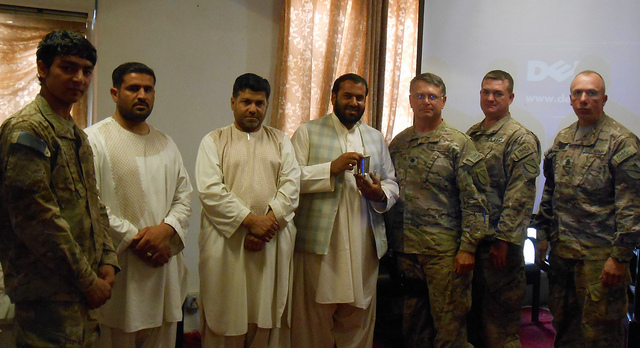
Lt. Col. Dallas Kratzer, Maj. Bill Hatfield and Sgt. Maj. David Munden meet with District Education Representative Bismillah Khan (center) and fellow Kandahar University staff members. Kentucky Agribusiness Development Team 5 took an educational approach to an agricultural problem and found great enthusiasm and success. (U.S. Army National Guard photo by Staff Sgt. Sidney Hoffmann)
ZHARI DISTRICT, KANDAHAR PROVINCE, Afghanistan — Before Kentucky Agribusiness Development Team 5 left the U.S. for its service in Afghanistan, it was their desire to bring agricultural leadership education to Afghanistan. The Soldiers and Airmen all held a strong belief that the future of Afghanistan lay in the hearts of young men and women who were open to learning new agricultural information, skills, techniques, and leadership abilities to equip them for a new Afghanistan that could stand on its own and serve its people.
“The key to Afghanistan’s success is the education of its young people, especially as it relates to agriculture,” said Col. Bob Hayter, the team’s commander. “Approximately 80% of Afghanistan’s economy is based on agriculture.”
Lt. Col. Dallas Kratzer agreed, adding that, “Much of the agriculture success in the US has its roots from organizations like 4H and FFA. It’s time to help partner, encourage and foster a Future Farmers of Afghanistan.”
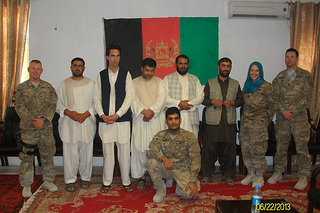
Tech. Sgt. Nathan Steele, Capt. Lund, 1st Lt. Benjamin Maillet worked with the Assistant District Governor of Zhari and Kandahar University Professors to educate local citizens on a wide variety of agricultural practices. (U.S. Army National Guard photo by Staff Sgt. Sidney Hoffmann)
Youth Leadership organizations like FFA and 4H have had a huge impact on American Agriculture. In many ways these organizations have shaped the American culture in entrepreneurship and leadership to where we are today. With 4H celebrating its 100 year anniversary and FFA celebrating it 75 year anniversary this past year, it is no wonder the United States has come so far with these combined years of investment leading to the agriculture leadership and ingenuity across our great country.
The first task was to identify a program that had an Afghan look and feel to it, being easily accepted by the Afghan culture and community. Curriculum promoted by KY ADT 3, written in Pashto, and supported by the Ministry of Agriculture at the capital in Kabul were found, along with several boxes of books, patches, and pins that students could earn while moving through the program.
The program selected was built on four important pillars; learning, doing, earning, and serving. Team members found this to be very profound as it is modeled programs like 4H back home, focusing on using the head, hands, heart, and health.
“This principle of ‘earning’ is important,” said Tech. Sgt. Nathan Steele who, along with 1st Lt. Benjamin Maillet, made up ADT 5’s Team Zhari. “After decades of war, a lot of Afghans have a difficult time looking at agriculture as a means to generate income, as a lot of families are simply using their farms to sustain them. Until recently, the district was too dangerous to travel to conduct business transactions, so most families produced only what they needed, not necessarily what they could sell for profit at the local market.”
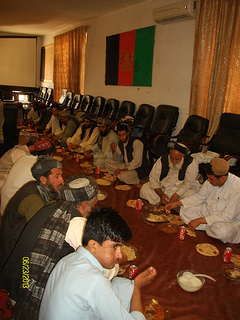
High school and middle school teachers attend a course given by the Kandahar University Professors in the Zhari District, Kandahar Province, Afghanistan. The teachers’ instruction was facilitated by 1st Lt. Benjamin Maillet and Tech Sgt. Nathan Steele of Kentucky’s ADT 5. (U.S. Army National Guard photo by Staff Sgt. Sidney Hoffmann)
With a solid foundation of an Afghan Youth Agriculture FFA style program already in existence, the Kentucky Guardsmen did not have to reinvent the wheel; they just had to find an avenue to implement this program successfully in Zhari. Although the program was intended to work through the District Director of Agriculture Irrigation and Livestock, the team took a different approach, building a relationship with the Director of Education Dr. Bizmillah Kahn. Together they started a Youth Agricultural Program in his district, as an after school program to over 500 students in two high schools and one middle school, teaching both boys and girls, eventually expanding it to all 5,000 students.
The curriculum was printed as a 70 plus page book in color giving teachers the ability to teach students about water management, irrigation techniques, soil management, wheat & corn production, chicken and egg production, terracing and rice production, and the water cycle that could have immediate impacts when students take this information back home to their families, having a lasting impact on their future.
Most important, the program was about Afghans teaching Afghans teaching Afghans! Kandahar University professors were going to teach high school teachers, who were going to teach students in their classrooms. Furthermore, according to Dr Bismillah Kahn, those high school teachers who received training were going to train other teachers to teach this program in their classrooms.
The Youth Agricultural Training was a huge success. It was supported by and attended by the district governor and the assistant district governor of Zhari, who encouraged them to teach this program well in their schools so the students could take these skills home with them to help their families, that this would bring honor for them.
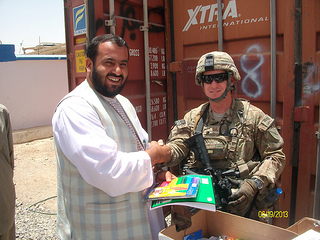
Tech. Sgt. Nathan Steele hands school supplies over to District Education Representative Bismillah Khan. The supplies were donated by Luhr Elementary School and Midway College in Kentucky. (U.S. Army National Guard photo by Staff Sgt. Sidney Hoffmann)
Along with this program KY ADT 5 delivered school supplies donated from Luhr Elementary School and Midway College in Kentucky to Dr. Bismillah Kahn to give out in his schools. This further created momentum for this program as they now had supplies to work with while making a friendly link between the students and teachers from the US, to those in Afghanistan.
Team Zhari’s outside the box thinking was instrumental to the program’s success. They had done two things never done before; moving the program through the Director of Education and creating a 70 plus page curriculum in color for the Youth Agricultural Program to meet the specific needs of the district.
“It was the right call to move this program through the Director of Education Dr. Bismillah Kahn,” said Maillet. “In Afghanistan, having the right program is not enough. You have to put it into the hands of the right people if you want to see it to succeed.”
“This Youth Agricultural Program is the most sustainable thing KY ADT 5 has done and has the potential to last years after we are long gone,” said Steele. “We just put valuable agricultural information into the hands of Afghans they put together themselves, through a program they are excited about expanding themselves.”
“My grandfather always told me hast makes waste,” added Steele. “This time we didn’t care more about this program than the Afghans did, we moved slowly and carefully, they took ownership of it and are carrying it forward. I guess he was right.”
“The way you change a culture is to engage and inspire the youth,” said Kratzer. “A program like this has the ability to effect change a generation from now. What these students will learn can never be taken away from them.”
Future success of this Youth Agricultural Program and impact on the Province of Kandahar is yet to be seen, but based on programs in the United States, its effect could be far reaching and last for years to come.
“We may never know what far reaching impacts that one idea or program can have,” said Hayter. “We have planted a lot of ideas or seeds here in Afghanistan. Who knows what it will look like when these ideas take root and grow into something we could never imagine.”
Story by Sgt. Matthew Thomason, Agribusiness Development Team 5
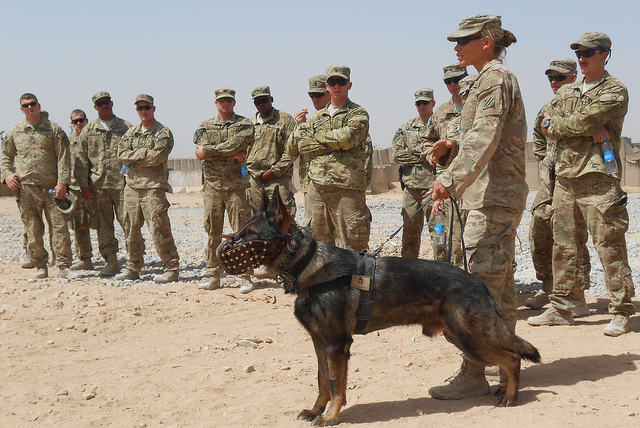
Tech Sgt. Jessie Johnson speaks to members of Kentucky Agribusiness Development Team 5 about her dog Crash and his abilities as an attack and bomb dog at Forward Operating Base Pasab, Afghanistan, June 20, 2013. The Military Working Dog Team is utilized to assist ADT 5 in clearing areas quickly when business is being conducted outside of the wire in the villages and farms. (U.S. Air National Guard photo by Lt. Col. Dallas Kratzer)
FORWARD OPERATING BASE PASAB, Afghanistan- The afternoon sun was beating down as soldiers from Kentucky Agribusiness Development Team 5, gathered for training conducted by Military Working Dog Teams in order to better understand their counterparts and the abilities they possess. Since their arrival to country, ADT5 has been utilizing the invaluable asset of the MWD teams and has established a great working relationship with the handlers and their dogs. Today would be a lesson to remember, as members of ADT5 would now gain a greater understanding of the professionalism and dedication of both the handlers and the dogs themselves.
The training began with a demonstration of the capabilities of the dogs in finding explosives. C4, a high explosive, was buried in a large search area out of the view of the MWD’s. Dart, a black Labrador, was let off his leash by his handler and the search began. Within a matter of minutes, Dart had found the buried explosives and lay down, a signal to his handler he had found something.
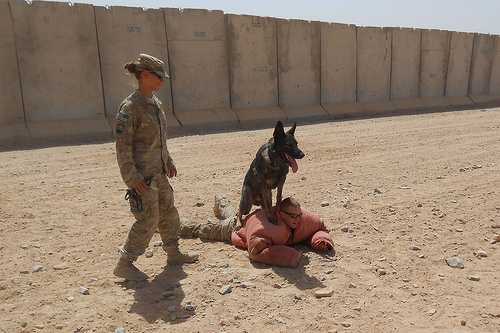
Staff Sgt. Matthew Nicholson is pinned down by Crash, Tech Sgt.
Jessie Johnson’s loyal companion during an exercise at Forward Operating Base Pasab, Afghanistan, June 20, 2013. The dog is trained to keep a detainee in place until further instructed to release his hold.(U.S. Air National Guard photo by Lt. Col. Dallas Kratzer)
“I’ve been on six deployments and this is the first time I’ve worked with Military Working Dogs,” said Sgt. 1st Class Richard Harris, Security Forces platoon sergeant. “Personally, I prefer dog teams because it allows me to move much faster when dismounted. Handlers train and work together every day, so it makes it easy to use different teams each mission.”
The biggest threat the International Security Assistance Forces face in Afghanistan is the Improvised Explosive Device and MWD teams are a great asset in defeating the IED threat. ISAF forces utilize MWD teams on a regular basis to clear areas of IED’s before allowing the security personnel to move into the area. MWD teams are essentially on the front lines of any mission. ADT5 uses MWD teams in the same capacity. When asked how the absence of MWD’s would affect the mission, Staff Sgt. Robert Denham, Security Forces Team Leader said it’s the fastest way to clear an area of threats.
“The mission would be impacted greatly because of the excessive time it would take to clear (the area) and the strain it puts on the dismounted security,” he said. “There is no tool, other than the Military Working Dog, as versatile and able to take on anything the mission throws at them.”
ADT5 soldiers were given a demonstration of obedience where the dogs were given many commands to follow and responded accordingly, proving just how much control the handlers have. Then came the main event: bite training. Many of these dogs serve a dual purpose, in that, they can search for explosives and are trained to attack. The troops were given a great demonstration of the power these dogs have and capped off the training day by volunteering to train with the dogs.
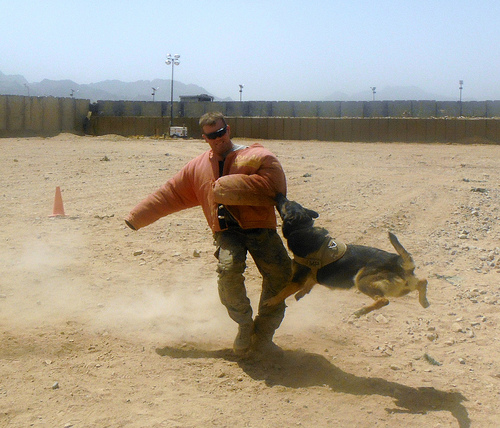
1st Lt. Clint Bushong of Kentucky’s Agribusiness Development Team 5 tries to get away from Crash, a military working dog during a demonstration at Forward Operating Base Pasab, Afghanistan, June 20, 2013. (U.S. Air National Guard photo by Lt. Col. Dallas Kratzer)
Spc. Morgan Vinson, a Security Forces team member, was the first brave soul to volunteer to be attacked by one of the dogs. He donned a protective jacket and was given a quick safety brief by one of the handlers. He then participated in several role plays where he played an aggressor and was suppressed by the MWD. One such role play was a situation where Vinson was a suspect who decided to run from the Military Police. The dog waited patiently until instructed by the handler to attack. Like a flash of lightning, the dog bolted after Vinson, quickly catching up and latching onto his arm. The power of the dog biting Vinson’s arm was enough to knock him off his feet.
“It’s like a strong force hitting you, but I knew I was protected by the suit,” said Vinson about his experience. “I felt very confident in the dog’s ability and it helped me realize the ability and obedience of the dogs. It was pretty cool.”
At the end of the day it seemed that everyone had a new respect for the dogs and their handlers. It was also a fun way to incorporate training with entertainment. The day ended with a group picture and lots of petting and wagging tails.
After all, what dog doesn’t like a little attention?
Story and photos by Staff Sgt. Sidney Hoffmann, ADT 5 Unit Public Affairs/Historian Representative
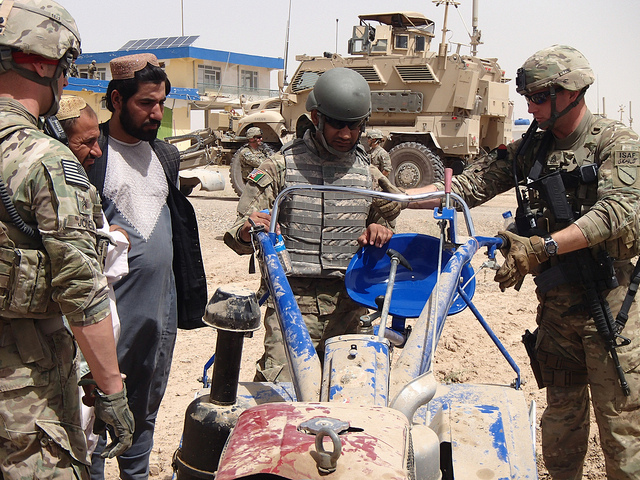
Staff Sgt. Matthew Nicholson with Kentucky’s Agribusiness Development Team 5 instructs local farmers on the operation of a tractor at the Zharay District Education Center in Kandahar Province, Afghanistan, June, 2013. The instruction was a refresher course from previous lessons given by ADT 4 in 2012.(U.S. Army National Guard photo by Staff Sgt. Sidney Hoffmann)
FORWARD OPERATING BASE PASAB, Afghanistan — The Kentucky Agribusiness Development Team 5 has worked diligently in maintaining working relationships with the surrounding areas of interest. The Zharay District Education Center or ZDEC is one of our closest ongoing projects. On this particular day, Tech. Sgt. Nathan Steele and 1st Lt. Ben Maillet recruited the assistance of our mechanics to come demonstrate a refresher course on how to use tractors for harvesting.
The Changchai is called a “walker” or “walk behind” tractor that has attachments serving different purposes. Since it is the season for harvesting their wheat, it is important the local farmers are comfortable working the equipment. Staff Sgt. Matthew Nicholson and Sgt. Johnathan Jones combined their skills to demonstrate how to start the tractor as well has how to safely operate the equipment and use of the gears while in motion.
“It was nice to use my abilities outside of the unit’s needs to assist the agribusiness team and actively contribute to the local farmers’ success,” said Nicholson, ADT 5’s motor sergeant.
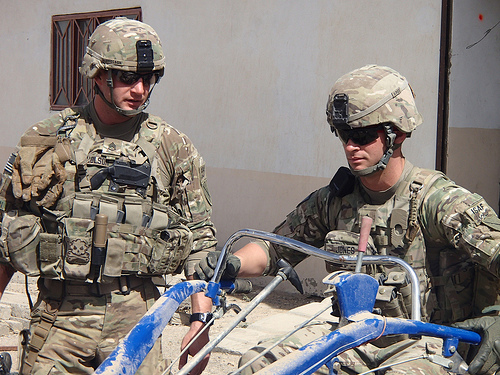
Staff Sgt. Matthew Nicholson (left) and Sgt. Jonathan Jones, both with Kentucky’s Agribusiness Development Team 5 test the gear of a walk-behind tractor during a refresher course for local farmers in Kandahar Province, Afghanistan, June, 2013. The Soldiers enjoyed the opportunity to put their personal skills from home at work on deployment. (U.S. Army National Guard photo by Staff Sgt. Sidney Hoffmann)
“At home, I really enjoy riding my tractor on the farm,” said Jones. “I never thought I would get to use my personal skills to aid this mission. It’s nice to have the chance to operate outside of my normal duties within the security forces and contribute to the agribusiness team.”
This mission is a continuation of the tractor safety training conducted with the ZDEC last year when ADT 4 was managing this location.
Click here for the ADT 4 story.
“We noticed the ZDEC workers were not utilizing all of the equipment available to maximize the amount harvested in a shorter period of time,” said Steele. “For example, it takes 2 or 3 weeks to harvest the wheat they currently have by hand, but if they were to use the Changchai, they could quite possibly complete the harvesting in one or two days. The intent is to ensure they know what the equipment can do for them.”
As ADT 5’s support is coming to a close, it is important to the team to leave behind a positive imprint and encourage the locals to continue to maximize their exporting abilities as well as build up the relationship between themselves and the Afghanistan government.
Story by Staff Sgt. Scott Tynes, 102nd Mobile Public Affairs Detachment
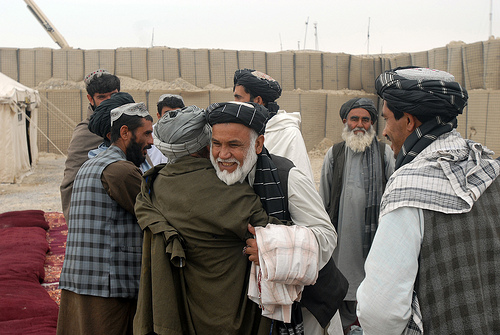
Hajji Faizal Mohammad, Panjwa’i district governor, greets a local farmer to an agricultural shura at Combat Outpost Mushan, Afghanistan, March 28, 2013. Mohammad and several other members of the Government of the Islamic Republic of Afghanistan addressed approximately 30 farmers about their concerns and presented the guests with simple tools. (U.S. Army photo by Staff Sgt. Scott Tynes)
COMBAT OUTPOST MUSHAN, Afghanistan – Hajji Faizal Mohammad, Panjwa’i district governor, and several officials of the Government of the Islamic Republic of Afghanistan met with approximately 30 local farmers for an agricultural shura at Combat Outpost Mushan, March 28, 2013. District Development Assistant Chairman Hajji Maik Mohammad and Mohammed Quodos, of the Ministry of Rural Rehabilitation and Development, also attended the shura to speak to farmers about their concerns and to inform them about what the government is doing for them. A shura is similar to a town hall meeting in the West.
The event was held at the request of Governor Mohammad, said Capt. Forrest Holdsworth of the Kentucky Agribusiness Development Team, based at Forward Operating Base Pasab. The 81st Civil Affairs also assisted with the shura and security was provided by Afghan National Army soldiers at Mushan and COP Mushan’s A Company, 4th Infantry Battalion, 4th Infantry Regiment, 2nd Infantry Division.
“We’re starting to establish linkages and that’s because security is getting better,” Holdsworth said. “The idea is to show (local farmers) we work closely with the district governor and they need to work with their government and use their process.”
Gov. Mohammad opened the shura and was followed by other GIRoA officials and the local ANA commander. A veterinarian, irrigation specialist and other professionals were also present. The officials then answered questions from the farmers, which ranged from how to get projects funded to complaints about crop lands being used for roads and other infrastructure improvements.
“It was a long shura and we didn’t really talk much at all,” Holdsworth said. “The fact that they led 90 percent of that discussion shows they are taking the lead.”
Gov. Mohammad said he was pleased with the results of the shura.
“It will benefit the people of the village,” he said. “This is good to build relationships and build security for this village.”
He said it is a continuing process and by talking with the people of the villages they can build the trust between local populations and the government. Mohammad hopes to be able to address other concerns in future shuras.
“It will be good in the future,” he said. “We should have more to benefit the villages on other things.”
Read more: http://www.dvidshub.net/news/104366/panjwai-district-governor-meets-with-farmers#ixzz2RDU6sl3c
Editor’s Note: Staff Sgt. Sidney Hoffmann, from Owensboro, Ky., is a signal support system specialist with the 149th Brigade Support Battalion in Louisville. Originally from Texas, Hoffmann moved to Kentucky after Basic Combat Training to pursue her education. She recently graduated with her bachelor’s degree in human resource management while deployed to Afghanistan with Agribusiness Development Team 5.
Commentary by Staff Sgt. Sidney Hoffmann, Agribusiness Development Team 5
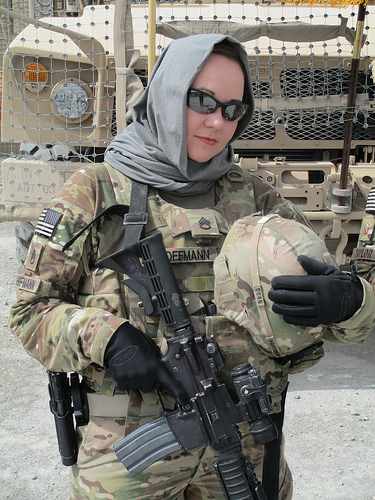
Staff Sgt. Sidney Hoffmann with Kentucky’s Agribusiness Development Team 5 recently graduated with her college degree from Ashford University while deployed to Afghanistan. Hoffmann’s father accepted her diploma during the school’s commencement in Moline, Ill., May 5, 2013. (Courtesy photo)
KANDAHAR, Afghanistan -Many Soldiers choose to join the military for a number of reasons: building of skills and abilities, supporting the war, better life for their families, fitness goals and education opportunities. In my personal experience, I joined the National Guard for a few reasons. The biggest reason was to ensure I could obtain my education without the financial support of my family and take responsibility for my future.
I was awarded my Associate’s in Arts with emphasis in Music and Art History at a community college hoping to pursue my Music Business degree at Eastern Kentucky University. After spending a year on campus, I needed a change. I enjoyed EKU, but I was struggling financially and I had lost the passion to follow my dreams in the music industry.
After dropping out of college in 2007 to work full time, I realized I needed to refocus and take a hard look at what I wanted out of my education. I decided to volunteer to deploy to Iraq and start school online while I was in country. Like most Soldiers, I came up with every excuse why I did not have the time to get started. After I returned from deployment, I determined I had procrastinated enough and started searching www.militaryonesource.mil for a suitable university.
I found Ashford University, called to get set up and the rest is history. The benefits of Ashford were astronomical compared to what I had experienced in the past. They have a veteran’s program that waves all of the tuition fees, the credit hour was no more than $250, and the electronic books were free and downloadable. It is an incredible resource enabling a student to access classes and books all from a laptop or phone while on the go. The class requirements are ideal for traveling and stationary Soldiers, the instructors are highly knowledgeable and flexible, and (best of all) many class mates are people just like you.
It took me a little over three years to finish my bachelor’s in human resource management. I was able to take breaks in between and my advisor always helped me get right back on track. GoArmyEd has also come a long way since it was established. Ashford is very familiar with the student voucher process, the transactions, and transcript updates. All are completed between Ashford University and the Kentucky National Guard’s education department.
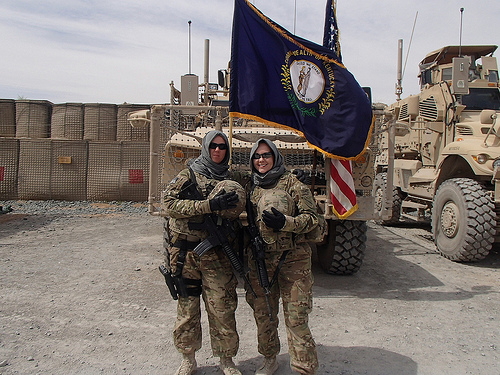
Staff Sgt. Sidney Hoffmann (right) with Sgt. Jamie Pungirum, both with Kentucky’s Agribusiness Development Team 5 in Afghanistan. (Courtesy photo)
As I was coming to the end of my degree, I knew it would be a challenge to maintain my high GPA while going through pre deployment training as well as turning in assignments on time. Not once did I have an issue meeting the requirements. One day, while waiting my turn to qualify on the M9 and M16 range, I responded to my classmates through my phone using the Ashford University Application. That’s just an example of how easy it is to make it happen.
I finished my degree this past February with a 3.84 GPA, graduated with honors, and became a member of Alpha Sigma Lambda. I really wanted to attend or at least participate in my graduation somehow from Afghanistan. With the eager assistance from Ashford, they asked me to find a proxy to go in my place, and they would take care of the expenses. They made my father and my grandfather feel right at home. As I watched the video of the ceremony from Afghanistan, I became emotional and in awe of the profound sound of the audience cheering when they announced my name and explained why my father was accepting my degree. The feeling of accomplishing one of my major goals in life is a relief and both my family and I were able to take part in it together.
Click here to see the story of Hoffmann’s father accepting her diploma.
My message to the Soldiers out there is to give education a chance. Ashford University is one of the many military supporting universities out there, but it all starts with the individual. Forget the excuses, how much it costs, and make the time. If you want it bad enough, MAKE IT HAPPEN. There are so many resources and support systems to help a Soldier increase their education.
It is never too late to start and you will be surprised in the amount of pride you will hold for yourself when you receive that diploma.
