Pages
Stay In Touch
More
© 2013 KentuckyGuard
Kentucky infantrymen conduct largest air assault exercise in six years
By Staff Sgt. Scott Raymond, Kentucky National Guard Public Affairs
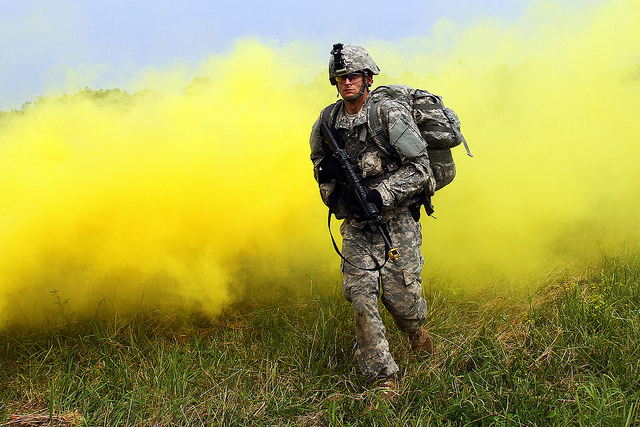
Spc. Robert Satterfield with Bravo Company, 1st Battalion, 149th Infantry exits a landing zone during an air assault exercise at Muscatatuck Urban Training Center in Butlerville, Ind., July 26, 2015. Three companies of infantrymen participated in one of the largest training exercises for the battalion in six years. (U.S. Army National Guard photo by Staff Sgt. Scott Raymond)
BUTLERVILLE, Ind. — In terms of basic Soldier skills, the infantry is arguably the hardest training unit in the Kentucky Guard. But it’s not everyday Soldiers of the 1st Battalion, 149th Infantry get to put all that training into a full-spectrum exercise. As a culminating event to this year’s two-week annual training for the unit, the Mountain Warriors conducted a multi-day air assault mission at the Muscatatuck Urban Training Center near Butlerville, Ind., July 24-27.
“Stuff like this is phenomenal, it’s great training,” said Spc. David Woodford with Alpha Company, 1/149th. “This kind of training will keep me in uniform.”
Soldiers with Alpha and Bravo Co., 1/149th loaded their gear and flew by UH-60 Blackhawks to the landing zone at Muscatatuck, compliments of the U.S. Army Reserves’ 11th Theater Aviation Command out of Fort Knox, Ky. Each Soldier carried their weapon and everything they needed for the three-day mission on their backs. Many of the Guardsmen flew on their first helicopter ride. And at the end of it, they had to get themselves, their gear and their fellow Soldiers out of the aircraft as quickly and as organized as possible.
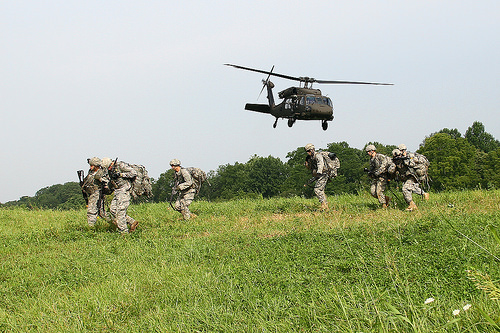
Soldiers with the 1st Battalion, 149th Infantry conduct an air assault exercise at Muscatatuck Urban Training Center in Butlerville, Ind., July 26, 2015. Aviators from the 11th Theater Aviation Command at Fort Knox, Ky., provided eight UH-60 Blackhawk helicopters to transport the infantrymen to the training site. (U.S. Army National Guard photo by Staff Sgt. Scott Raymond)
Click here for more photos.
From the landing zone, the 1/149th was tasked with assaulting and securing a building complex occupied by members of Charlie Company, simulating an opposition forces. The three companies of infantrymen then had to hold their position and establish relations with locals.
In advance of the air assault, a small platoon of scouts paved the way for the main body attack. For those scouts, the mission was a couple days longer as they infiltrated the area two days prior to the battalion’s arrival. They were the eyes and ears of the attack. A job they said they wouldn’t trade for any other in the battalion.
“This is as high as you can get as far as training value,” said Staff Sgt. Nicholas Combs with Headquarters, Headquarters Company, 1/149th. “No one here would want any other job during this training. When this mission is all said and done, only good stories will come out of it.”
From boarding and egressing a helicopter, moving as a fire team and even kicking in doors, the Mountain Warriors checked off a number of mission essential tasks they must train for each year. Lt. Col. Joseph Lear, commander of the 1/149th said the AT provided an excellent chance for each section of the battalion to not only train, but to put their job specialities to the test.
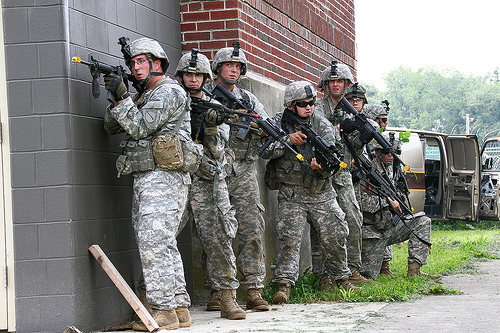
Soldiers with the 1st Battalion, 149th Infantry stack on a wall during a training exercise at the Muscatatuck Urban training Center in Butlerville, Ind., July 26, 2015. The unit conducted an air assault mission to seize a building complex and hold their position against a simulated enemy force. (U.S. Army National Guard photo by Staff Sgt. Scott Raymond)
“Conducting an air assault is one of our primary tasks,” said Lear. “This enabled us to do something we haven’t done since 2009 as a battalion. It’s a tremendous training multiplier for us, to be able to do that kind of mission at that scale, we are grateful to have the opportunity.”
Members of Delta Company provided the ground assault and convoyed by Humvees to the site. In reserve was the 1149th Forward Support Company, whose job is to ensure the infantry can do their job. Chief Warrant Officer Melissa Propes with the 1149th said the annual training was also an invaluable training opportunity for her Soldiers as well.
“I love seeing these Soldiers get experience in what they do, and they got to do that here. Not only did they get good training, it made a difference to the infantry. And that is absolutely what the 1149th FSC is supposed to do,” she said. “Everybody from the infantryman to the mess section, to distro to maintenance, everybody has an essential piece of the puzzle, or they wouldn’t be here. And we’re just happy to contribute.”
Leading up to the assault mission, Soldiers of the unit trained in a variety of squad and platoon-sized drills at Camp Atterbury, Indiana, to hone their skills and prepare for the final mission.
Pvt. Scottie Pace is a cook with the 1149th FSC and attended his first annual training.
“When I first enlisted, I had no idea what to expect on an AT,” he said. “Now, I feel like knowing that I can do my job and help the unit is a great thing to prepare me for future training and makes me a better Soldier.”
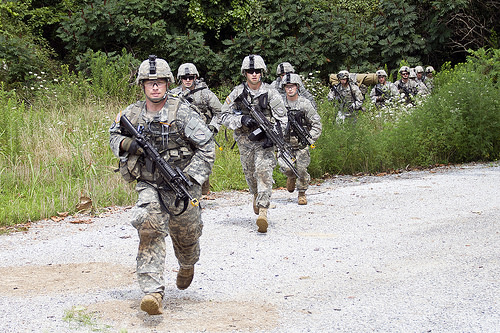
Soldiers with the 1st Battalion, 149th Infantry advance across a road during a training exercise at the Muscatatuck Urban Training Center in Butlerville, Ind., July 26, 2015. The exercise was the culminating event of the unit’s two-week annual training period. (U.S. Army National Guard photo by Staff Sgt. Scott Raymond)
More than 550 Soldiers of the battalion were on hand for the training period. Platoon leaders and company commanders agreed their Soldiers greatly benefitted from the unique training and the boost in morale.
“There’s nothing like training in the field,” said Spc. Joseph Hill from Alpha Co. “You’re really able to do your job and refresh your skills. It’s hard to find a bad part of this AT.”
Battalion leadership were pleased with the effort put forth by their Soldiers and the chance to put them in the field and participants and witnesses to the unique energy of the infantry.
“This type of training is also why people enlist,” said Lear. “They don’t join to stand a drill hall and get briefs. These troops will talk about this air assault for years.”
“That’s how this type of training leads to retention, which leads to strength, which leads to funding, which leads to more quality training. That’s the impact this has on this battalion.”
Story by: Sgt. Brandy Mort, 133rd Mobile Public Affairs Detachment
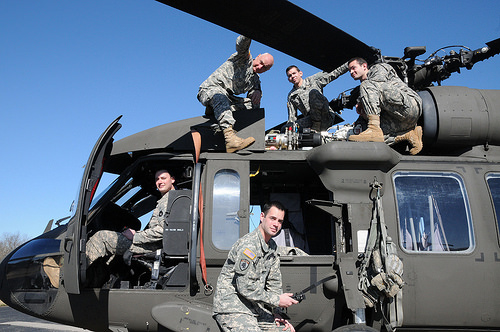
Master Sgt. Anthony J Tidei and his sons, Jonathon, Paul, Caleb, and Joshua climb aboard an aircraft during thier drill weekend on Boone National Guard Center in Frankfort, Ky. March 15. Each Tidei is positioned where they would usually be working or operating on the aircraft. (US Army National Guard photo by Sgt. Brandy Mort)
FRANKFORT Ky. – Hard working, determined, intelligent and responsible are a few of the many words Lindsay would use to describe the last name Tidei. Lindsay holds the name of a unique family in the Kentucky National Guard. The last name Tidei belongs to five members of the same family, which currently serve in the Kentucky National Guard, and one member who recently served.
Not only are the Tideis’ a part of the Kentucky National Guard, but Master Sgt. Anthony J. Tidei, an Aircraft Maintainer with Bravo Co. 351st, and his sons, all chose careers within the Aviation field.
“I have always tried to be a positive role model in my son’s lives,” said Anthony. “I’ve worked hard to give them proper values. Their success is my success and I am proud of each and every one of them.”
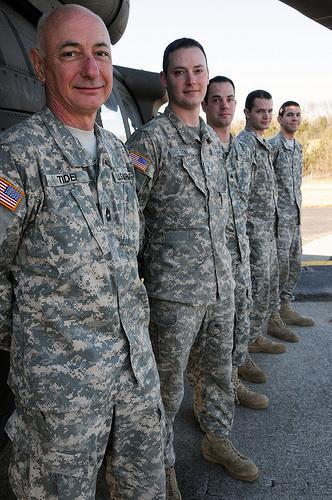
Master Sgt. Anthony J Tidei Chief Warrant Officer, Jonathon J. Tidei, Sgt. Paul E. Tidei, Spc. Joshua P. Tidei and Spc. Caleb P. Tidei (US Army National Guard photo by Sgt. Brandy Mort)
Chief Warrant Officer Jonathon J. Tidei, the oldest son, is a UH-60 pilot with Co. B 2/147th. He attributes a lot of his success to his father.
“Dad has always taught us to do the right thing,” said Jonathon. “I wanted to follow in his footsteps and carry on the Tidei legacy.”
Jonathon’s wife, Lindsay has seen the boys as Soldiers and Civilians. She says they are the same no matter what hat they are wearing.
“I’ve seen them at family picnics, but this is the first time I’ve seen them together in uniform,” she said. “They can be fun at times, but when they have a mission to do, they put their game face on and complete the task at hand.”
Sgt. Paul E. Tidei, Flight Operations Specialist with Operational Support Airlift Command Detachment 11, said that he felt like carrying on the family tradition would be a tough task.
“My dad has set the standard for the Tidei name,” said Paul. “Everyone looks up to him, including us. If you’re one of his kids, you’re expected to act as he does.”
Spc. Caleb P. Tidei and Spc. Joshua P. Tidei chose to be Aircraft Maintainers with Detachment 1, 2/147th Aviation to follow closely behind their father. When quizzed on certain parts of the aircraft by their dad, they passed with flying colors.
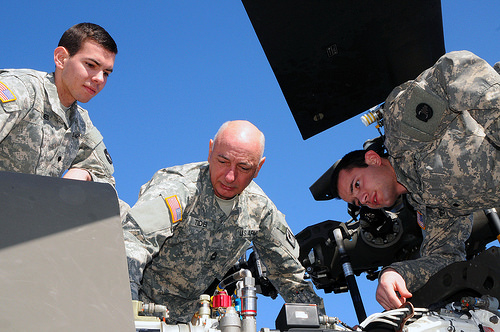
Master Sgt. Anthony J Tidei quizes his sons Caleb and Joshua on aircraft parts during thier drill weekend on Boone National Guard Center in Frankfort, Ky. March 15. Anthony and both of his sons are currently Aircraft Maintainers in the 63rd Theatre Aviation Brigade. (US Army National Guard photo by Sgt. Brandy Mort)
Daniel Tidei, now a civilian IT specialist, once held the rank of sergeant and was a hydraulics specialist.
Master Sgt. Tidei is preparing to finish up his long, influential career. He is well loved by all who have served alongside him, including Lt. Col. Michael Stephens, Deputy Commander of the 63rd Theatre Aviation Brigade.
“Master Sgt. Tidei has had an impact on this organization that is hard to measure,” said Stephens.” The fact that five of his sons have followed in his footsteps is astonishing. It is a testament to the way he leads his family and shows the love he has for the Kentucky National Guard and for the nation. Tony will be greatly missed when he retires, but I know his legacy will live on through his family.”
Story by Capt. Stephen Martin, Kentucky National Guard
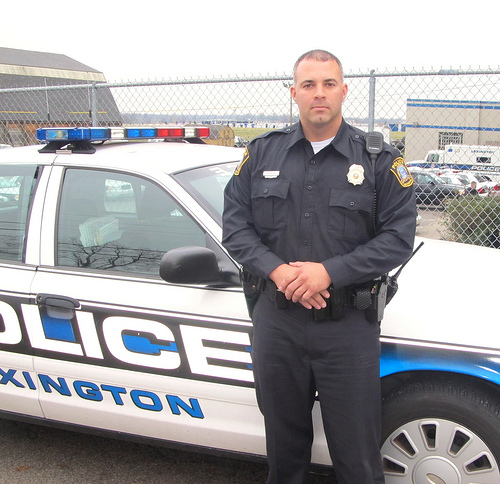
Officer Joel Bowling, Lexington Police Department. (Photo courtesy of CW2 Bowling)
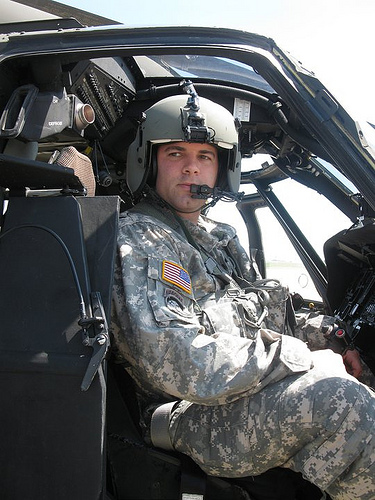
Chief Warrant Officer Joel Bowling, B Co., 2nd Battalion, 147th Aviation Regiment. (Photo courtesy of CW2 Bowling)
FRANKFORT, Ky. — The noted writer and blogger Eliezer Yudkowsky once said, “The police officer who puts their life on the line with no superpowers, no X-Ray vision, no super-strength, no ability to fly, and above all no invulnerability to bullets, reveals far greater virtue than Superman - who is only a mere superhero.” Well, Lexington Police Officer Joel Bowling fits this description minus the fact that he can fly — UH-60 Blackhawks that is.
Officer Bowling, also known as Army Chief Warrant Officer Bowling, is currently a UH-60 Blackhawk pilot for Bravo Co. 2nd Battalion, 147th Aviation, based out of Frankfort, Ky.
“Joel brings a great sense of professionalism to the cockpit and a calm under pressure that’s rare among his peers,” said Bowling’s military commander, Capt. Cliff Flanagan. “His time as a police officer on the civilian side brings a huge wealth of experience to our unit and I wouldn’t trade it for anything.”
To see more photos of CW2 Bowling, please click HERE.
“Flying helicopters has always been a dream of mine,” said Bowling. “but I never thought it would be possible in the National Guard. Through hard work, dedication and a little bit of luck, I was able to make this dream a reality.”
Bowling joined the Kentucky Guard exactly one-year before the Sept. 11 attacks in 2001, as a combat medic with the 617th Military Police (MP) Company, in Richmond, Ky.
In September of 2004, he was promoted to the rank of Sergeant over the medical section and then deployed to the middle east in support of Operation Iraqi Freedom.
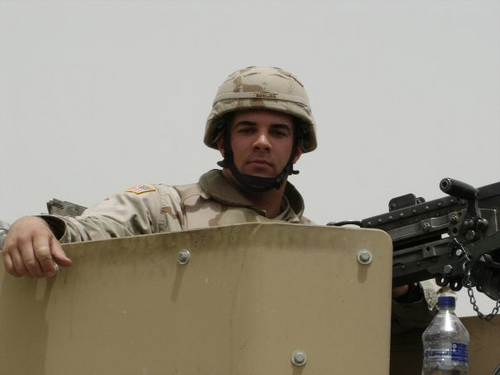
Chief Warrant Officer Joel Bowling, formerly Sgt. Bowling, deployed to the Middle East in support of Operation Iraqi Freedom in 2004-2005. (Photo courtesy of CW2 Bowling)
For eleven months Bowling provided medical support to MPs and other units who were running main supply route patrols and convoy security. Bowling was selected for a flight medic position with the C Co. 2nd Battalion, 238th Aviation Medical Evauation Unit out of Frankfort, Ky. after his deployment to Iraq. He was then accepted to flight school in 2008 and graduated as a UH-60 Blackhawk pilot.
When Bowling’s not flying helicopters for the National Guard, he serves as a patrolman for the Lexington Division of Police.
Bowling joined the police force in 2002 and has served in several different positions throughout his 12-year career, to include a specialized unit focusing on eliminating ‘part one’ crimes: narcotics, prostitution, auto thefts and burglaries. He’s since moved on to a being a field training officer for the organization, working with new recruits that have just finished the police academy.
“Joel’s enthusiasm has helped him build a great rapport with both our citizens and his colleagues alike,” commented Commander Gregg Jones, from the Lexington Division of Police. “He does a great job of communicating with the public and understanding their needs.”
This warrant officer manages both careers well which demand a lot of his attention to remain proficient in both disciplines… all while keeping a family happy at home.
“I’m blessed to have a wonderful wife and three beautiful children who are extremely supportive of both my careers,” said Bowling.
Photo Essay by Spc. Tom Harrington, B Co. 2-147 Unit Public Affairs Historian Representative
See all the photos HERE.
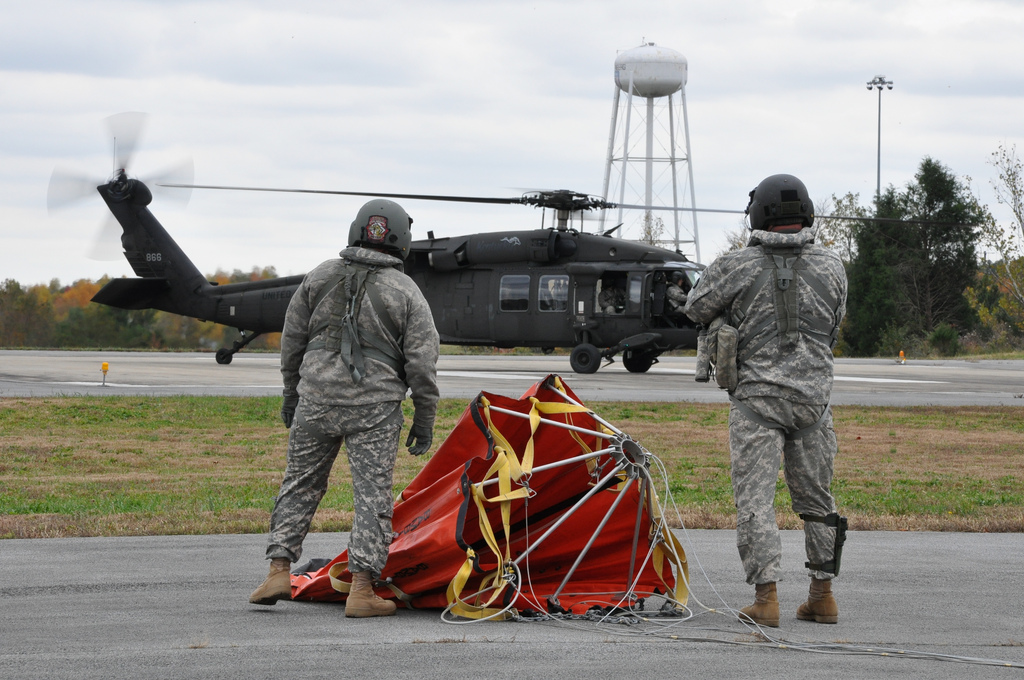
Sgt. 1st Class Matt Singer and Sgt. Lou Simpson, both from Bravo Company 2-147 AV, based out of Frankfort, Ky., conducts water bucket firefighting training at Wendell H. Ford Regional Training Center, in Greenville, Ky. Oct. 20, 2012. (photo by Spc. Tom Harrington, B Co. 2-147 Unit Public Affairs Historian Representative).
GREENVILLE, Ky. — B Co. 2-147 Aviation, based out of Frankfort, Ky, conducted firefighting training with water buckets hung below the UH-60 Blackhawks over the weekend to maintain their proficiency should the need arise.
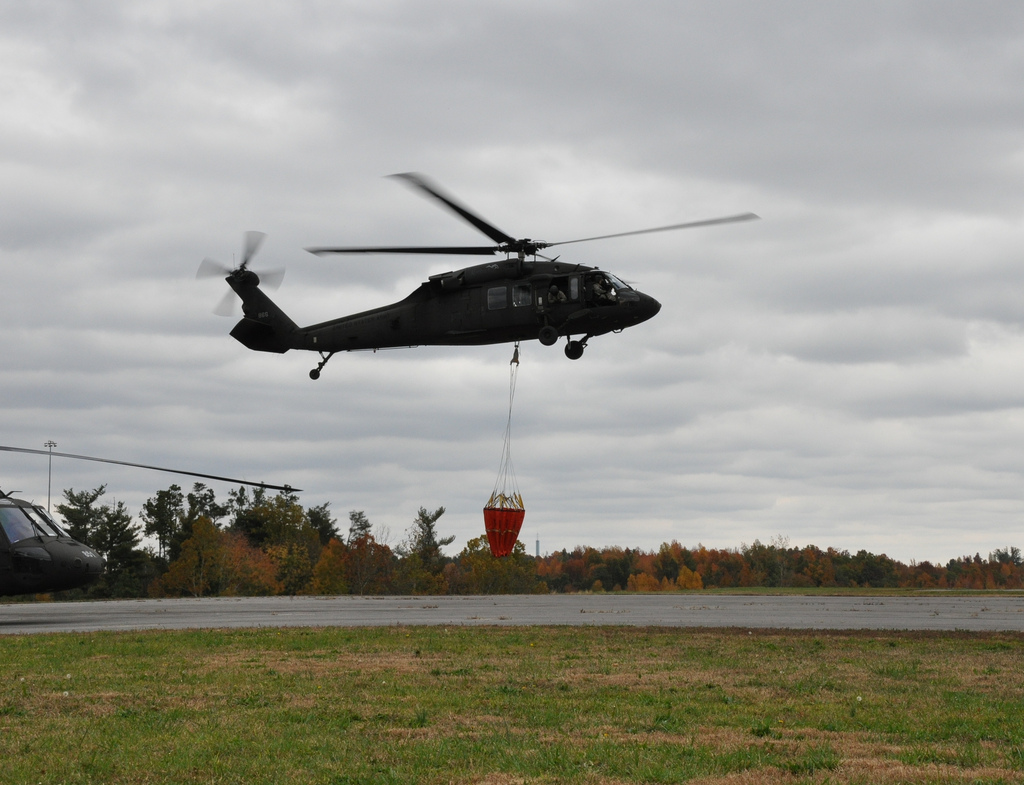
A Bravo Company 2-147 AV UH-60 Blackhawk, based out of Frankfort, Ky., moves to an adjacent lake to conduct water bucket firefighting training at Wendell H. Ford Regional Training Center, in Greenville, Ky. Oct. 20, 2012. (photo by Spc. Tom Harrington, B Co. 2-147 Unit Public Affairs Historian Representative).
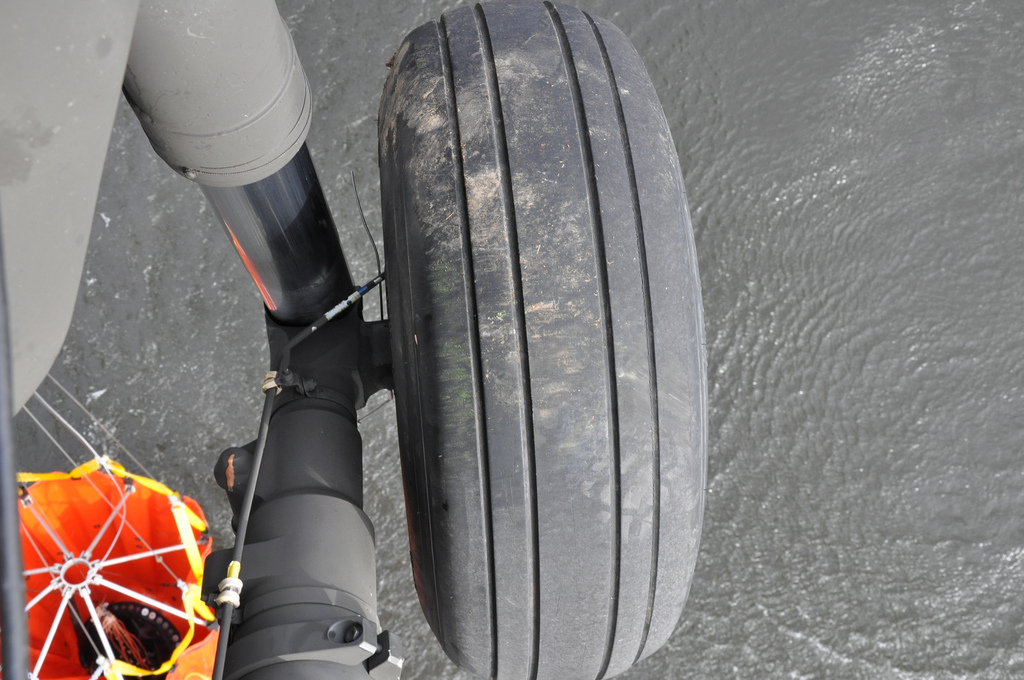
A UH-60 Blackhawk from Bravo Company 2-147 AV, based out of Frankfort, Ky., dips a Bambi Bucket into the lake on Wendell H. Ford Regional Training Center, in Greenville, Ky. The unit conducted water bucket firefighting training Oct. 20, 2012. (photo by Spc. Tom Harrington, B Co. 2-147 Unit Public Affairs Historian Representative).
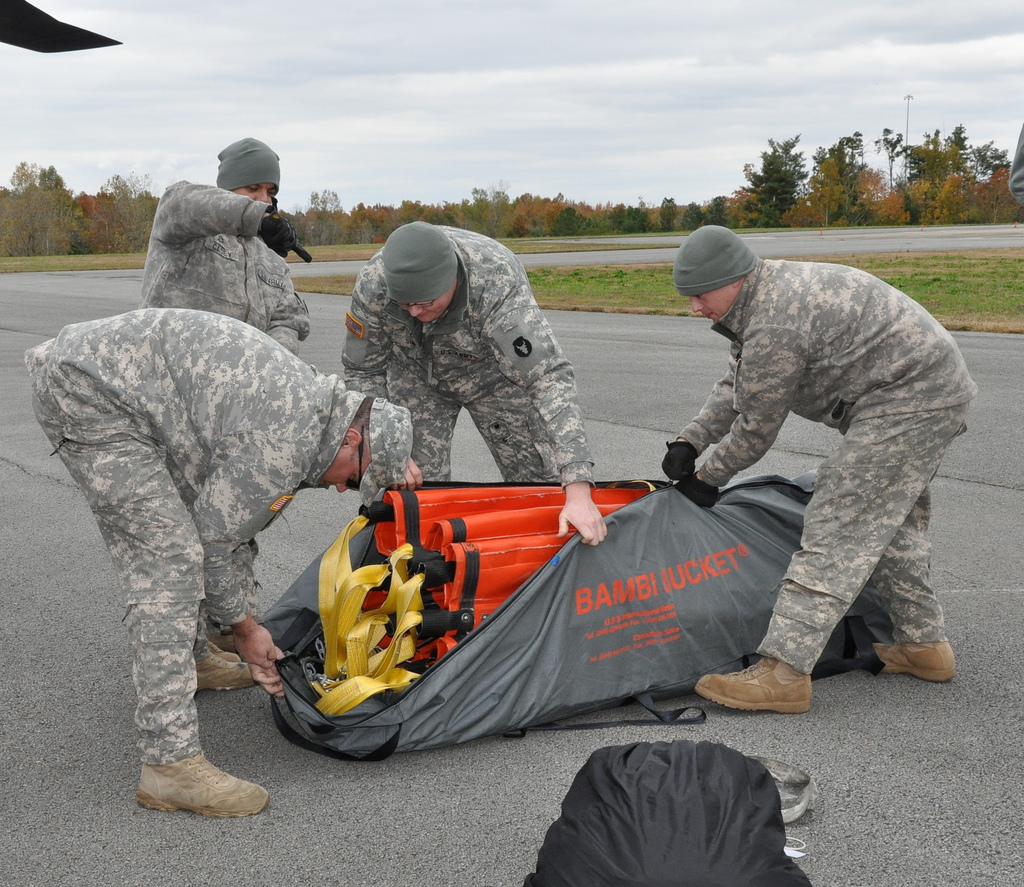
Soldiers from Bravo Company 2-147 AV, based out of Frankfort, Ky., pack up the Bambi bucket after water bucket firefighting training at Wendell H. Ford Regional Training Center, in Greenville, Ky. Oct. 20, 2012. (photo by Spc. Tom Harrington, B Co. 2-147 Unit Public Affairs Historian Representative).
Story by David Altom, Kentucky National Guard Public Affairs Office.
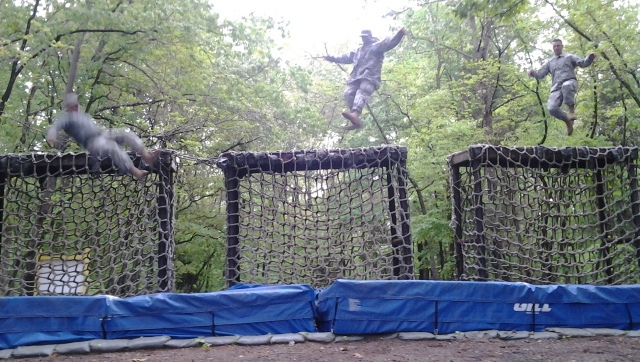
Spc. Michael Hill, Staff Sgt. Robert Unger and Staff Sgt. Richard Cummins leap to victory during a run on the obstacle course at Fort Knox, Ky. Spc. Christina Riddle used her cell phone to capture this memorable moment in her unit's training day. (KYNG photo by Spc. Christina Riddle, Co. B 351st Aviation Unit Public Affairs Historian Representative)
NOTE: Each week kentuckyguard.com publishes stories by or about Kentucky National Guard unit public affairs historian representatives, also known as UPAHRs. This is an additional duty taken on by a Soldier or Airmen with the intent of telling their unit’s story. This is one such story ….
Click here to view all the photos on this story.
FORT KNOX, Ky. – As a human resource specialist for the Kentucky National Guard, Spc. Christina Riddle has a passion for helping Soldiers with personnel issues and problems that affect their career and welfare.
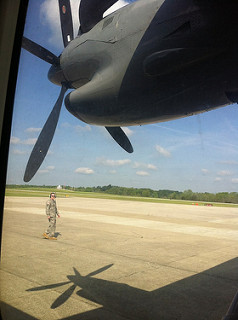
Sgt. Anthony Shick makes a last check on his C-23 Sherpa before taking off from the Capital City Airport in Frankfort, Ky. (KYNG photo by Spc. Christina Riddle, Co. B 351st Aviation Unit Public Affairs Historian Representative)
Riddle also serves as a supply specialist for Company B, 351st Aviation, where she ensures the troops have what they need for their missions and their training.
But that’s not all she does. Riddle took on the dubious extra position as the Unit Public Affairs Historian Representative, or UPAHR, where she takes on the task of telling the story of her fellow troops, to “make them famous.”
When Riddle saw an opportunity to tell her unit’s story, she seized the day … and the opportunity.
“When I was asked to attend the annual UPAHR training by my training NCO to take photos of my unit, I eagerly agreed,” said Riddle. “However, after informing others of the training, I was asked ‘who did you make angry?’”
Riddle quickly set aside any doubts about her new responsibilities once she attended the training in Greenville.
“Not only did I meet so many new people from other units, I also learned more than I could ever know about the Kentucky Guard,” she said. “I’ve only been in for four years, so knowing the history of what I represent is amazing to me.”
Her new responsibilities gave her a new perspective on what means to be in the Guard.
“After learning that it is now my job to show others what I see and what we do is an honor,” she said.
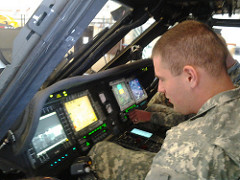
Spc. Jason Dunmire learns the controls of a UH-60 Blackhawk helicopter at Boone National Guard Center in Frankfort, Ky. (KYNG photo by Spc. Christina Riddle, Co. B 351st Aviation Unit Public Affairs Historian Representative)
Riddle’s first assignment was covering her unit’s weekend training at Fort Knox. She was issued a complete set of professional quality photography gear, but found the responsibility for the state of the art gear intimidating.
“I was so nervous about damaging it that I left it locked in the van,” she said with a laugh.
Her decision put her in a spot once she saw the troops getting into the spirit of the training. Not one to let an opportunity to pass her by, the new UPAHR pulled out her cell phone and started taking pictures.
“I was actually excited to think I could get the state of the art equipment to do this, but it’s not about the equipment,” she said. “My first trip with my unit as the UPAHR this past weekend proved that. It’s the people. It’s not just me, but the Soldiers. Without them there wouldn’t be a picture!”
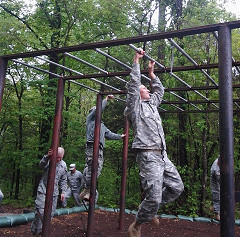
Staff Sgt. Richard Cummins breezes through the obstacle course at Fort Knox, Ky. (KYNG photo by Spc. Christina Riddle, Co. B 351st Aviation Unit Public Affairs Historian Representative)
“It’s amazing from to be able to capture what I get to see as a Soldier and show my pictures to my husband and children and have them actually understand what we do.”
For her next assignment Riddle will consider using her issued equipment. If her skills with a cell phone are any indication, she ought to do her unit proud.
dwa
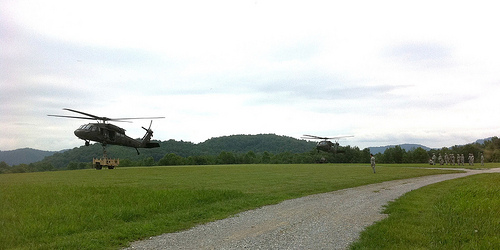
1-149th Intantry Soldiers attach sling loads to underside of UH60 Blackhawks during a training event at the Harold L Disney Training Center near Barbourville, Ky. (Photo by Lt. Col. Brian Demers, 1-149th Infantry)
FRANKFORT, Ky. — The 1st Battalion 149th Infantry (Rear) may be designated the “rear detachment” while its forward element has mobilized for Iraq, but that doesn’t mean its Soldiers just sit around and keep the lights on.
Yes, they support the forward element. Yes, they facilitate family support for the forward deployed Soldiers. Yes, they maintain daily status of personnel actions and new recruits.
And yes, they even keep the lights on.
However, they also continue to conduct some pretty exciting infantry training.
The battalion recently came together to conduct common infantry tasks during a training event at the Harold L Disney Training Center near Barbourville, Ky. In addition to land navigation, basic rifle marksmanship, urban operations, the Soldiers were able to practice some more advanced skills using helicopters.
“We wanted to give our rear detachment Soldiers some training that was worthy of talking about when they got home,” said Lt. Col. Brian DeMers, commander of the rear detachment. “Even though the bulk of the battalion has been sent to Iraq, there are still many Soldiers that drill here and they deserve the same high quality training we give to the forward elements.”
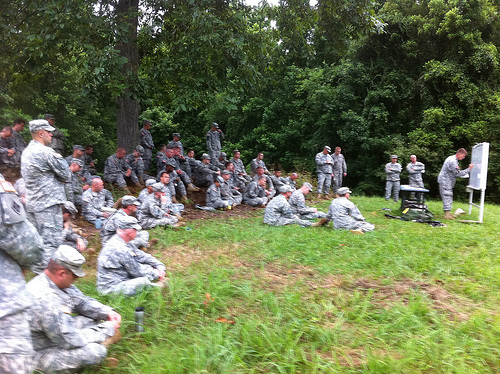
Classroom? A berm, a board, and nice day is all the infantry really needs to conduct training. (Photo by Lt. Col. Brian Demers, 1-149th Infantry)
“We want to make sure the message gets out that the 1-149th is still ready and relevant in the local community.”
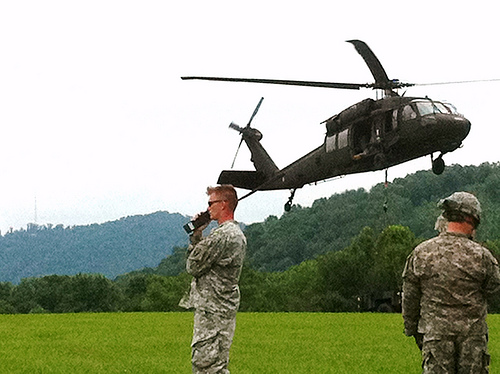
Capt. Robert Andersen maintains ground operational control during sling load operations. (Photo by Lt. Col. Brian Demers, 1-149th Infantry)
The rear detachment is composed of a mix of administrative and support personnel, as well as Soldiers with some sort of temporary medical condition that prevented them from deploying. There are also troops whose terms of service would end during the deployment or new recruits and Soldiers who were not in the unit when the forward element mobilized.
Combat assault and sling load operations were the highlight of the day for many of the Soldiers. During the combat assault, squads were picked up at one landing zone (LZ), flown around the area for a short flight and then dropped into a remote landing zone under simulated enemy conditions. Troops then had to navigate back to the original start point without using the roads. All squads made it to their designated rally points within the time standards. The Soldiers also enjoyed the sensation of open door flight by soaring through the hills and valleys of Eastern Kentucky.
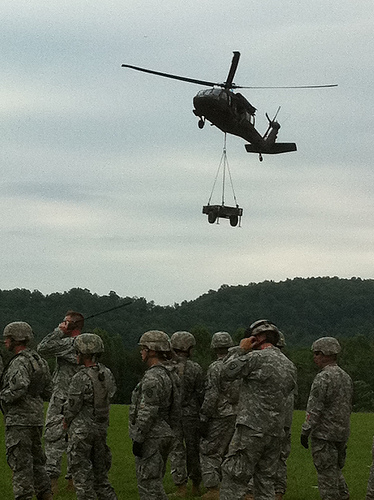
A Kentucky Army National Guard UH-60 Blackhawk approaches the landing zone as 1-149th Infantry Soldiers prepare for the next hookup. (Photo by Lt. Col. Brian Demers, 1-149th Infantry)
Sling loading was a task that many of the Soldiers had never accomplished, although it’s one that the Army performs almost every day in forward locations like Afghanistan and Iraq. To familiarize the Soldiers with the task, Soldiers working in teams ran under hovering helicopters, climbed on equipment and hooked loads to the bottom side of the aircraft. This task can be very intimidating as the aircraft are very loud, creates a tremendous amount of downwash, not to mention the rapidly spinning rotor blades.
“It’s kind of like working under a running lawn mower” one soldier was overhead saying.
Finally, as icing on the cake, recruits assigned to Det 2, Company C, 2nd Battalion 75th Recruiting and Retention were able to clamber on board for orientation flights.
Cries of “Now that’s what I’m talking about” and “Hooah” were heard several times from the recruits upon landing.
Many of the recruits are future 1-149th Infantry Soldiers currently assigned to the detachment to gain exposure to basic military skills while awaiting for their shipment to Initial Entry Training.
“We’re really grateful to Bravo Company, 2nd Battalion 147 Aviation for providing two helicopters and crews,” said Demers. “The weekend was exciting and one that these Soldiers will remember and speak of for a long time!”
###