Pages
Stay In Touch
More
© 2013 KentuckyGuard
Staff report
Chief Warrant Officer Travis Wright, his wife Tig, daughter Brooke and son Harrison with his commander in chief, President Barak Obama. Wright’s career as a warrant officer has taken him from all the way from flying special operations missions on active duty to working the National Guard counterdrug mission while stationed at our nation’s capital. (Official White House photo)
FRANKFORT, Ky. — The term “quiet professional” is used a lot in the military, and for good reason. Most military service members are just that, professionals who get the job done and move on to the next mission. Chief Warrant Officer Travis Wright is one of those quiet professionals. After 23 years of service in both the active duty Army and the Kentucky National Guard, he’s preparing for retirement and ready to move into the next chapter of his life. And since July is Warrant Officer Month we asked him to share some of his insights regarding his career as a “quiet professional.”
How did you begin your career?
I joined active duty at 18 as part of the Warrant Officer Flight Training (WOFT) program. I went straight from basic training to WOCS and then flight school where I graduated at 19. I was fortunate to accomplish all my professional goals in 10 years on active duty. I flew OH-58A/C, OH-58D Kiowa Warriors and AH-6J Little Birds in assault, attack and special operations units.
Back in “the day.” A young Travis Wright (right) during flight school. His warrant officer career took him from flying with the 82nd Airborne to the 160th Special Operations Aviation Regiment to marijuana eradication missions with the Kentucky National Guard. He’s amassed more than 4,000 flight hours in five different helicopters and several civilian aircraft. (Photo courtesy Travis Wright)
How did you come to join the Kentucky National Guard?
I left active duty and pursued a career as an airline pilot with Comair in Cincinnati where I was a first officer on the Canadair Regional Jet (CRJ). During my ground school training I ran into a colleague from my Army days and he told me about the Reconnaissance and Interdiction Detachment in Kentucky. I made a few calls and began my career with the Kentucky National Guard as an M-day pilot. Flying single pilot with a trooper looking for dope was probably one of the best jobs I had in the Army.
What other missions did you take on as a Kentucky Guard aviator?
While with the RAID I supported the G-8 Summit in Sea Isle (Savannah), Georgia and flew along the nation’s northern border in Burlington, Vermont to support the Department of Homeland Security. I had an opportunity for a short tour of duty to in Washington, D.C. to help out at the National Guard Bureau. I really enjoyed the mission there. After discussions with my wife we decided to make the move to DC so I could spend more time at home.
Tell us about your tour of duty at our nation’s capital.
The White House Office of National Drug Control Policy is responsible for producing the President’s annual National Drug Control Strategy. Additionally they produce the Southwest Border, Northern Border and Caribbean Drug Strategies. ONDCP is organized with three main departments, Office of Supply Reduction - mostly OCONUS and border operations, Office of Demand Reduction - preventing use before it starts and where I work, Office of State, Local and Tribal Affairs.
While I interact with those other offices, I chiefly work as a liaison from NGB to the High Intensity Drug Trafficking Area program. There are over 30 HIDTA programs throughout the country including the Appalachia HIDTA with its office in London, Kentucky. I provide a voice for the Natioanl Guard and our counterdrug program in support of HIDTA operations and interact with my fellow liaison officers from DEA, FBI, IRS and DHS.
What’s it like being a warrant officer?
Many others have said this, but a warrant officer is the best rank in the Army. My first experience that this was going to be “different” was just after I pinned on my bar at 19 years old. I was waiting for my airborne school date and working at the headquarters at Ft. Rucker. The command sergeant major came through the front door and said ‘Good morning, sir.’ I looked around to see who he was talking to. I’m sure he had kids my age, maybe older but I quickly figured out he meant me.
I’ve been given responsibilities and experiences that I never thought possible. My last four assignments I have replaced a lieutenant colonel and my current position is coded for a colonel. It’s a testament to the trust leadership places in warrant officer professionalism and expertise, regardless of what the pay grade is.
As part of the Joint Staff, I’ve had several opportunities to explain to my Air National Guard brothers and sisters what the heck a warrant officer is.
Story by Capt. Gustave LaFontaine, 133rd Mobile Public Affairs Detachment
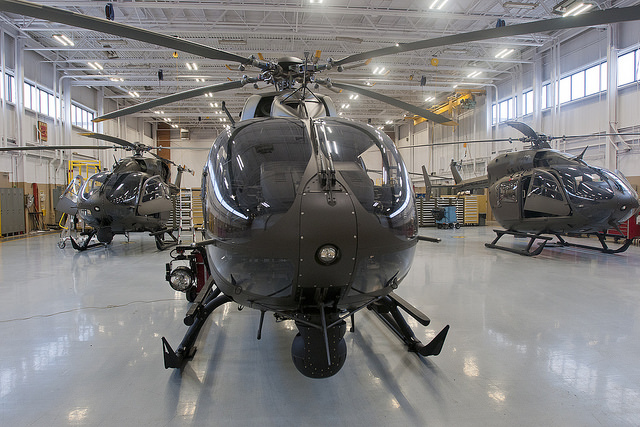
The three newest LUH-72s for the Kentucky National Guard sit in the Army Aviation Support Facility in Frankfort, Ky., Jan. 16, 2014. The Lakotas will replace the aging OH-58 Kiowa helicopters. (U.S. Army National Guard photo by Staff Sgt. Scott Raymond)
FRANKFORT, Ky. — The Kentucky Army National Guard recently added three new helicopters to their existing fleet. The brand new LUH-72A Lakota replaces the Vietnam era OH-58 Kiowa A/C. Charlie Company of the 1st Battalion, 376th Aviation now has four of the state of the art helicopters.
According to Col. Michael Ferguson, commander of the 63rd Theater Aviation Brigade, the new aircraft is designed to assist law enforcement as well as support domestic operations during hazardous events more effectively.
When asked to compare the UH-72A Lakota and the OH-58 A/C, Ferguson responded by saying that the Lakota has a modern avionics suite making the aircraft more capable to fly in inclement weather. He added that the aircraft’s Mission Equipment Package is updated and more robust to support a wide array of missions.
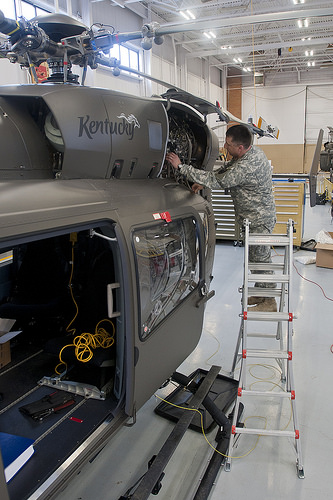
A Soldier with Charlie Co., 1st Battalion 376th Aviation examines the engine of a new LUH-72 helicopter at the Kentucky National Guard’s Army Aviation Support Facility in Frankfort, Ky., Jan. 16, 2014. Soldiers of the 63rd Theater Aviation Brigade are still getting used to the new aircraft and the many new upgrades the Lakota offers.(U.S. Army National Guard photo by Staff Sgt. Scott Raymond)
“The Lakota is a modern aircraft with unique capabilities to provide support to the citizens of the Commonwealth during our most challenging times,” said Ferguson.
Col. Brian Abney, Facility Commander for the Army Aviation Support Facility, spoke about how the increased capabilities of the Lakota will help serve the Commonwealth.
“This new airframe is a very stable and capable aviation platform. The aircraft’s flexibility enhances its ability to perform search and rescue, security support and command and control mission functions.”
Kentucky has been preparing to receive the Lakota for several years. A great deal of training accompanied the procurement of the new helicopters. Ferguson stated that the brigade has been sending Kentucky pilots to transition training for the past year. Pilots will continue the transition training through 2014.
Pilots aren’t the only Soldiers receiving new training. Helicopter maintainerswere recently certified by the Federal Aviation Administration as licensed Airframe and Powerplant Mechanics. Maintainers have also attended a course to learn how to sustain the Lakota.
Abney spoke about the readiness of Kentucky pilots and maintainers in regard to the new helicopter.
“I would put our aviators and maintainers up against the best in the world in any theater of operations. It’s a large part of their lives. It’s who they are. They have made a very good name for themselves in a very unforgiving environment and it’s well deserved.”
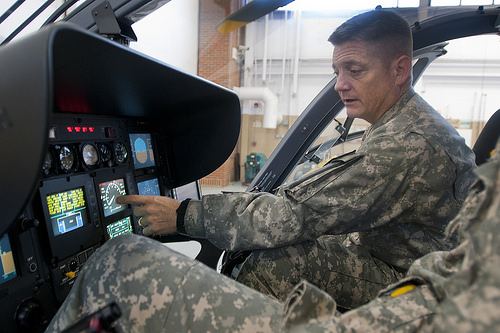
Chief Warrant Officer Joseph Mudd discusses the instrument panel of a new LUH-72 helicopter with another pilot at the Kentucky National Guard’s Army Aviation Support Facility in Frankfort, Ky., Jan. 16, 2014. (U.S. Army National Guard photo by Staff Sgt. Scott Raymond)
Kentucky will receive two more UH-72A helicopters during the next year. At that point Kentucky will have completed its fielding of the UH-72A. Ferguson feels confident that his pilots and maintainers are up to the task of utilizing the Lakota to its fullest capabilities.
“We are well postured to continue excellence in this specific mission. Kentucky has always been looked at as the standard bearer.”
Staff Report
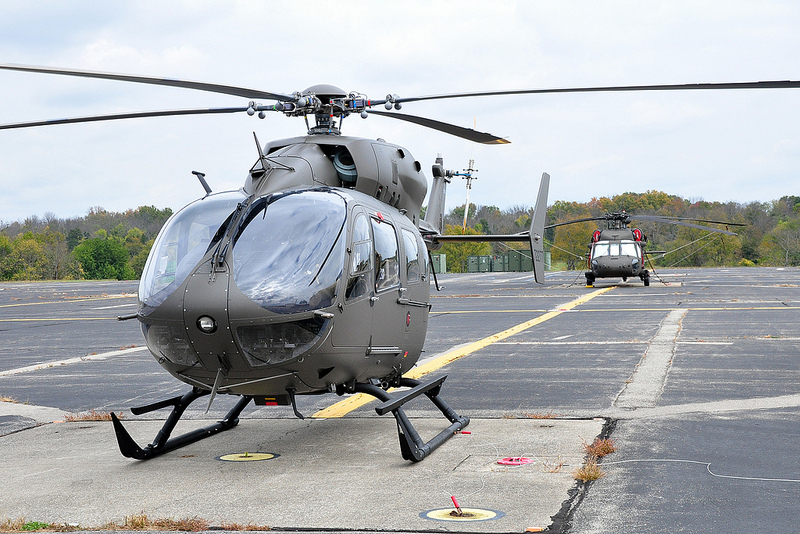
Charlie Co., 1st battalion 376th Aviation received their first UH-72 Lakota to replace the aging OH-58 Kiowas at the Boone National Guard Center, in Frankfort, Ky. Oct. 22, 2013. The Lakota is a twin-engine helicopter with a single, four-bladed main rotor. The UH-72 is a militarized version of the Eurocopter EC145 and is built by American Eurocopter division of EADS North America. (U.S. Army National Guard photo by Staff Sgt. Scott Raymond)
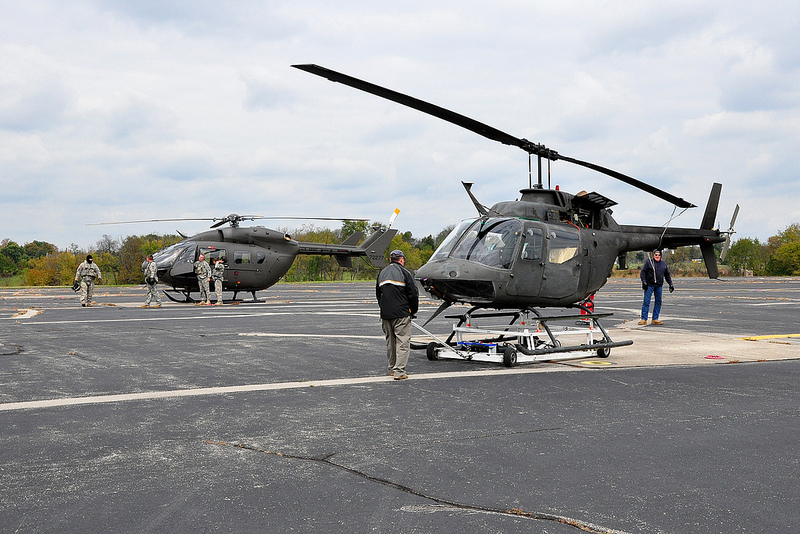
Charlie Co., 1st battalion 376th Aviation received their first UH-72 Lakota to replace the aging OH-58 Kiowas at the Boone National Guard Center, in Frankfort, Ky. Oct. 22, 2013. The Lakota is a twin-engine helicopter with a single, four-bladed main rotor. The UH-72 is a militarized version of the Eurocopter EC145 and is built by American Eurocopter division of EADS North America. (U.S. Army National Guard photo by Staff Sgt. Scott Raymond)
Story by Spc. Brandy Mort, 133rd Mobile Public Affairs Detachment
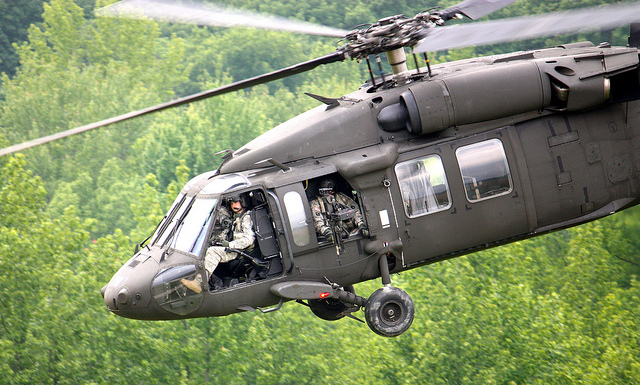
Chief Warrant Officer Jonathon Tidei pilots a UH-60 Blackhawk in aerial gunnery operations at Jefferson proving ground, Ind., June 2013. From an early age, Tidei knew he wanted to fly. (U.S. Army National Guard photo by Sgt. Tom Harrington)
July has been declared Kentucky National Guard Warrant Officer Month in a proclamation by Gov. Steve Beshear. This is one of a series of articles we are publishing in celebration of the warrant officer corps. Click here to read more about 95th birthday of the Army’s warrant officer corps.
FRANKFORT, Ky. — In 1953 the inception of the Warrant Officer Flight Program lead to the training of thousands who later became helicopter pilots during the Vietnam War. In April 1955, the 1st Aviation Class, at then, Camp Rucker, Alabama graduated. These first warrant officer pilots played an important role in the development of Army Aviation and were vital to its evolution.
Chief Warrant Ofiicer Jonathon Tidei, a UH-60 Blackhawk Pilot with Bravo Co. 2/147th Aviation, always knew he wanted a career in aviation. His father, Master Sgt. Anthony Tidei and his three brothers Sgt. Paul Tidei, Spc. Caleb Tidei and Pvt. Joshua Tidei, are all in an Aviation unit within the Kentucky National Guard.
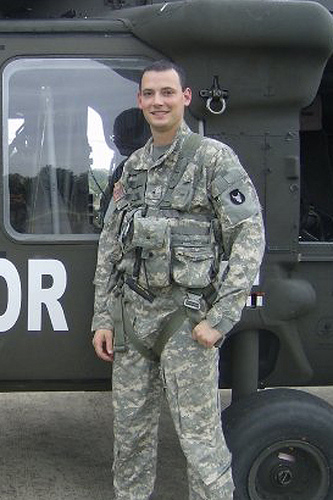
Warrant Officer Jonathon Tidei on deployment to Kosovo, 2009. (Courtesy photo)
“I was always interested in aviation,” said Tidei, “And all I wanted to do when I joined the military was fly. I signed up as an aircrewmember in the Kentucky Air Guard and flew as a C-130 Loadmaster for four years. I wanted to go to flight school as soon as I could, and when my dad told me about the Warrant Officer program I realized that would be the fastest way for me to get into flight school. Once I understood the role Army Aviation Warrant Officers serve in, I knew it was the right fit for me.”
As a Blackhawk pilot, Tidei’s primary job is to plan and fly missions to transport passengers and cargo to the right place at the right time to support ground forces.
“Warrant officers have a high level of specialization in their given job,” said Tidei, “In an aviation unit, warrant officers provide a continuity of experience and serve in specialty tracks as maintenance test pilots, safety officers, instructor pilots and tactical operations officers.”
Tidei and his wife travel whenever they can. Tidei has also previously been deployed. He is thankful for the unique experiences that the military has given him.
“At the end of our deployment to Kosovo we had to fly our aircraft from Kosovo to Germany so the helicopters could be shipped home,” said Tidei, “Flying along the Adriatic coastline and through Austria and Germany was an awesome experience.”
Tidei’s job also lets him be involved with some of the Kentucky National Guards newest pilots.
“I’ve been the Bravo Company ALSE officer,” said Tidei, “ Which means I help maintain aviation life support equipment that air crews require to do their jobs. Right now I’m also a unit trainer, so I help train newer pilots in some of their mission tasks like performing sling load operations.”
Most Service members will tell you that they have the best job, and Tidei thinks that being a warrant officer is the same way.
“I know this claim is made often,” said Tidei, “But I think being a warrant officer is the best job in the Army. If you are interested in being a subject matter expert in your branch, whatever it may be, go warrant!”
Story courtesy of Magen McCrarey, The Sentinel Echo

National Guard Medevac units took flight from the London airport headed to various airports in Kentucky to pick up “mock” patients during an aviation exercise. (Photo by Magen McCrarey, The Sentinel Echo)
LAUREL COUNTY, Ky. - For the first time, the Kentucky National Guard Joint Readiness Center in London was used to perform aviation training exercises for two medevac units in October. The units perform the exercise once a year and are expected to mobilize to Kuwait in 2013 for 24-hour support.
“This has been a very accommodating, great facility in London. They were very supportive of getting us down here and gives us the opportunity to operate outside of Frankfort, where we normally operate,” said Capt. Jimmy Caniff, detachment commander.
Three UH-60 Black Hawk helicopters took flight to and from the facility daily, while 31 members of the unit were trained from pilots, crew chiefs, mechanics, flight medics, flight operation specialists, and re-fuelers.
The units perform various aviation exercises throughout the year and provide support for forest fires, flood relief, earthquakes, ice storms and hurricanes. A UH-60 Black Hawk has the ability to fly 12,000 feet, and carry 600 pounds at the end a 200-foot line hoist for patients. The units that were visiting London are fairly new, Caniff said. They are five years old and were deployed to Kosovo in 2011 for assistance.
“We provided support in-country for a lot of training exercises so people there were able to provide support at all times. There were a handful of accidents we had out there. They were life saving missions that got people to a higher level of care. That’s our primary mission,” Caniff said.
This week, the helicopters crew were given multiple challenging scenarios, traveling to various locations in southeastern Kentucky to find simulated patients using maps and radioed direction and landing at a handful of airports in eastern Kentucky. The first stop for this unit on Tuesday afternoon was the Disney Training Center in Artemus, Ky.

Before medevac units took flight at the Nation Guard Joint-Readiness airstrip in London, all exterior and interior parts of the UH60 Black Hawk helicopter were checked for safety.(Photo by Magen McCrarey, The Sentinel Echo)
Crew Chief Mike Powers said, while out in the field, the unit really has to focus from thousands of feet up in the air because patients may or may not be where they originally say they are. In addition, there’s a multitude of equipment inside the helicopter because they never really know what type of situation they will run into.
“The atmosphere is anxious and focused,” Powers said.
Located inside the helicopter are heart monitors and a large modular pan for bodies to lay on, rescue gear, flight gear and helmets. There’s one medic in the back of the helicopters, trying to sustain life, while up front in the cockpit three crew members are communicating with units on the ground, air and between themselves.
“It’s a bit cumbersome with all of your gear on to come in here and slide them (patients) into the pan,” Powers said, adding, “Every situation is different, you may have to put a person on a pan, drop and reconfigure when you’re in the air. It’s a little unnerving when you’re on the edge (of the helicopter).”
“It’s a small office out here,” said Steve Clark, a crew medic.
Following a 300-foot hoist drop for practice, the helicopters took flight for their life saving missions. Patients were picked up at various locations and taken back to the London facility for “treatment.”
“This is probably one of the most well trained medevac units around. I don’t think a lot of people in Kentucky realize the kind of asset that they have here,” Caniff said.
The Kentucky National Guard Joint Readiness Center has about 30 to 100 Guard personnel working year-round, and will be used in the future for similar exercises as the one that took place this week to provide support for Kentucky National Guard headquarters in Frankfort, Ky.
Story and photos by Sgt. Scott Raymond, Kentucky National Guard Public Affairs Office
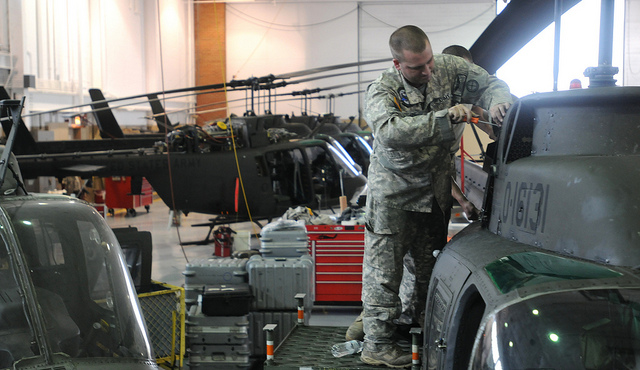
A Soldier with Charlie Co., 1st Battalion, 376th Aviation works to repair a OH-58 helicopter at the Army Aviation Support Facility in Frankfort, Ky., Sept. 18, 2012. The Kentucky Guard has become the maintenance hub for OH-58 repairs for all of the National Guard. (Kentucky National Guard photo by Sgt. Scott Raymond)
FRANKFORT, Ky. — It is often thought that a warrant officer in an Army Aviation unit is only a pilot. That is certainly not always the case. The aviation field also demands that experts are on hand as maintenance technicians to ensure that those pilots have a working aircraft to fly.
In the Kentucky National Guard some aviation warrant officers are not only keeping Kentucky Guardsmen in the air, but they’re also working to keep pilots in quality aircraft nationwide.
Chief Warrant Officer Three Jay Calcaterra, an aircraft maintenance supervisor for the 351st Aviation Support Battalion works daily at the Army Aviation Support Facility in Frankfort, Ky. He confirmed that not everyone in the hangar is a pilot, calling himself and other maintenance supervisors, “the walking warrants.”
“We determine which aircraft fly, how long they fly and what maintenance is required after they fly it,” he said.
Calcaterra said they have an extremely important job in the hangar, and that is to manage aircraft and the people who work on aircraft.
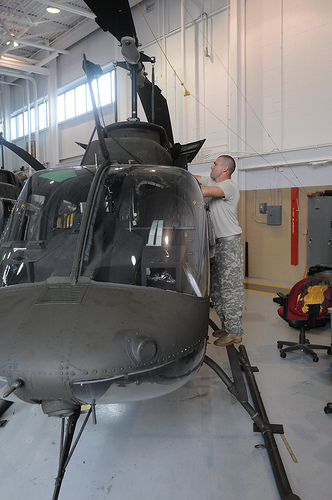
Spc. Tim Amyx with Charlie Co., 1st Battalion, 376th Aviation, works on a OH-58 helicopter at the Army Aviation Support Facility in Frankfort, Ky., Sept. 18, 2012. Because of the increase in maintenance requests, some Soldiers were brought on full time to help handle the workload. (Kentucky National Guard photo by Sgt. Scott Raymond)
The Kentucky Guard’s fleet of UH-60 Blackhawks and OH-58 Kiowa helicopters, and their operational readiness is the responsibility of Calcaterra and Chief Warrant Officer Two Ryan Thompson.
They said it takes a seasoned expert to meet the demands of what they are asked to do, but in referring to their warrant officer training, they rely on their abilities and the proficiencies of their staff to provide that expertise and keep Kentucky aircraft in the skies.
In 2011, the National Guard Bureau in Washington, D.C., was looking for a solution for the maintenance of all OH-58s flown by the Guard. They needed a hub where the aircraft could be properly and efficiently maintained to keep them flying. NGB looked to a state with a solid history of excellence in aviation.
“It’s because of our reputation, our work ethic and our operational readiness rates that we were asked to do this,” said Thompson. “Everyone knows we are always willing to step up and support the mission of NGB.”
With the amount of flight hours being put on a diminishing fleet of OH-58s nationally, NGB asked Kentucky to become the center though which all maintenance issues would stream. Kentucky’s Army Aviation originally only had four OH-58s of their own, but now they were asked to care for a lot more. Regardless of their home assignment, helicopters with any issue would be flown or transported to Frankfort to go through Thompson’s “phase”.
Thompson said the facility would normally put six helicopters through maintenance phases each year. Since February 2012, they have received, tested, worked on, and put back into service 23 OH-58s, across the country. That’s nearly a 400 percent increase and the year isn’t over yet.
He said Kentucky has worked with 16 different states in repairing their helicopters, transferring the aircraft back and forth to as far away as Arizona and Hawaii.
A phase begins with a test flight, if possible, to determine the faults or discrepancies, anything from broken radios to weak engines. The aircraft would then be disassembled from the nose to the tail and those problem areas would be fixed and required inspections completed. Upon its reassembly, the helicopter would be released for test flights to assure the problems were resolved, resulting in an “almost new” aircraft.
“I would never send out something that I wouldn’t give my own Soldiers,” said Thompson.
According to Thompson, the Kentucky Guard flies more hours in OH-58s than any other state. Thousands of hours of flight-time are given annually to support the state’s counter-drug program and in-state unit training missions.
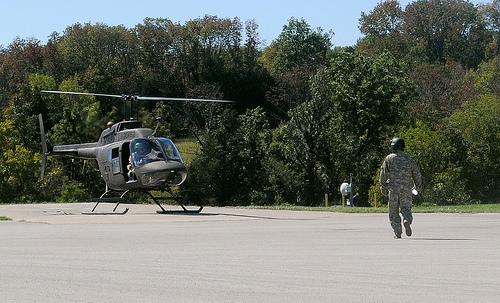
Soldiers at the Army Aviation Support Facility prepare for a test flight in a OH-58 helicopter in Frankfort, Ky., Sept. 24, 2012. The Kentucky Guard provides maintenance support to all OH-58s in the National Guard. (Kentucky National Guard photo by Sgt. Scott Raymond)
In addition to operations in the Commonwealth, OH-58s repaired by the Kentucky Guard are transferred to the U.S. State Department as well as flown in support of the Southwest border mission, Operation Guardian Eye.
Calcaterra, Thompson and the Soldiers in the hangars in Frankfort manage the maintenance of 75 percent of all OH-58s flying in the National Guard. Thompson said it’s a fine example of the Kentucky Guard preparing for and meeting the needs of the Guard as a whole.
Thompson believes the mission will last as long as OH-58s are flying for the Guard. In the meantime, Kentucky will remain nationally, a proven maintenance hub as well as an OH-58 parts hub.
The increased workload has benefitted some Soldiers with full-time work, which the warrants said creates an invaluable amount of experience for young aircraft mechanics. Thompson estimates that his Soldiers are getting as much hands-on training in two-weeks as some traditional Guardsmen serving on weekends would get in 15 years. In addition to the new airframes coming through, the experience for these Soldiers is the biggest gain of this mission said Thompson.
The warrants both said they couldn’t have done it without the support of Kentucky National Guard leadership. Thompson said Maj. Gen. Edward W. Tonini, Kentucky’s Adjutant General and Col. Michael Ferguson, 63rd Theater Aviation Brigade Commander, agreed to take on the mission and have consistently backed the mechanics’ efforts while promoting the quality work done by Kentucky Guardsmen.
“We take pride in what we do here,” Thompson said. “We have the experience and know-how to pull this off.”
“It’s a lot of work, a lot of hours, but we don’t have a reduction in our capabilities. This has been a whirlwind success.”
Story by David Altom, Kentucky National Guard Public Affairs Office.
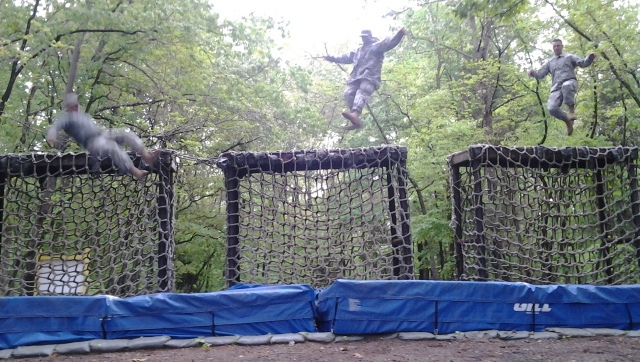
Spc. Michael Hill, Staff Sgt. Robert Unger and Staff Sgt. Richard Cummins leap to victory during a run on the obstacle course at Fort Knox, Ky. Spc. Christina Riddle used her cell phone to capture this memorable moment in her unit's training day. (KYNG photo by Spc. Christina Riddle, Co. B 351st Aviation Unit Public Affairs Historian Representative)
NOTE: Each week kentuckyguard.com publishes stories by or about Kentucky National Guard unit public affairs historian representatives, also known as UPAHRs. This is an additional duty taken on by a Soldier or Airmen with the intent of telling their unit’s story. This is one such story ….
Click here to view all the photos on this story.
FORT KNOX, Ky. – As a human resource specialist for the Kentucky National Guard, Spc. Christina Riddle has a passion for helping Soldiers with personnel issues and problems that affect their career and welfare.
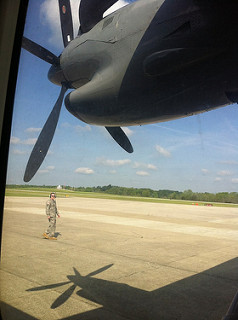
Sgt. Anthony Shick makes a last check on his C-23 Sherpa before taking off from the Capital City Airport in Frankfort, Ky. (KYNG photo by Spc. Christina Riddle, Co. B 351st Aviation Unit Public Affairs Historian Representative)
Riddle also serves as a supply specialist for Company B, 351st Aviation, where she ensures the troops have what they need for their missions and their training.
But that’s not all she does. Riddle took on the dubious extra position as the Unit Public Affairs Historian Representative, or UPAHR, where she takes on the task of telling the story of her fellow troops, to “make them famous.”
When Riddle saw an opportunity to tell her unit’s story, she seized the day … and the opportunity.
“When I was asked to attend the annual UPAHR training by my training NCO to take photos of my unit, I eagerly agreed,” said Riddle. “However, after informing others of the training, I was asked ‘who did you make angry?’”
Riddle quickly set aside any doubts about her new responsibilities once she attended the training in Greenville.
“Not only did I meet so many new people from other units, I also learned more than I could ever know about the Kentucky Guard,” she said. “I’ve only been in for four years, so knowing the history of what I represent is amazing to me.”
Her new responsibilities gave her a new perspective on what means to be in the Guard.
“After learning that it is now my job to show others what I see and what we do is an honor,” she said.
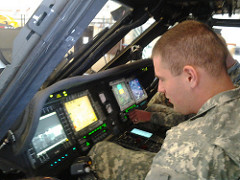
Spc. Jason Dunmire learns the controls of a UH-60 Blackhawk helicopter at Boone National Guard Center in Frankfort, Ky. (KYNG photo by Spc. Christina Riddle, Co. B 351st Aviation Unit Public Affairs Historian Representative)
Riddle’s first assignment was covering her unit’s weekend training at Fort Knox. She was issued a complete set of professional quality photography gear, but found the responsibility for the state of the art gear intimidating.
“I was so nervous about damaging it that I left it locked in the van,” she said with a laugh.
Her decision put her in a spot once she saw the troops getting into the spirit of the training. Not one to let an opportunity to pass her by, the new UPAHR pulled out her cell phone and started taking pictures.
“I was actually excited to think I could get the state of the art equipment to do this, but it’s not about the equipment,” she said. “My first trip with my unit as the UPAHR this past weekend proved that. It’s the people. It’s not just me, but the Soldiers. Without them there wouldn’t be a picture!”
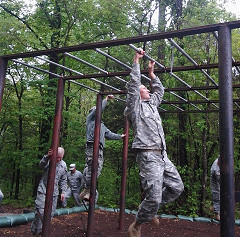
Staff Sgt. Richard Cummins breezes through the obstacle course at Fort Knox, Ky. (KYNG photo by Spc. Christina Riddle, Co. B 351st Aviation Unit Public Affairs Historian Representative)
“It’s amazing from to be able to capture what I get to see as a Soldier and show my pictures to my husband and children and have them actually understand what we do.”
For her next assignment Riddle will consider using her issued equipment. If her skills with a cell phone are any indication, she ought to do her unit proud.
Capt. Cliff Flanagan, 63rd Theatre Aviation Brigade, and Chief Warrant Officer 2 Gustavo Grande, Bravo Company 2 Battalion, 147 Aviation Regiment, pre-flight a New York National Guard CH-47D Chinook during training conducted in Rochester, Ny., Nov. 18.
ROCHESTER, Ny. (Nov. 29, 2010)–
A unique partnership between two states allows Kentucky Army National Guard aviators to keep up their skills and support a crucial homeland security mission.
Capt. Cliff Flanagan, Capt. Stephen D. Martin and Chief Warrant Officer 2 Gustavo Grande are all qualified in the CH-47D Chinook, though Kentucky currently has none. In order to maintain currency in the tandem-rotor helicopter, they fly with the 1st Detachment, Bravo Co., 3rd Battalion, 126th Aviation Regiment from the New York National Guard on a bi-monthly basis either traveling to Rochester or having a Chinook travel to Kentucky for training.
The Kentucky aviators work with the New York Guard conducting troop and equipment transport as well as sling load operations, training to remain proficient as well as to build the working relationship between the two states. Their training flights are in support of CCMRF (Chemical Biological Radiological and High-Yield Explosive Consequence Management Response Force) homeland security mission, a part of Joint Task Force Civil Support under U.S. Northern Command.
In the event of a large-scale chemical, biological, nuclear or high-yield explosive incident, Kentucky’s 63rd Theater Aviation Brigade has the responsibility of providing command and control of aviation assets in an affected area, while the New York National Guard’s Chinooks will be responsible for providing first line support working directly under the 63rd TAB.
Capt. Stephen D. Martin, Capt. Cliff Flanagan, Chief Warrant Officer 5 Mike Zanghi, Chief Warrant Officer 2 Gustavo Grande and Capt. Eric Fritz complete their bi-monthly CH-47D Chinook training in Rochester, Ny., Nov. 19. Zanghi and Fritz are assigned to the New York Army National Guard.
“It feels great to accomplish a job working alongside different states in order to keep the country safe,” said Flanagan, who is assigned to the 63rd TAB. “We’re doing everything we can to prepare for an event that we hope never happens.”