Pages
Stay In Touch
More
© 2013 KentuckyGuard
Kentucky National Guard Staff Report

Chief Warrant Officer Jacob Lewis was named the Outstanding Engineer Warrant Officer for 2014. Lewis serves as the Construction Engineering Technician with the 149th Vertical Construction Company. (Kentucky National Guard command photo)
FRANKFORT, Ky. — Chief Warrant Officer Jacob Lewis with Kentucky’s 149th Vertical Construction Company has been named the Outstanding Engineer Warrant Officer for 2014 for the Army National Guard. Lewis serves as the Construction Engineering Technician for the Cynthiana, Kentucky-based 149th.
“Being named the Outstanding Engineer Warrant Officer of the Year is an honor and words can’t explain my feelings right now,” said Lewis. “This means to me what I think every engineer regardless of enlisted or officer strive to accomplish at some point in their careers.”
Enlisting in 2002 as a combat engineer, Lewis has spent his entire time in uniform in the Kentucky Guard. A decision based upon his family’s history of service and a desire to serve.
“I believe it was my path to serve this great nation and to be part a team of individuals that all fight for the same cause. I wanted to be able to look back at my life and say I did what most only dream of in seeing the world and helping out with our freedoms, and I have and will continue to do just that.”
It was in 2012 that Lewis decided to make the transition from NCO to warrant officer. With the confidence he had garnered as an enlisted Soldier, Lewis felt his abilities could take him further.
“During my time as an NCO I felt like I could offer so much more and wanted to take my expertise to the next level. I chose to become a technical expert so that I could not only lead Soldiers through diverse situations, but also train them into becoming experts in their fields.”

Warrant Officer Jacob Lewis and members of the 149th Vertical Construction Company stand with a German engineer officer at Camp Spann, Afghanistan, 2012. Enlisting into the Kentucky Guard in 2002, Lewis has been an engineer his whole career, deploying twice to Afghanistan. (Courtesy photo)
After graduating warrant officer school, Lewis didn’t skip a beat, keeping his focus on the mission at hand, his Soldiers and the quality work ethic known from warrant officers. He said being a warrant officer has been the most rewarding experience of his career.
“I believe that it takes more than just being able to build a structure in order to be recommended for such a prestigious award. It takes time hard work and dedication. We as warrants hold the keys to our success, we have to be the ones that answer the hard questions to our supervisors and advise our chain of command in order to accomplish the mission and for them to have great faith and trust in us. I think it is something that anyone can achieve its not unreachable by any means but they have to want it as I did and put in the work. Sometimes we are faced with challenges and it’s how you as an individual handle those challenges that make each of us different.”
Kentucky’s state command chief warrant officer, Chief Warrant Officer Dean Stoops believes Lewis was the first Kentucky warrant submitted for this award. And based upon Lewis’ win, Stoops plans to submit more Kentucky warrant officers for national-level honors.
“CW2 Jacob Lewis is the embodiment of our State military motto of ‘Unbridled Service’, so it makes my job easy when we have such outstanding talent and exceptional leaders as him. I couldn’t be more proud of Chief Lewis and our Warrant Officer community.”
The Outstanding Engineer Warrant Officer awards are presented annually to the engineer warrant officer in each Army component, selected in recognition of their outstanding contributions to military engineering by demonstrating technical and leadership ability. Lewis is scheduled to receive the award in May at Fort Leonard Wood, Mo.
With new bragging rights in his field, Lewis is also taking the next step in his personal life as he and his fiancee are planning their wedding for later this year.
“Life is too good right now,” he said. “I will just count my blessings each day and go out and try to be better than yesterday.”
Story by Chief Warrant Officer Joseph Lyddane
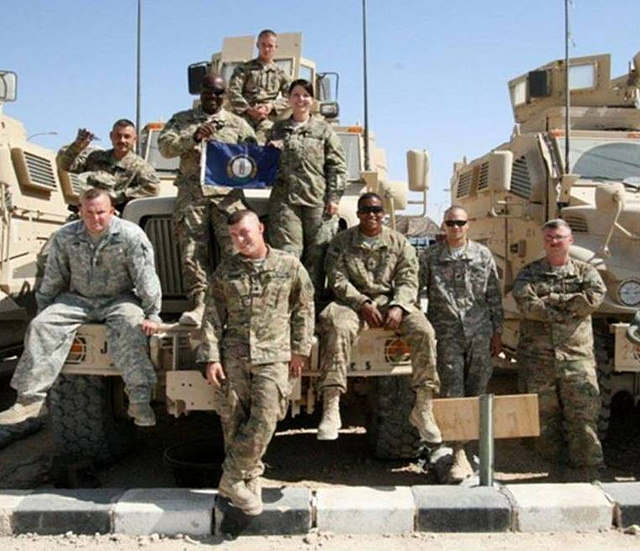
Chief Warrant Officer Melissa Propes (second row from top, middle) with her team in Jordan. During her deployment with 1st Battalion 623rd Field Artillery she was the Battalion Maintenance Officer. She later became the first female FMS Shop Chief for the Kentucky Army National Guard. (Photo courtesy Chief Warrant Officer Melissa Propes)
FRANKFORT, KY. — The title “mechanic” is synonymous with the terms hard work, grease, oil, and more often than not, male. Although inequality remains prevalent between men and women in the workforce, there are those amongst the projected 159.4 million females in the United States proving that women can dominate, excel, and outperform males at their own game.
One Kentucky Army National Guard Soldier decided to break the mold in pursuit her own aspirations. Emerging from humble beginnings, Chief Warrant Officer Melissa Propes took the advice of her mother who told her, “You can be anything you want to be if you work hard for it.”
When Propes joined the Kentucky Army National Guard on February 25, 1999 she was faced with a decision, as many of us are, as to which path to choose. With pride and determination, as a senior at Campbellsville High School, she set her sights on the male dominated Military Occupational Specialty of 63W (Wheeled Vehicle Mechanic) and was assigned to the 326th Ordnance Detachment in Glasgow. She attended basic training thereafter and made a name for herself right away by graduating as the Honor Graduate during her Advanced Individual Training.
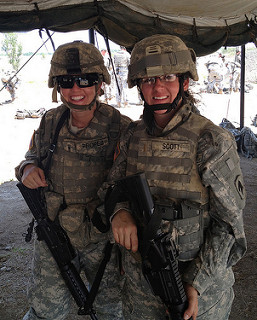
Chief Warrant Officer Melissa Propes (right) and 2nd Lt. Stephanie Scott, both of 1st Battalion, 623rd Field Artillery, pause during training at Wendell H. Ford Regional training Center in Greenville, Ky. July, 2012. (Courtesy photo)
Chief Propes recognized the importance of continuing her education early on and enrolled in Eastern Kentucky University in 1999 and attended Western Kentucky University from 2000-2002. However, she decided her heart was in the maintenance field, so while serving on orders for a pending deployment she decided to apply for the Nashville Auto Diesel College (NADC) and was accepted shortly after.
Propes’ work ethic became apparent during her tenure at NADC. She not only was a contributing member on the school newspaper staff, but she worked her way up the ladder at Outback Steakhouse to become a server trainer.
Amid all of her responsibilities, additional duties and monthly drills Propes was able to graduate in 2004 with a diploma in Auto and Diesel Technology as well as receive the prestigious Craftsman Award for having a ninety-five percent shop average.
“There was a defining moment when I realized that being in the National Guard meant more than just showing up for drill and ‘doing your job,'” said Propes. “I was very young when we got mobilized it became clear to me that if I wasn’t proficient at my job, someone could get killed. That’s when it became serious for me.”
In true leadership fashion, Propes credits her team for getting through that period of her life. “I could not have done it without the flexibility and support from my managers, coworkers and family.”
It is difficult to get a foot in the door at some of your major mechanics facilities much less to be the first female mechanic. Propes did just that when she became a hydraulics technician for Thompson Machinery in 2004. Overcoming the odds against her, the disregard of her coworkers, and even the advice of her supervisor that perhaps she was in the wrong career field, she persevered by starting early, working late, and sometimes putting in over eighty hours per week eventually winning the confidence and respect due her.
The experience and credibility established during her time with Thompson Machinery led to her becoming the first full-time female mechanic to be hired at the Combined Support Maintenance Shop as a Heavy Mobile Equipment Repairer. A promotion and new responsibilities validated her hard work and efforts.
“This was the first time I felt that I could impact my organization beyond just being a good mechanic,” she said.
After being promoted to Staff Sergeant, becoming a shop foreman, senior mechanic, again being the first female to be selected as an equipment specialist, she decided to accept the challenge of attending Warrant Officer Candidate School to become a 915A Surface Maintenance Mechanic Warrant Officer. Did I mention she was the honor graduate once again of her Warrant Officer Basic Course?
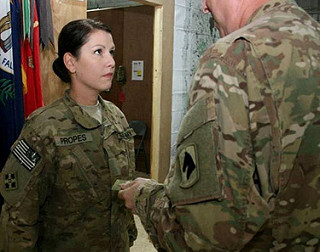
Melissa Propes being promoted to the rank of CW2. Early on in life Propes took the advice of her mother who told her, “You can be anything you want to be if you work hard for it.” (File photo)
A newly minted Warrant Officer Propes was eager to accept the position Battalion Maintenance Officer for the 1-623rd. She later became the first female field maintenance shop chief in the state. She deployed with the 1-623 thereafter in 2013 where she provided area maintenance support of active duty units, Marines, Special Forces, civilian contractors, reefer vans, and UAV launchers.
“There was something new and challenging every day,” said Propes.
Her attitude and approach are exactly why she was nominated for the 2014 Warrant Officer of the Year award. While she didn’t win, she gave her competition a run for their money.
“Chief Propes was very competitive and made the job of the selection board very difficult.” said State Command Chief Warrant Officer Dean Stoops. “We need more women in the warrant officer corps and if Chief Propes is an indicator of the potential that’s out there, then the future of the corps is bright.”
“Chief Propes is proof that with hard work, commitment, and a willingness to assume responsibilities,”said Chief Warrant Officer Connie Vick, one of Propes’ mentors and friends. “All dreams can be accomplished. She is an inspiration to young female Soldiers to excel and achieve their own dreams. I am proud to call her one of my fellow warrant officers.”
After the challenges and struggles throughout the last fifteen years, many would choose to take a break or at least stop to breathe. Not Chief Propes. Upon returning from deployment she now has an additional goal of attending Western Kentucky University’s Technology Management Program in order to enhance her supervisory and leadership skills as well as become, as she put it “an even greater asset to the maintenance community.”
“I can’t take personal credit for my accomplishments,” said Propes. “I’ve had some outstanding mentors throughout my career. Our organization has a focus on mentorship, both in receiving and providing, at all levels, NCOs and officers.”
According to Propes, being a warrant isn’t exactly a walk in the park. “It’s not for easy and I don’t think it’s for everybody. But if you love what you do and you wan to continue being a part of your specialized field and make it better, then the warrant officer program is perfect for someone with that mindset and desire.”
Story by David Altom, Kentucky National Guard Public Affairs

Warrant Officer William Cottrell receives his first salute from Sgt. 1st Class Ramon Perales during a graduation ceremony fro the Kentucky Guard’s newest officers and warrant officers in Frankfort, Ky., Sept. 27, 2014. After several years of service, Cottrell commissioned as a warrant officer through the Kentucky Guard’s Warrant Officer Candidate School. (U.S. Army National Guard photo by Staff Sgt. Scott Raymond)
FRANKFORT, KY. — After nearly 100 years since being established by an act of congress, the warrant officer corps remains a mystery to a good many of us, civilian and military alike. It’s been call “the best rank in the Army” as well as the most misunderstood.
Earlier this year we published a top five “mythbusting” article about warrant officers. It turns out there was a lot more about this rank than meets the eye, so we thought it was time to revisit the matter and go for a top ten. Following are the next five truths we thought it was important for you to know.
LINK: Click here to see the first “Top 5 Myths” about warrant officers.
Myth #6: You must have flight experience to become an aviation warrant officer.

A Kentucky National Guard warrant officer inspects cockpit controls of a UH-60 Blackhawk prior to a maintenance test flight in Frankfort, Ky., Oct. 23, 2014. (U.S. Army National Guard photo by Staff Sgt. Scott Raymond)
False: “No, you do not need to have any previous flight experience to become a Kentucky Army National Guard aviation warrant officer,” said State Command Chief Warrant Officer Dean Stoops. “All that is required is that you posses the perseverance necessary to complete the application process and the Initial Entry Flight Training Program. It doesn’t matter what MOS you’re in now, believe it or not. ”
There are some stipulations before you apply, though. You must be at least 18 years old, but not have reached your 33rd birthday by the time you report to flight school. Applicants must successfully pass a Class 1 (warrant officer candidate) Flying Duty Medical Examination (FDME) IAW AR 40-501 and score 40 or higher on the Selection Instrument for Flight Training (SIFT) test. Applicants will be referred to the 63rd Theater Aviation Brigade commander and State Army Aviation Officer for a personal interview.
Myth #7: Army National Guard Warrant Officers must compete for promotion.
False: “Warrant Officers in the National Guard do not compete for promotion like the active component,” said Chief Warrant Officer Ryan Turner. “To be considered for promotion to the next higher rank, an Army Guard warrant officer must be in an active status and duty MOS qualified. You also have to be medically fit in accordance with regulation and meet prescribed the height and weight standards.”
Turner also said the Soldier must also have completed the minimum years of promotion service indicated in NGR 600-101, table 7-1 and have completed the minimum military education requirements prescribed in table 7-2. In addition, the warrant officer must have a current APFT and must be receive the written recommendation of their immediate commander. And, unlike commissioned officers and enlisted personnel, warrant officers may be promoted up to the grade of CW4 without regard to the standard of grades limitations shown in TOE/MTOE/TDA documents or limitations listed in DA Pam 611-21.
Yes, you are reading this correctly: Army National Guard warrant officers serving in a CW2 position or higher, may be promoted up to the rank of CW4 as long as all other requirements are met.
Myth #8: You must have a college degree to become a Warrant Officer.
False: According to Chief Stoops, “Although there is a requirement to have some college credits for certain warrant officer jobs, generally there is no requirement to have a college degree or college courses.”
Stoops explained that each applicant must demonstrate understanding and proficiency of the English language. An applicant whose native language is not English must achieve a minimum score of 80 on the English Comprehension Level Test. At a minimum, Warrant Officer must be a high school graduate or pass the General Education Development (GED) test.
“Still, we encourage every Soldier to attain higher education for self-development and pursuit of higher learning related to their specific MOS,” Stoops said.

Chief Warrant Officer Greg Stepp conducts the 202nd Army Band during a performance in Covington, Ky., July 5, 2014. Warrant officer positions cover a wide variety of skills and expertise. (U.S. Army National Guard photo by Sgt. 1st Class Steve Baker)
Myth #9: You must accept your appointment to WO1 immediately upon completion of Warrant Officer Candidate School (WOCS).
False: That’s a negative, according to Chief Warrant Officer Ricky Skelton, TAC officer with the 238th Regional Training Institute’s warrant officer candidate school.
“Most soldiers assume that they must accept their appointment as a WO1 immediately upon completion of warrant officer candidate school, but this is not the case,” said Skelton. “Soldiers who successfully complete WOCS may elect to delay accepting their initial appointment as a WO1 for up to five years, although federal approval will have to be reapplied for prior and received prior to appointment.”
Skelton said this is particularly helpful for AGR or technician soldiers who do not have a full-time Warrant Officer position to go into immediately following WOCS, but who want to position themselves to apply for full-time Warrant Officer positions that may come open in the future.
Myth #10: Enlisted Soldiers in the grade of E7, E8 or E9 may be initially commissioned as a CW2.
“Well, not exactly,” said Chief Stoops. “Upon completion of WOCS, all Warrant Officer Candidates are temporarily appointed as a WO1 until they complete their warrant officer basic course. However, enlisted Soldiers in the grade of E7 with a minimum of two-years time in grade applying for an MOS that is less than 100% strength, may be promoted to CW2 upon completion of WOBC.”
“Enlisted Soldiers in the grade of E8 or E9 may be promoted to CW2 upon completion of WOCS and WOBC without regard to enlisted time in grade,” he said.
So there you have it, five more steps toward greater enlightenment about the warrant officer corps. If you think you have something special to offer, you should consider this as the next step in your career. Warrant officers continue to be the Army’s technical experts, and as they continue to evolve with future threats and everchanging technologies, they are as dynamic and essential as ever before.
Soldiers interested in obtaining more information should contact Chief Warrant Officer Ryan Turner, Warrant Officer Strength Manager, office: 502-607-6200, mobile: 502-320-3653, or email [email protected].
Photo essay by Warrant Officer Candidate Orbin Rudd, Forward Support Co., 201st Engineer Battalion
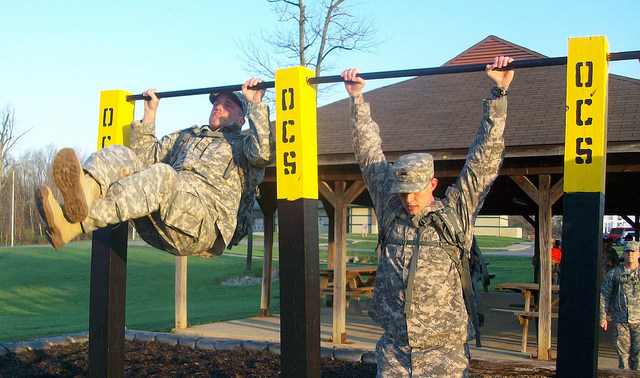
Warrant Officer Candidates Lawrence Webb and Duncan Lewis tackle the pull up bars during their Warrant Officer Candidate training at the Kentucky National Guard’s Wendell H. Ford Regional Training Center. (Photo by Warrant Officer Candidate Orbin Rudd, Forward Support Co., 201st Engineer Battalion)
The man who spends more sleepless nights with his army and who works harder in drilling his troops runs the fewer risks in fighting his foe.
— The Emperor Maurice, c. AD 600
WENDELL H. FORD REGIONAL TRAINING CENTER, GREENVILLE, Ky. — Military training is hard enough the first time you go through it. The second or third time you’d think it would get easier, that’s not necessarily true. There’s always that unexpected challenge, that one stubborn obstacle to overcome, no matter how experienced or educated you think you are.
Click here for more photos of this event.
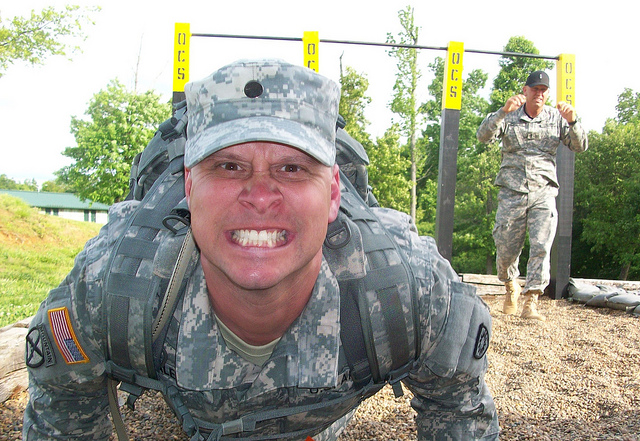
Warrant Officer Candidate Jeffrey Valentine shows off his “war face” while in the front lean and rest position. (Photo by Warrant Officer Candidate Orbin Rudd, Forward Support Co., 201st Engineer Battalion)
Following are some photos from the 238th Regimental Training Institute’s Warrant Officer Candidate training weekend. In addition to extensive physical training and testing there are classes in leadership, tactics and military history and protocol.
For more information on the Kentucky National Guard’s warrant officer program contact Chief Warrant Officer Ryan Turner at (502) 607-6200, Cell: (502) 320-3653 or email him at [email protected].
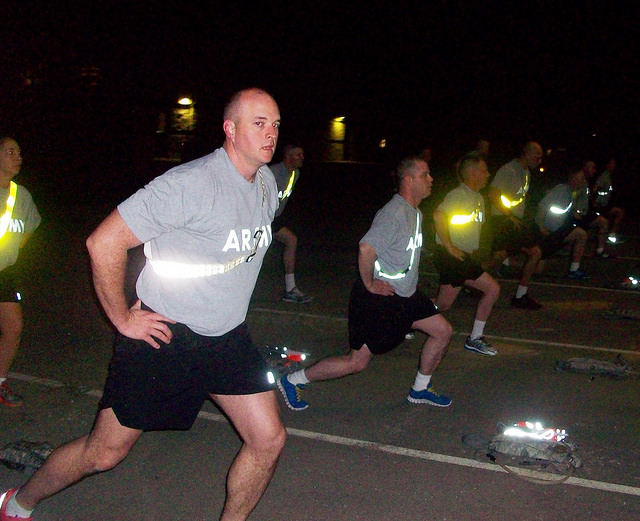
They call it “oh dark early” for a reason. Warrant Officer Candidate Matthew Vincent joins his class for a little early morning PT. (Photo by Warrant Officer Candidate Orbin Rudd, Forward Support Co., 201st Engineer Battalion)
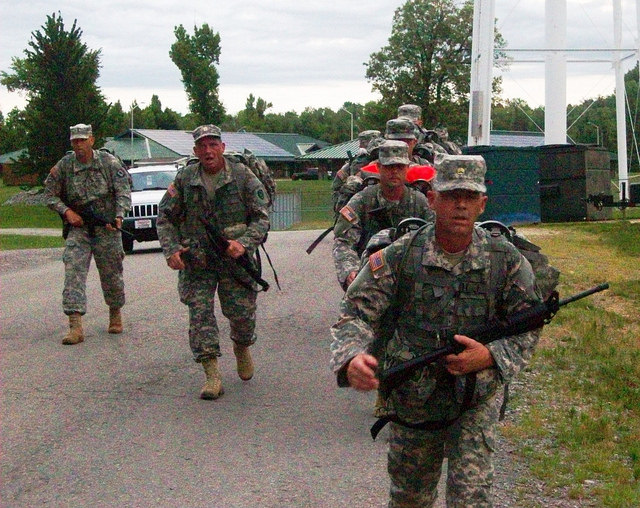
Hauling that rucksack on a leisurely march through the Wendell H. Ford Regional Training Center. (Photo by Warrant Officer Candidate Orbin Rudd, Forward Support Co., 201st Engineer Battalion)
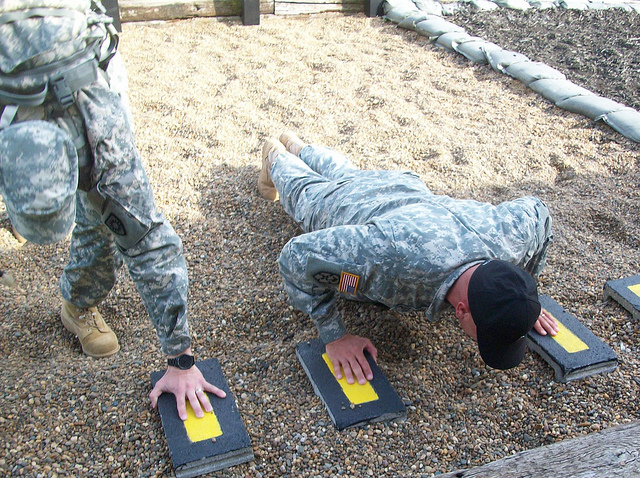
TAC Officer Ricky Skelton shows his warrant officer cadets how it’s done. (Photo by Warrant Officer Candidate Orbin Rudd, Forward Support Co., 201st Engineer Battalion)
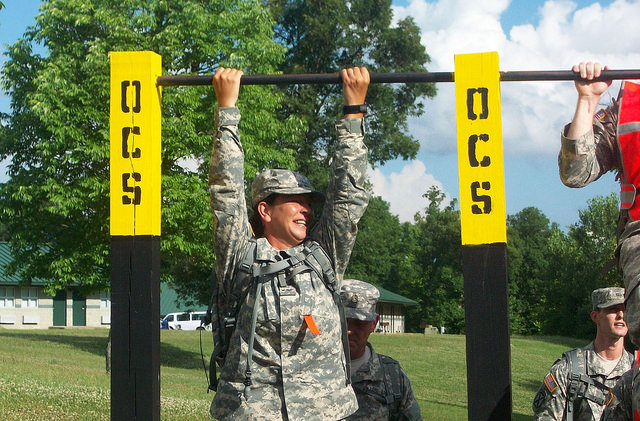
Warrant Officer Jessica Peel takes her turn at the pull up bar. Peel is the only female in her WOCS class. At present there are only eight female warrant officers in out of a total of 148 in the Kentucky National Guard. (Photo by Warrant Officer Candidate Orbin Rudd, Forward Support Co., 201st Engineer Battalion)
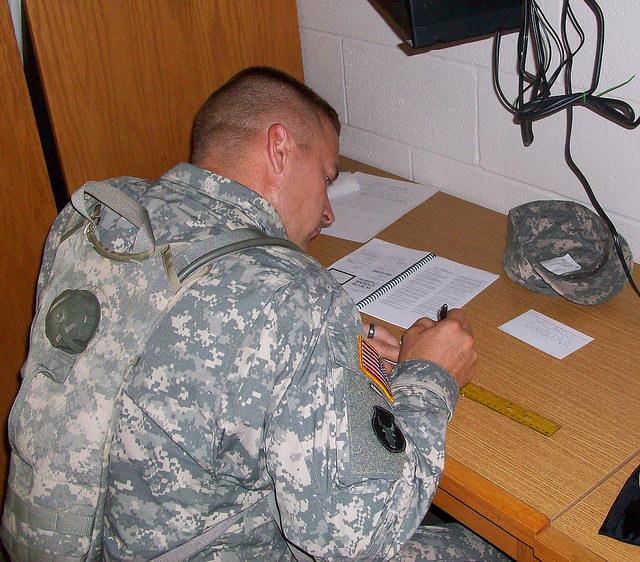
It’s not all fun and games in the field. Warrant Officer Jess Willard hits the books before heading out for more training with his fellow cadets. (Photo by Warrant Officer Candidate Orbin Rudd, Forward Support Co., 201st Engineer Battalion)
20141016 Call for WOCS TAC Officers and Academic Instructors
Story by Chief Warrant Officer Joseph Lyddane

Kentucky National Guard State Command Chief Warrant Officer Dean Stoops salutes members of Warrant Officer Candidate School Class 14-001 as they prepare to take part in a 5 kilometer “Run to Remember” in Bloomfield, Kentucky. (Photo by Janice Hill, Run to Remember Committee)
BLOOMFIELD, Ky. — On May 10, 2014 Kentucky’s 238th Regional Training Institute Warrant Officer Candidate School Class 14-001 demonstrated their patriotism, selfless-service, and cohesiveness by participating in a 5 kilometer “Run to Remember” in Bloomfield, Kentucky. The cadets’ participation was in support of the Kentucky National Guard Memorial which breaks ground later this month in Frankfort.
Taking part in the run had a two-fold mission: giving back to the memory of fallen troops and building esprit de corps among the cadets in training.

Members of Warrant Officer Candidate School Class 14-001 prepare to take part in a 5 kilometer “Run to Remember” in Bloomfield, Kentucky. (Kentucky National Guard photo by Chief Warrant Officer Joseph Lyddane)
“Soldiers become more effective when they share experiences and achievements as a unit,” said Chief Warrant Officer Ricky Skelton, one of the training, advising and counseling officers in charge of the cadets. “Whether this triumph is achieved outside on deployment during combat or in a garrison environment, the sharing of one common victory helps build a distinct bond.”
“I believe it’s important for candidates to be involved with the community because giving back is one of the Army Values, selfless-service,” said WOC Dustin Lewis, who participated in the run. Lewis is accessing to be a 420A Human Resources Technician. “Community involvement gives each of us a chance to reach out and make a positive impact on the individuals for which we serve.”

Members of Warrant Officer Candidate School Class 14-001 during a 5 kilometer “Run to Remember” in Bloomfield, Kentucky. (Kentucky National Guard photo by Chief Warrant Officer Joseph Lyddane)
The WOCs, all of which are prior non-commissioned officers are in their second month of a six month process where they are building on their already established academic, leadership, discipline, character, physical, and mental capacities. They will be trained, evaluated, and assessed to become the self-aware and adaptive technical experts, combat leaders, trainers, mentors, and advisors that soldiers and commanders have come to expect. The curriculum includes leadership development, officer roles and responsibilities, communications and briefings, military operations, military and warrant officer history, land navigation and urban operations. The course culminates into a final two-week phase at Camp Atterbury, Indiana this summer.
The six month school is designed around drill weekends which provides soldiers who have aspirations of becoming a Warrant Officer the flexibility needed to work around their civilian careers; as opposed to the accelerated format at Fort Rucker, Alabama which requires a five week temporary duty assignment.
“The Warrant Officer Candidates that participated in this event not only ‘talk the talk’, but they ‘walk the walk’ as it pertains to living the army values and the tenants of the warrant officer creed,” said State Command Chief Warrant Officer Dean Stoops. “I am very proud of how well they represented the warrant officer corps of Kentucky.”
Stoops presented the team with a certificate and a yellow streamer embroidered with “Class 14-001 Esprit de Corps.” The streamer will become a part of Kentucky’s Warrant Officer, a symbol of Class 14-001’s “Unbridled Spirit.”
For more information on the Kentucky National Guard’s warrant officer program contact Chief Warrant Officer Ryan Turner at (502) 607-6200, Cell: (502) 320-3653 or email him at [email protected].
Story by David Altom, Kentucky National Guard Public Affairs
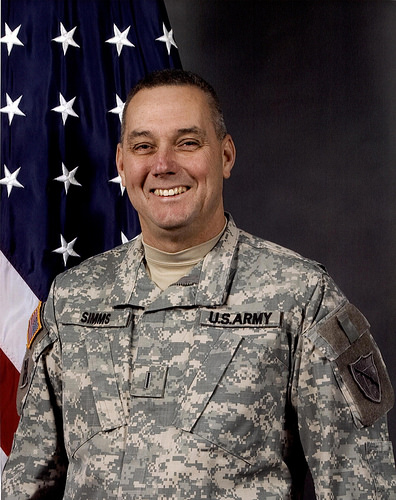
State Command Chief Warrant Officer James “Jimmy” Simms retired after 42 years of service with the Kentucky National Guard. Among his accomplishments, he helped develop Kentucky’s first Warrant Officer Candidate School. (Official Kentucky National Guard photo)
FRANKFORT, Ky. — Retired State Command Chief Warrant Officer Jimmy Simms has had a long row to hoe, as we say here in the Bluegrass State. The fourth person to hold that prestigious position, Simms retired last month after 42 years in the Kentucky Army National Guard and leaving behind a legacy that will affect generations to come.
Born in Versailles, Simms enlisted in the Kentucky Guard in February of 1972 as a wheel vehicle mechanic. His first assignment was with the old 203rd General Support Company in Danville, Kentucky until transferring to the 2nd Battalion, 138th Field Artillery in 1984.
“I joined the Kentucky Guard when the country was still committed to Viet Nam and a lot of protest against that war was ever present,” he said. “At the age of eighteen I wasn’t sure what direction was right for me. I had friends that were in the National Guard and I liked how they could be part of the military and still go to college or have a career here at home, so I decided that was for me.”
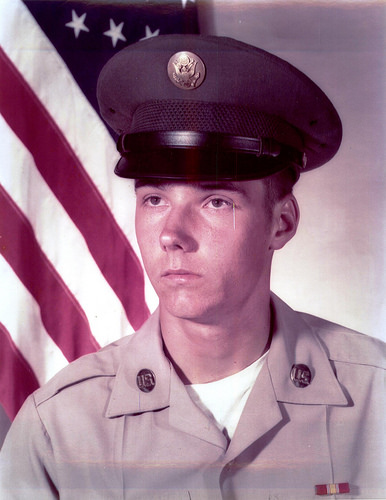
A brand new Jimmy Simms 42 years ago. Little did he know where his career would take him. (Photo courtesy retired CW5 Jimmy Simms)
In 1985 Simms was appointed as a warrant officer in field artillery as the battalion maintenance technician. He would later transition to the same position for the 138th Field Artillery Brigade where he helped with the transition to the new fires brigade concept.
“After being in the Guard a while I began to see how all the different ranks and MOS’s supported each other and the unique qualities of each,” he said. “I thought about that and decided that my experience and knowledge could open the door to become a warrant officer.”
While assigned to the 138th Fires Brigade Simms was mobilized twice and deployed once to Iraq in support of Operation Iraqi Freedom. He also completed a six month tour with the Joint Task Force in support of the Alaskan Road project on Annette Island Alaska.
“I have known Chief Simms since for over 30 years,” said Maj. Gen. Lonnie Culver, who commanded Simms during his time in the artillery. “He is a great Soldier, warrant officer, father, husband and friend. It has been an honor and pleasure serving with him, and it was always good to know that I had an expert who took pride in his work and took care of his Soldiers. He represents the warrant officer corps so well.”
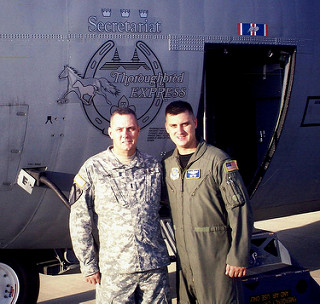
CW5 Jimmy Simms and his son, Bradley. Both father and son flew on the same flight that brought the senior Simms home from Iraq. (Photo courtesy retired CW5 Jimmy Simms)
In October 2009 Simms was transferred to the state headquarters and assigned the position of senior maintenance officer. He was promoted to the rank of CW5 in January 2010.
Simms’ career also included a variety of positions in the federal technician program, starting out as a wheeled vehicle mechanic and moving up to shop chief. He retired as a technician in in 2009 with 31 years of service. Upon his retirement he was selected to run the operational equipment reset program at the maneuver and training equipment site at Fort Knox until his selection as the fourth state command chief on February 24, 2011.
Simms had many highlights in his warrant officer career, but two stand out above all the rest: his appointment to CW5 and being part of the planning and establishing of the Kentucky National Guard’s Warrant Officer Candidate School. In July 2011 Kentucky graduated its first warrant officers and Simms was there to witness it.
“I was so proud of those eight new warrant officers,” he said. “That was a great day for Kentucky and a great day for the warrant officer program.”
Newly appointed State Command Warrant Officer Dean Stoops had high praise for his predecessor.
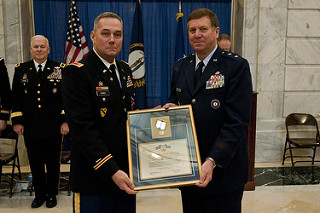
State Command Chief Warrant Officer Jimmy Simms receiving the Kentucky Distinguished Service Medal from Adjutant General Edward W. Tonini on January 14, 2014. Simms relinquished his responsibility to newly appointed State Command Chief Dean Stoops and retired after 42 years of service. (U.S. Army National Guard photo by Staff Sgt. Scott Raymond)
“There are several things to admire about Chief Simms, but in particular is his commitment to know about each and every Warrant Officer in the Kentucky National Guard,” said Stoops. “It’s not easy to remember the details about each Soldier, but Chief Simms has the ability to know where each of his Warrant Officers are assigned, where they work, what their civilian and military jobs are, and even the personal things he has learned over the years.
“This is the characteristic of a great leader and I hope I can do half as well as Chief Simms.”
What would Simms advise someone looking to become a warrant officer? “I would tell a young soldier considering being a warrant office to plan their career to be an outstanding NCO by attending all their professional military education and be a leader regardless of their current rank. Then when the opportunity for warrant officer becomes available they will have the background and experience to meet the requirements to apply.”
He has similar advice for senior NCOs, but he tempers it by saying, “As a senior NCO you have a vital role in your command and you must weigh the benefits to both yourself and the Guard.”
After retiring from the Guard Simms plans to spend more time with Patricia, his wife of forty years, and his three children Autumn, Bradley and Benjamin and grandchildren Preston, Brayden and Eva.
But the Guard is still in his blood. He recently accepted an appointment as the executive director of the National Guard Association of Kentucky, the professional organization for the Kentucky Guard’s officer and warrant officer corps. His passion for that organization is in sync with his continuing dedication for the Guard.
“I’d love to see all NCOs and officers become active members in either the NGAKY or the Enlisted Association National Guard of Kentucky. With a joint effort we can send a strong message from all members of the Kentucky Guard to leaders in Frankfort and Washington to support legislation that protects our military and the individual Soldier and Airmen.”
Story by Staff Sgt. Scott Raymond, Kentucky National Guard Public Affairs
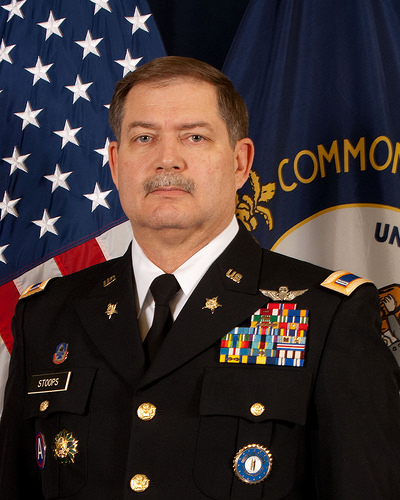
Chief Warrant Officer Dean Stoops assumed the role as Kentucky’s Command Chief Warrant Officer Jan. 31, 2014. Stoops has served for 35 years in the Kentucky National Guard, primarily as an aviation warrant officer. (Kentucky National Guard file photo)
FRANKFORT, Ky. — After 35 years in uniform for the Kentucky National Guard, Chief Warrant Officer Dean Stoops is at the top of his game. He assumed responsibility as Kentucky’s Command Chief Warrant Officer in January, but he said he’s not the Soldier he expected to be.
“I knew that I wanted to be a Soldier since I was a little kid,” said Stoops. “But I wanted to be a ranger out in the field, the tip of the spear kind of guy.”
“Timing and positions and duty assignments did not afford me those opportunities. I knew I wasn’t going to be a general, but there are so many other ways to be a leader.”
Stoops traces his military lineage back generations and credits his father, retired Army Lt. Col. Dick Stoops for getting him into the Guard. Stoops father was a battery executive officer with the 2nd Battalion, 138th Field Artillery in Bardstown, so he enlisted as a fire direction specialist, but would quickly learn that his path would be different than he had thought.
Even after so many years, Stoops still vividly remembers the last words his father said to him as he boarded the bus to basic training in 1978. His father said ‘be a leader and seek leadership positions.’ As a young private, the words helped guide him through leadership roles all through his training and into his career in the military.’
“It was the most profound piece of advice he could give me as father and as a Soldier,” he said. “I sought the leadership positions and leadership opportunities my whole career to improve myself and has certainly helped me along the way.”
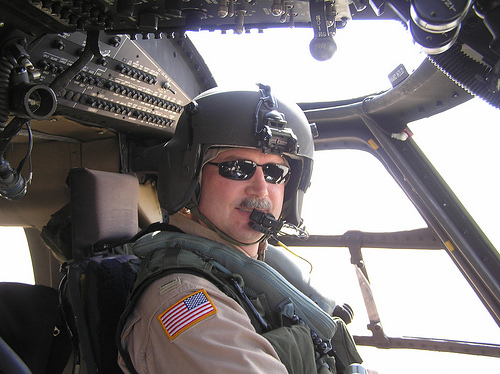
Chief Warrant Officer Dean Stoops pilots a UH-60 Blackhawk while deployed to the Middle East in 2005. Stoops deployed to the region where he served as the Theater Aviation Standardization Officer for U.S. Army Central Command. (Courtesy photo)
Shortly after coming to his father’s battery, Stoops saw an opportunity and steered his career into a different direction by attending Warrant Officer Candidate School and Rotary Wing Flight Training. His father was a private pilot, so it was an easy transition.Stoops would graduate as the honor graduate at flight school and spend the next 19 years flying helicopters for the Kentucky Guard. He became qualified in three of four aviation warrant officer career fields and held positions such Kentucky’s Standardization Instructor Pilot, Air Traffic and Aerospace Officer and State Aviation Safety Officer. On the civilian side, Stoops holds FAA certifications as a commercial helicopter pilot and private airplane pilot, and is certified as an aviation accident investigator.
The latter role brought Stoops into one of the toughest assignments of his career when he was chosen to assist in the shoot-down investigation of a CH-47 Chinook in Afghanistan that claimed the lives of 30 U.S. Service members in 2011.
After a four-year stint as the Army National Guard Aviation Standardization Officer in Washington D.C., Stoops returned to Kentucky to take on what he called the pinnacle role in his career.
“This feels really good because I’m coming back to family, friends and an organization that I know,” he said. “I enjoyed the assignment at NGB, but this is also a position that I had set a goal of having in the zenith in my career.”
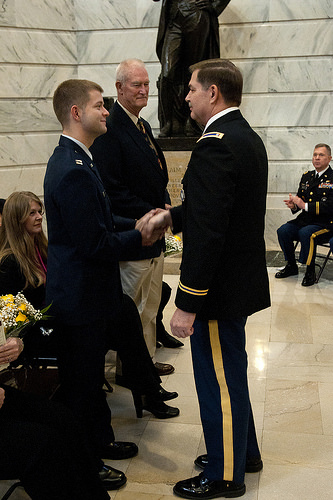
U.S. Air Force Capt. Brian Stoops congratulates his father, Chief Warrant Officer Dean Stoops following a change of responsibility ceremony in Frankfort, Ky., Jan. 31, 2014. The Air Force officer is the fourth generation career Service member, following his father and grandfather, retired Army Lt. Col. Dick Stoops, also pictured. (U.S. Army National Guard photo by Staff Sgt. Scott Raymond)
The next generation of Stoops’ in the military said his father’s guidance has been of the utmost importance in his life. Stoops’ son, Capt. Brian Stoops is a pilot in the U.S. Air Force and said his father’s principles and advice have shown him the way through the “tough questions in life.”
“Dad’s military values of honor, hard work, integrity, service, duty, and excellence that he not only internalized, but passed on to me are what have influenced me the most both personally and professionally,” Brian said. “His example, as a dedicated father and as a consummate professional, as both an aviator and an officer, continues to be a constant guiding light for me now as a young father, officer, and pilot.”
Stoops’ own friends and mentors, including Chief of the Joint Staff, Brig. Gen. Benjamin Adams believe Stoops is more than ready for the role. Adams called him one of the finest officers he has served with and the perfect fit for the job.
“He is the epitome of a professional aviator, Soldier and officer,” Adams said. “He brings a vitality and energy that will
continue to grow the interest in and maintain our warrant officer strength.”
Stoops’ new hope is to impact future leaders and manage the warrant officers of the Kentucky Guard to the best of his ability, all the while paying tribute to a lasting legacy of inspiration and cementing his own chapter as a true mentor.
“I think my dad is proud, my son is proud, but the important part is not the pride they have in my accomplishment,” he said. “The important part to me is by ascending to the leadership positions that I have attained, I have influenced my son, my daughter, and any other warrant officer out there and inspired them to seek their own leadership opportunities.”
Story by Staff Sgt. Scott Raymond, Kentucky National Guard Public Affairs
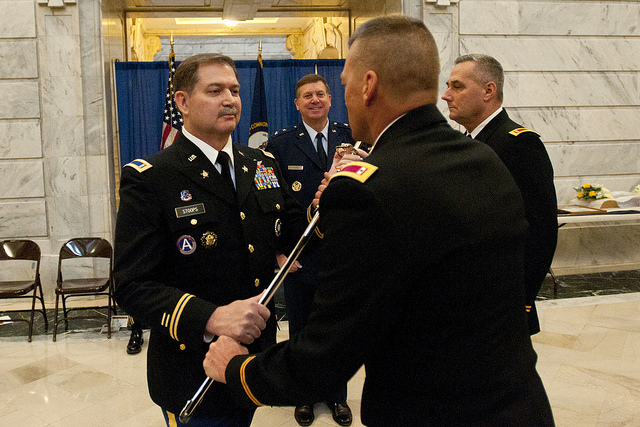
Chief Warrant Officer Dean Stoops passes the officer’s sword back to Warrant Officer Victor Blair to complete the symbolic change of responsibility as Stoops became the Kentucky National Guard’s command chief warrant officer, Jan. 31, 2014 in Frankfort, Ky. Stoops assumed the role from Chief Warrant Officer James Simms who is retiring after more than 40 years in uniform. (U.S. Army National Guard photo by Staff Sgt. Scott Raymond)
FRANKFORT, Ky. — Chief Warrant Officer Dean Stoops assumed responsibility as Kentucky’s fifth command chief warrant officer during a ceremony held at the State Capitol in Frankfort, Ky., Jan. 31, 2014.
Stoops succeeds Chief Warrant Officer James Simms who is retiring after more than 40 years in uniform and three years as the state’s command chief warrant officer.
“It is indeed an honor to be here as the command chief warrant officer for the Kentucky National Guard,” said Stoops. “I have to thank General Tonini for having the confidence in me to lead and manage the warrant officer corps into the future.”
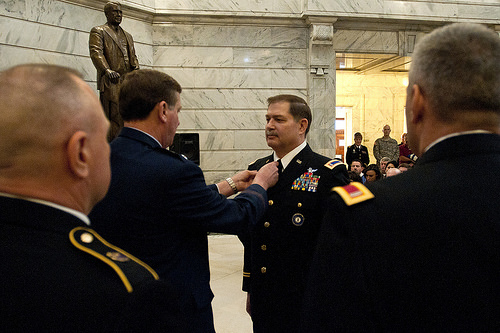
Kentucky’s adjutant general, Maj. Gen. Edward W. Tonini places Command Staff insignia on the uniform of Chief Warrant Officer Dean Stoops during a change of responsibility ceremony in Frankfort, Ky., Jan. 31, 2014. The insignia replaced Stoops aviation branch insignia and symbolized his transfer to the command staff as the new command chief warrant officer for the Kentucky Guard. (U.S. Army National Guard photo by Staff Sgt. Scott Raymond)
To see more photos from the ceremony, click here.
Kentucky’s adjutant general, Maj. Gen. Edward W. Tonini oversaw the ceremony and participated in the passing of the officer sword from Simms to Stoops. In front of a large crowd of family, friends and fellow Guardsmen in the Capitol Rotunda, Stoops exchanged the aviation branch insignia on his uniform and became the newest member of the Kentucky Guard’s Command Staff.
Also in attendance were Stoops’ father, retired Army Lt. Col. Dick Stoops and son, Air Force Capt. Brian Stoops, a generational example of a long military tradition in the Stoops family.
Born in Fort Campbell, Ky., Stoops has served in the Kentucky Guard for more than 35 years and is returning to the Commonwealth after his last assignment with the National Guard Bureau. He has served for the last four years in Washington D.C. as the Army National Guard Aviation Standardization Officer and senior aviation warrant officer advisor where he said he learned of the Kentucky Guard’s reputation at the highest levels of the military.
Chief Warrant Officer Dean Stoops presents his first coins as Kentucky’s new command chief warrant officer to his son, Air Force Capt. Brian Stoops and father, retired Army Lt. Col. Dick Stoops following a change of responsibility ceremony in Frankfort, Ky., Jan. 31, 2014. Stoops is a third generation career Soldier and thanked his father and son for inspiring him to succeed in his own career. (U.S. Army National Guard photo by Staff Sgt. Scott Raymond)
“All along the way, Kentucky was referred to as an organization with exceptional leadership and that not only met the standard but exceeded the standard,” he recalled. “So it’s very gratifying for me to come back into this position.”
Stoops new role serves as the senior warrant officer advising the adjutant general on the state of the Warrant Officer Corps. He is also responsible for providing guidance, resources, assistance and supervision to all warrant officers in the Kentucky Army National Guard.
“We need to ensure that we do not lose the expertise and knowledge gained in the past decade at war, and one of the keys to that is our warrant officer corps,” said Tonini. “Dean’s qualifications for this job are unquestionable and his history with the Kentucky Guard is quite extensive. He is the right man at the right time for this job.”
Story and photos by Staff Sgt. Scott Raymond, Kentucky National Guard Public Affairs
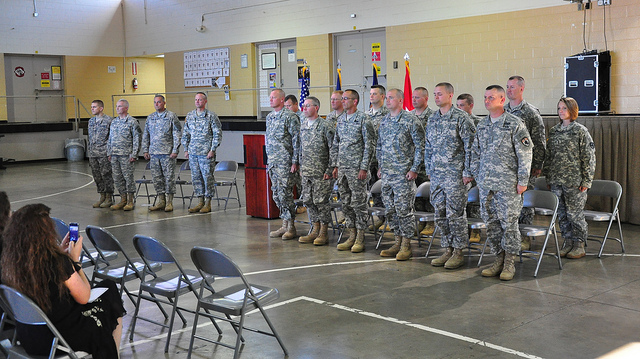
The newest graduates of the Kentucky National Guard’s Warrant Officer Candidate School stand at attention during a ceremony in Frankfort, Ky., Sept. 23, 2013. The new warrant officers recently completed the school and were commissioned Sept. 21 at Camp Atterbury, Ind. (U.S. Army National Guard photo by Staff Sgt. Scott Raymond)
FRANKFORT, Ky. — The small family that is the Kentucky Army National Guard’s Warrant Officer Corp got a little bigger with the commissioning of 12 new warrant officers, Sept. 21, 2013.
The Soldiers had just completed the final two-week phase of Warrant Officer Candidate School at Camp Atterbury Joint Maneuver Training Center in Edinburgh, Ind. Following the graduation there, the new warrant officers returned home for a recognition ceremony at the Boone National Guard Center in Frankfort, Ky., Sept. 23.
“On Saturday (Sept. 21), their military careers took on a whole new look, and a whole new responsibility,” said Kentucky’s State Command Chief Warrant Officer James Simms. ” This class represents the largest we’ve had, so the future is looking good for the warrant officer in Kentucky.”
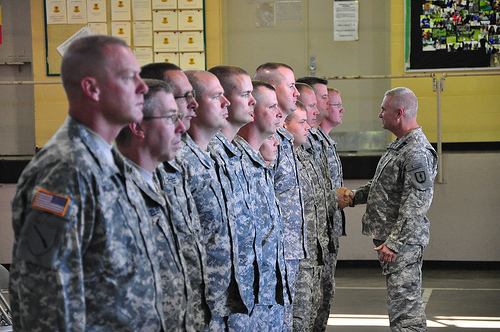
Col. Hal Lamberton, commander of the 238th Regiment congratulates each graduate of the Kentucky National Guard’s newest Warrant Officer Candidate School class during a ceremony in Frankfort, Ky., Sept. 23, 2013. The 12-member class represented the largest graduating class for the 238th and their WOCS. (U.S. Army National Guard photo by Staff Sgt. Scott Raymond)
The candidates started down the commissioning road around the beginning of the year, spending the majority of their time in training one weekend a month with the 238th Regimental Training Institute (RTI) in Greenville, Ky.
Warrant Officer Candidate School is made up of four phases: an on-line phase for preparatory course work, two phases of training with the 238th at the Wendell H. Ford Regional Training Center followed by the final phase at Camp Atterbury.
Kentucky’s RTI was recently named an Institute of Excellence by the U.S. Army and has been expanding it’s role as the state’s premier training facility, taking on new courses and more students. The unit has also impressed other states and other components with its availability and course offerings.
For two of the new warrant officers in the class, that’s just what they were looking for, because neither one are from the Kentucky Guard. Warrant Officer Arthur Stevens is an Army Reservist from the 378th Military Police Detachment in Louisville, Ky., but he lives in Clarksville, Tenn. Stevens said he had issues scheduling his school around his job and had never heard of the RTI. He said the decision worked perfectly with his work schedule and Reserve drill weekends.
“The only way I could have done this is with the RTI,” said the 13-year Veteran. “When I go back, I’m going to tell everyone I know that this is the way to go.”
“It was a great all-around experience,” Stevens said of the training. “It was great that the Guard took me in and made me part of the team.”
Simms said the Kentucky National Guard will help anyone become a warrant officer, regardless of their state or component. Warrant officers across the country work hand in hand with advanced courses and problem-solving and Simms believes they should work together to create new warrant officers as well.
“Thanks to skilled recruiters, quality leadership in the units and a fine training element we have in the 238th, we can make that happen here,” he said.
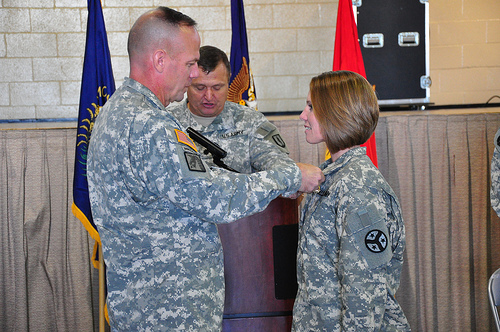
Brig. Gen. Stephen Hogan, assistant adjutant general for training recognizes Warrant Officer Amy Meadows as the honor graduate of the newest Warrant Officer Candidate School class during a ceremony in Frankfort, Ky., Sept. 23, 2013. Meadows, a Soldier with the Tennessee National Guard, chose Kentucky’s course because it allowed her to juggle work, college and becoming a warrant officer. (U.S. Army National Guard photo by Staff Sgt. Scott Raymond)
Warrant Officer Amy Meadows is with the Tennessee National Guard and also didn’t know how to deal with her full schedule of work and school. She knew the school would be longer than going through the traditional course at Fort Rucker, Ala., but had heard great things about the training provided by the 238th.
“I chose to go to Kentucky’s RTI because I needed another option,” she said. “I’m a full-time student and I work full-time at my civilian job, so I needed an option that allowed me to do all three, and the RTI was the best fit for my life.”
Meadows, from Mt. Juliet, Tenn., also graduated as the honor graduate of the class and said she has had always had respect for warrant officers, who always the ones who had the right answers.
“I’m a big believer in continuing knowledge and self-development,” she said. “And warrant officers are the pulse, the continuity of the Army, and I just wanted to be a part of it.”
Meadows will now be the Soldier everyone looks to for answers at the 278th Armored Cavalry Regiment in Knoxville, Tenn.
Each of the new warrant officers will now schedule and attend their job specific warrant officer basic course. But the training doesn’t stop there. To be the experts in their fields, warrant officers continually educate themselves for the benefit of themselves and their units. And from the regimental commander to each training, advising and counseling (TAC) officer, the 238th is glad to be instrumental in furthering the careers of the Army’s future leaders.
“We’re focused on building a stronger and more capable Warrant Officer Corps, the new leaders in the field,” said Chief Warrant officer Rick Skelton, TAC Officer with the 238th. “And I believe we are making good strides in doing our part here in Kentucky at the 238th.”
Story and photos by Staff Sgt. Scott Raymond, Kentucky National Guard Public Affairs
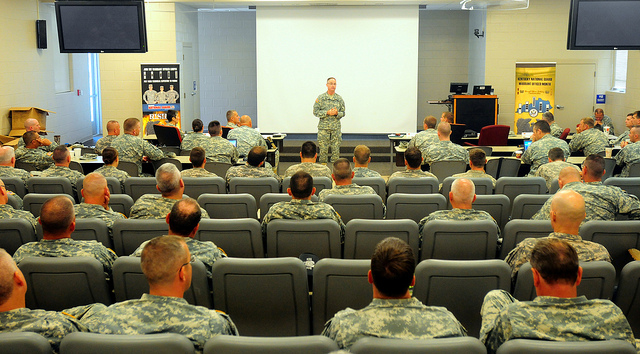
Chief Warrant Officer Gary Ensminger, the Command Chief Warrant Officer for the National Guard speaks to warrant officers of the Kentucky Guard at the Wendell H. Ford Regional Training Center in Greenville, Ky., Sept. 7, 2013. The warrant officers gather for their annual professional development conference to discuss the state of the warrant officer in the Kentucky National Guard. (U.S. Army National Guard photo by Staff Sgt. Scott Raymond)
GREENVILLE, Ky. — Warrant officers from every corner of the Commonwealth gathered at the Wendell H. Ford Regional Training Center, Sept. 7-8 for the chance to add more knowledge to their expertise. More than 100 Kentucky Guardsmen were there to attend an annual Warrant Officer Professional Development Conference.
“We hope this weekend that everyone can leave with a better understanding of training requirements, school requirements and recruiting requirements they need to become better warrant officers” said State Command Chief Warrant Officer James Simms. “We have warrants in Paducah, we have warrants in Ashland and they never see each other, but they have the same job, so this is the chance to bring them together to talk about improvements that could be made.”
Brig. Gen. Benjamin Adams, Chief of the Joint Staff for Kentucky visited the warrant officers and reminded them that they are the quiet professionals.
“The Warrant Officer Corps is a small group, but a professional group,” said Adams. “You are the ones that keep the organization running right at the speed we need it to run.”
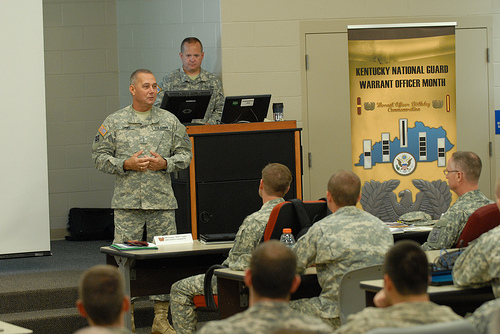
Chief Warrant Officer James Simms, Kentucky’s State Command Chief Warrant Officer speaks to warrant officers at the Wendell H. Ford Regional Training Center in Greenville, Ky., Sept. 7, 2013. Simms stressed continued education to those in attendance, a key to a successful career as a warrant officer. (U.S. Army National Guard photo by Staff Sgt. Scott Raymond)
The Kentucky Army Guard has around 140 warrant officers in its ranks and Simms said it is very hard to get all of them together at one time.
“We have 80 to 85 percent of all of our warrants here this weekend,” he said. “With deployments, attendance at advanced courses and some mission requirements, there’s a few that cannot make it, but we have guys here from every command, so they will take back the knowledge to those not here.”
Chief Warrant Officer Gary Ensminger, the Command Chief Warrant Officer for the Army National Guard made the trip to Kentucky to get feedback personally from Kentucky’s warrant officers. He said it’s his goal to gather questions and concerns to take back to the National Guard Bureau for the benefit of the Corps as a whole.
Also in attendance for the weekend was Chief Warrant Officer Douglas Englen, Regimental Standardization Officer for the 160th Special Forces Aviation Regiment from Fort Campbell, Ky.
Simms said the the guest speakers represented the outside components and their participation can give Kentucky an idea of what issues warrant officers around the whole Army are dealing with and how they are solving them.
“We have 140 different personalities to deal with, and each one has their own opinion because they are a warrant officer,” said Simms. “And each one of them think they know what right looks like. It is my job to get all those ideas together for the common good.”
The weekend offered the chance for the Soldiers to get to know one another and also to break-out into individual commands to discuss how things are going within each major command of the Kentucky Guard.
It was a first time experience for newly commissioned Warrant Officer Leah Pedicone with the 103rd Chemical Battalion. After 16 years in uniform, most recently as a military police officer, Pedicone decided to become a warrant officer.
In August, she graduated as the first female Warrant Officer for the Kentucky Guard as a chemical technician.
“I was approached about becoming a warrant officer and that was a great privilege,” she said. “Its a great opportunity for experience and to push the envelope and stretch the limits of the Chemical Corps.”
“I really didn’t know what to expect, but this weekend is pretty exciting,” said Pedicone. “I think this is a good chance for us to learn what our role is and to ensure we are all on the same page.”
Click HERE for more stories about the Kentucky National Guard Warrant Officer Program