Pages
Stay In Touch
More
© 2013 KentuckyGuard
Kentucky infantrymen conduct largest air assault exercise in six years
By Staff Sgt. Scott Raymond, Kentucky National Guard Public Affairs
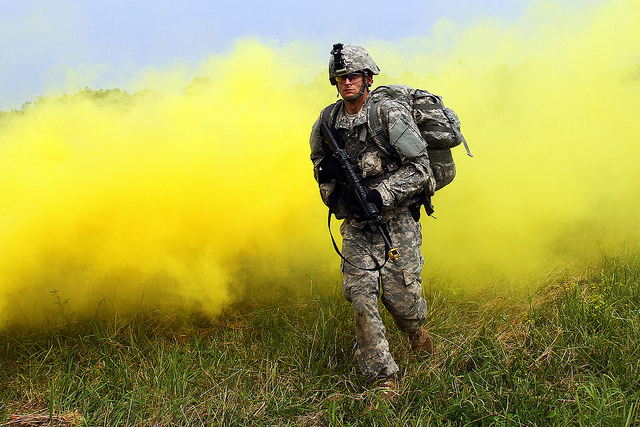
Spc. Robert Satterfield with Bravo Company, 1st Battalion, 149th Infantry exits a landing zone during an air assault exercise at Muscatatuck Urban Training Center in Butlerville, Ind., July 26, 2015. Three companies of infantrymen participated in one of the largest training exercises for the battalion in six years. (U.S. Army National Guard photo by Staff Sgt. Scott Raymond)
BUTLERVILLE, Ind. — In terms of basic Soldier skills, the infantry is arguably the hardest training unit in the Kentucky Guard. But it’s not everyday Soldiers of the 1st Battalion, 149th Infantry get to put all that training into a full-spectrum exercise. As a culminating event to this year’s two-week annual training for the unit, the Mountain Warriors conducted a multi-day air assault mission at the Muscatatuck Urban Training Center near Butlerville, Ind., July 24-27.
“Stuff like this is phenomenal, it’s great training,” said Spc. David Woodford with Alpha Company, 1/149th. “This kind of training will keep me in uniform.”
Soldiers with Alpha and Bravo Co., 1/149th loaded their gear and flew by UH-60 Blackhawks to the landing zone at Muscatatuck, compliments of the U.S. Army Reserves’ 11th Theater Aviation Command out of Fort Knox, Ky. Each Soldier carried their weapon and everything they needed for the three-day mission on their backs. Many of the Guardsmen flew on their first helicopter ride. And at the end of it, they had to get themselves, their gear and their fellow Soldiers out of the aircraft as quickly and as organized as possible.
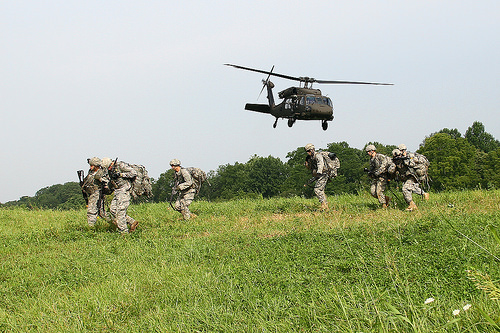
Soldiers with the 1st Battalion, 149th Infantry conduct an air assault exercise at Muscatatuck Urban Training Center in Butlerville, Ind., July 26, 2015. Aviators from the 11th Theater Aviation Command at Fort Knox, Ky., provided eight UH-60 Blackhawk helicopters to transport the infantrymen to the training site. (U.S. Army National Guard photo by Staff Sgt. Scott Raymond)
Click here for more photos.
From the landing zone, the 1/149th was tasked with assaulting and securing a building complex occupied by members of Charlie Company, simulating an opposition forces. The three companies of infantrymen then had to hold their position and establish relations with locals.
In advance of the air assault, a small platoon of scouts paved the way for the main body attack. For those scouts, the mission was a couple days longer as they infiltrated the area two days prior to the battalion’s arrival. They were the eyes and ears of the attack. A job they said they wouldn’t trade for any other in the battalion.
“This is as high as you can get as far as training value,” said Staff Sgt. Nicholas Combs with Headquarters, Headquarters Company, 1/149th. “No one here would want any other job during this training. When this mission is all said and done, only good stories will come out of it.”
From boarding and egressing a helicopter, moving as a fire team and even kicking in doors, the Mountain Warriors checked off a number of mission essential tasks they must train for each year. Lt. Col. Joseph Lear, commander of the 1/149th said the AT provided an excellent chance for each section of the battalion to not only train, but to put their job specialities to the test.
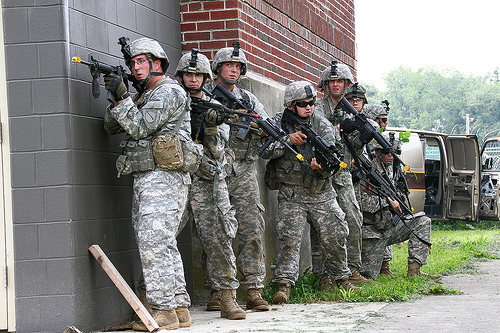
Soldiers with the 1st Battalion, 149th Infantry stack on a wall during a training exercise at the Muscatatuck Urban training Center in Butlerville, Ind., July 26, 2015. The unit conducted an air assault mission to seize a building complex and hold their position against a simulated enemy force. (U.S. Army National Guard photo by Staff Sgt. Scott Raymond)
“Conducting an air assault is one of our primary tasks,” said Lear. “This enabled us to do something we haven’t done since 2009 as a battalion. It’s a tremendous training multiplier for us, to be able to do that kind of mission at that scale, we are grateful to have the opportunity.”
Members of Delta Company provided the ground assault and convoyed by Humvees to the site. In reserve was the 1149th Forward Support Company, whose job is to ensure the infantry can do their job. Chief Warrant Officer Melissa Propes with the 1149th said the annual training was also an invaluable training opportunity for her Soldiers as well.
“I love seeing these Soldiers get experience in what they do, and they got to do that here. Not only did they get good training, it made a difference to the infantry. And that is absolutely what the 1149th FSC is supposed to do,” she said. “Everybody from the infantryman to the mess section, to distro to maintenance, everybody has an essential piece of the puzzle, or they wouldn’t be here. And we’re just happy to contribute.”
Leading up to the assault mission, Soldiers of the unit trained in a variety of squad and platoon-sized drills at Camp Atterbury, Indiana, to hone their skills and prepare for the final mission.
Pvt. Scottie Pace is a cook with the 1149th FSC and attended his first annual training.
“When I first enlisted, I had no idea what to expect on an AT,” he said. “Now, I feel like knowing that I can do my job and help the unit is a great thing to prepare me for future training and makes me a better Soldier.”
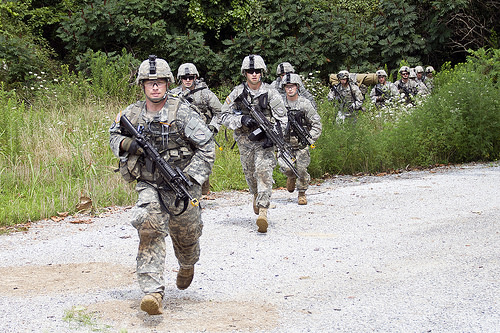
Soldiers with the 1st Battalion, 149th Infantry advance across a road during a training exercise at the Muscatatuck Urban Training Center in Butlerville, Ind., July 26, 2015. The exercise was the culminating event of the unit’s two-week annual training period. (U.S. Army National Guard photo by Staff Sgt. Scott Raymond)
More than 550 Soldiers of the battalion were on hand for the training period. Platoon leaders and company commanders agreed their Soldiers greatly benefitted from the unique training and the boost in morale.
“There’s nothing like training in the field,” said Spc. Joseph Hill from Alpha Co. “You’re really able to do your job and refresh your skills. It’s hard to find a bad part of this AT.”
Battalion leadership were pleased with the effort put forth by their Soldiers and the chance to put them in the field and participants and witnesses to the unique energy of the infantry.
“This type of training is also why people enlist,” said Lear. “They don’t join to stand a drill hall and get briefs. These troops will talk about this air assault for years.”
“That’s how this type of training leads to retention, which leads to strength, which leads to funding, which leads to more quality training. That’s the impact this has on this battalion.”
Story by Staff Sgt. Scott Raymond, Kentucky National Guard Public Affairs
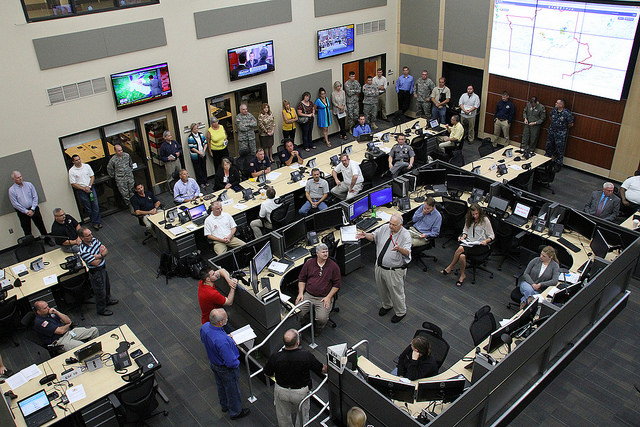
Charlie O’Neal, Assistant Director of Kentucky’s Emergency Management speaks to representatives from various state agencies to kickoff CAPSTONE-14 at the Commonwealth Emergency Operations Center in Frankfort, Ky., June 16, 2014. More than 20 state and local agencies gathered for the exercise which tested the state’s response to a major earthquake in the New Madrid Seismic Zone at the border of Kentucky and Missouri. (U.S. Army National Guard photo by Staff Sgt. Scott Raymond)
FRANKFORT, Ky. — During the winter of 1811-1812, the New Madrid fault line shook several times. The quakes were the strongest earthquakes east of the Rocky Mountains since Europeans settled the continent. The movement of the Earth reversed the flow of the Mississippi River and rang bells on the East Coast, more than 1,000 miles away. Two hundred years later, scientists say the seismic zone situated along the Kentucky-Missouri border is at high risk for another major earthquake at any moment.
To prepare for the possibility of a catastrophic event, Kentucky Emergency Management, the Kentucky National Guard and more than 20 other state and local agencies gathered June 16-20 in Frankfort for CAPSTONE-14. The multi-state exercise tested the state’s emergency response to a catastrophic earthquake along the fault line.
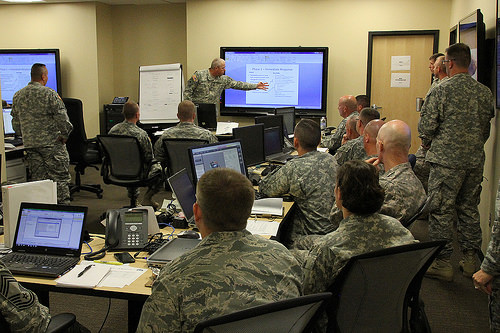
Col. William A. Denny briefs members of the Kentucky National Guard on their roles during the CAPSTONE-14 exercise in Frankfort, Ky., June 16, 2014. The exercise brought the Guard together with more than 20 other agencies to discuss their response to a major earthquake striking the state in the future. (U.S. Army National Guard photo by Staff Sgt. Scott Raymond)
“CAPSTONE-14 offers Kentucky and our neighboring states the opportunity to build upon the existing partnerships and opportunities to identify unified real-world solutions for emergency response to a catastrophic event of this magnitude,” said Michael Dossett, KYEM Director.
Under the direction of the Central United Earthquake Consortium (CUSEC), CAPSTONE-14 took three years to plan and is based upon the occurrence of a damaging earthquake in the New Madrid Seismic Zone. The consortium is made up the states which would be immediately affected by such an event and includes Alabama, Arkansas, Illinois, Indiana, Kentucky, Mississippi, Missouri and Tennessee.
Click here to see more photos from CAPSTONE-14.
A primary goal of the exercise was interoperability among the numerous agencies involved. Soldiers and Airmen of the Kentucky National Guard manned posts within the Commonwealth Emergency operations Center in Frankfort, but also put boots on the ground in earthquake response scenarios in the region.
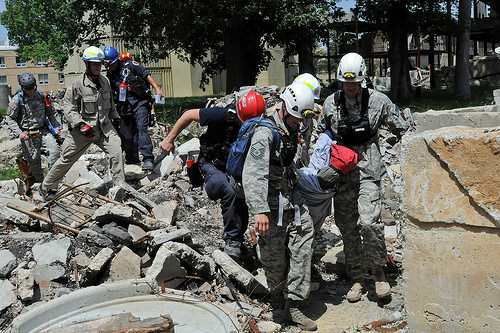
Members of the 41st Civil Support Team work with firefighters to recover a simulated casualty during training at Muscatatuck Urban Training Center in Butlersville, Ind., June 17, 2014. The firefighters, known as Task Force One from Louisville, Lexington and Northern Kentucky departments trained with the 41st as part of CAPSTONE-14, a multi-state exercise that tested emergency response to a major earthquake in the New Madrid Seismic Zone. (U.S. Army National Guard photo by Staff Sgt. Scott Raymond)
Members of the 41st Civil Support Team would be among the first called in. For CAPSTONE-14, the unit worked alongside civilian firefighters in search and rescue operations at Muscatatuck Urban Training Center (MUTC) in Indiana.
“Doing this in an exercise such as CAPSTONE allows us to experience the challenges that will be present during a real incident and gives us the opportunity to develop procedures to combat issues now instead of when a real threat hits,” said Capt. Steve Smith, team leader with the 41st.
“While the state of Kentucky would drastically be affected by a seismic incident on the New Madrid fault, it should give the citizens a little more comfort knowing that Search and Rescue organizations and the National Guard are being proactive in taking steps to work together prior to any incident,” said Smith.
Kentucky Guardsmen with the Chemical, Biological, Radiological, Nuclear and High Yield Explosive (CBRNE) Enhanced Response Force Package, or CERFP would also hit the ground quickly. The unit’s mission would assist in the location and extraction of victims from collapsed structures and the treatment of a mass casualty scenario. CERFP Soldiers and Airmen also trained at MUTC in conjunction with their counterparts from the Indiana and Georgia National Guard.
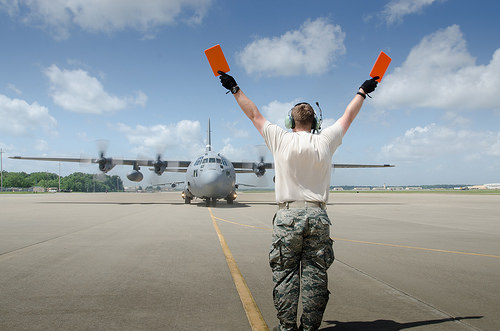
Staff Sgt. Joseph Bigelow, a crew chief for the Kentucky Air National Guard’s 123rd Contingency Response Group, marshals a Kentucky Air National Guard C-130 Hercules during CAPSTONE-14, a homeland earthquake-response exercise at Fort Campbell, Ky., on June 17, 2014. The 123rd CRG is joining with the U.S. Army’s 688th Rapid Port Opening Element to operate a Joint Task Force-Port Opening here from June 16 to 19, 2014. (U.S. Air National Guard photo by Master Sgt. Phil Speck)
Air Guardsmen with Kentucky’s 123rd Airlift Wing flew into regional airports in Western Kentucky to assess runway conditions and ensure a cargo hub could be set up for relief efforts into the damaged area. The wing worked with local officials and an active duty U.S. Army unit in their part of the exercise.
“The cooperation and interaction we have had this week is a critical part of what would be our response to such an event,” said Col. William A. Denny, plans and operations officer for the Kentucky Guard. “We must remain partners in our service to the commonwealth and CAPSTONE-14 has shown us what we have done right and what we can improve.”
“This is a scenario we don’t ever want to see, but when it happens, the Kentucky Guard will be there side by side with those who can best aid the state and the region.”
Story and photos by Sgt. 1st Class Brad Staggs, Atterbury-Muscatatuck Public Affairs
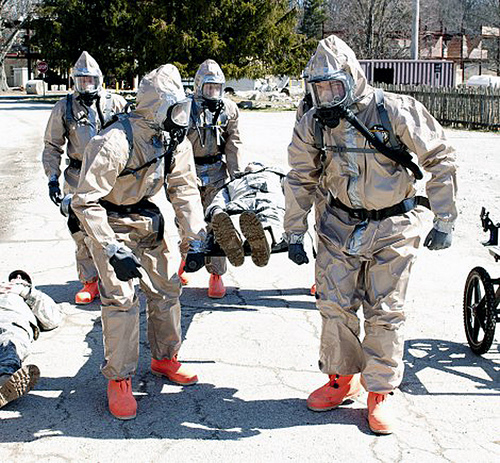
Members of the Kentucky Chemical, Biological, Radiological, Nuclear and High Yield Explosive Enhanced Response Force Package decontamination element transport a mock victim for medical assessment during training at Muscatatuck Urban Training Center in Butlerville, Ind., March 22, 2013. (Photo by Sgt. 1st Class Brad Staggs, Atterbury-Muscatatuck Public Affairs)
MUSCATATUCK URBAN TRAINING CENTER, Ind. (4/1/13) - For today’s Soldiers and Airmen, the more realistic their training, the better prepared in the event of an actual situation they’ll be.
For the Kentucky National Guard’s Chemical, Biological, Radiological, Nuclear and High Yield Explosive Enhanced Response Force Package, or CERFP, the training center here provides a realistic urban scenario where CERFP team members can hone their existing skills and then teach them to new volunteers.
“We’re training a lot of new folks,” said Lt. Col. Lance Grebe, commander of the CERFP. “We’re working on the crawl, walk, run phases. Yesterday was slow, today is a walk phase, and tomorrow should be full run.”
In 2004, the National Guard created 12 CERFP teams. The purpose of those teams is to conduct life-saving actions in a contaminated environment. Today, those CERFP teams have grown to 17 across the United States.
Each team consists of up to 180 Soldiers and Airmen working together in five elements. Each team has a command and control section; a decontamination element; a medical element; a casualty search and extraction element; and a fatalities search and recovery element.
Search and recovery is handled primarily by the Army National Guard, while most medical duties fall to the Air National Guard. For the Kentucky CERFP, that includes the 123rd Airlift Wing, 301st Chemical Company, 299th Chemical Co., and the 103rd Headquarters and Headquarters Detachment.
The CERFP is a quick reaction force, expected to begin rescue operations very soon after receiving the call, Grebe said.
“Our recall time is six hours,” he said. “Once we shake the hand of the incident commander, the clock starts and we have two hours” to be set up and working.
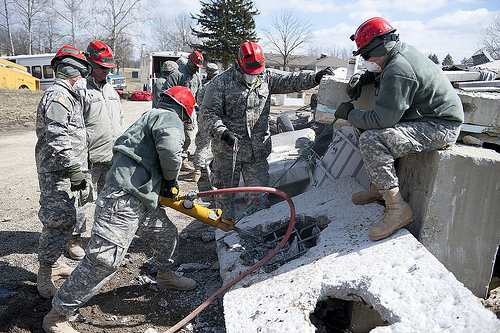
Members of the Kentucky CERFP breaching and breaking team learn how to use a jackhammer safely to get through concrete in order to rescue a victim following a disaster during training at Muscatatuck Urban Training Center in Butlerville, Ind., March 22, 2013. (Photo by Sgt. 1st Class Brad Staggs, Atterbury-Muscatatuck Public Affairs)
The Kentucky CERFP was validated during an exercise at Muscatatuck Urban Training Center in May 2012 when they shattered the previous set-up time record. The team received their validation, and left confident that their training methods would be used by other CERFP teams.
First Lt. Charles Brannon has only recently begun serving as officer-in-charge of search and extraction.
“We’re just learning the process for setting up and extracting people from a hot zone,” Brannon said. “That could be anything from a nuclear disaster to a natural disaster that we are responding to.”
The environment at Muscatatuck creates the perfect place for CERFP to train because of the rubble piles and training venues that simulate buildings and infrastructure following a disaster.
During training, a reconnaissance team may be sent out to observe the site and find victims. Following reconnaissance operations, follow-on teams will begin rescue operations. Breaching and breaking teams, for instance, provide access to trapped victims. Shoring teams ensure walls that are in danger of falling don’t tumble down on victims or rescuers. A ropes team might be called on to rappel into areas to retrieve victims. And lift-and-haul teams are available to move large objects away from victims.
All teams must work in synch to ensure victims are rescued and sent to the waiting medical teams in the “warm” and “cold” zones, which are sometimes miles away from the “hot” zone. Long tents are set up and put together to create a conveyer belt system that takes the victim through several necessary steps.
Decontamination is handled first in the warm zone. Once personnel are assured that the victim has no chemical or radioactive signature, proper medical care can be given in the cold zone.
“I’m confident that if they called me today, I would have no problem taking this unit out to help people,” Grebe concluded. “Handling an emergency is all we train for. We’ll be there if our neighbors need us.”
Story and photos by Pfc. Lerone Simmons, 133rd Mobile Public Affairs Detachment
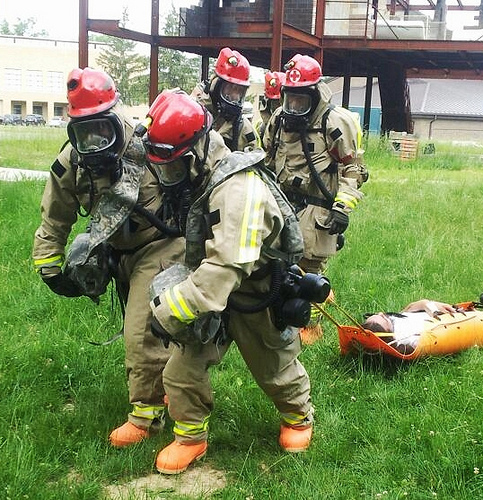
Soldiers with the Kentucky National Guard Chemical Biological Radiological Nuclear high - yield Explosives team(CBRNE) transport a mock casualty as part of their CBRNE Enhanced Response Force Package (CERFP) training at Muscatatuck Urban Training Facility, North Vernon, Ind. Kentucky Guardsmen were rated the best in the nation based upon the training exercise.(Kentucky National Guard photo by Pfc. Lerone Simmons, 133rd Mobile Public Affairs Detachment/Released).
MUSCATATUCK URBAN TRAINING CENTER, Butlerville, Ind. - Kentucky National Guardsmen assigned to Kentucky’s Chemical, Biological, Radiological, Nuclear and High Yield Explosive (CBRNE) Enhanced Response Force Package (CERFP) can call themselves the nation’s best after an evaluation May 24 at the Muscatatuck Urban Training Center in Butlerville, Ind.
“This is our culmination event and we wanted to be the best CERFP in the country,” said Lt. Col. Joseph H. Gardner, commander of the Richmond-based 103rd Chemical Battalion.
A joint-effort between Airmen from the 123rd Airlift Wing, Louisville, Ky., and Army Guardsmen from the 301st Chemical Company, Morehead Ky., 299th Chemical Company, Maysville, Ky., and 103rd Headquarters and Headquarters Detachment, Richmond, Ky., the CERFP is a high-speed team that must be ready to deploy within six hours of a CBRNE attack, with a mission to locate and extract victims, perform mass patient or casualty decontamination and treat and stabilize patients for evacuation.
The team was validated on its ability to perform those tasks by observer controller trainers from the Joint InterAgency Training and Education Center.
“When real-world events happen, we want them to safely and efficiently get people out,” said Sgt. 1st Class Jared Lane, Observer Controller Trainer, JITEC.
In the event of an attack on the Commonwealth – or one of the eight Southeastern states Kentucky would respond to – CERFP Soldiers and Airmen must prioritize and quickly react.
“We want them to have the skills necessary to correctly assess the situation, then safely rescue and transport all casualties,” said Staff Sgt. Matthew Park, Observer Controller Trainer, JITEC.
According to Maj. Joseph Whitt, deputy commander of the CERFP, the team received a “T” rating, for trained in 16 collective tasks required to validate a CERFP mission.
“The raters said ‘we shattered all the CERFP records,’” he said.
“We had multiple best practices that the OCTs said would be taught to all CERFPs nationwide,” he said. “We beat all the records for the site set up, decontamination throughput, search operations and medical set-ups and treatment throughput.
“We are the best CERFP in the national CBRNE enterprise,” he said.
The training and validation of Kentucky’s CERFP proves that Kentucky’s Citizen Soldiers and Airmen stand always ready to support the Commonwealth.
For Spc. Jason Woodruff, litter bearer, 299th Chemical Co., said the CERFP team opened the door for joint-training with his Air Guard counterparts, something he wasn’t able to do before CERFP.
“The more training exercises like this, the better we can react,” he said.
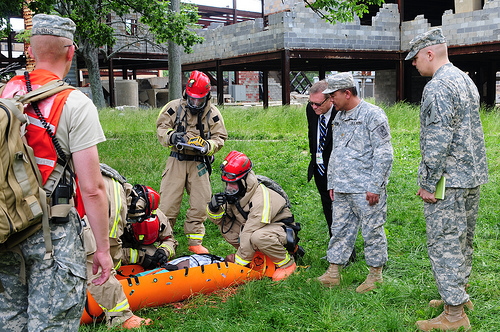
Maj. Pirom Srinual, Joint Collective Training branch, National Guard Bureau, Maj. Paul A. Best, J39-Combatting Weapons Of Mass Destruction, NGB and Mark Honeycutt, NGB, observe Kentucky National Guardsmen transport a casualty during a training exercise May 23 at Muscatatuck Urban Training Center, Butlerville, Ind. The Guardsmen are assigned to the Kentucky Chemical Radiological Nuclear High-Yield Explosives Enhanced Response Force Package which validated its mission May 24 at MUTC. (Kentucky National Guard Photo by Pfc. Lerone Simmons, 133rd Mobile Public Affairs Detachment/Released)
Kentucky’s top senior enlisted advisors said they are proud of the joint-efforts and the hard work the CERFP put into its validation. Command Sgt. Maj. David P. Munden, senior enlisted advisor Joint Forces Headquarters, said the certification is a big deal, and State Command Sgt. Maj. Gregory D. Armstrong agreed.
“This is one of Kentucky’s greatest assets that we will greatly benefit from in the years to come,” said Armstrong.