
Pages
Stay In Touch
More
© 2013 KentuckyGuard
Kentucky National Guard Public Affairs Staff Report
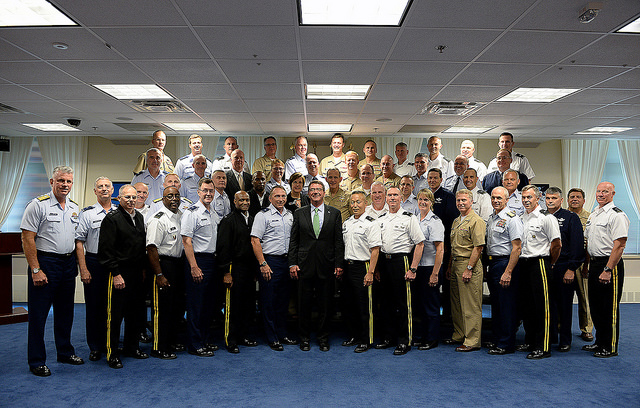
Secretary of Defense, Ash Carter gathers with more than 50 U.S. general officers during the CAPSTONE General and Flag Officer Course in Washington, D.C., July, 2015. Kentucky’s Brig Gen. Scott Campbell was one of six National Guard officers selected to attend. (Courtesy photo)
FRANKFORT, Ky. — Brig. Gen. Scott Campbell, of the Kentucky National Guard, is the deputy commanding general of the 38th Infantry Division and was chosen to attend the Department of Defense’s CAPSTONE Program July 13 to Aug. 14, 2015.
The CAPSTONE General and Flag Officer Course was created in 1982. The Goldwater-Nichols DoD Reorganization Act of 1986 subsequently mandated that all newly selected active duty generals and flag officers attend CAPSTONE. The course is managed by the National Defense University in Washington, D.C. Course attendance is still competitive for National Guard and Reserve general officers.
According to NDU, the course objective is to make these individuals more effective in planning and employing U.S. forces in joint and combined operations. The CAPSTONE curriculum examines major issues affecting national security decision making, military strategy, joint/combined doctrine, interoperability, and key allied nation issues.
Campbell was one of only six National Guard general officers included in the class of 55 Fellows. Few Kentucky Guard general officers have been extended the privilege of attending this course since its inception.
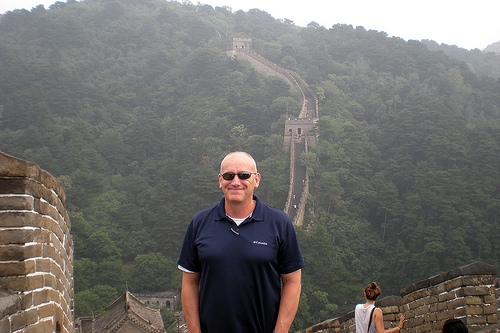
Brig. Gen. Scott Campbell tours the Great Wall of China during the overseas portion of the CAPSTONE General and Flag Officer Course, July, 2015. Campbell visited China, Japan and Korea as part of the course which examines major issues affecting national security decision making, military strategy, joint/combined doctrine, interoperability, and key allied nation issues.(Courtesy photo)
“This was by far the best educational experience of my 34-year career,” said Campbell. “It was an amazing experience that exposed me to senior decision makers, both domestic and international, and gave me a better understanding of the complexities in the world and the security challenges facing the U.S.”
The course began in Washington, D.C. with briefings from directors of the various federal agencies and combatant commanders. Day 3 began stateside travel with visits to various military command headquarters in Virginia, Florida, Nebraska, Colorado, and Illinois.
The class returned to Washington upon completion of the 10-day stateside trip and prepared for overseas travel. The class was broken into three groups traveling to Europe, South America or the Pacific region.
Campbell was selected for the Pacific trip which included stops in Japan, South Korea, and China with a visit to U.S. Pacific Command in Hawaii on the return trip. The overseas trip lasted approximately 13 days with the CAPSTONE Fellows visiting with U.S. and host nation military officials, U.S. Embassy officials to include ambassadors, host nation government officials and local think tanks.
Campbell said the focus of the overseas tour was to study U.S. policy as it relates to the visited nation and the region. The exchanges also included cultural stops which included The Forbidden City and The Great Wall of China, the Demilitarized Zone, Seoul Tower and Gyeongbok Presidential Palace in Korea, and Pearl Harbor in Hawaii.
The course ended back in Washington, D.C. and concluded with briefings from the Secretary of Defense and directors of federal agencies, to include the National Security Agency, Central Intelligence Agency, Federal Emergency Management Agency, as well as the DoD Service Chiefs from each branch of the military.
“I feel very privileged for being selected to attend,” Campbell said. “The senior leader briefers and CAPSTONE staff told us that the most fundamental objective of this course is an understanding and appreciation of the other services and agencies and building relationships with the other Fellows that will stay with you throughout your life. I feel like that objective is being met. I’ve already met several of my Capstone classmates in other forums and we now share a common bond.”
Story by Staff Sgt. Scott Raymond, Kentucky National Guard Public Affairs
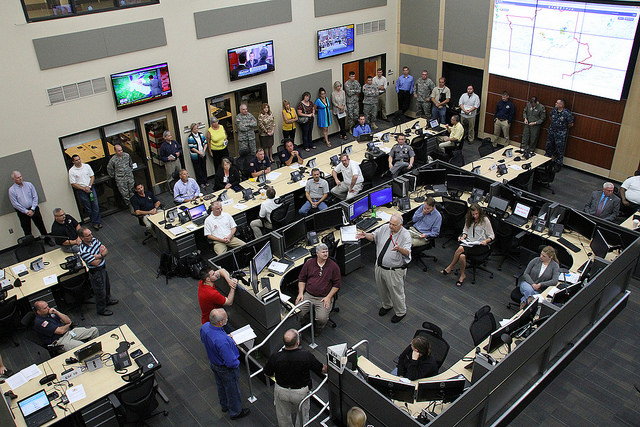
Charlie O’Neal, Assistant Director of Kentucky’s Emergency Management speaks to representatives from various state agencies to kickoff CAPSTONE-14 at the Commonwealth Emergency Operations Center in Frankfort, Ky., June 16, 2014. More than 20 state and local agencies gathered for the exercise which tested the state’s response to a major earthquake in the New Madrid Seismic Zone at the border of Kentucky and Missouri. (U.S. Army National Guard photo by Staff Sgt. Scott Raymond)
FRANKFORT, Ky. — During the winter of 1811-1812, the New Madrid fault line shook several times. The quakes were the strongest earthquakes east of the Rocky Mountains since Europeans settled the continent. The movement of the Earth reversed the flow of the Mississippi River and rang bells on the East Coast, more than 1,000 miles away. Two hundred years later, scientists say the seismic zone situated along the Kentucky-Missouri border is at high risk for another major earthquake at any moment.
To prepare for the possibility of a catastrophic event, Kentucky Emergency Management, the Kentucky National Guard and more than 20 other state and local agencies gathered June 16-20 in Frankfort for CAPSTONE-14. The multi-state exercise tested the state’s emergency response to a catastrophic earthquake along the fault line.
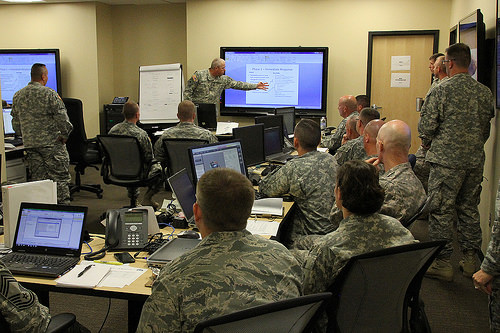
Col. William A. Denny briefs members of the Kentucky National Guard on their roles during the CAPSTONE-14 exercise in Frankfort, Ky., June 16, 2014. The exercise brought the Guard together with more than 20 other agencies to discuss their response to a major earthquake striking the state in the future. (U.S. Army National Guard photo by Staff Sgt. Scott Raymond)
“CAPSTONE-14 offers Kentucky and our neighboring states the opportunity to build upon the existing partnerships and opportunities to identify unified real-world solutions for emergency response to a catastrophic event of this magnitude,” said Michael Dossett, KYEM Director.
Under the direction of the Central United Earthquake Consortium (CUSEC), CAPSTONE-14 took three years to plan and is based upon the occurrence of a damaging earthquake in the New Madrid Seismic Zone. The consortium is made up the states which would be immediately affected by such an event and includes Alabama, Arkansas, Illinois, Indiana, Kentucky, Mississippi, Missouri and Tennessee.
Click here to see more photos from CAPSTONE-14.
A primary goal of the exercise was interoperability among the numerous agencies involved. Soldiers and Airmen of the Kentucky National Guard manned posts within the Commonwealth Emergency operations Center in Frankfort, but also put boots on the ground in earthquake response scenarios in the region.
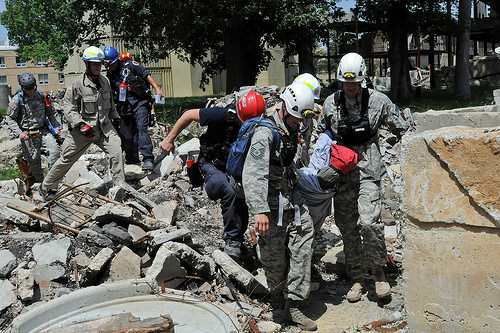
Members of the 41st Civil Support Team work with firefighters to recover a simulated casualty during training at Muscatatuck Urban Training Center in Butlersville, Ind., June 17, 2014. The firefighters, known as Task Force One from Louisville, Lexington and Northern Kentucky departments trained with the 41st as part of CAPSTONE-14, a multi-state exercise that tested emergency response to a major earthquake in the New Madrid Seismic Zone. (U.S. Army National Guard photo by Staff Sgt. Scott Raymond)
Members of the 41st Civil Support Team would be among the first called in. For CAPSTONE-14, the unit worked alongside civilian firefighters in search and rescue operations at Muscatatuck Urban Training Center (MUTC) in Indiana.
“Doing this in an exercise such as CAPSTONE allows us to experience the challenges that will be present during a real incident and gives us the opportunity to develop procedures to combat issues now instead of when a real threat hits,” said Capt. Steve Smith, team leader with the 41st.
“While the state of Kentucky would drastically be affected by a seismic incident on the New Madrid fault, it should give the citizens a little more comfort knowing that Search and Rescue organizations and the National Guard are being proactive in taking steps to work together prior to any incident,” said Smith.
Kentucky Guardsmen with the Chemical, Biological, Radiological, Nuclear and High Yield Explosive (CBRNE) Enhanced Response Force Package, or CERFP would also hit the ground quickly. The unit’s mission would assist in the location and extraction of victims from collapsed structures and the treatment of a mass casualty scenario. CERFP Soldiers and Airmen also trained at MUTC in conjunction with their counterparts from the Indiana and Georgia National Guard.
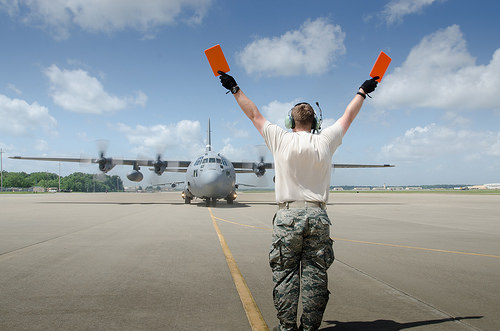
Staff Sgt. Joseph Bigelow, a crew chief for the Kentucky Air National Guard’s 123rd Contingency Response Group, marshals a Kentucky Air National Guard C-130 Hercules during CAPSTONE-14, a homeland earthquake-response exercise at Fort Campbell, Ky., on June 17, 2014. The 123rd CRG is joining with the U.S. Army’s 688th Rapid Port Opening Element to operate a Joint Task Force-Port Opening here from June 16 to 19, 2014. (U.S. Air National Guard photo by Master Sgt. Phil Speck)
Air Guardsmen with Kentucky’s 123rd Airlift Wing flew into regional airports in Western Kentucky to assess runway conditions and ensure a cargo hub could be set up for relief efforts into the damaged area. The wing worked with local officials and an active duty U.S. Army unit in their part of the exercise.
“The cooperation and interaction we have had this week is a critical part of what would be our response to such an event,” said Col. William A. Denny, plans and operations officer for the Kentucky Guard. “We must remain partners in our service to the commonwealth and CAPSTONE-14 has shown us what we have done right and what we can improve.”
“This is a scenario we don’t ever want to see, but when it happens, the Kentucky Guard will be there side by side with those who can best aid the state and the region.”
Story by 2nd Lt. James Killen, 123rd Airlift Wing Public Affairs
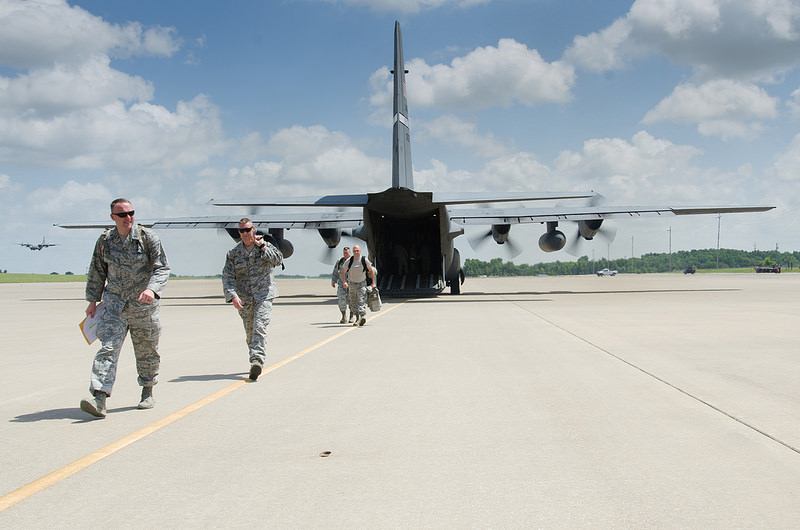
Airmen from the Kentucky Air National Guard’s 123rd Contingency Response Group arrive at Fort Campbell, Ky., June 17, 2014, via a Kentucky Air Guard C-130 Hercules to participate in CAPSTONE-14, a homeland earthquake-response exercise. The 123rd CRG is joining with the U.S. Army’s 688th Rapid Port Opening Element to operate a Joint Task Force-Port Opening here from June 16 to 19, 2014. (U.S. Air National Guard photo by Master Sgt. Phil Speck)
FORT CAMPBELL, Ky. – More than 100 members of the Kentucky Air National Guard’s 123rd Contingency Response Group and the U.S. Army’s 688th Rapid Port Opening Element deployed here June 16-19 for an exercise that will test their ability to respond to a major earthquake along the New Madrid Seismic Zone.
The exercise, called CAPSTONE-14, requires the troops to set up and operate a Joint Task Force-Port Opening, a self-contained air cargo distribution center that delivers crucial relief supplies during disasters and contingencies, according to Col. Mark Heiniger, JTF-PO commander.
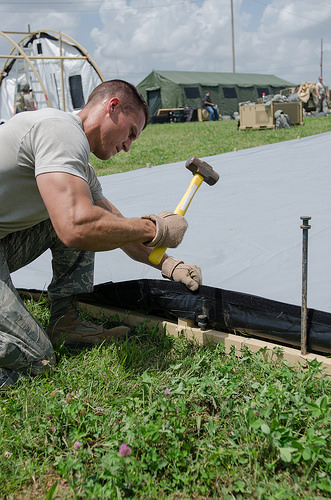
Tech. Sgt. Jason Prifogle, squad leader for the Kentucky Air National Guard’s 123rd Contingency Response Group, hammers stakes for an Alaskan Shelter during CAPSTONE-14, a homeland earthquake-response exercise at Fort Campbell, Ky., on June 17, 2014. The 123rd CRG is joining with the U.S. Army’s 688th Rapid Port Opening Element to operate a Joint Task Force-Port Opening here from June 16 to 19, 2014. (U.S. Air National Guard photo by Master Sgt. Phil Speck)
The two units will work together this week to run the JTF-PO, which combines an Air Force Contingency Response Group with an Army Transportation Company to form an Aerial Port of Debarkation. The CRG ensures the seamless flow of relief supplies by air, while the transportation company facilitates their final distribution over land.
Click here to see more photos from this story.
The mission is not a new one for Kentucky’s 123rd Contingency Response Group. The unit stands ready to respond to any contingency natural disaster, Heiniger said, initially deploying an 11-person Joint Assessment Team to evaluate airfield infrastructure in the affected area and determine if it can support large-scale relief operations.
This week’s exercise began June 16, with the JAT landing here and providing a “go-no go” report to U.S. Transportation Command within four hours of arrival. In that time, they evaluated the runway’s integrity for airlift operations and the movement capability of ground vehicles that will distribute relief supplies brought in by cargo aircraft. They also established a secure communications channel for operations.
“The JAT has an important mission that has to be carried out quickly by experts,” Heiniger said. “Decisions have to be made, and they have to be right for the JTF-PO to be successful.”
Upon site approval, the JAT began accepting the remaining Airmen and Soldiers, along with all the equipment necessary to execute the mission, from tents and electric generators to forklifts and communications gear.
One of the key objectives of the exercise is perfecting seamless operations between multiple states, multiple state and federal agencies, and multiple military units. A common theme here is “purple,” which signifies the merger of green (U.S. Army) and blue (U.S. Air Force) forces toward the accomplishment of one mission.
“The interoperability, especially stateside for the RPOE mission and the CRG, is critical,” said U.S. Army Capt. Jacob Elders, executive officer for the 688th RPOE. “Not every service brings everything to the fight, but when you link the two together, you have a full mission.
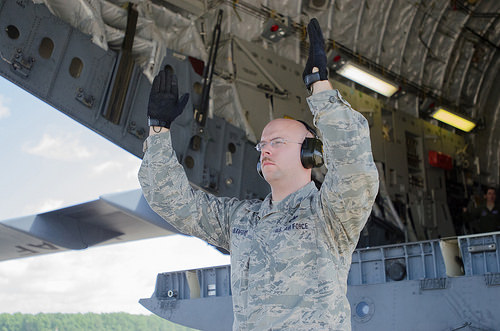
Tech. Sgt. Jerrod Blanford, an aerial porter from the Kentucky Air National Guard’s 123rd Contingency Response Group, spots a forklift as it unloads cargo from a Kentucky Air Guard C-130 Hercules during CAPSTONE-14, a homeland earthquake-response exercise at Fort Campbell, Ky., on June 17, 2014. The 123rd CRG is joining with the U.S. Army’s 688th Rapid Port Opening Element to operate a Joint Task Force-Port Opening here from June 16 to 19, 2014. (U.S. Air National Guard photo by Master Sgt. Phil Speck)
CAPSTONE-14 is part of a broader effort to ensure the region has an effective response to a major earthquake to a zone that spans eight states. According to seismologists, the New Madrid Zone operates on a 200-year cycle for magnitude 6.0 and greater earthquakes. The last earthquake of that magnitude was recorded in 1811.
“To really put it in perspective, a major earthquake along the New Madrid Seismic Zone is likely to cause more damage than Hurricane Katrina,” noted Lt. Col. Bruce Bancroft, Joint Assessment Team chief for the Kentucky Air National Guard. “Preparing for the possibility is essential to saving lives and getting the region back to normal as quickly as possible.”
The 123rd Contingency Response Group is the only fully operational CRG in the Air National Guard and one of just seven CRGs in entire U.S. Air Force. It and the 688th RPOE have previously been verified by U.S. Transportation Command as fully mission capable to provide key assistance during national or international emergencies.
