Pages
Stay In Touch
More
© 2013 KentuckyGuard
Stories by Senior Airman Joshua Horton, 123rd Airlift Wing Public Affairs and Master Sgt. Phil Speck, 123rd Airlift Wing Public Affairs Office
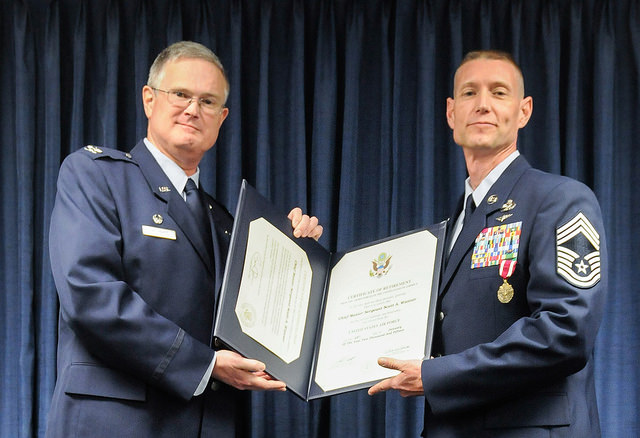
Col. David Mounkes (left), commander of the 123rd Contingency Response Group, presents Chief Master Sgt. Scott A. Wanner, the group’s chief enlisted manager, with a certificate of retirement during a ceremony held at the Kentucky Air National Guard Base in Louisville, Ky., April 26, 2015. Wanner served in the active-duty Air Force, Air Force Reserve and Air National Guard for more than 30 years. (U.S. Air National Guard photo by Staff Sgt. Vicky Spesard)
KENTUCKY AIR NATIONAL GUARD BASE, LOUISVILLE, Ky. — After more than three decades of service to the active-duty Air Force and Air National Guard, Chief Master Sgt. Scott A. Wanner was officially retired in a ceremony here April 25.
As the chief enlisted manager for the 123rd Contingency Response Group, Wanner’s responsibilities included advising the commander on enlisted force morale, welfare, training and utilization; and overseeing the needs of the group’s enlisted force.
“From day one, your military bearing and calm spirit have been an outstanding benefit to our group,” said Col. David J. Mounkes, the commander of the 123rd Contingency Response Group. “I want to personally thank you for the numerous meetings where we had to discuss the way ahead for the CRG, dealing with the day-to-day leadership challenges for which you always had wise and mature advice. It wasn’t always easy in a group with such a unique contingency airfield-opening mission, but you were always up for it.”
Wanner enlisted in the active-duty Air Force in July 1983 as an inventory management specialist. His first assignment with the 305th Supply Squadron provided exposure to contingency operations during the invasion of Grenada. His second assignment with the 10th Supply Squadron, Royal Air Force Alconbury Air Base, England, further enhanced his desire for emergency and contingency operations.
During this period, Wanner played a supporting role in multiple operations, including a bombing raid in Libya and numerous deployments augmenting both Civil Engineering Red Horse and Prime Beef squadrons. His next assignment brought him back to the United States with the 445th Supply and CE Squadrons at Altus Air Force Base, Okla. He was then deployed to Bateen Air Base, United Arab Emirates, in support of Operations Desert Shield and Operation Desert Storm. After returning home, Wanner was approved for a voluntary separation incentive and enlisted as an air transportation specialist with the Air Force Reserve’s 87th Aerial Port Squadron at Wright-Patterson Air Force Base, Ohio, in September 1992.
During the next six years, Wanner applied for and trained in every aspect of his new career field. In September 1998, he left the 87th and enlisted with the Kentucky Air National Guard’s 123rd Aerial Port Squadron. By April of 2008, Wanner was promoted to the rank of chief master sergeant and assumed the position of squadron superintendent. Two years later, he accepted the position of chief enlisted manager with the newly formed 123rd Contingency Response Group.
During his time with the Kentucky Air Guard, Wanner has deployed to support both domestic and international missions, including Operations Noble Eagle, Iraqi Freedom, Southern Watch, and Deep Freeze; and relief efforts for Hurricanes Katrina and Rita.
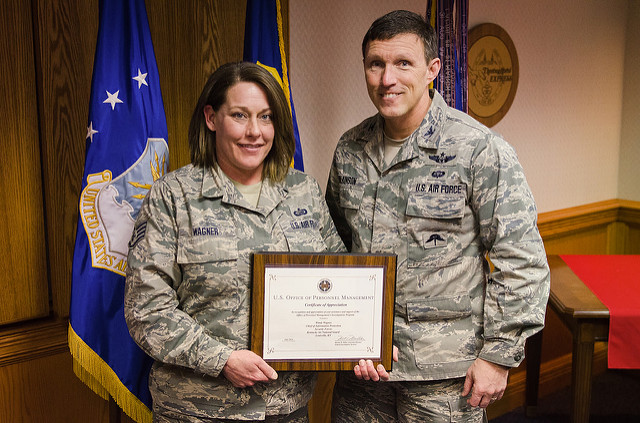
Col. Jeff Wilkinson, vice commander of the 123rd Airlift Wing, presents a certificate of recognition to Staff Sgt. Windy Wagner, chief of information protection, at the Kentucky Air National Guard Base in Louisville, Ky., Jan 8, 2015. Wagner was recognized for providing outstanding support to the U.S. Office of Personnel Management in its execution of security clearance investigations. (U.S. Air National Guard photo by Master Sgt. Phil Speck)
KENTUCKY AIR NATIONAL GUARD BASE, LOUISVILLE, Ky. — Staff Sgt. Windy Wagner has been recognized by the U.S. Office of Personnel Management for the outstanding support she provides to the Federal Investigative Services in the execution of security clearance background interviews.
Wagner is the Kentucky Air National Guard’s Chief of Information Protection. Her job is to ensure the security of information and monitor the implementation of Air Force information policies and programs for the 123rd Airlift Wing. As part of that work, she manages security background investigations for members of the wing.
To help OPM, Wagner assisted field agents in reserving locations on base that were private and comfortable in which to conduct national security background interviews, according to Col. Jeff Wilkinson, the wing’s vice commander. With more than 50 interviews being conducted each year, Wagner is constantly helping field agents complete their investigations, he added.
Wilkinson noted that Wagner often provides this assistance on her own time, above and beyond the requirements of her job description.
“These efforts directly enhance our overall national security posture by allowing these security interviews to be conducted in an expedient and professional manner,” said Scott Benson, special agent-in-charge of the OPM’s St. Louis Investigative Field Office.
Some of the interviews Wagner facilitated weren’t even for members of the Air Guard, but for personnel from other government agencies. To assist with those cases, Wagner conducted preliminary background checks so the personnel were cleared to enter the installation.
Wagner also has been key in ensuring that members whose open clearance investigations are about to expire get fast-tracked, saving OPM weeks of work that would otherwise need to be re-accomplished.
Photos by Maj. Dale Greer, 123rd Airlift Wing Public Affairs
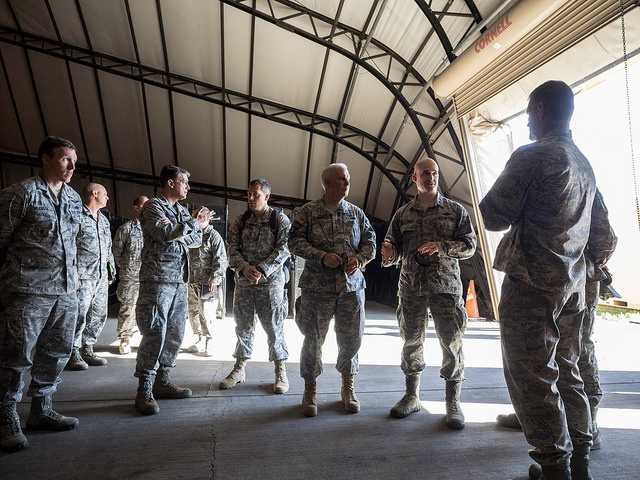
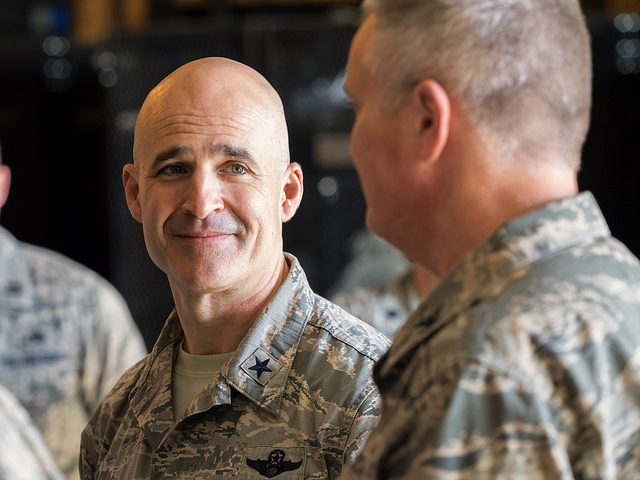
Brig. Gen. David San Clemente (third from right), deputy director for strategy, plans and programs at U.S. Africa Command, talks with members of the 123rd Airlift Wing during a visit to the Kentucky Air National Guard Base in Louisville, Ky., May 12, 2015. San Clemente toured the wing’s 123rd Contingency Response Group, Fire and Emergency Services, and Headquarters facilities. (U.S. Air National Guard photo by Maj. Dale Greer)
LOUISVILLE, Ky. — Brig. Gen. David San Clemente, deputy director for strategy, plans and programs at U.S. Africa Command, visited with members of the 123rd Airlift Wing during a visit to the Kentucky Air National Guard Base in Louisville, Ky., May 12, 2015. San Clemente toured the wing’s 123rd Contingency Response Group, Fire and Emergency Services, and Headquarters facilities.
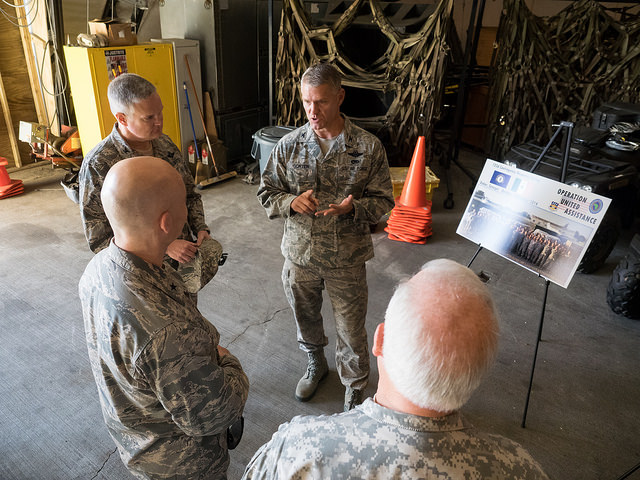
Col. Barry Gorter (center), commander of the 123rd Airlift Wing, discusses the mission of the 123rd Contingency Response Group with Brig. Gen. David San Clemente, deputy director for strategy, plans and programs at U.S. Africa Command, during a tour of the Kentucky Air National Guard Base in Louisville, Ky., May 12, 2015. The group deployed more than 80 Kentucky Air Guardsmen to Africa in 2014 to stand up and operate an aerial port of debarkation in support of Operation United Assistance, the U.S. government’s coordinated effort to fight the worst Ebola outbreak in history. (U.S. Air National Guard photo by Maj. Dale Greer)
Col. Barry Gorter (center), commander of the 123rd Airlift Wing, discusses the mission of the 123rd Contingency Response Group with Brig. Gen. David San Clemente, deputy director for strategy, plans and programs at U.S. Africa Command, during a tour of the Kentucky Air National Guard Base in Louisville, Ky., May 12, 2015. The group deployed more than 80 Kentucky Air Guardsmen to Africa in 2014 to stand up and operate an aerial port of debarkation in support of Operation United Assistance, the U.S. government’s coordinated effort to fight the worst Ebola outbreak in history. (U.S. Air National Guard photo by Maj. Dale Greer)
Story by 2nd Lt. James W. Killen, 123rd Airlift Wing Public Affairs Office
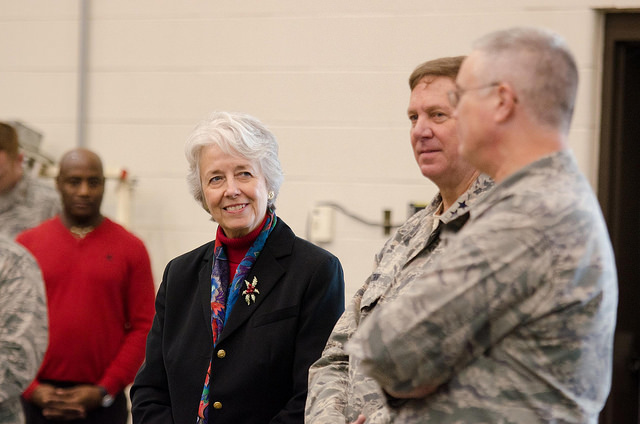
Lt. Gov. Crit Luallen welcomes home members of the 123rd Contingency Response Group at the Kentucky Air National Guard Base in Louisville, Ky., Dec. 6, 2014. The Airmen spent seven weeks in Senegal operating an air cargo hub that delivered more than 750 tons of humanitarian aid and equipment to West Africa in support of Operation United Assistance, the international effort to fight an Ebola outbreak there. (U.S. Air National Guard photo by Senior Airman Joshua Horton)
KENTUCKY AIR NATIONAL GUARD BASE, LOUISVILLE, Ky. — Lt. Gov. Crit Luallen visited with more than 70 members of the 123rd Contingency Response Group here Dec. 6 to welcome them home from a deployment to Africa, where they supported Operation United Assistance, the international effort to fight Ebola.
“I am here to personally thank you on behalf of Gov. (Steve) Beshear,” Luallen told the Airmen. “We are proud to know our people from Kentucky were part of such an important mission.”
The Airmen, most of whom deployed overseas Oct. 2 and returned to Kentucky in late November, established an air cargo hub in Senegal that funneled more than 750 tons of humanitarian supplies and equipment into West Africa, where the worst Ebola outbreak in history has claimed more than 6,300 lives.
Luallen told the Airmen that she and the governor have tremendous respect for the men and women of the Kentucky Air National Guard.
“We know what a great job you do and are truly grateful for your service,” she said.
Kentucky’s adjutant general, Maj. Gen. Edward W. Tonini, echoed Luallen’s sentiments.
“You guys were absolutely the focus of the nation and the world,” Tonini told the Airmen. “Having you at the tip of the spear is something we should all be proud of.”
The Kentucky Air National Guard’s 123rd Contingency Response Group is the only unit of its kind in the Air National Guard. Conceived as an “airbase in a box,” the group acts as an early responder in the event of contingencies worldwide. Its personnel are capable of deploying into remote airfields, providing command and control of aircraft, and establishing airfield operations so troops and cargo can flow into affected areas.
After meeting the CRG Airmen, Luallen visited the Kentucky Air Guard’s Maintenance Hangar to eat lunch with Airmen and their families.
Story by Lt. Col. Kirk Hilbrecht, Kentucky National Guard Public Affairs
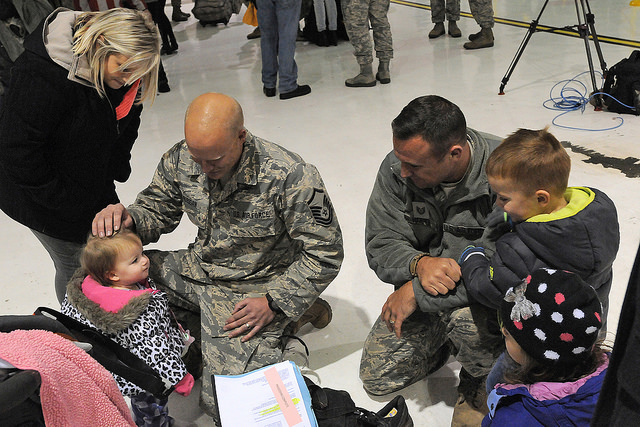
Master Sgt. Matthew Hourigan (left) and Tech Sgt. Jacob Harper greet their children in Louisville, Ky., after the Airmen returned from a deployment, Nov. 19, 2014. The Airmen with the 123rd Contingency Response Group deployed to West Africa in support of Operation United Assistance, the international effort to fight Ebola. (U.S. Army National Guard photo by Staff Sgt. Scott Raymond)
LOUISVILLE, Ky. - Approximately 40 Airmen from the Kentucky Air National Guard returned home in the early morning hours of Nov. 19 from a deployment to West Africa. The Guardsmen were based in Senegal where the 123rd Contingency Response Group established a cargo processing hub in support of Operation United Assistance, the international effort to battle Ebola.
The arrival was the first of several flights scheduled to bring the unit home. Additional members are expected arrive before the weekend.
Senior Airman Jeff Hall worked as a member of the security forces with the said the “fulfilling” experience ranks near the top in his seven-year career.
“It was my first time able to assist with a humanitarian mission, and to be a part of it was exciting and I am proud to be a part of it,” said Hall.
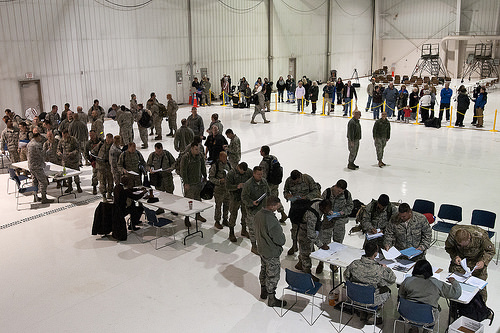
Airmen with the 123rd Contingency Response Group file through in-processing after landing at the Kentucky National Guard Air Base in Louisville, Ky., Nov. 19, 2014. After serving in an Ebola-free area of West Africa, the Airmen were not required to be quarantined or self-monitored for 21 days. (U.S. Army National Guard photo by Staff Sgt. Scott Raymond)
Even with the excitement of a gratifying mission, the worry of working near Ebola areas reached all the back home. Hall said those worries were absent overseas.
“We didn’t really think about it much. We were so busy. We knew we were in an Ebola-free zone and we have really good officers that kept us on track with our health. We looked out for each other and never felt there was a threat.”
Master Sgt. Matthew Hourigan served as the maintenance supervisor for the unit taking care of the numerous aircraft arriving with humanitarian aid in Senegal.
“This mission gave you, at the end of the day, when you put your head on the pillow, a feeling that what you are doing is providing a difference for someone else,”
With no concerns over their health, Hourigan and his wife, Rachel said its simply time to enjoy the holidays and move on like today is no different than yesterday.
“Its just a normal day, we get to start our Thanksgiving plans,” he said. “We’re going back to life and feeling a little bit more fulfillment about what we did over there.”
Click here for more photos.
The 123rd Contingency Response Group is the only unit of its kind in the Air National Guard. Conceived as an “airbase in a box,” the group acts as an early responder in the event of contingency operations worldwide. Several members of the CRG were involved in previous humanitarian missions, to include the Haiti earthquake aid in 2010. Unit members represent a broad spectrum of specialties, including airfield security, ramp and cargo operations, aircraft maintenance, and command and control.
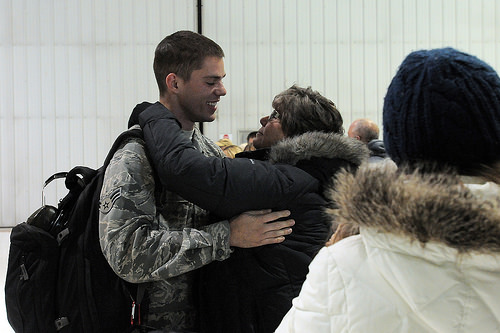
An Airman with the 123rd Contingency Response Group greets family members in Louisville, Ky., after returning home for a deployment to West Africa Nov. 19, 2014. The flight was the first of several bringing the unit home from overseas. (U.S. Army National Guard photo by Staff Sgt. Scott Raymond)
“I am so proud of the incredible job our Kentucky Guardsmen executed overseas,” said Maj. Gen. Edward W. Tonini, adjutant general for Kentucky. “Our Kentucky Air Guard members continue to show the world how we stand ready to serve and how we are responsive global neighbors who make such an important contribution to this crisis.”
The Guardsmen were stationed in Dakar, Senegal, a World Health Organization designated Ebola Virus Disease-free country approximately 800 miles from Liberia, the closest EVD-zone. As such, DoD does not require military personnel returning from an EVD-free country to conduct a 21 day quarantine, as these military personnel had no close contact to the virus or affected personnel. As an extra precautionary measure, these Kentucky troops completed symptom monitoring by healthcare providers for the duration of their
deployment.
Story by Maj. Dale Greer, JTF-PO Senegal Public Affairs
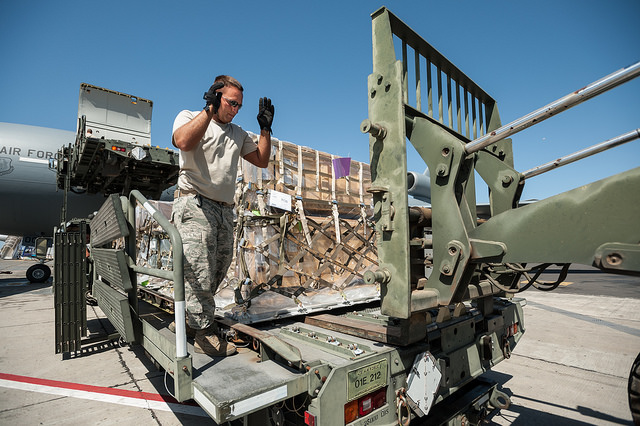
U.S. Air Force Tech. Sgt. Brian Leach, an aerial porter from the Kentucky Air National Guard’s 123rd Contingency Response Group, directs the positioning of a forklift to offload pallets of humanitarian aid from a Halverson cargo-handling vehicle at Léopold Sédar Senghor International Airport in Dakar, Senegal, Nov. 12, 2014. The cargo will be staged in Senegal before being transloaded to U.S. Air Force C-130J aircraft for delivery into Monrovia, Liberia, in support of Operation United Assistance, the U.S. Agency for International Development-led, whole-of-government effort to contain the Ebola virus outbreak in West Africa. (U.S. Air National Guard photo by Maj. Dale Greer)
DAKAR, Senegal — Airmen from the Kentucky Air National Guard’s 123rd Contingency Response Group transferred control of a humanitarian cargo hub to replacement forces Nov. 18, successfully completing their support of an Ebola-response mission that has processed more than 750 tons of relief supplies for airlift into Liberia.
While the Kentucky unit’s role is winding down as its members prepare to redeploy to the United States, the humanitarian cargo operation will continue at Léopold Sédar Senghor International Airport under the direction of the new troops — more than 70 Airmen assigned to the 787th Air Expeditionary Squadron.
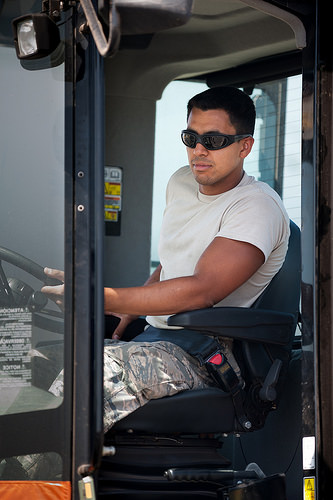
U.S. Air Force Airman 1st Class Randy Kirkland, an aerial porter from the Kentucky Air National Guard’s 123rd Contingency Response Group, uses an all-terrain forklift to offload pallets of humanitarian aid from a Halverson cargo-handling vehicle at Léopold Sédar Senghor International Airport in Dakar, Senegal, Nov. 12, 2014. The cargo will be staged in Senegal before being transloaded to U.S. Air Force C-130J aircraft for delivery into Monrovia, Liberia, in support of Operation United Assistance, the U.S. Agency for International Development-led, whole-of-government effort to contain the Ebola virus outbreak in West Africa. (U.S. Air National Guard photo by Maj. Dale Greer)
“As one of the first Air Force assets in theater, the 123rd Contingency Response Group’s mission was to open an airfield for military cargo operations, establish an Aerial Port of Debarkation, and hand off the operation to follow-on forces within 60 days,” explained David Mounkes, commander of the 123rd. “We’ve now completed that mission, and the 787th is ready to take over. I know they will do a superb job.”
Lt. Col. Michael Brock, commander of the 787th, expressed his gratitude to the men and women of the Kentucky Air Guard for their “outstanding stewardship” of the aerial port from its inception.
“I’d like to express our sincere thanks to the 123rd CRG for shaping the environment for future success,” Brock said. “Due to their exceptional professionalism, our Airmen are fully prepared to carry on this mission without missing a beat, delivering equipment and supplies to Liberia that are essential for combating an Ebola outbreak that has claimed over 5,000 lives.”
Mounkes said he was proud of his forces, which include more than 70 Air Guardsmen from Louisville, Kentucky, and seven active-duty Airmen from Travis Air Force Base, California, and Joint Base Maguire-Dix-Lakehurst, New Jersey.
Those Airmen arrived in Senegal Oct. 4 to find a bare-base facility consisting of little more than two empty buildings and a vacant lot situated next to an airport taxiway. From that, the Airmen built a fully operational aerial port in less than 24 hours, supplying their own satellite-based voice and data communications, electric power generation, airfield command-and-control capability, all-terrain forklifts, specialized cargo-handling equipment and aircraft maintenance assets.
“I could not be more pleased with what our Airmen accomplished here in a rapidly changing, dynamic environment,” Mounkes said. “They hit the ground running and never let up, getting critically important humanitarian cargo and troop-support equipment downrange to help fight the worst Ebola outbreak in history.”
That cargo, which arrived in Senegal aboard civilian 747s and U.S. Air Force C-17 and KC-10 cargo aircraft, included items like tents, latex gloves, human blood, stretchers, electric generators, and food and water. Airmen from the 123rd worked around-the-clock to offload cargo as it arrived, prioritize it for forward movement, and upload it to U.S. Air Force C-130s for final delivery in Liberia.
Click here for more photos from the 123rd’s mission.
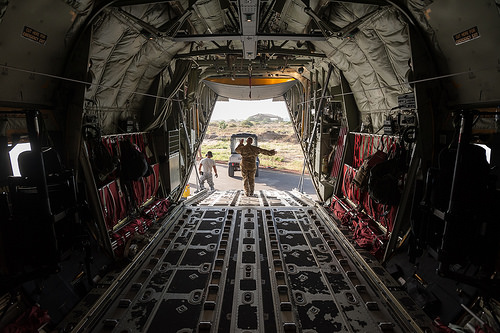
U.S. Air Force Staff Sgt. Kassondra Cline, a loadmaster for the 787th Air Expeditionary Squadron, directs the loading of a tactical vehicle onto a U.S. Air Force C-130J aircraft at Léopold Sédar Senghor International Airport in Dakar, Senegal, Nov. 11, 2014. The aircraft and crew, from Dyess Air Force Base Texas, are deployed to Senegal to fly humanitarian aid and troop-support equipment into Monrovia, Liberia, in support of Operation United Assistance, the U.S. Agency for International Development-led, whole-of-government effort to contain the Ebola virus outbreak in West Africa. (U.S. Air National Guard photo by Maj. Dale Greer)
Since beginning operations in Senegal, the Kentucky Airmen have coordinated the movements of 188 in-bound and out-bound aircraft, processed 809 passengers for airlift and handled 754.9 tons of cargo, Mounkes said.
“The U.S Government’s response to this outbreak is a massive commitment of resources from multiple federal agencies, all under the direction of the U.S. Agency for International Development,” Mounkes noted. “The Department of Defense alone has committed to deploying nearly 4,000 forces to build multiple Ebola treatment facilities in Liberia, staff medical laboratories and train local health-care workers.
“That kind of response requires a tremendous level of logistical support, and I’m proud to say that our Airmen played a central role in establishing the air bridge needed to provide it.”
Mounkes also expressed his appreciation to the people and government of Senegal for their support throughout the deployment.
“The Senegalese Military and the High Airport Authority continue to be essential partners in this effort, and their contributions have been fundamental to the success of the mission in every way,” he said.
For many of the deployed Kentucky Air Guardsmen, Operation United Assistance has been one of the high points of their careers.
“It’s really satisfying to know that all the cargo we sent to Liberia is going to help people who need it,” said Capt. Matt Skeens, the 123rd’s logistics readiness officer. “It’s been a lot of hard work, but it’s absolutely worth it when you know you’re making a direct impact on people’s lives. This mission has been one of the most rewarding things I’ve ever done.”
Master Sgt. Charles Wilding agreed.
“I think the entire CRG has done astounding things here,” said Wilding, non-commissioned officer in charge of aerial port operations. “Working with all the different entities, including the U.S. Army and the Defense Logistics Agency, has been a real pleasure. Everyone put forth maximum effort, and we all came together like a big family to deliver a lot of support downrange.
“This deployment has been, without a doubt, one of the best of my career. I will look back on this 20 years from now and be able tell people, ‘We were there — we helped make a positive difference in the world.'”
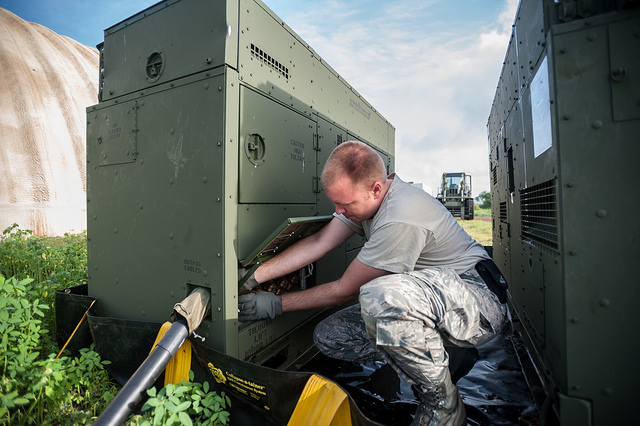
SrA. Courtnay Hester sets up an electric generator to feed the Joint Task Force-Port Opening Senegal operations center Oct. 5, 2014, at Léopold Sédar Senghor International Airport in Dakar, Senegal, in support of Operation United Assistance. Air National Guard photo by Maj. Dale Greer.
“We’re doing what we do best: leveraging our unique capabilities to support the international and US effort in response to this crisis,” Dempsey said. The lead agency for the operation is USAID, with the Defense Department filling in to support the efforts as needed. However, DOD’s “unique capabilities” do not include actual patient care.
For airmen, these capabilities consist of delivering supplies via international staging bases—or ISBs—and establishing Expeditionary Medical Support Systems (EMEDS) to assist US public health workers with their efforts.
Members of the Kentucky Air National Guard’s 123rd Contingency Response Group deployed to Senegal to “facilitate and expedite the transportation of equipment, supplies, and personnel” from the intermediate staging base at Léopold Sédar Senghor International Airport in Dakar into the affected region, Col. David Mounkes, commander of the Joint Task Force-Port Opening Senegal and commander of the 123rd CRG, told Air Force Magazine via email.
Airmen continue moving protective medical equipment, medication, medical test equipment, tents, vehicles, generators, Army mobile deployable rapid assembly shelters (also known as Drash trailers), diesel fuel, lithium batteries, forklift and support personnel, cots, MREs, water, milk, and various other support items through the airport, he said.
For members of the 123rd, this is the type of mission they train for, Mounkes said.
“The 123d CRG deploys to open and operate airfields, usually as the first US Air Force presence deployed,” he said. “This mission was not that different from previous missions, in that the unit was deployed on short notice to an airfield where there was very little infrastructure for DOD air mobility operations. We bring that infrastructure with us, set up initial air mobility operations, and hand off the mission in 45 to 60 days to follow-on operators.”
“This is what we do, and we feel privileged to be able to do it,” Mounkes added.
The 633rd Medical Group at JB Langley-Eustis, Va., recently returned from West Africa after deploying on short notice to set up an EMEDS system. Col. Wayne Pritt, group commander, told Air Force Magazine that educating his unit about what to expect helped ease the understandable “level of anxiety with this mission.”
Between “solid leadership of the team down-range,” and educating and training airmen “about public health, about Ebola, the way it’s transmitted, what they would and wouldn’t be doing,” and reassuring them “that when you’re not treating an Ebola patient— which they would not be doing and did not do—the risk of transmission is essentially zero,” concerns over the nearly-three week mission were eased a bit.
Earlier this month, some members of Congress expressed concerns over the safety and healthcare of US service members traveling to Africa to aid in the efforts. However, lawmakers authorized $750 million to fund the operation on Oct. 10.
Dempsey assured naysayers via his video address that all of those sent to support the relief efforts are “provided the right training and the proper protective equipment” and that DOD is utilizing “the highest medical and safety protocols … before, during, and after deployment.”
“While the mission in West Africa will not include direct care to patients, the safety and health concerns of the men and women of our joint forces and their families remain of greatest importance to me and our Joint Chiefs,” Dempsey said.
Pritt echoed the Chairman’s assertion, saying the safety of airmen on the ground was a top priority and airmen felt confident in their preparation and health security during the mission.
“Once they got on the ground, they saw that the pre-mission training was exactly correct and the anxiety level dissipated pretty quickly,” he said. The team got in and executed, and returned back to Langley “around 3 a.m.” Oct. 20. They were predictably “very glad to be back,” but they also were “very proud of what they had done.”
“They really went out there and exercised and showed the world … what the Air Force is [about],” Pritt said. “The speed at which we can engage in an activity and the flexibility that we have is really one of the strong points of the Air Force, and they had shown that; and they were proud of that, and we were proud of them.”
Pritt said the airmen from the 633rd Medical Group “came back from this deployment with no known exposure, which is exactly the way we thought they would come back.”
Story by Maj. Dale Greer, Joint Task Force-Port Opening Senegal
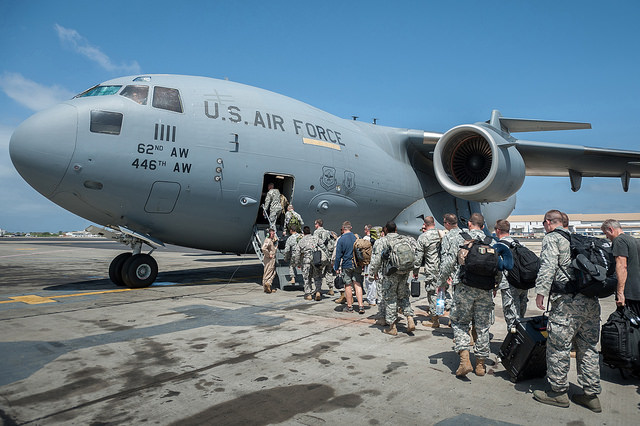
A group of 30 U.S. military personnel, including Marines, Airmen, and Soldiers from the 101st Airborne Division, board a U.S. Air Force C-17 Globemaster III at Léopold Sédar Senghor International Airport in Dakar, Senegal, Oct. 19, 2014. The service members are bound for Monrovia, Liberia, where U.S. troops will construct medical treatment units and train health care workers as part of Operation United Assistance, the U.S. Agency for International Development-led, whole-of-government effort to respond to the Ebola outbreak in West Africa. (U.S. Air National Guard photo by Maj. Dale Greer)
DAKAR, Senegal – The Joint Task Force-Port Opening Senegal (JTF-PO) supported the 101st Airborne Division’s departure from Léopold Sédar Senghor International Airport here October 19th, en route to Liberia, where the division will join hundreds of U.S. service members engaged in the fight against Ebola in West Africa.
JTF-PO Senegal is staffed by more than 70 Airmen from the Kentucky Air National Guard’s 123rd Contingency Response Group and stood up operations here October 5th.
The JTF-PO’s mission is to funnel humanitarian aid and military support into West Africa in support of Operation United Assistance (OUA), according to Col. David Mounkes, the JTF-PO Senegal commander and member of the Kentucky ANG.
Click here for more photos.
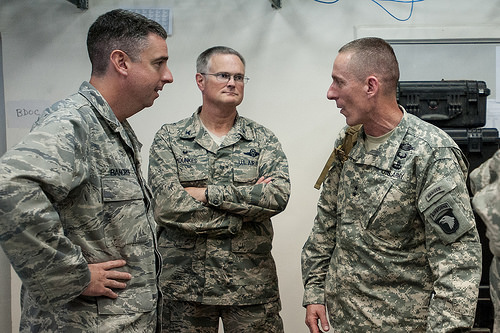
U.S. Army Maj. Gen. Gary J. Volesky (right), commanding general of the 101st Airborne Division, speaks with U.S. Air Force Lt. Col. Bruce Bancroft (left) and U.S. Air Force Col. David Mounkes of the Kentucky Air National Guard’s 123rd Contingency Response Group Oct. 18, 2014, during a tour of the Joint Operations Center for Joint Task Force-Port Opening Senegal at Léopold Sédar Senghor International Airport in Dakar, Senegal. The JTF-PO is funneling humanitarian supplies and military support into West Africa as part of Operation United Assistance, the U.S. Agency for International Development-led, whole-of-government effort to respond to the Ebola outbreak. Volesky will serve as the new commander of the U.S. military’s Operation United Assistance Joint Forces Command, headquartered in Liberia, where the Department of Defense is sending 3,000 troops to support the mission. (U.S. Air National Guard photo by Maj. Dale Greer)
The Kentucky ANG Airmen are also augmented by seven active-duty Airmen from Travis Air Force Base, California, and Joint Base Maguire-Dix-Lakehurst, New Jersey.
“I couldn’t be more proud of the professionalism and unique capability that all the members of our United States Transportation Command JTF-PO team have exhibited in this dynamic and challenging environment,” Mounkes said. “JTF-PO Senegal stands ready to continue supporting the international response and humanitarian aid the United States and partner nations are bringing to the effort to alleviate human suffering and contain the spread of Ebola.”
U.S. Army Maj. Gen. Gary J. Volesky, the commanding general of the 101st Airborne Division (Air Assault), will take charge of the Joint Forces Command for OUA upon arrival in Liberia, replacing U.S. Army Maj. Gen. Darryl Williams, the commander of U.S. Army Africa.
“Operation United Assistance is a critical mission,” Volesky said. “We will coordinate all of the Department of Defense resources in Liberia in support of the United States Agency for International Development (USAID), the U.S. government’s lead agency in this mission, and the government of Liberia to contain the Ebola virus and, ultimately, save lives.”
The Army is sending approximately 700 Soldiers from the 101st Airborne Division as part of the effort, including members of the division headquarters staff, sustainment brigade, combat support hospital and military police battalion, according to Volesky. Another 700 troops will be deployed from multiple engineering units to build 17,100-bed medical treatment units and a 25-bed hospital.
Story by Maj. Dale Greer, 123rd Airlift Wing Public Affairs
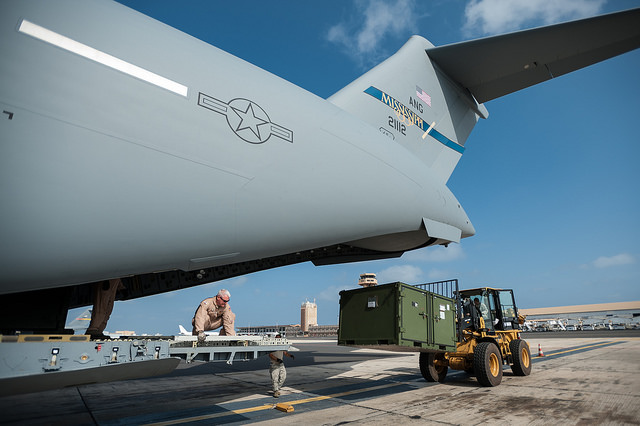
Aerial porters from the Kentucky Air National Guard’s 123rd Contingency Response Group off-load the unit’s gear from a Mississippi Air National Guard C-17 Globemaster III at Léopold Sédar Senghor International Airport in Dakar, Senegal, Oct. 4, 2014, in support of Operation United Assistance. More than 70 Kentucky Airmen arrived with the gear to stand up an Intermediate Staging Base at the airport that will funnel humanitarian supplies and equipment into West Africa as part of the international effort to fight Ebola. (U.S. Air National Guard photo by Maj. Dale Greer)
DAKAR, Senegal — More than 80 Airmen from the Kentucky Air National Guard’s 123rd Contingency Response Group stood up a cargo hub here Oct. 5 that will funnel humanitarian supplies and equipment into West Africa in support of Operation United Assistance, the international effort to fight Ebola.
The epidemic has already claimed over 3,500 lives, according to the U.S. Centers for Disease Control.
The majority of Kentucky Airmen arrived Oct. 4, joining a 13-member assessment team that has been in place since Sept. 28. They’re operating an Intermediate Staging Base to Support Joint Task Force-Port Opening operations at Léopold Sédar Senghor International Airport, according to Air Force Col. David Mounkes, commander of the Louisville-based 123rd.
Click here for more photos.
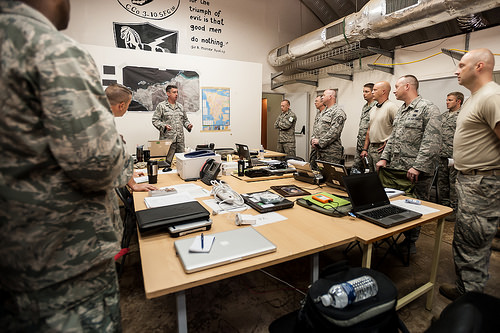
Air Force Lt. Col. Bruce Bancroft of the Kentucky Air National Guard’s 123rd Contingency Response Group talks to unit members about their role in Operation United Assistance during a briefing in the Joint Operations Center at Léopold Sédar Senghor International Airport in Dakar, Senegal, Oct. 5, 2014. The Kentucky Air Guardsmen stood up an Intermediate Staging Base at the airport that will funnel humanitarian supplies and equipment into West Africa as part of the international effort to fight Ebola. (U.S. Air National Guard photo by Maj. Dale Greer)
The Intermediate Staging Base is designed to accept large quantities of cargo arriving on C-17 Globemaster III aircraft, process the material for forward movement, and load it onto C-130 Hercules aircraft for distribution into affected areas. Soldiers from the U.S. Army’s 689th Rapid Port Opening Element also are assessing the movement of cargo here from seaports along the African coast.
The Kentucky Airmen landed in Senegal with all the equipment they need to provide command and control of aircraft and aerial port operations, including all-terrain forklifts, satellite communications gear and power-production capability.
“Our job is to get the right cargo to the right place at the right time,” Mounkes said. “This is the mission we train for 365 days a year, and our personnel are some of the best in the business. We’re ready to execute.”
The Department of Defense has committed to deploying up to 3,000 troops in support of the United States Agency for International Development, the lead federal agency coordinating the U.S. Government’s comprehensive response for Operation United Assistance. In addition to the creation of the cargo hub here and logistics nodes across West Africa, American forces will construct a hospital and more than a dozen other treatment facilities in affected areas.
Air Force Lt. Col. Matt Groves, commander of the 123rd’s Global Mobility Readiness Squadron, underscored the importance of the Intermediate Staging Base mission.
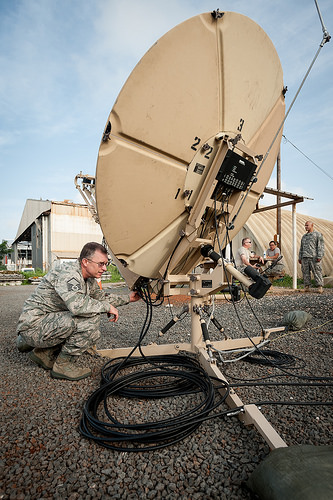
Air Force Master Sgt. Paul Edwards of the Kentucky Air National Guard’s 123rd Contingency Response Group establishes satellite communications for the Joint Operations Center at Léopold Sédar Senghor International Airport in Dakar, Senegal, Oct. 5, 2014, in support of Operation United Assistance. More than 80 Kentucky Air Guardsmen stood up an Intermediate Staging Base at the airport that will funnel humanitarian supplies and equipment into West Africa as part of the international effort to fight Ebola. (U.S. Air National Guard photo by Maj. Dale Greer)
“What we’re doing here could save hundreds of thousands of lives,” Groves said. “We’re talking about a disease that, if left untreated, has a mortality rate of up to 50 percent. There is absolutely no other mission we will perform this year that is more important, or will impact more people, than this one.”
The 123rd Contingency Response Group is the only unit of its kind in the Air National Guard. Conceived as an “airbase in a box,” the group acts as an early responder in the event of contingency operations worldwide. Its personnel are capable of deploying into remote airfields, providing command and control of aircraft, and establishing airfield operations so troops and cargo can flow into affected areas.
Unit members represent a broad spectrum of specialties, including airfield security, ramp and cargo operations, aircraft maintenance, and command and control.
In 2010, the group was one of two Air Force contingency response units to establish overseas airlift hubs supporting earthquake-recovery efforts in Haiti, directing the delivery of hundreds of tons of relief supplies into the Dominican Republic for subsequent trucking to Haiti.
Story by Lt. Col. Kirk Hilbrecht, Director of Public Affairs, Kentucky National Guard
Photos by SSG Scott Raymond, Kentucky Guard Public Affairs

LOUISVILLE, Ky. (2OCT14)- More than 60 Airmen from the Kentucky Air National Guard will begin departing Thursday afternoon for Senegal to establish a cargo-processing hub in support of Operation United Assistance, the international effort to battle Ebola in West Africa (photo by Staff Sgt. Scott Raymond, Kentucky National Guard Public Affairs).
LOUISVILLE, Ky. — More than 60 Airmen from the Kentucky Air National Guard deployed Oct. 2 to Senegal to establish a cargo-processing hub in support of Operation United Assistance, the international effort to battle Ebola in West Africa.
Click here for more photos of this story.
Kentucky’s Airmen departed aboard multiple aircraft along with all the equipment necessary to establish an Aerial Port of Debarkation at Léopold Sédar Senghor International Airport.
The Aerial Port of Debarkation, or APOD, is designed to accept large quantities of cargo arriving on C-17 and C-5 aircraft, process the material for staging and then load it onto smaller aircraft for distribution into affected areas.
The Kentucky Airmen assigned to the Louisville-based 123rd Contingency Response Group, will remain in place as long as the mission dictates.
Airmen with the 123rd Contingency Response Group board a Mississippi Air National Guard C-17 headed for West Africa from the Kentucky Air National Guard Base in Louisville, Ky., Oct. 2, 2014. The Guardsmen will work to set up a logistics hub in support of Operation United Assistance. (U.S. Army National Guard photo by Staff Sgt. Scott Raymond)
An advance team of eight Kentucky Air Guardsmen and one active-duty Airman arrived in Senegal on Sunday to assess the airfield and operational capabilities.
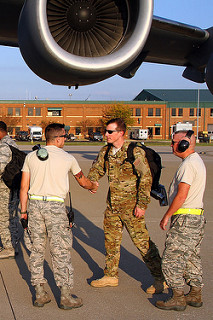
Lt. Col. Matthew Groves, commander of Global Mobility Readiness Squadron of the 123rd Contingency Response Group says farewell as he joins his fellow Airmen headed for West Africa Oct. 2, 2014. The Guardsmen will work to set up a logistics hub in support of Operation United Assistance. (U.S. Army National Guard photo by Staff Sgt. Scott Raymond)
“The eyes of the world are on West Africa right now and Kentuckians are on the way to help,” said Maj. Gen. Edward W. Tonini, adjutant general for Kentucky. “There is no better organization to respond to this kind of mission than the Kentucky Air National Guard. The men and women of the 123rd Contingency Response Group are trained and experienced professionals, and I am confident they will make an important difference during this crisis.”
“We know that this mission is not about us. The estimates that we’ve seen are somewhere between 500,000 and a million lives that could potentially be lost in this epidemic and that’s what we are going to stop that’s what we are going to be part of,” said Lt. Col. Matthew Groves, commander of Global Mobility Readiness Squadron of the 123rd Contingency Response Group.
The 123rd Contingency Response Group is the only unit of its kind in the Air National Guard. Conceived as an “airbase in a box,” the group acts as an early responder in the event of contingency operations worldwide. Several members of the CRG were involved in previous humanitarian missions, to include Haiti earthquake aid in 2010.
Its personnel have the training and equipment to deploy to remote sites, rapidly open a runway and establish airfield operations so cargo or troops can begin to flow into affected areas. Unit members represent a broad spectrum of specialties, including airfield security, ramp and cargo operations, aircraft maintenance, and command and control.
MEDIA HITS:
WHAS-11 (ABC Louisville Affiliate):
http://www.whas11.com/news/Airmen-from-Ky-Air-National-Guard-heading-to-West-Africa-to-fight-Ebola-virus-277938411.html
WDRB-41 (FOX Louisville Affiliate):
http://www.wdrb.com/story/26693076/kentucky-national-guard-members-leave-to-help-with-ebola-crisis
Courier-Journal
http://www.courier-journal.com/story/life/wellness/health/2014/10/02/ky-guardsmen-part-ebola-response-africa/16599343/
Lexington Herald-Leader
http://www.kentucky.com/2014/10/02/3460137_kentucky-national-guard-sends.html?rh=1
By 2nd Lt. James W. Killen, 123rd Airlift Wing Public Affairs
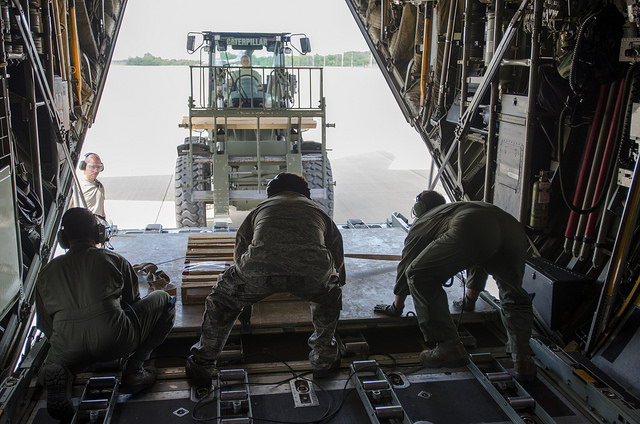
Airmen from the Kentucky Air National Guard’s 123rd Contingency Response Group offload cargo from a Kentucky Air Guard C-130 Hercules during Capstone ’14, a homeland earthquake-response exercise at Fort Campbell, Ky., on June 18, 2014. The 123rd CRG joined forces with the U.S. Army’s 688th Rapid Port Opening Element to operate a Joint Task Force-Port Opening here from June 16 to 19, 2014. (U.S. Air National Guard photo by Master Sgt. Phil Speck)
FORT CAMPBELL, Ky. – Natural disasters are an unavoidable fact of life, but that doesn’t mean the nation can’t be prepared for them. Architects can design more resilient buildings and strengthen existing ones, disaster-management officials can pre-stage recovery equipment and supplies, and the men and women who respond can hone their training to ensure rapid assistance.
The Airmen of the Kentucky Air National Guard’s 123rd Contingency Response Group are those men and women, and they successfully demonstrated their disaster-response capabilities here June 16-19 during a simulated-earthquake exercise called CAPSTONE ’14. The exercise tested the 123rd CRG’s response to a major earthquake in the New Madrid Seismic Zone that caused massive damage across an eight-state region from Arkansas to Ohio.
Click here for additional photos from this story.
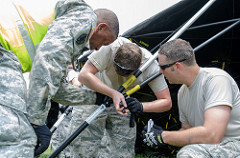
Personnel from the Kentucky Air National Guard’s 123rd Contingency Response Group and the U.S. Army’s 688th Rapid Port Opening Element work together to erect a Base X tent at Fort Campbell, Ky., on June 17, 2014, while participating in at Capstone ’14, a homeland earthquake-response exercise. The 123rd CRG joined with the 688th RPOE to operate a Joint Task Force-Port Opening from June 16 to 19, 2014. (U.S. Air National Guard photo by Master Sgt. Phil Speck)
The 123rd CRG, working in partnership with the U.S. Army’s 688th Rapid Port Opening Element, established a Joint Task Force-Port Opening within hours of deploying to Fort Campbell’s airfield. The task force was charged with receiving and processing large quantities of food, water, medicine and other relief supplies arriving by airlift. The supplies were then trucked to a staging point for further distribution into affected areas.
The reception and off-loading of aircraft was handled by the Kentucky Air Guardsmen, while the Soldiers were responsible for delivering the supplies to their final destination, explained Army Capt. Jacob Elders, executive officer of the 688th RPOE.
The flight line operated like a well-orchestrated dance, with C-130 Hercules aircraft landing, offloading their cargo to multiple 10,000-pound forklifts and taking off again in quick succession, all under the control of the CRG. Meanwhile, heavy vehicles from the 688th RPOE would transport the supplies to a staging area called the forward node, known here only as “The Node.”
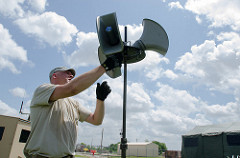
Master Sgt. Kyle Goins, a communications specialist for the Kentucky Air National Guard’s 123rd Contingency Response Group, sets up a “big voice” system at Fort Campbell, Ky., June 17, 2014, during Capstone ’14, a homeland earthquake-response exercise. The 123rd CRG joined forces with the U.S. Army’s 688th Rapid Port Opening Element to operate a Joint Task Force-Port Opening here from June 16 to 19, 2014. (U.S. Air National Guard photo by Master Sgt. Phil Speck)
If one were to peer into the Joint Operations Center, it wouldn’t have been difficult to understand how seriously each service member took the mission. Everyone was busy continuously, acting with a sense of urgency to ensure the steady flow of relief to people in need.
Morning meetings functioned as round tables where every element had the opportunity to outline its objectives, expectations, needs and successes. The meetings took less than 15 minutes despite the fact that input was being sought from more than 30 people — a testament to knowing the importance of the mission, the need to be quick and efficient, but also to ensure that necessary information was shared, according to Lt. Col. Bruce Bancroft, Joint Assessment Team chief.
“When you are trying to get relief supplies to hundreds of thousands of people, there is no time for extra words,” Bancroft said. “The mission comes first, and it has to be accomplished quickly, efficiently and in a manner that ensures no one waits longer for us than is absolutely necessary.”
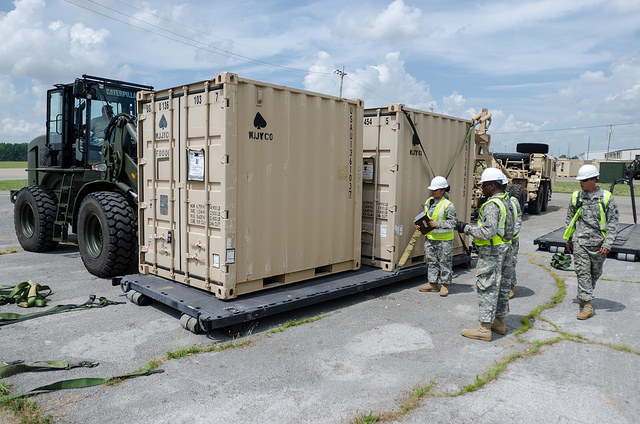
Soldiers from the U.S. Army’s 688th Rapid Port Opening Element inspect cargo on June 18, 2014, before strapping it down for transport to a staging area called the Forward Node during Capstone ’14, a homeland earthquake-response exercise at Fort Campbell, Ky. The 688th RPOE joined forces with the Kentucky Air National Guard’s 123rd Contingency Response Group to operate a Joint Task Force-Port Opening here from June 16 to 19, 2014. (U.S. Air National Guard photo by Master Sgt. Phil Speck)
Army Capt. Gary “Luke” Wheeler, commander of the 688th RPOE, was pleased with the performance of the joint Army-Air Guard team, saying the exercise “turned out very well.”
“We had some great planning going into the exercise and good communications,” he added. “Everything we needed, we got support for on the RPOE side. It was definitely a well-executed mission by everybody.”
The Kentucky Air Guard’s Col. Mark Heiniger agreed with Wheeler’s assessment, noting that the teamwork displayed by the Airmen and Soldiers was “phenomenal.”
“We’re very proud of our Airmen and Soldiers,” said Heiniger, commander of both the 123rd CRG and the JTF-PO. “Their enthusiasm for the mission and willingness to give it everything they had was the key to our mission success.”
Exercises like CAPSTONE ’14 are not only designed to test the capabilities of military personnel, Heiniger added. They also enhance working relationships with multiple cooperating civilian agencies.
“We incorporated our exercise with another event called CUSEC, which is short for Central U.S. Earthquake Consortium,” he said. “So, we got as much bang for the buck out of this exercise as we could. This was a team-building exercise for government agencies, state agencies, our CRG and our RPOE.”