
Pages
Stay In Touch
More
© 2013 KentuckyGuard
Story by Staff Sgt. Scott Raymond, Kentucky National Guard Public Affairs
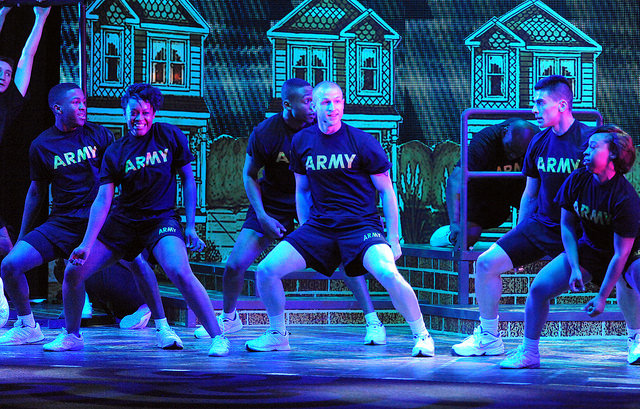
Kentucky Army National Guard 1st Lt. William Bland (center) performs during the 2015 U.S. Army Soldier Show’s opening weekend at the Fort Sam Houston Theatre in San Antonio. The musically-inclined Louisville-native serves as the personnel officer with the 198th Military Police Battalion. (U.S. Army photo by Tim Hipps, IMCOM Public Affairs)
FRANKFORT, Ky. — Since 1983 talented Soldiers have had the opportunity to share their artistry with the Nation as part of the U.S. Army Soldier Show. This year the Kentucky National Guard’s 1st Lt. William Bland earned a spot in the nationally-touring production.
A native of Louisville, Kentucky, Bland serves as the personnel officer for the 198th Military Police Battalion. When he’s not in uniform Bland likes to perform at clubs, festivals, benefits and wherever he can to gain exposure and experience.

Kentucky National Guard 1st Lt. William Bland’s promotional photo for the 2015 U.S. Army Soldier Show. The tour opened in San Antonio, Texas, in April and runs through October. (Image courtesy of IMCOM)
“It is truly a once in a life time opportunity,” he said. “Being a part of the U.S. Army Soldier Show and seeing all that goes into a big production and being a part of all of it has definitely opened my eyes to a world of opportunities after this.”
Click here for more photos.
Bland is one of three Guardsmen performing in the tour. He is joined by Louisiana Army National Guard Sgt. Neasha Powell of Shreveport and Idaho Army National Guard Sgt. Andrew Enriquez of Coeur d’Alene.
Bland’s journey to the show began like that of hundreds of other Soldiers around the country in the form of an audition tape and packet submitted to Army Entertainment, a program of Morale, Welfare and Recreation that runs the Soldier Show. He called the audition process a long and stressful one, but made the cut to try out in person and flew to Fort Sam Houston, Texas where the hard work began.
“Audition week culminated with a live performance of the choreography and the vocal number that we learned throughout the week, and a piece we each prepared on our own. On February 16, 2015 the cast was selected and narrowed down to a total of 18 members, and that was the day the dream became reality.”
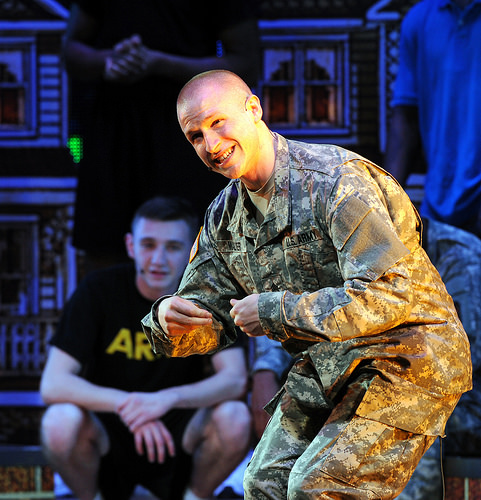
Kentucky Army National Guard 1st Lt. William Bland of Louisville performs during the 2015 U.S. Army Soldier Show’s opening weekend at the Fort Sam Houston Theatre in San Antonio. (U.S. Army photo by Tim Hipps, IMCOM Public Affairs)
As one of 18 performers, Bland will travel the country for shows in a scheduled 40-stop tour. An experience he said “couldn’t be a better way to use my passion to impact the lives of others in a positive way.”
Music entered Bland’s life at an early age. He said he still remembers when his older brother taught him about freestyling and how he was finally able to step out of his shell and attend open mic nights as a student at Union College. Influenced by Eminem and Michael Jackson, Bland keeps an open mind musically and pulls inspiration from as many other musicians as possible.
He first saw the Soldier Show while he was in basic training and left with a great motivation and pride in being a Soldier. As he got more serious with his own music and more into his Guard career, the idea of combining the two became a perfect fit.
“I thought it would be amazing to share what I love to do and to give Soldiers that same motivation and purpose that was given to me when I saw the show.”
Initially enlisting to help pay for college, Bland quickly realized a “greater purpose” in uniform and commissioned as an officer through ROTC. Rising through the ranks, he has earned the respect of his unit and leadership, who are proud to be his cheerleaders during the tour.
“While we will miss his services in 198th MP Battalion, we couldn’t be more excited and proud to have one of our own representing the battalion, the 149th Maneuver Enhancement Brigade and the Kentucky National Guard in this very prestigious program,” said Maj. Timothy Starke, commander of the 198th. “We hope to have a large turn out to support 1st Lt. Bland when the show comes to Kentucky this year.”
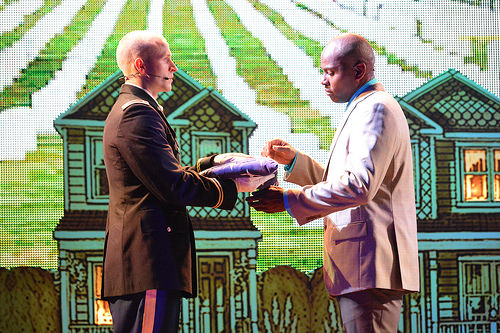
Kentucky Army National Guard 1st Lt. William Bland of Louisville presents Sgt. Darius Riggins of Fort Gordon, Georgia, a U.S. flag during the Gold Star segment of the 2015 U.S. Army Soldier Show’s opening weekend at the Fort Sam Houston Theatre in San Antonio. (U.S. Army photo by Tim Hipps, IMCOM Public Affairs)
According to the U.S. Army, “entertainment for the Soldier, by the Soldier” has been a part of the U.S. Army’s heritage since 1774. Building on the tradition of Civil War camp shows, and more known military shows “Yip Yip Yaphank” during World War I and “This Is The Army” during World War II written and directed by then Sgt. Irving Berlin, Army Entertainment was formalized to inspire, support and coordinate theatrical and musical programs at Army installations worldwide.
Bland said his routine with the show has included a lot of hard work, many 16 plus hour days and has been physically and mentally exhausting, but he wouldn’t change a thing,
“A dream can only come true if you are willing to do the work necessary to make it come true. But success is worth the sacrifice. When you are faced with a challenge just tell yourself, ‘Easy’s never worked for me!'”
The Soldier Show is a 90-minute high-energy top ‘40s and classics show, and it’s free!. It makes two stops in Kentucky during the 2015 tour: July 29-30 at Fort Knox, and Aug. 2-3 at Fort Campbell.
By 2nd Lt. James W. Killen, 123rd Airlift Wing Public Affairs
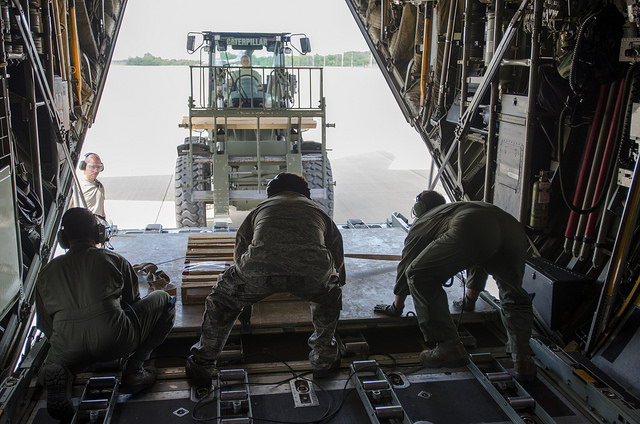
Airmen from the Kentucky Air National Guard’s 123rd Contingency Response Group offload cargo from a Kentucky Air Guard C-130 Hercules during Capstone ’14, a homeland earthquake-response exercise at Fort Campbell, Ky., on June 18, 2014. The 123rd CRG joined forces with the U.S. Army’s 688th Rapid Port Opening Element to operate a Joint Task Force-Port Opening here from June 16 to 19, 2014. (U.S. Air National Guard photo by Master Sgt. Phil Speck)
FORT CAMPBELL, Ky. – Natural disasters are an unavoidable fact of life, but that doesn’t mean the nation can’t be prepared for them. Architects can design more resilient buildings and strengthen existing ones, disaster-management officials can pre-stage recovery equipment and supplies, and the men and women who respond can hone their training to ensure rapid assistance.
The Airmen of the Kentucky Air National Guard’s 123rd Contingency Response Group are those men and women, and they successfully demonstrated their disaster-response capabilities here June 16-19 during a simulated-earthquake exercise called CAPSTONE ’14. The exercise tested the 123rd CRG’s response to a major earthquake in the New Madrid Seismic Zone that caused massive damage across an eight-state region from Arkansas to Ohio.
Click here for additional photos from this story.
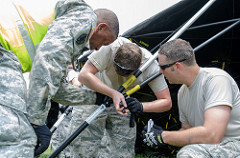
Personnel from the Kentucky Air National Guard’s 123rd Contingency Response Group and the U.S. Army’s 688th Rapid Port Opening Element work together to erect a Base X tent at Fort Campbell, Ky., on June 17, 2014, while participating in at Capstone ’14, a homeland earthquake-response exercise. The 123rd CRG joined with the 688th RPOE to operate a Joint Task Force-Port Opening from June 16 to 19, 2014. (U.S. Air National Guard photo by Master Sgt. Phil Speck)
The 123rd CRG, working in partnership with the U.S. Army’s 688th Rapid Port Opening Element, established a Joint Task Force-Port Opening within hours of deploying to Fort Campbell’s airfield. The task force was charged with receiving and processing large quantities of food, water, medicine and other relief supplies arriving by airlift. The supplies were then trucked to a staging point for further distribution into affected areas.
The reception and off-loading of aircraft was handled by the Kentucky Air Guardsmen, while the Soldiers were responsible for delivering the supplies to their final destination, explained Army Capt. Jacob Elders, executive officer of the 688th RPOE.
The flight line operated like a well-orchestrated dance, with C-130 Hercules aircraft landing, offloading their cargo to multiple 10,000-pound forklifts and taking off again in quick succession, all under the control of the CRG. Meanwhile, heavy vehicles from the 688th RPOE would transport the supplies to a staging area called the forward node, known here only as “The Node.”
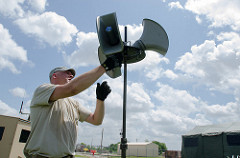
Master Sgt. Kyle Goins, a communications specialist for the Kentucky Air National Guard’s 123rd Contingency Response Group, sets up a “big voice” system at Fort Campbell, Ky., June 17, 2014, during Capstone ’14, a homeland earthquake-response exercise. The 123rd CRG joined forces with the U.S. Army’s 688th Rapid Port Opening Element to operate a Joint Task Force-Port Opening here from June 16 to 19, 2014. (U.S. Air National Guard photo by Master Sgt. Phil Speck)
If one were to peer into the Joint Operations Center, it wouldn’t have been difficult to understand how seriously each service member took the mission. Everyone was busy continuously, acting with a sense of urgency to ensure the steady flow of relief to people in need.
Morning meetings functioned as round tables where every element had the opportunity to outline its objectives, expectations, needs and successes. The meetings took less than 15 minutes despite the fact that input was being sought from more than 30 people — a testament to knowing the importance of the mission, the need to be quick and efficient, but also to ensure that necessary information was shared, according to Lt. Col. Bruce Bancroft, Joint Assessment Team chief.
“When you are trying to get relief supplies to hundreds of thousands of people, there is no time for extra words,” Bancroft said. “The mission comes first, and it has to be accomplished quickly, efficiently and in a manner that ensures no one waits longer for us than is absolutely necessary.”
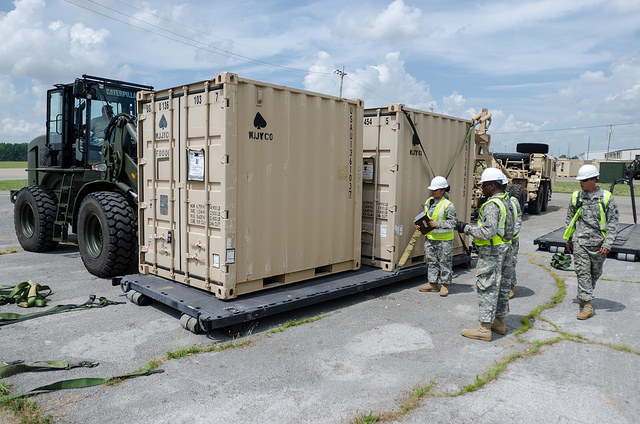
Soldiers from the U.S. Army’s 688th Rapid Port Opening Element inspect cargo on June 18, 2014, before strapping it down for transport to a staging area called the Forward Node during Capstone ’14, a homeland earthquake-response exercise at Fort Campbell, Ky. The 688th RPOE joined forces with the Kentucky Air National Guard’s 123rd Contingency Response Group to operate a Joint Task Force-Port Opening here from June 16 to 19, 2014. (U.S. Air National Guard photo by Master Sgt. Phil Speck)
Army Capt. Gary “Luke” Wheeler, commander of the 688th RPOE, was pleased with the performance of the joint Army-Air Guard team, saying the exercise “turned out very well.”
“We had some great planning going into the exercise and good communications,” he added. “Everything we needed, we got support for on the RPOE side. It was definitely a well-executed mission by everybody.”
The Kentucky Air Guard’s Col. Mark Heiniger agreed with Wheeler’s assessment, noting that the teamwork displayed by the Airmen and Soldiers was “phenomenal.”
“We’re very proud of our Airmen and Soldiers,” said Heiniger, commander of both the 123rd CRG and the JTF-PO. “Their enthusiasm for the mission and willingness to give it everything they had was the key to our mission success.”
Exercises like CAPSTONE ’14 are not only designed to test the capabilities of military personnel, Heiniger added. They also enhance working relationships with multiple cooperating civilian agencies.
“We incorporated our exercise with another event called CUSEC, which is short for Central U.S. Earthquake Consortium,” he said. “So, we got as much bang for the buck out of this exercise as we could. This was a team-building exercise for government agencies, state agencies, our CRG and our RPOE.”
Story by 2nd Lt. James Killen, 123rd Airlift Wing Public Affairs
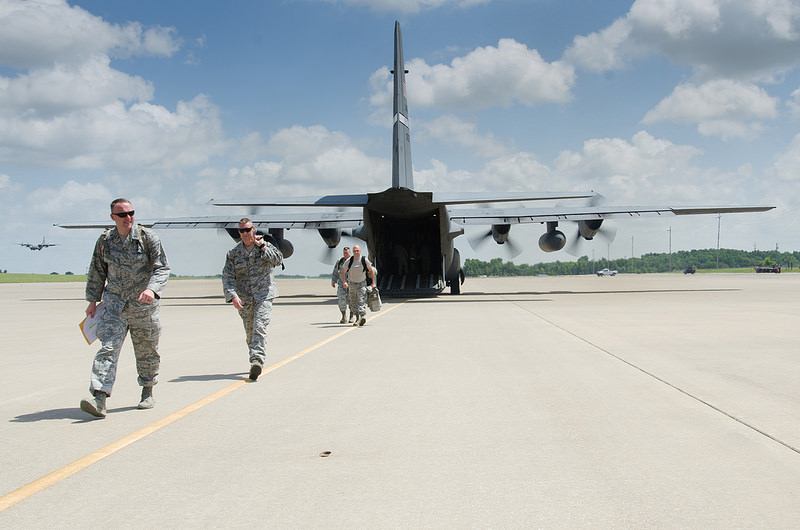
Airmen from the Kentucky Air National Guard’s 123rd Contingency Response Group arrive at Fort Campbell, Ky., June 17, 2014, via a Kentucky Air Guard C-130 Hercules to participate in CAPSTONE-14, a homeland earthquake-response exercise. The 123rd CRG is joining with the U.S. Army’s 688th Rapid Port Opening Element to operate a Joint Task Force-Port Opening here from June 16 to 19, 2014. (U.S. Air National Guard photo by Master Sgt. Phil Speck)
FORT CAMPBELL, Ky. – More than 100 members of the Kentucky Air National Guard’s 123rd Contingency Response Group and the U.S. Army’s 688th Rapid Port Opening Element deployed here June 16-19 for an exercise that will test their ability to respond to a major earthquake along the New Madrid Seismic Zone.
The exercise, called CAPSTONE-14, requires the troops to set up and operate a Joint Task Force-Port Opening, a self-contained air cargo distribution center that delivers crucial relief supplies during disasters and contingencies, according to Col. Mark Heiniger, JTF-PO commander.
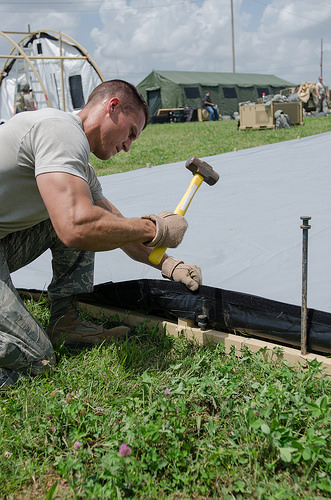
Tech. Sgt. Jason Prifogle, squad leader for the Kentucky Air National Guard’s 123rd Contingency Response Group, hammers stakes for an Alaskan Shelter during CAPSTONE-14, a homeland earthquake-response exercise at Fort Campbell, Ky., on June 17, 2014. The 123rd CRG is joining with the U.S. Army’s 688th Rapid Port Opening Element to operate a Joint Task Force-Port Opening here from June 16 to 19, 2014. (U.S. Air National Guard photo by Master Sgt. Phil Speck)
The two units will work together this week to run the JTF-PO, which combines an Air Force Contingency Response Group with an Army Transportation Company to form an Aerial Port of Debarkation. The CRG ensures the seamless flow of relief supplies by air, while the transportation company facilitates their final distribution over land.
Click here to see more photos from this story.
The mission is not a new one for Kentucky’s 123rd Contingency Response Group. The unit stands ready to respond to any contingency natural disaster, Heiniger said, initially deploying an 11-person Joint Assessment Team to evaluate airfield infrastructure in the affected area and determine if it can support large-scale relief operations.
This week’s exercise began June 16, with the JAT landing here and providing a “go-no go” report to U.S. Transportation Command within four hours of arrival. In that time, they evaluated the runway’s integrity for airlift operations and the movement capability of ground vehicles that will distribute relief supplies brought in by cargo aircraft. They also established a secure communications channel for operations.
“The JAT has an important mission that has to be carried out quickly by experts,” Heiniger said. “Decisions have to be made, and they have to be right for the JTF-PO to be successful.”
Upon site approval, the JAT began accepting the remaining Airmen and Soldiers, along with all the equipment necessary to execute the mission, from tents and electric generators to forklifts and communications gear.
One of the key objectives of the exercise is perfecting seamless operations between multiple states, multiple state and federal agencies, and multiple military units. A common theme here is “purple,” which signifies the merger of green (U.S. Army) and blue (U.S. Air Force) forces toward the accomplishment of one mission.
“The interoperability, especially stateside for the RPOE mission and the CRG, is critical,” said U.S. Army Capt. Jacob Elders, executive officer for the 688th RPOE. “Not every service brings everything to the fight, but when you link the two together, you have a full mission.
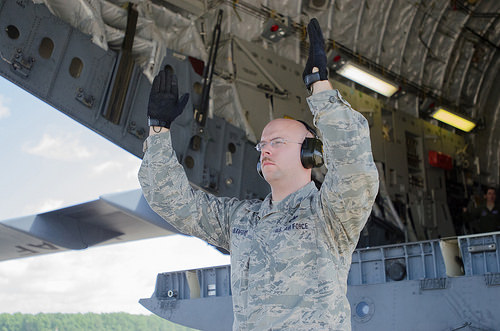
Tech. Sgt. Jerrod Blanford, an aerial porter from the Kentucky Air National Guard’s 123rd Contingency Response Group, spots a forklift as it unloads cargo from a Kentucky Air Guard C-130 Hercules during CAPSTONE-14, a homeland earthquake-response exercise at Fort Campbell, Ky., on June 17, 2014. The 123rd CRG is joining with the U.S. Army’s 688th Rapid Port Opening Element to operate a Joint Task Force-Port Opening here from June 16 to 19, 2014. (U.S. Air National Guard photo by Master Sgt. Phil Speck)
CAPSTONE-14 is part of a broader effort to ensure the region has an effective response to a major earthquake to a zone that spans eight states. According to seismologists, the New Madrid Zone operates on a 200-year cycle for magnitude 6.0 and greater earthquakes. The last earthquake of that magnitude was recorded in 1811.
“To really put it in perspective, a major earthquake along the New Madrid Seismic Zone is likely to cause more damage than Hurricane Katrina,” noted Lt. Col. Bruce Bancroft, Joint Assessment Team chief for the Kentucky Air National Guard. “Preparing for the possibility is essential to saving lives and getting the region back to normal as quickly as possible.”
The 123rd Contingency Response Group is the only fully operational CRG in the Air National Guard and one of just seven CRGs in entire U.S. Air Force. It and the 688th RPOE have previously been verified by U.S. Transportation Command as fully mission capable to provide key assistance during national or international emergencies.
Photos by Maj. Dale Greer and Senior Airman Maxwell Rechel, Kentucky Air National Guard
Story by Lt. Col. Kirk Hilbrecht, Public Affairs, Kentucky National Guard
CLICK HERE for more pictures from the exercise.
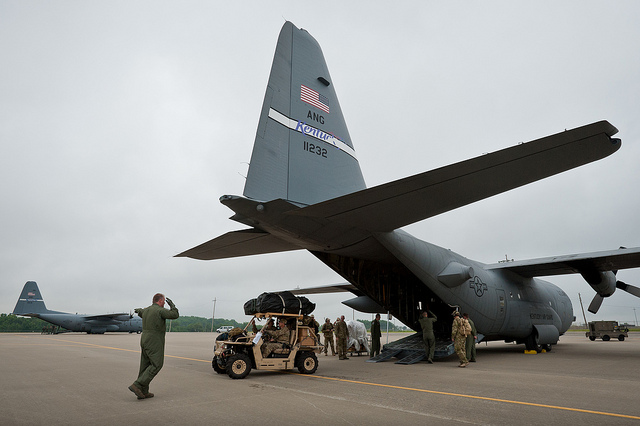
A loadmaster from the Kentucky Air National Guard’s 123rd Airlift Wing directs an all-terrain vehicle May 14, 2012, as its driver exits the cargo bay of a Kentucky Air Guard C-130 onto the flight line at Fort Campbell, Ky. The 123rd was participating in an exercise to test its response to a simulated earthquake in the New Madrid Seismic Zone, a fault line that originates near New Madrid, Mo., and stretches southwest across four states. More than 30 Kentucky Airmen, all assigned to the 123rd’s Initial Response Hub package, assessed Campbell Army Airfield for earthquake damage, determined the kinds of airlift operations the facility could support and opened the ramp for incoming relief and aeromedical evacuation flights within five hours of being called to duty. (U.S. Air Force photo by Maj. Dale Greer)
FORT CAMPBELL, Ky (May 14th, 2012) — More than 30 Kentucky Guardsmen and two C-130 aircraft from the 123rd Airlift Wing mobilized and flew to Fort Campbell, Ky, during a no-notice exercise response to a notional 7.6 magnitude earthquake outside of St. Louis on Monday. Within three hours of the telephonic recall initiated by the Initial Response Hub Mission Commander, Col. Warren Hurst, the relief response personnel from the special tactics squadron, the contingency response group, security forces, maintenance, medical and public affairs were airborne to Western Kentucky.
“We threw the team a curve ball,” said Col. Gregory Nelson, commander of the 123rd Airlift Wing. “Initially our Airmen were planning and preparing for a notional hurricane in the Gulf of Mexico, as hurricane season is coming. At the last minute, we changed the entire mission and injected a New Madrid earthquake response exercise, requiring the crews to create new flight plans and prepare for a completely different scenario. This is how real life and real disasters work.”
See the video from Louisville’s Fox station, WDRB
Once at Fort Campbell, the Kentucky first air-responders assessed the runways, evaluated the air traffic routes, prepared for emergency evacuations and established voice, data and video communication with FEMA, Transportation Command, the National Guard Bureau and other vital national agencies.
“I’m a critical care nurse in the Air National Guard, and I’ve come down to help where air evac assets should be used,” said Lt. Col. David Worley from the 123rd’s medical squadron.
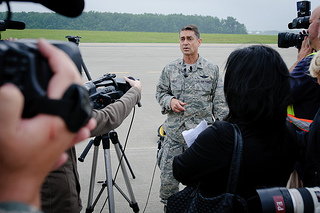
Col. Warren Hurst, commander of the 123rd Contingency Response Group, briefs members of the news media at Fort Campbell, Ky., during an earthquake-response exercise May 14, 2012. About 30 Airmen from the 123rd Contingency Response Group and 123rd Special Tactics Squadron deployed to Fort Campbell to demonstrate their preparedness for an initial response after a natural disaster. The Kentucky Air Guard’s Initial Response Hub team is the first of its kind in the nation. No other unit in the U.S. military has the same breadth of capabilities housed in one unit, with the C-130 aircraft to permit immediate response. (U.S. Air Force photo by Senior Airman Maxwell Rechel)
Accompanying the Kentucky Air Guard were eight member of the Commonwealth’s civilian media, including Lexington’s Sean Moody from WKYT. “It was an eye-opening experience,” Moody explained. “I was amazed at how fast the 123rd packed up and flew out of Louisville, landed in Campbell and so quickly went to work on the airfield.”
The earthquake relief exercise tested several lessons learned from recent real-world relief missions involving Katrina, Haiti, Japan and Pakistan. The initial response hub is a unique first air response asset that the 123rd AW can provide FEMA during any state-side disaster, natural or man-made.
“Only in Louisville have we put these capabilities together along with the C130’s to provide a rapid response to a disaster in our country,” said Nelson. “We stand ready to do this mission when our nation needs us. We have proven we can do this mission.”
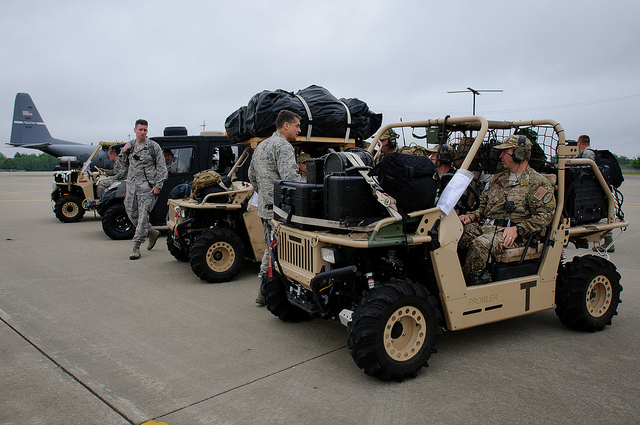
Members of the Kentucky Air National Guard use all-terrain vehicles to conduct an airfield assessment at Fort Campbell, Ky., during an earthquake-response exercise May 14, 2012. More than 30 Airmen examined all aspects of Campbell Army Airfield for simulated earthquake damage, determined the kinds of airlift operations the facility could support and opened the ramp for incoming relief and aeromedical evacuation flights within five hours of being called to duty. (U.S. Air Force photo by Senior Airman Maxwell Rechel)
CLICK HERE for more pictures from the exercise.
Photos by Maj. Dale Greer and Senior Airman Maxwell Rechel, Kentucky Air National Guard
Story by Lt. Col. Kirk Hilbrecht, Public Affairs, Kentucky National Guard
CLICK HERE for more pictures from the exercise.
A loadmaster from the Kentucky Air National Guard’s 123rd Airlift Wing directs an all-terrain vehicle May 14, 2012, as its driver exits the cargo bay of a Kentucky Air Guard C-130 onto the flight line at Fort Campbell, Ky. The 123rd was participating in an exercise to test its response to a simulated earthquake in the New Madrid Seismic Zone, a fault line that originates near New Madrid, Mo., and stretches southwest across four states. More than 30 Kentucky Airmen, all assigned to the 123rd’s Initial Response Hub package, assessed Campbell Army Airfield for earthquake damage, determined the kinds of airlift operations the facility could support and opened the ramp for incoming relief and aeromedical evacuation flights within five hours of being called to duty. (U.S. Air Force photo by Maj. Dale Greer)
FORT CAMPBELL, Ky (May 14th, 2012) — More than 30 Kentucky Guardsmen and two C-130 aircraft from the 123rd Airlift Wing mobilized and flew to Fort Campbell, Ky, during a no-notice exercise response to a notional 7.6 magnitude earthquake outside of St. Louis on Monday. Within three hours of the telephonic recall initiated by the Initial Response Hub Mission Commander, Col. Warren Hurst, the relief response personnel from the special tactics squadron, the contingency response group, security forces, maintenance, medical and public affairs were airborne to Western Kentucky.
“We threw the team a curve ball,” said Col. Gregory Nelson, commander of the 123rd Airlift Wing. “Initially our Airmen were planning and preparing for a notional hurricane in the Gulf of Mexico, as hurricane season is coming. At the last minute, we changed the entire mission and injected a New Madrid earthquake response exercise, requiring the crews to create new flight plans and prepare for a completely different scenario. This is how real life and real disasters work.”
See the video from Louisville’s Fox station, WDRB
Once at Fort Campbell, the Kentucky first air-responders assessed the runways, evaluated the air traffic routes, prepared for emergency evacuations and established voice, data and video communication with FEMA, Transportation Command, the National Guard Bureau and other vital national agencies.
“I’m a critical care nurse in the Air National Guard, and I’ve come down to help where air evac assets should be used,” said Lt. Col. David Worley from the 123rd’s medical squadron.
Col. Warren Hurst, commander of the 123rd Contingency Response Group, briefs members of the news media at Fort Campbell, Ky., during an earthquake-response exercise May 14, 2012. About 30 Airmen from the 123rd Contingency Response Group and 123rd Special Tactics Squadron deployed to Fort Campbell to demonstrate their preparedness for an initial response after a natural disaster. The Kentucky Air Guard’s Initial Response Hub team is the first of its kind in the nation. No other unit in the U.S. military has the same breadth of capabilities housed in one unit, with the C-130 aircraft to permit immediate response. (U.S. Air Force photo by Senior Airman Maxwell Rechel)
Accompanying the Kentucky Air Guard were eight member of the Commonwealth’s civilian media, including Lexington’s Sean Moody from WKYT. “It was an eye-opening experience,” Moody explained. “I was amazed at how fast the 123rd packed up and flew out of Louisville, landed in Campbell and so quickly went to work on the airfield.”
The earthquake relief exercise tested several lessons learned from recent real-world relief missions involving Katrina, Haiti, Japan and Pakistan. The initial response hub is a unique first air response asset that the 123rd AW can provide FEMA during any state-side disaster, natural or man-made.
“Only in Louisville have we put these capabilities together along with the C130’s to provide a rapid response to a disaster in our country,” said Nelson. “We stand ready to do this mission when our nation needs us. We have proven we can do this mission.”
Members of the Kentucky Air National Guard use all-terrain vehicles to conduct an airfield assessment at Fort Campbell, Ky., during an earthquake-response exercise May 14, 2012. More than 30 Airmen examined all aspects of Campbell Army Airfield for simulated earthquake damage, determined the kinds of airlift operations the facility could support and opened the ramp for incoming relief and aeromedical evacuation flights within five hours of being called to duty. (U.S. Air Force photo by Senior Airman Maxwell Rechel)
CLICK HERE for more pictures from the exercise.
Story and Photos By: 1st Lt. Mark Slaughter, Kentucky Yellow Ribbon Program
Additional photos provided by Bruce Herrick Secretary of Derby City QDMA.
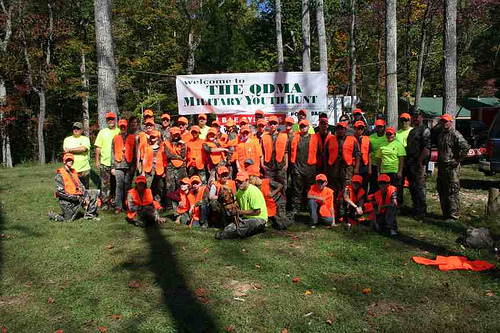
Brandenburg, Ky. — If you have ever been around a group of kids all weekend, chances are good you probably heard more than a few times, “I am bored.” Well, that’s what didn’t happen the weekend the Derby City Quality Deer Management Association’s hosted their first military youth hunt.
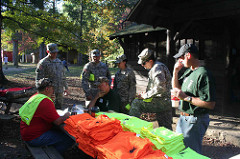
Soldiers from Fort Knox and Fort Campbell registering their kids for the Derby City Quality Deer Management Association’s (QDMA) Military Youth Hunt. The four day event took place October 7th-10th at YMCA, Camp Piomingo (Photo by Bruce Herrick, Secretary of Derby City QDMA)
The four day event started October 7th and ran through the 10th at YMCA Camp Piomingo at the Otter Creek Outdoor Recreation Area. More than 30 young hunters and their mentors spent four-days enjoying the great outdoors, all thanks to some volunteers from the Derby City Branch QDMA and the Bourbon Trail Branch QDMA.
The children were provided everything they needed at no cost to the families, all thanks to sponsors like BAE Systems, Bass Pro Shops, Plano, Cabelas, Society of Military Engineers, WMMG Radio, Raytheon, League of Kentucky Sportsmen, Bluegrass Game Calls, Hunters for the Hungry, YMCA, Camp Piomingo, Walmart, KDFWR and others.
QDMA members of the Quality Deer Management Association raised almost $20,000 for the hunt. It was such a success plans are already in the works for another event next year, and the kids can’t wait.
The QDMA, by the way, is a non-profit wildlife conservation organization dedicated to ensuring a high-quality and sustainable future for deer hunting. Founded in 1988, the QDMA currently has more than 50,000 members in all 50 states and several foreign countries including many deer management professionals.
By partnering with state wildlife agencies, timber companies, hunting groups, and product manufacturers they work to achieve their goals of safe and ethical hunting. The overall focus of the group is a strict adherence to wildlife and trespass laws promoting involvement in education and management for the hunters and non-hunters toward a better understanding of wildlife management. QDMA members strive to maintain a stewardship and appreciation for all wildlife in the hopes of passing these values on to future hunters, and there is no doubt that the weekend’s event did just that.
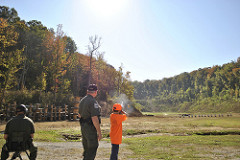
Matthew Robinson, son of Master Sgt. (retired) Shawn Robinson, going through shotgun familiarization training at Knob Creek Gun Range, in Bullitt County, Kentucky, under the watchful eye of members from Kentucky Fish and Wildlife. (Photo by 1st LT Mark Slaughter, Kentucky Yellow Ribbon)
Committee member of the Derby City Chapter of QDMA, and Chairman of the Military Youth Hunt, Joe Shreves worked hard to organize the event that brought kids in from almost every branch of service and from all over the Commonwealth.
Like all good hunting stories, the program came about during a discussion while sitting around a campfire.
“Naturally, we wanted the most deserving
kids and that is when we decided to give
consideration to children whose parents
were deployed overseas defending our
freedoms,” said Shreves. “The idea came up to go to Fort Knox and take some military kids.”
The idea grew and eventually 30 youth participated, 17 from Fort Campbell, six from Fort Knox, two from the Navy, and four are children of members in the Kentucky National Guard.
Before the youth hunt began the young people took part in the hunter education course and every one of them received a completion card, which is required to hold a Kentucky hunting license. Department of Fish and Wildlife Employees were on hand to help the kids complete the hunter education. This includes training, testing and range work with .22 rifles and 20 gauge shotguns.
On the range Matthew Robinson, son of retired Master Sgt. Shawn Robinson from the Murray State College ROTC program was impressed.
“This is awesome!” he declared as he finished the shotgun familiarization portion of the program.
Education was the first phase of the camp. Before the kids could hunt they had to learn about important topics like firearm safety, archery, wilderness survival techniques, conservation, and ethical hunting before heading into the field. After completing the classes the young hunters were provided a rifle donated by local hunters and sent to the range where they zeroed their sights.
On the zero range Kaytlin Nestor got some help from her father, Staff Sgt. David Nestor from the 101st Airborne Division Fort Campbell. The father-daughter team worked quickly with expertise, accurately setting up her rifle. Kaytlin has had a lifetime of shooting experience, but this weekend was special because it gave her some precious with her father, who has been deployed in support of the Global War on Terror.
“I am really looking forward to Saturday morning when the hunt begins,” said Kaytlin.
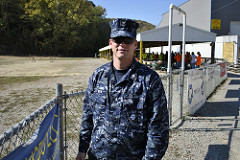
Navy Corpsman HM2 Brian Minton from the Naval Operation Support Center Louisville provided medical support over the weekend. (Photo by 1st LT Mark Slaughter, Kentucky Yellow Ribbon)
Hunting began before the sun came up Saturday morning, when the hunters and their mentors were taken to designated hunting positions. Throughout the weekend the number one goal was safety and every precaution was taken to insure the safety of the kids and volunteers. Hunting procedures were prepared and rehearsed well in advance.
Navy Hospital Corpsman Second Class Brian Minton was on duty from the Naval Operation Support Center Louisville. Minton provided medical support over the weekend and was on the scene ready for action in the event of any misstep.
Shreves had high praise for his medical support. “HM2 Minton was a valuable asset, and his presence brought great credit to himself and the US Navy.”
Minton, by the way, works as an EMT in the civilian world, and had just returned from a deployment in Afghanistan where he served as a corpsman for the United States Marine Corps.
“The weekend was great, and it was good to see so many kids and families enjoying themselves,” said Minton.
With their training complete early Saturday morning the kids were taken to designated hunting areas.
“We mainly hunted on two properties, Grand View Hunt Club, which is a private hunt club that I manage, and we hunted the Hardin County Landfill,” said Shreves.
Besides hunting skills the younger hunters learned something many of the seasoned mentors already knew. Hunting is a great sport but it is not just about connecting with nature, it is about making friends, and having a hunting buddy that life long memories are made with is priceless.
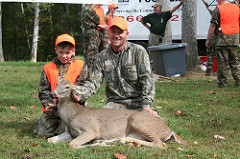
Ben Hutchinson and mentor Donnie Dattilo pose with Ben’s first deer. Ben’s mother took the processed meat to Camp Atterbury, Ind. where his father was preparing to for an upcoming deployment (Photo by Bruce Herrick, Secretary of Derby City QDMA)
A lot of the kids had early success in the hunt but more than that many of them connected with one another on a personal level. Having a parent deployed is tough, and it is good to have a friend to help you through that time, someone who knows what it is like when a Mom or Dad is away.
That is exactly what Brandon Jeffcoat and Ben Hutchinson experienced. Over the weekend whenever you saw Brandon, Ben would not be far away. The two of them made a great pair. When Ben tagged his deer on Sunday Brandon was there to celebrate. Ben’s mom made the drive in with his two younger brothers to pick up the deer and take it to his dad who was at Camp Atterbury, Indiana preparing to deploy.
Ben’s proud Mother said “You have shown me the side of my son that I have never seen.”
Ben’s mentor Donnie Dattilo also had a great time saying, “I could shoot a 200 class deer this year, and not have as good a time as I did with Ben.”
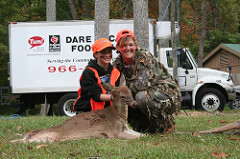
Jessica Slater and her mentor, Jennifer Shannonhouse posed with a deer harvested at the Derby City Quality Deer Management Association’s Military Youth Hunt. Jessica proudly declared that she would process the entire thing into jerky and send it to her father, 1st Lt. Greg Slater, in Iraq. (Photo by Bruce Herrick, Secretary of Derby City QDMA)
Jessica Slater comes from a military family. She has two brothers in the military — one just left for basic training — and her father, 1st Lt. Greg Slater is deployed with the 1204th Aviation Support Battalion.
Both Jessica and her mentor, Jennifer Shannonhouse, had a great experience during the hunt. Jessica proudly declared that she was going to send venison jerky to her father in Iraq. The first step, of course, was getting a dear. Shannonhouse was a little worried at first when she saw how small Jessica was and how big the rifle was, but her fears soon faded.
“After her first 4 shots she had hit the target 3 times,” said Shannonhouse. “I was not concerned anymore. She was a lot of fun and was so incredibly excited about getting her deer. I am glad she has decided to process the meat for her dad. He will never forget that and neither will she.”
The youth hunters also donated their meat to Hunters for the Hungry making a difference in the local community. It is programs like these have brought hundreds of thousands of pounds of venison to homeless shelters, soup kitchens and food banks, that help feed those in need.
Shreves was pleased with the final result, saying “It was our goal to provide a quality hunting experience for the children of our deserving service members. From the looks of the children that participated, we were successful at making that happen, but we can do so much more. Imagine what a dozen chapters in Kentucky could accomplish. With the two chapters that participated in this hunt, Derby City and Bourbon Trail, we were able to host 30 children. There are hundreds that need our support!”
For more information on next year’s event please contact Derby City QDMA president, Pete Blandford, (502) 231-2625; Joe Shreves, (502) 377-5333, email [email protected]; or Bruce Herrick, (502) 239-8388, email [email protected] or visit www.derbycityqdma.com to volunteer, donate or sign up.
dwa
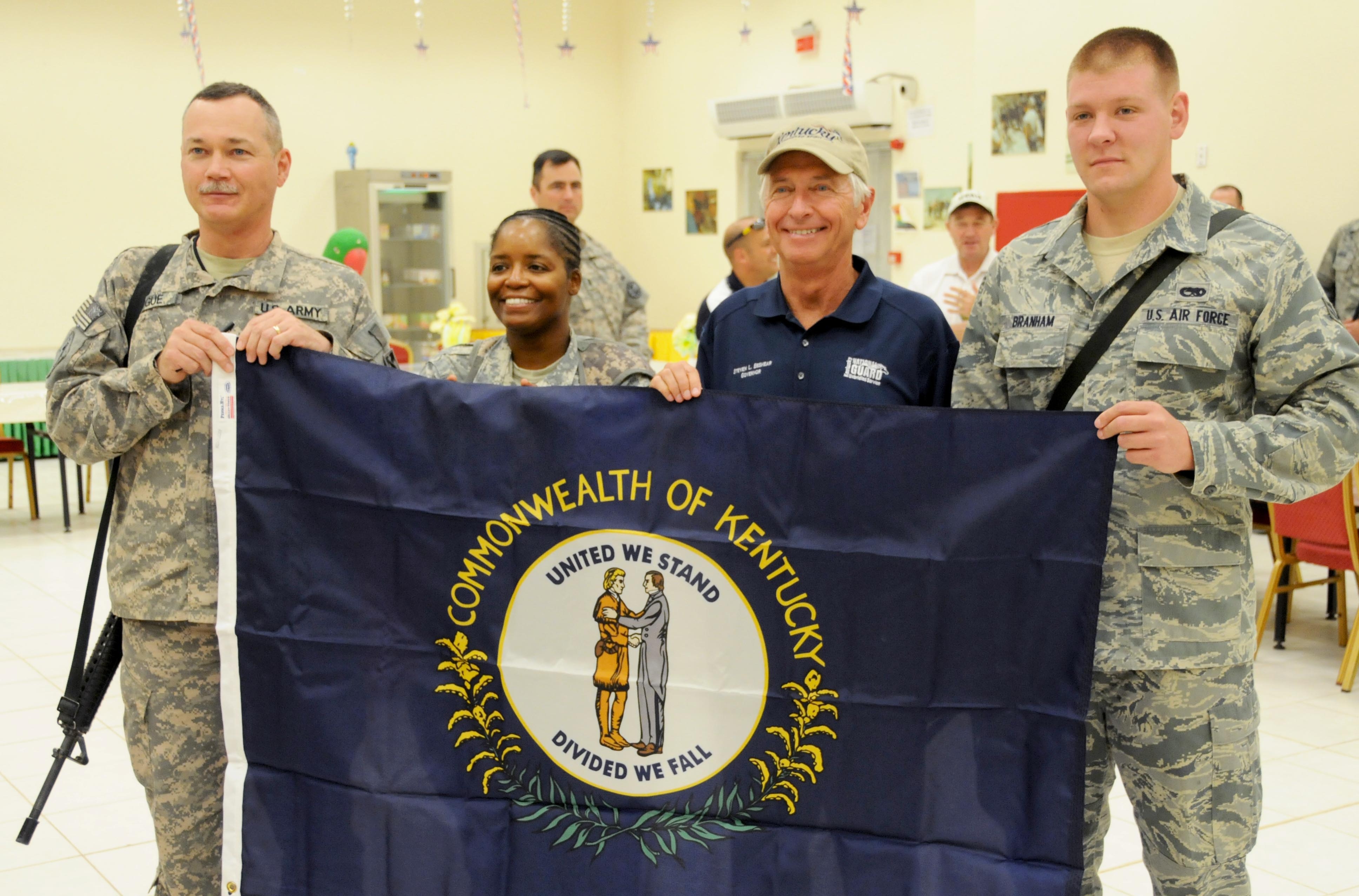
Kentucky Governor Steve Beshear and Kentucky service members at Joint Air Base Balad, Iraq. (U.S. Air Force photo by Senior Airman Jeffrey Schultze)
[youtube http://www.youtube.com/watch?v=vqqxnDfosE4?hl=en&fs=1]
WKYT TV: Governor delivers message to Soldier’s wife
Lexington Herald-Leader: Governor gives wife message from deployed Kentucky Guard Soldier
WLKY: Governor visits Iraq - Shelbyville Guardsmen Sends Back Special Message To Wife
WLKY Youtube: raw video of Governor’s message
Click here for the Courier-Journal story
Click here for the WHAS 11 story
KUWAIT (Aug. 2, 2011) – Governor Steve Beshear visited U.S. troops serving in Iraq and Kuwait today, including troops from Kentucky, as part of a special Department of Defense trip. The visit marks the first time in recent history that a sitting Kentucky governor has visited an active war zone.
“In Kentucky, we truly appreciate and support the thousands of troops from our home state who are serving in the far reaches of the world, who protect our nation’s security and promote peace,” said Gov. Beshear. “When the Pentagon invited me on this trip, I jumped at the chance to meet these troops face-to-face and tell them personally how much their service means to us.”
More than 2,600 Kentucky servicemen and women are currently deployed to Iraq and Kuwait. Approximately 1,000 troops are deployed from Ft. Campbell, as well as an additional 140 troops from Ft. Knox. Nearly 1,500 Kentucky National Guard troops are serving in Iraq and Kuwait, including the 149th Maneuver Enhancement Brigade. This brigade consists of 1,467 soldiers from units in Louisville and Southeastern Kentucky, and just deployed to the area this week. It is the largest mobilization of Kentucky National Guard troops since World War II.
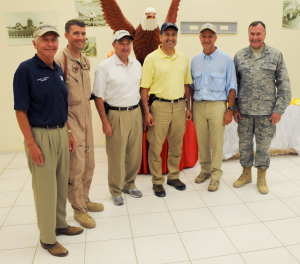
Kentucky Gov. Steve Beshear in Iraq with service members and Utah Gov. Gary Herbert, Nevada Gov. Brian Sandoval and Tennessee Gov. Bill Haslam. (U.S. Air Force photo by Senior Airman Jeffrey Schultze)
The Department of Defense reached out to the Governor’s Office in late May with the offer to travel to Iraq to visit Kentucky troops. Other governors on this trip include Tennessee Gov. Bill Haslam, Nevada Gov. Brian Sandoval, and Utah Gov. Gary Herbert.
After a briefing by Secretary of Defense Leon Panetta and other high-level Defense officials Monday morning at the Pentagon, the Governor departed for the Middle East war zones, visiting troops in Iraq and Kuwait. In Kuwait, Gov. Beshear visited Ali Al Salem Air Base and Camp Arifjan. In Iraq, he met with troops at Joint Air Base Balad, Taji Air Base, Camp Victory Baghdad, and Baghdad International Airport (BIAP is a large military base).
He will return to Kentucky later this week.
“I am deeply appreciative of the opportunity to meet our Kentucky troops as they continue to serve their country,” said Gov. Beshear. “I told each one that we hold them and their families in our hearts and prayers, and we are looking forward to their safe return home.”
###
