Pages
Stay In Touch
More
© 2013 KentuckyGuard
Story by John Trowbridge, Kentucky National Guard
Wrapping up Black History Month and leading into Women’s History Month, kentuckyguard.com presents this unique look at a woman who swore to fight for her nation and ended up combating social justice ….
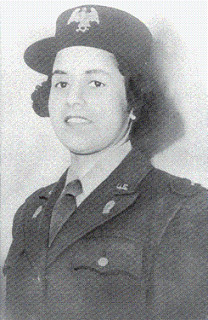
1st Lt. Anna Mac Clarke was a pioneer, part of a unique group of women who came together to help their country win a world war. She and her sister Soldiers also fought another war at home; that of racism, and they, as one unified force, began to break down the barriers of her race and gender which would eventually lead to the civil rights movement of the late 1940s, up through the 1960s.
FRANKFORT, Ky. — “It was raining that April morning as the train rolled into the station at Lawrenceburg, Kentucky. It was one of those day-long rains that slows the world down and gives you time to reflect. They had been waiting to meet the train that was bringing her back home. Home to her final resting place, this young woman who had, in the short span of 24 years, accomplished so much, not only for herself but for her race and her gender.” From the introduction to A Study in Military Leadership, 1997
Anna Mac Clarke was born June 20, 1919 in Lawrenceburg, Kentucky. Anna Mac, as she was called, was always known by her neighborhood friends as a “tomboy” who liked to play football and take care of animals, specifically cats and her pet chameleon. While growing up in her small town community, Clarke’s peers and elders knew that she was destined to do something great.
On May 28, 1937, less than one month before her 18th birthday, Clarke was awarded a diploma from Lawrenceburg High School, which at the time was referred to as the “Colored High School.” After graduating from high school, Anna Mac decided to pursue a college education. She considered many options, but in the end decided to attend Kentucky State College (now KSU), an historically black college located in Frankfort, Kentucky which is less than 15 miles from where she grew up in Lawrenceburg. While at Kentucky State, Clarke was a very active student, participating in sports, Delta Sigma Theta Sorority, and the school’s newspaper, The Kentucky Thorobred. Clarke graduated from Kentucky State College in 1941, earning a Bachelor’s degree in both sociology and economics. However, Anna Mac had a hard time finding employment that was appropriate for her skills and was not extremely low paying.
In 1942, Anna Mac Clarke joined the All-Volunteer Women’s Army Auxiliary Corps and left for Basic Training at Fort Des Moines, Iowa. After she completed Basic Training, Clarke went on to Officer Candidate School.
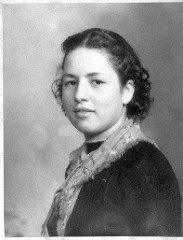
Anna Mac Clarke’s high school photograph.
On November 30, 1942, the Officer Candidate School at Fort Des Moines in Iowa –where Clarke was stationed—was desegregated. Within two weeks of the desegregation, Clarke became a candidate in the 15th Officer Class, WAAC OCS Program. There were two other African Americans in her class, but she would be the only one to finish the course eight weeks later on February 16, 1943. By the end of February, Clarke was reassigned to the Fourth Company, Third Regiment, as a Platoon Leader. Third Officer Anna Mac Clarke was the first African-American WAAC assigned to command what was otherwise an all-White unit.
With First Officer Sara E. Murphy, Clarke led a unit of 144 African-American WAACs to serve in Wakeman General Hospital at Camp Atterbury in Indiana. This assignment lasted for only a month, and in June 1943, Clarke worked in the Classification and Assignment Department of WAAC headquarters in Washington, D.C. She enrolled in the Adjutant General’s School at Camp Meade, Maryland, and after having completed the training she was assigned to Chicago’s WAAC recruiting program. Clarke was promoted to second officer on July 16, 1943, and she returned to Fort Des Moines. The Army transformed the auxiliary units of WAAC into the Regular Army, and Clarke became a member of the Women’s Army Corps (WAC) in September 1943.
Protesting enforced segregation
On February 7, 1944, Clarke led the first WAC unit onto the base at Douglas Army Air Field. Located in eastern Arizona, this Army Air Field was one of only four in the U.S. to have both African-American soldiers and WACs. The theater on the post was segregated, and Clarke had been warned by the African-American soldiers not to go there. However, Clarke and several women went to the theater, refusing to sit in the colored section. She protested the enforced segregation to the theater management, her immediate supervisor and then the Commanding Officer, Colonel Harvey E. Dyer. On February 21, 1944, Colonel Dyer issued the order to his officers “to educate properly all enlisted and civilian personnel in your respective departments to accept any colored WACs assigned as you would any white enlisted man or enlisted woman in the Army of the United States. Every consideration, respect, courtesy and toleration will be afforded every colored WAC. No discrimination will be condoned.”
In March 1944 Anna Mac was admitted to a hospital on the base with sharp pains in her side. Doctors diagnosed her with appendicitis, and decided that she needed an appendectomy to save her life. At first it was believed to be a successful surgery and Clarke was expected to make a full recovery. Unfortunately, gangrene had entered her body due to the infection brought on by the surgery.
1st Lt. Anna Mac Clarke died on April 19, 1944, at the age of 24.
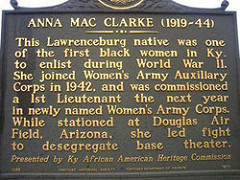 She was buried back home in Lawrenceburg, where a Kentucky historical marker located on the grounds of the courthouse now tells her story.
One person can make a difference
Anna Mac Clarke was a pioneer, part of a unique group of women who came together for one purpose, to help their country win a world war. She and her sister WAACs would also fight another war at home; that of racism, and they, as one unified force, began to break down the barriers of her race and gender which would eventually lead to the civil rights movement of the late 1940s, up through the 1960s. Anna Mac would never know the full impact her efforts to right injustice would have on things that we take for granted today, not only in the military, but in the civilian world as well.
On July 26, 1946, a little over two years after her death, President Truman issued Executive Order 9981, which called for equal treatment and opportunity for blacks in the military. Four years later on March 1, 1950, the President’s Committee on Equality of Treatment and Opportunity reported that beginning in April 1950 the Army’s quota system for blacks was out and that segregation was over in the military.
As for the WAC, in 1947 members of the WAC were permitted to opt for service in either the army or the newly separated air force. The Women’s Armed Services Integration Act gave women permanent military status in the regular army or reserves. Finally, in 1978, the WAC itself was disestablished and its members were assigned or could enroll in all branches of the army and air force.
Story by John Trowbridge, Kentucky National Guard Historian/Archivist
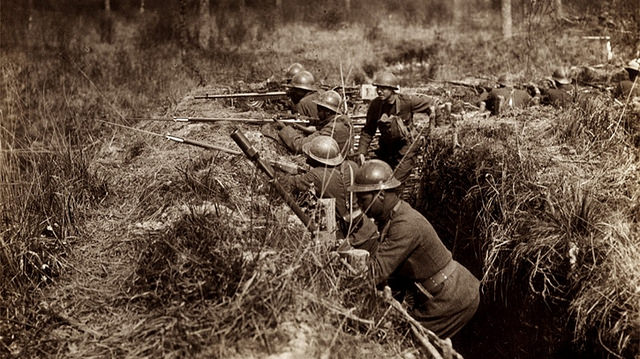
The 369th in action during “The War to End All Wars.” Note the French helmets worn by the men. (Archive photo)
FRANKFORT, Ky. — Last year marked the beginning of the Centennial Commemoration of the First World War, the Great War, the War to End All Wars, which started in Europe on July 28, 1914. It was not until April 6, 1917, that the United States would enter into the war. America quickly moved to raise, equip, and ship the American Expeditionary Force (AEF) to join the war in Europe. An estimated 95,575 Kentuckians served during the war and 2,418 Kentuckians would become casualties of the Great War.
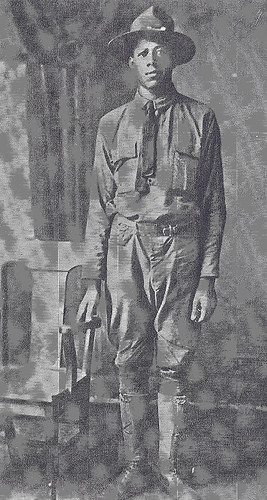
Private John Ray Carter served with the 369th Infantry Regiment, nicknamed the “Harlem Hellfighters.” The 368th was as “The Regiment That Never Lost a Man Captured, a Trench, or a Foot of Ground.” (Archive photo)
One of those Kentuckians who would serve and later become the only black Soldier from Anderson County to die in the First World War was John Ray Carter. John Ray was the son of John and Laura Carter, born in Frankfort in 1894. At an early age his family moved to Anderson County. John Ray’s two brothers, Sam and Ira would also serve in the war. Sam with the 167th and Ira with the 801st Pioneer Infantry Regiment.
On June 20, 1918, John Ray was inducted into the Army at Anderson County. He was sent to Camp Zachary Taylor in Louisville, where he received his initial military training with the 64th Company, 16th Battalion, of the 159th Depot Brigade. On July 16, 1918, he was transferred to Company A, 801st Pioneer Infantry, and ready to be sent overseas. By mid-August he was in France and immediately transferred to the 369th Infantry.
The 369th Infantry Regiment, nicknamed the “Harlem Hellfighters,” was becoming known as “The Regiment That Never Lost a Man Captured, a Trench, or a Foot of Ground.” The “Hellfighters” were among the first U. S. regiments to arrive in France, formerly the Old 15th Regiment, New York National Guard. It would become one of the most highly decorated American regiments of the war. The 369th was an all-black regiment commanded by mostly white officers, commanded by Col. William Hayward.
On May 8, 1918, General John J. “Black Jack” Pershing relieved the regiment from assignment to the American 185th Infantry Brigade, becoming part of the 16th (French) Division. The men were issued French weapons, French helmets, brown leather belts and pouches, although they continued to wear their U. S. uniforms. The exception was when they went on raids; then, they wore French uniforms.
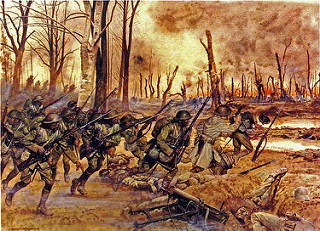
“Hell Fighters! Let’s Go!” Meuse-Argonne, September 26-October 1, 1918. The 369th Infantry fought valiantly in the Allied (Champagne) Offensive as part of the French 161st Division. Attacking behind a fiery barrage, the 369th Infantry assaulted successive German trenchlines and captured the town of Ripont. Against determined resistance, the 369th advanced up the heights north of the Dormoise River and spearheaded the attack toward the town of Sechault. On 29 September, the Regiment “. . . stormed powerful enemy positions, . . . took, after heavy fighting, the town of Sechault; captured prisoners and brought back six cannons and a great number of machine guns.” Despite heavy casualties, the 369th, called “Hell Fighters” by the French and Germans, relentlessly continued the attack at dawn. Raked by enemy machine guns, they assaulted into the woods northeast of Sechault, flanking and overwhelming enemy machine gun positions. The “Le’s Go!” elan and indomitable fighting spirit of the 369th Infantry was illustrated throughout the battle action. Their initiative, leadership and gallantry won for their entire Regiment the French Croix de Guerre.
By the time Private Carter joined his new unit, Company I, 369th Infantry Regiment, the regiment had been pulled off the front line to rest and train replacements. Soon however, the regiment found itself back in the fight participating in the Meuse – Argonne Campaign. On September 25, 1918 the 4th French Army went on the offensive in conjunction with the American drive in the Meuse-Argonne. The 369th turned in a good account of itself in heavy fighting, sustaining severe losses. They captured the important village of Sechault. At one point the regiment advanced faster than French troops on their flanks. There was a danger of its being cut off. By the time the regiment pulled back for reorganization, it had advanced fourteen kilometers through severe German resistance.
By mid-October the regiment was moved to a quiet sector in the Vosges Mountains. On October 17, 1918, Private Carter was transferred to Company B, of the 369th. The 369th would remain in the Vosges Mountains sector until November 11, the day of the Armistice. Private John Ray Carter was not part of the victory celebration of the men.
It is difficult to say when or how Private Carter died; officially his cause of death is listed as accidental/not shown. His date of death is listed as on or about October 16, 1918, however his service record indicates that he was transferred to Company B, on October 17, 1918, and there is a letter, written by Private Carter to his father which has the date of October 22, 1918.
Following is John Ray’s final letter home to his father. It arrived in the mail the day after the family had been notified of his death.
Somewhere in France, Oct. 22, 1918.
Mr. John Carter,
My Dear Father,
I thought that I would drop you a few lines this leaves me well and hope when this letter come to you it will find you all the same. I wrote to Mamma the other day I don’t know whether she got it or not. When did your hear from Sam, where is he, give my love to all. Where is Ira? Now I want you all to send me some Chocolate candy in my box and tell Mr. Dawrson I have not forgot him, I am looking for something from him. Tell Black Howdy, and my Partner. Did Mamma get my letter, don’t worry about me for I am getting a long all rite I have not seen Sam yet I don’t know where he is. When did you all hear from Georgie, tell Son that I said don’t let them get away.
Well Papa you all can send me some candy that is all that [I] want. Is Raymond Pleasant still at home and Clide Pleasant. Well news is dull with me now love to all much love to you all and all answer soon –
John R. Carter
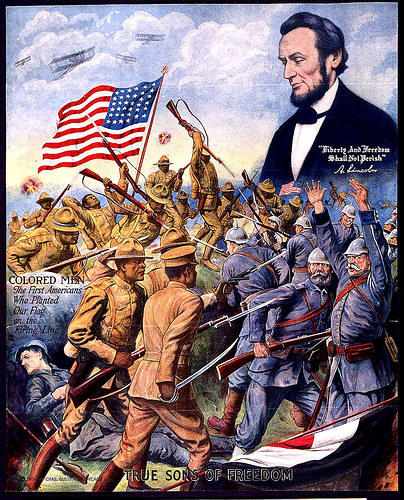
Wartime poster of the 396th fighting German soldiers, with the figure of Abraham Lincoln looking down from above.
Within twenty days of writing this letter home, the War to End All Wars was over.
Initially the body of Private Carter was buried in a small church yard in France. In the 1920’s during the efforts by the Allied Governments to recover the remains of their soldiers, Carter’s body was located and his family was notified. The family requested that John Ray be returned home. On December 20, 1921, the body of John Ray Carter was buried in Woodlawn Hills Cemetery in Anderson County, Kentucky. He was buried beneath a persimmon tree growing in the cemetery.
Over time John Ray Carter’s sacrifice in the world to end all wars was forgotten. Eventually the local American Legion Post had a monument constructed on the courthouse lawn honoring the county’s war casualties, the bronze table on which John Ray’s name is cast appears as John Roy Carter.
In 1997, it was learned by a group of local citizens that John Ray Carter, a soldier of the Great War was buried in an unmarked grave. The old persimmon tree that had once marked his grave had long since died and rotted away, leaving no trace or indication that an American soldier was buried there. Additionally it was determined that the medals he had earned had not been awarded. Efforts were immediately begun to correct these oversights and by June 1998, the grave of Private Carter was marked with a veteran’s headstone and the medals he had earned were formally presented to his family.
Story by John Trowbridge, Kentucky National Guard
In recognition of February as Black History Month kentuckyguard.com is publishing a series of articles honoring African-American men and women who are significant figures in Kentucky’s military history. The following is one such story ….
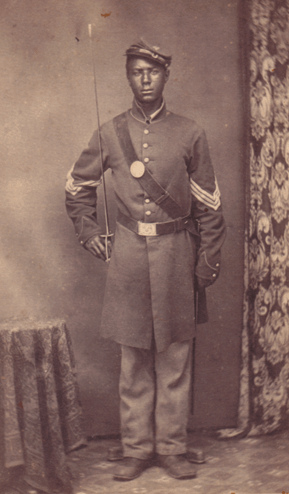
Corporal Andrew Jackson Smith posthumously received the Medal of Honor 137 years after his actions at the Battle of Honey Hill, South Carolina,
FRANKFORT, Ky. — On January 16, 2001, two Medal of Honor presentations were made by President Bill Clinton at the White House. The first, to the descendants of Corporal Andrew Jackson Smith, 137 years after his actions at the Battle of Honey Hill, South Carolina, and former President Theodore Roosevelt was also posthumously awarded the medal at the same ceremony, for his actions during the Spanish-American War.
Andrew Jackson Smith was born into slavery on September 3, 1843 at Grand Rivers, Ky., the son of Susan, a slave, and Elijah Smith, a slave owner. Upon the outbreak of the Civil War, Elijah Smith joined the Confederate military, with the intention of taking 19-year-old Andrew along with him. When Andrew Smith learned of this, he and another slave ran away, walking 25 miles through the rain before presenting themselves to a Union Army regiment, the 41st Illinois Infantry, in Smithland.
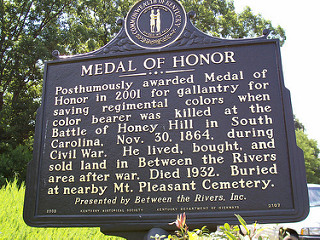
A historical marker honoring Corporal Andrew Jackson Smith. Smith died in 1932 and was buried in the Mount Pleasant African American Cemetery in Lyon County, Kentucky. The cemetery is located in the Land Between the Lakes National Park that straddles both Kentucky and Tennessee.
Smith was taken in by the 41st Illinois and became a servant to Maj. John Warner at the regiment’s post in nearby Paducah. Among Smith’s duties were, in the event of Warner’s death, to return his belongings to his home in Clinton, Il.. On March 10, 1862, the regiment moved out to Pittsburg Landing, Tn., where it took part in the Battle of Shiloh a month later. During the fighting, Smith supplied Warner with fresh horses after the officer had two mounts shot out from under him. Smith was then struck by a spent minie ball that entered his left temple, rolled just under the skin, and stopped in the middle of his forehead. The bullet was removed by the regimental surgeon, leaving Smith with only a scar.
By November 30, 1864, Smith was serving as a corporal in the 55th Massachusetts Volunteer Infantry. On that day, both the 55th and its sister regiment, the 54th Massachusetts, participated in the Battle of Honey Hill in South Carolina. The two units came under heavy fire while crossing a swamp in front of an elevated Confederate position. When the 55th’s color bearer was killed, Smith took up the Regimental Colors and carried them through the remainder of the fight. It was for this action that Smith was later awarded the Medal of Honor.
It’s interesting to note that Smith’s regimental commander had recommended him for the Medal of Honor shortly after the battle, but it never came to fruition. It was only after family members brought it to the attention of state officials just a few years ago that the process was completed.
Smith was promoted to color sergeant before leaving the Army. After the war, he returned to Kentucky, where he bought and sold land. He died at age 88, on March 4, 1932, and was buried in Mount Pleasant Cemetery, Grand Rivers, Ky.
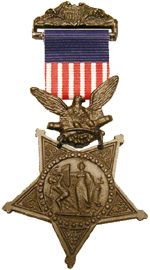
The Civil War Medal of Honor.
Smith’s official Medal of Honor citation reads:
Corporal Andrew Jackson Smith, of Clinton, Illinois, a member of the 55th Massachusetts Voluntary Infantry, distinguished himself on 30 November 1864 by saving his regimental colors, after the color bearer was killed during a bloody charge called the Battle of Honey Hill, South Carolina. In the late afternoon, as the 55th Regiment pursued enemy skirmishers and conducted a running fight, they ran into a swampy area backed by a rise where the Confederate Army awaited. The surrounding woods and thick underbrush impeded infantry movement and artillery support. The 55th and 54th regiments formed columns to advance on the enemy position in a flanking movement. As the Confederates repelled other units, the 55th and 54th regiments continued to move into flanking positions. Forced into a narrow gorge crossing a swamp in the face of the enemy position, the 55th’s Color-Sergeant was killed by an exploding shell, and Corporal Smith took the Regimental Colors from his hand and carried them through heavy grape and canister fire. Although half of the officers and a third of the enlisted men engaged in the fight were killed or wounded, Corporal Smith continued to expose himself to enemy fire by carrying the colors throughout the battle. Through his actions, the Regimental Colors of the 55th Infantry Regiment were not lost to the enemy. Corporal Andrew Jackson Smith’s extraordinary valor in the face of deadly enemy fire is in keeping with the highest traditions of military service and reflect great credit upon him, the 55th Regiment, and the United States Army.
Story by John Trowbridge, Kentucky National Guard Command Historian
In recognition of February as Black History Month kentuckyguard.com is republishing a series of articles honoring African-American men and women who are significant figures in Kentucky’s military history. The following is one such story ….
FRANKFORT, Ky. — The Medal of Honor was created during the American Civil War and is the highest military decoration presented by the United States government to a member of its armed forces. The recipient must have distinguished themselves at the risk of their own life above and beyond the call of duty in action against an enemy of the United States.
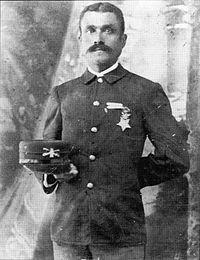
Sgt. Brent Woods, Medal of Honor recipient, 1894.
During the Western Indian Wars of the mid to late eighteen hundreds, two Kentucky African Americans received the Medal of Honor for their actions in battle.
Brent Woods was born in 1855, in Pulaski County, Kentucky and joined the Army from Louisville, Kentucky. By August 19, 1881, he was serving as a sergeant in Company B of the 9th United States Cavalry Regiment, (Buffalo Soldiers). On that day he participated in an engagement in New Mexico where he “[s]aved the lives of his comrades and citizens of the detachment.” Thirteen years later, on July 12, 1894, Sgt. Woods was awarded the Medal of Honor for his actions during the engagement. He eventually retired from the Army in 1902, and returned to Kentucky. He died on March 31, 1906, and is buried in Mill Springs National Cemetery, Nancy, Kentucky.
Sgt. Woods’ citation reads: “… saved the lives of his comrades and citizens of the detachment.”
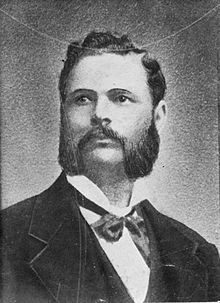
Medal of Honor Recipient Sgt. Thomas Shaw is buried at Arlington National Cemetery.
Thomas Shaw was born in 1846, in Covington, Kentucky, and joined the Army from Pike County, Missouri. On August 12, 1881, he was serving as a sergeant in Company K of the 9th United States Cavalry Regiment (Buffalo Soldiers). On that day he participated in an engagement at Carrizo Canyon in New Mexico. For his actions during the engagement, Shaw was awarded the Medal of Honor nine years later, on December 7, 1890.
Shaw died on June 23, 1895, and was buried in Arlington National Cemetery, Arlington County, Virginia.
Sgt. Shaw’s citation reads: “Forced the enemy back after stubbornly holding his ground in an extremely exposed position and prevented the enemy’s superior numbers from surrounding his command.”
Story by John Trowbridge, Kentucky National Guard
Wrapping up Black History Month and leading into Women’s History Month, kentuckyguard.com presents this unique look at a woman who swore to fight for her nation and ended up combating social justice ….
1st Lt. Anna Mac Clarke was a pioneer, part of a unique group of women who came together to help their country win a world war. She and her sister Soldiers also fought another war at home; that of racism, and they, as one unified force, began to break down the barriers of her race and gender which would eventually lead to the civil rights movement of the late 1940s, up through the 1960s.
FRANKFORT, Ky. — “It was raining that April morning as the train rolled into the station at Lawrenceburg, Kentucky. It was one of those day-long rains that slows the world down and gives you time to reflect. They had been waiting to meet the train that was bringing her back home. Home to her final resting place, this young woman who had, in the short span of 24 years, accomplished so much, not only for herself but for her race and her gender.” From the introduction to A Study in Military Leadership, 1997
Anna Mac Clarke was born June 20, 1919 in Lawrenceburg, Kentucky. Anna Mac, as she was called, was always known by her neighborhood friends as a “tomboy” who liked to play football and take care of animals, specifically cats and her pet chameleon. While growing up in her small town community, Clarke’s peers and elders knew that she was destined to do something great.
On May 28, 1937, less than one month before her 18th birthday, Clarke was awarded a diploma from Lawrenceburg High School, which at the time was referred to as the “Colored High School.” After graduating from high school, Anna Mac decided to pursue a college education. She considered many options, but in the end decided to attend Kentucky State College (now KSU), an historically black college located in Frankfort, Kentucky which is less than 15 miles from where she grew up in Lawrenceburg. While at Kentucky State, Clarke was a very active student, participating in sports, Delta Sigma Theta Sorority, and the school’s newspaper, The Kentucky Thorobred. Clarke graduated from Kentucky State College in 1941, earning a Bachelor’s degree in both sociology and economics. However, Anna Mac had a hard time finding employment that was appropriate for her skills and was not extremely low paying.
In 1942, Anna Mac Clarke joined the All-Volunteer Women’s Army Auxiliary Corps and left for Basic Training at Fort Des Moines, Iowa. After she completed Basic Training, Clarke went on to Officer Candidate School.
Anna Mac Clarke’s high school photograph.
On November 30, 1942, the Officer Candidate School at Fort Des Moines in Iowa –where Clarke was stationed—was desegregated. Within two weeks of the desegregation, Clarke became a candidate in the 15th Officer Class, WAAC OCS Program. There were two other African Americans in her class, but she would be the only one to finish the course eight weeks later on February 16, 1943. By the end of February, Clarke was reassigned to the Fourth Company, Third Regiment, as a Platoon Leader. Third Officer Anna Mac Clarke was the first African-American WAAC assigned to command what was otherwise an all-White unit.
With First Officer Sara E. Murphy, Clarke led a unit of 144 African-American WAACs to serve in Wakeman General Hospital at Camp Atterbury in Indiana. This assignment lasted for only a month, and in June 1943, Clarke worked in the Classification and Assignment Department of WAAC headquarters in Washington, D.C. She enrolled in the Adjutant General’s School at Camp Meade, Maryland, and after having completed the training she was assigned to Chicago’s WAAC recruiting program. Clarke was promoted to second officer on July 16, 1943, and she returned to Fort Des Moines. The Army transformed the auxiliary units of WAAC into the Regular Army, and Clarke became a member of the Women’s Army Corps (WAC) in September 1943.
Protesting enforced segregation
On February 7, 1944, Clarke led the first WAC unit onto the base at Douglas Army Air Field. Located in eastern Arizona, this Army Air Field was one of only four in the U.S. to have both African-American soldiers and WACs. The theater on the post was segregated, and Clarke had been warned by the African-American soldiers not to go there. However, Clarke and several women went to the theater, refusing to sit in the colored section. She protested the enforced segregation to the theater management, her immediate supervisor and then the Commanding Officer, Colonel Harvey E. Dyer. On February 21, 1944, Colonel Dyer issued the order to his officers “to educate properly all enlisted and civilian personnel in your respective departments to accept any colored WACs assigned as you would any white enlisted man or enlisted woman in the Army of the United States. Every consideration, respect, courtesy and toleration will be afforded every colored WAC. No discrimination will be condoned.”
In March 1944 Anna Mac was admitted to a hospital on the base with sharp pains in her side. Doctors diagnosed her with appendicitis, and decided that she needed an appendectomy to save her life. At first it was believed to be a successful surgery and Clarke was expected to make a full recovery. Unfortunately, gangrene had entered her body due to the infection brought on by the surgery.
1st Lt. Anna Mac Clarke died on April 19, 1944, at the age of 24.
She was buried back home in Lawrenceburg, where a Kentucky historical marker located on the grounds of the courthouse now tells her story.
One person can make a difference
Anna Mac Clarke was a pioneer, part of a unique group of women who came together for one purpose, to help their country win a world war. She and her sister WAACs would also fight another war at home; that of racism, and they, as one unified force, began to break down the barriers of her race and gender which would eventually lead to the civil rights movement of the late 1940s, up through the 1960s. Anna Mac would never know the full impact her efforts to right injustice would have on things that we take for granted today, not only in the military, but in the civilian world as well.
On July 26, 1946, a little over two years after her death, President Truman issued Executive Order 9981, which called for equal treatment and opportunity for blacks in the military. Four years later on March 1, 1950, the President’s Committee on Equality of Treatment and Opportunity reported that beginning in April 1950 the Army’s quota system for blacks was out and that segregation was over in the military.
As for the WAC, in 1947 members of the WAC were permitted to opt for service in either the army or the newly separated air force. The Women’s Armed Services Integration Act gave women permanent military status in the regular army or reserves. Finally, in 1978, the WAC itself was disestablished and its members were assigned or could enroll in all branches of the army and air force.
Story by John Trowbridge, Kentucky National Guard
In recognition of February as Black History Month kentuckyguard.com is publishing a series of articles honoring African-American men and women who are significant figures in Kentucky’s military history. The following is one such story ….
Corporal Andrew Jackson Smith posthumously received the Medal of Honor 137 years after his actions at the Battle of Honey Hill, South Carolina,
FRANKFORT, Ky. — On January 16, 2001, two Medal of Honor presentations were made by President Bill Clinton at the White House. The first, to the descendants of Corporal Andrew Jackson Smith, 137 years after his actions at the Battle of Honey Hill, South Carolina, and former President Theodore Roosevelt was also posthumously awarded the medal at the same ceremony, for his actions during the Spanish-American War.
Andrew Jackson Smith was born into slavery on September 3, 1843 at Grand Rivers, Ky., the son of Susan, a slave, and Elijah Smith, a slave owner. Upon the outbreak of the Civil War, Elijah Smith joined the Confederate military, with the intention of taking 19-year-old Andrew along with him. When Andrew Smith learned of this, he and another slave ran away, walking 25 miles through the rain before presenting themselves to a Union Army regiment, the 41st Illinois Infantry, in Smithland.
A historical marker honoring Corporal Andrew Jackson Smith. Smith died in 1932 and was buried in the Mount Pleasant African American Cemetery in Lyon County, Kentucky. The cemetery is located in the Land Between the Lakes National Park that straddles both Kentucky and Tennessee.
Smith was taken in by the 41st Illinois and became a servant to Maj. John Warner at the regiment’s post in nearby Paducah. Among Smith’s duties were, in the event of Warner’s death, to return his belongings to his home in Clinton, Il.. On March 10, 1862, the regiment moved out to Pittsburg Landing, Tn., where it took part in the Battle of Shiloh a month later. During the fighting, Smith supplied Warner with fresh horses after the officer had two mounts shot out from under him. Smith was then struck by a spent minie ball that entered his left temple, rolled just under the skin, and stopped in the middle of his forehead. The bullet was removed by the regimental surgeon, leaving Smith with only a scar.
By November 30, 1864, Smith was serving as a corporal in the 55th Massachusetts Volunteer Infantry. On that day, both the 55th and its sister regiment, the 54th Massachusetts, participated in the Battle of Honey Hill in South Carolina. The two units came under heavy fire while crossing a swamp in front of an elevated Confederate position. When the 55th’s color bearer was killed, Smith took up the Regimental Colors and carried them through the remainder of the fight. It was for this action that Smith was later awarded the Medal of Honor.
It’s interesting to note that Smith’s regimental commander had recommended him for the Medal of Honor shortly after the battle, but it never came to fruition. It was only after family members brought it to the attention of state officials just a few years ago that the process was completed.
Smith was promoted to color sergeant before leaving the Army. After the war, he returned to Kentucky, where he bought and sold land. He died at age 88, on March 4, 1932, and was buried in Mount Pleasant Cemetery, Grand Rivers, Ky.
The Civil War Medal of Honor.
Smith’s official Medal of Honor citation reads:
Corporal Andrew Jackson Smith, of Clinton, Illinois, a member of the 55th Massachusetts Voluntary Infantry, distinguished himself on 30 November 1864 by saving his regimental colors, after the color bearer was killed during a bloody charge called the Battle of Honey Hill, South Carolina. In the late afternoon, as the 55th Regiment pursued enemy skirmishers and conducted a running fight, they ran into a swampy area backed by a rise where the Confederate Army awaited. The surrounding woods and thick underbrush impeded infantry movement and artillery support. The 55th and 54th regiments formed columns to advance on the enemy position in a flanking movement. As the Confederates repelled other units, the 55th and 54th regiments continued to move into flanking positions. Forced into a narrow gorge crossing a swamp in the face of the enemy position, the 55th’s Color-Sergeant was killed by an exploding shell, and Corporal Smith took the Regimental Colors from his hand and carried them through heavy grape and canister fire. Although half of the officers and a third of the enlisted men engaged in the fight were killed or wounded, Corporal Smith continued to expose himself to enemy fire by carrying the colors throughout the battle. Through his actions, the Regimental Colors of the 55th Infantry Regiment were not lost to the enemy. Corporal Andrew Jackson Smith’s extraordinary valor in the face of deadly enemy fire is in keeping with the highest traditions of military service and reflect great credit upon him, the 55th Regiment, and the United States Army.
Story by John Trowbridge, Kentucky National Guard
In recognition of February as Black History Month kentuckyguard.com is publishing several articles honoring African-American men and women who are significant figures in Kentucky’s military history. The following is one such story ….
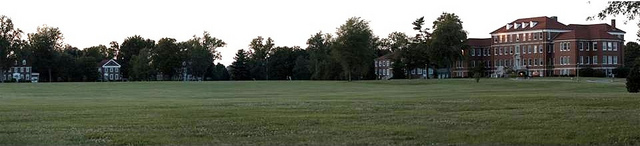
Pvt. Robert H. Brooks is the namesake of Brooks Field at Fort Knox. Ky. When the news of his death reached Fort Knox, the post commander, General Jacob Devers, decided to name the main parade ground in Brooks’ honor.
FRANKFORT, Ky. — Pvt. Robert H. Brooks the son of Adline and Ray Brooks, was born on October 8, 1915, in McFarland, Kentucky. He was raised in Sadieville, Kentucky. As an adult, he moved to Cincinnati, Ohio, where he was inducted into the army in late 1940.
While training at Fort Knox, Kentucky in November, 1940, Brooks was assigned to the maintenance section of D Company, 192nd Tank Battalion, a Kentucky National Guard unit which had been federalized.
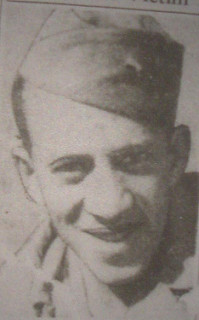
Pvt. Robert H. Brooks, the first U.S. Armored casualty of World War II.
In late August, 1941, the 192nd went on maneuvers in Louisiana. Due to the battalion’s outstanding performance during the maneuvers it was selected to be sent overseas. D Company traveled by train to San Francisco. From there, they boarded ships for the Philippines Islands.
On December 8, 1941, just ten hours after the attack on Pearl Harbor, Japanese planes appeared over Clark Field near Fort Stotsenburg, Philippine Islands. Most of the members of D Company were at lunch at the time of the attack. Brooks was with two mechanics from maintenance section when the first bombs began to fall. It is believed that Brooks was attempting to get to his half-track to man the .50 caliber machine gun, when a bomb exploded next to him. He was killed instantly.
When the news of his death reached Fort Knox, the post commander, General Jacob Devers, decided to name the main parade ground in Brooks’ honor. Brooks was officially declared the first U. S. Armored Forces casualty of WW II.
One of General Dever’s subordinates called the Farmer’s Deposit Bank in Sadieville, attempting to reach Robert’s parents. As it turned out, the bank had the only phone in the town. W. T. Warring at the bank answered the phone. The aide asked if it would be possible for someone from the town to be present at the dedication ceremony.
The aide asked Mr. Warring if he could tell him anything about Robert’s parents. Mr. Warring said, ” His parents are tenant farmers, ordinary black people; maybe you could contact them and see if they could come.”
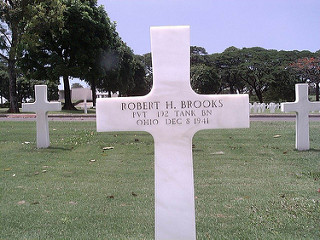
Following World War II Robert Brooks’ remains were moved to the American Military Cemetery outside of Manila. He was posthumously promoted to private first class.
The general’s representative hung up the phone and immediately called back. He said to Mr. Warring, “Did you say they were black?” Warring responded, “Yes, his mother and father are very dark.”
The aide felt that this might change the situation. When he reported back to General Devers, the general said, “It did not matter whether or not Robert was black, what mattered was that he had given his life for his country.”
Remember, this was a time when the U.S. military was segregated. Blacks typically served in all-black units, such as the Tuskegee Airmen, 761st Tank Battalion and the lesser-known but equally distinguished 452nd Anti-Aircraft Artillery Battalion.
Being light-skinned, Brooks often passed for white. His fellow Soldiers knew his background, never questioned it as he was considered “just one of the guys.”
The ceremony dedicating the main parade ground in honor of Robert Brooks was held with Robert’s parents present. During the dedication, General Devers said in his dedication speech, “In death there is no grade or rank. And in this greatest democracy the world has ever known, neither riches or poverty, neither creed or race, draws a line of demarcation in this hour of national crisis.”
After the war, Robert Brooks’ remains were moved to the American Military Cemetery outside of Manila. He was posthumously promoted to private first class.
Today a Kentucky Historical Marker located in Sadieville, Kentucky, honors Pvt. Robert H. Brooks’ service and sacrifice to our country.
Story by Maj. David page, Kentucky National Guard Public Affairs
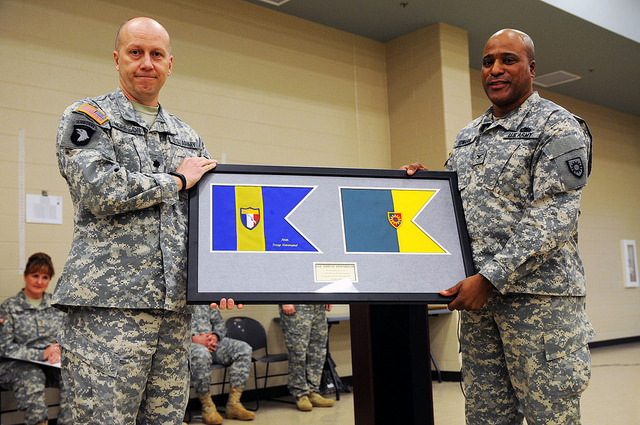
Lt. Col. Jerry Morrison (left) presents Col. John Edwards framed guidons during a change of command ceremony in Richmond, Ky., Feb. 2, 2014. The two guidons represent Edwards’ service as the commander of both the 75th Troop Command and the 149th Maneuver Enhancement Brigade. (U.S. Army National Guard photo by Spc. Brandy Mort)
RICHMOND, Ky. — To command at a brigade-level unit is an honor for which most officers can only dream, but for Col. John H. Edwards, he has now lived that opportunity twice.
In 2011, Edwards was placed in command of the 75th Troop Command in Richmond, where he served with distinction. Then in August 2013, he was tapped again to help with the reorganization and move of the 149th Maneuver Enhancement Brigade.
“My staff and I helped conduct a re-stationing initiative for the 149th Maneuver Enhancement Brigade,” said Edwards. “It was an honor and privilege to do it. And, if given the chance, I would do it all over again.”
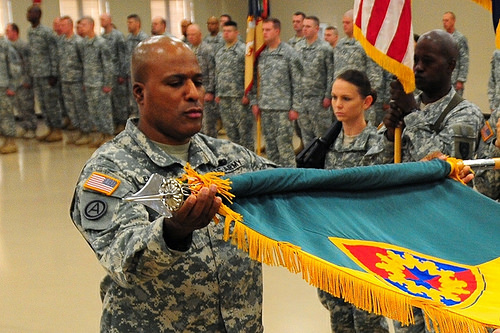
Col. John H. Edwards Jr. unfurls the colors of the 149th Maneuver Enhancement Brigade during an uncasing ceremony in Richmond, Ky., Nov. 1, 2013. Edwards played a pivotal role in the major realignment of the brigades leading up to the transition. (U.S. Army National Guard photo by Staff Sgt. Scott Raymond)
Not only did he and his team move the headquarters from Louisville to Richmond, they also reorganized units, which meant losing units like the 751st Troop Command but gaining units like the 198th Military Police Battalion.
“I am proud that we took the brigade from less than 100 percent strength to now 103 percent. And, we moved from 80 percent MOS (Military Occupational Specialty) qualified personnel to now over 91 percent,” he said.
It should not be of any surprise that Edwards has had the honor of commanding two separate brigades. His prior leadership positions, which ranged through platoon leader through battalion command, as well as awards such as the Bronze Star Medal awarded during his deployment to Kuwait in 2005-2006 as the Camp Victory commander, are testament to his ability and the faith the Kentucky National Guard leadership has bestowed on him.
“I have been successful because of the influence of my mother,” said Edwards. As a single parent, his mother instilled in him the drive to achieve and study hard. Her influence is evident in his education. He holds an Associates in Science in Engineering from Georgia Military College, a Bachelor of Science in Occupation Training and Development from the University of Louisville, a master’s degree in strategic studies from the U.S. Army War College, and he is working on a second master’s degree in clinical psychology from Capella University.
But Edwards also recognizes the importance his military mentors have played in his life and ultimately his military career. “I have had numerous military mentors along the way who helped me learn and grow as an officer,” he said. “I encourage every young Soldier to seek out strong mentors.”
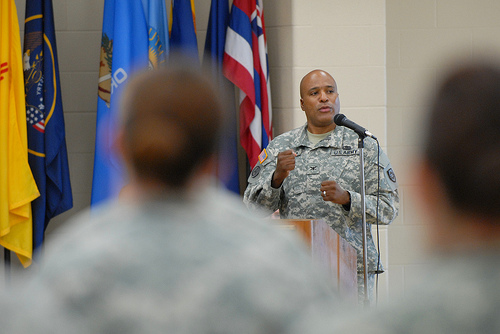
Col. John Edwards Jr. speaks to the Soldiers of the 149th Maneuver Enhancement Brigade during an uncasing ceremony in Richmond, Ky., Nov. 1, 2013. In both brigades Edwards has commanded, he has always asked his Soldiers to give nothing less than 110 percent both in uniform and out. (U.S. Army National Guard photo by Staff Sgt. Scott Raymond)
On Feb. 2, Edwards relinquished command of the 149th Maneuver Enhancement Brigade to Lt. Col. Jerry Morrison. With this change of command, Edwards now becomes the director of the J-7, in charge of joint doctrine, joint operations and joint training concepts.
When asked what enduring mark he hoped he left with his Soldiers at the 149th MEB , Edwards said, “I hope I left my Soldiers with two things: one, every Soldier in the Brigade plays an important role in the success of the unit. Be proud of what you do in the military and represent you and your unit with distinction and honor, both in and out of uniform. Two, education is key, whether military or civilian. Every day you can learn something new so always strive to grow yourself.”
As February is Black History Month, Edwards was asked what advice he would you give to young minority Soldiers in today’s National Guard.
“Regardless of what anybody tells you, you can be whatever you desire to be,” he said. “Don’t let anyone persuade you or tell you what you can or cannot do. You do what is in your heart. If you give it 110 percent, you will accomplish your desires, aspirations and dreams.”
Story by John Trowbridge, Kentucky National Guard Command Historian
In recognition of February as Black History Month kentuckyguard.com is publishing a series of articles honoring African-American men and women who are significant figures in Kentucky’s military history. The following is one such story ….
FRANKFORT, Ky. — The Medal of Honor was created during the American Civil War and is the highest military decoration presented by the United States government to a member of its armed forces. The recipient must have distinguished themselves at the risk of their own life above and beyond the call of duty in action against an enemy of the United States.
Sgt. Brent Woods, Medal of Honor recipient, 1894.
During the Western Indian Wars of the mid to late eighteen hundreds, two Kentucky African Americans received the Medal of Honor for their actions in battle.
Brent Woods was born in 1855, in Pulaski County, Kentucky and joined the Army from Louisville, Kentucky. By August 19, 1881, he was serving as a sergeant in Company B of the 9th United States Cavalry Regiment, (Buffalo Soldiers). On that day he participated in an engagement in New Mexico where he “[s]aved the lives of his comrades and citizens of the detachment.” Thirteen years later, on July 12, 1894, Sgt. Woods was awarded the Medal of Honor for his actions during the engagement. He eventually retired from the Army in 1902, and returned to Kentucky. He died on March 31, 1906, and is buried in Mill Springs National Cemetery, Nancy, Kentucky.
Sgt. Woods’ citation reads: “… saved the lives of his comrades and citizens of the detachment.”
Medal of Honor Recipient Sgt. Thomas Shaw is buried at Arlington National Cemetery.
Thomas Shaw was born in 1846, in Covington, Kentucky, and joined the Army from Pike County, Missouri. On August 12, 1881, he was serving as a sergeant in Company K of the 9th United States Cavalry Regiment (Buffalo Soldiers). On that day he participated in an engagement at Carrizo Canyon in New Mexico. For his actions during the engagement, Shaw was awarded the Medal of Honor nine years later, on December 7, 1890.
Shaw died on June 23, 1895, and was buried in Arlington National Cemetery, Arlington County, Virginia.
Sgt. Shaw’s citation reads: “Forced the enemy back after stubbornly holding his ground in an extremely exposed position and prevented the enemy’s superior numbers from surrounding his command.”