Pages
Stay In Touch
More
© 2013 KentuckyGuard
By Staff Sgt. Scott Raymond, Kentucky National Guard Public Affairs
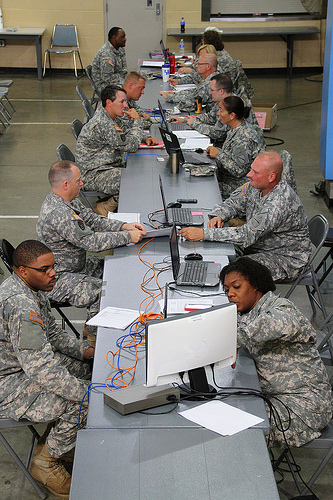
Soldiers preparing to exit their term of service or ETS, speak with members of the Kentucky Guard’s personnel office to verify personal records during a final formation event in Frankfort, Ky., July 12, 2015. The Soldiers are required to review their records for accuracy including finance and medical histories. (U.S. Army National Guard photo by Staff Sgt. Scott Raymond)
FRANKFORT, Ky. — A new program in the Kentucky National Guard is now providing Soldiers leaving the Service their own opportunity to close, or open the door to a future in the Guard.
Known as the Final Formation, Soldiers preparing for their expiration of term of service or ETS are required to attend the one-day event to either re-up or out-process. This initiative provides a process that enables the Soldiers to out process from the Kentucky National Guard, for personnel staff to work issues, and an opportunity for the senior leadership to affect a Soldier’s decision to reenlist.
“We absolutely want to retain every good qualified Soldier, no doubt,” said Col. Michael Abell, director of the Kentucky Guard’s personnel office. “But for those who have honorably served, whether it was one term or 30 years, we also want to ensure they exit the Kentucky Guard with the same level of detail and care as when they entered.”
The program provides two objectives: 1. To ensure the Soldiers who are going to ETS are provided a transition program and understand the benefits they will retain and the benefits they will lose. 2. One last appeal to the Soldier to retain highly qualified Soldiers and their experience.
After six years in the Guard, Sgt. Russell Gray from the 223rd Military Police Company has decided to leave to spend more time with his family.
“It’s good to be able to come here and have the opportunity to say your peace, your side of the story and why you’re getting out,” said Gray.
For Pfc. Dillon Morvel, also from the 223rd, the program was a window of opportunity to continue his service to the commonwealth by re-enlisting.
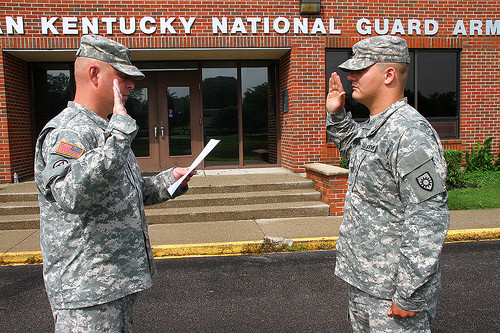
Lt. Col. Lance Grebe re-enlists Pfc. Dillon Morvel during a final formation event in Frankfort, Ky., July 12, 2015. The final formation program offers Soldiers on last chance to re-up or out-process with assistance from the Kentucky Guard’s personnel office. (U.S. Army National Guard photo by Staff Sgt. Scott Raymond)
“It’s more formal to come to Frankfort to do this,” he said. “Being here really shows you that not only your unit wants you stay in, but your state wants you too.”
“I love being in the Guard, I really enjoy every minute each month,” he added.
Items Covered at the event include: Personal records review, medical records review, Veteran benefits, finance review, retirement planning, and employment services. For those Soldiers retiring, the Final Formation offers a critical piece of their out-processing as all paperwork is reviewed for accuracy and completion.
Kentucky borrowed pieces of the program from other states, after hearing the success stories. Lt Col. Lance Grebe, transition officer, said the program is expected to continue indefinitely as Guardsmen ETS monthly.
“I believe one of the biggest misconceptions of Final Formation is we are strictly focused on trying to change Soldiers decisions about discontinuing their service to the Kentucky Army National Guard. However, the intent of the program is focused on providing Soldiers with a smooth transition out of the military if they choose,” said Grebe. “They have earned it and deserve our attention regardless of their intentions.”
By Staff Sgt. Scott Raymond, Kentucky National Guard Public Affairs
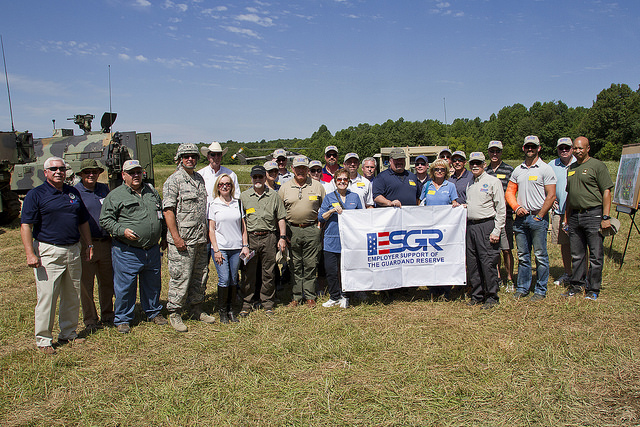
Kentucky civic leaders and employers visit with Kentucky Guardsmen as part of an Employer Support of the Guard and Reserve (ESGR) Boss Lift at Fort Knox, Ky., July 22, 2015. (U.S. Army National Guard photo by Staff Sgt. Scott Raymond)
FRANKFORT, Ky. — When a National Guard Soldier or Airman serves their one weekend and month and two-weeks in the summer, they are considered a traditional Guardsman. With the overwhelming majority of Kentucky’s Guardsmen falling into that category, hundreds of employers across the commonwealth are included in the extended Guard family. During ceremonies to welcome home, promote or award Guardsmen, we always hear the common gratitude to the families for sharing their loved one with the Guard. But it also a familiar acknowledgment to the employers and businesses that have also supported Kentucky’s Citizen-Soldiers.
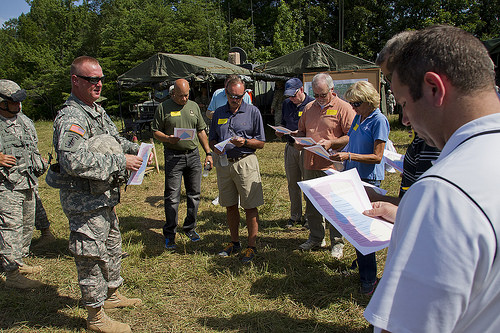
Lt. COl. Rob Larkin, command of the 138th Field Artillery Brigade speaks to employers and civic leaders during the civilians’ visit to the unit as part of an Employer Support of the Guard and Reserve boss lift at Fort Knox, Ky., July 22, 2015. The ESGR group toured the 138th’s tactical operations center, interacted with Soldiers and witnessed a live fire exercise of M109 Paladins. (U.S. Army National Guard photo by Staff Sgt. Scott Raymond)
As a thank you to several such military-friendly employers, Kentucky’s Employer Support of the Guard and Reserve held a day with the troops event, July 22. Commonly referred to as a Bosslift, such events provide employers and civic leaders the opportunity to see first hand what Kentucky’s Guardsmen, their employees, do when they are “off work.”
More than 30 representatives from local agencies and businesses from Lexington to Bowling Green flew by Blackhawk helicopter to Fort Knox, Kentucky and the Wendell H. Ford Regional Training Center in Greenville, Kentucky for the up-close view of National Guard training.
“The ESGR Bosslift program is essential in helping employers and community leaders understand what our Citizen-Soldiers do while in uniform,” said retired Army Brig. Gen. Mike Richie, a support specialist with Kentucky’s ESGR. “Most develop a deep appreciation for the dedication and sacrifice required to serve in the military. It’s also an opportunity to thank them for their contribution to our nation’s defense by employing and supporting our Service members.”
Click here for more photos.
Soldiers with the 138th Field Artillery Brigade were first to play host to the ESGR group at Fort Knox. Kentucky Adjutant General, Maj. Gen. Edward W. Tonini joined Lt. Col. Rob Larkin, commander of the 138th in greeting the civilians in a field environment the 138th was occupying for annual training. The employers met with the artillery Soldiers, toured their tactical operation center and vehicles, and witnessed a live fire exercise by the unit’s M109 Paladins.
One of the Paladin crew members was Sgt. 1st Class James Hatfield, a fireman with the Bardstown FIre Department. Among the visitors was Chief Marlin Howard, Hatfield’s boss.
“He has seen me in uniform before, but never in the field, never in this atmosphere, I’m sure his perspective will probably change a little bit,” said Hatfield. “Telling someone what you do is one thing, but when they see you in the environment you do it, is a completely different story. It’s hard for them to get that visual.”
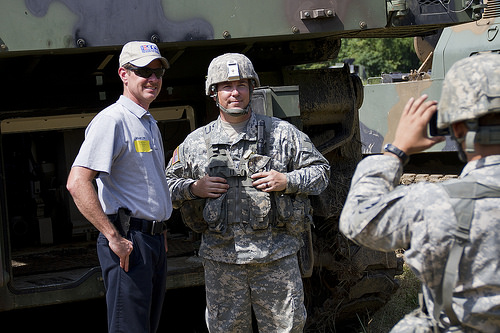
Chief Marlin Howard, chief of the Bardstown FIre Department has he photo taken with Sgt. 1st Class James Hatfield during an Employer Support of the Guard and Reserve boss lift at Fort Knox, Ky., July 22, 2015. Hatfield serves with Howard in Bardstown as his full-time employment. (U.S. Army National Guard photo by Staff Sgt. Scott Raymond)
“It means a lot that he came out here,” Hatfield added. “We are super busy at work and for him to take the time, see what I do and be a part of it, and to have a boss care enough to want to know what you do is pretty awesome.”
Hatfield has spent 21 years in the military uniform and 14 years as a fireman. The balance has worked for him, but knows some still believe that Guardsmen just get a couple extra days off each month.
“Employers on these boss lifts can see first hand, this isn;t a vacation out here, it’s good quality training for something we might have to do down the road.”
Howard said he has a small and close department, so everyone knows each other pretty well but hearing and seeing are two different things.
“He is a great employee and I kinda knew what he did outside work, but until you put boots on the ground with him, stand there beside with the equipment he works with, it’s an unbelievable moment,” said Howard. “It’s great to know and see that training that they get here, they take it back to their community.”
“I really appreciate everything the Guard has done to make us feel welcome into all of this, it’s been very nice and educational.”
In addition to the visit with the 138th, the employers and civic leaders traveled to the Kentucky’s Guard’s primary training facility in Greenville to see members of the 103rd Chemical Company during search and rescue training and Soldiers with the 138th Signal Company conducting vehicle roll-over training.
Chief Keith Jackson has a unique view of the day as he spent 27 years in the military. Now the Lexington Fire Department chief returns to the training fields to see Larkin, his friend and fellow fireman. Jackson expressed the pride he has for Larkin and the accomplishments he continues in the Guard and knows the sights and sounds will have an impact on the other employers.
“I think, today has opened their eyes to what truly at Citizen-Soldier is,” he said. “And they see what the Service members can offer, not only to the country but to the average American citizen.”
For more information on ESGR, visit www.esgr.mil, and www.kentuckyguard.com for information on Kentucky’s ESGR program.
 Hero2Hired (H2H.jobs) has transitioned its online capabilities to the Department of Veterans Affairs (VA) Veterans Employment Center (VEC) (https://www.ebenefits.va.gov/ebenefits/jobs).
This transition supports the White House Joining Forces initiatives to combine Federal efforts to hire veterans under one web portal and strengthens interagency collaboration among the VA, Department of Defense and Department of Labor.
H2H Employment Coordinators will continue to provide quality career readiness assistance to Reserve Component Service members preparing for the next civilian career.
The Kentucky National Guard Public Affairs Office is posting a three-part series regarding Kentucky’s ESGR program and the opportunities it helps create for Kentucky Guardsmen and fellow veterans.
Staff Report
FRANKFORT, Ky. — Employer Support of the Guard and Reserve (ESGR) is the lead Defense Department agency promoting cooperation and understanding between civilian employers and their National Guard and Reserve employees.
Kentucky’s ESGR seeks career opportunities to unite employers with Service members throughout the Commonweath.
Upcoming Career Events in October include:
Manufacturer and Employee of the Year Awards Luncheon
When: October 3, 2014 — 11:30 a.m. – 1:30 p.m. Where: The Seelbach Hilton, Louisville
Speakers: Lt. Governor Jerry Abramson, Mayor Greg Fischer 16 Oct Military to Manufactures luncheon
Military to Manufacturing: Get Skills to Work in Kentucky
When: October 16, 2014
Where: Gateway Community & Technical College Convening Center, Boone Campus, Florence
Speakers: Heather French Henry, Commissioner, Kentucky Department of Veterans Affairs, Major General (Retired) D. Allen Youngman
Co-presented by KAM, the Employer Support of the Guard and Reserve and Gateway Community & Technical College, this extended luncheon event focuses on our military veterans rising to fulfill the needs of manufacturers who have opportunities for engineers, managers, and production careers. This disciplined, mature and “work-ready” workforce is a natural solution to having an ample talent pipeline for the future.
Click here for more information regarding manufacturing career opportunities and venues.
Established in 1972, ESGR operates within the Office of the Assistant Secretary of Defense for Reserve Affairs. The agency’s responsibilities fall into three categories: Increasing awareness of the Uniformed Services Employment and Reemployment Rights Act, recognizing outstanding support of employers for their Guard and Reserve employees, and resolving workplace conflict through mediation.
ESGR seeks to foster a culture in which all employers support and value the employment and military service of members of the National Guard and Reserve. For more information about ESGR, go to: http://www.esgr.mil.
Staff report
GEORGETOWN, Ky. — Toyota Motor Manufacturing, Ky., Kentucky Career Center and Hero2Hired have teamed up to offer a unique employment opportunity. They’re looking for individuals that are in the National Guard, Reserve, spouses and family of service members, and veterans and can meet the minimum qualifications of at least one of three Toyota job positions (click to see the descriptions):
Skilled Group Leader — Low $80,000 per year (based on experience)
Skilled Team Member - General Maintenance — $26-$27 per hour (based on experience)
Tool and Die Team Member - Stamping, Die Manufacturing & Plastics Department — $17.99- $30.97 per hour (based on experience)
This is an invitation only hiring event for 100 available openings. If you in the National Guard or Reserve, a military spouse or in the family of a service member and would like an invitation you must send a resume that shows you are qualified to [email protected]
If you are a Veteran and would like an invitation you must send a resume that shows you are qualified to [email protected]
Follow these additional steps to get your invitation:
1. Please be specific on what job you are qualified for in the subject line of your email.
2. You must meet the minimum job requirements if you want to be considered for this opportunity. You can find these requirements in each of the above job descriptions.
3. And finally, applicants need to register with Hero2Hired when putting in their application. It’s easy and helps expedite the process.
Good luck!
Story and photos by Sgt. Scott Raymond, Kentucky National Guard Public Affairs
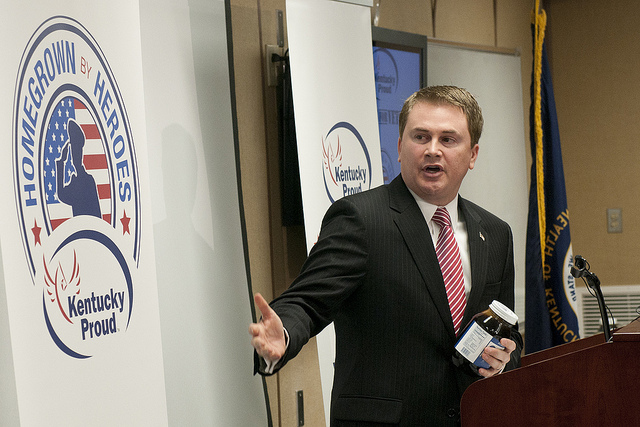
Kentucky Agriculture Commissioner, James Comer speaks during a press conference at Boone National Guard Center in Frankfort, Ky., Jan. 22, 2013. Comer announced two new programs to benefit veterans and military farmers, in cooperation with the Kentucky National Guard. (Kentucky National Guard photo by Sgt. Scott Raymond)
FRANKFORT, Ky. — Serving in the military and farming are said to be two of the hardest jobs one could have. New initiatives launched by Kentucky’s Department of Agriculture aim to make both just a bit easier in the Commonwealth. Agriculture Commissioner James Comer announced the Kentucky Proud Jobs for Vets and Homegrown by Heroes programs during a press conference at Boone National Guard Center in Frankfort, Ky., Jan. 22, 2013.
To see more photos from the press conference, click here.
Click here for the Homegrown by Heroes website.
Click here to see the WUKY story.
Click here to see the Lexington Herald-Leader story.
Comer spoke to a packed room that included Kentucky’s Adjutant General, Maj. Gen. Edward W. Tonini, state senators and representatives and veteran/farmers. He said the initiatives aim to improve employment of veterans in agriculture and to benefit military farmers, by using the state’s successful history on the battlefield and in the crop fields.
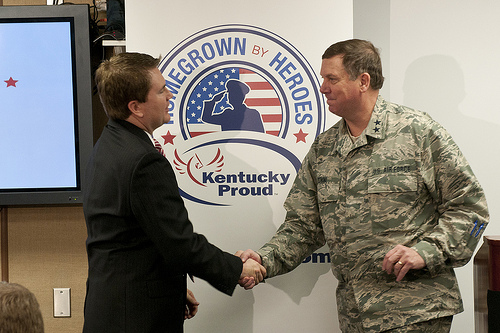
Kentucky Agriculture Commissioner, James Comer thanks Kentucky’s Adjutant General, Maj. Gen. Edward W. Tonini following his speech during a press conference at Boone National Guard Center in Frankfort, Ky., Jan. 22, 2013. Tonini said the two new programs launched by the Agriculture Department would benefit the Kentucky Guard and the Commonwealth. (Kentucky National Guard photo by Sgt. Scott Raymond)
“We know Kentucky is a great agriculture state with a great agriculture heritage, and we know Kentucky is a great military state,” said Comer. “What a great partnership this will be, that will highlight the work of Kentucky troops teaching farming all over the world and to come back and create economic development back here at home. That’s what this partnership is all about.”
The Kentucky Proud Jobs for Veterans program will work to connect military veterans looking for work in agriculture with Kentucky farmers and agribusiness who need labor. Comer said it’s a simple idea that will work with national organizations to connect people from all over the country to employment opportunities in the state.
Robert Silverthorn, Kentucky Field Chairman for the Employer Support of the Guard and Reserve (ESGR), said the new program can help fill the void of employment possibilities in the rural areas of the state for Guardsmen, reservists and veterans.
“This is an exciting day for the Commonwealth of Kentucky,” said Silverthorn. “And the reason is, you have a five billion dollar industry that often times gets lost in the other noise of economic development in our state. And for the Kentucky committee of the Employer Support of the Guard and Reserve now to be partnered in this initiative is something that is particularly exciting for us.”
The Kentucky Proud Homegrown By Heroes program allows military farmers to identify themselves through a new logo applied to any or all of their products for sale throughout the state. Comer said this will only increase the awareness buyers have of products grown in Kentucky and their desire to support not only Kentucky farmers, but also local farmers that are Veterans as well.
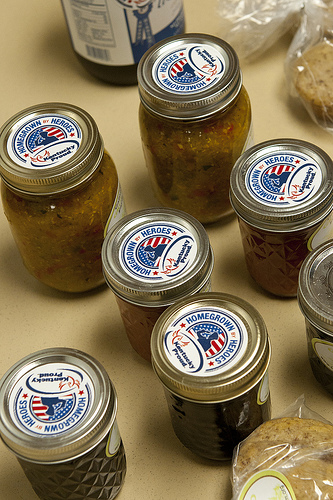
Jars of products produced by military farmers in Kentucky are adorned with the new Kentucky Proud Homegrown By Heroes label at a press conference in Frankfort, Ky., Jan. 22, 2013. Kentucky Agriculture Commissioner James Comer hopes the labels will become a national model for other states to implement. (Kentucky National Guard photo by Sgt. Scott Raymond)
Comer has hopes the new programs will become national models for other states to follow. He called attention to the Veteran Farmer Coalition, whose nationwide mission “is to mobilize veterans to feed America.”
Michael O’Gorman, Executive Director of the Veteran Farmer Coalition said he has been working to introduce veterans to careers in agriculture for years and hopes for every American “to recognize the Homegrown By Heroes label, to know where it came from and to know who it stands for.”
Tonini said Kentucky has always been perceived as a great agriculture state, and in turn produced five successful agribusiness development teams in Afghanistan. The Kentucky Guard has been instrumental in the agricultural improvements overseas, and now has the chance to help out at home.
“There’s no better core in America than Soldiers and farmers, it’s as simple as that,” said Tonini. “The Kentucky National Guard is very proud to be a part of such a unique endeavor and will support it in every way possible.”
Story by David Altom, Kentucky National Guard Public Affairs
 FRANKFORT, Ky. — If we’ve learned anything in today’s US military environment it’s that communications is the key to mission success. The new buzz word for 21st century operations, “jointness,” requires it; ground troops talk to aviation assets, blue talks to green, squads take direction from headquarters — and the list goes on.
The same goes for looking for a job in “the real world.” You’re out there on your own, either unemployed or underemployed, and you need top cover and you need it now. Just as you’d use any number of technologies and practices on the battlefield to call in air support, you’ve got to communicate with potential employers and let them know you’re available. Not only that, but you have to let them know that you have the right skill set and attitude and that you’re the right person for the job.
And how to do you do that, you might ask? You network, that’s how.
“Network, network, network,” says Tammie Hollar, Employment Transition Coordinator with Kentucky Employer Support of the Guard and Reserve. “That’s the key to finding the right job. Half of all retained hires are via networking, so you can see why we push it. It’s what works in our world today.”
Hollar counsels Guard members routinely on how to find employment and she loves what she does. And one of her favorite things to talk about is networking. She considers it one of the three legs on the tripod of “job readiness,” along with a good resume and the ability to deliver at an interview.
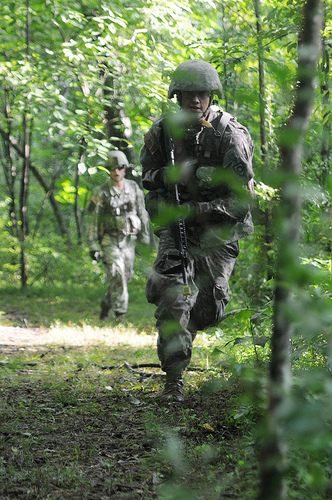
Good networking tactics can help you find your way through to employment and a satisfying career. (Photo by Sgt. David Bolton, Public Affairs Specialist, 133rd Mobile Public Affairs Detachment, Kentucky Army National Guard)
“Networking is making connections with others,” said Hollar. “You can network by posting your availability to LinkedIn, contact others in your field via phone, text or email and get out into your community, volunteer.”
Just uploading a general resume to websites doesn’t cut it anymore to find a great job or career; instead, probably the most effective way to network is start by going online. Sites such as LinkedIn and Hero 2 to Hired (also known as “H2H”) are the new normal.
Hollar’s advice on networking? “Own it and take responsibility for your future. Utilize the resources that are available to be successful in your search. Connect with people in the area you would like to be employed in.”
Keep in mind that all the advice in the world isn’t any good without hard work on the part of the job-seeker.
“This process is for someone who’s made looking for a job their job,” said Hollar. “We’re here to help people who are interested in being employed, especially those who’ve been interested for a while.
“Do not depend on someone else to find you a job. That belongs to you,” said Hollar. “You have to have it in your heart, and you usually get out of it what you put into it.”
One of the misconceptions about working with agencies like ESGR is that they’re going to hand you a job. That’s not exactly true.
“There’s a myth that we’re a staffing agency,” said Hollar. “We don’t find you jobs — we help you prepare to be employed.”
Good advice from someone who knows.
For more information on Kentucky’s Employment of Guard and Reserve and how they can help you email [email protected] or [email protected] or call 502-607-1532 or 502-607-6055.
Story and photos by Sgt. Scott Raymond, Kentucky National Guard Public Affairs
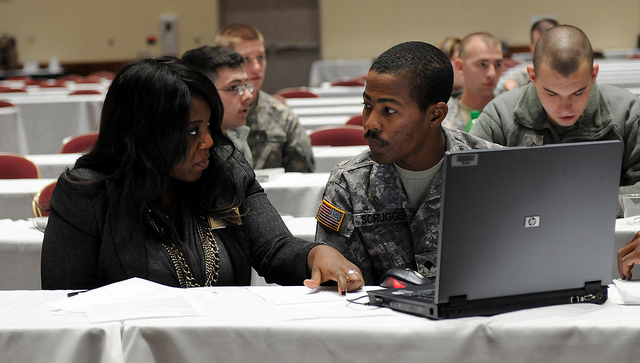
Monai Bell-Carson, an employment assistance consultant assists Spc. Martin Scruggs of the 1204th Aviation Support Battalion during the unit’s Transition Assistance Program (TAP) in Covington, Ky., Dec. 6, 2012. TAP provided the Soldiers with classes on resume writing, interview techniques and using their military experience to attain or improve their employment. (Kentucky National Guard photo by Sgt. Scott Raymond)
COVINGTON, Ky. — After a recent tour overseas, Soldiers of the 1204th Aviation Support Battalion gathered for a hands-on employment assistance workshop Dec. 3-9 at the Northern Kentucky Convention Center in Covington, Ky.
The workshop, created by the U.S. Departments of Defense and Labor, called the Transition Assistance Program (TAP), offered training on resume writing, interviewing techniques, and current methods for job searches. Professionally trained facilitators interacted with participants in one-on-one learning, including information on Veterans’ benefits.
Lt. Col. Tom Roach, commanding officer of the 1204th is extremely proud of the work his Soldiers did on deployment. But he had to deal with an alarming number of troops facing unemployment when they returned. He said there have been improvements with several Soldiers now employed with many still “aggressively” looking.
“The National Guard in general, and the Kentucky National Guard have done such a good job preparing Soldiers to accomplish their mission in theater. I think it’s tremendous that we are now putting that same effort into preparing Soldiers for success in their communities,” said Roach.
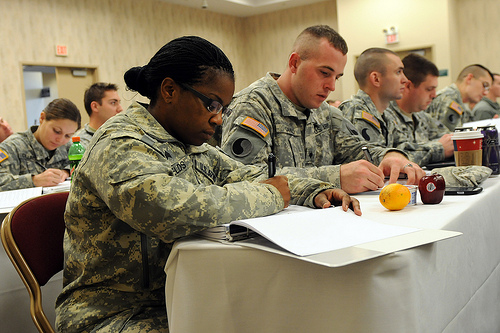
Sgt. Tasha Fields and Spc. Ben Cahill, both with the 1204th Aviation Support Battalion take noted during an employment assistance workshop in Covington, Ky., Dec. 6, 2012. The workshop was part of the unit’s “reblue” transition program following their deployment overseas. (Kentucky National Guard photo by Sgt. Scott Raymond)
The efforts, according to Kentucky Employment Support for Guard and Reserve (ESGR) are meant to stabilize the Guard’s force by improving their abilities to obtain and retain civilian employment through education and job search training. The week provided ESGR as well as other state and national agencies to put available resources in front of those who need help and to help them navigate through to employment.
Among those Soldiers without a full-time job is Capt. Patrick Rogers. Roach said Rogers came off active duty, where he had deployed twice before, to deploy with the 1204th. Rogers has gathered all of his military documents in hopes of putting together a new resume. TAP instructors said Rogers’ approach could create a “rockstar” resume and is an example of the right way to revise one’s resume.
“As an unemployed member of the Guard, I came to the program to gain as much knowledge as I could get to help me with my job search,” said Rogers. “The many people and resources offered from TAP have been well appreciated.”
The program also benefited those already employed, such as Sgt. Tosha Fields, who actually was given a promotion upon her return from deployment. Roach praised her work in the unit and said it is because of her time spent preparing the unit for deployment and while overseas that the company saw the increased value in an employee. Fields said one should not assume that they can get promoted just because they are already an existing employee.
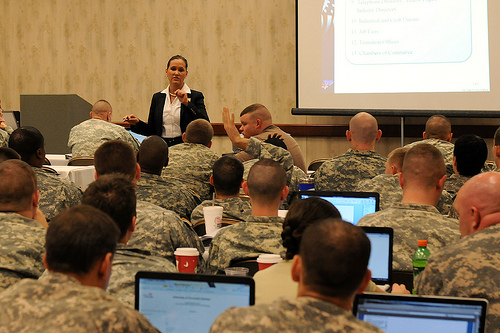
An instructor with Inverness Technologies speaks to Soldiers of the 1204th Aviation Support Battalion during the unit’s Transition Assistance Program in Covington, Ky., Dec. 6, 2012. The Soldiers received several classes during the employment assistance workshop to attain or improve their employment. (Kentucky National Guard photo by Sgt. Scott Raymond)
“Participating in this week’s events will allow me to be prepared for future opportunities that become available,” she said. “I plan to walk away with skills to prepare me to pursue other opportunities.”
Rogers remained optimistic for his future employment and was happy to see such a program included for the benefit of Soldiers.
“I am very thankful to have this offered as a free service and plan to take full advantage of the resources provided.”
On the final day of the workshop, a job fair was held for the Soldiers to put to work the knowledge they had gained during the training. Nearly 50 companies were on hand to offer employment opportunities. Soldiers “dressed up” from their uniforms into appropriate job seeking attire, handed out their newly revised resumes and utilized recently acquired interview techniques in their best effort to persuade a local business to say “you’re hired.”
According to Kentucky’s Yellow Ribbon Program, at least two Soldiers were hired that day, with several others scheduling interviews. Soldier and leaders of the 1204th all agreed that the week was valuable time spent that could stabilize and benefit not only the 1204th, but is good for the Guard and good for Kentucky.
By Master Sgt. Philip Speck, 123rd Airlift Wing Public Affairs
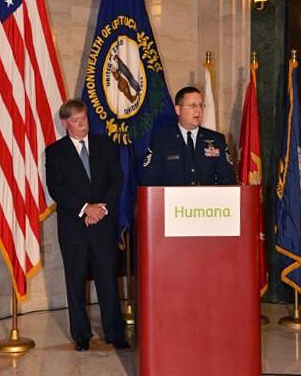
Master Sgt. James Tongate, a Humana employee and loadmaster with the Kentucky Air National Guard’s 165th Airlift Squadron, speaks during a ceremony at Humana’s corporate headquarters in Louisville, Ky. Humana was being honored as a finalist for the Secretary of Defense Employer Support Freedom Award, the highest recognition given by the U.S. government to employers for exceptional support of employees serving in the Guard and Reserve. Also pictured is Mike McCallister, Humana’s chief executive officer. (Courtesy photo)
LOUISVILLE, Ky. — Humana Inc. was honored as a finalist for the Secretary of Defense Employer Support Freedom Award during a ceremony at its corporate headquarters here Nov 1.The award is the highest recognition given by the U.S. government to employers for their support of employees who serve in the National Guard and Reserves.
Robert Silverthorn Jr., a retired Army major general and chairman of the Kentucky Committee for Employer Support of the Guard and Reserve, presented the honor to Humana chairman and CEO Mike McCallister.
“Today’s event, while it focuses on the National Guard and Reserves, represents another opportunity for Humana to say ‘Thank you’ to all our military-affiliated associates and their families,” McCallister said. “Humana understands the importance of the healthcare needs that the Guard, Reserves and their families face, especially in this time of extended deployments.”
In accepting the award, McCallister noted Humana’s progress toward its goal of hiring 1,000 former servicemen and servicewomen or their spouses by late 2014. The company has hired 928 veterans and spouses to date.
Master Sgt. James Tongate, a Humana employee and loadmaster in the Kentucky Air National Guard’s 165th Airlift Squadron, also spoke at the event.
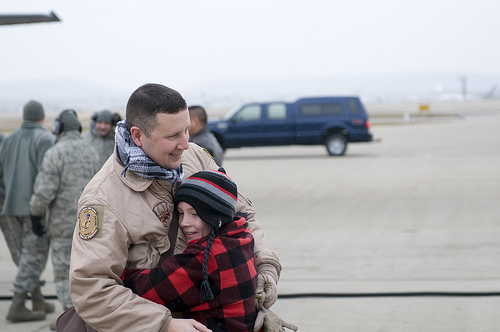
Master Sgt. James Tongate hugs his daughter after his Air and Space Expeditionary Force (AEF) deployment. (Air Force Photo by Master Sgt. Phil Speck)
“I’m proud to be a part of a company that strives to help those that have sacrificed for their country,” Tongate said.The Freedom Award was instituted in 1996 under the auspices of ESGR to recognize exceptional support from the employer community. In the years since, 160 employers have been honored with the award.ESGR was established as a DoD agency 40 years ago. It develops and maintains employer support for Guard and Reserve service, advocating for relevant initiatives, recognizing outstanding support, increasing awareness of applicable laws, and resolving conflict between service members and employers.
Paramount to ESGR’s mission is encouraging the employment of Guardsmen and Reservists who bring integrity, global perspective and proven leadership to the civilian workforce, officials said.
Story Re-Published from USA Today: Click HERE.
By Chris Kenning, The (Louisville) Courier-Journal
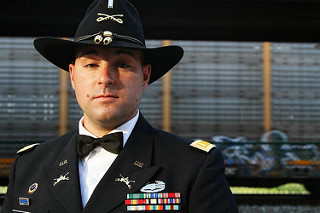
1st Lt. David Doggette
LOUISVILLE (October 23. 2012) - More than nine months after returning from a second deployment to Iraq, Kentucky National Guard Lt. David Doggette has been struggling to translate his broad military experience — ranging from driving a tank to leading a platoon — into a good civilian job.
(NOTE: If you would like more information on the Employer Support to the Guard and Reserve (ESGR) and the Employment Initiative Program, please contact Phil Miller at 502-607-1532 or Tim Stinnett at 502-607-6055.)
Doggette, a 30-year-old from Park City, Ky., who wants a career in safety management, said finding a job in the tight labor market is made more difficult by his long deployments away from the workforce — and the possibility of more to come.
“Everybody’s been very quick to thank me for my service, and nobody’s saying outright they’re worried about (future) deployments, but it’s definitely an undercurrent,” he said.
Unemployment for veterans of the wars in Iraq and Afghanistan remains a problem, but it is even more of an issue for National Guard members who juggle jobs and repeated deployments.
Although still higher than the overall jobless rate of 7.8%, the unemployment rate for veterans of Iraq and Afghanistan dropped to 9.7% in September, down from 11.7% a year earlier, according to the Bureau of Labor Statistics.
The Kentucky Guard’s “citizen soldiers” — who, unlike former active-duty troops, face the added difficulty of having to hold down jobs while being deployed overseas for what is often a year at a time — had a jobless rate last month of 16.3%, according to Guard figures.
Ross Cohen, senior director of the U.S. Chamber of Commerce’s Hiring our Heroes program, which has held about 100 job fairs, said there’s an array of new programs to help.
They range from Guard outreach directly to employers to job fairs put on by veterans groups, politicians and local workforce agencies.
One problem being addressed is showing vets how to bridge a “communication gap” as they try to translate their military skills into experience that employers can see will make them good employees.
Employers “need to know that you also learn to work well in teams, give and take orders, (can) be accountable for millions of dollars of equipment and respond to changing circumstances,” Cohen said.
Ted Daywalt, president of the Georgia-based group VetJobs, who testified about the issue before Congress earlier this year, said it’s a national problem. While recent veterans are increasingly finding work, National Guard members — whose part-time role differs from full-time, active-duty troops, but who in the past decade have been mobilized at record levels — have faced steeper challenges.
Though few will openly admit it, “a lot of employers are reluctant to hire them,” said Daywalt, noting that many will volunteer for another deployment to help pay bills at home. “We get thousands of calls a month, and easily 40 to 50% of them are in the National Guard.”
Though partly a function of a recovering economy, the state is also “connecting more veterans with jobs,” said Bill Riggs, Deputy Secretary of Kentucky’s Education and Workforce Development Cabinet, who oversees the “Hiring Kentucky Heroes” jobs program.
Still, with an estimated 3,000 unemployed post-9/11 veterans in Kentucky, Riggs said “there’s still more work to be done.” Indiana’s National Guard says its unemployment rate is 10.5 percent.
With the wars in Afghanistan and Iraq winding down and bringing an expected 1 million-plus veterans into the workforce by 2016, the issue of veteran unemployment has loomed large nationally.
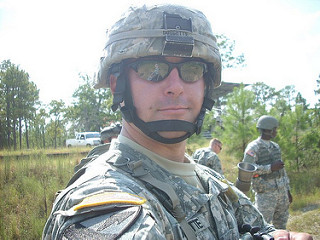
1st Lt. David Doggette trains with his unit prior to deploying to Iraq in 2010. (photo submitted)
Both President Obama and Republican challenger Mitt Romney have said veteran jobs is a top priority, with Romney encouraging states to create a standardized way to recognize military training credentials, an idea that is also part of a jobs bill pending in Congress.
Obama has helped enact tax credits to encourage companies to hire vets, while overhauling post-service training. According to the White House, more than 125,000 service members and military spouses have been hired or trained in the last year through a program called Joining Forces.
In June, Kentucky Gov. Steve Beshear enacted a statewide jobs program for vets, who are now getting help translating military experience into marketable civilian skills, developing their resumes and conducting practice job interviews.
State officials could not immediately provide figures on how many vets have been helped.
Ross Cohen, senior director for the U.S. Chamber’s “Hiring our Heroes” program, which has held about 100 job fairs, including the Louisville event that is expected to draw 300 jobless vets, said there’s an array of new programs to help.
That ranges from Guard outreach directly to employers to job fairs put on by veterans groups, politicians and local workforce agencies.
One problem they are addressing is showing vets how to bridge a “communication gap” as they try to translate their military skills into experience that employers can see will make them good employees.
Employers “need to know that you also learn to work well in teams, give and take orders, (can) be accountable for millions of dollars of equipment and respond to changing circumstances,” he said.
Kentucky National Air Guard member Jacob Fuller, 22, of Lexington, who recently landed a job as an airport firefighter in northern Kentucky, says he was alerted to the opening through the Kentucky Guard’s employment program.
And he said he capitalized on his military firefighter training and beat out a more than 100 other applicants, he said.
“I ended up getting really lucky,” he said. “I still know a decent number of people who are still unemployed, or can only find part time or low-level jobs.”
Ted Daywalt, president of the Georgia-based group VetJobs, who testified about the issue before Congress earlier this year, said it’s a national problem. While recent veterans are increasingly finding work, National Guard soldiers — whose part-time role differs from full-time, active-duty soldiers, but who in the past decde have been mobilized at record levels — have faced steeper challenges.
Many of the nearly more than 8,000 people in the Kentucky Army National Guard and the Air National Guard, for example, have served at least three, and as many as five, deployments — leaving them away from the workforce for years.
Guard members have job protections while they are serving, but those don’t protect them when factories are shuttered or small contracting businesses dry up during a recession. And when they return, younger soldiers especially are fighting for jobs with less work experience.
Though few will openly admit it, “a lot of employers are reluctant to hire them,” said Daywalt, noting that many will volunteer for another activation deployment to help pay bills at home. “We get thousands of calls a month, and easily 40 to 50 percent of them are in the National Guard.”
Finding a good job has been a challenge for Kentucky National Guard Specialist Matthew Dornbusch, of Walton, Ky., who returned in June from a deployment to Iraq and Kuwait.
“It’s hard returning from overseas” to find good jobs scarce, he said, adding that most of what’s available “seems like you’re either making $8 an hour or you need a college degree.”
Dornbusch said he initially struggled with the prospect of low-paying jobs after a deployment during which he felt that his soldiering duties, including being a mechanic to writing public information stories, were infused with a larger meaning.
“You get a job offer at a gas station attendant making $7.50 an hour, you think, ‘I just came from a combat zone. I feel like I’m worth more that,’” he said.
Now married, with a child on the way, he’s pursuing a bachelor’s degree in Geographic Information Systems at Northern Kentucky University — and continues to look for a good job, including by going to state veterans hiring fairs.
“A lot of us have so much experience, you’ve just got to get that across,” he said.
Some guard families are hoping that the winding down of the wars may presage fewer deployments, which would ease the burdens to employment.
But Daywalt said planned reductions in active-duty troop strength could keep demand for fill-in guard units high for the near future.
Additionally, U.S. Army chief of staff Gen. Ray Odierno said this summer that guard and reservists would shift next year from previous peacetime training blocks of two weeks a year to up to seven weeks to increase readiness.
That could present further employment barriers, but it’s still far less time than soldiers have been asked to give during the wars in Iraq and Afghanistan.
Despite the challenges, Daywalt said he’s encouraged that overall veteran unemployment figures are “going in the right direction” and that “everyone is trying to figure out how to help these people.”