Pages
Stay In Touch
More
© 2013 KentuckyGuard
By Pfc. Courtney Gapac, 138th Field Artillery Brigade
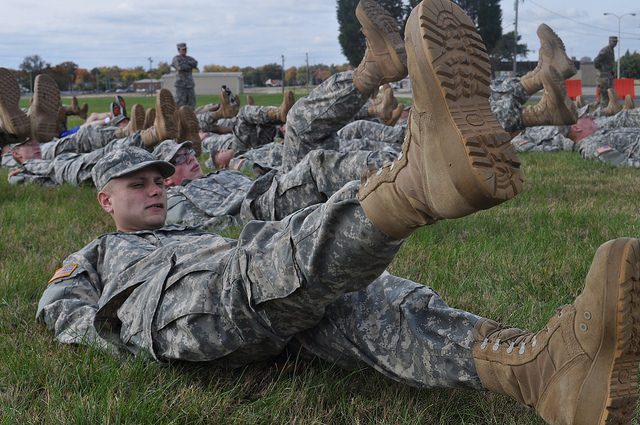
Pvt. Eli Reiners, a recruit from Mt. Washington, Ky., participates in corrective action with the entire company at the Kentucky Guard’s Recruit Sustainment Program’s (RSP) monthly drill in Louisville, Ky., Oct. 25, 2015. Kentucky’s RSP provides new recruits the preparation for basic training and advanced individual training prior to being assigned to a unit. (U.S. Army National Guard photo by Pfc. Courtney L. Gapac, 138th Field Artillery Brigade)
LOUISVILLE, Ky. — The Kentucky National Guard’s Recruit Sustainment Program in Louisville, relocated in August to better accommodate the training needs of new recruits who attend monthly drills here. The RSP recruits were welcomed into the new Bowman Readiness Center which was just opened Oct. 14.
The primary concern of RSP is to reduce training pipeline losses by preparing newly enlisted Soldiers for basic combat training and advanced individual training, said Staff Sgt. Robert H. Foushee, the readiness noncommissioned officer for Detachment 3, Alpha Company, Kentucky Recruiting and Retention Battalion.
State wide, RSP has decreased from eight sites to six, Foushee said. The program has had to evolve due to a tight budget and the constant influx of new recruits.
“We have to figure out how to do more with less,” Foushee said. We’re having to get more creative, and reach back into our toolbox to figure out ways to meet our goals.”
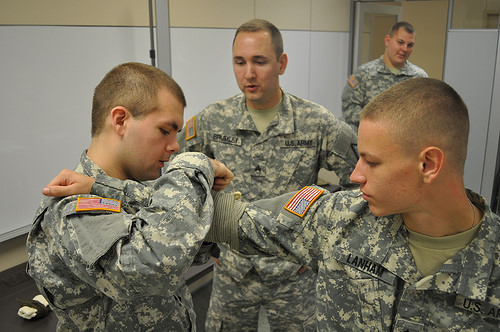
Sgt. Jonathan Brumley, a recruiting and retention non-commisioned officer for the Kentucky Recruiting and Retention Battalion, leads a classroom activity on first aid at the Kentucky Guard’s Recruit Sustainment Program’s monthly drill Oct. 25, 2015. Pvt. Mason Smith, a recruit from Shepherdsville, Ky., and Pvt. Gene Lanham, from Lebanon, Ky., take turns practicing how to properly apply a field dressing. (U.S. Army National Guard photo by Pfc. Courtney L. Gapac, 138th Field Artillery Brigade)
Click here for more photos.
With more classrooms, more adequate storage space, a fitness room, and a classroom with full computer access for Soldiers to complete online training modules, the new facility will only further improve the successes of the RSP here.
It is also beneficial that the new facility is located in the same building as headquarter elements, said Foushee.
“The nature of the Guard, which forces Soldiers to take a break from civilian life, makes them more susceptible to forces that cause failure,” Foushee said. “RSP is setting Soldiers up for success by preparing them for training, keeping them motivated, relieving fear of the unknown, and keep the flow going by giving them someplace to come back to.”
The curriculum for new enlistees preparing to ship to BCT is designed for three months and is organized into a three-phase system. Once the recruits are in-processed, they are integrated into military culture and given instructions on the Army values, the chain of command and proper wear of the uniform.
Later phases focus on the training community, military history and background and physical readiness.
RSP has a continued curriculum for troops who enlisted in the Split Training Option program and are awaiting advanced individual training (AIT). During this phase, they may serve as student leaders while they receive additional physical readiness and leadership responsibilities.
Once Soldiers have completed AIT, they attend three months of drill at RSP to ensure that they are fit to report to their home units.
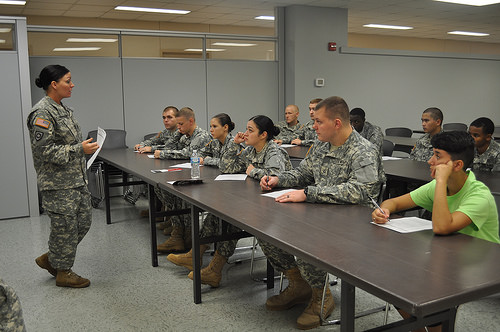
Staff Sgt. Rachel Richmond, a recruiting and retention non-commissioned officer-in-charge for the Kentucky Recruiting and Retention Battalion, leads a classroom discussion with new enlistees in Louisville, Ky., Oct. 25, 2015. New recruits in the Louisville area now drill in the Kentucky Guard’s newly renovated Bowman Readiness Center. (U.S. Army National Guard photo by Pfc. Courtney L. Gapac, 138th Field Artillery Brigade)
“The method of teaching has changed,” said Pfc. Christian Cowgill, a recent AIT graduate who spent more than a year with RSP. “It used to be very rigid, but has evolved into a classroom type of environment-almost like AIT - where there is still a physical aspect of training, but the actual education side of it has become more in-depth.”
“It’s a very productive program,” said Bobby Prather Sr., retired master sergeant and recruit sustainment program specialist for Det. 3. “Our ship rate is up, our completion rate is up, and we have very few administrative issues when the Soldiers get to their training sites.”
Many of the recruits who attend RSP value the experience, and are eager about the future of the program.
“It’s a place where you feel safe to develop and learn,” said Pfc. Jalen Manor North, another recent AIT graduate. “It gave me the chance to interact with NCOs and to try my hand out as a leader.”
The Soldiers that have come through RSP have felt fully prepared to face the challenges to come.
“When it comes to the military, you constantly have to adapt and be combat effective,” said Cowgill. “To build the house, you must have a solid foundation. This program helps make sure we are prepared for anything, so if a deployment happened, we won’t be a fish out of water.”
By Walt Leaumont, Kentucky National Guard Public Affairs
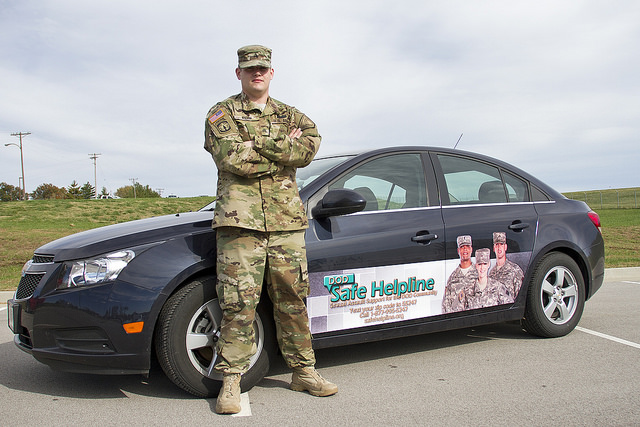
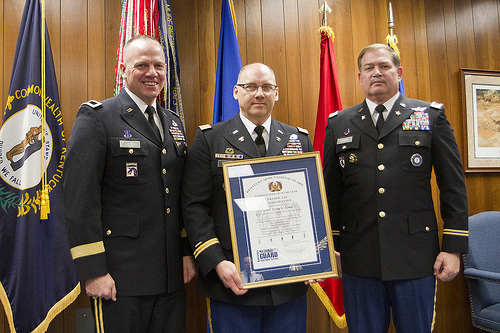
Sgt. Josh Kemp with the 2nd Battalion, 75th Recruiting and Retention Command was honored by the National Guard Bureau for his graphic design work in support of the Department of Defense’s Safe Helpline number. Kemp was presented the 2015 Sexual Assault Prevention Innovation Award for his contribution. (U.S. Army National Guard photo by Staff Sgt. Scott Raymond)
FRANKFORT, Ky. — Sgt. Joshua Kemp with the 2nd Battalion, 75th Recruiting and Retention Command received the 2015 Sexual Assault Prevention Innovation Award Oct. 23.
The award recognizes Service members and Department of Defense (DoD) civilians whose work in support of the military community has been particularly noteworthy. DoD created the award to spark creativity and incentivize efforts to address not only sexual assault prevention, but also ideas that enhance overall command climate. Kemp was recognized for proactively participated in peer-to-peer mentorship on topics of healthy relationships, responsible drinking, and bystander intervention in social settings.
Maj. Gen. Edward W. Tonini, Kentucky’s adjutant general presented the award during a presentation that was held in conjunction with a video teleconference with Gen. Frank J. Grass, chief of the National Guard Bureau.
“This was a collaborative effort with the Sexual Assault Response Center, this award is for all who helped with this project,” said Kemp. “And I have to thank my command staff for creating a climate that allows for developing and implementing creative solutions.”
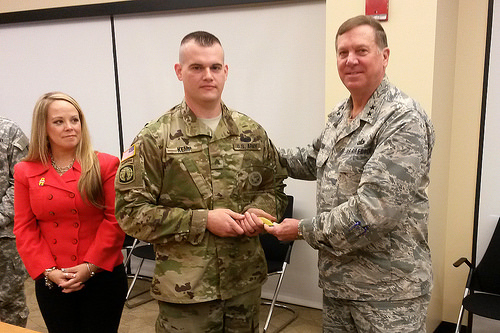
Sgt. Josh Kemp with the 2nd Battalion, 75th Recruiting and Retention is presented the 2015 Sexual Assault Prevention Innovation Award by Maj. Gen. Edward Tonini in Frankfort, Ky., Oct. 23, 2015. (Kentucky National Guard photo by Lt. Col. Scott Thomas)
One of the creative solutions Kemp developed was a mobile marketing campaign centered on wrapping General Services Administration (GSA) vehicles with the DoD Safe Helpline logo and contact information. The campaign is also an example to the Soldiers and Airmen of the Kentucky Guard that the Sexual Assault Prevention and Response program has the support of senior leadership and sexual misconduct will have severe consequences.
“We have a zero tolerance in Kentucky for such actions, and we’re not afraid to spread the word of our program,” said Maj. John Harvey, the state’s Sexual Assault Prevention and Response Officer.
“Without Sergeant Kemp’s enthusiasm and ingenuity, the car wrap idea never would have culminated into a finished product, for so many people to see as this car drives by.”
According to Harvey Kemp has played an integral role in raising awareness of sexual assault since arriving at Joint Force Headquarters in 2009. Not to be deterred by rank restrictions inhibiting his ability to serve as a Victim Advocate, Kemp has found creative ways to make an impact in other areas by leveraging his passion, talent, and dedication for sexual assault prevention.
He constantly mentors his peers on attitudes, behaviors, and personal responsibility when in social settings and informs fellow Service members of sexual assault prevention and response information and resources. He leads hip-pocket training on responsible drinking and bystander intervention methods so Soldiers can be better prepared in the event a sexual assault occurs. Kemp also indirectly supports families of Kentucky Guard Soldiers by providing context to his wife, Rebecca, a Family Readiness Support Assistant, on the regulations and policies pertaining to dependent members of the military affected by sexual assault.
“Regardless of the message, the Kentucky Guard is a family and we must make sure everyone knows what we stand for and how we can help when the time comes,” he said.
“This is about getting the word out and this is just one more way we can do just that.”