Pages
Stay In Touch
More
© 2013 KentuckyGuard
This July we proudly celebrate Independence Day and our Nation’s 238th birthday. And we continue to honor Kentucky’s military history each month with important dates and events that have helped shape our Commonwealth and our country.
The following is a compilation of significant dates in our commonwealth’s military history. For more on the legacy of our Citizen-Soldiers and Airmen, visit the Kentucky National Guard eMuseum.
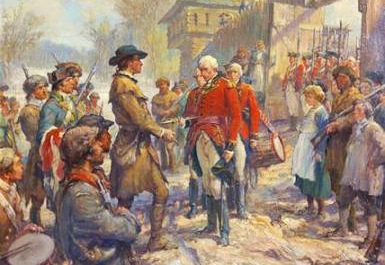
George Rogers Clark and the capture of Kaskaskia, July 4, 1778.
July 1-3, 1863 - Battle of Gettysburg, Pa. The turning point in the American Civil War.
July 1, 1898 - 1st Lt. Benjamin Hardaway from Benleyville, Ky., with the 17th U.S. Infantry assists in rescuing wounded Soldiers under heavy enemy fire at El Cany, Cuba during the Spanish-American War. He is awarded the Medal Honor for his actions. - Pvt. James Nash from Louisville, Ky., with the 10th U.S. Infantry is also awarded the Medal of Honor for his actions at Santiago, Cuba.
July 1, 1942 – Tech. Sgt. Berchell Keeling, Company D, 192nd Light Tank Battalion (Harrodsburg Tankers) died at Camp Cabanatuan, Nueva Ecija, Philippines of dysentery (World War II)
July 1, 1945 – Borneo campaign ended unopposed (World War II)
July 1, 1970 – Siege of Fire Base Ripcord began (Vietnam War)
July 1, 1955 – Units of Kentucky Air National Guard were redesignated as fighter-interceptor outfits.
July 2, 1926 – U.S. Army Air Corps established.
July 2, 1950– Korean War’s only U.S. Sea Battle (Korean War)
July 2, 1951 – 1st. Lt. Eugene Louis Ruiz was the first combat casualty from the Kentucky Air National Guard’s 123rd when he was shot down in Korea, as a member of the 45th Tactical Reconnaissance Squadron of the 543rd Tactical Support Group (Korean War)
July 2, 1967 – Operation Buffalo began (Vietnam War)
July 2, 1969 – Sgt. James Allen Wray, formerly Battery C, 2nd Battalion, 138th Field Artillery, was killed while serving with Battery B, 1st Battalion, 40th Field Artillery, 108th Artillery Group (Vietnam War)
July 3, 1863 - Pvt. Oliver Rood, a native of Franklin County, Ky., while serving with the 20th Indiana Volunteer Infantry, captures the flag of the 21st North Carolina Infantry during the Battle of Gettysburg, Pa. He is awarded the Medal of Honor for his actions.
July 3, 1942 – Pvt. Edward George Willis, Headquarters Company, 192nd Light Tank Battalion (Harrodsburg Tankers) died at Camp Cabanatuan, Nueva Ecija, Philippines of dysentery (World War II)
July 3, 2005 – Sgt. Ryan Jay Montgomery, of Greensburg, Kentucky was killed in Iraq when his up-armored HUMVEE encountered an improvised explosive device (IED) while returning from a convoy escort mission near Baghdad. At the time of his death, Montgomery was assigned to B Battery 1st Battalion, 623rd Field Artillery (Global War on Terrorism)
July 4, 1776 - The Continental Congress approves the final wording of the Declaration of Independence. The original draft was submitted on July 2nd, but Congress finally agreed on changes and edits two days later. Day becomes a national holiday in 1870.
July 4, 1777 – Second attack on Boonesborough by Indians (Early Indian Wars)
July 4, 1778 – Kaskaskia surprised and captured by George Rogers Clark and his men (Revolutionary War).
July 4, 1863 – Battle of Tebb’s Bend, Taylor County, Kentucky (Civil War)
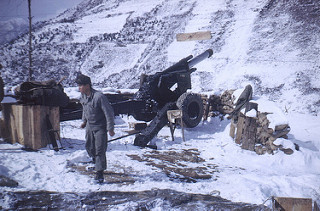
1st Battalion, 623rd Field Artillery in the “Smoke Valley”, South Korea, 1952.
July 5, 1952 – Kentucky’s 1st Battalion, 623rd Field Artillery, armed with eighteen 155mm towed howitzers, moves into “Smoke Valley,” South Korea in support of X Corps in holding operations against Communist Chinese assaults. During this period it will earn a Republic of Korea Unit Citation for its fire support of South Korea troops in repelling an enemy assault. In October the battalion, the last Guard artillery unit deployed to Korea, will see hard fighting and earns a Navy Unit Commendation embroidered PANMUNJOM for firing missions in support of the 1st Marine Division (Korean War)
July 5, 1950 – Battle of Osan (Korean War)
July 8, 1942 – Sgt. Jennings Bryan Scanlon, Headquarters Company, 192ndLight Tank Battalion (Harrodsburg Tankers) died at Camp Cabanatuan, Nueva Ecija, Philippines of dysentery. (World War II)
July 8, 1998 – Maj. Robert Stephen Hacker, a member of Headquarters and Headquarters Company, 201st Engineer Battalion of the Kentucky Army National Guard, died of injuries received in a vehicle accident while on active duty in the Esmeraldas Province of the South American nation of Ecuador.
July 9, 1918 – Army Warrant Officer Corps birthday.
July 9, 1966 – Battle of Minh Thanh Road (Vietnam War)
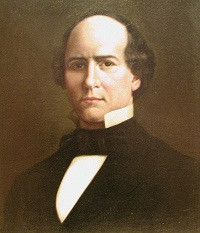
Theodore O’Hara
July 10, 1867 – Death of Theodore O’Hara in Alabama.
July 10, 1943 – Operation Husky (World War II)
July 12, 1870 - Cpl. John Given, a native of Davies County, Ky., with Company K, 6th U.S. Cavalry, dies in action against a numerically superior hostile force of Native Americans at Wichita River, Texas. His gallantry in action on this day earns him the Medal of Honor.
July 12, 1942 – 1st Sgt. Yandell Terhune, of Company D, 192nd Light Tank Battalion (Harrodsburg Tankers) died at Camp Cabanatuan, Nueva Ecija, Philippines of dysentery (World War II)
July 13, 1892 – Pvt. Almyr Sherrell Edwards of Company G, 3rd Regiment Kentucky State Guard died while on state active duty. His unit activated on July 11, 1892 at the request of the mayor of Paducah in response to a riot by an armed group of citizens intent on freeing a suspect from the local jail, On that day an African American, Thomas Burgess, was arrested on charges of being a “sneak thief” (burglar). The African American community believed that this individual was going to be unfairly convicted, and a group tried to release him from the jail, dispersing once daylight hours came, peaceably. The next evening they returned near midnight, armed, and then commenced firing on the jail and the guardsman who were defending it. During a short firefight Edwards was mortally wounded. Newspaper accounts of the time reflect a tense state of race relations during these events in Paducah. A monument in honor of Edwards was dedicated on July 13, 1893. The monument was believed to have been moved to its current location after the 1939 floods and it is now located in Caldwell Park at 14th & Park Ave in Paducah.
July 13, 1950 – Battle of Kum River began (Korean War)
July 13, 1953 – Battle of Kumsong River Salient began (Korean War)
July 13, 1995 – Sgt. 1st Class Charles Sidney “Chuck” Fitch Sr. died of a massive heart attack following a PT test. Fitch enlisted in the Kentucky Army National Guard in September of 1988. Fitch became an Active Guard Reserve (AGR) in September 1991 serving as a Recruiting and Retention NCO until his death.
July 15, 1916 – Pvt. Kenneth Witty of Hopkinsville, Christian County, died while on federal active duty of typhoid pneumonia at Fort Thomas, Kentucky. He was part of the Kentucky National Guard contingent called to federal duty to patrol a sixty mile stretch of the border between Fort Bliss and Fort Hancock during the Mexican Punitive Expedition. He enlisted in Company D, 1st Battalion, 3rd Regiment on June 21, 1916.
July 15, 1951 – 1st Lt. George Conder perished during a massive flight demonstration when two F-51s collided in mid-air.
July 15, 1970 – Pfc. Lanny Kay Brown, of Monticello (Wayne County) died during Annual Training at Fort Knox. He was a member of C Battery, 1st Battalion, 623rd Field Artillery. Brown was standing inside a squad tent in the unit bivouac area at approximately 8:30 p.m. during a violent thunderstorm when he was electrocuted by a lightning strike. Brown joined the Kentucky Army National Guard on June 12, 1968.
July 16 – Atomic Veterans Day – First Nuclear Bomb Test; Code name “Trinity”
July 16, 1968 – Operation Kingfischer began (Vietnam War)
July 16, 1836 – Gov. Morehead, at the request of President Jackson, issues his proclamation calling for 1,000 mounted Kentuckians, to rendezvous in Frankfort by August 17, to proceed to Camp Sabine, and protect the southwestern frontier. Before August 3, 45 companies tender their services, but only 10 are accepted, one each from Franklin, Henry, Shelby, Madison, Harrison, Oldham, Gallatin, Woodford, Jefferson, and Fayette counties. The governor appoints Leslie Combs, of Fayette, colonel, Thomas A. Russell, of Fayette, lieutenant colonel, and George Boswell, of Shelby, major. Before they commence their march, orders are received for their discharge.
July 17, 1789 – Chenoweth Station Massacre, Shawnee Indians attacked the settlement of Capt. Richard Chenoweth killing 3 of his children and another man. Chenoweth and 3 other children were wounded, his wife was shot with an arrow tomahawked and scalped, but did not perish.
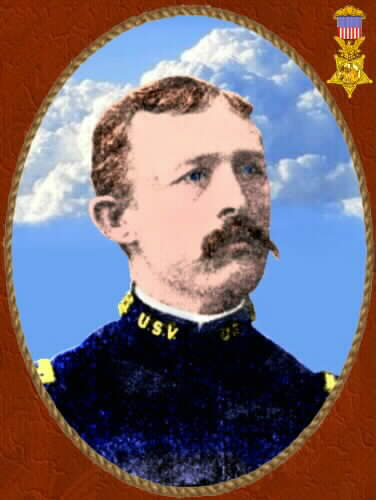
Thomas Cruse, Owensboro native and Medal of Honor recipient.
July 17, 1882 - 2nd Lt. Thomas Cruse, a native of Owensboro, Ky., with the 6th U.S. Cavalry in action at Big Dry Fork, Arizona Territory, gallantly charged hostile Native Americans, and with his carbine compelled a party of them to keep under cover of their breastworks, thus being enabled to recover a severely wounded soldier. He is awarded the Medal of Honor for his actions. Cruse was a 1879 graduate of West Point and retired from the Army as a brigadier general.
July 17, 1952 – Battle for Old Baldy began (Korean War)
July 19, 1950 – Battle of Taejon began (Korean War)
July 20, 1847 – Remains of Col. William R. McKee, Lt. Col. Henry Clay, Jr., Capt. William T. Willis, Capt. William H. Maxey, Adjutant E.M. Vaughn, Lt. James Powell and 11 privates who fell in battle during the Mexico War are interred in the state cemetery at Frankfort. 20,000 people were present, including several hundred of the returned Soldiers from the Mexican War.
July 22, 1864 – Battle of Intrenchment Creek, part of Atlanta Campaign. Kentucky Orphan Brigade suffers heavy casualties (Civil War)
July 22, 1946 – Organization of the units of the Kentucky Air National Guard authorized by the War Department. Organizational authority was extended in October and December during the process of organizing and manning the Kentucky Air National Guard.
July 22, 1942 – Staff Sgt. Wallace Denny, Company D, 192nd Tank Battalion (Harrodsburg Tankers) died at Camp Cabanatuan, Nueva Ecija, Philippines of dysentery (World War II)
July 22, 1977 – Staff Sgt. Joseph M. McHenry, of Owensboro (Daviess County) and Pfc. Danny Edwin Rowan, of Hartford (Ohio County) died in a ¼ -ton jeep accident during a convoy from Fort Hood, Texas to Home Station for the CSC, 2nd Battalion, 123rd Armor in Owensboro. McHenry and Pfc. Danny Rowan were traveling eastbound on Interstate 30 near Mt Vernon, in Franklin County, Texas at approximately 1:10 p.m. local time when the left rear tire blew out causing the vehicle to go out of control.
July 22, 1991 – Tech. Sgt. David A. Atkinson, of Louisville (Jefferson County) died about 8 p.m. during an airborne training exercise at Hurlburt Field near Fort Walton Beach Florida. Atkinson was performing a “high-opening” jump from about 12,500 feet. Atkinson was a member of the 123rd Tactical Airlift Wing Combat Control Team of the Kentucky Air National Guard.
Clockwise, from top: UN forces reach the 38th parallel; F-86 Sabre fighter aircraft in Korean combat; Incheon harbor, starting point of the Battle of Inchon; Chinese soldiers welcomed home; Marines over the top of the Incheon seawall.
July 24, 1953 – Final U.S. Ground Combat of Korean War began (Korean War)
July 27, 1953– Korean War ended.
July 27 - National Korean War Veterans Armistice Day.
July 27, 2009 – Pfc. Timothy J. Rogers, of Corbin, Whitley County, died as the result of a traffic accident while on the way home from annual training. He was a member of Company B, 1st Battalion, 149th Infantry.
July 28, 1942 – Pvt. Fred C. Leonard, Jr., Headquarters Company, 192nd Light Tank Battalion (Harrodsburg Tankers) died at Camp Cabanatuan, Nueva Ecija, Philippines of cerebral malaria (World War II)
July 31, 1813 – Kentucky Governor Isaac Shelby issues call for volunteers to revenge hundreds of Kentuckians massacred at the River Raisin (present-day Monroe, MI). Shelby would go on to lead the Kentucky troops himself at the Battle of the Thames while still serving as governor (War of 1812)
###
The following is a compilation of significant dates in our nation’s and the commonwealth’s military history. For more on the legacy of our Citizen-Soldiers and Airmen, visit the Kentucky National Guard eMuseum.
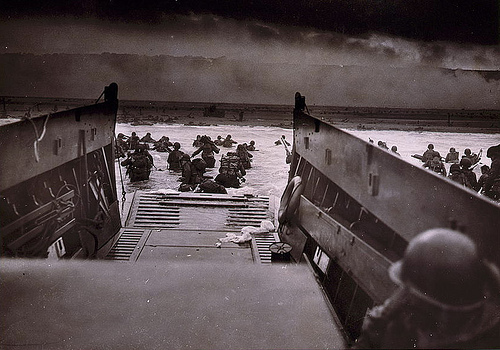
Normandy invasion, D-Day, June 6, 1944.
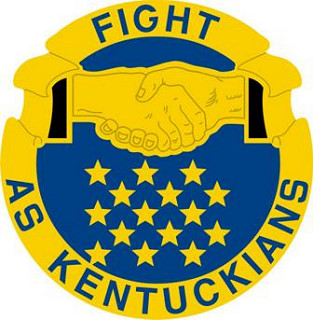
The crest for Army National Guard units of the Commonwealth of Kentucky includes fifteen stars, a reference to Kentucky being the fifteenth state admitted to the Union.
June 1, 1792 – Kentucky’s Birthday – Kentucky became the 15thstate of the United States of America.
June 1, 1942 – Technical Sgt. Johnnie Bottoms, Headquarters Company, 192nd Light Tank Battalion (Harrodsburg Tankers) died at Calauan Camp #3 – Old Bilibid Prison, Rizal Manila Philippines. (World War II)
June 1, 1969 – Sgt. Bertram A. “Sonny” Carr, Louisville, Ky., of B Battery 2nd Battalion, 138th Field Artillery was killed near Hamburger Hill. He was originally a member of Service Battery. (Vietnam War)
June 2, 1942 – Pvt. Willard Emmal Foster, Headquarters Company, 192nd Light Tank Battalion (Harrodsburg Tankers) died of dysentery at Camp O’Donnell, Capas, Tarlac, Philippines. (World War II)
June 3, 1942 – Battle of Midway began. (World War II)
June 6, 1944– D-Day Invasion of Europe. (World War II)
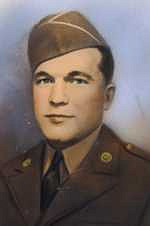
Sgt. Hezakiah Franklin Sallee
June 6, 1944 – Sgt. Hezakiah Franklin “Heze” Sallee of Company D, 192nd Light Tank Battalion (Harrodsburg Tankers) died in coal mining accident at Japanese Prisoner of War Camp Fukuoku-17, Nagasaki, Japan. (World War II)
June 6, 1952 – Operation Counter began. (Korean War)
June 8, 1864 – John H. Morgan raided Mt. Sterling, took Lexington, thence to Georgetown and Cynthiana, thence through Flemingsburg and West Liberty into the State of Virginia. (Civil War)
June 9, 1969 – Kentucky Air National Guard returned home from its duties during the Pueblo Crisis (Korea) and was released from active duty in ceremonies in Louisville. During the recall period of 17 months the wing flew 19,715 tactical flying hours from a total of 11,561 sorties. The 165th Squadron alone processed 257,200 prints and 284,251 feet of film and flew 4,438 recon sorties totaling 7,192 hours.
June 10, 1951 – Battle for the Punchbowl began. (Korean War)
June 10, 1953 – Siege of Outpost Harry began. (Korean War)
June 11, 1960 – The Kentucky Air National Guard facility at Standiford Field was dedicated to the honor of a former member of the unit, Capt. John William Shewmaker, killed in Korea Oct. 23, 1951, while flying with the 111th Fighter- Bomber Squadron. Members of the family were guests of the Kentucky Air National Guard for the occasion.
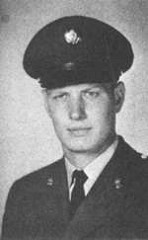
Staff Sgt. Harold Brown
June 11, 1969 – Staff Sgt. Harold Milton Brown, Mt. Washington, Ky., formerly Battery C, 2nd Battalion, 138th Field Artillery was killed by rocket fire while in a bunker in Chu Lai while serving with Battery C, 1st Battalion, 82nd Artillery, Americal Division. (Vietnam War)
June 13, 1942 – Pvt. Herbert C. Steele of Company D, 192nd Light Tank Battalion (Harrodsburg Tankers) died of dysentery at Camp O’Donnell, Capas, Tarlac, Philippines. (World War II)
June 14 – Flag Day
June 14, 1775 – U.S. Army founded.
June 14, 1920 – Col. Isaac Wilder is appointed Adjutant General of Kentucky, by Governor Edwin P. Morrow. Wilder resigned the position two days later.
June 15, 1950 – Governor Clements issues an executive order appointing Brig. Gen. Roscoe L. Murray to the rank of major general conforming to general assembly’s change to KRS 36.030 raising the rank of the adjutant general from brigadier general to major general. This is the first time in the history of the Commonwealth that the adjutant general was granted the rank of major general.
June 16, 1920 – James Madison DeWeese is appointed adjutant general of Kentucky for the second time by Governor Edwin P. Morrow.
June 18, 1812– U.S. Congress declared war against England. (War of 1812)
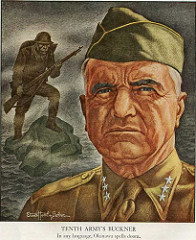
Lt. General Simon Buckner
June 18, 1945 – During action on Okinawa. Lt. Gen. Simon B. Buckner Jr. became the highest ranking American general officer killed in action during WWII. The Kentucky native was the son of Confederate General and Kentucky Governor Simon B. Buckner. In 1954 Congress posthumously promoted him to the rank of general. (World War II)
June 19, 1969 – C Battery, 2nd Battalion, 138thField Artillery attacked on Tomahawk Hill by North Vietnamese Army sappers. Other 2ndBattalion batteries at nearby firebases were shelled by the NVA so that they could provide little or no fire support for C Battery. Pfc. Joseph R. McIlvoy, Mackville, Ky., Specialist Four Ronald E. Simpson, Bardstown, Ky., Specialist Four David B. Collins, Bardstown, Ky., Sgt. James T. Moore, Bardstown, Ky., 1st Sgt. Luther M. Chappel, Worthville, Ky., were killed in the attack. When Firebase TOMAHAWK was attacked during the early morning hours in a pouring rain, sappers infiltrated the base and during the attack threw some 150 satchel charges into the bunkers in addition to firing rocket propelled grenades (RPG). The battle went on some two hours before the NVA were forced to retreat. The attack destroyed an ammunition storage area, four of the six M-109 self-propelled howitzers, nine bunkers, the mess hall, dining tent, maintenance building, four ammunition carriers, three 2 1/2-ton trucks, two 3/4-ton trucks, and three jeeps. The Battery had nine men killed; five of them were from Kentucky and the other four were non-Guard replacements from various, non-Kentucky, locations. The unit also suffered 37 wounded. A platoon of infantrymen from the 101stAirborne Division was providing perimeter security for the firebase and four of the 101st soldiers were killed and another 13 wounded. Senior Commander in Vietnam, General Creighton Abrams, said the 2ndBattalion 138th Field Artillery, was “one of the best trained, and absolutely the best maintained battalion-sized unit in Vietnam.” (Vietnam War)
June 20, 1792 – Governor Isaac Shelby signs act establishing the Kentucky Militia.
June 21, 1871 – Reunion at Paris, Ky., of 69 soldiers of the War of 1812; their combined ages equal 5,487.
June 21, 1871 – Capt. Thomas S. Theobald, of Frankfort, aged 79, receives a pension certificate as a veteran of the War of 1812, the first issued to a Kentuckian, and entitling him to $8 per month. He was First Lieutenant in Morrill’s company of Kentucky Mounted Rifles.
June 22, 1780 – Capture by Capt. Henry Bird and British-Canadian-Indian army, of Ruddle’s and Martin’s Stations, on upper waters of Licking River. (Early Indian Wars)
June 22, 1942 – Pledge of Allegiance recognized by Congress.
June, 1944 – GI Bill signed into law.
June 24 – Kentucky National Guard Day in the Commonwealth of Kentucky. On this day in 1792 Governor Shelby established how the Kentucky Militia was to be organized.
June 24, 1792 – Kentucky Militia is organized by Governor Shelby.
June 25, 1850 – Construction of Kentucky’s Battle Monument completed in the state cemetery at Frankfort.
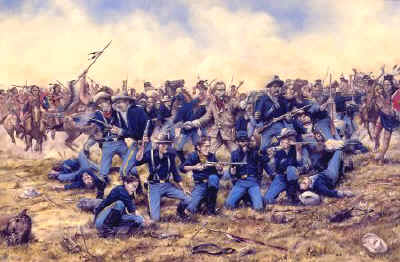
The Battle of Little Bighorn, June 25, 1876
June 25, 1876 - During the Battle of Little Bighorn, Madison County, Ky.-native, Pvt. William Harris and Pvt. George Scott of Lancaster County, Ky. bring water to Soldiers while under enemy fire. Their actions earn them both the Medal of Honor. Both are among the 263 Soldiers of the 7th Cavalry killed in the battle.
June 25, 1950 – Korean War began.
June 28, 1914 – World War I began in Europe after Archduke Francis of Austria and wife were assassinated.
June 29, 1846 – Appointment by President Polk of William O. Butler, of Carroll County, Kentucky to be major general of volunteers. Butler was the son of Kentucky’s first adjutant general, P.P. Butler. Butler State Park in Carrollton is named in honor of William O. Butler. (Mexican War)
June 29, 1950 – First U.S. ground forces arrive in Korea. (Korean War)
The following is a compilation of significant dates in our nation’s and the commonwealth’s military history. For more on the legacy of our Citizen-Soldiers and Airmen, visit the Kentucky National Guard eMuseum.
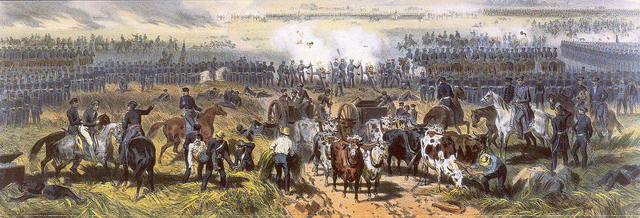
The Battle of Palo Alto, May 8, 1846
May 1, 1970– Cambodia Campaign began (Vietnam War)
May 2-3, 1863 – Battle of Chancellorsville, Virginia (Civil War)
May 2, 1936 – First records of Kentucky National Guardsmen assisting in the security of Churchill Downs for the Kentucky Derby.
May 2, 1945 – German unconditional surrender to Italian Allies (World War II)
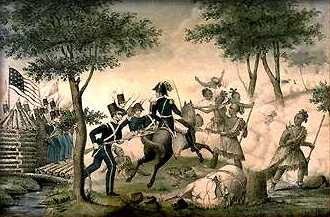
Siege of Fort Meigs, Ohio, May 5, 1813
May 5, 1813 – Brig. General Green Clay, with 3,000 Kentuckians, reaches besieged Fort Meigs, Ohio. On orders from General William Henry Harrison divides his force, his part of the force cuts their way through the enemy’s lines into the fort. 800 Kentuckians, under Col. Wm. Dudley, are order to cross the Maumee River and attack the guns and spike them so they can no longer fire. Once this was accomplished, the militia pursues what appears to be retreating Indians under the leadership of Tecumseh. After they entered the woods, the Indians counterattacked while the British forces swung around their flanks cutting most off from the river. Only about 150 escaped with the remainder being killed or captured. Of those captured, about 50 were murdered by the Indians before Tecumseh put a stop to it. The British, without use of their artillery, soon lifted the siege and moved back into Canada (War of 1812)
May 5, 1942 – Fall of Corregidor (World War II)
May 5, 1968 – Mini-Tet began (Vietnam War)
May 8, 1846 – General Zachary Taylor defeats the Mexicans at Palo Alto (Mexican-American War)
Pvt. Roy Goodpaster
May 8, 1945 – Pvt. Roy Edward Goodpaster, Company D, 192nd Light Tank Battalion (Harrodsburg Tankers) died at Camp Moji Hospital Fukuoka #4 Kyushu Island Japan of wounds received aboard the “Hell Ships” Oryoku Maru & Enoura Maru (World War II)
May 8, 1945 – VE (Victory Europe) Day, Germany’s Unconditional Surrender Signed (World War II)
May 8, 1972 – U.S. Navy mined North Vietnamese ports (Vietnam War)
May 9, 1781 – McAfee Station, along Salt River attacked by over 150 indians. Only 13 men and their families inside who kept up a gallant defense for near 1/2 day until help arrived from nearby Harrodsburg. One settler killed at onset of action, 1 minor wounded. As pursuit was made the Indians made a stand at the ford of the river 1 more killed and 1 injured when thrown from horse. (Early Indian Wars)
May 9, 1846 – General Zachary Taylor defeats the Mexicans at Resaca de la Palma (Mexican-American War)
May 9, 1868 – Kentucky Legislature to present a Gold Medal to Samuel Hatfield, of Floyd County, another survivor of the Kentuckians who assisted in achieving Perry’s victory on Lake Erie, September 10, 1813.
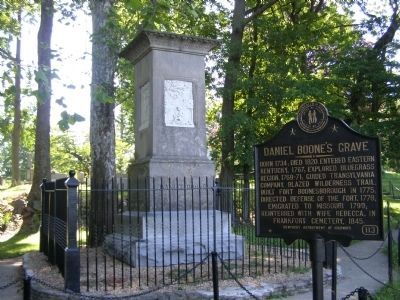
Daniel Boone gravesite, Frankfort Cemetery
May 9, 1868 – Kentucky Legislature appropriates funding to repair monument over Daniel Boone’s grave, which had been defaced by Federal soldiers during the war.
May 10, 1773 – The McAfee Company (James Jr., Robert, & George McAfee along with James McCoun Jr. and Samuel Adams) left Virginia on a 4-month expedition into Kentucky . Explored lands along Ohio & Kentucky Rivers. descended the Kentucky to where Frankfort now is located, continued exploration of Henry, Franklin, Anderson, & Mercer Counties. Eventually making land claims along Salt River.
May 10, 1863 – Confederate General “Stonewall” Jackson dies from wounds after being fired upon by his own men a week earlier. (Civil War)
May 10, 1969 – Battle for Hill 937, nicknamed Hamburger Hill (Vietnam War)
May 10, 1972 – Operation Linebacker (Vietnam War)
May 11, 1871 – Re-interment at Crab Orchard, Lincoln, County, of the unknown Southern soldiers who fell at the Battle of Wildcat Mountain, in 1862.
Pfc. Wesley Hungate
May 12, 1942 – Pfc. Wesley Davis Hungate, Company D, 192nd Light Tank Battalion (Harrodsburg Tankers) died at Camp O’Donnell, Capas, Tarlac, Philippines of dysentery while a Japanese prisoner of war (World War II)
May 13, 1846 – Congress of the United States declares war on Mexico. Maj. Gen. E.P. Gaines makes a requisition on the Governor of Kentucky for 4 regiments of volunteers, comprising 2,400 men (Mexican War)
May 13, 1968 – 2nd Battalion, 138th Field Artillery entered active duty and served 11½ months in Vietnam. Kentucky was only one of two states to have both Air and Army Guard units called up in 1968 (the other being Kansas). Kentucky was the only state to have both Air and Army mobilized units deploy overseas (Vietnam War and Pueblo Call-up)
May 16, 1861 – Kentucky proclaimed its neutrality. (Civil War)
May 17 – Armed Forces Day.
May 17, 1846 – Governor Owsley issues a proclamation, appealing to Kentuckians “to form themselves into volunteer companies,” and to report to him forthwith (Mexican War)
May 18, 1846 – The Louisville Legion, offer their services to the governor, and are accepted (Mexican War)
May 19, 1942 – Sergeant Ben R. Devine, Company D, 192nd Tank Battalion (Harrodsburg Tankers) died at Camp O’Donnell, Capas, Tarlac, Philippines of dysentery while a Japanese prisoner of war (World War II)
May 20, 1777 – St. Asaph’s or Logan’s Fort or Logan’s Station resists attack by Indians (Early Indian Wars)
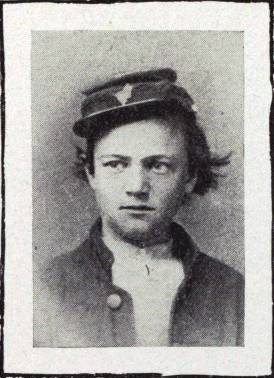
William Horsfall
May 21, 1862 – William H. Horsfall from Campbell County, Ky., a 15-year-old drummer with Company G, 1st Kentucky Infantry, saves the life of a wounded officer lying between the lines of fire at Corinth, Miss. Horsfall received the Medal of Honor for his actions. (Civil War)
May 22, 1846 – Formal proclamation of Governor Owsley for two regiments of infantry or riflemen, and one of cavalry, for the service of the United States against Mexico (Mexican-American War)
May 24, 1946 – The 359th Fighter Group was redesignated as HQ, 123rd Fighter Group, and allotted to the Air National Guard of Kentucky, together with its colors and World War II battle participation credits. The 368th Fighter Squadron was also allotted to the KyANG with its colors and record, and redesignated as the 165th Fighter Squadron.
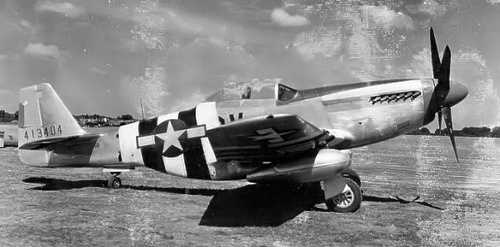
P-51 Mustang of the 359th Fighter Group
May 25, 1921 – Private Manley Vaughan, Troop C, 53rd Machine Gun Squadron, Louisa, Kentucky, was killed near Borderland W. Va. Kentucky National Guard soldiers from Louisa, Morehead and London were on state active duty from May 14, to June 4, 1921 along the Kentucky – West Virginia border in connection with a coal strike in the Tug River District.
May 26, 1846 – Governor Owsley announces, that the requisition upon Kentucky for troops is full (Mexican War)
May 26, 1871 – Confederate Memorial Day inaugurated, commemorating the occasion when Jefferson Davis was freed from prison.
May 27, 1778 – George Rogers Clark and men camp on Corn Island, at Falls of the Ohio (Louisville).
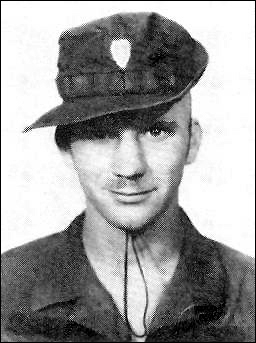
Sgt. Chales Clinton Fleek
May 27, 1969 – Sgt. Charles Clinton Fleek from Petersburg, Ky. smothered the blast of an enemy hand grenade with his body, sacrificing his life to protect those around him fighting in Bihn Duong Province, Vietnam. Fleek was awarded the Medal of Honor for his gallantry and willing self-sacrifice. (Vietnam War)
May 30 – Memorial Day
May 30, 1806 - In Logan County, Ky., future president Andrew Jackson participates in a duel, killing Charles Dickinson, a lawyer regarded as one of the best pistol shots in the area. The proud and volatile Jackson, a former senator and representative of Tennessee, called for the duel after his wife Rachel was slandered as a bigamist by Dickinson, who was referring to a legal error in the divorce from her first husband in 1791. Jackson met his foe at Harrison’s Mills on Red River in Logan, Kentucky, on May 30, 1806. In accordance with dueling custom, the two stood 24 feet apart, with pistols pointed downward. After the signal, Dickinson fired first, grazing Jackson’s breastbone and breaking some of his ribs. However, Jackson, a former Tennessee militia leader, maintained his stance and fired back, fatally wounding his opponent. It was one of several duels Jackson was said to have participated in during his lifetime, the majority of which were allegedly called in defense of his wife’s honor. None of the other rumored duels were recorded, and whether he killed anyone else in this manner is not known. In 1829, Rachel died, and Jackson was elected the seventh president of the United States.
May 30, 1868 – By proclamation of General John A. Logan of the Grand Army of the Republic, the first major Memorial Day observance is held to honor those who died “in defense of their country during the late rebellion.” Known to some as “Decoration Day,” mourners honored the Civil War dead by decorating their graves with flowers. On the first Decoration Day, General James Garfield made a speech at Arlington National Cemetery, after which 5,000 participants helped to decorate the graves of the more than 20,000 Union and Confederate soldiers buried in the cemetery. The 1868 celebration was inspired by local observances that had taken place in various locations in the three years since the end of the Civil War. In fact, several cities claim to be the birthplace of Memorial Day, including Columbus, Mississippi; Macon, Georgia; Richmond, Virginia; Boalsburg, Pennsylvania; and Carbondale, Illinois. In 1966, the federal government, under the direction of President Lyndon B. Johnson, declared Waterloo, New York, the official birthplace of Memorial Day. They chose Waterloo–which had first celebrated the day on May 5, 1866–because the town had made Memorial Day an annual, community-wide event, during which businesses closed and residents decorated the graves of soldiers with flowers and flags. By the late 19th century, many communities across the country had begun to celebrate Memorial Day, and after World War I, observers began to honor the dead of all of America’s wars. In 1971, Congress declared Memorial Day a national holiday to be celebrated the last Monday in May. Today, Memorial Day is celebrated at Arlington National Cemetery with a ceremony in which a small American flag is placed on each grave. It is customary for the president or vice president to give a speech honoring the contributions of the dead and to lay a wreath at the Tomb of the Unknown Soldier. More than 5,000 people attend the ceremony annually. Several Southern states continue to set aside a special day for honoring the Confederate dead, which is usually called Confederate Memorial Day.
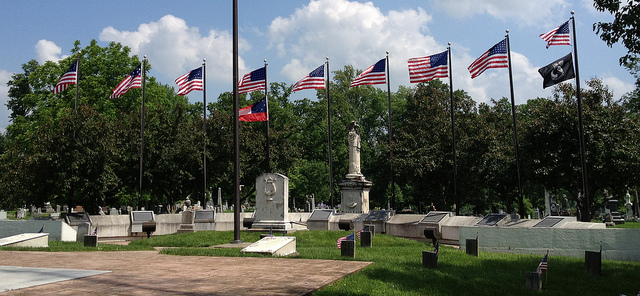
Memorial Day - the last Monday in May
The following is a compilation of significant dates in the Nation and in our Commonwealth’s military history. For more on the legacy of our Citizen-Soldiers and Airmen, visit the Kentucky National Guard eMuseum.
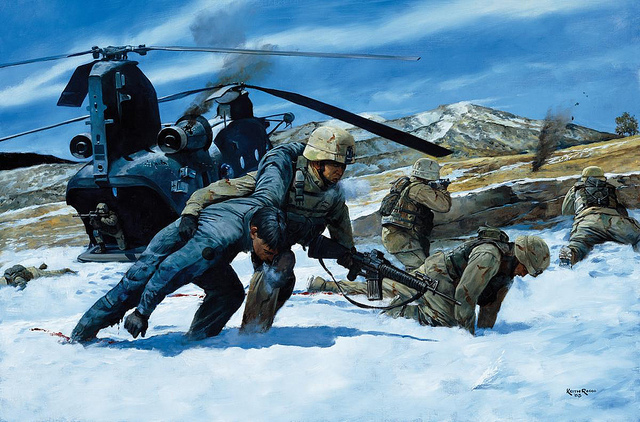
Takur Ghar, Afghanistan, March 4, 2002
March 1, 1781 – Attack on Strode’s Station, Clark County. (Early Indian Wars)
March 1, 1847 – Central mound in the Frankfort cemetery conveyed to the State for a public burying ground, The State Mound.
March 2, 1943 – Battle of Bismarck Sea began. (World War II)
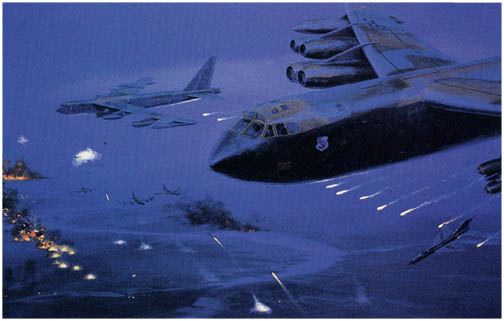
Operation Rolling Thunder, Vietnam, 1968
March 2, 1968 – Operation Rolling Thunder began. Operation Rolling Thunder marked the first sustained American assault on North Vietnamese territory and thus represented a major expansion of U.S. involvement in the Vietnam War. (Vietnam War)
March 3, 1931 – “Star Spangled Banner” made U.S. National Anthem.
March 4, 1966 – Operation Utah (Vietnam War)
March 4, 2002 – Takur Ghar, Patkia Province, Afghanistan-Tech Sgt. Keary Miller, a Combat Search and Rescue Team Leader from the Kentucky Air Guard’s 123rd Special Tactics Squadron, earns a Silver Star for his actions in pulling wounded men out of the line of fire after their MH-47E helicopter crashed landed due to ground fire. Once he established a safe causality treatment area he immediately began giving first aid to a growing number of men. Later he stripped ammunition from the dead and injured and, while repeatedly exposing himself to enemy fire, resupplied those men still able to defend the position. Although seven soldiers lost their lives and ten others were seriously wounded during this 17-hour engagement with Taliban fighters, probably several more would have died without Miller’s heroic service. (Global War on Terrorism)
March 5, 1860 – Act for organization of the Kentucky Militia (State Guard Law).
March 7, 1777 – First siege of Harrodsburg by 47 Indians, under their chief, Blackfish. (Early Indian Wars)
March 7, 1862 - Capt. William Black from Woodford County, Ky., while serving with the 37th Illinois Infantry, single-handedly confronted a Confederate assault during the battle of Pea Ridge, Ark., and turned the tide of the battle. Black would receive the Medal of Honor for his actions. Black’s brother, John, also received the award later that year at the Battle of Prairie Grove, Ark., making them one of the few sets of brothers to earn the Medal of Honor. (Civil War)
March 7, 1951 – Operation Ripper began. (Vietnam War)
March 7, 1867 – 235 copies ordered to be purchased of Adjutant General Daniel W. Lindsey’s Report for 1861-66, known as the “History of Kentucky Soldiers during the late War;” by the Kentucky State Legislature.
March 9, 1867 – The Kentucky legislature cedes to the United States government jurisdiction over the national cemeteries at Perryville, Camp Nelson, Lebanon, and at Mill Springs.
March 9, 1870 – Josiah Stoddard Johnston is appointed Adjutant General of Kentucky by Gov. John W. Stevenson.
March 11, 1968 – Operation Resolve to Win began. (Vietnam War)
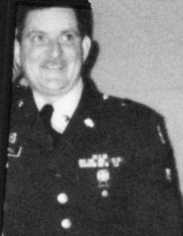
Sgt. Glenn Scott Stanfill
March 12, 2004 – Sgt. Glenn Scott Stanfill, Perry County, sustained fatal injuries when the HUMMWV (M998) he was driving was struck by a tractor-trailer on the Hal Rogers Parkway just East of Manchester, Ky. Stanfill was in route to the East Kentucky Training Site in Artemus with Bravo Company, 206th Engineer Battalion, Hazard, Ky., as part of a battalion Field Training Exercise (FTX).
March 13, 1922 – Pvt. Frank Crone of Covington, a member of the Kentucky National Guard, was on duty as a guard at the Newport Rolling Mill, he was being relieved from duty by John Yates of Newport. Crone was accidentally killed when a revolver slipped from Yates’ pocket and fell to the ground, discharging and mortally wounding Crone.
March 14, 1862 – Engagement at Pound Gap, Letcher County. (Civil War)
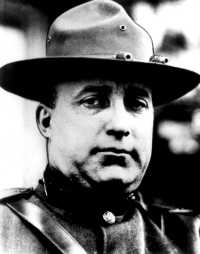
Henry Herman Denhardt
March 14, 1932 – Henry Herman Denhardt is appointed Adjutant General of Kentucky by Gov. Ruby Laffoon.
March 18, 1969 – Operation Breakfast. (Vietnam War)
March 18, 2014 - In the largest Medal of Honor ceremonies in U.S. history, President Barack Obama presents 24 Army Veterans with the nation’s highest honor for their actions in World War II, Korea and Vietnam. The Soldiers were previously recognized with the Distinguished Service Cross, but upgraded after further review of their actions.
March 19, 1836 – Arsenal at Frankfort burnt, with 4,740 stand of arms, besides equipments.
March 19, 1912 – Kentucky State Guard officially renamed the Kentucky National Guard.
March 19, 1924 – James Arthur Kehoe is appointed Adjutant General of Kentucky by Gov. William J. Fields.
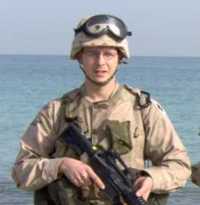
Sgt. Jonathan Adam Hughes
March 19, 2005– Sgt. Jonathan “Adam” Hughes, of Lebanon, Marion Co., Ky., was killed in Iraq when his armored HMMWV vehicle encountered an improvised explosive device (IED) during an escort patrol for a convoy enroute to Baghdad International Airport. At the time of his death, Hughes was assigned to B Battery, 1st Battalion, 623rd Field Artillery, based in Campbellsville, Ky. He joined the Guard in May 2001 when he was 17. His unit mobilized for Operation Iraqi Freedom in November and deployed to Southwest Asia in January 2005. (Global War on Terrorism)
March 22, 1782 – Estill’s defeat by Indians, near Little Mountain (Mount Sterling). (Early Indian Wars)
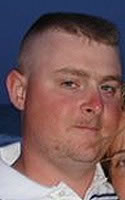
Staff Sgt. Brock A. Beery
March 23, 2006 – Staff Sgt. Brock A. Beery, of Whitehouse, Tenn., was killed when his armored vehicle encountered an improvised explosive device (IED) near Al Habbaniyah, west of Fallujah in Iraq. At the time of the incident Beery was driving a fully-armored light medium tactical vehicle (LMTV). Beery was assigned to the Kentucky Army National Guard’s Headquarters and Headquarters Company, 2nd Battalion, 123rd Armor, based in Bowling Green. The unit mobilized for Operation Iraqi Freedom in March of 2005 and deployed to the Persian Gulf that July (Global War on Terrorism)
March 24, 1992 – SSgt. William Dean Bentley of Elizabethtown (Hardin County) died while on active duty for training at Fort Knox from cardiac arrest while training at the Kentucky Military Academy’s Non-Commissioned Officer Academy in the Primary Leadership Development Course during a field problem. Immediate aid was rendered by members of the 475th MASH and Emergency Room Staff member from Ireland Army Hospital, also participating in PLDC, but they were unable to revive him. Bentley was a member of Battery B, 2nd Battalion, 138th Field Artillery, located in Elizabethtown.
March 25 – Medal of Honor Day.
March 25, 1917 – Claude Somerville of Portland Tenn., died at the Louisville city hospital, following surgery. He had been ill with measles and later developed pneumonia and after recovering from that became ill from emphysema. He enlisted in the 3rd Infantry Regiment of the Kentucky National Guard in Franklin, Kentucky. He died shortly after returning from federal active duty on the Mexican Border.
March 29, 1973 – Last remaining U.S. forces withdraw from South Vietnam.
March 30, 1825 – Confederate General Samuel Maxey is born in Tompkinsville, Ky.
March 30, 1951 – Capt. Merlin R. “Bob” Kehrer perished in the crash of his F-51 “Mustang” near Leesburg, Va., while returning to Louisville from Bolling Air Force Base , D.C. He was a member of the Kentucky Air National Guard.
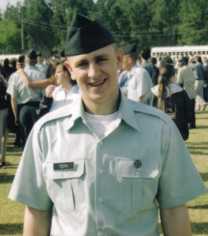
Sgt. Eric Lee Toth
March 30, 2005 – Sgt. Eric Lee Toth, of Edmonton, Metcalfe Co., Ky, was killed in Iraq when his HUMVEE encountered a vehicle-borne Improvised Explosive Device (IED) while returning from an escort patrol for a convoy along the main supply route in Baghdad. Toth joined the National Guard in May 2001. He was assigned to A Battery, 1st Battalion, 623rd Field Artillery, based in Tompkinsville, Ky. This unit mobilized for Operation Iraqi Freedom in November and deployed to Southwest Asia in January 2005. (Global War on Terrorism)
The following is a compilation of significant dates in our Nation’s and commonwealth’s military history. For more on the legacy of our Citizen-Soldiers and Airmen, visit the Kentucky National Guard eMuseum.
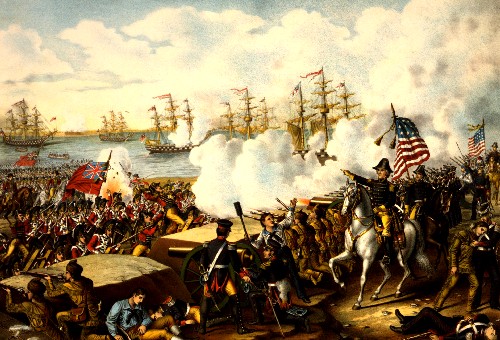
Battle of New Orleans, 1815
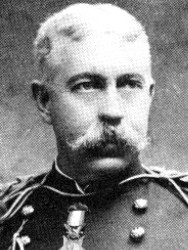
Brig. Gen. John Kerr
January 7, 1815 – 2,500 Kentucky militia, under Maj. Gen. John Thomas, less than one-fourth of them armed (as their arms were on flat-boats, not yet arrived), reach New Orleans. (War of 1812)
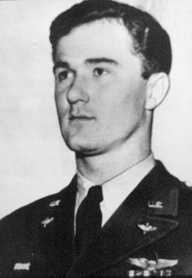
Capt. Thomas Mantell
January 7, 1948 – Capt. Thomas Francis Mantell Jr., was killed while on a training flight with three other P-51Ds (Mustang). Mantell was directed by flight tower at Godman Field, Ft. Knox, to pursue an unidentified flying object. While in pursuit of the object, his aircraft crashed near Franklin, Simpson County, Ky. Capt. Mantell was the first flight casualty of the Kentucky Air National Guard.
January 8, 1815 – American victory at the Battle of New Orleans. (War of 1812)
January 8, 1967 – Operation Cedar Falls (Vietnam War)
January 11, 1862 – Gunboat action at Columbus, Kentucky. (Civil War)
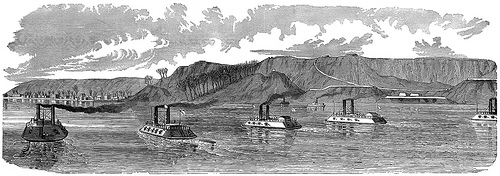
Union gunboats on the Mississippi River near Columbus, Ky., during the Civil War.
January 12, 1945 – 1st Lt. George A. Vanarsdale, Headquarters Company, 192nd Light Tank Battalion (Harrodsburg Tankers) died when the Japanese “Hell Ship” Enoura Maru was sunk (World War II)
January 13, 1917 – Lt. Nathaniel Gibson Hale of Murray’s L Company, Third Kentucky Infantry died of an accidental gunshot wound. Hale was in his tent at the regimental camp, Camp Owen Bierne, some two miles from Fort Bliss, near El Paso, TX. He was part of the Kentucky National Guard contingent called to federal duty to patrol a sixty mile stretch of the border between Fort Bliss and Fort Hancock during the Mexican Punitive Expedition. Hale belonged to the Murray unit, joining as a Pvt. on June 22, 1912. He was promoted to Sgt. and 1st Sgt. and elected 1st Lt. on July 10, 1914.
January 17, 1991 – Operation Desert Storm began
January 18, 1813 – Battle of Frenchtown, Michigan Territory (Monroe, MI) (War of 1812)
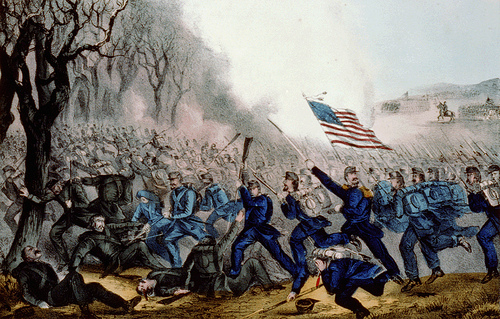
Battle of Mill Springs, Ky., 1862
January 19, 1862– Battle of Mill Springs, Pulaski County (Civil War)
January 20, 1968 – Battle of Khe Sanh began (Vietnam War)
January, 1847 – Maj. John P. Gaines and Capt. Cassius M. Clay, with 30 Kentucky cavalry, along with 50 Arkansas cavalry, are surrounded at Encarnacion by an overwhelming force of Mexican cavalry, and compelled to surrender, taken to the city of Mexico, and imprisoned (Mexican-American War)
January 21, 1839 – The “Louisville Legion,” of dragoons, artillery, infantry and riflemen, authorized as part of the Kentucky Militia.
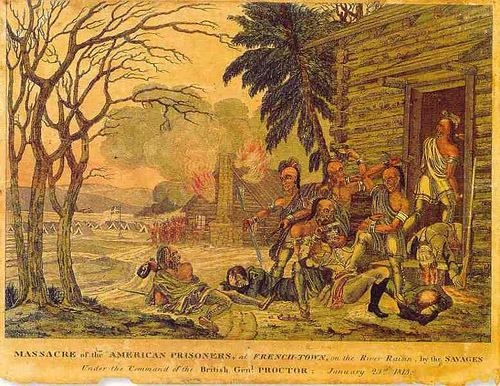
Massacre at the River Raisin, Mich., 1813
January 22-23, 1813 – Battle of the River Raisin, disastrous defeat and massacre of Kentucky troops. “Remember the Raisin” would become the battle cry of Kentucky troops during the remainder of the war in the northwest (War of 1812)
January 22, 1944 – Allies land at Anzio, Italy (World War II)
January 23, 1937 – Sgt. Thomas J. “Tommy” Brown of Madisonville, drowned while on state active duty in response to the flood of 1937. He was assigned to Headquarters Company, 3rd Battalion, 149th Infantry from Madisonville. He is the only known Kentucky National Guardsman who perished on duty during the great flood of 1937. According to newspaper accounts, Brown and 2ndLt. James L. Moore, Pvt. C. W. Anthony and a civilian, Emmett Ashby, were in a boat that lost its stern from vibrations from an outboard motor and quickly sank by the stern throwing all four into the nine-foot deep water. The other three were able to swim to shallow waters but did suffer from exposure and shock. Brown was last seen clinging to the boat bow debris before he sank from sight. The Guardsmen were on a survey mission to assess conditions in Ashbyburg and Jewel City area and Ashby was catching a ride to Ashbyburg in hopes of getting another ride closer to his home. Brown was a butcher in civilian life and was married and had one child. Brown’s battalion commander, Oren Coin, wrote a letter to a legislative committee on the widow’s behalf in December of 1937 seeking some sort of relief for his family. Sgt. Brown’s death most likely was the beginning of the push for the state’s death gratuity for Kentucky National Guardsmen who die on State Active Duty missions.
January 24, 1955 – Col. Philip P. Ardery, senior commander of the Kentucky Air National Guard since its founding, was promoted to the rank of Brig. Gen., the first Kentucky Air Guard member to wear the star of a general officer.
January 25, 1944 – Gustavus Herbert May is appointed Adjutant General of Kentucky by Gov. Simeon Willis.
January 25, 1951 – Operation Thunderbolt began (Korean War)
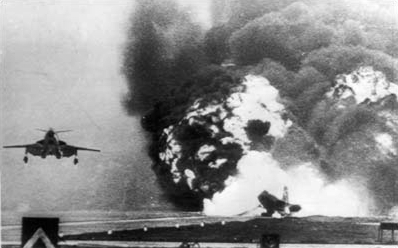
A Kentucky Air National Guard RF-101 Voodoo explodes shortly after take off at Itazuke Air Base, Japan.
January 26, 1968 – All units of the Kentucky Air National Guard except state Headquarters were called to federal service. Kentucky is only one of two states to have both Air and Army Guard units called up in 1968 (the other being Kansas). Kentucky was the only state to have both Air and Army mobilized units deploy overseas. The 165th Tactical Reconnaissance Squadron was assigned, along with two other Air National Guard recon squadrons to a rotation scheme which had each squadron assigned for 60-90 days to the Panama Canal, Alaska and Itazuke Air Base in Japan. During these missions their RF-101 Voodoo jets would photograph areas of interest looking for Soviet, or in the case of Japan, North Korean, naval activity. While the 165th was stationed in Japan in the spring of 1969 one of its pilots, Captain William Seiber, was almost killed when his plane exploded upon take off. The unit returned home and was released from active duty on June 9, 1969. (Pueblo Call-up/Vietnam War)
January 27, 1943 – Sgt. Elzie E. Anness, Headquarters Company, 192nd Light Tank Battalion (Harrodsburg Tankers) died at Camp Tanagawa, Osaka, Japan of dysentery (World War II)
January 28, 1957 – 1st Lt. Owen W. Turner, of Pleasure Ridge (Jefferson County) died when his burning plane crashed near Piedmont, Alabama, some sixty miles west of Atlanta. Turner was flying a T-28 from the Naval Air Station at Atlanta for a navigational proficiency flight to Standiford Field. Turner decided to return to Atlanta because of worsening weather conditions in his flight path. Turner joined the Kentucky Air National Guard in 1948 and was a member of the 165th Fighter Interceptor Squadron.
January 27, 1973 – Signing of Vietnam Peace Accord (Vietnam War)
January 29, 1828 – Preston S. Loughborough is appointed Adjutant General of Kentucky by Gov. Joseph Desha.
January 30, 1968 – Tet Offensive began (Vietnam War)
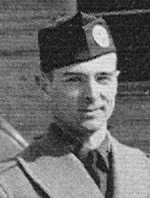
2nd Lt. Archibald Rue
January 31, 1945 – 2nd Lt. Archibald B. “Arch” Rue, Company D, 192nd Light Tank Battalion (Harrodsburg Tankers) died at Camp Fukupka #3 Yawata, Kyushu, Japan of acute colitis (World War II)
January 31, 1956 – Col. Lee J. Merkel, veteran commander of the Kentucky Air National Guard’s base and vice commander of the 123rd Fighter-Interceptor Wing, was killed in an air crash of an F-51 Mustang 10 miles north of Bedford, In.
January 31, 1968 – Battle of Hue began (Vietnam War)
The following is a compilation of significant dates in our commonwealth’s military history. For more on the legacy of our Citizen-Soldiers and Airmen, visit the Kentucky National Guard eMuseum.
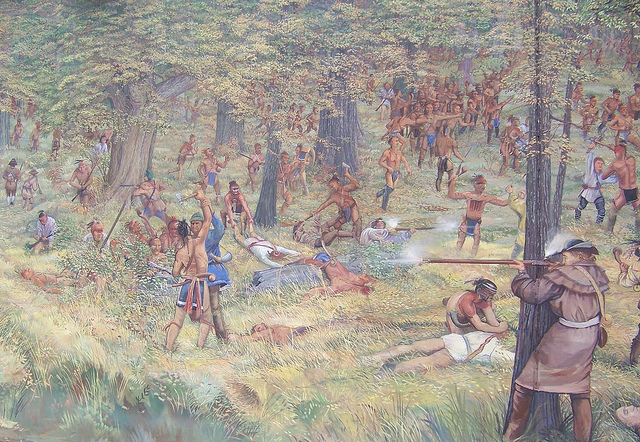
The Battle of Point Pleasant, October 10, 1774
October 1, 1879 – Joseph Preyer Nuckols appointed Adjutant General of Kentucky by Gov. Luke P. Blackburn.
October 1, 1887 – Samuel Ewing Hill is appointed Adjutant General of Kentucky by Gov. Simon Bolivar Buckner.
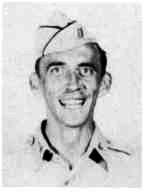
Capt. Richard Ross
October 1, 1950 – Capt. Richard Lee Ross, of Prospect (Jefferson County) died in an aircraft accident near West Point Kentucky during a training flight. He was a member of the 165th Fighter Squadron, Kentucky Air National Guard.
October 2, 1867 – Franklin Lane Wolford is appointed Adjutant General of Kentucky by Gov. John W. Stevenson.
October 2, 1869 – Pvt. Allie Cooper was killed while on state active duty in Springfield, Marion County while serving with Captain Levy’s Cavalry Company of the Woodford Rifles . The Guard had been called out by the governor in response to a request from a District Judge citing lawless bands in the area, sometimes referred to as “Regulators,” they had hung a man named Clem Crowdus. The Guard was sent to assist in capturing those responsible and to keep further similar incidents from occurring. Pvt. Allie Cooper’s killer, a citizen with the last name of Rollins was tried and convicted for Cooper’s murder. Newspaper accounts from the time say that Cooper and an unknown number of fellow soldiers were apparently off duty, were fired upon from the back room of a saloon by at least two assailants. Cooper and his fellow soldiers had been attending the county fair, was reportedly killed by a member of one of the “lawless bands” the Guard had been called in to quiet shortly after they entered the saloon and were speaking to the owner.
October 3, 1993 - Rangers from the 3/75th Ranger Regiment and Soldiers of the 160th Special Operations Aviation Regiment were involved in the Battle of Mogadishu, Somalia, later known through a book and movie as “Black Hawk Down.” Task Force Ranger successfully captured two high-ranking members of clan leader Mohammed Farah Aidid’s forces, but at the loss of 18 U.S. Service Members and two aircraft.
October 4, 1846 – Duel at Port Lavacca, Texas, between Capt. Thos. F. Marshall and Lieut. James S. Jackson, of Capt. Cassius M. Clay’s company, both of the Kentucky cavalry regiment; two shots exchanged, but both escape unhurt (Mexican-American War).
October 5, 1813 – Kentucky Governor Shelby, with 4,000 Kentuckians reinforce Gen. Harrison, and take part in the brilliant victory at the Battle of the River Thames, which closes the hostilities in the northwest theatre of operations (War of 1812).
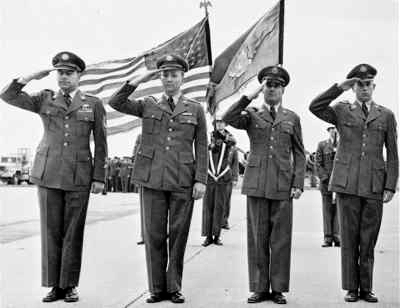
Recognized for their gallantry in rescuing Puerto Rican soldiers from a civilian air crash at Standiford Field were (from left): Master Sgt. Howard Curtis, Tech. Sgt Walter Carter, Tech. Sgt. Charlie Simmons, and Airman 1st Class Jessie Brown.
October 6, 1954 – The Kentucky Medal for Valor presented to Airman 1st Class Jessie Brown, Tech. Sgt. Walter Carter, Master Sgt. Howard Curtis and Tech. Sgt. Charles Simmons by Governor Lawrence Wetherby. They were the first Kentucky Air National Guard recipients to be awarded the medal.
October 7, 1961 – The 413th Ordnance Company arrived at Fort Stewart for active duty in response to the Berlin Crisis. They returned to Kentucky National Guard status on August 12, 1962.
October 7, 2001 – Operation Enduring Freedom began (Global War on Terrorism).
October 8, 1862 – Battle of Perryville, followed by Gen. Bragg’s withdrawal from Kentucky (Civil War).
October 8, 1971 – Operation Jefferson Glenn (Vietnam War)
October 9, 1950 – Invasion of North Korea (Korean War)
October 10, 1774 – Battle of Point Pleasant during Lord Dunmore’s War. Frontier militiamen from Va. were attacked by Ohio River Valley Indian tribes. After an all day battle the Indians left the field, heavy casualties on both sides. The treaty that followed this battle ceded the land southeast of Ohio River to Virginia, opening up that territory for settlement.
October 10, 1864 - Sgt. John Darrough from Maysville, Ky., serving with F Company, 113th Illinois Infantry saves the life a Union officer during action near Eastport, Miss. For his heroism, he receives the Medal of Honor.
October 10, 1942 – Sgt. Oscar Dean, Company D, 192nd Tank Battalion (Harrodsburg Tankers) died at Camp Cabanatuan, Nueva Ecija, Philippines of dysentery (World War II).
October 10, 1950 – Kentucky Air National Guard’s 123rd Fighter Group, personnel and equipment placed on active duty at the direction of President Harry S. Truman. They are ordered to report to Standiford Municipal Airport to serve for a period of 21 consecutive months unless sooner relieved. The unit is part of the First Air Force, Continental Air Command. Elements called to active duty: 123rd Fighter Group, 165th Fighter Squadron, 223rd Air Service Group (Less Detachment C) and 165th Utility Flight (Korean War).
October 10, 1961 – The 3rd Medium Tank Battalion arrived at Fort Knox for active duty in response to the Berlin Crisis. They returned to Kentucky National Guard status on August 12, 1962.
October 11, 1867 – Gov. John W. Stevenson authorizes Adjutant General Frank Wolford to raise 3 volunteer companies in Boyle, Marion, and Casey counties, to sustain the laws and protect the people against the outrages and murders of the “regulators.”
National Guard Association of the United States
October 11, 1879 – The first annual conference of the National Guard Association is held. The Association, which continues in operation today, acts as a political interest group representing Guard concerns with members of Congress. Federal law prohibits members of the armed forces on active duty from ‘lobbying’ Congress so the Association, which is composed of active and retired Guard officers, performs this function.
October 11, 1991 – Tebbs Shewmaker Moore is appointed Adjutant General of Kentucky by Gov. Wallace G. Wilkinson.
October 12, 2000 – Bombing of USS Cole in Yemen.
October 13, 1775 – United States Navy established in Philadelphia, Pa.
October 14, 1861 – John William Finnell is appointed Adjutant General of Kentucky by Gov. Beriah Magoffin and re-appointed to the position by Gov. James F. Robinson.
October 14, 1858 – Presentation to the Masonic Grand Lodge of Kentucky, of the sword worn by Col. Joseph Hamilton Daviess when he fell at the Battle of Tippecanoe – enclosed in a box made of oak from the vary tree under whose shade he expired; presented by Judge Levi H. Todd, of Indiana, a native of Kentucky and a member of the family of Col. Daviess.
October 14, 1952 – Operation Showdown/Battle of Hill 598 (Sniper Ridge) began. (Korean War)
October 15, 1813 – Kentucky troops reach Frenchtown, on the river Raisin, on their return from the victory of the Thames. They collect 65 skeletons of their massacred countrymen, and inter them with proper honors. (War of 1812)
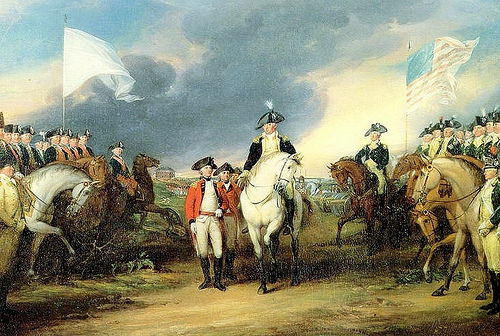
Cornwallis’ surrender at Yorktown, 1781
October 19, 1781 – Surrender of Gen. Charles Cornwallis at Yorktown, Virginia. (American Revolutionary War)
October 19, 2001 – First U.S. Combat Forces on ground in Afghanistan. (Operation Enduring Freedom)
October 20, 1969 – 2nd Battalion, 138th Field Artillery returned home and was released from active duty on October 20, 1969 after serving 11½ months in Vietnam. (Vietnam War)
October 20, 1950 – Korean War’s first Airborne Operation (Korean War)
October 22, 1790 – Harmar’s Defeat. Col. Trotter leads Kentuckians during the campaign. (Early Indian Wars)
October 23, 1944– Battle for Leyte Gulf (World War II)
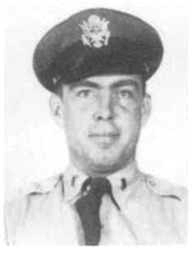
Capt. John Shewmaker
October 23, 1951 – Capt. John William Shewmaker of Harrodsburg was a pilot with the 165th Fighter Squadron for several years and went to Korea with the 111th Fighter-Bomber Squadron and was killed while flying an escort mission over North Korea on a bombing raid on this date. He was classified missing in action until the end of 1953. The Kentucky Air National Guard base was named Shewmaker Air National Guard Base in his honor on February 17, 1959 with a public ceremony in June 1960. The name was ordered changed in 1976 with the new designation of Standiford Field (ANG).
October 23, 1965 – Battle of the Ia Drang Valley began (Vietnam War)
October 23, 1983 – Beirut Terrorist Attack
October 24 – United Nations Day
October 24, 1944 – Pvt. Vernon H. Bussell, Pfc. Robert V. Cloyd, Pfc. Ancel Edgar Crick, Pvt. First Class John Lewis Cummins, Pvt. James William Sallee, all serving with Headquarters Company 192nd Light Tank Battalion (Harrodsburg Tankers) died aboard the Japanese “Hell Ship” Arisan Maru, when it was sunk.
October 25, 1983 – Operation Urgent Fury.
October 26, 1918 - Godman Airfield at Fort Knox becomes first airfield for U.S. Army Air Corps in Kentucky. It was built for the 29th Aero Squadron and first used by the 31st Balloon Company.
October 27 – Navy Day
October 28, 1961 – The 2nd Medium Tank Battalion arrived at Fort Stewart for active duty in response to the Berlin Crisis. They returned to Kentucky National Guard status on August 12, 1962.
October 29, 1967– Battle of Loc Ninh began (Vietnam War)
2nd Lt. Richard Hudson
October 30, 1957 – 2nd Lt. Richard Lloyd Hudson perished near Vevay, In., when the Kentucky Air National Guard F-86A Sabre Jet he was piloting crashed during a routine Air Defense Command scramble. He enlisted in the Kentucky Air National Guard in August 1953. He entered cadet training in November 1955 and received his commission and wings on March 28, 1957.
October 31, 1968 – Operation Rolling Thunder ended (Vietnam War)
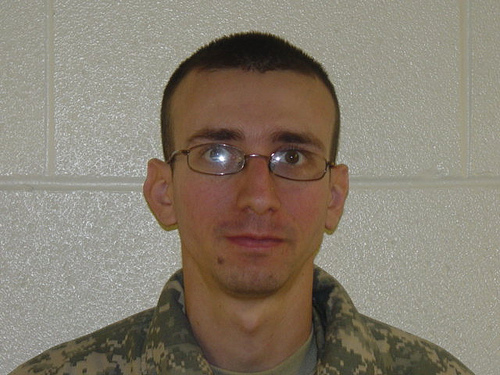
Sgt. Daniel Wallace
October 31, 2008 – Sgt. Daniel Wallace, of Dry Ridge, Grant County, Kentucky was killed when his unit was attacked by enemy forces while conducting a route clearing mission to remove improvised explosive devices (IED’s) in West Paktika Province, Afghanistan. Wallace was a member of Company C, 201st Engineer Battalion based in Cynthiana and serving with Company B from Olive Hill in Afghanistan. Wallace was serving as a gunner on a Mine-Resistant, Armor-Protected vehicle (MRAP) when they came under small-arms fire. The 201st mobilized in March 2008 and deployed to Afghanistan in May 2008. Wallace enlisted in the Kentucky National Guard in May of 2006.
The following is a compilation of significant dates in our commonwealth’s and Nation’s military history. For more on the legacy of our Citizen-Soldiers and Airmen, visit the Kentucky National Guard eMuseum.
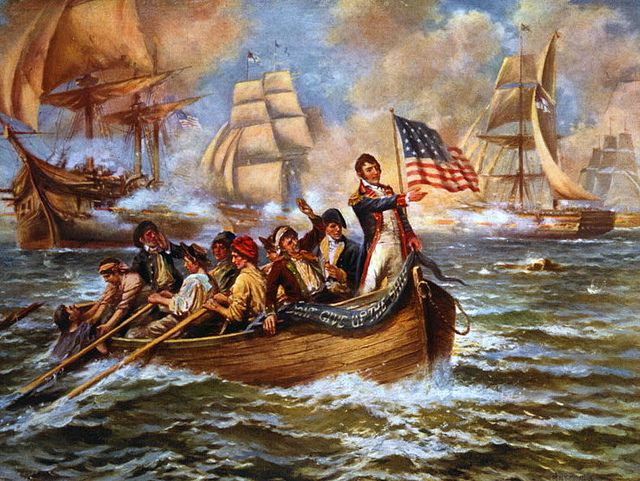
The Battle of Lake Erie, September 10, 1813.
September, 1793 – Gen. “Mad” Anthony Wayne calls for mounted volunteers from Kentucky; but, having lost confidence in the regular troops in Harmar’s and St. Clair’s defeats, Kentuckians refuse to volunteer.
September 1, 1863 – John Boyle appointed Adjutant General of Kentucky by Gov. Thomas E. Bramlette.
September 1, 1864 – Battle of Jonesboro, Ga. part of Atlanta Campaign. Kentucky Orphan Brigade attempts to hold strategic railroad position south of the city. However are not reinforced when attacked in force and are cut off from main Confederate position, suffer heavy casualties. The loss of rail line cuts off any hope of resupply for the Confederates in Atlanta and the city is evacuated. Union Army enters Atlanta the next day. (Civil War)
September 1, 1864 - Pvt. Henry Mattingly from Marion County, Ky., with Company B, 10th Kentucky Infantry displays fierce bravery in the Battle of Jonesboro, Georgia and captures the regimental flag of the 6th and 7th Arkansas Infantry. Mattingly receives the Medal of Honor for his actions.
September 1, 1891 – First appointment of Andrew Jackson Gross as Adjutant General of Kentucky by Gov. John Y. Brown.
September 1, 2010 – Beginning of Operation New Dawn, end of U.S. Military’s combat role in Iraq.
September 2, 1914 – James Tandy Ellis appointed Adjutant General of Kentucky by Gov. Augustus O. Stanley. Ellis would be re-appointed as the Adjutant General by Gov. James B. Black.
September 2, 1945– VJ (Victory Japan) Day: Japan signed formal surrender. (World War II)
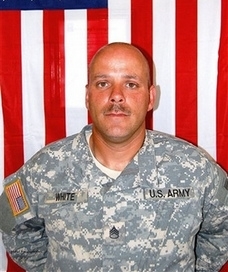
Staff Sgt. Delmar White
September 2, 2007 – Staff Sgt. Delmar White, Lexington (Fayette County), was killed by an improvised explosive device (IED) while on a convoy escort mission in Baghdad, Iraq. White, 37, was assigned to Battery B, 2nd Battalion, 138thField Artillery, based in Carlisle, Ky. White was a corrections officer with Lexington Fayette Urban County Government and deployed with his unit in August 2007 in support of Operation Iraqi Freedom. He joined the Kentucky Army National Guard in 1998. (Global War on Terror).
September 4, 1864 – Gen. John Hunt Morgan shot and killed by Union officers at Greenville, Tennessee. (Civil War)
September 4, 1875 – John Montgomery Wright is appointed Adjutant General of Kentucky by Gov. James B. McCreary.
September 5, 1871 – James Allen Dawson is appointed Adjutant General of Kentucky by Gov. Preston H. Leslie.
September 5, 1883 – John Breckinridge Castleman is appointed acting Adjutant General of Kentucky from 1883 – 1887, by Gov. J. Proctor Knott.
September 6, 1845 – Gov. Owsley is notified by the secretary of war, that Gen. Zachary Taylor is authorized to call upon Kentucky for troops to repel the apprehended Mexican invasion. Gov. Owsley replies that any requisition upon Kentucky will be promptly and gallantly responded to.
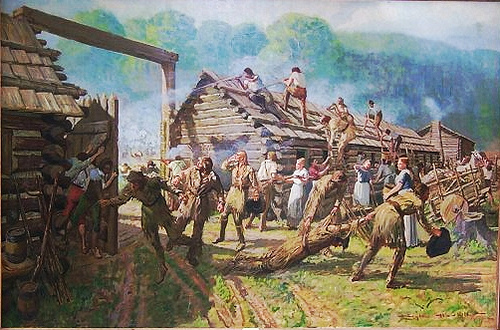
Siege of Boonesborough
September 7, 1778 – Siege of Boonesborough by Captain de Quindre and a large force of Indians and Canadians. Siege ended Sept. 20. (American Revolutionary War)
September 7, 1944 – 2nd Lt. Harry Ricker LaFon, Jr., and Pvt. Hugh J. Leonard, both serving with Company D, 192nd Light Tank Battalion (Harrodsburg Tankers) died aboard the Japanese “Hell Ship” Shinyo Maru when it was sunk. (World War II)
September 8, 1898 – Wilbur Rush Smith is appointed Adjutant General of Kentucky by Gov. William O. Bradley.
September 8, 2009 - U.S. Marine Cpl. Dakota Meyer from Columbia, Ky., at the Battle of Ganjgal, Afghanistan, made multiple trips through intense enemy fire in a gun truck to help rescue U.S. and Afghan personnel, then returned on foot to secure the bodies of his fallen team members. Meyer receives the Medal of Honor for his actions.
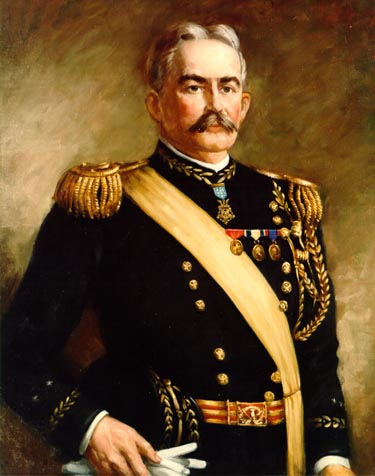
Maj. Gen. James Franklin Bell
September 9, 1899 - Col. James Franklin Bell from Shelbyville, Ky., alone charged a bunker through enemy fire causing the surrender of several combatants at Porac, Luzon, Philippine Islands during the Philippine Insurrection. He receives the Medal of Honor for his actions. Bell was a 1878 graduate of West Point and during the Spanish-American War, becomes the first Medal of Honor recipient to also receive the Distinguished Service Cross. He served as the Chief of Staff for the U.S. Army and attained the rank of major general prior to his death in 1919.
September 9, 1943 – Operation Avalanche (Allied landing at Salerno, Italy). (World War II)
September 10, 1813 – Commodore Oliver Hazard Perry’s victory at Put-In-Bay (Battle of Lake Erie). Approximately 150 Kentucky Militiamen served as Marines aboard Perry’s fleet. (War of 1812)
September 10, 1845– Gen. Peter Dudley, sent by Gov. Owsley to Clay County. Two companies of troops from Madison County, under command of Col. John Miller ordered out to maintain law and order, remain until after the execution of Dr. Baker.
September 10, 1962 – U.S. Naval Sea Cadet Corps Incorporated.
Pfc. Sammie Phillips
September 10, 2007 – Pfc. Sammie E. Phillips of Vine Grove (Hardin County), was killed when his vehicle overturned while conducting a traffic control mission on a highway near Rustamiyah, Iraq. Phillips, 19, was assigned to Battery B, 2nd Battalion, 138th Field Artillery, based in Carlisle, Ky. Phillips joined the Kentucky Army National Guard in 2006 and deployed with his unit in August 2007 in support of Operation Iraqi Freedom. He was a 2006 graduate of North Hardin High School. (Global War on Terrorism)
September 11 – Patriot Day: World Trade Center and Pentagon Terrorist Attacks
September 11, 1895 – Two cannon crews of Battery A, 1st Regiment of the Kentucky State Guard, known as the Louisville Legion were dispatched from the downtown Louisville armory to Phoenix Hill Park to fire a 44-gun salute at sunrise to awaken the city as a part of the festivities for the 29th Encampment of the Grand Army of the Republic (GAR). Each cannon was to fire 22 times. When the second caisson, which was 15 minutes behind the first, reached 4th and Broadway at 5:30 a.m. an explosion occurred. Forty-four bags of carefully packed black powder; each weighing 1.5 lbs., mysteriously ignited. The result was five men and two horses killed several people injured and property damage to buildings in the area. Those killed were Corp. Arthur Langan Robinson, Pvt. Charles Brechner (Biechner), Pvt. Charles C. Woods, Pvt. Archibald McBride, and a civilian, Mr. William Adams Sr. Mr. Adams had been hired by the officers of the Louisville Legion to drive the caisson to Phoenix Hill.
September 11, 1967 – Siege of Con Thien began. (Vietnam War)
September 12, 1859 – Scott Brown is appointed Adjutant General of Kentucky by Gov. Beriah Magoffin.
September 13, 1951 – Battle of Heartbreak Ridge (Korean War)
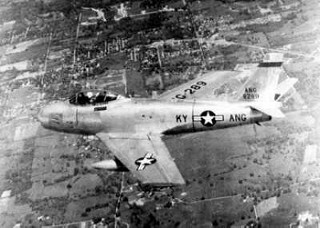
F-86A Sabre
September 13, 1956 – The Kentucky Air National Guard receives its first F-86 Sabrejets at Standiford Field. The full complement of 25 Sabres was expected by October 15, with three T-33s and eight T-28 trainers.
September 14, 1781 – Long Run Massacre. As Indian activity increased the settlers at Boone’s Station sought protection at Linn’s Station. While enroute to that location they were attacked along the banks of Long Run Creek, about 60 people were killed.
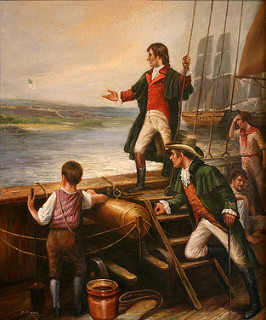
Francis Scott Key in Baltimore Harbor
September 14, 1814 – “Star Spangled Banner” written by Francis Scott Key (War of 1812)
September 14, 1966 – Operation Attleboro (Vietnam War)
September 14, 1971 – Capt. Roger M. Sanders died when his RF-101 “Voodoo” crashed shortly after takeoff. He was able to eject, but did not survive his injuries from the incident. Sanders was taking off simultaneously with another aircraft for a night refueling exercise. The other aircraft landed safely in Indiana.
September 14, 2002 – Marion National Guard Armory named in honor of 1st Sgt. Carson G. Davidson.
September 15, 1950 – Inchon Landing (Korean War)
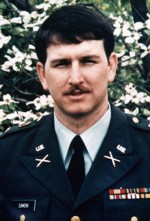
2nd Lt. Vincent Simon
September 15, 1984 – 2nd Lt. Vincent Simon, age 30, of Glasgow (Barren County), died at Fort Knox, Kentucky in the line of duty while on inactive duty for training (IDT). He was a member of Battery C, 1st Battalion, 623rd Field Artillery based in Monticello. He died from injuries he received when the military vehicle, a M-151 ¼ ton “Jeep” he was operating was involved in an accident. He was a graduate of Western Kentucky University and was a Civil Engineer in his civilian life with J. N. Gray Construction Company in Glasgow. He joined the US Army in 1972 after high school and rose to the rank of Specialist 5 before leaving the Army and joining the Kentucky Army National Guard in December 1975. He rose to the rank of Staff Sgt. He was a graduate of the Boone Raiders course in 1983 and the Kentucky Military Academy’s Officer Candidate School. He was commissioned a 2nd Lt. on July 8,1984, just a few weeks before his death.
September 16, 1847 – Kentucky soldiers who fell at the Battle of Buena Vista, Mexico, from Shelby, Montgomery, and Franklin counties, interred with full military honors in the state cemetery.
September 16, 1950 – Naktong Perimeter Breakout began. (Korean War)
September 17, 1787 – Citizenship (Constitution) Day: U.S. Constitution approved.
September 17, 1862 – Battle of Antietam near Sharpsburg, Maryland (Civil War)
September 17, 1914 – Ladies Auxiliary VFW organized.
September 17, 1944 – Operation Market Garden (World War II)
September 18-20, 1863 – Battle of Chickamaugua, Georgia (Civil War)
September 18, 1947 – U.S. Air Force established.
September 18, 1950 – Inchon Operation and Liberation of Seoul began. (Korean War)
September 18, 1994 – Operation Uphold Democracy.
September 19 – POW/MIA Recognition Day.
September 19, 1817 – Oliver Garnett Waggoner/Waggener is appointed Adjutant General of Kentucky by Gov. Gabriel Slaughter. He was re-appointed to the position under governors John Adair, and Joseph Desha.
September 19, 1971– Kentucky Air National Guard Chaplain Lt. Col. William Hisle died after a long illness. His work with Korean War orphans had been carried on despite his declining health and Lt. Col. Hisle was presented the first Legion of Merit received by a member of the Kentucky Air Guard.
Staff Sgt. William Alvin Allers III
September 20, 2005– Staff Sgt. William Alvin Allers III, 28, of Leitchfield (Grayson County) Ky., was killed near Al Khalis, Iraq (40 miles north of Baghdad) when his armored humvee encountered an Improvised Explosive Device (IED). Allers was assigned to the Kentucky Army National Guard’s 617th Military Police Company, based in Richmond with a detachment in Bowling Green. The 617thMP Company mobilized for Operation Iraqi Freedom in October of 2004 and deployed to Southwest Asia that November. Originally from Baltimore, Md., Allers joined the Kentucky Army National Guard in September of 2003 after serving with the U.S. Army and worked in Leitchfield for an office supply business. (Global War on Terror)
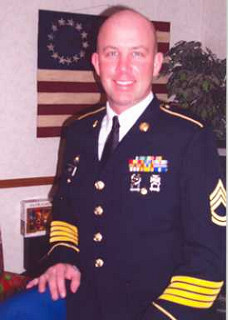
Sgt. 1st Class Chales Jason Jones
September 20, 2006 – Sgt. 1st Class Charles Jason Jones of Lawrenceburg (Anderson County), 29, died at Camp Liberty in Baghdad of non-combat related cause. Jones was assigned as a medic to the 149th Brigade Combat Team Headquarters. The unit, comprised of 50 soldiers, deployed to Iraq earlier in 2006 and had teams stationed throughout Iraq. Jones joined the Kentucky National Guard in 1993 at age 17 and graduated from South Laurel High School in London, Ky. in 1994. Prior to deploying to Iraq, Jones was a full-time Kentucky National Guard soldier stationed in Frankfort, Ky. Jones was a seasoned veteran, with previous deployments in 2002 to Germany and Bosnia. He also deployed to Afghanistan in support of Operation Enduring Freedom in 2004. (Global War on Terror)
September 21, 1951 – Operation Summit (Korean War)
September 24, 1846 – Capture of Monterey, Mexico. The Louisville Legion, being posted to guard a mortar battery, and exposed to the enemy’s cannon fire for about 24 hours without being able to return their fire, hold in check the enemy’s cavalry, and “display obedience, patience, discipline, and calm courage.” Maj. Gen. Wm. O. Butler seriously wounded, and Maj. Philip Norbourne Barbour, of the 3rd regular infantry, killed (both Kentuckians). (Mexican-American War)
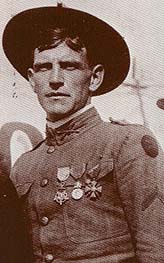
Sgt. Willie Sandlin
September 26, 1918 - Sgt. Willie Sandlin from Jackson, Ky., with Company A, 132rd Infantry, 33rd Division single-handedly destroyed three German machine gun emplacements and killed twenty-four of the enemy on at Bois de Forges, France. Sandlin receives the Medal of Honor for his actions. During World War I, only Sgt. Alvin York is more decorated than Sandlin.
September 28, 1793 – Gov. Shelby orders the first draft for Kentucky troops, which is successful in getting troops for Wayne’s expedition. (Early Indian Wars)
September 28 – Gold Star Mother’s Day
September 28, 1953 – Four Kentucky Air National Guardsmen were cited for their heroic efforts to rescue survivors in the wreckage of a chartered C-46 transport carrying soldiers from Camp Kilmer, NJ to Fort Knox. Recognized for their bravery were Jess D. Brown, Walter Carter, Howard A. Curtis and Charles W. Simmons, all were full-time air guard technicians.
September 29, 1899 – VFW established.
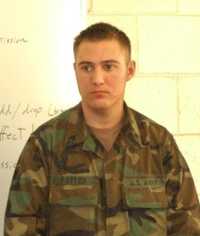
Sgt. Darrin Potter
September 29, 2003 – Sgt. Darrin K. Potter, 24, of Louisville, Ky., was killed in Iraq when his military police team responded to reports of a mortar attack outside of Baghdad near Abu Ghraib Prison, in Iraq. Potter was a member of the 223rd Military Police Company serving with the 800th Military Police Brigade in Iraq. It was the Kentucky Guard’s first combat-related death since the Vietnam War. (Global War on Terrorism)
September 30, 1848 – Col. Edward Brooks reaches Frankfort with the bones of the brave Kentuckians who were massacred by the Indians at the River Raisin, Jan. 18, 1812, which are interred in the state cemetery. They had been found in a common grave, and discovered, while digging down a street in Monroe, Mich. The skulls were all cloven with the tomahawk, and an aged French citizen, a survivor of the massacre, knew them as the bones of the unfortunate Kentuckians, because he remembered the spot where they were buried.
Story by David Altom, Kentucky National Guard Public Affairs
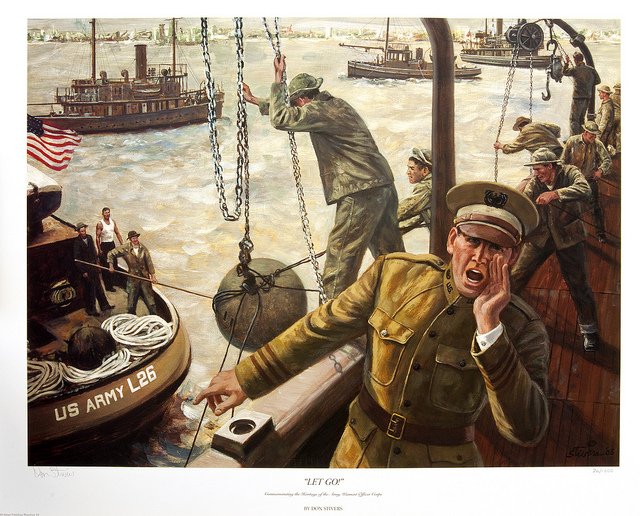
“Let Go!” depicts the founding the Army Mine Planter Service as part of the Coast Artillery Corps. The act designated warrant officers to serve as masters, mates, chief engineers and assistant engineers of mine-planting vessels.
July has been declared Kentucky National Guard Warrant Officer Month in a proclamation by Gov. Steve Beshear. This is one of a series of articles we are publishing in celebration of the warrant officer corps. Click here to read more about 95th birthday of the Army’s warrant officer corps.
FRANKFORT, Ky. — The warrant officer corps is probably the most misunderstood of all of ranks in the United States Army. The truth of the matter is that the warrant officer rank has a long and distinguished legacy going back to 1775 and the founding of our nation. As far as the Army is concerned, in July 1918 the first Warrant Officer Corps was established when an act of congress established the Army Mine Planter Service as part of the Navy’s Coast Artillery Corps; during the First World War warrant officers were responsible for mine defenses in major ports and vessels of all sizes were used to lay and maintain minefields.
Chuck Yeager, famed for breaking the sound barrier, began his career during World War II as a flight officer, the U.S. Army Air Corps equivalent of a warrant officer.
There are several notable warrant officers in military history. Brig. Gen. Chuck Yeager, famous for breaking the sound barrier, began his career as a flight officer (aka warrant officer) in the U.S. Army Air Corps during World War II.
Michael Novosel once piloted a B-29 bomber in World War II. During the Vietnam War he made the decision to give up his rank of lieutenant colonel in the Air Force to fly Army helicopters as a chief warrant officer with special forces and MEDEVAC units. It was as a warrant officer that he was presented the Medal of Honor for his bravery in conducting a medical evacuation under fire.
Tom Hennen was a United States Army warrant officer with 24 years in the imagery intelligence field. His skills and training led to him becoming the first warrant officer in space, flying aboard the Space Shuttle Atlantis in 1991.
A B-29 bomber pilot during World War II, Michael Novosel gave up his commission as an Air Force lieutenant colonel to fly Huey helicopters with the Army during Vietnam. He was a chief warrant officer when he received the Medal of Honor in 1971.
Today, in its 95th anniversary, the Army’s warrant officer corps continues its legacy as an integral and essential element in daily operations and the chain of command. Following are a few myths and facts about this fascinating and often misunderstood rank.
Myth #1. Warrant officers are not “real officers.”
False: Warrant officers are highly skilled, specialty officers, and while the ranks are authorized by Congress, each branch of the uniformed services selects, manages, and utilizes warrant officers in slightly different ways. Warrant officers can and do command detachments, units, activities, vessels, aircraft, and armored vehicles as well as lead, coach, train, and counsel subordinates.
According to Chief Warrant Officer Ryan Turner, who runs the Kentucky Guard’s warrant officer recruiting program, “The warrant officer’s main job is to serve as a technical expert, provide skills, guidance, and expertise to commanders and organizations in their particular field.”
Among his many accomplishments, Tom Hennen goes down in history as the first warrant officer in space.
Myth #2. Only the Army has warrant officers.
False: The United States Navy and the Marine Corps have warrant officers, as does the Coast Guard and the Public Health Service Commissioned Corps. The United States Air Force inherited the warrant officer ranks from the Army Air Corps at its inception in 1947, but stopped appointing warrant officers in 1959.
Myth #3. All warrant officers are pilots.
False: Not so, says Turner. “Warrant officers in the Army are the technical experts, combat leaders, trainers, and advisors in more than forty basic military occupational specialties. They serve across the active component, the Army National Guard, and the U.S. Army Reserve.”
Warrant officers also command the Army’s waterborne and sea-going vessels, most Army Bands and as aircraft commanders of most Army Aviation aircraft. In addition, they may be found in command of various small units and detached teams such as special forces and criminal investigation detachments.
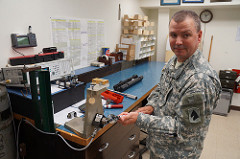
Warrant Officer Robert Boatman’s calibration shop ensures that the Kentucky Guard’s equipment and gear are all set to the right specifications, an essential factor in the increasing technology used by today’s soldiers. (Photo by David Altom, Kentucky National Guard Public Affairs)
Myth #4. Warrant officer training is a piece of cake.
False: Well, depending on your point of view. There are three basic approaches to becoming a warrant officer: 1) The six-week active resident course at Fort Rucker, Ala. 2) Distance learning plus four and a half weeks (if you are an E-5 with Warrior Leader Course) or 3) Through the 238th Regimental Training Institute, completing distance learning, five drills and a two-week annual training period. No matter which direction take, there are classes in leadership, tactics and military history and protocol, along with extensive physical training and testing.
According to Chief Warrant Officer Rick Skelton, TAC officer with the 238th RTI’s warrant officer candidate school, the training ain’t easy, but it’s not insurmountable, either.
“At one point it was actually one of the toughest schools in the army,” said Skelton. “It’s still pretty rigorous. We just finished a 6.2 mile ruck march with a fifty pound pack. You’ve got to have your head in the game, but you can do it. You just have to want to be there.”
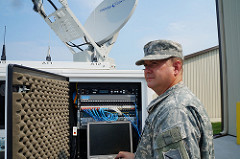
Kentucky National Guard Chief Warrant Officer Harold Brandenburg runs satellite communications during emergencies and natural disaster missions, linking local, state and federal agencies together when traditional networks are at a complete standstill. (Photo by David Altom, Kentucky National Guard Public Affairs)
Myth #5: The warrant officer corps is an archaic and dying breed.
False: “The warrant officer corps is alive and well and growing,” said State Command Warrant Officer Chief Jimmy Simms. “Just recently the Kentucky Army National Guard has received authorization for new warrant positions in electronic warfare, putting us ahead of the curve in this growing field. Artillery targeting is another warrant officer field that is growing, as are warrant positions in special forces. So, yes, we are a powerful force in the Guard and we’re getting stronger every day.”
For more information on the Kentucky National Guard’s warrant officer program contact Chief Warrant Officer Ryan Turner at (502) 607-6200, Cell: (502) 320-3653 or email him at [email protected].
The following is a compilation of significant dates in our nation’s and the commonwealth’s military history. For more on the legacy of our Citizen-Soldiers and Airmen, visit the Kentucky National Guard eMuseum.
Battle of Pal Alto, May 8, 1846
May 1, 1970– Cambodia Campaign began (Vietnam War)
May 2-3, 1863 - Battle of Chancellorsville, Virginia (Civil War)
May 2, 1936 - First records of Kentucky National Guardsmen assisting in the security of Churchill Downs for the Kentucky Derby.
May 2, 1945 – German unconditional surrender to Italian Allies (World War II)
May 5, 1813 – Brig. General Green Clay, with 3,000 Kentuckians, reaches besieged Fort Meigs, Ohio. On orders from General William Henry Harrison divides his force, his part of the force cuts their way through the enemy’s lines into the fort. 800 Kentuckians, under Col. Wm. Dudley, are order to cross the Maumee River and attack the guns and spike them so they can no longer fire. Once this was accomplished, the militia pursues what appears to be retreating Indians under the leadership of Tecumseh. After they entered the woods, the Indians counterattacked while the British forces swung around their flanks cutting most off from the river. Only about 150 escaped with the remainder being killed or captured. Of those captured, about 50 were murdered by the Indians before Tecumseh put a stop to it. The British, without use of their artillery, soon lifted the siege and moved back into Canada (War of 1812)
May 5, 1942 – Fall of Corregidor (World War II)
May 5, 1968 – Mini-Tet began (Vietnam War)
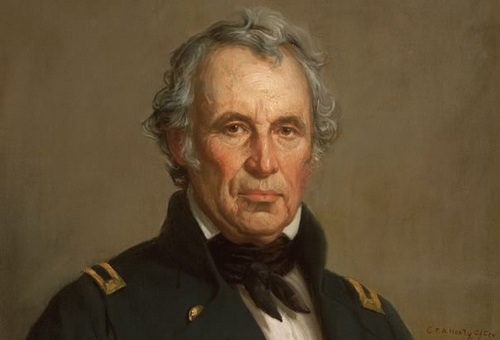
Gen. Zachary Taylor
May 8, 1846 – General Zachary Taylor defeats the Mexicans at Palo Alto (Mexican-American War)
Pvt. Roy Edward Goodpaster
May 8, 1945 – Pvt. Roy Edward Goodpaster, Company D, 192nd Light Tank Battalion (Harrodsburg Tankers) died at Camp Moji Hospital Fukuoka #4 Kyushu Island Japan of wounds received aboard the “Hell Ships” Oryoku Maru & Enoura Maru (World War II)
May 8, 1945 – VE (Victory Europe) Day, Germany’s Unconditional Surrender Signed (World War II)
May 8, 1972 – U.S. Navy mined North Vietnamese ports (Vietnam War)
May 9, 1781 – McAfee Station, along Salt River attacked by over 150 indians. Only 13 men and their families inside who kept up a gallant defense for near 1/2 day until help arrived from nearby Harrodsburg. One settler killed at onset of action, 1 minor wounded. As pursuit was made the Indians made a stand at the ford of the river 1 more killed and 1 injured when thrown from horse. (Early Indian Wars)
May 9, 1846 – General Zachary Taylor defeats the Mexicans at Resaca de la Palma (Mexican-American War)
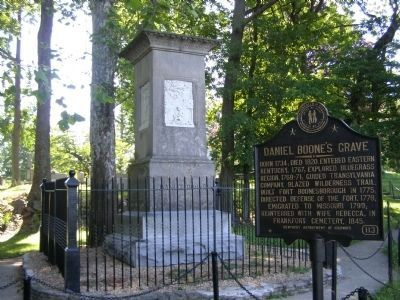
Daniel Boone Gravesite in Frankfort Cemetery
May 9, 1868 – Kentucky Legislature to present a Gold Medal to Samuel Hatfield, of Floyd County, another survivor of the Kentuckians who assisted in achieving Perry’s victory on Lake Erie, September 10, 1813.
May 9, 1868 – Kentucky Legislature appropriates funding to repair monument over Daniel Boone’s grave, which had been defaced by Federal soldiers during the war.
May 10, 1773 – The McAfee Company (James Jr., Robert, & George McAfee along with James McCoun Jr. and Samuel Adams) left Virginia on a 4-month expedition into Kentucky . Explored lands along Ohio & Kentucky Rivers. descended the Kentucky to where Frankfort now is located, continued exploration of Henry, Franklin, Anderson, & Mercer Counties. Eventually making land claims along Salt River.
May 10, 1863 - Confederate General “Stonewall” Jackson dies from wounds after being fired upon by his own men a week earlier. (Civil War)
May 10, 1969 – Battle for Hill 937, nicknamed Hamburger Hill (Vietnam War)
May 10, 1972 – Operation Linebacker (Vietnam War)
May 11, 1871 – Re-interment at Crab Orchard, Lincoln, County, of the unknown Southern soldiers who fell at the Battle of Wildcat Mountain, in 1862.
Pfc. Wesley Hungate
May 12, 1942 – Pfc. Wesley Davis Hungate, Company D, 192nd Light Tank Battalion (Harrodsburg Tankers) died at Camp O’Donnell, Capas, Tarlac, Philippines of dysentery while a Japanese prisoner of war (World War II)
May 13, 1846 – Congress of the United States declares war on Mexico. Maj. Gen. E.P. Gaines makes a requisition on the Governor of Kentucky for 4 regiments of volunteers, comprising 2,400 men (Mexican War)
May 13, 1968 – 2nd Battalion, 138th Field Artillery entered active duty and served 11½ months in Vietnam. Kentucky was only one of two states to have both Air and Army Guard units called up in 1968 (the other being Kansas). Kentucky was the only state to have both Air and Army mobilized units deploy overseas (Vietnam War and Pueblo Call-up)
May 16, 1861 – Kentucky proclaimed its neutrality. (Civil War)
May 17 – Armed Forces Day.
May 17, 1846 – Governor Owsley issues a proclamation, appealing to Kentuckians “to form themselves into volunteer companies,” and to report to him forthwith (Mexican War)
May 18, 1846 – The Louisville Legion, offer their services to the governor, and are accepted (Mexican War)
May 19, 1942 – Sergeant Ben R. Devine, Company D, 192nd Tank Battalion (Harrodsburg Tankers) died at Camp O’Donnell, Capas, Tarlac, Philippines of dysentery while a Japanese prisoner of war (World War II)
May 20, 1777 – St. Asaph’s or Logan’s Fort or Logan’s Station resists attack by Indians (Early Indian Wars)
William H. Horsfall, Medal of Honor Recipient
May 21, 1862 - William H. Horsfall from Campbell County, Ky., a 15-year-old drummer with Company G, 1st Kentucky Infantry, saves the life of a wounded officer lying between the lines of fire at Corinth, Miss. Horsfall received the Medal of Honor for his actions. (Civil War)
May 22, 1846 – Formal proclamation of Governor Owsley for two regiments of infantry or riflemen, and one of cavalry, for the service of the United States against Mexico (Mexican-American War)
P-51 Mustang of the 359th Fighter Group
May 24, 1946 – The 359th Fighter Group was redesignated as HQ, 123rd Fighter Group, and allotted to the Air National Guard of Kentucky, together with its colors and World War II battle participation credits. The 368th Fighter Squadron was also allotted to the KyANG with its colors and record, and redesignated as the 165th Fighter Squadron.
May 25, 1921 – Private Manley Vaughan, Troop C, 53rd Machine Gun Squadron, Louisa, Kentucky, was killed near Borderland W. Va. Kentucky National Guard soldiers from Louisa, Morehead and London were on state active duty from May 14, to June 4, 1921 along the Kentucky – West Virginia border in connection with a coal strike in the Tug River District.
At approximately 10 p.m. on May 25, 1921, a West Virginal State Policeman reported some sixty shots fired on the Kentucky shore of the Tug River below Nolan, West Virginia. Lt. Fred See of the Kentucky National Guard was stationed nearby in Pike County and asked by the West Virginia State Police to reconnoiter and try to end the disruption. There was a coal strike in progress in the area and martial law was in effect and the shots were apparently fired across the river in the direction of the Big Splint mining camp in West Virginia where the United Mine Workers union had erected a tent camp to house the striking miners.
Lieutenant See and seven men, including Vaughn, set out to investigate. They crossed the river at Borderland into West Virginia due to heavy rains making roads nearly impassable, he planned to follow the railroad track and cross back to the Kentucky side below Nolan to get to the site of the disturbance. At Nolan he was joined by an unknown number of West Virginia State Police and they proceeded down the track. Hearing a group of men coming up the track, Lieutenant See and his men advanced and stopped four men. When ordered to put up their hands, two men cooperated. Soldiers were searching the individuals for weapons when Vaughan and a West Virginia State Police Officer Charles M. Kackley were shot in the head from behind. Both were killed. One of the union miners in the group escaped in the darkness but was recaptured the next day.
May 26, 1846 – Governor Owsley announces, that the requisition upon Kentucky for troops is full (Mexican War)
May 26, 1871 – Confederate Memorial Day inaugurated, commemorating the occasion when Jefferson Davis was freed from prison.
May 27, 1778 – George Rogers Clark and men camp on Corn Island, at Falls of the Ohio (Louisville).
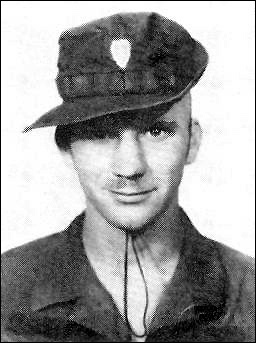
Charles Clinton Fleek, Medal of Honor Recipient
May 27, 1969 - Sgt. Charles Clinton Fleek from Petersburg, Ky. smothered the blast of an enemy hand grenade with his body, sacrificing his life to protect those around him fighting in Bihn Duong Province, Vietnam. Fleek was awarded the Medal of Honor for his gallantry and willing self-sacrifice. (Vietnam War)
May 30 – Memorial Day
May 30, 1806 - In Logan County, Ky., future president Andrew Jackson participates in a duel, killing Charles Dickinson, a lawyer regarded as one of the best pistol shots in the area. The proud and volatile Jackson, a former senator and representative of Tennessee, called for the duel after his wife Rachel was slandered as a bigamist by Dickinson, who was referring to a legal error in the divorce from her first husband in 1791. Jackson met his foe at Harrison’s Mills on Red River in Logan, Kentucky, on May 30, 1806. In accordance with dueling custom, the two stood 24 feet apart, with pistols pointed downward. After the signal, Dickinson fired first, grazing Jackson’s breastbone and breaking some of his ribs. However, Jackson, a former Tennessee militia leader, maintained his stance and fired back, fatally wounding his opponent. It was one of several duels Jackson was said to have participated in during his lifetime, the majority of which were allegedly called in defense of his wife’s honor. None of the other rumored duels were recorded, and whether he killed anyone else in this manner is not known. In 1829, Rachel died, and Jackson was elected the seventh president of the United States.
May 30, 1868 – By proclamation of General John A. Logan of the Grand Army of the Republic, the first major Memorial Day observance is held to honor those who died “in defense of their country during the late rebellion.” Known to some as “Decoration Day,” mourners honored the Civil War dead by decorating their graves with flowers. On the first Decoration Day, General James Garfield made a speech at Arlington National Cemetery, after which 5,000 participants helped to decorate the graves of the more than 20,000 Union and Confederate soldiers buried in the cemetery. The 1868 celebration was inspired by local observances that had taken place in various locations in the three years since the end of the Civil War. In fact, several cities claim to be the birthplace of Memorial Day, including Columbus, Mississippi; Macon, Georgia; Richmond, Virginia; Boalsburg, Pennsylvania; and Carbondale, Illinois. In 1966, the federal government, under the direction of President Lyndon B. Johnson, declared Waterloo, New York, the official birthplace of Memorial Day. They chose Waterloo–which had first celebrated the day on May 5, 1866–because the town had made Memorial Day an annual, community-wide event, during which businesses closed and residents decorated the graves of soldiers with flowers and flags. By the late 19th century, many communities across the country had begun to celebrate Memorial Day, and after World War I, observers began to honor the dead of all of America’s wars. In 1971, Congress declared Memorial Day a national holiday to be celebrated the last Monday in May. Today, Memorial Day is celebrated at Arlington National Cemetery with a ceremony in which a small American flag is placed on each grave. It is customary for the president or vice president to give a speech honoring the contributions of the dead and to lay a wreath at the Tomb of the Unknown Soldier. More than 5,000 people attend the ceremony annually. Several Southern states continue to set aside a special day for honoring the Confederate dead, which is usually called Confederate Memorial Day.
The following is a compilation of significant dates in our nation and in our commonwealth’s military history. For more on the legacy of our Citizen-Soldiers and Airmen, visit the Kentucky National Guard eMuseum.
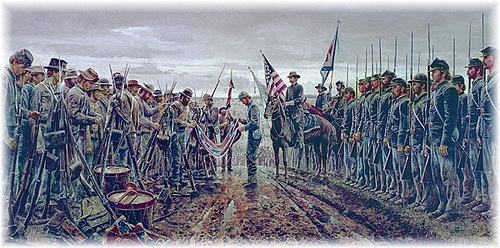
Confederate Soldiers surrender to Gen. Joshua L. Chamberlain during the Army of Northern Virginia’s surrender at Appomattox Courthouse, Va., April 9, 1865.
April 1, 1945 – Invasion of Okinawa began (World War II)
April 1, 1968 – Operation Pegasus began (Vietnam War)
April 1, 1977 – Kentucky Air National Guard wing vice commander John B. Conaway appointment as Deputy Director of the Air National Guard at National Guard Bureau approved by Congress.
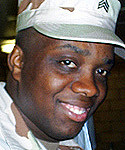
April 3, 2005 – Sgt. James Alexander Sherrill, of Ekron, Ky. in Meade County, was killed in Bayji, Iraq, when his armored medium truck encountered an Improvised Explosive Device (IED). Sherrill was assigned to the 2113th Transportation Company, Paducah, Ky. This unit mobilized for Operation Iraqi Freedom in December 2004 and deployed to Southwest Asia in January 2005.
April 5, 1951 – Operation Rugged began (Korean War)
April 6, 1972 – Operation Linebacker began (Vietnam War)
April 8, 1972 – Siege of An Loc began (Vietnam War)
April 9, 1845 – The officers of the 123rd Regiment of Kentucky Militia unanimously, by newspaper communications and petitions, seek the abolition of the present militia system.
April 9, 1858 – Twenty-one companies volunteered for service. Only 10 companies were selected by Governor Morehead (The Utah War)
April 9, 1856 – Gen. Robert E. Lee surrenders the Army of Northern Virginia to Gen. Ulysses S. Grant at Appomattox Courthouse, Va. (Civil War)
April 9, 1942 – Fall of Bataan (World War II)
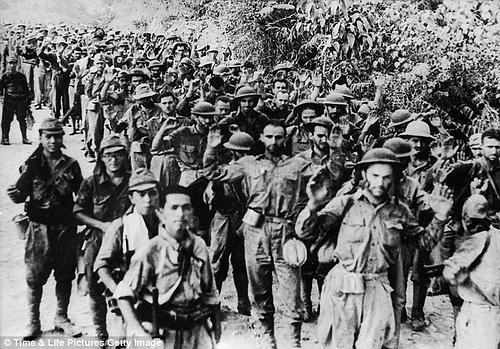
American and Filipino Soldiers on the Bataan death march, April, 1942.
April 10, 1942 – Bataan Death March – Sixty-six Kentucky Army National Guardsmen from Harrodsburg took part in the march; only 33 survived captivity to return home. (World War II)
April 10, 1968 – Battle for Lang Vei began (Vietnam War)
April 10, 1990 – Staff Sgt. Regina L. Isenberg of Bowling Green was killed in a military vehicle accident on the Western Kentucky Parkway near Leitchfield in Grayson County. She was assigned to Headquarters, State Area Command (STARC) Kentucky Army National Guard. She was transporting a M-60 tank engine from the Wendell H. Ford Regional Training Center to the Combined Support Maintenance Shop (CSMS) in Frankfort in an engineer dump truck on rain slick roads. She was a Technician Material Control and Accounting Specialist at the Unit Training Equipment Site (UTES 2) in Greenville. Isenberg graduated from Warren Central High School in 1978 and joined the 2123d Transportation Company in Bowling Green in February 1981. She also served in Headquarters and Headquarters Battery of the 138th Field Artillery Brigade.
April 11, 1873 – Brig. General Edward R.S. Canby, U.S. Army, commanding the Department of Columbia, murdered by Captain Jack, chief of the Modoc Indians, while mediating for their removal from their rocky fastness on the northern border of California to a government reservation. General Canby was a native of Mason County, Kentucky.
April 11, 1991 – Persian Gulf Official Cease Fire
April 13, 1865 - Louisville native, U.S. Army Maj. John Francis Weston, while serving with the 4th Regiment Kentucky Volunteer Cavalry, was part of a daring raid on Confederate supply boats near Wetumpka, Ala., capturing all supplies and boats. He would receive the Medal of Honor for his actions. Weston enlisted in the Union Army at the age of 16 while his father, uncle and brother joined the Confederacy. After the Civil War, Weston would serve for more than 40 years in the Army, reaching the rank of major general before retiring in 1909. He is buried at Arlington National Cemetery.
April 15, 1777 – First attack on Fort Boonesborough by Indians (Early Indian Wars)
April 16, 1851 – John Marshall Harlan appointed Adjutant General of Kentucky by Governor John L. Helm. At time of his appointment Harlan was 17 years old, the youngest individual to hold the position. He served as Adjutant General from 1851 to 1859.
April 16, 1953 – Battle of Pork Chop Hill began (Korean War)
April 16, 1978 – Private First Class Jeffery Clinton Howard died while training with his unit, the 307th Maintenance Company – Central City, at Ft. Campbell. Howard reportedly retrieved his gas mask from the cab of the truck to put it on as a part of training and unknowingly released the hand brake before he walked behind the truck, which had been parked on a gradual incline, the vehicle rolled backwards some 4 feet and pinned him between a tree and the trailer of a truck.
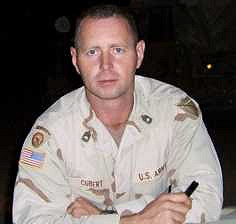
April 16, 2006 – Master Sgt. Clinton Wayne Cubert, died at the Lexington Veterans Affairs Medical Center, Lexington, Ky., of injuries sustained when an improvised explosive device detonated near his armored Humvee during combat operations in Samarra, Iraq, on Sept. 11, 2005. Cubert was assigned to the 2113th Transportation Company, based in Paducah, during his deployment.
April 17, 1868 – The remains of General John Hunt Morgan Re-interred, with impressive ceremonies, at the cemetery in Lexington, Ky.
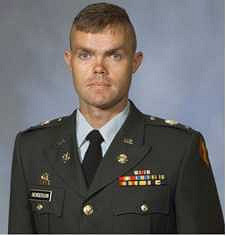
April 17, 2004 – First Lieutenant Robert Lewis Henderson, II, of Alvaton, Ky., (Warren County) died in Diwaniyah, Iraq when his convoy tried to avoid an overturned trailer and came under small arms attack. Henderson, though mortally wounded, continued to drive his vehicle and lead the convoy out of the ambush and repositioned his vehicle so that the other soldiers in the vehicle could return fire before he collapsed. Henderson was assigned to Detachment 1, 2123rd Transportation Company, Owensboro, Ky.
April 18, 1847 – Storming of Cerro Gordo, Mexico. Captain John S. Williams’ company (the only Kentucky company engaged) behaved with distinguished valor (Mexican-American War)
April 18, 1942 – Doolittle Raid on Japan (World War II)
April 18, 2010 – Sgt. Randolph A. Sigley Jr., of Richmond (Madison County), was found dead in his quarters at Bagram Airbase, Afghanistan where he was serving with the 2123rd Transportation Company. A member of the Kentucky Army National Guard since 2006, Sigley served from 2000-2004 with the United States Marine Corps. He served a tour of duty in Afghanistan with the Marines.
April 19, 1906 – Henry Robert Lawrence appointed Adjutant General of Kentucky by Governor J. C. W. Beckham.
April 19, 1968 – 2nd Battalion, 138th Field Artillery, Kentucky National Guard with units in Louisville, Bardstown, Elizabethtown and Carrollton, Kentucky were ordered to active duty by President Lyndon B. Johnson (Vietnam War)
April 19, 1968 – Operation Delaware began (Vietnam War)
April 20, 1953 – Operation Little Switch began (Korean War)
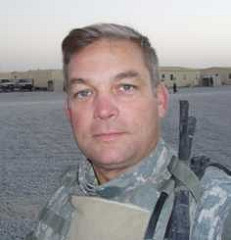
April 20, 2006 – Capt. Clayton Lee Adamkavicius, of Louisville, was mortally wounded by small arms fire while investigating an anti-coalition weapons cache discovered near Dihrawud district, Uruzghan Province, Afghanistan. Adamkavicius, a native of California, joined the Kentucky Army National Guard in 1999, and was assigned to Headquarters Company, 149th Brigade in Louisville. Adamkavicius was on his third operational deployment with the Kentucky National Guard. His first deployment was to Eastern Europe in 2003 where he served as Commander of Headquarters and Headquarters Company, 2nd Battalion, 123rd Armor, in support of Operation Joint Forge at Eagle Base, Tuzla, Bosnia-Herzegovina. In a subsequent deployment to Bosnia in 2004, he served with Headquarters Company, 149th Brigade. Adamkavicius had been training Afghan soldiers when he was killed.
April 21, 1945 – Second Lieutenant Everett R. Preston, assigned to Company A, 192nd Light Tank Battalion (Harrodsburg Tankers), died at Fukuoka Camp #1-D Honshu, Japan of acute enteritis.
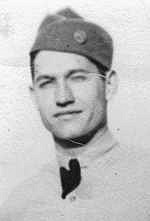
April 22, 1942 – Sgt. Edward Theodore French, Company D, 192nd Light Tank Battalion (Harrodsburg Tankers) died in a field hospital on Bataan while recovering from shrapnel wounds received in a Japanese bombing attack. He perished when the hospital was inadvertently hit by artillery fire from Fort Drum.
April 24, 1873 – Kentucky Legislature directs that the remains of General Cary H. Fry, Colonel Theodore O’Hara, and Adjutant George N. Cardwell to be brought from distant states, and buried in state military lot at Frankfort, and graves marked with appropriate stones.
April 24, 1967 – Battle of the Hills began (Vietnam War)
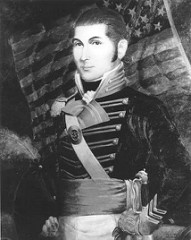 April 27, 1805 – Battle of Derne - Lt. Presley O’Bannon led an expedition across North African desert and captured the fortified city then held against numerous attempts to retake the place until peace treaty was signed on June 4 1805. O’Bannon was the first to plant the American Flag on foreign soil. The phrase “the shores of Tripoli” from the U.S. Marine Corps Hymn refers to O’Bannon’s expedition. O’Bannon is buried in the Frankfort Cemetery. (War with Tripoli)
April 28, 1967 – Heavyweight boxing champion Muhammad Ali refused to be inducted into the Army and was stripped of his boxing title.
April 29, 1984 – Private Steven E. Jones of DeMossville (Pendleton County), died while training with his unit, Company C, 201st Engineer Battalion in Cynthiana. Jones was killed after an accident near the armory when the unit was training on erecting and using gin poles. Jones was struck by the pole when the rigging failed and he was unable to escape the falling pole. He was given immediate aid by members of the 475th Combat Support Hospital who were at the armory and transported to the hospital but he died from his injuries a short time later. Jones had just joined the unit on March 2, 1984 and was training with the unit until he got orders sending him to basic and advanced training as a Combat Engineer.