
Pages
Stay In Touch
More
© 2013 KentuckyGuard
Story by David Altom, Kentucky National Guard Public Affairs
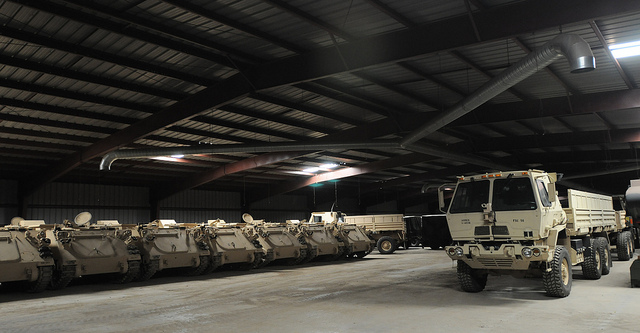
This is just a sample of the equipment stored under corrosion preventing conditions by the Kentucky Army National Guard at the Wendell H. Ford Regional Training Center. Corrosion is a worldwide problem, consuming our infrastructure and threatening our military gear. On a daily basis the Kentucky Guard has to protect more than $100 million worth of equipment from falling prey to corrosion. (Kentucky National Guard photo by Staff Sgt. Scott Raymond, Kentucky National Guard Public Affairs Office)
FRANKFORT, Ky. — Riddle me this: What ensures combat readiness, preserves our equipment, protects the environment, and saves taxpayers a whole lotta money?
Answer: corrosion awareness!
Okay, bad joke. But the truth of the matter is, corrosion awareness is no joke. In fact, today — April 24, 2015 — is World Corrosion Awareness Day. Not just for the National Guard, not just for the United States Army, but for the whole world.
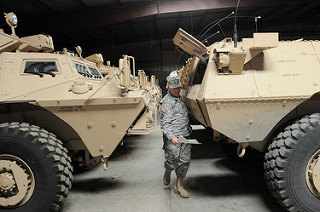
Chief Warrant Officer Gregg Blakeley checks the status of an M1117 Armored Security Vehicle. More than $100 million worth of vehicles and gear are under daily monitoring for corrosion by Kentucky National Guard personnel. (U.S. Army National Guard photo by Staff Sgt. Scott Raymond)
So, what’s the big deal? Well, corrosion costs nearly $4 trillion worldwide each year, which makes for the big deal. Corrosion eats away at our infrastructure, our bridges, rail systems, pipelines, you name it. Given enough time and neglect, our technological society and way of life are at risk, threatened by corrosion and its aftereffects.
Okay, so that’s why corrosion awareness is important. But now you may ask, what’s that got to do with the Kentucky National Guard?
The answer: plenty.
Click here for more photos on this story.
One of the best kept secrets about the Kentucky National Guard is our corrosion protection program. At Fort Knox and the Wendell H. Ford Regional Training Center we have established long-term corrosion protection measures that are essential to our war-fighting mission.
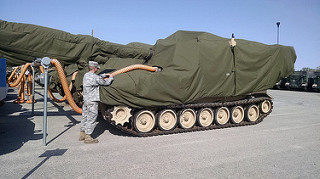
Staff Sgt. Eric Miers checks the controlled humidity protection hose hooked up to an M109 Paladin at the Mobilization and Training Equipment Site at Fort Knox. (Kentucky National Guard photo by Chief Warrant Officer Christopher Kehl)
“We’ve got twelve Paladins and twelve ammo carriers worth about thirty million dollars,” said Command Sgt. Maj. Timothy Gividen, artillery shop supervisor at the Kentucky Guard’s Mobilization and Training Equipment Site at Fort Knox. “There’s another forty million in HIMARS rocket launchers, too. Add on all of the other equipment we’re signed for, that’s more than one hundred million dollars of the taxpayers’ dollars that we have to protect.
“That’s a huge investment in the Guard and a great responsibility for our shop.”
Gividen’s team of eight mechanics focuses primarily on artillery. They keep the M109A6 Paladins hooked up to a controlled humidity protection system, which keeps the interior of the vehicles dry and tight. The complex series of overgrown hoses are hooked up to hatches and the muzzles of the gun barrels, connected to what amounts to a giant dehumidifier. The soldiers do daily checks to ensure everything is sealed up right.
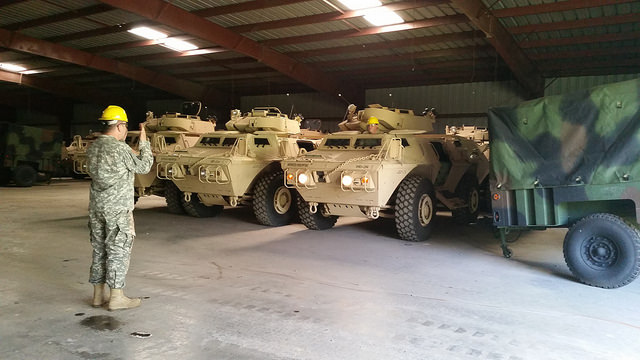
From HUMVEES and ASVs to high dollar HIMARS launchers, more than $100 million worth of vehicles and gear are under daily monitoring for corrosion by Kentucky National Guard personnel. (Photo courtesy Kentucky National Guard UTES)
“The CHP system does its part, but people are still essential to the process,” said Gividen. “It’s our job to keep all of this equipment in combat ready status, so all the troops have to do is come in, do some PMCS [preventive maintenance checks and services] and go train or deploy.”
The M142 High Mobility Artillery Rocket System launchers are kept in a giant warehouse-like building with controlled temperature environment that protects them from weather and moisture. The latest in artillery technology, they are precise and accurate and battlefield proven. At $2.5 million apiece, they are also very expensive. Warrant Officer William Cottrell, work group leader at the MATES artillery shop, emphasizes the sensitive nature of the systems they are charged with protecting.
“There are a lot of computer components in these systems,” he said. “Replacing one computer box on HIMARS can run hundreds of thousands of dollars. This isn’t our money we’re talking about; it’s the taxpayers’. We work hard to make sure there aren’t any problems.”
“Our CHPs and OP [operation preservation] lines provide us with a distinct advantage during these challenging times in our operating environment, to preserve equipment for much longer periods of time and reduce our overall maintenance costs exponentially,” said Maj. Steven Engels, Surface Maintenance Manager for the Kentucky Guard. “With the likelihood that equipment modernization will decrease in the future due to budget constraints, preserving and maintaining the equipment that we have is as important as ever to respond to potential domestic natural disasters in support of civil authorities as well as military missions across the world.”
Story by Sgt. Scott Raymond, Kentucky National Guard Public Affairs
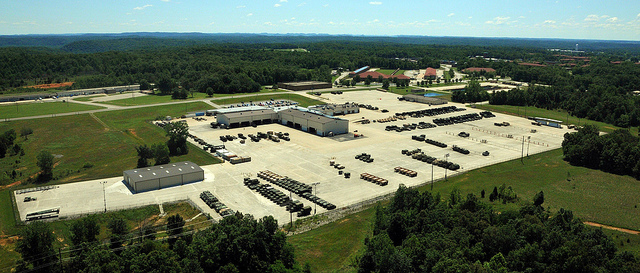
Aerial view of the Kentucky Army National Guard’s Maneuver Area Training Equipment Site at Fort Knox, Ky. The facility received the 2012 Army Award for Maintenance Excellence for Region III, a competition with 13 other states. (Photo by Chief Warrant Officer 2 Greg Scott)
FORT KNOX, Ky. — On the edge of the Fort Knox garrison, military vehicles and equipment sit in clean, straight lines next to ordinary maintenance buildings that line the roads. A majority of those vehicles are ready for service, thanks to the extraordinary work of the Soldiers in those buildings who maintain them.
One such building is the Kentucky Army National Guard’s Maneuver Area Training Equipment Site (MATES), whose Soldiers were recently recognized for running one of the best maintenance facilities in the National Guard.
In competition with 13 other states, the Kentucky facility placed first to win the 2012 Army Award for Maintenance Excellence (AAME) for their region, in the TDA (Table of Distribution Allowances) Small category.
“This award is a true measurement of everything this facility has accomplished, from maintenance to safety to community involvement,” said 1st Lt. Timothy Lee, Assistant MATES Superintendent.
In August, the site submitted its packet for consideration at the National Guard level. Shops across the country were graded on mission readiness, training, hazardous material management, resource management and recycling, to name a few categories.
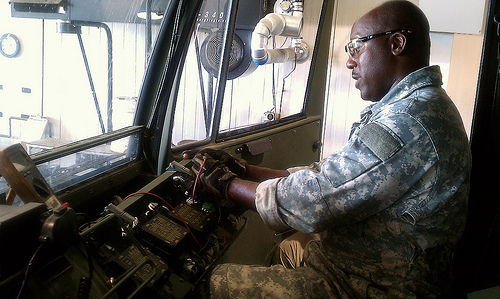
Master Sgt. Aaron Young, a Surface Maintenance Mechanic Inspector with HHB 623rd Field Artillery, troubleshoots an electrical fault in a M1078 vehicle at the Maneuver Area Training Equipment Site at Fort Knox, Ky. The facility employs 51 Kentucky Guardsmen full-time supporting Kentucky units and neighboring states.(Photo by Chief Warrant Officer 2 Greg Scott)
Lee said changes put into effect over the past year have really made an impact in the overall operation.“We have redefined our workflow process,” he said. “Redefined everyone’s jobs and job duties and implemented an inspection section for all aspects of work.”
Improvements in cost savings and site management have produced numbers worthy of national attention. The last eight months of the fiscal year saw a 300 percent increase in productivity per person over the previous year. All while 15 Soldiers of the 51-man workforce were deployed overseas.
Lee said they are working toward cost savings by changing the way they order parts. Instead of ordering whole repair kits for vehicles, individual parts were ordered. In complying with the Army Oil Analysis Program, which addresses the usage of vehicle and equipment fluids, Lee estimates that Kentucky saved $51,000 in man-power in just one year, while saving around $105,000 in products.
The site also has decreased its electrical needs thanks to installed solar panels that help provide power to the building. The panels contributed to a decrease of 31.5 percent in electric energy usage. Their inventory has nearly 400 less products on hand than last year.
“We have truly been able to do more with less in this fiscally constrained environment,” said Lee.
A number Lee said the whole MATES is proud of is its 96.6 percent organizational readiness rate from last year. This means that only 3.4 percent of the entire fleet was down for maintenance for more than one month consistently. This covers vehicles and equipment used in support of drill weekends, annual training periods or pre-mobilization training during the year for Kentucky units as well as National Guard units from Tennessee, Pennsylvania, Indiana and North Carolina.
“Our participation in the AAME competition has had great command emphasis and has been a critical ingredient to establishing an organizational culture that highlights the necessity of a rock-solid maintenance program,” said Lt. Col. Timothy Pickerrell, MATES Superintendent. “I am honored to lead this facility and to be a part of this hardworking group of technicians.”
1st Sgt. Douglas Hall is also proud of his Soldiers at the MATES, and gives a lot of credit to the leadership for “keeping everyone on track”. He said his command’s collective effort to improve the operation and boost morale is well received in the building and increases the motivation of the Soldiers to do a better job.
“Because of the way everything is organized and flows so well, we have maintained productivity,” said Hall. “Each shop is seeking even more work.”
Hall isn’t shy about acknowledging the accolades, knowing he’s part of a special operation that represents the Kentucky National Guard on a national level.
“If you want to see what a successful maintenance operation looks like, look at us.”
In addition to the MATES facility, the Central City-based 307th Component Repair Company also won first place in their regional unit category and will participate nationally later this year in an Army-wide competition.
