Pages
Stay In Touch
More
© 2013 KentuckyGuard
By Maj. Dale Greer, 123rd Airlift Wing Public Affairs
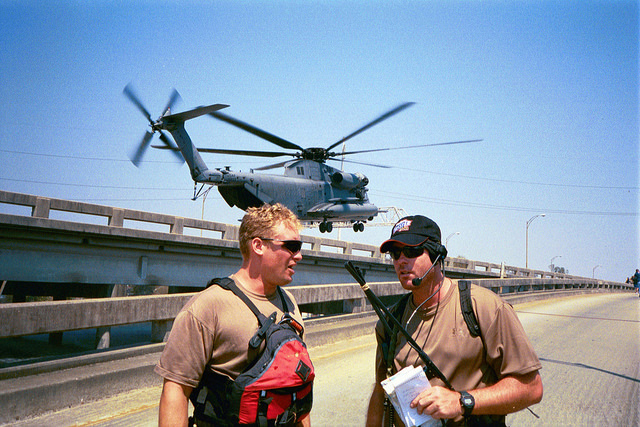
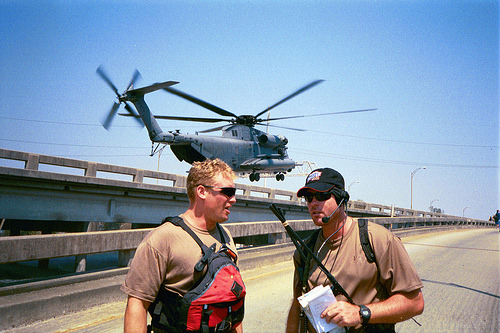
Two Kentucky Air National Guard Special Tactics troops confer as an Air Force MH-53 helicopter lands on Interstate 610 to evacuate New Orleans residents following Hurricane Katrina Sept. 4, 2005. (U.S. Air National Guard photo)
LOUISVILLE, Ky. — Chief Master Sgt. Pat Malone had seen a lot in his 23 years as a pararescueman for the U.S. military, including dicey combat extractions in Iraq and Afghanistan and more than a decade’s worth of civilian search-and-rescue missions in Alaska. But none of it prepared him for the devastation he saw firsthand when he and 21 fellow Kentucky Air National Guardsmen deployed to New Orleans Naval Air Station 10 years ago today as part of efforts to evacuate the victims of Hurricane Katrina and the ensuing flood.
“This was, by and large, the worst site of devastation I have ever seen in my entire career,” said Malone, who was chief enlisted manager for the Kentucky Air Guard’s 123rd Special Tactics Squadron in 2005 and retired from the service in 2012. “The sheer magnitude of it — and the conditions that our guys worked in — was the most horrific I’d seen in 23 years of service.” Chief Master Sgt. Jon Rosa, a Kentucky combat controller who also deployed with the 123rd Special Tactics Squadron and retired in 2009, concurred.
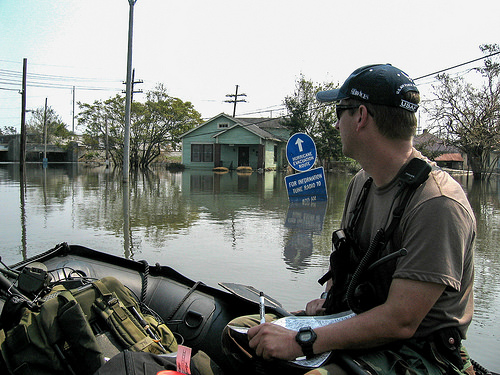
A Kentucky Air National Guard combat controller searches for stranded residents during a search-and-rescue mission in New Orleans following Hurricane Katrina Sept. 5, 2005. (U.S. Air National Guard photo)
“New Orleans is usually a place of such revelry,” said Rosa, then the squadron’s superintendent of combat controllers. “But it was like a scene out of ‘The Twilight Zone’ to be in downtown New Orleans and hear total silence except for the sloshing of flood waters. I just couldn’t believe this was America.”
But it was America, and thousands of New Orleaneans were stranded without provisions amid a sea of sewage- and chemical-laced water covering nearly 80 percent of the city.
Rosa, Malone and 20 other Kentucky special tactics troops were among the first military search-and-rescue troops to arrive in the stricken city and begin extracting trapped citizens starting Aug. 31.
The Kentucky forces joined up with about 25 other special tactics troops from across the Air National Guard, including Alaska’s 212th Rescue Squadron, California’s 131st Rescue Squadron, New York’s 102nd Rescue Squadron and Oregon’s 125th Special Tactics Squadron.
Patrolling the city in Zodiac motorboats and other vehicles, the Kentucky-led contingent rescued 1,292 people, sometimes by cutting through roofs to extract trapped residents.
“We had the ability to go through the city and conduct searches where no one else could reach at the time,” Malone said. “We launched from four to 14 boats a day, running about 14-hour shifts in the water.”
Once evacuees climbed aboard the Zodiacs, they were transported to makeshift helicopter landing zones set up along portions of the interstate highway system that weren’t submerged by flood waters.
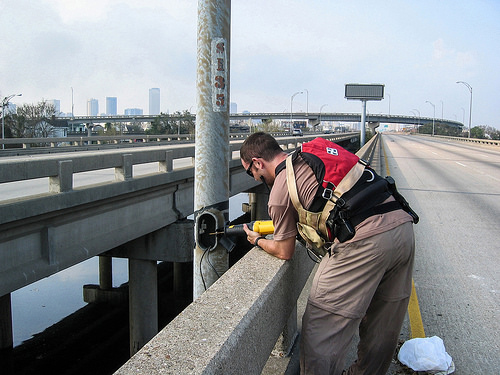
A special tactics troop from the Kentucky Air National Guard cuts down street light poles along Interstate 610 in New Orleans following Hurricane Katrina Sept. 3, 2005, to clear the way for a helicopter landing zone. (U.S. Air National Guard photo)
The landing zones were cleared by saw-wielding combat controllers who cut down light poles to remove obstructions and then marked the spots with spray paint so information like communications frequencies would be visible from the air, Rosa said.
After an LZ was established, combat controllers would make radio contact with any of the three airborne controlling authorities — entities like an Air Force AWACS plane — and advise that evacuees were ready for transport.
As helicopters began to roll in, the controllers would direct their safe flight into and out of the landing zones using the communications gear they carried on their backs.
One particularly productive LZ became so active that a new helicopter was landing every 50 seconds for 48 straight hours, Rosa said.
“For a while, I would imagine it was the busiest airport on the face of the earth,” he noted.
By the time the Kentucky Airmen returned home Sept. 7, the Air Guard special tactics contingent had controlled the flights of 3,179 sorties responsible for the evacuation of 11,927 people.
Working conditions were challenging, to say the least. Most troops got less than six hours of sleep a night, and the constant exposure to contaminated water caused rashes and minor chemical burns on some of the Airmen, Malone said.
“These guys were working in a giant cesspool contaminated with any chemical in anyone’s garage, oil, gas, deceased animals and sewage,” he said. “It was a giant petri dish. But they knew that what they were doing was important. They chose to be totally selfless and help fellow citizens of the United States. They’re the biggest heroes on the planet as far as I’m concerned.”
Rosa noted that many New Orleans residents seemed to agree.
“All the folks we rescued down there were so thankful,” he said. “I had about 20 people come up and hug me while I was trying to control helicopter landings. That’s very self-satisfying.”
This is Part V of a five-part series documenting the travels of Kentucky Guard Command Historian John Trowbridge as he explores Kentucky’s participation in the War of 1812.
Story and photos by Sgt. Scott Raymond, Kentucky National Guard Public Affairs
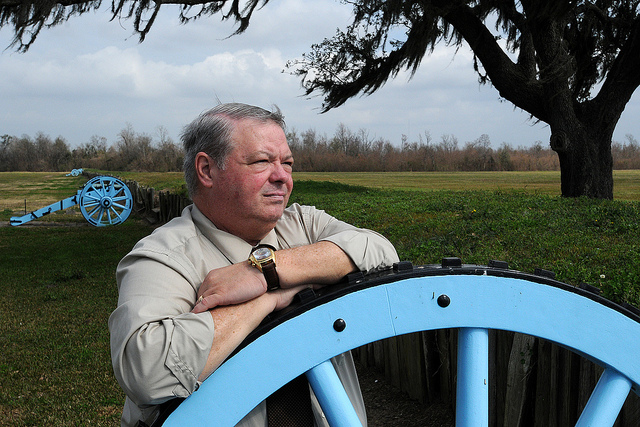
John Trowbridge, State Command Historian for the Kentucky National Guard takes in the view of Chalmette Battlefield in New Orleans, La., Jan. 28, 2013. Trowbridge’s site visit was part of his continued documentation of the role Kentuckians played in the War of 1812. (Kentucky National Guard photo by Sgt. Scott Raymond)
NEW ORLEANS, La. — In the latter days of the War of 1812, the conflict was winding down in the North and East, but Gen. Andrew Jackson was still preparing to meet the British on the final field of battle. With the help of Choctaw Indians, free men of color, pirates and volunteers from Tennessee and Kentucky, Jackson’s army defended New Orleans and the gateway up the Mississippi River from the redcoats final attempt to defeat the upstart United States.
The victory on the plantation fields of Chalmette outside New Orleans proved to be a much greater event to the fledgling government than a just a battle won. The outcome ended the last war with England, preserved a claim to the Louisiana Territory, triggered migration and settlement along the Mississippi River and rebuilt the spirit of the American people.
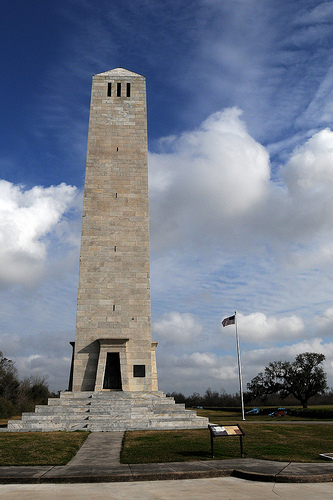
The Chalmette Monument stands just behind the canal Gen. Andrew Jackson fortified to defend New Orleans during the War of 1812. The victory preserved the U.S. claim to the Louisiana Territory and built patriotism in the American people. (Kentucky National Guard photo by Sgt. Scott Raymond)
“This was the most one-sided victory in U.S. military history,” said John Trowbridge, State Command Historian for the Kentucky National Guard. “And it was won by a ragtag army, pieced together to face what was at the time the greatest army in the world. More than two thousand Kentuckians were part of that group that fought for Jackson at New Orleans.”
Answering the call to fight, the Kentuckians gathered along the Ohio River, built rafts and flatboats and floated down the Mississippi to New Orleans. They took up defensive positions along a canal Jackson ordered fortified and across the water along the west bank of the river. The British arrived with a 10,000 man army, nearly out numbering the Americans 2-1. The final battle last roughly two hours. With thousands of causalities and their commanding general, Sir Edward Pakenham dead on the field, the British retreated, leaving the Americans in control of the Mississippi River.
Although the Treaty of Ghent had already been signed, news did not travel the ocean quickly. But with the victory at New Orleans, there was little doubt, the Americans had the upper hand in defending their country. Several months after the battle, the volunteers from Kentucky and Tennessee began the long journey home. At the time, the Natchez trace was the path to follow.
The trace had been used by Native Americans for centuries. In 1803, President Thomas Jefferson ordered the trace be improved for travel and postal runs to connect the newly purchased western territories. In 1815, it was the most direct and reliable route north to Tennessee. Stands or roadside markets and inns were constructed to aid travelers in their journey.
Several sections of the original trace remain, similar to the early nineteenth century. Trowbridge felt especially connected to the militiamen from 1815 as he placed his steps in the same ground two hundred years later. Stories of the time said the militias were loud and boisterous in celebrating their victory as they made their way home. Some were welcomed as national heroes when they arrived in Nashville. Not every Kentuckian came home however. Although casualities in the battle were low compared to the British, illness and infection struck down many Americans in the harsh swamp lands of Louisiana.
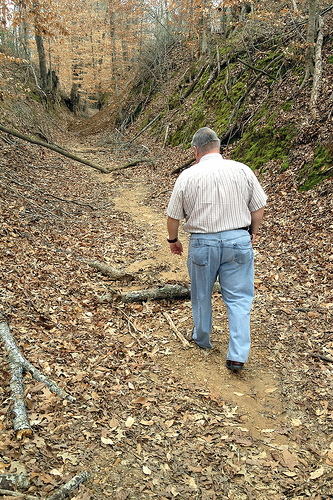
John Trowbridge, State Command Historian for the Kentucky National Guard walks along an old portion of the Natchez Trace near Jackson, Miss., Jan. 29, 2013. Trowbridge’s site visit was part of his continued documentary of the role Kentuckians played in the War of 1812. (Kentucky National Guard photo by Sgt. Scott Raymond)
“This is the same route they used, marching home from war,” said Trowbridge as he placed his own steps in the sunken pathway in Mississippi. “It may have been a sorrowful return for the Kentuckians after losing several compatriots in New Orleans. But it was still a return home and a return that meant the end of the war.”
“The Battle of New Orleans and the War of 1812 put Kentucky on the national stage,” he said. “The war established a warrior spirit in Kentuckians and a tradition of military service that remains today in the Kentucky National Guard.”
Victory in the forgotten War of 1812 forged the destiny of the continent for generations. From New Orleans through the Indiana Territory and into Canada, Kentuckians sacrificed to help establish the United States as a player in the events of the world.
As the last battle of the war, Trowbridge said this site visit should wrap up his planned documentary on Kentuckians during the War of 1812. He is looking forward to the bicentennial events he calls significant dates in the nation’s history, each with a Kentucky connection.
“After these visits, I have a better perspective of the Kentuckians roles in the War of 1812 and look forward to honoring their memories during the next several months,” he said.