
Pages
Stay In Touch
More
© 2013 KentuckyGuard
By Senior Airman Vicky Spesard, 123rd Airlift Wing Public Affairs
 KENTUCKY AIR NATIONAL GUARD BASE, LOUISVILLE, Ky. — Two homemade pressure-cooker bombs exploded during the Boston Marathon April 15, killing three people and severely wounding more than 200 others. In the aftermath of this horrific event, many questions are being asked about what constitutes a terrorist act and whether people put their safety at risk by attending large public events.
Capt. Joshua Elwell of the Kentucky Air National Guard’s 123rd Contingency Response Group offers his own insight as director of the anti-terrorism program here. He’s specially trained in identifying the causes and effects of terrorist activities within the United States and how to combat them. The intelligence officer also meets regularly with members of the civilian intelligence community, local civic leaders and law enforcement agencies to discuss terrorism awareness and citizen reporting efforts.
Q.: What is the definition of terrorism, and is there a difference between terrorism abroad or domestically?
A.: A terrorist is someone who wants to instill fear and terror in a society for a political or religious reason. The intent of terrorism is to cause our country pain at a national level, to shut us down economically or to instill enough fear that that we stop participating in public events. If any of these things happens, a terrorist has met his or her intent.
In my opinion, there is no difference in terrorism carried out abroad or domestically. The intent is still the same.
Q.: With so many large, public events happening around the country, can a person feel safe attending them?
A.: The intent of terrorism is to scare us into disrupting our lives, to make it a challenge to go out and participate in these events. Don’t stay home and be scared to live your life. A lot of attention is now being given to security at big events as local authorities, security agencies and threat working groups implement enhanced security measures. I would just encourage everyone attending to be patient with security personnel who may be checking bags or coolers and things of that nature. Remember, they are there for our protection.
Q.: How can a person minimize his or her own risk at large events?
A.: There are many things you can do for your personal safety. If you are attending public activities, don’t stand around in large gatherings of officials. Don’t hang around a table of VIPs. Be aware of your surroundings and use common sense. Keep your eyes open and report what looks out of place.
Q.: What can an individual do to help?
A.: “Watch, report, protect” is the motto for the EagleEyes program, operated by the Air Force Office of Special Investigations. The program encourages the public, both on and off base, to report anything that looks odd or out of place. In the Louisville area, reports can be made by calling the Kentucky Air Guard’s 123rd Security Forces Squadron at (502) 412-4477.
Anonymous tips can be made online at https://www.tipsubmit.com/WebTips.aspx?AgencyID=1111 or by texting “AFOSI” to 274637.
Terrorists are looking at us and trying to find our weaknesses. If they can see us, we can see them. We can’t be everywhere, so we need the community to be part of the effort to see things and let the right people know about it.
Story and photos by Sgt. David Bolton, Kentucky National Guard Public Affairs Office
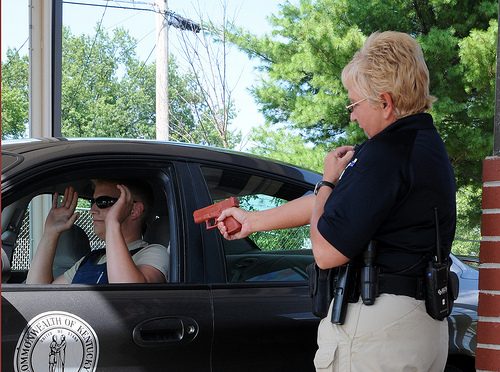
Kentucky Guardsman Spc. Austin Kirk, a security specialist at Boone National Guard Center in Frankfort,Ky., plays the role of a terrorist during a training exercise designed to simulate a suicide bomb attack August 15, 2012. Ginger Starrett and Brady Murphy, also security specialists at BNGC were on scene to apprehend Kirk as he attempted to detonate a vehicle-borne improvised explosive device. (photo by Sgt. David Bolton, Kentucky National Guard Public Affairs Office)
FRANKFORT, Ky.— An unassuming vehicle pulls up to the front gate of the Boone National Guard Center August 15, 2012 in Frankfort, Ky. It’s a typical Wednesday afternoon. The driver is motioned forward by Ginger Starrett, a security specialist assigned to BNGC. White-knuckled with a stone-cold face, the driver pulls up to the entry control point. Noticing his stern demeanor, Starrett begins to inspect the vehicle with a discerning eye. An instant later, the driver has pulled out a homemade detonator and attempts to set off a vehicle-borne improvised explosive device (VBIED).What happened next was part of a carefully designed and choreographed series of events that was meant to diminish any further threat to service members and civilians working at BNGC.
“We have a plan for Boone Center”, said Eldern Riley, State Anti-terrorism Program Manager. “Protect the assets and resources of the Kentucky National Guard including personnel and facilities.”
Col. Charlie Harris, State Security Manager, said that in addition to exercising the plan to keep the people of BNGC safe, the coordination with other agencies like the Kentucky State Police Bomb Squad and the Frankfort Police Department was important.
Despite the intensity of this event, it is not the first rigorous training exercise that has taken place at BNGC. Other scenarios have included an active shooter situation in which the security forces had to respond to a shooter on post.
“Our security force has done a lot,” said Larry McCord, Security Operations Chief at BNGC. “J2 (which deals with physical, personnel, and intelligence security) writes the plans and someone must implement it, we can do that.”
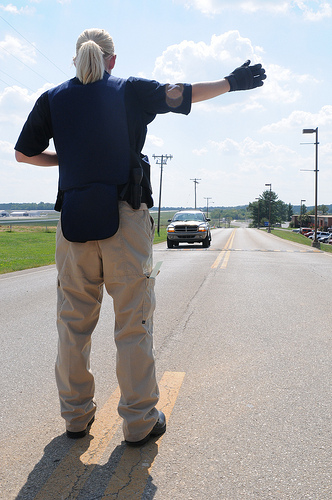
Jennifer Chilton, an Interim Security Specialist at Boone National Guard Center in Frankfort, Ky., directs traffic away from the front gates after a Vehicle-Bourne Improvised Explosive Device (VBIED) was detected as part of a bomb threat exercise scenario at BNGCC in Frankfort, Ky., Aug. 15, 2012. (Photo by Sgt. David Bolton, Kentucky National Guard Public Affairs Office)
The hard work of the BNGC officers has not gone unnoticed. Over the past few years the BNGC has been presented the Army Security Award as well as the Department of the Army’s Best Antiterrorism Program Unit for 2011.The process of responding and adjusting to these kinds of threats is continually revamped based on prior exercises and training simulations.
“We learned some things and we’ll use what we learned to update future plans,” said Harris.
McCord noted that the exercise was a huge success saying, “It’s a big feather in our cap for the Kentucky State Police to give us credit for our part in the exercise.
The true benefit of conducting this kind of life-like training is the payoff that it brings.
Riley said that the training exercises helped the younger officers to prepare for real world events.
“There’s a lot more than most people think,” said McCord. “Someday, someone is going to make a move and I hope that we’re there to catch it. It’s not a matter of if, but when.”
The Kentucky Guard Command Staff directed August as Antiterrorism Awareness Month to bring a heightened sense to the potential threats against personnel and facilities throughout Kentucky.
By Sgt. Scott Raper, Kentucky National Guard Public Affairs
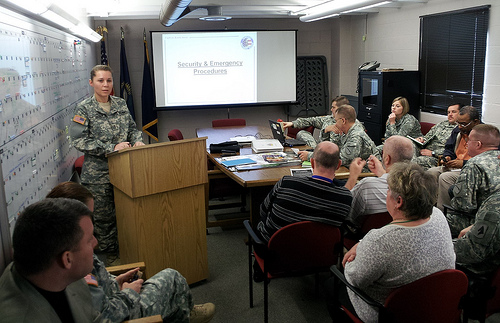
Civilian and military employees of the Kentucky National Guard gather for a security meeting at Boone National Guard Center in Frankfort, Ky, Feb. 7. The meeting provided training of proper security precautions prior to safety exercises held twice a year. (Photo by David Altom, Kentucky National Guard Public Affairs)
FRANKFORT, Ky. – Every military task begins with planning. And what would any function of the military be without training? The execution goes to show how good the planning was and how useful the training. For the Kentucky National Guard’s Security Office, it all equaled high profile recognition. They were awarded the Department of the Army’s Best Antiterrorism Program Unit for 2011. The award recognizes Army units that focus a high level of effort towards protecting Army personnel and missions from terrorist attacks.
“This is a confirmation from the Army that we are the best in their inventory,” said Eldern Riley, State Antiterrorism Program Manager.
In a statement from the U.S. Army Provost Marshal General, Maj. Gen. David Quantock said, “the Kentucky National Guard’s hard work, innovative actions, extraordinary training efforts and awareness management reflect the utmost dedication towards an essential program that protects our most valuable resources.”
“Our success is greatly attributed to the support of the Kentucky National Guard leadership and the excellent cooperation and working relationships we have with state agencies and the Kentucky Office of Homeland Security,” said Richard Copas, State Antiterrorism Officer.
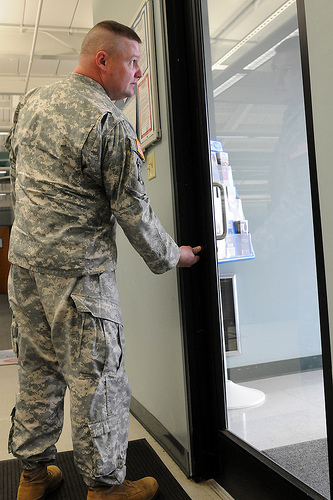
Sgt. Christopher Turpen with Joint Force Headquarters, secures the front door of a building during a training exercise at Boone National Guard Center in Frankfort, Ky Feb. 8. Scenarios require a variety of personnel actions to be conducted to protect employees and property.(Photo by Sgt. Scott Raper, Kentucky National Guard Public Affairs)
Exercises conducted at Boone National Guard Center are given as realistic conditions as possible with scenarios that potentially could happen in Kentucky. Each event involves the Joint Operations Center and the Crisis Management Team. From bomb drills to tornado drills, every facet of the training brings a variety of responses necessary to save lives and protect property. Twice a year, the Security Office runs the exercises to assess internal emergency operations and to keep the knowledge fresh for everyone on post.
Col. Charles Harris, State Security Manager, said their success is because of all the experience in the office. And the Kentucky National Guard benefits from it all, pointing out that there are several award winning programs in the same office.
“Everyone on post really participates, all employees, military and civilian,” said Copas. “That makes our exercises go very well and everyone benefits from it. We take the results each time and fix any issues we have, so we will be ready for anything.”
