
Pages
Stay In Touch
More
© 2013 KentuckyGuard
Story by Staff Sgt. Scott Raymond, Kentucky National Guard Public Affairs
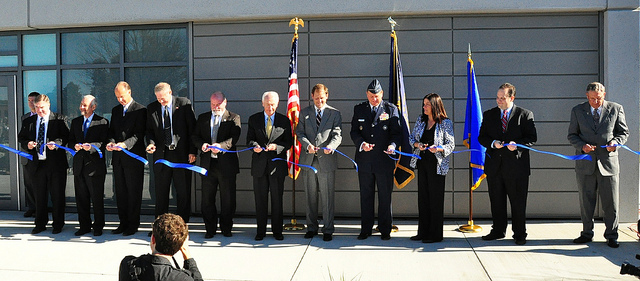
Governor Steve Beshear joins Adjutant General, Maj. Gen. Edward W. Tonini, and state and local elected officials in cutting the ribbon on the new Commonwealth Emergency Operations Center in Frankfort, Ky., Oct. 21, 2013. The facility will act as the hub of operations for future emergency response throughout the state. (U.S. Army National Guard photo by Staff Sgt. Scott Raymond)
FRANKFORT, Ky. — Kentucky Governor Steve Beshear joined Maj. Gen. Edward W. Tonini, the adjutant general for the Kentucky National Guard and emergency management officials from across the state for a ribbon cutting ceremony for the new Commonwealth Emergency Operations Center at Boone National Guard Center in Frankfort, Oct. 21, 2013.
The two-story, 26,150 square-foot facility replaces the former CEOC, built in the 1970s. The new building is constructed to withstand a variety of threats and weather conditions, including winds of up to 250 miles per hour. It is also outfitted with complete state-of-the-art communications technology to ensure rapid and efficient response during natural disasters and emergencies.
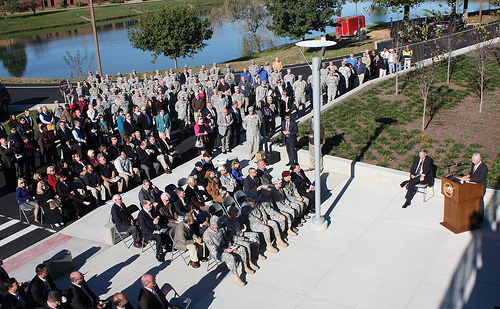
Governor Steve Beshear speaks to a crowd gathered for the ribbon cutting for the new Commonwealth Emergency Operations Center in Frankfort, Ky., Oct. 21, 2013. Gov. Beshear called the facility a lifeline to all 120 counties in the state in their time of need. (U.S. Army National Guard photo by Capt. Stephen Martin)
“This facility is a huge step toward bringing Kentucky’s emergency operations where it needs to be in the 21st century,” said Gov. Beshear. “As nice as it is, this is more than a building, it’s the lifeline to all of Kentucky’s 120 counties in times of trouble.”
To see more photos from the ribbon cutting, click here.
Tonini called the CEOC a symbol of the commitment made to the people of the Commonwealth. He recalled stories from past floods and tornadoes that wreaked havoc across the state, with the emergency response coming from cramped rooms in an out-dated building.
Beshear and Tonini both complimented the emergency operations staff and first responders in attendance, calling them the reason why Kentucky is a national model for emergency management.
“I am very enthusiastic about this new Commonwealth Emergency Operations Center and the effect it will have on Kentucky’s ability to respond in the future,” said Tonini. “This state-of-the-art, nearly $12 million facility, with all of the latest gear and systems, with its media room and conference rooms and planning rooms, it’s not worth a nickel without our people.”
“Our emergency managers are among the best in the nation, and they have proven their worth time and time again,” said Gov. Beshear.
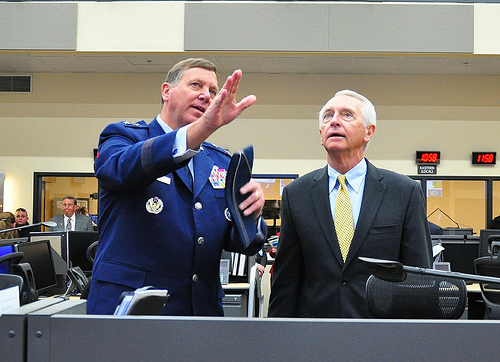
Kentucky’s Adjutant General, Maj. Gen. Edward W. Tonini explains to Governor Steve Beshear, features of the new Commonwealth Emergency Operations Center in Frankfort, Ky., Oct. 21, 2013. The tour followed the official ribbon cutting of the $11.8 million facility which took less than two years to complete. (U.S. Army National Guard photo by Staff Sgt. Scott Raymond)
The new center is capable of supporting more than 200 personnel during a disaster response, including Kentucky Emergency Management, the Kentucky Guard, state and federal agencies and private partners.
A large crowd gathered in front of the new building for the ribbon cutting including state and local elected officials. One in attendance has first hand knowledge of the abilities of those who will work in the facility. Pendleton County Judge Executive Henry Bertram spoke of the day he awoke to a completely flooded city in 1997. The rising waters of the Licking River devastated his county and surrounding areas. He contributed the resilience of the people affected to the work of Gov. Beshear and the agencies that will call the CEOC home.
“This place is a tool to give people the opportunity to put their community back together after a natural disaster,” he said. “The only reason we got back to our lives, was the people with emergency management.”
The new CEOC, funded at $11.8 million, was completed on time and at approximately $400,000 under budget. Nearly $10 million of the funding came from the Federal Emergency Management Agency’s Chemical Stockpile Emergency Preparedness Program. The Kentucky Department of Military Affairs and Office of Homeland Security provided the remainder.
Staff Report
Kentucky will participate in the 2013 Great Central U.S. ShakeOut today, Oct. 17 at various locations around the state. The exercise is an annual event to remind citizens to prepare for earthquakes. (Illustration courtesy of shakeout.org)
FRANKFORT, Ky. — September is National Preparedness Month according to the Federal Emergency Management Agency (FEMA). But FEMA also advises that safety precautions be considered throughout the year. As an example, each October, more than 40 states and territories and millions of people participate in earthquake safety activities nationwide.
In the middle of the country, including Kentucky, the Great Central U.S. ShakeOut occurs on the third Thursday of October. During the self-led drill, participants practice how to “Drop, Cover, and Hold On”. More than 12 million people are expected to participate in ShakeOut drills nationwide. In addition to safety drills, many participants take extra steps to become more prepared for earthquakes.
Many know about the risks that earthquakes pose here in the U.S. and around the world. Some have heard of the New Madrid Earthquake Zone located in Western Kentucky, but the truth is, earthquakes can happen any time, anywhere throughout Kentucky.
According to FEMA, several thousand shocks of varying sizes occur annually in the United States, and 70 to 75 damaging earthquakes occur throughout the world each year. All 50 states and all U.S. territories are vulnerable to earthquakes. Where earthquakes have occurred in the past, they will happen again. The largest earthquakes felt in the United States were along the New Madrid Fault in Missouri, where a 3-month-long series of quakes from 1811 to 1812 included three quakes larger than a magnitude of 8 on the Richter Scale. These earthquakes were felt over the entire eastern United States (over 2 million square miles), with Missouri, Tennessee, Kentucky, Indiana, Illinois, Ohio, Alabama, Arkansas, and Mississippi experiencing the strongest ground shaking.
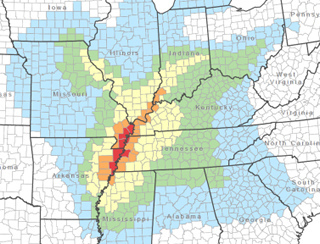
The New Madrid Siesmic Zone can be seen in the red and orange colors along the borders of Kentucky, Tennessee, Arkansas, Missouri and Illinois. The colors indicate a higher threat of a severe earthquake occurring in the area. (Map courtesy of the Missouri State Emergency Management Agency)
It is critical that our citizens, communities and schools are prepared for natural disasters. A catastrophic earthquake in the New Madrid Zone would impact not only Kentucky, but several surrounding states, as well. The overall impact could make the disaster of Hurricane Katrina pale in comparison.
Such possibilities demand attention and planning, which is why the Kentucky Division of Emergency Management (KYEM) participates in several annual exercises to ensure the right people are in the right place and know what to do.
“We recognize that a major earthquake is our largest natural threat,” said Buddy Rogers, public information officer for KYEM. “By preparing for an earthquake our citizens, and officials should be prepared for any natural disaster and when such a event occurs the Commonwealth Emergency Operations center would be instrumental in the response and recovery.”
Kentucky also has a new tool in its own safety preparedness in the new emergency operations center, recently completed in Frankfort, Ky. Rogers said the replaced EOC handled more than 5,000 statewide incidents in the first 10 months of the year.
“We certainly would require full capacity involvement from our 15 Emergency Support Function partners and the CEOC will run 24/7 for a long duration,” he said. ” You never know, the next call could be a catastrophic earthquake.”
dwa
Story by Capt. John T. Stamm, 123rd Airlift Wing Public Affairs
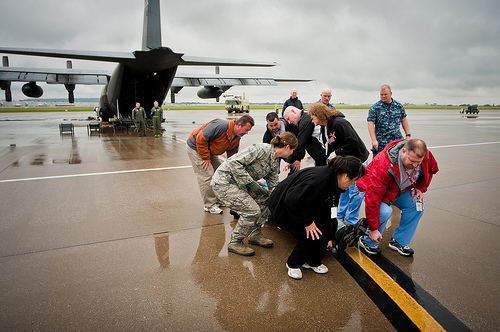
Volunteers for the National Disaster Medical System carry simulated patients off a C-130 during a earthquake-response exercise held May 18, 2011, at the Kentucky Air National Guard Base in Louisville, Ky. Operated by the U.S. Department of Health and Human Services with volunteers from multiple agencies like the Department of Veterans Affairs, NDMS was created to manage the federal government’s overall medical response to major emergencies and disasters. (U.S. Air Force photo by Maj. Dale Greer)
Click here for more photos on this story.
KENTUCKY AIR NATIONAL GUARD BASE, LOUISVILLE, Ky. — Amidst the chaos of moans, groans and cries for help, members of the 123rd Airlift Wing conducted patient triage and provided emergency medical care for more than a dozen men and women badly injured in an earthquake and subsequent plane crash here May 18.
Paul Beard (left), a mental health professional at the Robley Rex Veterans Affairs Medical Center in Louisville, and Troy Colón, an assistive technology professional at the Louisville VA hospital, carry a simulated patient off a Kentucky Air National Guard C-130 during earthquake-response exercises held May 18, 2011, at the Kentucky Air National Guard Base in Louisville, Ky. The exercises were designed to test the capabilities of government agencies following a major earthquake along the New Madrid fault line. (U.S. Air Force photo by Maj. Dale Greer)
Fortunately, the patients were volunteers, and their injuries weren’t real. Instead, they were part of two simulations designed to test the disaster-response capabilities of the Kentucky Air Guard medical group and multiple federal agencies, including the Robley Rex Veterans Affairs Medical Center in Louisville.
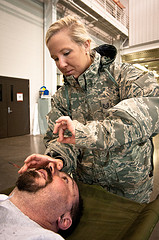
Tech. Sgt. Heather Speidel, a medic with the Kentucky Air National Guard’s 123rd Medical Group, simulates inserting a breathing tube in the windpipe of a notional plane-crash victim during earthquake-response exercises held May 18, 2011, at the Kentucky Air National Guard Base in Louisville, Ky. The exercises were designed to test the ability of the Department of Veterans Affairs and the Kentucky Air Guard to provide medical care following a major earthquake along the New Madrid fault line. (U.S. Air Force photo by Maj. Dale Greer)
In the first scenario, a C-130 carrying injured earthquake victims landed at the Kentucky Air Guard Base, where medical personnel were standing by to carry them off the plane and prepare them for transport to local hospitals. Many of the “patients” had been evacuated from simulated hospitals and nursing homes in the notional earthquake zone, which meant they required special care as soon as they arrived in Louisville, according to Lt. Col. Beth Leistensnider, medical readiness officer for the 123rd Airlift Wing.
Although medical personnel from the wing assisted with patient care during the first scenario, the event primarily was intended to test the VA’s support of the National Disaster Medical System, Colonel Leistensnider explained. Operated by the U.S. Department of Health and Human Services, NDMS was created to manage the federal government’s overall medical response to major emergencies and disasters. In addition to the VA, the NDMS also partners with the Federal Emergency Management Agency, the Department of Defense, state and local departments of health, and private hospitals.
“In the event of a large-scale disaster such as an earthquake, the Louisville VA will be responsible for setting up a patient reception area on our base,” Colonel Leistensnider said. “Under NDMS, federal authorities will arrange for patients to be flown here from affected areas, the patients will be received by the VA, and they will be transported to local healthcare facilities.”
The partnership between the VA and the Kentucky Air Guard is a valuable one, according William Young, emergency response coordinator for the Louisville VA.
“The base’s involvement in this operation is very critical,” Mr. Young said. “We don’t have the manpower or support to do this by ourselves. Additionally, the medical staff here provides us with invaluable training on how to provide the best care to a large number of patients.”
Colonel Leistensnider agreed that joint exercises offer tremendous benefits for patient care.
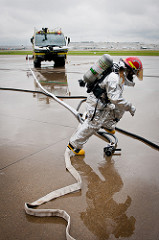
A member of the Louisville Regional Airport Authority Fire Department responds to a simulated plane crash during earthquake-response exercises held May 18, 2011, at the Kentucky Air National Guard Base in Louisville, Ky. The exercises were designed to test the capabilities of government agencies following a major earthquake along the New Madrid fault line. (U.S. Air Force photo by Maj. Dale Greer)
“The more contact we have with the different agencies we may be involved with during an emergency, the more effective we all become,” she said.
The second exercise held May 18 was limited to the wing’s 123rd Medical Group, whose members were tasked with rendering aid to earthquake victims who were subsequently involved in a plane crash. The scenario required triage of difficult and combative patients and emergency medical care under field conditions, with cases ranging from head trauma and fractured bones to a heart attack and a woman in labor.
“After notification of the incident, we set up our medical control and emergency operations center, set up our communications channels, practiced our system of patient tracking and provided treatment as patients arrived,” Colonel Leistensnider said.
“We didn’t know what was coming at us, which is a very realistic possibility. But we met our objectives by creating a realistic environment and performing our duties using the equipment we had available. With each exercise, we improve. The next time, we’ll be even more prepared.”
Both exercises augmented National Level Exercise 2011, a weeklong event designed to test the local, state and national response to a simulated earthquake along the New Madrid Fault. NLE 2011, which concludes May 20, includes participation from emergency responders in eight central states, the National Guard and multiple federal entities.
###
keh
Story by the Kentucky National Guard Public Affairs Office
Photos by Staff Sgt. Michael J. Oliver, KYNG PAO
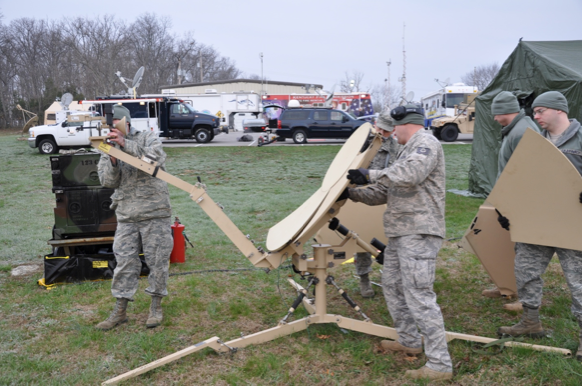
Kentucky Air Guardsmen install the Small Portable Initial Communications Equipment satellite antenna at Boone National Guard Center State Communication Exercise in Frankfort, Ky., April 1.
FRANKFORT, Ky-The Kentucky Guard and Kentucky Emergency Management hosted a mobile communications capability “Rodeo” for state public safety agencies at the Boone National Guard Center on Friday April 1. These agencies also participated in the state-wide communication exercise in preparation for the National Level Earthquake Exercise (NLE) scheduled for mid-May.
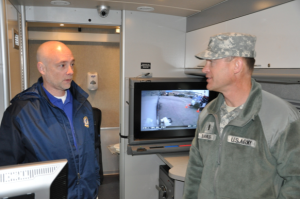
Chuck Stribling, OSH Federal-State coordinator with Labor Cabinet, and Chief Warrant Officer 4 David Barker, JFHQ wireless IT manager, discuss logistics in the labor cabinet mobile center for the state communication exercise.
“It’s a definite ‘win’ when we all can get together, work together, and problem-solve together as one Kentucky before an emergency, “said Chief Warrant Officer 4 David Barker, KYNG Wireless Manager. “When we had the ice storm of 2009, we asked the Florida Guard to provide communication resources that we now know we have in Kentucky.”
The COMEX and Communications rodeo was comprised of over 300 personnel from the Kentucky Army and Air National Guard, the Kentucky Emergency Management, Kentucky State Police, Kentucky Transportation Cabinet, Kentucky State Fire Commission, Kentucky Labor Cabinet, Murray State University, and Lexington Fayette Emergency Management.
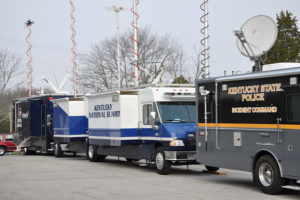
Several state agencies participated in the communication 'rodeo' and COMEX at Boone Center, 1 April 2011.
The COMEX involved setting up primary communication of voice and data required to serve Kentucky in the aftermath of a devastating earthquake, as will be simulated during the NLE.
This specific earthquake exercise, known as NLE 2011, will model the decisions and actions that officials will take in the first 96-hours after a 7.0 earthquake. This is the first NLE to focus on a natural hazard, rather than a terrorism scenario.
“Is Kentucky ready for a 7.7 earthquake? No. Are we more prepared than we used to be? Absolutely!” said John Heltzel, director for Kentucky Emergency Management. “The ice storm of 2009 taught us many valuable lessons which we have continued to build from. From our lessons learned, we now have a fully staffed resource management section. Prior to the ice storm, we didn’t.”
The NLE 2011 will include hands on training with local responders, federal and state emergency management officials, and private sector partners throughout the Commonwealth. FEMA and Homeland Security officials are scheduled to participate in NLE 2011 as well.
The NLE 2011 is expected to be the largest joint exercise in United States’ history, based on a natural event.
