Pages
Stay In Touch
More
© 2013 KentuckyGuard
sdm
Story and photos by Capt. Stephen Martin, Kentucky National Guard Public Affairs
Sgt 1st Class Bert O`Daniel discusses logistical operations with Army Guard Lt. Col. Chris Meyer and Air Guard Lt. Col. Dawn Muller during the National Level Exercise in Bowling Green, Ky. May 17. (Photo by Capt. Stephen Martin, Kentucky National Guard Public Affairs)
BOWLING GREEN, Ky. (May 24, 2011) - The nation’s largest-ever multi-agency exercise involving an actual natural threat was held last week across seven states to respond to a simulated catastrophic earthquake along the New Madrid Fault.
To support the National Level Exercise, the Kentucky National Guard established a Joint Reception, Staging, Onward Movement and Integration team based out of Bowling Green, Ky.
According to Sgt. 1st Class Bert O`Daniel, JRSOI logistics coordinator, the team’s function is to receive personnel from outside the Commonwealth, equip them and move them forward to provide support.
“Realistically, there’s not enough assets to support everyone,” said O`Daniel. “We will have to balance our need to distribute supplies with those who are already supporting the effort.”
The JRSOI team set up camp at the Bowling Green Police Department as a place to coordinate their efforts. Their mission is to identify locations in Bowling Green that would be suitable to receive potentially thousands of troops and aid workers each day, in-process them and send them forward.
Kentucky Air Guardsman Lt. Col. Dawn Muller works alongside South Carolina Army Guardsman Maj. Shannon Goad in Bowling Green, Ky during the National Level Exercise May 17. (Photo by Capt. Stephen Martin, Kentucky National Guard Public Affairs)
“A big challenge is identifying a site in the middle of nowhere to take in these people who are here to provide support,” said Lt. Col. Chris
Meyer, Army Guard JRSOI Director. “We need to provide fuel, housing and medical support just to name a few. It’s a daunting task.”
This group also runs into simulated problems that they might encounter in an actual emergency and are forced to think outside-the-box when dealing with them.
Members of the Joint Reception, Staging, Onward Movement and Integration, or JRSOI, stage out of the Bowling Green, Ky Police Department during the National Level Exercise May 17. The JRSOI is responsible for receiving personnel from outside the Commonwealth, equipping them and quickly moving them forward to provide support. (Photo by Capt. Stephen Martin, Kentucky National Guard Public Affairs)
O`Daniel brings 35 years of logistical experience to the JRSOI team. He currently works full-time for the Surface Maintenance Office as a Management Analyst in Frankfort, Ky.
“We’ve improved a lot over the last few years. It’s a continuous process – constantly evaluating the job at hand.”
http://kentuckyguard.wordpress.com/2011/04/15/preparing-the-force-for-a-catastrophic-incident/
http://www.dvidshub.net/news/70549/national-level-exercise-showcases-guards-interagency-operability
http://isurfhopkins.com/local/11163-kentucky-tests-communications-and-response-capabilities-in-the-national-earthquake-exercise.html
http://www.flickr.com/photos/kyngpao/
dwa
by Master Sgt. Philip Speck, 123rd Airlift Wing Public Affairs
EMTs from CoxHealth of Springfield, Mo., carry a mannequin into the back of a Kentucky Air Guard C-130 at Springfield-Branson National Airport in Springfield, Mo., on May 18, 2011, as part of National Level Exercise 2011. The exercise is based on a scenario involving a massive earthquake along the New Madrid fault line, requiring extensive aeromedical evacuation of injured patients. (U.S. Air Force photo by Senior Airman Maxwell Rechel)
Click here to see more on this story
SPRINGFIELD, Mo. (May 19, 2011) — More than 40 members of the Kentucky Air National Guard’s Contingency Response Element are operating a key patient-movement hub here as part of National Level Exercise 2011, a weeklong scenario designed to test the local, state and national response to a simulated 7.7-magnitude earthquake along the New Madrid Seismic Zone.
The event, which began May 16, is billed as part of the largest joint exercise in U.S. history, with participation from emergency responders in eight central states, the National Guard and multiple federal entities like the Department of Defense, U.S. Transportation Command and the Federal Emergency Management Agency, said Lt. Col. Dave Mounkes, commander of the Kentucky Air Guard’s 123rd Contingency Response Element.
Under the scenario, the 123rd CRE was tasked to deploy from its Louisville, Ky., base of operations to Springfield-Branson National Airport here and establish an air hub at the notionally inoperative airfield. The unit’s Airmen brought everything necessary to establish the hub and support inbound or outbound aircraft, providing command and control, satellite-based communications and cargo handling equipment, among other capabilities.
Once operational, which started following the arrival of the first aircraft, the unit began supporting a Defense Aeromedical Staging Facility to coordinate the aeromedical evacuation of injured patients to multiple reception centers around the country, Mounkes said. Those evacuation flights are being carried out by three C-130 aircraft from the Kentucky Air National Guard’s 123rd Airlift Wing at the direction of U.S. Transportation Command.
“This is exactly what we can expect to see in the event of a real-world earthquake,” Mounkes said. “There will be a lot of injured patients who will need to be moved quickly and efficiently from the affected area to accepting hospitals throughout the United States. One key to making this work is knowing which patients are being sent where, so they can be tracked through the system. That’s why we’re working closely with the DASF throughout this exercise.”
Capt. Ross Birdsong, a nurse with the 60th Inpatient Operations Squadron at Travis Air Force Base, Calif., and Sgt. Ursus Vargas of the 6th Medical Group, MacDill Air Force Base, Fla., carry a mannequin onto a Kentucky Air Guard C-130 Hercules on May 17, 2011, on Springfield-Branson National Airport's flight line during National Level Exercise 2011. The exercise is based on a scenario involving a simulated earthquake along the New Madrid fault line. (U.S. Air Force photo by Senior Airman Maxwell Rechel)
Mounkes noted that the Kentucky Air Guard is no stranger to operating initial-response air hubs. The unit opened the Alexandria Airfield Hub in Louisiana in support of aeromedical evacuations after Hurricane Katrina, and last year it operated the major airlift hub in the Dominican Republic supporting earthquake relief operations in Haiti.
But each new deployment or exercise provides a valuable opportunity to learn more, and NLE 2011 is no different, officials said.
“This has been a tremendous training experience for us because of the opportunity it’s providing to work with so many local, state and federal agencies,” said 2nd Lt. Matt Skeens, 123rd CRE logistics officer.
“Working with civilian agencies is always an important lesson, and that’s really been one of our primary focuses here: to integrate our processes with those of the civilian agencies like FEMA, local emergency management personnel and medical teams from the U.S. Department of Health and Human Services. Being able to speak the same language is probably the most difficult thing we’ve had to do, and it’s also the thing we’ve learned the most about.”
This kind of training does more than enhance mission accomplishment, according to Master Sgt. James Nalley, the 123rd CRE’s maintenance flight chief. It also helps grow a new generation of leaders ready to answer the nation’s call any time a natural disaster strikes.
“Exercises like this are essential to developing the skills and confidence of our young Airmen,” Nalley said. “We’re already very good at what we do, but I feel like we can’t get enough of this stuff. It makes us better every time.”
###
dwa
Story by Capt. John T. Stamm, 123rd Airlift Wing Public Affairs
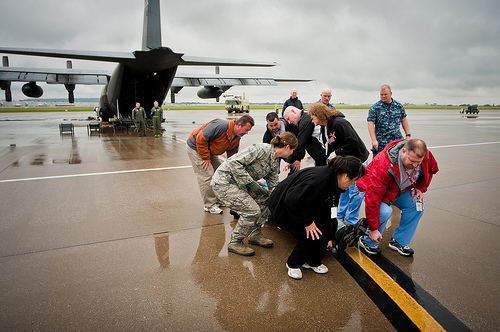
Volunteers for the National Disaster Medical System carry simulated patients off a C-130 during a earthquake-response exercise held May 18, 2011, at the Kentucky Air National Guard Base in Louisville, Ky. Operated by the U.S. Department of Health and Human Services with volunteers from multiple agencies like the Department of Veterans Affairs, NDMS was created to manage the federal government’s overall medical response to major emergencies and disasters. (U.S. Air Force photo by Maj. Dale Greer)
Click here for more photos on this story.
KENTUCKY AIR NATIONAL GUARD BASE, LOUISVILLE, Ky. — Amidst the chaos of moans, groans and cries for help, members of the 123rd Airlift Wing conducted patient triage and provided emergency medical care for more than a dozen men and women badly injured in an earthquake and subsequent plane crash here May 18.
Paul Beard (left), a mental health professional at the Robley Rex Veterans Affairs Medical Center in Louisville, and Troy Colón, an assistive technology professional at the Louisville VA hospital, carry a simulated patient off a Kentucky Air National Guard C-130 during earthquake-response exercises held May 18, 2011, at the Kentucky Air National Guard Base in Louisville, Ky. The exercises were designed to test the capabilities of government agencies following a major earthquake along the New Madrid fault line. (U.S. Air Force photo by Maj. Dale Greer)
Fortunately, the patients were volunteers, and their injuries weren’t real. Instead, they were part of two simulations designed to test the disaster-response capabilities of the Kentucky Air Guard medical group and multiple federal agencies, including the Robley Rex Veterans Affairs Medical Center in Louisville.
Tech. Sgt. Heather Speidel, a medic with the Kentucky Air National Guard’s 123rd Medical Group, simulates inserting a breathing tube in the windpipe of a notional plane-crash victim during earthquake-response exercises held May 18, 2011, at the Kentucky Air National Guard Base in Louisville, Ky. The exercises were designed to test the ability of the Department of Veterans Affairs and the Kentucky Air Guard to provide medical care following a major earthquake along the New Madrid fault line. (U.S. Air Force photo by Maj. Dale Greer)
In the first scenario, a C-130 carrying injured earthquake victims landed at the Kentucky Air Guard Base, where medical personnel were standing by to carry them off the plane and prepare them for transport to local hospitals. Many of the “patients” had been evacuated from simulated hospitals and nursing homes in the notional earthquake zone, which meant they required special care as soon as they arrived in Louisville, according to Lt. Col. Beth Leistensnider, medical readiness officer for the 123rd Airlift Wing.
Although medical personnel from the wing assisted with patient care during the first scenario, the event primarily was intended to test the VA’s support of the National Disaster Medical System, Colonel Leistensnider explained. Operated by the U.S. Department of Health and Human Services, NDMS was created to manage the federal government’s overall medical response to major emergencies and disasters. In addition to the VA, the NDMS also partners with the Federal Emergency Management Agency, the Department of Defense, state and local departments of health, and private hospitals.
“In the event of a large-scale disaster such as an earthquake, the Louisville VA will be responsible for setting up a patient reception area on our base,” Colonel Leistensnider said. “Under NDMS, federal authorities will arrange for patients to be flown here from affected areas, the patients will be received by the VA, and they will be transported to local healthcare facilities.”
The partnership between the VA and the Kentucky Air Guard is a valuable one, according William Young, emergency response coordinator for the Louisville VA.
“The base’s involvement in this operation is very critical,” Mr. Young said. “We don’t have the manpower or support to do this by ourselves. Additionally, the medical staff here provides us with invaluable training on how to provide the best care to a large number of patients.”
Colonel Leistensnider agreed that joint exercises offer tremendous benefits for patient care.
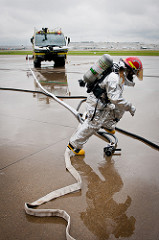
A member of the Louisville Regional Airport Authority Fire Department responds to a simulated plane crash during earthquake-response exercises held May 18, 2011, at the Kentucky Air National Guard Base in Louisville, Ky. The exercises were designed to test the capabilities of government agencies following a major earthquake along the New Madrid fault line. (U.S. Air Force photo by Maj. Dale Greer)
“The more contact we have with the different agencies we may be involved with during an emergency, the more effective we all become,” she said.
The second exercise held May 18 was limited to the wing’s 123rd Medical Group, whose members were tasked with rendering aid to earthquake victims who were subsequently involved in a plane crash. The scenario required triage of difficult and combative patients and emergency medical care under field conditions, with cases ranging from head trauma and fractured bones to a heart attack and a woman in labor.
“After notification of the incident, we set up our medical control and emergency operations center, set up our communications channels, practiced our system of patient tracking and provided treatment as patients arrived,” Colonel Leistensnider said.
“We didn’t know what was coming at us, which is a very realistic possibility. But we met our objectives by creating a realistic environment and performing our duties using the equipment we had available. With each exercise, we improve. The next time, we’ll be even more prepared.”
Both exercises augmented National Level Exercise 2011, a weeklong event designed to test the local, state and national response to a simulated earthquake along the New Madrid Fault. NLE 2011, which concludes May 20, includes participation from emergency responders in eight central states, the National Guard and multiple federal entities.
###
dwa
Story by Capt John Stamm, 123rd Airlift Wing Public Affairs
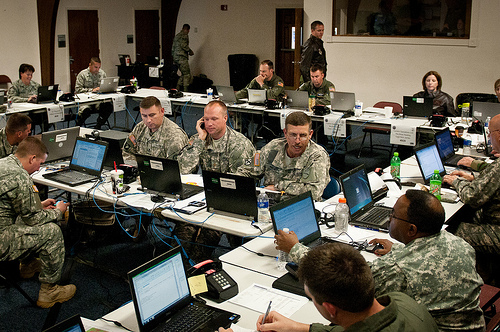
Airman and Soldiers from the Kentucky National Guard staff a Joint Air Operations Center at the Kentucky Air National Guard Base in Louisville, Ky., on May 17, 2011. The JAOC is supporting a major earthquake-response exercise by prioritizing and allocating air assets for missions into affected areas across the state. (U.S. Air Force photo by Capt. John T. Stamm)
KENTUCKY AIR NATIONAL GUARD BASE, LOUISVILLE, Ky. – The Kentucky National Guard stood up a Joint Air Operations Center here May 16 to serve as the main command node for all the state’s fixed-wing and rotary aircraft participating in the largest earthquake-response exercise in U.S. history.
The weeklong event, called National Level Exercise 2011, is designed to test the local, state and national response to a simulated earthquake along the New Madrid Fault. It includes participation from emergency responders in eight central states, the National Guard and multiple federal entities like the Department of Defense and the Federal Emergency Management Agency.
Kentucky’s Joint Air Operations Center, or JAOC, is supporting the exercise by prioritizing and allocating air assets for missions into affected areas across the Commonwealth, transporting personnel and equipment, and providing aeromedical evacuation and search-and-rescue capabilities as appropriate, said Brig. Gen. Mark Kraus, who commands the JAOC and is Kentucky’s Joint Forces Air Component Commander.
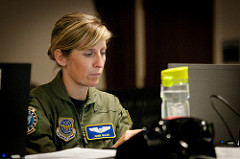
Capt. Jenn Nash coordinates long-range mission planning for the Joint Air Operations Center at the Kentucky Air National Guard Base in Louisville, Ky., on May 17, 2011. The JAOC is supporting a major earthquake-response exercise by prioritizing and allocating air assets for missions into affected areas across the state. (U.S. Air Force photo by Capt. John T. Stamm)
“Yesterday, we were alerted to the simulated earthquake, reported for duty, set up our facility here, checked our communication lines, and made sure our plans were in place to receive taskings and then allocate missions to either C-130 cargo planes, Blackhawk helicopters or whatever air assets we might have,” he said. “The initial focus was on search and rescue, so our job was to get teams from different parts of the state into the affected areas – primarily the 24 Western Kentucky counties deemed most at risk from a New Madrid earthquake.”
The Kentucky Guard also performed airfield assessments May 16, flying a joint team of Air and Army National Guardsmen to airports across the state, where they conducted tests and surveys to determine which runways were undamaged by the earthquake and could support humanitarian airlift operations if necessary.
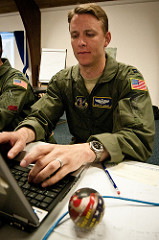
Capt. Ryan Adams tracks the planning and execution of aviation activity across Kentucky while working at the Joint Air Operations Center at the Kentucky Air National Guard Base in Louisville, Ky., on May 17, 2011. The JAOC is supporting a major earthquake-response exercise by prioritizing and allocating air assets for missions into affected areas across the state. (U.S. Air Force photo by Capt. John T. Stamm)
Meanwhile, the Kentucky Air Guard’s 123rd Airlift Wing is heavily engaged in supporting the exercise at the national level. The unit is expected to deploy three C-130 aircraft May 17 to transport aeromedical evacuation teams from Pope Air Force Base, N.C., and Scott Air Force, Ill., to Springfield-Branson National Airport in Springfield, Mo. There, more than 40 members of the 123rd Airlift Wing’s Contingency Response Element have set up an air hub to receive relief supplies and evacuate injured citizens to hospitals as far away as Iowa and Louisiana, said Lt. Col. David Mounkes, CRE commander. The aeromedical evacuation flights will take place aboard Kentucky Air Guard C-130s as directed by U.S. Transportation Command.
While the exercise is designed to assess response and recovery capabilities both nationally and regionally, Kentucky will use this week’s events to update and augment the Commonwealth Earthquake Response Plan, General Kraus said.
Col. Steve Bullard, vice commander of the 123rd Airlift Wing, said the exercise also provides a valuable opportunity to work with scores of government agencies and civil authorities, so officials will know how to interact effectively in the event of a real emergency.
“The whole point of this exercise is to bring us together, to help us learn how to best work together to serve the people of the Commonwealth of Kentucky and the United States,” he said.
###
dwa
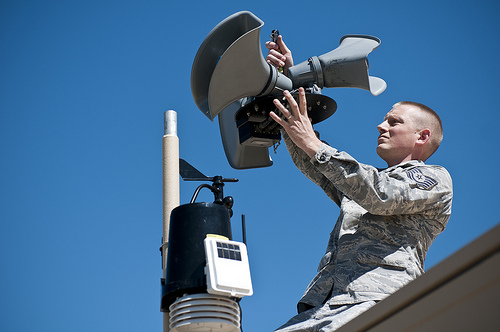
Tech. Sgt. Phil Seif with the Kentucky Air National Guard's 123rd Contingency Response Element installs a speaker system on top of the Hard-sided Expandable Light Air Mobile Shelter in Springfield, Mo. on May 16, 2011 during the National Level Exercise. With participants from the Department of Defense and human services such as the Mobile Aeromedical Staging Facility and the Federal Emergency Management Agency, the NLE is based on a scenario of a 6.0 or higher earthquake on the New Madrid fault line. (U.S. Air Force photo by Senior Airman Maxwell Rechel)
Click here to see more photos of the Kentucky Air National Guard’s 2011 NLE mission.
SPRINGFIELD, Mo. (May 16, 2011) - The Kentucky Air National Guard’s Contingency Response Element is currently in Springfield, Mo. to support the 2011 National Level Exercise, which simulates a 6.0 or higher earthquake on the New Madrid fault line. Chief among the Citizen-Airmen’s duties is setting up an air hub to evacuate patients to other hospitals.
These 50 Air Guard men and women are experienced in humanitarian relief efforts, many of whom performed similar duties while deployed last year to the Dominican Republic in support of earthquake relief operations in Haiti.
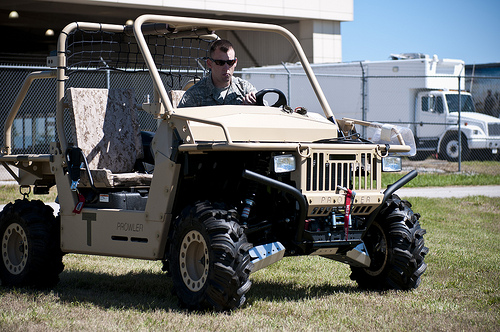
Senior Airman Pete Vicini of Kentucky Air National Guard's 123rd Security Forces drives the parameter of the Springfield-Branson Regional Airport during the National Level Exercise, May 16, 2011. With participants from the Department of Defense and human services such as the Mobile Aeromedical Staging Facility and the Federal Emergency Management Agency, the NLE is based on a scenario of a 6.0 or higher earthquake on the New Madrid fault line. (U.S. Air Force photo by Senior Airman Maxwell Rechel)
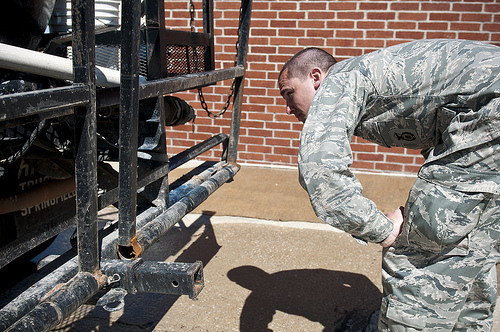
Airman 1st Class Mike Watts with the Kentucky Air National Guard's 123rd Security Forces inspects a truck at the entry control point before allowing access to the flight line in Springfield, MO on May 16, 2011 during the National Level Exercise. With participants from the Department of Defense and human services such as the Mobile Aeromedical Staging Facility and the Federal Emergency Management Agency, the NLE is based on a scenario of a 6.0 or higher earthquake on the New Madrid fault line. (U.S. Air Force photo by Senior Airman Maxwell Rechel)
keh
Story by the Kentucky National Guard Public Affairs Office
Photos by Staff Sgt. Michael J. Oliver, KYNG PAO
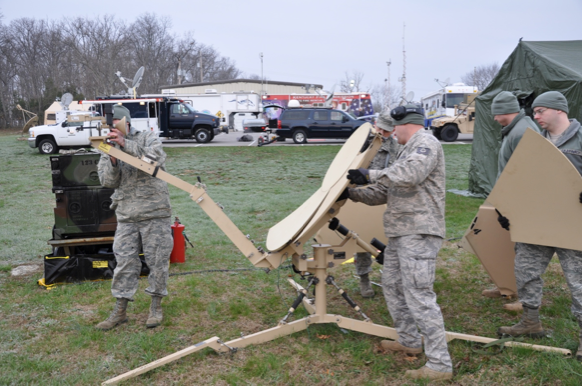
Kentucky Air Guardsmen install the Small Portable Initial Communications Equipment satellite antenna at Boone National Guard Center State Communication Exercise in Frankfort, Ky., April 1.
FRANKFORT, Ky-The Kentucky Guard and Kentucky Emergency Management hosted a mobile communications capability “Rodeo” for state public safety agencies at the Boone National Guard Center on Friday April 1. These agencies also participated in the state-wide communication exercise in preparation for the National Level Earthquake Exercise (NLE) scheduled for mid-May.
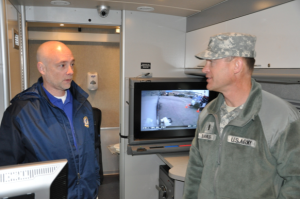
Chuck Stribling, OSH Federal-State coordinator with Labor Cabinet, and Chief Warrant Officer 4 David Barker, JFHQ wireless IT manager, discuss logistics in the labor cabinet mobile center for the state communication exercise.
“It’s a definite ‘win’ when we all can get together, work together, and problem-solve together as one Kentucky before an emergency, “said Chief Warrant Officer 4 David Barker, KYNG Wireless Manager. “When we had the ice storm of 2009, we asked the Florida Guard to provide communication resources that we now know we have in Kentucky.”
The COMEX and Communications rodeo was comprised of over 300 personnel from the Kentucky Army and Air National Guard, the Kentucky Emergency Management, Kentucky State Police, Kentucky Transportation Cabinet, Kentucky State Fire Commission, Kentucky Labor Cabinet, Murray State University, and Lexington Fayette Emergency Management.
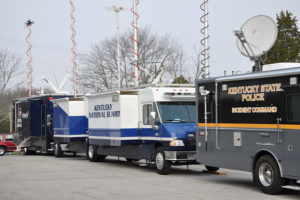
Several state agencies participated in the communication 'rodeo' and COMEX at Boone Center, 1 April 2011.
The COMEX involved setting up primary communication of voice and data required to serve Kentucky in the aftermath of a devastating earthquake, as will be simulated during the NLE.
This specific earthquake exercise, known as NLE 2011, will model the decisions and actions that officials will take in the first 96-hours after a 7.0 earthquake. This is the first NLE to focus on a natural hazard, rather than a terrorism scenario.
“Is Kentucky ready for a 7.7 earthquake? No. Are we more prepared than we used to be? Absolutely!” said John Heltzel, director for Kentucky Emergency Management. “The ice storm of 2009 taught us many valuable lessons which we have continued to build from. From our lessons learned, we now have a fully staffed resource management section. Prior to the ice storm, we didn’t.”
The NLE 2011 will include hands on training with local responders, federal and state emergency management officials, and private sector partners throughout the Commonwealth. FEMA and Homeland Security officials are scheduled to participate in NLE 2011 as well.
The NLE 2011 is expected to be the largest joint exercise in United States’ history, based on a natural event.