Pages
Stay In Touch
More
© 2013 KentuckyGuard
Commentary by Chief Warrant Officer Joseph P. Lyddane, 138th Field Artillery Brigade
FRANKFORT, Ky. — The transcontinental railroad was completed on May 10, 1869 by Chinese immigrants and twenty-six years before that, on May 7, 1843 the first Japanese people began migrating to the United States. These are but two of the many reasons why the month of May was chosen to take the opportunity to recognize the contributions made by Asian American and Pacific Islanders (AAPIs). They represent almost fifty countries with more than one hundred languages and dialects. According to the Census Bureau, there are 16.6 million AAPIs residing in the US which accounts for 5.4 percent of the US population and it is estimated that by 2050 that number will rise to about 42.6 million.
For generations Asian Americans and Pacific Islanders have impacted the United States helping to develop and defend the country, often times amid racial and cultural prejudice. The American way of life has been improved by AAPIs through major contributions to athletics, public servitude, science initiatives, and artistic achievements, to name a few.
Click here for more information on Asian American Pacific Islander Month.
Nicknamed Road Runner for her unflagging energy and enthusiasm, Carolyn Hisako Tanaka served in Vietnam in spite of a scarring childhood memory. At the age of six, she saw her family evicted from their California home in the wake of Pearl Harbor and relocated to an internment camp in Poston, Arizona. When the family returned to California after the war, they found their home burned to the ground. In 1966, as an emergency room nurse, she decided to enlist in the Army, telling skeptical friends, “I have a skill that is needed in Vietnam, and I’m going there to do my duty for my country.” Ironically, she returned from that war to a “welcome” that brought back bitter memories.
Daniel Inouye was a Medal of Honor recipient who was wounded during WWII and served on the US Senate; Patsy Mink was the first Asian American Congresswoman; Har Gobind Khorana was a significant contributor to discovering the genetic code and later won the Nobel Prize in 1968; Elaine Chao was President Bush’s deputy secretary of transportation and director of the Peace Corps in the early 90s; Maya Lin, a world renowned architect and designer of the Vietnam Memorial; and Norman Yoshio Maneta who served twenty years in the US House of Representatives.
As a youth, Jimmie Kanaya became fascinated with the military, and at 20 he jumped at the chance to enlist in 1941—months before the attack on Pearl Harbor. After helping his parents relocate from their Oregon home to an Idaho internment camp, Kanaya took his skills as a medic to the 442nd Regimental Combat Team. He aggressively looked out for his men, even negotiating a halt to fighting to bring in casualties from the battlefield. Captured by German troops, he escaped three times and at war’s end was the only non-Caucasian in his POW camp. Kanaya continued to serve his country during the Korean and Vietnam Wars.
These are just some of the countless individuals who overcame adversity and made an impact.
Through partnerships like that of the United States and AAPIs we are able to broaden our horizons and enhance our effectiveness. Diversity is about acceptance; the U.S. military depends on it.
Take time this month to reflect on diversity and the benefits of including everyone. Research other cultures and educate yourself on what makes each of us different; by doing so you will discover how similar we all are and possibly gain a new perspective.
Story by David Altom, Kentucky National Guard Public Affairs
May is Asian-Pacific American Heritage Month, and the Defense Department takes time to recognize and honor the dedicated service and contributions of Asian Americans and Pacific Islanders, both past and present, through military service in defense of our nation.
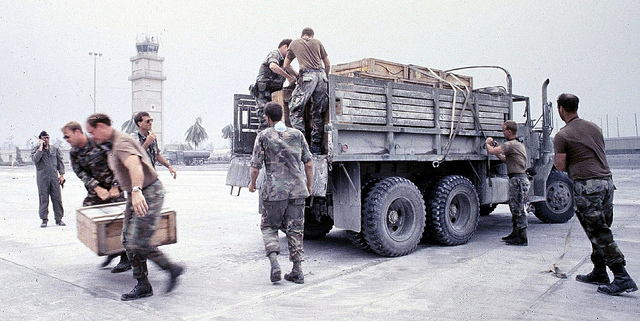
CLARK AIR BASE, Philippines — In 1991 U.S. Air Force and Marine personnel evacuated a truckful of munitions aboard a helicopter at the height of the Mount Pinatubo volcanic eruption at here. Clark AB closed down in November of 1991 ending almost a century of American military presence in the Philippines. (U.S. Air Force photo by Master Sgt. Val Gempis)
FRANKFORT, Ky. — Stacy Pesut’s earliest memories of leaving the Philippines aren’t really hers — she’s heard the story so often from her father, though, that they’ve become part of who she is.
“My dad says he remembers putting me on a duffle bag on the plane,” she says. “I was just a baby then, and he had to stay behind while my mom and I were evacuated.”

June 12, 1991, Mount Pinatubo eruption cloud from Clark Air Base (U.S. Air Force photo by R.S. Culbreth)
It was June of 1991 and Mount Pinatubo had erupted, killing 800 people and leaving 100,000 homeless. The amount of ash and smoke from the volcano was so severe that it actually lowered temperatures around the world for years to come.
Nearby Clark Air Force Base was devastated during the eruption, putting U.S. service members and their families at risk. Pesut was only a few weeks old when her mother and her father made a decision that would change her life forever. She and mom would fly out on a military transport while her dad, a military policeman with the Air Force, remained at his post.
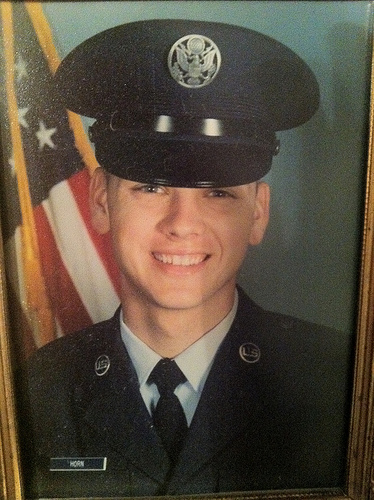
Pesut’s father, Tony Horn, as a young United States Air Force military policeman. Horn stayed behind while Pesut and her mother were evacuated in the wake of the eruption of Mt. Pinatubo, which killed more than 800 people in 1992. Horn is now a sergeant with the 149th Maneuver Enhancement Brigade. (Photo courtesy Spc. Stacy Pesut)
“My dad said it was really hard for him to see us leave,” said Pesut. “And it was really nerve-wracking for my mom because she’d never been away from home. She didn’t know anybody and she barely spoke any English, so it was really difficult for her.”
Pesut and her mother lived with her father’s mother in South Carolina. She was walking by the time her dad made it home. The family eventually settled down in Berea, Kentucky and for years Pesut considered herself a down home “country girl.”
One day that all changed.
“My dad came up to me and said, I think we’re going back to the Philippines for a year,” she said. “He had an opportunity to do some mission work for the church and we all went with him.”
The family had vacationed in the Philippines visiting family, but the idea of completely uprooting and moving to another country was a shock. Pesut joked that one of her main concerns was what they were going to eat.
“Until then my mom would fix two separate meals at home, Filipino food for herself and regular food for the rest of us. When I found out we were going to the Philippines I asked, are we going to have to eat Filipino food all the time?”
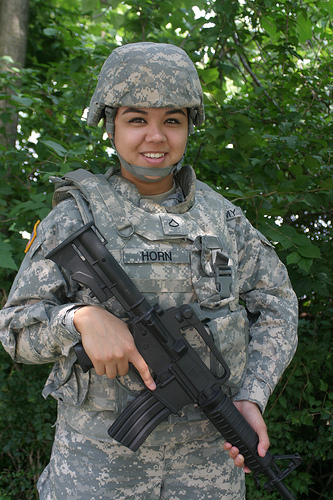
Before she was married, then-Pfc Stacy Horn took part in the Kentucky National Guard’s Be the Elite recruiting program, speaking at schools and helping promote the Guard’s image. (Photo courtesy Kentucky Army National Guard Recruiting)
The one year mission trip soon turned into two years, and that became eight. Pesut adapted to her new home just as her taste buds accepted new eating habits. She was a typical kid, going to school and making friends. Languages were a problem as she only spoke English, and the eastern Kentucky version of that.
“When I first got there they were going to make me do a report in front of the class, only it had to be in Filipino,” she said. “So here’s this little girl talking in this thick southern accent and I thought, I can’t speak Filipino. My uncle helped me write out some stuff, which I read in front of the class. Everybody laughed, saying you don’t pronounce it like that. I came home crying to my mom over that.”
Driven by this experience, Pesut became fluent in the two primary Filipino languages of Tagalog and Kapampangan. She overcame her shyness and became a praise and worship leader in her church, she graduated high school and majored in physical therapy at Angeles University Foundation.
Then came the time to return home. Coming back to the United States was yet another culture shock to Pesut. There was the language, of course, but other, little things were evident. Filipino culture is more conservative, she said, particularly when it comes to dressing modestly and the use of language.
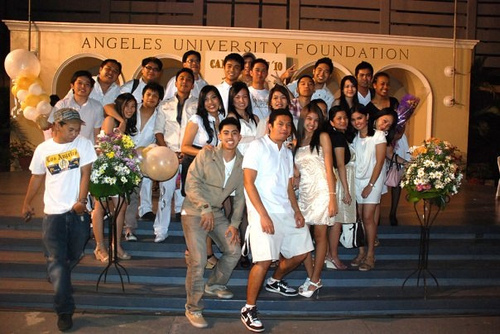
Spc. Stacy Pesut and her classmates at Angeles University Foundation in the Philippines. (Photo courtesy Spc. Stacy Pesut)
“We don’t cuss much,” she said.
Most important was how differently her family interacts.
“It’s taken me a while to get used to how we’re all spread apart here in the states,” she said. “In the Philippines your house is next to your parents’ house, which is next to your grandparents house, and so on. We all live in a sort of family compound where we can get together and support one another.”
After settling down in Kentucky for a second time, Pesut began looking for a way to challenge herself even further. She also wanted to find a way to serve others, her nation in particular.
“I am from the Philippines,” she said, “But I consider the United States my home. I am a servant of God and I wanted a way to help other people.”
After discussing it with her father, Pesut decided to join the Kentucky National Guard. In an unexpected turn, dad not only supported her decision, he took her lead and joined up, too!
“He’d been in the Guard for a while before we went to the Philippines,” she said. “When I told him I wanted to join he said, I think I’ll go, too. So we went to the recruiter together and said, yep, we want to join.”
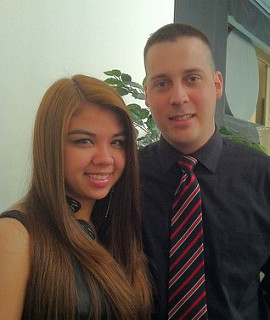
Spc. Stacy Pesut and her husband Sgt. Christopher Pesut. (Photo courtesy Spc. Stacy Pesut)
Her father, Sgt. Tony Horn, is currently in the 149th Maneuver Enhancement Brigade where he works in communication technology. Spc. Stacy Pesut is a human resources specialist for the Kentucky Army Guard, as is her husband, Sgt. Christopher Pesut.
Aside from her family, Pesut’s strongest connection with her Filipino culture is with food. Her current favorite Filipino food is sisig, a which is a pork dish. Sisig is a Kapampangan term which means “to snack on something sour.” The meat is usually marinated in lemon juice or vinegar, then seasoned with salt, pepper and other spices.
“It’s pretty hot,” she said. “We plenty of chili peppers to spice it up.”
At home she and her husband eat lumpia, which is similar to an eggroll. She also fixes stir fry beef, and according to her husband, “rice on rice on rice.”

Spc. Stacy Pesut (center) with brother Joshua, mother Marifi, grandmother Leticia and brother Joseph. Pesut continues to keep in touch with her grandmother and extended family in the Philippines. (Photo courtesy Spc. Stacy Pesut)
She said it’s difficult to pin down a favorite American dish as she and her family now mostly eat Filipino food.
“Even when we have family gatherings like Thanksgiving and Christmas, my mom fixes food from the Philippines,” she said.
Pushed for an answer, she resorts to an American classic.
“You can’t go wrong with cheeseburger,” she said, laughing.