
Pages
Stay In Touch
More
© 2013 KentuckyGuard
Story and photos by David Altom, Kentucky National Guard Public Affairs Office
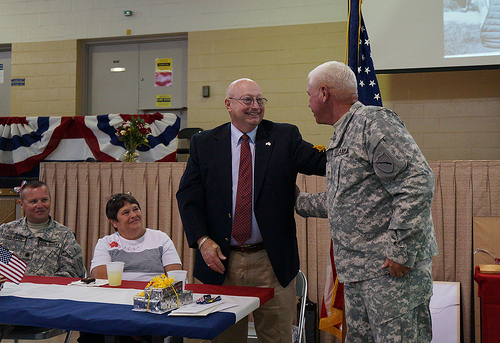
Brig. Gen. Mike Richie (right), congratulates Joe Wilkins during a retirement ceremony at Boone National Guard Center in Frankfort, Ky., Aug.8, 2012. Wilkins was honored for more than 40 years of service to the Kentucky National Guard. (Kentucky National Guard photo by David Altom)
FRANKFORT, Ky.— When Joe Wilkins joined the Kentucky National Guard in 1960, he had no idea that the path he began would lead him to playing a key role in Kentucky’s military legacy. After a one year mobilization during the Berlin Crisis and selling men’s clothing while attending college, he thought his military career would be short-lived.“When I joined the Guard it was my intent to serve three years and get out,” said Wilkins. “My best friend who joined with me followed through with our plan.”
But fate had other plans for him. Wilkins, who recently retired as the civilian director of facilities for the Kentucky Department of Military Affairs, was a major influence in the development of the Wendell H. Ford Regional Training Center, the Guard’s flagship training site in the western part of the state, as well as Bluegrass Station in central Kentucky.
To see more photos from this story, click here
Often referred to as the “NTC of the east” - a reference to the National Training Center in California - WHFRTC is a 12,000 acre facility built on reclaimed strip mine land in Muhlenberg County. Where temporary shacks and house trailers once stood, a fully equipped and dynamic military installation is now in full swing, complete with multiple classroom buildings, shooting ranges, maintenance and long-term storage facilities as well as a mess hall and medical station. Thousands of Kentucky National Guard troops, active duty members from all branches of service and even civilians have trained at the facility.
“I have to credit Major General Bob DeZarn for his vision to make a lot of my dreams for the Wendell Ford Training Center become reality,” said Wilkins. “I am grateful to all of the professionals that I’ve worked with, from our troops and state employees to agencies like the state finance cabinet. I’ve been fortunate to work with a lot of good people.”
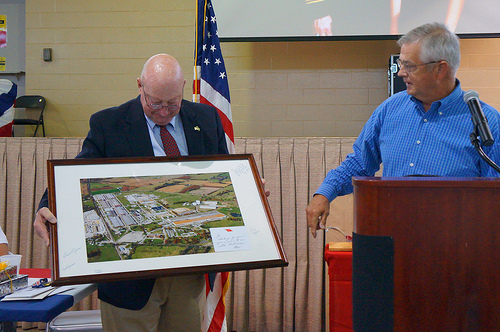
Joe Wilkins is presented a framed aerial photo of Bluegrass Station by retired Maj. Gen. Steve Collins during a retirement ceremony at Boone National Guard Center in Frankfort, Ky., Aug. 8, 2012. As the former civilian director of facilities for the Kentucky Department of Military Affairs, Wilkins oversaw the economic development of the site just outside Lexington, Ky. (Kentucky National Guard photo by David Altom)
Bluegrass Station was an economic development project taken on by the department in the wake of closing down the old Lexington-Bluegrass Depot Activity. Under Wilkins’ tenure there the facility’s occupancy grew to more than 90 percent, attracting military contractors and equipment redistribution programs and bringing thousands of jobs to Kentucky.”We did a lot of great things at both of those facilities,” said Wilkins. “It was a lot of hard work, but it was fun and it brought prestige to the National Guard and the state of Kentucky.”
Brig. Gen. Mike Richie, Assistant Adjutant General, said that Wilkins’ wisdom and leadership were instrumental his success.
“Joe has a fatherly leadership style that is authentic and persuasive,” said Richie. “He was able to see the big picture, put together all of the pieces and then convince you this was the right thing to do. The proof is in his legacy at the Wendell Ford Training Center and what he did at Bluegrass Station.”
“It has been my privilege to have been nurtured and mentored by Joe,” said State Command Sgt. Maj. Greg Armstrong. “I have long admired his positive actions and gentle professional manner. He has provided countless positive impacts on Kentucky Guardsman from young enlisted to our most senior general officers during his career.”
Wilkins’ legacy with the Kentucky Guard lives on with his sons, Lt. Col. Brent Wilkins, Command Sgt. Maj. Kevin Wilkins, his daughter Spc. Susan Wilkins and daughter-in-law Sgt. 1st Class Angela Wilkins.
In case you’re interested, Wilkins plans to keep busy in his retirement. “I’m looking forward to spending time with my hobby, collecting and repairing antique clocks and traveling about these great United States with my wife, Frances.”
Story and photos by Cody Stagner, Medical Outreach Coordinator, Kentucky National Guard
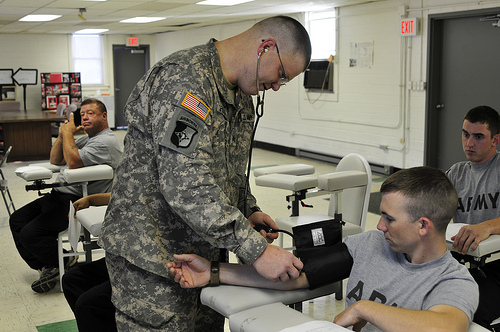
Sgt. Thomas J. Shaddix, assigned to the Kentucky National Guard Medical Detachment, checks vitals during a periodic health assessment at Bluegrass Station in Lexington, Ky., May 10, 2012. (U.S. Army photo by Cody Stagner, Medical Outreach Coordinator, Kentucky National Guard/Released)
LEXINGTON, Ky. -Built in Lexington as a major Army depot in support of war efforts during World War II, Bluegrass Station is best known for its triumphs over unique challenges. The now self-sufficient depot was once home to 275 German prisoners of war from 1945-1946.
Today it’s home to the Kentucky National Guard’s G1-Health Services Clinic—a valuable resource to increase the medical readiness of Kentucky’s Citizen Soldiers.
“The clinic began as a way to provide make up health assessments, physicals and behavioral health exams,” said Capt. Stephanie K. Fields, Deputy State Surgeon.
“We knew we would have to avoid relying on active duty treatment facilities like those at Fort Knox, and Bluegrass Station’s clinical facilities were already in use by the Kentucky Medical Detachment during weekend drill,” said Fields. “This gave us the perfect opportunity to staff the clinic during the week and provide these additional services to our Soldiers.”
To see more photos from this story, click here
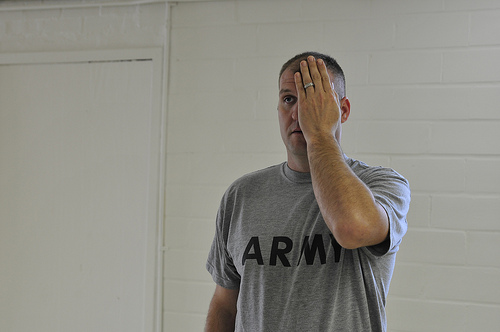
Sgt. Michael Farrar, a diesel mechanic from Detachment 1, 207th Horizontal Engineer Construction Company, reads out letters and numbers on the eye exam chart at Bluegrass Station Clinic in Lexington, Ky., May 10, 2012. The clinic is a new asset to the Kentucky National Guard which offers medical readiness services; such as periodic health assessments, mental health evaluations and focused exams to provide physical profiles. (U.S. Army photo by Cody Stagner, Medical Outreach Coordinator, Kentucky National Guard/Released)
The Kentucky Guard has more than 7,000 Soldiers to schedule periodic health assessments for each year, and missing PHAs could have a negative impact on a unit’s deployment readiness. The clinic gives the Kentucky Guard a proactive approach to identify and action missing PHAs as well as non-deployable Soldiers in a timelier manner.
While PHAs are typically scheduled on drill weekends, occasionally a curve ball is thrown at Soldiers that require their units to reschedule on an individual basis.
Sgt. Michael Farrar, a diesel mechanic with the 207th Horizontal Engineer Construction Company, lives in the small town of Woods Bend, located just outside of West Liberty, Ky., which was one of the most affected areas hit by devastating tornadoes, March 2, 2012.
“The next day after the big storm was drill, but I spent that whole weekend removing more than fifty trees out of my driveway,” said Farrar. “I came here to make up for that missed PHA.”
Whether it is an annual PHA or required physicals for training, the G1-HS Clinic stays busy.
“Since we opened, we have completed over 400 periodic health assessments,” said Monique Carter, the fitness for duty coordinator at the clinic.
Carter also credited an additional 132 focused exams, 86 mental health evaluations and 43 other physicals to the clinic’s first quarter’s report card.
When medical exams reveal a Soldier has a medical or psychological condition that needs further evaluation, physical profile, referral, or even special examinations for military schools, the G1-HS Clinic is a preferred option to provide the necessary service.
Staff Sgt. Anthony T. Hughes and Sgt. Aleksander Vinogradov, from the 577th Engineer Sapper Company, are both enrolled in an upcoming Sapper Leader Course at Fort Leonard Wood, Mo.
“Coming here was the most convenient way to complete our physical exams that qualify us for school,” said Hughes, a combat engineer and training NCO.
For both Soldiers, the Lexington location was convenient.
“This was my first time coming to Bluegrass Station,” Vinogradov said. “It was a little harder to find the medical building than WHFRTC (Wendell H. Ford Regional Training Facility in Greenville, Ky.), but the short drive was much easier coming from Ashland.”

1st Lt. Mark J. Martin, a member of Kentucky Army National Guard Medical Detachment, analyzes medical data after examining a Soldier at Bluegrass Station Clinic, Lexington, Ky., May 10, 2012. Martin’s civilian job as state medical services specialist plays key to maintaining medical readiness of Kentucky Guard members. (U.S. Army photo by Cody Stagner, Medical Outreach Coordinator, Kentucky National Guard/Released)
Bluegrass Station is centrally located in Lexington which adds overall convenience to Kentucky Guard members residing on the Eastern side of the state who normally would have driven an additional three hours to Greenville and stayed overnight. The benefit of many getting to spend more time with family is a welcomed and unforeseen advantage.
1st Lt. Mark J. Martin has a dual role in Kentucky Guard medical readiness. On drill weekends, Martin is an Army nurse for the Kentucky Guard’s medical detachment and provides his expertise as a military medical officer. During the week, however, Martin is the state medical services specialist, where his efforts with the clinic make large strides for Kentucky.
“Since G1-Health Services began this initiative, readiness has gone up seven percent,” said Martin. “We have become the most productive medical asset for the state.”
Bluegrass Station is located at 5751 Briar Hill Road, Lexington, KY 40516. To schedule a PHA or exam, Soldiers must contact their unit’s readiness NCO.
sdm
Story by Capt. Stephen Martin, Kentucky National Guard Public Affairs.
The Kentucky Logistics Operations Center at Bluegrass Station is a self-sustaining military industrial complex in Lexington, Ky. (photo provided by Bluegrass Station)
LEXINGTON, Ky. - -The Kentucky Logistics Operations Center at Bluegrass Station was recently awarded a contract for a new clothing distribution program with the U.S. Navy running from Jan. to Dec. 2011.
“Securing this contract with the U.S. Navy is a great accomplishment for the Kentucky Logistics Operations Center at Bluegrass Station,” said Cabinet for Economic Development Secretary Larry Hayes. “The addition of 30 new jobs at Bluegrass Station this year will certainly provide a positive economic impact on the area.”
The Kentucky Logistics Operations Center at Bluegrass Station is a self-sustaining military industrial complex in Lexington, Ky. (photo provided by Bluegrass Station)
This contract will provide the opportunity to bring on 30 additional jobs to Kentucky employees for the rest of the year.
“The Logistics Operations Center exemplifies our Unbridled Service,” said Maj. Gen. Edward W. Tonini, adjutant general for Kentucky. “This is yet another example of the great things that Bluegrass Station is doing.”
Bluegrass Station, located just outside Lexington, Ky. is a self-sustaining military industrial complex using no state funds to operate and has an economic impact of over 200 million dollars a year.
DWA
Story and photo By David Altom, KYNG Public Affairs
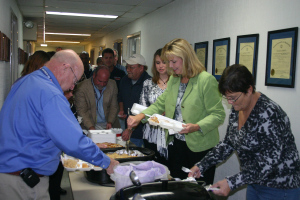
Activities like this brunch held by the Facilities Division helped the Department of Military Affairs set new records with the 2010 Kentucky Employees Charitable Campaign.
Frankfort, Ky. (November 8, 2010) – Employees of the Kentucky Department of Military Affairs set a new record for donations during this year’s Kentucky Employee Charitable Campaign.
“Our final tally for this year’s donations was $41,084,” said Col. Steve Bullard, director of the Division of Administration Services. “That’s 117.4 percent of our goal of $35,000, easily topping our previous record amount of $37,610 set during the 2007 campaign.”
The department also had nine “Leadership Givers” who donated one percent or more of their salary.
“The generosity shown by our employees during this year’s campaign is remarkable,” said Bullard. “Donations to other charitable organizations have suffered somewhat due to the economy. For us to surpass our previous KECC record is a welcome surprise.”
Bullard credits the accomplishment on the mindset of the department’s staff.

“This organization has a mission statement that focuses on helping others in their time of need,” he said. “This is just one more way the Department of Military Affairs makes a positive contribution to the citizens of Kentucky.”
Here’s a listing of donations by division:
Kentucky Logistics Operations Center - $21,971 OMA/Administrative Services - $7,692 Kentucky Emergency Management - $5,850 Facilities Division - $3,527 Bluegrass Station - $1,654 Youth Challenge - $390
