Pages
Stay In Touch
More
© 2013 KentuckyGuard
Story by Master Sgt. Phil Speck, 123rd Airlift Wing Public Affairs Office
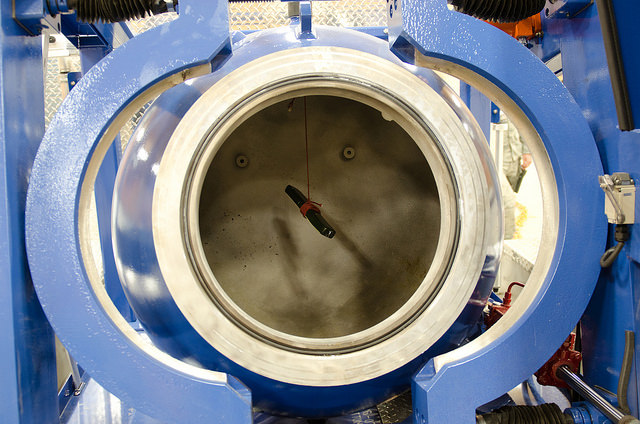
A stick of C4 explosives is suspended in a Bomb Containment Vessel during Explosive Ordnance Disposal training at the Fern Creek Fire Department in Louisville, Ky., Nov. 11, 2014. The vessel is the Kentucky Air National Guard’s newest piece of EOD equipment, allowing personnel to detonate explosives on-site with no repercussions to nearby people or structures. (U.S. Air National Guard photo by Master Sgt. Phil Speck)
KENTUCKY AIR NATIONAL GUARD BASE, LOUISVILLE, Ky. — The Kentucky Air National Guard has a new piece of equipment that allows specially trained Airmen to safely detonate bombs and other explosives without harming nearby personnel or structures.
Click here for more photos.
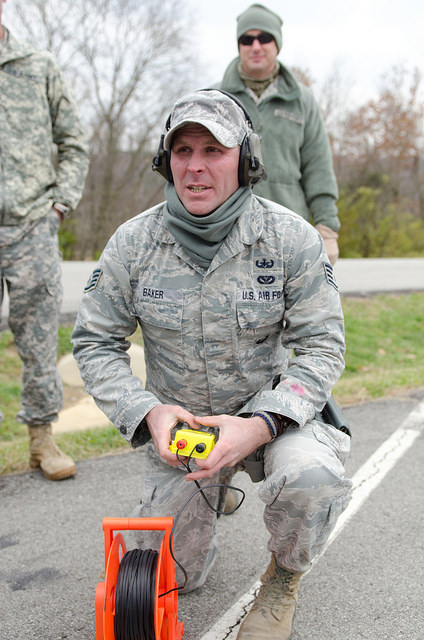
Staff Sgt. Timothy Baker, an Explosive Ordinance Disposal technician for the Kentucky Air National Guard’s 123rd Civil Engineer Squadron, prepares to detonate C4 inside the unit’s new Bomb Containment Vessel at a Fern Creek Fire Department training site in Louisville, Ky., Nov. 11, 2014. The steel vessel, which is mounted to a trailer, allows EOD personnel to detonate explosives on-site with no repercussions to nearby people or structures. (U.S. Air National Guard photo by Master Sgt. Phil Speck)
The gear, known as a Bomb Containment Vessel, does exactly what its name implies, according to Staff Sgt. Timothy Baker, an Explosive Ordinance Disposal technician for the 123rd Civil Engineer Squadron here. The capability can be especially useful if EOD is called upon to dispose of explosives in populated areas like the city of Louisville.
“If an improvised explosive device or any other sort of explosive is discovered anywhere in the area, EOD can destroy those explosives in a safe and contained manner without the worry of the destruction of any structures or bodily harm to bystanders,” Baker said.
The Kentucky Air Guard’s EOD team is one of the first three Air Guard units to receive the vessel, he added. Prior to its arrival, only one other Bomb Containment Vessel existed in the state of Kentucky.
The vessel is a trailer-mounted metal sphere with four-inch-thick steel walls. To make an explosive “safe,” EOD technicians carefully place the device into the vessel, seal the door and detonate it remotely.
The vessel can be used repeatedly for the disposal of up to 10 pounds of TNT-equivalent explosives without compromising its structural integrity, Baker said. For explosives of up to 20 pounds, the vessel can be used safely only once without being inspected for damage. It can be operated in a vented mode, to allow gases from an explosion to escape into the air, or in containment mode to prevent release of suspected chemical, biological or radiological contaminants.
The vessel also includes ports from which inside air samples can be extracted, or through which solutions can be pumped to neutralize threats.
“As soon as we received this piece of equipment, we reached out to all local law enforcement agencies, informing them of this new capability and the fact that we could aid them in responses as needed,” Baker said.
Maj. Keith Smith, commander of the 123rd’s Explosive Ordnance Disposal Team, said the vessel makes the unit even more effective in its dual mission of protecting military personnel from explosive weapons and in assisting civil authorities by neutralizing all manner of explosive devices.
“The total containment vessel drastically upgrades our capabilities to deal with explosive devices by allowing EOD techs to either contain a blast or transport the device to a safe location for disposal,” he said.
Story by Master Sgt. Phil Speck, 123rd Airlift Wing Public Affairs
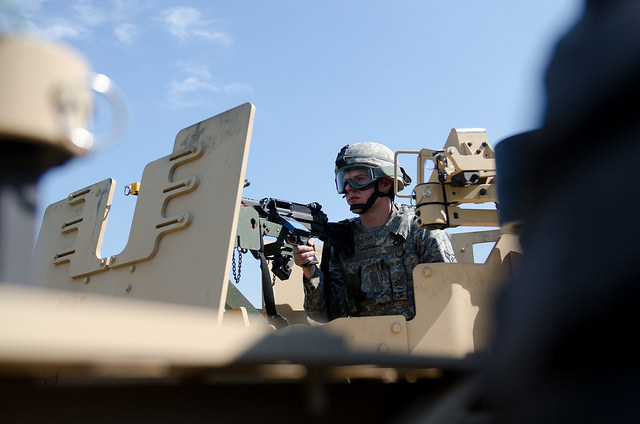
Airman First Class Adam Cantrell, a security forces journeyman from the Kentucky Air National Guard’s 123rd Security Forces Squadron, provides over watch during a mounted patrol as part of a training exercise at the Wendell H. Ford Regional Training Center in Greenville, Ky., on Sept. 17, 2014. The unit’s Airmen conducted a five-day, combat-skills training course to prepare for future deployments. (U.S. Air National Guard photo by Master Sgt. Phil Speck)
GREENVILLE, Ky. — Airmen from the Kentucky Air National Guard’s 123d Security Forces Squadron conducted five days of intense field training here recently to prepare them for future deployments in potentially hostile environments.
The training kicked off Sept. 15 with the Airmen being inserted into the Wendell H. Ford Regional Training Center via a Kentucky Army National Guard UH-60 Blackhawk helicopter. From there, they set up a perimeter, completed a two-mile patrol and assaulted a village to rescue two simulated prisoners of war — all in just the first two hours.
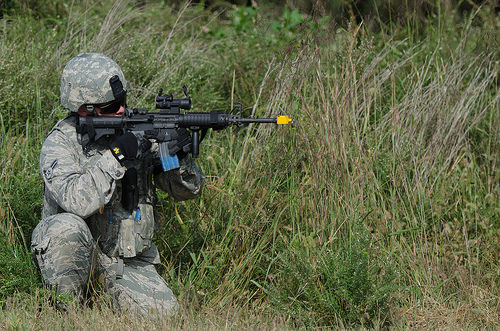
An Airman from the Kentucky Air National Guard’s 123 Security Forces Squadron aims his weapon at opposing-force actors during a training exercise at the Wendell H. Ford Regional Training Center in Greenville, Ky., on Sept. 18, 2014. The unit’s Airmen conducted a five-day, combat-skills training course to prepare for future deployments. (U.S. Air National Guard photo by Master Sgt. Phil Speck)
The Airmen also conducted exercises on land navigation and night patrols before concluding the week with a robust field-training scenario designed to simulate air base defense and mounted patrols in a combat environment, according to Lt. Col. George Imorde, commander of the 123d Security Forces Squadron.
Imorde said the training couldn’t have come a better time, as many of the squadron’s Airmen were preparing at the time to deploy to Africa in support of Operation United Assistance, the U.S. government’s multi-agency effort to stop the largest Ebola outbreak in history.
“This field training exercise enhanced our rapid-deployment ability to support Operation United Assistance, and the realistic base defense/force protection training provided a refresher of the duties and expectations directly related to our combat mission,” Imorde said.
A common misconception is that security forces only guard the gates at Air Force installations, secure the flight line and patrol the base, according to Tech. Sgt. Craig Davis, NCOIC of combat arms for the 123rd. But that is just a small portion of their responsibilities, he said.
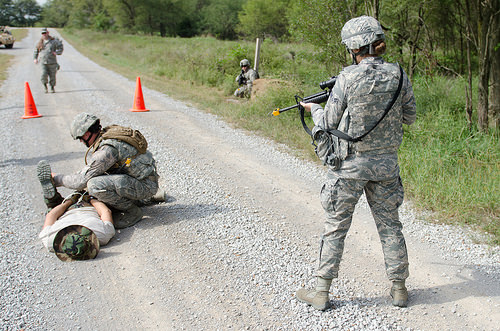
Personnel from the Kentucky Air National Guard’s 123 Security Forces Squadron apprehend a simulated opposing-force actor during a training exercise at the Wendell H. Ford Regional Training Center in Greenville, Ky., on Sept. 18, 2014. The unit’s Airmen conducted a five-day, combat-skills training course to prepare for future deployments. (U.S. Air National Guard photo by Master Sgt. Phil Speck)
“The bigger picture of what we do is the defense and protection of air bases in deployed environments,” Davis said. “The methodology of completing those tasks is really our primary mission. When we deploy, these Airmen and NCOs are expected to know air base defense.”
For some of the 123rd’s newest NCOs, the Greenville exercise provided their first opportunity to demonstrate leadership under a deployed base-defense scenario, Davis said.
“Letting these young Airmen see what we do, and how we do it, is a very rewarding thing,” Davis said. “You get to see young NCOs become seasoned NCOs and take charge by bringing teams together. Everyone is an individual, but when people come together and work toward a common goal as a team, it’s pretty rewarding. When they are no longer looking to you for instruction, and they are looking to each other for approval, then you know the training has been successful.”
Members of the Wing’s 123rd Force Support Squadron also participated in the exercise, serving hot meals prepared in the unit’s Disaster Relief Mobile Kitchen Trailer.
Story by Cpl. Alexander Mitchell, II Marine Expeditionary Force
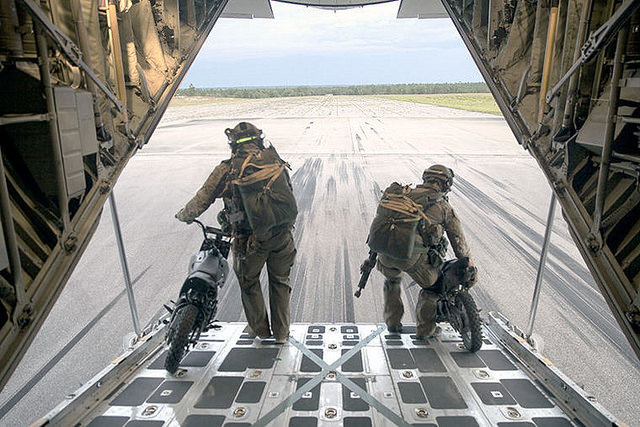
Two Airmen from the Kentucky Air National Guard’s 123rd Special Tactics Squadron off load 50 cc mini bikes to stage on a runway at Eglin Air Force Base, Fla., April 28, 2015, prior to a static line jump and Jump Clearing Team mission from a KC-130J Super Hercules assigned to Marine Aerial Refueler Transport Squadron 252 during exercise Emerald Warrior 2015. The mini bikes are used to patrol the air strip before the plane lands to ensure there is no debris or hostile forces near the landing zone. Emerald Warrior is a joint exercise led by Air Force Special Operations Command that provides pre-deployment training for U.S. and partner nation special operations forces and interagency elements. (U.S. Marine Corps photo by Cpl. Alexander Mitchell)
HURLBURT FIELD, Fla. — Marines with the 2nd Marine Aircraft Wing transported a team of 20 Airmen from the Kentucky Air National Guard’s 123rd Special Tactics Squadron and Chilean Air Commandos aboard a KC-130J Super Hercules during Emerald Warrior 2015 here April 28.
Working with VMGR-252, the team landed and prepositioned two 50cc mini bikes at an airfield before later taking off again and jumping out to parachute down to the airfield to conduct their planned Jump Clearing Team mission.
“Flying with Americans and the unit helps us toward the training that we do out here,” said Rudy, a team leader with the Chilean Air Commandos. “Working together helps with future missions in a combat area.”
The Marines aboard the Hercules set up static lines and locked down the bikes aboard the aircraft. The 123rd STS and Chilean jump masters worked side by side with Marine crew masters during jumps to ensure safety, speed and proper technique.
“We run checklists before the jumps to ensure quick and safe executions,” said Marine Staff Sgt. Arnold Sosa, a crew master with VMGR-252. “Once we secure the inside of the plane and open up the back ramp, the jump master takes charge of his jumpers while I make wind and time calls prior to the jump.”
Once the jump is complete the crew masters relay information to the pilots.
“I notify the pilots when the first jumper goes as well as the last jumper,” Sosa said. “After that, we give them a total jumper count and total chute count to ensure a safe jump.”
The partnership between the different services and partner nations during training exercises like Emerald Warrior 2015 further enhances their relationships.
“It is a great partnership with great forces,” Rudy said. “Training together and completing missions during Emerald Warrior help toward our commando unit in the future. It brings our guys and American forces together in a strong bond.”
Emerald Warrior is a joint exercise led by Air Force Special Operations Command that provides pre-deployment training for U.S. and partner nation special operations forces and interagency elements. The annual exercise is the Department of Defense’s only irregular warfare exercise.
Photos by Maj. Dale Greer, 123rd Airlift Wing Public Affairs
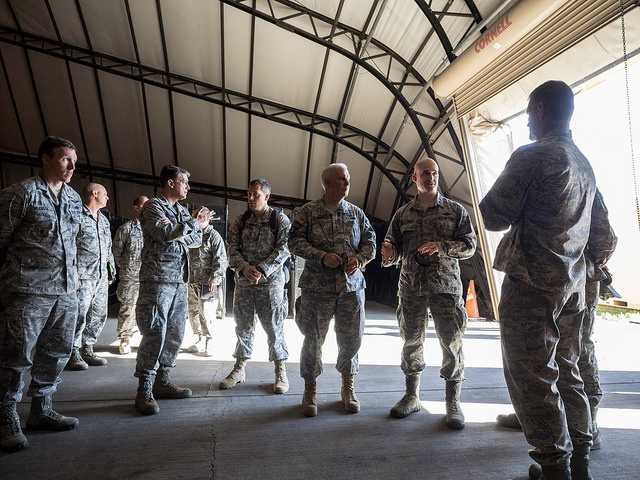
Brig. Gen. David San Clemente (third from right), deputy director for strategy, plans and programs at U.S. Africa Command, talks with members of the 123rd Airlift Wing during a visit to the Kentucky Air National Guard Base in Louisville, Ky., May 12, 2015. San Clemente toured the wing’s 123rd Contingency Response Group, Fire and Emergency Services, and Headquarters facilities. (U.S. Air National Guard photo by Maj. Dale Greer)
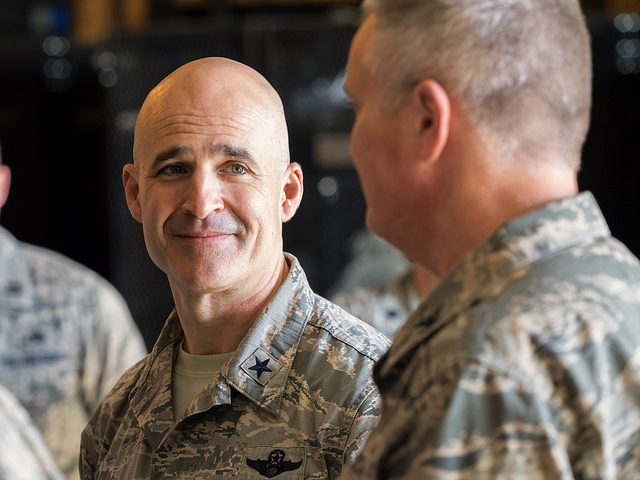
LOUISVILLE, Ky. — Brig. Gen. David San Clemente, deputy director for strategy, plans and programs at U.S. Africa Command, visited with members of the 123rd Airlift Wing during a visit to the Kentucky Air National Guard Base in Louisville, Ky., May 12, 2015. San Clemente toured the wing’s 123rd Contingency Response Group, Fire and Emergency Services, and Headquarters facilities.
Col. Barry Gorter (center), commander of the 123rd Airlift Wing, discusses the mission of the 123rd Contingency Response Group with Brig. Gen. David San Clemente, deputy director for strategy, plans and programs at U.S. Africa Command, during a tour of the Kentucky Air National Guard Base in Louisville, Ky., May 12, 2015. The group deployed more than 80 Kentucky Air Guardsmen to Africa in 2014 to stand up and operate an aerial port of debarkation in support of Operation United Assistance, the U.S. government’s coordinated effort to fight the worst Ebola outbreak in history. (U.S. Air National Guard photo by Maj. Dale Greer)
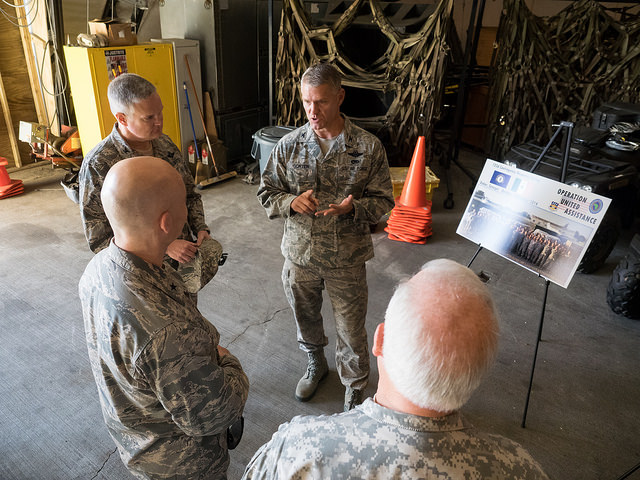
Col. Barry Gorter (center), commander of the 123rd Airlift Wing, discusses the mission of the 123rd Contingency Response Group with Brig. Gen. David San Clemente, deputy director for strategy, plans and programs at U.S. Africa Command, during a tour of the Kentucky Air National Guard Base in Louisville, Ky., May 12, 2015. The group deployed more than 80 Kentucky Air Guardsmen to Africa in 2014 to stand up and operate an aerial port of debarkation in support of Operation United Assistance, the U.S. government’s coordinated effort to fight the worst Ebola outbreak in history. (U.S. Air National Guard photo by Maj. Dale Greer)
Story by Senior Airman Joshua Horton, 123rd Airlift Wing Public Affairs
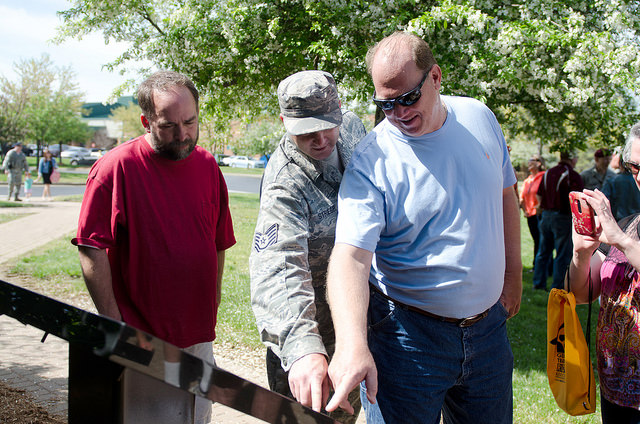
Retired Tech. Sgt. Earl J. Hartlage Jr. (right) finds his name on a plaque honoring retirees at the Kentucky Air National Guard Base in Louisville, Ky., April 18, 2015. The plaque was unveiled during a ceremony held for more than 50 members of the 123rd Airlift Wing who retired in 2014 after serving for 20 or more years. (U.S. Air National Guard photo by Senior Airman Joshua Horton)
KENTUCKY AIR NATIONAL GUARD BASE, LOUISVILLE, Ky. — More than 50 former members of the Kentucky Air National Guard were honored here April 18 when a plaque bearing their names was unveiled in front of the 123rd Airlift Wing’s Lt. Gen. John B. Conaway Headquarters Building.
The black granite plaque is the newest addition to a monument that honors Airmen who have completed 20 or more years of service and retired from the Kentucky Air National Guard, dating all the way back to the unit’s inception in 1947.
This year’s ceremony celebrated 52 retirees for the year 2014, along with one from 2013 and one from 2005.
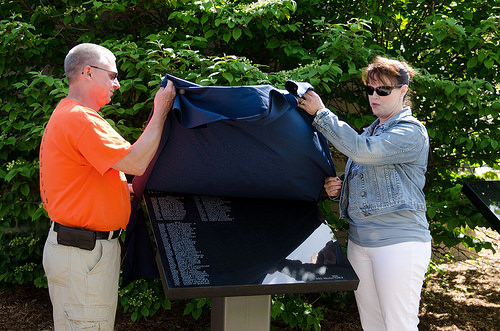
Retired Senior Master Sgt. Gary Dunlap and Retired Chief Master Sgt. Lori F. Zinsmeister unveil a plaque bearing the names of more than 50 Airmen who retired from the 123rd Airlift Wing last year during a ceremony at the Kentucky Air National Guard Base in Louisville, Ky., April 18, 2015. The annual unveiling celebrates Airmen who served for 20 or more years. (U.S. Air National Guard photo by Senior Airman Joshua Horton)
“I’ve been doing this a number of years, and it’s a grand event,” said Maj. Gen. Edward W. Tonini, Kentucky’s adjutant general. “Your names engraved upon these plaques bear testament to the fact that you’re part of our family. Welcome home.”
Army Gen. Frank J. Grass, chief of the National Guard Bureau, also spoke at the ceremony, addressing a crowd of dozens of retirees, family members and Airmen wishing to pay their respects.
“I want to say thank you to the retirees here today for your service,” Grass said. “Less than one percent of our population serves in uniform, but it’s you all who have served 20-plus years and who have grown the leaders behind you. You’ve got to be extremely proud of that.”
These annual plaque unveilings are made possible through donations from the non-profit Kentucky Air National Guard Retiree Group Inc.
Story by 2nd Lt. James Killen, 123rd Airlift Wing Public Affairs
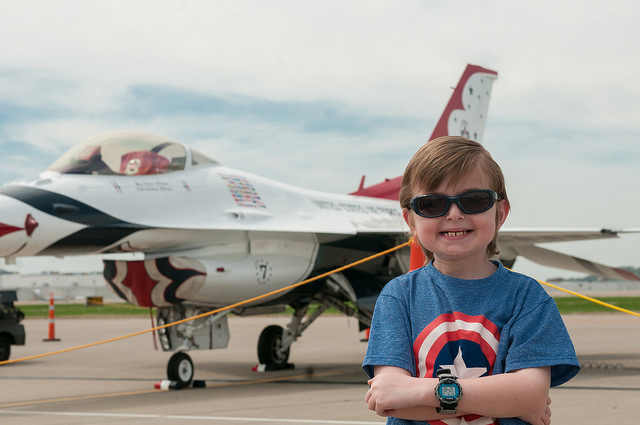
Nine-year-old Dawson Barr and his family visit the Kentucky Air National Guard’s 123rd Airlift Wing to view aircraft that will be flown in the annual Thunder Over Louisville Air Show, in Louisville, Ky., April 18, 2015. Dawson has been battling cancer his entire life and currently has an inoperable brain tumor, making him legally blind in both eyes. (U.S. Air National Guard photo by 2nd Lt. James W. Killen)
KENTUCKY AIR NATIONAL GUARD BASE, LOUISVILLE, Ky. — Members of the Kentucky Air National Guard welcomed a 9-year-old boy with cancer to the base Saturday as aircraft from around the world prepared to perform in the Thunder Over Louisville air show.
Dawson Barr, accompanied by his sister, mother and father, toured the flight line with Chief Master Sgt. Joe Dawson, superintendent of the 123rd Operations Group here.
“Dawson had an absolute blast!” Chief Dawson said. “We visited every aircraft on the flight line, met and talked with several people along the way, and we also got to watch a C-17 Globemaster taxi out and take off.”
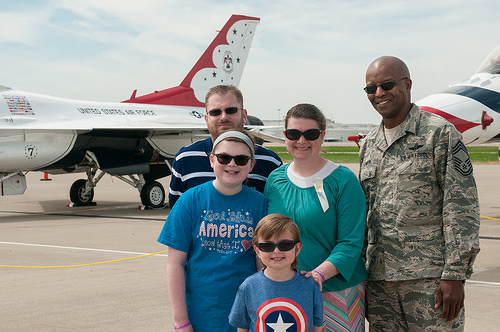
Nine-year-old Dawson Barr and his family visit the Kentucky Air National Guard’s 123rd Airlift Wing to view aircraft that will be flown in the annual Thunder Over Louisville Air Show, in Louisville, Ky., April 18, 2015. Dawson has been battling cancer his entire life and currently has an inoperable brain tumor, making him legally blind in both eyes. (U.S. Air National Guard photo by 2nd Lt. James W. Killen)
Dawson toured the Operations Building, ate lunch supplied by the 123rd Security Forces Squadron, and watched several aircraft take off while observing from the 165th Airlift Squadron Heritage Room, which offers one of the best views on base.
Dawson was diagnosed with cancer at just 6 months of age. Doctors were cautious about his life expectancy, primarily because of the number of tumors he has — seven on the brain and three on the spine — and their severity.
He has defied the odds, though, and according to his mother, Aimee Barr, “He’s an amazing little kid with a magnetic personality; he’s a fighter, too.”
Dawson endured five years of chemotherapy, ending his treatments in February 2012. He currently has one inoperable tumor that severely impacts his vision, making him legally blind in both eyes. The chemotherapy and other treatments have left Dawson with a number of challenges, from hormone imbalances to osteoporosis.
Aimee says that doesn’t stop him, though.
“He’s a normal 9-year-old boy. He wants to play soccer, he wants to be a professional football player, and if that doesn’t work, he’s going to be a professional baseball player.”
Dawson made an impact on several of the people he met at the Kentucky Air Guard, with many noting how positive and upbeat he was, and how he asked so many great questions.
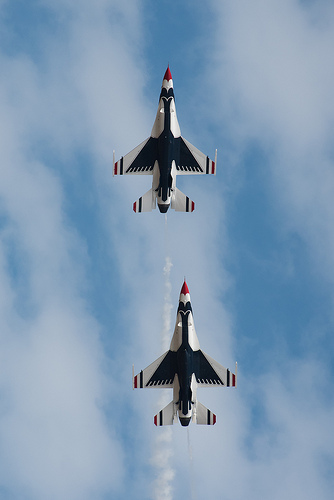
Two F-16 Fighting Falcons from the U.S. Air Force Thunderbirds aerial demonstration team perform in the Thunder Over Louisville air show April 18, 2015, in Louisville, Ky. More than 650,000 people lined the banks of the Ohio River for the show. (U.S. Air National Guard photo by Maj. Dale Greer)
“I thoroughly enjoyed meeting and spending time with Dawson, his sister, Lauren, and their parents, Aimee and Shane Barr,” Chief Dawson said. “That young man is a fighter in the true sense of the word, with the most positive attitude and the most uplifting spirit that you will ever see in a little boy.”
Dawson has a message for those who may be struggling with challenges or illness. In a calm and steady voice he said, “If you’re going through something, just keep going. Eventually something good will happen, and it will be okay.”
By Maj. Dale Greer, 123rd Airlift Wing Public Affairs
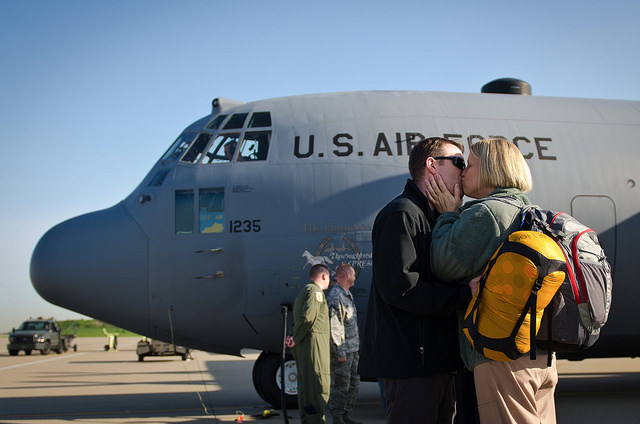
Maj. Jenn Helton, a C-130 navigator in the 123rd Airlift Wing, kisses her husband at the Kentucky Air National Guard Base in Louisville, Ky., April 24, 2015, prior to departing for a deployment to the Persian Gulf. Helton was among more than 40 Kentucky Air National Guardsmen who deployed to an undisclosed air base in support of Operation Freedom’s Sentinel. (U.S. Air National Guard photo by Master Sgt. Phil Speck)
KENTUCKY AIR NATIONAL GUARD BASE, LOUISVILLE, Ky. — The third rotation of more than 40 Kentucky Air National Guardsmen departed here today for deployment to an undisclosed air base in the Persian Gulf, where they will fly airlift missions in support of Operation Freedom’s Sentinel.
Click here for more photos.
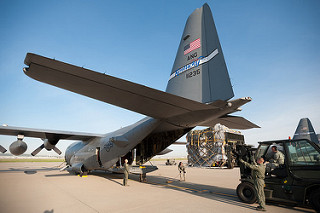
Loadmasters and cargo specialists from the 123rd Airlift Wing load cargo onto a C-130 Hercules aircraft at the Kentucky Air National Guard Base in Louisville, Ky., April 24, 2015, prior to the aircraft’s departure for deployment to an undisclosed air base in the Persian Gulf region. More than 40 Kentucky Air National Guardsmen boarded the plane. They will join other Airmen already in theater to fly airlift missions in support of Operation Freedom’s Sentinel. (U.S. Air National Guard photo by Maj. Dale Greer)
Freedom’s Sentinel is the follow-on mission to Operation Enduring Freedom. It focuses on training, advising and assisting Afghan security forces; and on counterterrorism operations in Afghanistan.
Kentucky’s adjutant general, Maj. Gen. Edward W. Tonini, thanked the deploying Airmen for their continued commitment to military operations all over the world.
“The 123rd Airlift Wing has been engaged in the Global War on Terror from the beginning, and I know you will be a part of this fight until the very end,” Tonini told the Airmen in a briefing just before their departure. “When our nation, our Air Force and our Commonwealth needs the best, they call on you. I have the utmost trust and confidence in your abilities to conduct your mission while overseas, and I thank you for stepping up once again to answer our nation’s call.”
The director of the state Board of Elections, Matt Selph, also was on hand to wish the Airmen farewell as a representative of Alison Lundergan Grimes, Kentucky’s secretary of state.
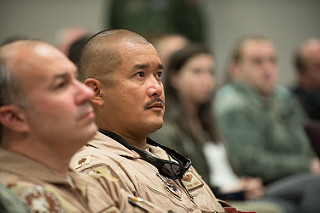
Maj. Johnny Cantu, a C-130 pilot in the 123rd Airlift Wing, attends a briefing at the Kentucky Air National Guard Base in Louisville, Ky., April 24, 2015, prior to his deployment to an undisclosed air base in the Persian Gulf region. Cantu and more than 40 other Kentucky Air Guardsmen comprise the third rotation of 123rd Airmen to deploy to the base since February. They will be flying airlift missions throughout the U.S. Central Command Area of Responsibility in support of Operation Freedom’s Sentinel, which provides military training and counterterrorism capabilities in Afghanistan. (U.S. Air National Guard photo by Maj. Dale Greer)
“As a former Army first sergeant in the reconnaissance field who spent time in Iraq and Afghanistan being transported on C-130s by men and women just like you, I’d like to relay on behalf of Secretary Grimes how thankful we are for the jobs that you do and the sacrifies that your families make,” Selph said. “I know I was thankful that men and women like you were able to get me and my troops deployed and redeployed safely.”
The Airmen, who departed aboard a Kentucky Air National Guard C-130 Hercules aircraft, will replace earlier rotations of Kentucky Airmen that deployed in February. While overseas, the Airmen are expected to transport troops and cargo supporting a range of coalition military operations in the United States Central Command Area of Responsibility, which includes Afghanistan, Northern Africa and the Persian Gulf. Deploying Airmen include aircrew members, aircraft maintenance personnel and support staff.
The mission is expected to conclude by early July.
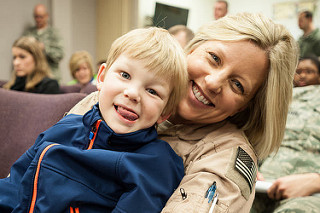
Maj. Jenn Helton, a C-130 navigator in the 123rd Airlift Wing, and her son, Kaiden Helton, attend a briefing at the Kentucky Air National Guard Base in Louisville, Ky., April 24, 2015, prior to Helton’s deployment to an undisclosed air base in the Persian Gulf region. Helton and more than 40 other Kentucky Air Guardsmen comprise the third rotation of 123rd Airmen to deploy to the base since February. They will fly airlift missions throughout the U.S. Central Command Area of Responsibility in support of Operation Freedom’s Sentinel, which provides military training and counterterrorism capabilities in Afghanistan. (U.S. Air National Guard photo by Maj. Dale Greer)
The deployment marks the sixth time in the past 12 years that the Kentucky Air Guard has sent its aircraft, aircrews and maintenance personnel to support U.S. military operations in the U.S. Central Command AOR. The wing deployed aviation assets there in 2003, 2007, 2009, 2010 and 2012, operating from multiple undisclosed locations and Bagram Air Field, Afghanistan.
The wing’s non-aviation personnel also have been heavily engaged around the world since Sept. 11, 2001, logging thousands of deployments to dozens of overseas locations, including Iraq and Afghanistan. In October, more than 70 of the wing’s Airmen deployed to Africa to support Operation United Assistance, the international effort to fight the worst Ebola outbreak in history.
Story by Maj. Dale Greer, 123rd Airlift Wing Public Affairs
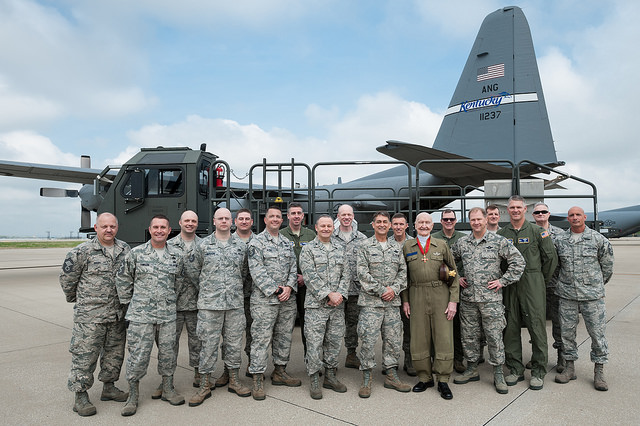
Col. Gail Halvorsen, a former U.S. Army Air Corps pilot who originated the idea of airdropping candy to German children during the 1948-49 Berlin Airlift, visits the Kentucky Air National Guard Base in Louisville, Ky., April 17, 2015. Halvorsen, who is known as the Berlin Candy Bomber, will be the guest of honor during the 2015 Thunder Over Louisville air show April 18. The Airmen are standing in front of a Halverson Loader, named for the colonel, that can rapidly load up to 25,000 pounds of cargo onto airlift aircraft. (U.S. Air National Guard photo by Maj. Dale Greer)
KENTUCKY AIR NATIONAL GUARD BASE, LOUISVILLE, Ky. — Members of the Kentucky Air National Guard will pay tribute to the famous “candy drops” of the Berlin Airlift during Saturday’s Thunder Over Louisville air show.
A Kentucky Air Guard flight crew will deploy two simulated bundles of candy over the Ohio River from the back of a Kentucky C-130 Hercules aircraft at 4:39 p.m., according to Lt. Col. John Ward, a pilot in the 123rd Airlift Wing who will be flying the aircraft.
The idea for candy drops originated in 1948 with C-54 pilot Gail Halvorsen, who was then a first lieutenant in the U.S. Army Air Corps. Halvorsen, who eventually rose to the rank of colonel, will be the guest of honor at this year’s air show.
“It’s a real privilege to participate in this kind of tribute because it honors the tremendous accomplishments of Colonel Halvorsen and the proud military heritage of the airlift community,” Ward said.
“In a way, the Berlin Airlift was similar to the missions our own wing flew in Bosnia in the 1990s, when we were able to drop hundreds of tons of food and humanitarian aid to Bosnian civilians after they were cut off from the rest of the world by an intense ethnic war.”
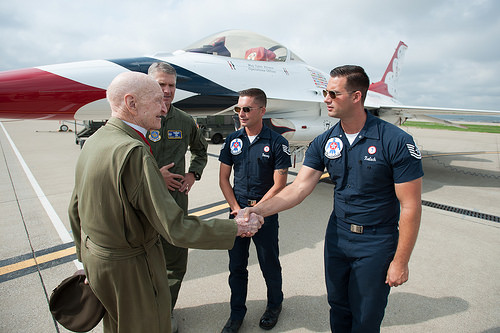
Col. Gail Halvorsen, a former U.S. Army Air Corps pilot who originated the idea of airdropping candy to German children during the 1948-49 Berlin Airlift, visits with crew members from the U.S. Air Force Thunderbirds at the Kentucky Air National Guard Base in Louisville, Ky., April 17, 2015. Halvorsen, who is known as the Berlin Candy Bomber, will be the guest of honor during the 2015 Thunder Over Louisville air show April 18. (U.S. Air National Guard photo by Maj. Dale Greer)
In 1948, Halvorsen found himself flying airlift missions into West Berlin as part of Operation Vittles, the U.S.-backed effort to keep the territory supplied with food, milk and coal after the Soviet Union blocked road and rail access in what was to become the first major battle of the Cold War.
One day in July, Halvorsen was walking inside the perimeter fence at West Berlin’s Tempelhof Air Base — headquarters for Operation Vittles — when he came across about 30 children gathered on the other side.
“We had been bombing Germany just a few years before, and you’d thing they would be antagonistic, but they weren’t,” Halvorsen recalled Friday during a visit to the Kentucky Air National Guard Base. “I was there at the fence talking to them for about an hour, and when I turned to leave, I realized that not one had asked for candy. It was the first time that had ever happened to me when I was in a foreign country. And these kids hadn’t had any chocolate for a couple of years.
“They didn’t ask because they were grateful — grateful for flour and grateful to be free. They wouldn’t beg for something so extravagant as chocolate. When I realized that kids from 9 to 15 years of age had that kind of value system, that they valued freedom so much, it kind of blew my mind.
“So I reached in my pocket, and I had two sticks of Wrigley’s Doublemint gum, and I thought, ‘You can’t give that to 30 kids. You’re going to have a fight.’
“I turned to leave again, and I got about two steps when a voice came through to me clear as a bell: ‘Go back to the fence.’ It was almost a command. So I went back to the fence and pulled my hand out of pocket, and I broke the sticks in half so I would have four pieces.
“They didn’t push or shove, and the kids that didn’t get to have a piece of gum asked for a strip of the wrapper. They took those pieces of wrapper and put them to their noses so they could smell it, and their eyes got big just from the smell.
“That did it. I thought, ‘I gotta do something more.’
“I’d always flown by the book, and I got promoted because I flew by the book. But I told them, ‘Stand in this grassy area tomorrow, and when I fly overhead, I’ll drop enough chocolate for all of you to have some.’”
When the children asked Halvorsen how they would know which plane was his, he told them to look for the aircraft that’s wiggling it wings, earning him the nickname Uncle Wiggly Wings.
That same day, Halvorsen asked his crewmates to give him their chocolate rations. He then fashioned makeshift parachutes from three handkerchiefs, to which he attached the precious candy.
When Halvorsen’s crew returned to the airfield the next day while flying a re-supply mission, he looked down and saw all 30 kids standing exactly where they were told to be. The crew chief collected the tiny bundles and dropped them out of the plane from a flare chute behind the pilot’s seat.
“We didn’t know if the candy had made it over the fence, but when we flew over them again on takeoff, all 30 kids were lined up by the fence with their mouths going up and down, chewing like crazy and waving at the airplane.”
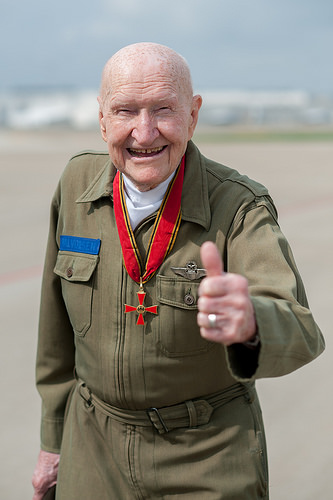
Col. Gail Halvorsen, a former U.S. Army Air Corps pilot who originated the idea of airdropping candy to German children during the 1948-49 Berlin Airlift, visits the Kentucky Air National Guard Base in Louisville, Ky., April 17, 2015. Halvorsen, who is known as the Berlin Candy Bomber, will be the guest of honor during the 2015 Thunder Over Louisville air show April 18. (U.S. Air National Guard photo by Maj. Dale Greer)
Encouraged by the success, Halvorsen’s crew repeated the candy drop three more times — “and then I got caught.”
His superior officers were not happy by the unauthorized airdrops, and the phrase “court martial” was used more than once. But a general officer caught wind of Halvorsen’s stunt and, impressed by the kindness of the act, told him to keep it up. Others American aircrews soon joined in. By the end of the operation — and with the help of boatloads of candy from American manufacturers — more than 21 tons of sweets had been airdropped to the children of West Berlin.
Experts in foreign relations say the campaign “had a major impact on the transition of hate that West Berliners had for (Allied forces),” Halvorsen noted. “It really helped change the attitudes of the West Berliners and improve relations after the war.”
In fact, the impact extended far beyond the borders of Germany, affecting a global audience that had begun to view the actions of the Soviet Union with increasing unease.
“The Soviets were putting the screws to the West Berliners, while we were feeding their children chocolate,” Halvorsen said. “The contrast was remarkable, and several historians have said it helped end the blockade.”
The mission also made a lasting personal impression on Halvorsen, who is 96 and will forever be remembered as the Berlin Candy Bomber.
“It made me realize the importance of little decisions in my life,” he said. “Those little decisions that you make on the road of life put your footsteps on the path where you end up, good or bad.”
The voice that Halvorsen heard, clear as a bell in 1948, led to a very small decision that helped change the course of history.
In addition to the “Candy Bomber” tribute, this year’s air show will feature performances by the U.S. Air Force Thunderbirds and the U.S. Marine Corps Harrier Harrier AV-8B Demonstration Team.
Other acts include the U.S. Army Golden Knights parachute demonstration team, a Canadian Air Force CT-142 trainer, P-51 Mustang and F-86 Sabre warbirds, a United Parcel Service 767, and multiple aerobatic performances.
As in past years, the Kentucky Air National Guard is providing logistical support that enables military aircraft to participate in the show, which routinely draws crowds of more than 500,000 and is broadcast live by local TV and radio stations, said Capt. Josh Ketterer, air show coordinator for the Kentucky Air Guard.
“We log hundreds of hours of work every year to plan and support Thunder so the public has an opportunity to see for themselves the incredible abilities of the finest military aviators in the world,” Ketterer said. “It’s a privilege and an honor for us to support that mission, and I’m looking forward to great show.”
Story by Maj. Dale Greer, 123rd Airlift Wing Public Affairs
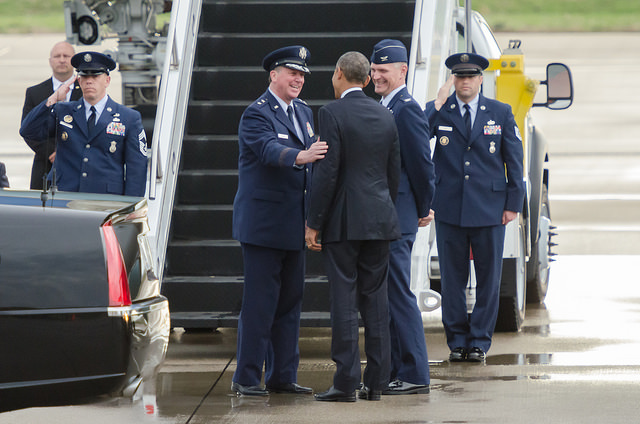
President Barack Obama transits through the Kentucky Air National Guard Base in Louisville, Ky., aboard Air Force One April 2, 2105. Obama was in town to discus job training and economic growth during a visit to Indatus, a Louisville-based technology company that focuses on cloud-based applications. (U.S. Air National Guard photo by Maj. Dale Greer)
KENTUCKY AIR NATIONAL GUARD BASE, LOUISVILLE, Ky. — President Barack Obama arrived here April 2 aboard Air Force One as part of a visit to Louisville to discuss job creation in the technology sector.
After stepping off Air Force One, Obama traveled downtown to address a gathering of employees and guests at Indatus, a Louisville company that specializes in cloud-based applications. During his speech, Obama praised Indatus as a model for “innovation and job creation here in the 21st century.”
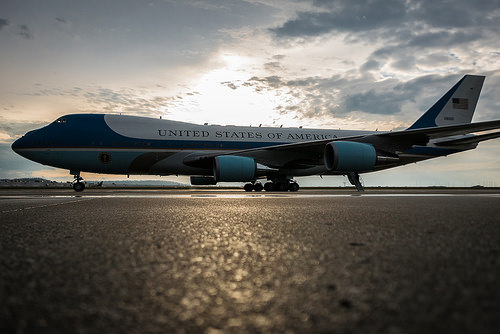
President Barack Obama transits through the Kentucky Air National Guard Base in Louisville, Ky., aboard Air Force One April 2, 2105. Obama was in town to discus job training and economic growth during a visit to Indatus, a Louisville-based technology company that focuses on cloud-based applications. (U.S. Air National Guard photo by Maj. Dale Greer)
See all photos on our flickr page.
The president also used the occasion to promote a new initiative called TechHire that’s designed to train employees for high-tech jobs.
“It brings employers and local governments together to support innovative job-training programs like online classes, coding boot camps and community college courses designed by local employers,” Obama explained.
The president returned to the Kentucky Air Guard Base for departure, where he was greeted by Maj. Gen. Edward W. Tonini, Kentucky’s adjutant general, and Col. Barry Gorter, commander of the 123rd Airlift Wing.
By Staff Sgt. Vicky Spesard, 123rd Airlift Wing Public Affairs
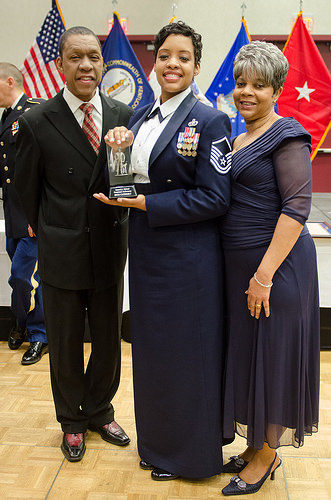
Master Sgt. Zakiya Taylor stands with her parents after receiving the award for 2014 Kentucky Air National Guard Senior Non-Commissioned Officer of the Year during a ceremony held at the Kentucky State Fairgrounds March 14, 2015. Taylor, who a services manager for the Kentucky Air Guard’s 123rd Force Support Squadron, credits her parents’ encouragement for her successful military career. (U.S. Air National Guard photo by Staff Sgt. Vicky Spesard)
KENTUCKY AIR NATIONAL GUARD BASE, LOUISVILLE, Ky. — As the nation honors the accomplishments of women in the military during National Women’s History month, the 123rd Airlift Wing reflects on one of its own, Master Sgt. Zakiya Taylor, a mentor to young people, an acknowledged leader among her peers and a decorated Airman answering the call to duty around the world.
An 18-year veteran of the Kentucky Air National Guard, Taylor joined the wing just after finishing high school, with the encouragement of her parents to help pay for college. She never intended to make it a career.
“I got the love of travel from my musician father, who took me with him when he performed around the world,” Taylor explained. “I knew that the Guard would allow me to travel as well and help me further my education.”
After completing her bachelor’s degree in sociology and psychology at Western Kentucky University, Taylor decided to continue her career in the Guard, where she got her opportunity to see the world. Taylor’s career has taken her to deployments in Kuwait, Saudi Arabia, Europe, Afghanistan and Africa.
“I have had the opportunity to learn all these different cultures and fellowship with all these different people,” Taylor said. “In that process I have learned that we are not very much different. We all want the same things: good health, wealth and security for our families.”
Fellowship through mentoring is a passion for Taylor, who worked throughout her high school summers as a camp counselor for youth at the Metro Parks summer camp in Louisville. While in college, she became a dance instructor for a local youth arts program.
She continued her desire to mentor in her Guard career when she accompanied a group of young Army ROTC cadets to Burkina Faso, Africa.
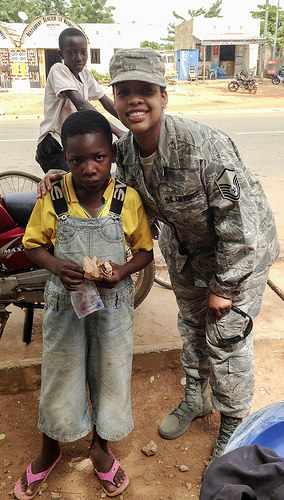
Air Force Master Sgt. Zakiya Taylor of the Kentucky Air National Guard’s 123rd Airlift Wing greets a Burkinabe boy while serving as a cadre leader for U.S. Army Cadets participating in the U.S. Army Cadet Command’s Cultural Understanding and Language Proficiency Program in Burkina Faso in June 2014. The program strengthens cultural awareness and foreign language skills among the Army’s future leaders. (Courtesy photo)
“This was a great leadership opportunity for me,” she said. “I was solely responsible for these cadets, getting them to their mission location and taking care of them from start to finish. It has made me a better leader. I know the cadets’ experiences will make them better leaders, too.”
Leading by example is just one of the many characteristics that has brought Taylor to this point in her career. In March, she was honored as the Kentucky Air National Guard’s 2014 Senior Non-Commissioned Officer of the Year.
“As a leader and as a woman, it is exciting to be honored alongside all of the men,” Taylor said. “It shows that we can do this. We have come so far and had so many challenges. I think when an award like this happens, it shows that women are breaking down barriers, moving forward and making progress.”
Accepting challenges is something Taylor is no stranger to. As well as performing her duties as unit training manager for the 123rd Services Flight here, she has been appointed by Chief Master Sgt. Ray Dawson, 123rd Airlift Wing command chief master sergeant, to assist with a new education initiative designed to bring college classes on base.
“She is one of the most professional, dynamic senior NCOs I have ever worked with,” Dawson said about Taylor, who is the Force Development Education Services Technician for his education program. “Her commitment to excellence is second to none. When she is in charge of a detail, the outcome is set from the start.”
And right from the start in her career, Taylor has had a vision of what her own outcome should be.
“It is very important to me to display my leadership and exemplify what it means to me to be here and set an example for other Airmen,” she explained. “I may not always say the right thing, but if I’m doing the right thing at the right time for the right reasons, someone is going to pick up on that. Hopefully, I am making a difference for someone.”