Pages
Stay In Touch
More
© 2013 KentuckyGuard
Story by Chief Warrant Officer Joseph Lyddane
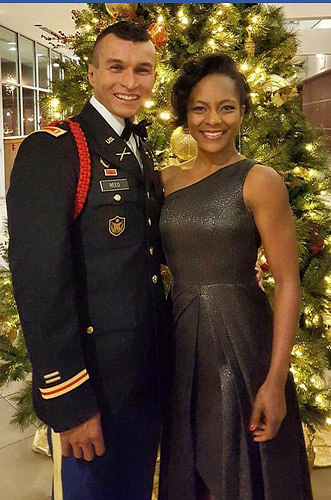
1st Lt. Holdun Reed with the 2nd Battalion, 138th Field Artillery and his girlfriend, Jasmine at the 2015 St. Barbara’s Dining Out in Bowling Green, Ky., Dec. 5, 2015. Reed is an award-winning body builder competing in regional events. (Courtesy photo)
FRANKFORT, Ky. — According to the TRADOC Standardized Physical Training Guide, physical fitness is defined as having “the ability to effectively function in work, training and other activities while maintaining optimal health and well-being.” Many of our Kentucky Guardsman know and understand this notion, but 1st Lt. Holdun Reed embraces it.
Throughout the past year his mental fortitude, determination, and hard work has afforded him the opportunity to compete as a natural body builder. Reed recently competed in the Kentucky Derby Championships, Natural Kentucky Championships, and Kentucky Muscle Championships. He represented both himself and the National Guard well by dominating the competition, taking first place in Physique Novice Class B, third place in Physique Open Class B, and won Overall Physique Novice Champion, respectively.
“Body building gives me something to work towards,” Reed said. “I feel that I am an athlete at heart and have found my sport.”
Competent leaders lead by example, overcome adversity, and are able to persevere through the toughest challenges. Reed has proven that he possesses those traits. Reed serves as a platoon leader for Charlie Battery, 2nd Battalion, 138th Field Artillery located in Bardstown, Kentucky.
He deployed with the unit to Iraq during Operation Iraqi Freedom from October of 2006 to February 2008. Not long after returning home, Reed was severely burned in an automobile fire.
“There were more challenges than I can remember, I woke up in pain for nearly eight months,” he said.
He endured a major surgery to repair the burned areas and skin was grafted from his legs to replace the skin that had been burned away on his arms. He attributes the love and support of his friends and family and especially his girlfriend who stuck beside him every step of the way. For some, this may have negatively impacted their motivation. For Reed, this was a driving force that created a more intense desire to achieve his goals.

1st Lt. Holdun Reed and his girlfriend Jasmine both place in their respective categories at the 2015 Kentucky Muscle Championships in Louisville, Ky., Nov. 14, 2015. (Courtesy photo)
“My parents raised me with the attitude to let nothing stop me from achieving my goals. They told me to never make excuses but instead create solutions.”
After a full recovery, Reed felt there was more he could do in uniform. With years of honing his leadership skills as a Non-Commissioned Officer under his belt, and completing his degree in Business Management and Administration at Western Kentucky University, he decided to challenge himself by attending Officer Candidate School in 2012.
As an artillery officer, Reed is an expert in fire support, observed firing tactics, fire direction procedures, and well versed in platoon leadership. He is a firm believer that great leaders can transform people and encourage the best out of a unit; he has known that type of leader and wanted to follow in their footsteps.
Reed said that as an officer, the challenge is greater because of the requirement to not only provide guidance to subordinates but juggle that responsibility with being a role model and mentor. If you ask Reed’s chain of command, you’ll hear similar comments.
“Lt. Reed has faced many challenges in his life, but continues to demonstrate a true resiliency to persevere,” said Col. Rob Larkin, commander of the 138th Field Artillery Brigade. “His work ethic in and out of uniform has helped him become a well-rounded officer who sets a fine example for others to follow.”

1st Lt. Holdun Reed takes 1st place in his category at the NPC Kentucky Derby Festival in Louisville, Ky., April 25, 2015. (courtesy photo)
Now with five body building awards under his belt, Reed plans to continue competing and challenging himself. Body building has similar requirements to that of being a Soldier, it involves a tremendous amount of focus and commitment - Reed knows this all too well. Leading up to competitions takes hours of time in a gym, knowledge of the human anatomy, and strict adherence to a diet regimen. Similar to the way he uses his position to influence, mentor, and encourage other service members in his unit.
This is part I of a three-part series on the Kentucky National Guard’s Resiliency Training Assistant Course conducted for Guardsmen returning from deployment.
Commentary by Sgt. 1st Class Gina Vaile-Nelson
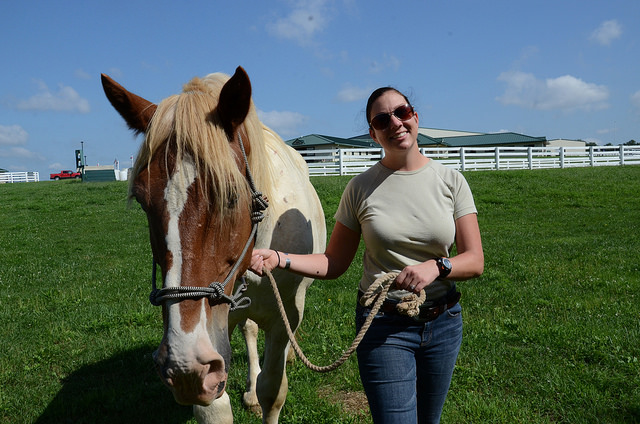
Sgt. 1st Class Gina Vaile-Nelson walks with Sargent at the Central Kentucky Riding for Hope center in Lexington, Ky., Aug. 13, 2014. As part of the Kentucky National Guard’s Resiliency Training Assistant course, Soldiers are introduced to therapeutic activities with horses. (U.S. Army National Guard photo by Sgt. Brandy Mort)
LEXINGTON, Ky. — When you’re blindfolded, turned around five times and handed the lead rope to a 1,300-pound American Draft horse, your heart will pound so loud that it ends up practically in your throat. Your other senses take over. The distinct smell of hay, manure and leather will hit you like a ton of bricks. You feel the ground, every shake from the stomp of a hoof, every uneven pebble, pile of unmentionables, straw of hay in the arena. You’ll hear the woosh of each breath that enters his nostrils, fills his lungs then releases. You’ll match his breath, which sounds just as loud as his. You’ll feel the wind at your face, the fly that bounces from his mane to your ear. Everything becomes clear.
It’s an exercise in trust. Between me and Sargent – the 1,300-pounder who could break my foot with one wrong step.
It’s an exercise in listening. Of the directions Sgt. Brandy Mort calls out to lead me through cones, around barrels, over jumps and into a hula-hoop.
It’s an exercise in self. Focusing on just the task at hand, not worrying about the e-mails I’m missing, the family drama I’d just experienced, the memories of a 10-month deployment or who I’m going to pick for my fantasy team.
It’s resilience.
As Soldiers, we train for combat; the worst case scenario is always present in the back of our minds. We’re high strung, but that’s a good thing because we need to be. Survival is key, mission success is essential.
But when the mission ends and the welcome home party subsides, the life we left prior to deployment starts again. Sometimes it’s changed so drastically we seem lost in our own homes. As our battle buddies readjust to their own lives, even they become distant because the team isn’t together 24/7. It seems that the puzzle pieces just don’t fit because they came out of different boxes.
But in case you forgot, it’s okay to come from different boxes. Sometimes we forget that. As leaders, it’s imperative to recognize our Soldiers, their backgrounds, their needs. And when we see that a Soldier needs to reassess and regroup, it’s our job to provide every resource possible to make that Soldier successful on the home front and within our ranks.
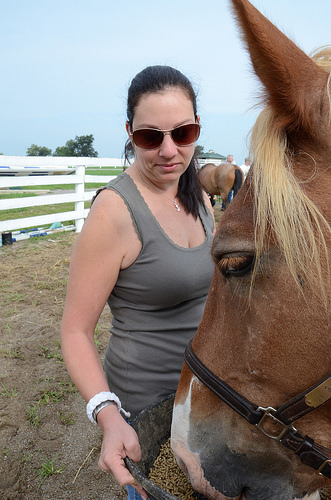
Sgt. 1st Class Gina Vaile-Nelson feeds Sargent at the Central Kentucky Riding for Hope center in Lexington, Ky., Aug. 12, 2014. Principles discussed throughout the resiliency training was applied with daily interaction with the horses to help Guardsmen achieve their maximum potential. (U.S. Army National Guard photo by Sgt. Brandy Mort)
The Kentucky National Guard’s Resiliency Program isn’t your average cookie-cutter class. It’s an outside-the-box course that combines instruction in basic resilience principles designed to increase a Soldier’s effectiveness and well-being to develop and enhance their leadership potential. It focuses on self-awareness and regulation, connections and character strengths to help participants grow and thrive in the face of challenges and bounce back from adversity.
While thousands of Soldiers across the globe are required to train using this approved University of Pennsylvania program, no other program in the Army uses horses on a daily basis through the course to reinforce the principles and capitalize on the lessons learned in a classroom setting. That’s what makes Kentucky’s program unique – what helps us to maintain that Unbridled Service and commitment to our Soldiers well-being.
The Central Kentucky Riding for Hope program partnered with the Kentucky National Guard Resilience Program in 2012, using equine therapy to help Guardsmen deal with emotions of internal conflict, personal relationships, mental agility and character strengths. Every principle discussed throughout the training is applied with daily interaction with the horses to help Guardsmen achieve their maximum potential.
It’s a program that leaders at every level should, and do support. Though resilience training is a quarterly requirement at the unit level, the one-week course held at the Kentucky Horse Park is something that the Kentucky National Guard Resiliency Team opens up throughout the year to Soldiers and leaders.
Its goal is to help Kentucky Guardsmen who are in need. It’s more important now than ever. There are reports of 22 veterans committing suicide every day. The program is another tool to spread awareness and provide knowledge to Guardsmen on how to tap into their own strengths to become better communicators and better leaders in their unit, the community and for their Family.
On that particular day, my goal was to not be stepped on. But that didn’t happen. Sargent got me. Instead of trying to lead him, I should’ve been next to him. It’s a humbling moment when 1,300 pounds comes landing on your heel. It wasn’t Sgt. Mort’s directions or Sargent trying to get ahead. It was me, getting ahead of myself, of Sargent, of Sgt. Mort.
I didn’t drop the lead, pull off my blindfold and stomp away with my pride degraded. I regrouped, stood beside Sargent and walked with him through the next obstacle. I finished the task at hand and thanked Sgt. Mort for her solid directions and communication skills. And I praised Sargent for his ability to follow my misguided movements and judgments.
Then, as a leader I understood.
Your vote will determine which National Guard state will win the Resiliency Video Contest. Will it be Georgia, Kentucky or Arizona? It’s up to you!
Resiliency can be defined as a movement to improve our Soldiers’ overall wellness. A resilient Soldier has a healthy physical, emotional and spiritual being. It is a critical mission of National Guard Bureau to ensure all Soldiers have the tools to remain resilient.
To help spread the word about resiliency, this contest tasked the states to produce videos to inform Soldiers about the issues that can affect resiliency. After a recent promotion to receive submissions, the Army National Guard has now selected three finalist videos. Check them out and cast your vote!
Winners will be going to Association of the United States Army (AUSA) 2010 to present how their state supports resiliency!
Kentucky: “Resilience—An Inclination of the Human Spirit” - This video offers a great message for our Warriors about the inherent resilience of the human spirit.
http://www.nationalguard.com/events/resiliency-video-contest?icid=homepage_r