Pages
Stay In Touch
More
© 2013 KentuckyGuard
The following is a compilation of significant dates in the Nation and in our Commonwealth’s military history. For more on the legacy of our Citizen-Soldiers and Airmen, visit the Kentucky National Guard eMuseum.
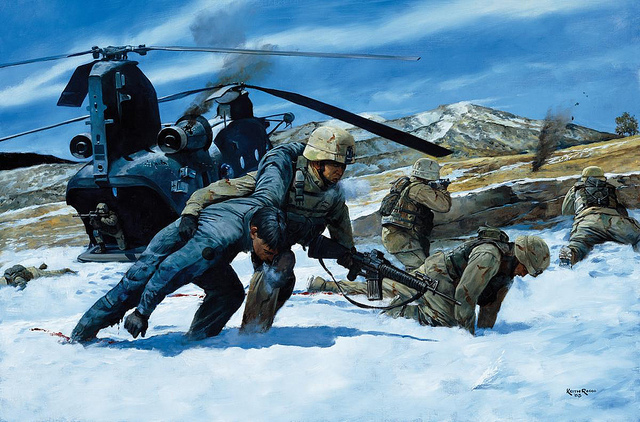
Takur Ghar, Afghanistan, March 4, 2002
March 1, 1781 – Attack on Strode’s Station, Clark County. (Early Indian Wars)
March 1, 1847 – Central mound in the Frankfort cemetery conveyed to the State for a public burying ground, The State Mound.
March 2, 1943 – Battle of Bismarck Sea began. (World War II)
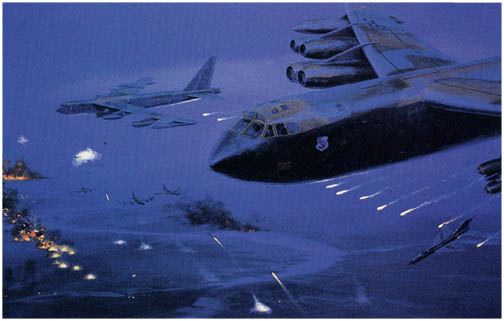
Operation Rolling Thunder, Vietnam, 1968
March 2, 1968 – Operation Rolling Thunder began. Operation Rolling Thunder marked the first sustained American assault on North Vietnamese territory and thus represented a major expansion of U.S. involvement in the Vietnam War. (Vietnam War)
March 3, 1931 – “Star Spangled Banner” made U.S. National Anthem.
March 4, 1966 – Operation Utah (Vietnam War)
March 4, 2002 – Takur Ghar, Patkia Province, Afghanistan-Tech Sgt. Keary Miller, a Combat Search and Rescue Team Leader from the Kentucky Air Guard’s 123rd Special Tactics Squadron, earns a Silver Star for his actions in pulling wounded men out of the line of fire after their MH-47E helicopter crashed landed due to ground fire. Once he established a safe causality treatment area he immediately began giving first aid to a growing number of men. Later he stripped ammunition from the dead and injured and, while repeatedly exposing himself to enemy fire, resupplied those men still able to defend the position. Although seven soldiers lost their lives and ten others were seriously wounded during this 17-hour engagement with Taliban fighters, probably several more would have died without Miller’s heroic service. (Global War on Terrorism)
March 5, 1860 – Act for organization of the Kentucky Militia (State Guard Law).
March 7, 1777 – First siege of Harrodsburg by 47 Indians, under their chief, Blackfish. (Early Indian Wars)
March 7, 1862 - Capt. William Black from Woodford County, Ky., while serving with the 37th Illinois Infantry, single-handedly confronted a Confederate assault during the battle of Pea Ridge, Ark., and turned the tide of the battle. Black would receive the Medal of Honor for his actions. Black’s brother, John, also received the award later that year at the Battle of Prairie Grove, Ark., making them one of the few sets of brothers to earn the Medal of Honor. (Civil War)
March 7, 1951 – Operation Ripper began. (Vietnam War)
March 7, 1867 – 235 copies ordered to be purchased of Adjutant General Daniel W. Lindsey’s Report for 1861-66, known as the “History of Kentucky Soldiers during the late War;” by the Kentucky State Legislature.
March 9, 1867 – The Kentucky legislature cedes to the United States government jurisdiction over the national cemeteries at Perryville, Camp Nelson, Lebanon, and at Mill Springs.
March 9, 1870 – Josiah Stoddard Johnston is appointed Adjutant General of Kentucky by Gov. John W. Stevenson.
March 11, 1968 – Operation Resolve to Win began. (Vietnam War)
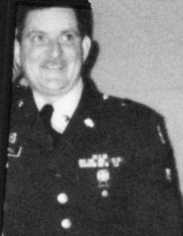
Sgt. Glenn Scott Stanfill
March 12, 2004 – Sgt. Glenn Scott Stanfill, Perry County, sustained fatal injuries when the HUMMWV (M998) he was driving was struck by a tractor-trailer on the Hal Rogers Parkway just East of Manchester, Ky. Stanfill was in route to the East Kentucky Training Site in Artemus with Bravo Company, 206th Engineer Battalion, Hazard, Ky., as part of a battalion Field Training Exercise (FTX).
March 13, 1922 – Pvt. Frank Crone of Covington, a member of the Kentucky National Guard, was on duty as a guard at the Newport Rolling Mill, he was being relieved from duty by John Yates of Newport. Crone was accidentally killed when a revolver slipped from Yates’ pocket and fell to the ground, discharging and mortally wounding Crone.
March 14, 1862 – Engagement at Pound Gap, Letcher County. (Civil War)
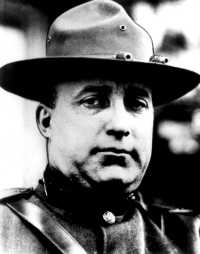
Henry Herman Denhardt
March 14, 1932 – Henry Herman Denhardt is appointed Adjutant General of Kentucky by Gov. Ruby Laffoon.
March 18, 1969 – Operation Breakfast. (Vietnam War)
March 18, 2014 - In the largest Medal of Honor ceremonies in U.S. history, President Barack Obama presents 24 Army Veterans with the nation’s highest honor for their actions in World War II, Korea and Vietnam. The Soldiers were previously recognized with the Distinguished Service Cross, but upgraded after further review of their actions.
March 19, 1836 – Arsenal at Frankfort burnt, with 4,740 stand of arms, besides equipments.
March 19, 1912 – Kentucky State Guard officially renamed the Kentucky National Guard.
March 19, 1924 – James Arthur Kehoe is appointed Adjutant General of Kentucky by Gov. William J. Fields.
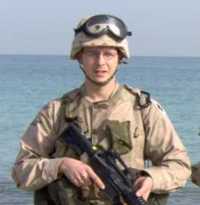
Sgt. Jonathan Adam Hughes
March 19, 2005– Sgt. Jonathan “Adam” Hughes, of Lebanon, Marion Co., Ky., was killed in Iraq when his armored HMMWV vehicle encountered an improvised explosive device (IED) during an escort patrol for a convoy enroute to Baghdad International Airport. At the time of his death, Hughes was assigned to B Battery, 1st Battalion, 623rd Field Artillery, based in Campbellsville, Ky. He joined the Guard in May 2001 when he was 17. His unit mobilized for Operation Iraqi Freedom in November and deployed to Southwest Asia in January 2005. (Global War on Terrorism)
March 22, 1782 – Estill’s defeat by Indians, near Little Mountain (Mount Sterling). (Early Indian Wars)
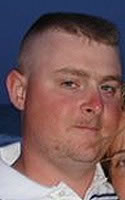
Staff Sgt. Brock A. Beery
March 23, 2006 – Staff Sgt. Brock A. Beery, of Whitehouse, Tenn., was killed when his armored vehicle encountered an improvised explosive device (IED) near Al Habbaniyah, west of Fallujah in Iraq. At the time of the incident Beery was driving a fully-armored light medium tactical vehicle (LMTV). Beery was assigned to the Kentucky Army National Guard’s Headquarters and Headquarters Company, 2nd Battalion, 123rd Armor, based in Bowling Green. The unit mobilized for Operation Iraqi Freedom in March of 2005 and deployed to the Persian Gulf that July (Global War on Terrorism)
March 24, 1992 – SSgt. William Dean Bentley of Elizabethtown (Hardin County) died while on active duty for training at Fort Knox from cardiac arrest while training at the Kentucky Military Academy’s Non-Commissioned Officer Academy in the Primary Leadership Development Course during a field problem. Immediate aid was rendered by members of the 475th MASH and Emergency Room Staff member from Ireland Army Hospital, also participating in PLDC, but they were unable to revive him. Bentley was a member of Battery B, 2nd Battalion, 138th Field Artillery, located in Elizabethtown.
March 25 – Medal of Honor Day.
March 25, 1917 – Claude Somerville of Portland Tenn., died at the Louisville city hospital, following surgery. He had been ill with measles and later developed pneumonia and after recovering from that became ill from emphysema. He enlisted in the 3rd Infantry Regiment of the Kentucky National Guard in Franklin, Kentucky. He died shortly after returning from federal active duty on the Mexican Border.
March 29, 1973 – Last remaining U.S. forces withdraw from South Vietnam.
March 30, 1825 – Confederate General Samuel Maxey is born in Tompkinsville, Ky.
March 30, 1951 – Capt. Merlin R. “Bob” Kehrer perished in the crash of his F-51 “Mustang” near Leesburg, Va., while returning to Louisville from Bolling Air Force Base , D.C. He was a member of the Kentucky Air National Guard.
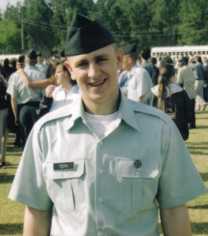
Sgt. Eric Lee Toth
March 30, 2005 – Sgt. Eric Lee Toth, of Edmonton, Metcalfe Co., Ky, was killed in Iraq when his HUMVEE encountered a vehicle-borne Improvised Explosive Device (IED) while returning from an escort patrol for a convoy along the main supply route in Baghdad. Toth joined the National Guard in May 2001. He was assigned to A Battery, 1st Battalion, 623rd Field Artillery, based in Tompkinsville, Ky. This unit mobilized for Operation Iraqi Freedom in November and deployed to Southwest Asia in January 2005. (Global War on Terrorism)
Story by Staff Sgt. Scott Raymond, Kentucky National Guard Public Affairs
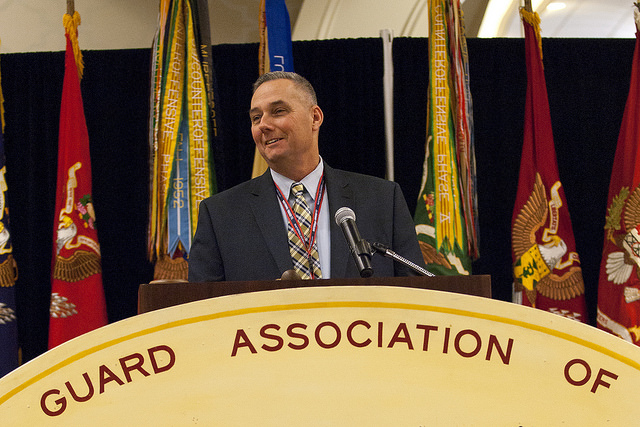
Chief Warrant Officer retired James Simms speaks during the National Guard Association of Kentucky Conference in Louisville, Ky., Feb. 8, 2014. Simms took over as the executive director of the association from Kim Knight during the meeting. (U.S. Army National Guard photo by Staff Sgt. Scott Raymond)
LOUISVILLE, Ky. — It was business as usual for the annual National Guard Association of Kentucky Conference held in Louisville, Ky., Feb. 8. Speakers spoke, the future was discussed and awards were given, but it also marked the end of a decade of service for the association’s director.
Kim Knight had worked tirelessly as the executive director for 10 years and felt it was time to hand over the reigns. Retired Chief Warrant Officer James Simms will take over for Knight.
“This job has given me an opportunity to grow and make many new lifelong friends along the way,” said Knight, who’s husband, Chief Warrant Officer Steve Knight is a standardization flight officer for the Kentucky Guard. “It is time for me to begin a new chapter in mine and Steve’s life. I look forward to what God has planned for us.”
Knight said she was honored to serve as the director and was happy to be a part of the associations growth. She fully supports her successor and offered her assistance in the transition.
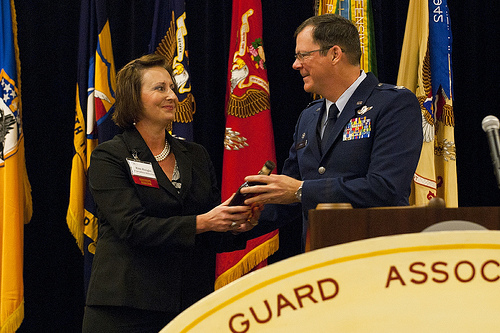
Kim Knight is presented a token of appreciation from the National Guard Association of Kentucky Board President, Col. Robert Hamm during the NGAKY Conference in Louisville, Ky., Feb. 8, 2014. Knight served as the executive director of the association for 10 years. (U.S. Army National Guard photo by Staff Sgt. Scott Raymond)
“I feel that James Simms will take the National Guard Association to the next level with his expertise and military experience he brings to the organization.”
Simms said he was humbled to take over from such a long-standing tradition in Kentucky and praised Knight’s work.
“Kim Knight has put her heart and soul into this association over the last decade to insure it never made a step backwards and was always striving to have us all realize the value of the organization,” he said.
Simms believes the lessons he learned from being a warrant officer will help analyze issues and present possible solutions to help the association’s board to better the National Guard in Kentucky.
“As the executive director of NGAKY I will face many new challenges and responsibilities. With the changing times facing the nation today, in both the military and in other government agencies, we all must look how we can meet our obligations as tax payers and Soldiers.”
“Myself, along with the members of the Board of Directors, will do our best to insure we are good stewards of the associations finances and send a message to our leaders that supports the needs of our Soldiers and Airmen in these uncertain times.”
To See more photos from this year’s conference, click here.
Story by Staff Sgt. Scott Raymond, Kentucky National Guard Public Affairs
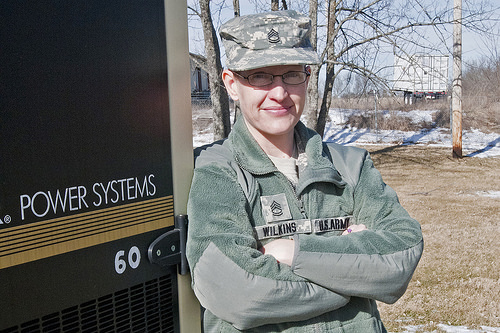
Sgt. 1st Class Angela Wilkins with the 202nd Army Band worked as a liaison for the Kentucky National Guard, the Corps of Engineers and the Federal Emergency Management Agency during the winter storm of 2009. Wilkins coordinated the deliveries of more than 200 generators across the commonwealth after storm-induced power outages. (U.S. Army National Guard photo by Staff Sgt. Scott Raymond)
FRANKFORT, Ky. — In January 2009, Angela Wilkins was warm and comfortable as a stay-at-home mom with her two children in Frankfort, Ky. They watched as the National Weather Service predicted a winter storm to dump accumulating ice and snow across the region. The forecast was right, but the estimated totals were less than what actually coated several states, knocking out power for hundreds of thousands and pushing state agencies to the brink.
Wilkins was also without power and soon found herself in the middle of the largest activation of the Kentucky National Guard in its history.
“On a state level, it was catastrophic. They even had to call up the band,” said Sgt. 1st Class Wilkins, the readiness NCO for the Kentucky Guard’s 202nd Army Band.
Kentucky Governor Steve Beshear would be quoted saying that the storm that blew through Kentucky was the “worst natural disaster” to ever hit the commonwealth. Nearly all of the 120 counties were affected in some way and almost every Kentucky Guardsman would be called up to assist citizens from the Bluegrass to the Mississippi River.
Wilkins was at the time, a traditional Guardsman serving one weekend a month as a musician in the band. After the storm hit she joined more than 4,600 other Soldiers and Airmen in Kentucky and reported for duty. Members of the band filled in wherever needed, assisting with logistical tracking or the delivery of radios and supplies to other Guardsmen across the state.
The Kentucky Division of Emergency Management needed help with the coordination of multiple agencies out of Frankfort. Wilkins had previously worked as a program analyst for the Kentucky Guard’s J6 (Communications and Information Technology), so she was asked to put her expertise to task.
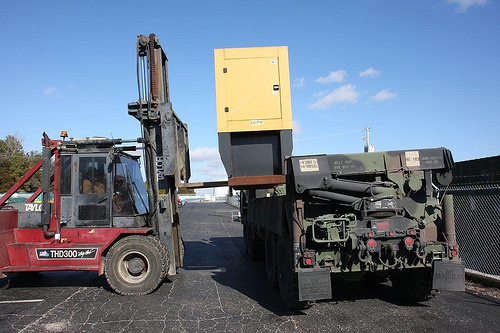
Kentucky Guardsmen load generators for transport during the winter storm, Feb. 3, 2014. Generators were sent to assist local communities with basic needs such as powering hospitals and state offices to keep relief efforts up and running. (File photo)
“It was almost chaos,” Wilkins remembers of the emergency response coming out of Frankfort. “I was a clarinet player directing where generators went.”
Wilkins assisted Emergency Management with the placement of more than 200 generators from the state, the Corps of Engineers and the Federal Emergency Management Agency. Each agency offered the use of the equipment, but someone had to decide where they needed to go.
“Each agency had their own way of sending the generators out,” Wilkins recalled. “They choose me to be the liaison between the groups and get the equipment out to the field in the most efficient way possible. We were able to get them to those who needed them quicker and easier, and we helped a lot of people.”
Wilkins’ children were able to stay with relatives that had power and it took at least five days for the heat and lights to come back on in Frankfort, so many sleepless nights were spent in an armory, making the best of the situation.
For two weeks, thousands of Guardsmen cleared roads, delivered food and water and conducted home to home wellness checks throughout the state. Soldiers from the infantry, the artillery, MPs and of course, the band came to the assistance of hundreds of thousands of citizens. By the time the last generator was turned off and returned, the Soldiers and Airmen were sent home with a big pat on their backs.
“I scheduled the last pick-up, typed up my after action report and left. Those two weeks pushed me to the limits,” she said.
“Sergeant Wilkins’ performance during the 2009 ice storm is typical of the professionalism we’ve come to expect from our troops, particularly in a time of crisis,” said Maj. Gen. Lonnie Culver, a task force commander during the relief mission. “This was absolutely the worst natural disaster in our state’s history and everyone from our combat engineers to the band had a role to play, and they did so with urgency, efficiency and passion. The people of Kentucky owe much to these great Citizen Soldiers and Airmen.”
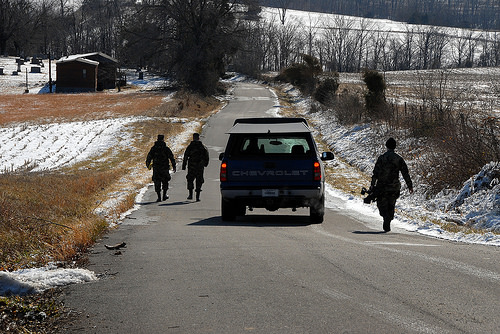
Members of the Kentucky Air National Guard walk rural roads of McDaniels, Ky. providing “Wellness Checks” to its residents during emergency ice storm relief efforts, Feb. 1, 2009. More than 4,600 Kentucky Guardsmen were activated to support local and federal agencies following the storm. (File photo)
Wilkins said it was the first time the entire band had been called up for State Active-Duty. If there were highlights in such a costly event, she said it was getting to see members of her unit playing a part in the historical call-up.
“It was great to say that the band got to help,” she said.
“They arose to the occasion. Everyone worked for the welfare of the state, everyone had a role, they didn’t complain about it not being their job, they just helped where they could. That’s what sets the National Guard apart.”
Staff report
FRANKFORT, Ky. — Responding to a devastating winter storm that shut down most of the state, Governor Steve Beshear directed in January 2009 for Kentucky’s adjutant general, Maj. Gen. Edward W. Tonini, to order the unprecedented activation of all Kentucky Army National Guard units, along with selected portions of the Kentucky Air National Guard. This was the largest state call up of Kentucky National Guard forces in the history of the Commonwealth.
Take a look at the following for some behind the scenes moments from that remarkable mission.
Click here for the full story.
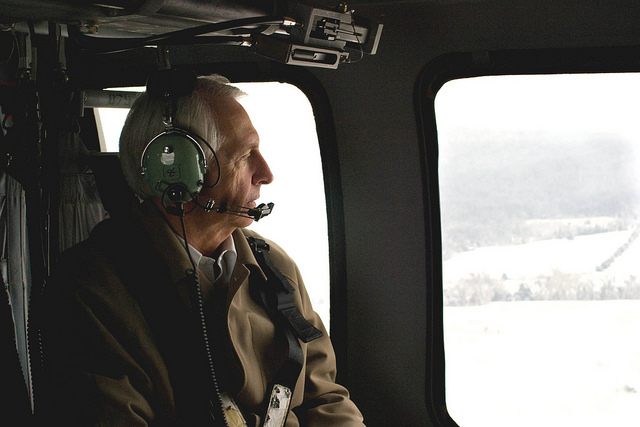
Kentucky Governor Steve Beshear views winter storm damage in rural Kentucky while en route to Louisville, Ky. to meet with Louisville Mayor Jerry Abramson. (Kentucky National Guard photo)
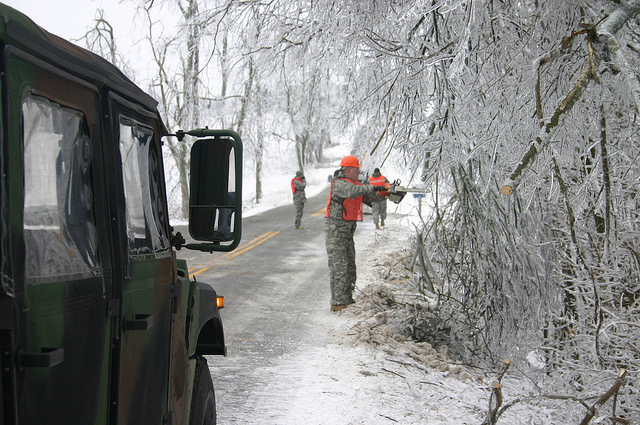
Soldiers from A Co. 103rd Brigade Support Battalion cut down trees overhanging the roadways caused by the damaging ice storm that hit the commonwealth Jan. 29. Approximately 500 Kentucky National Guardsmen were mobilized in response to the storm to assist in clearing roadways, transporting supplies and securing shelters throughout the state of Kentucky. (Kentucky National Guard photo)
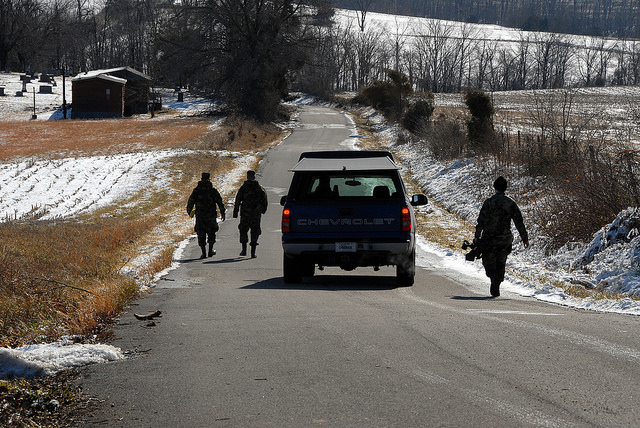
Members of the Kentucky Air National Guard walk rural roads of McDaniels, Ky. providing “Wellness Checks” to its residents during emergency ice storm relief efforts. (Photo by Tech. Sgt. Dennis Flora / KyANG)
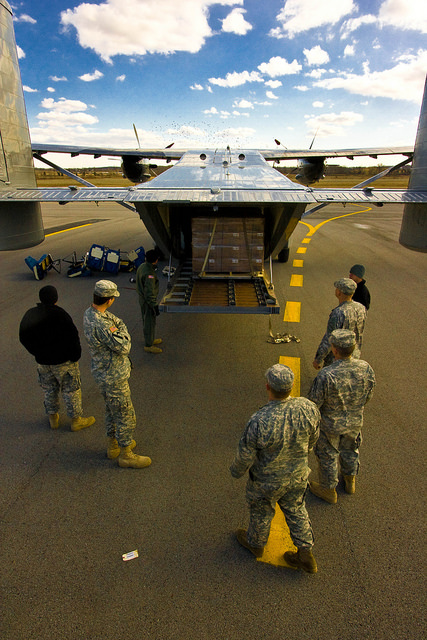
Soldiers of the 307th Component Repair Company prepare to transfer cases of MREs from a C-23 Sherpa aircraft to a 2.5 ton truck for transport to the distribution facility at Wendell H. Ford Regional Training Center in Greenville, Ky. on Monday, February 2, 2009. (Kentucky National Guard photo)
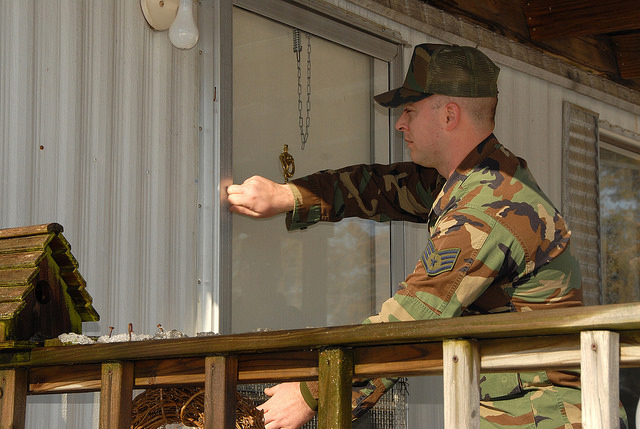
Staff Sgt. Burkman of the Kentucky Air National Guard knocks on the door of a resident of McDaniels, Ky. providing a “Wellness Checks” during emergency ice storm relief efforts. (Photo by Tech. Sgt. Dennis Flora / KyANG)
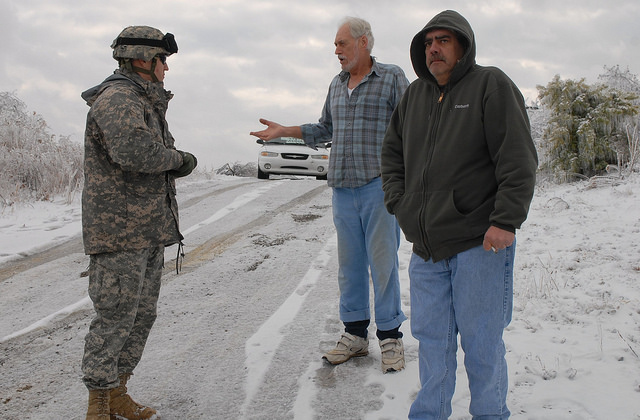
Army Sgt. Joshua White, 206th Engineer Battalion, talks with residents of Leitchfield, Ky. as part of a door-to-door health and welfare visit program conducted by members of the Kentucky National Guard. (Kentucky National Guard photo)
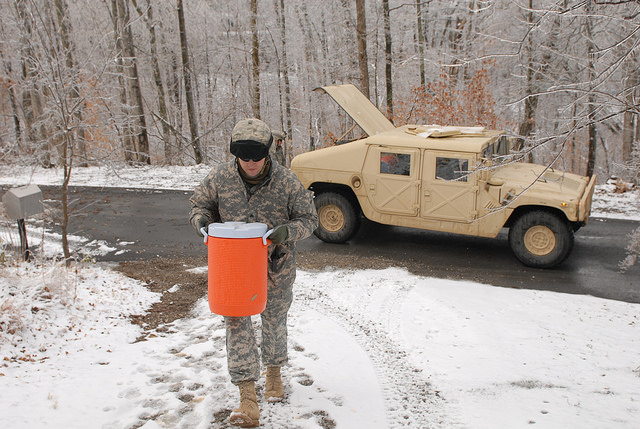
Army Sgt. Joshua White, 206th Engineer Battalion, delivers water to residents of Leitchfield, Ky. who have gone without it since power outages have shut down water treatment facilities in Grayson County, Ky. (Kentucky National Guard photo)
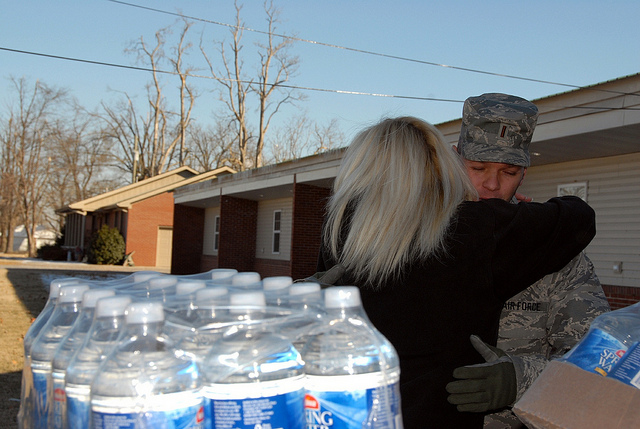
Kentucky Air National Guard member, 2nd Lt. James Campbell, 123rd Maintenance Squadron. Receives a grateful hug from a resident in Banadana, Kentucky during ice storm relief efforts. (Photo by Tech. Sgt. Dennis Flora / KyANG)
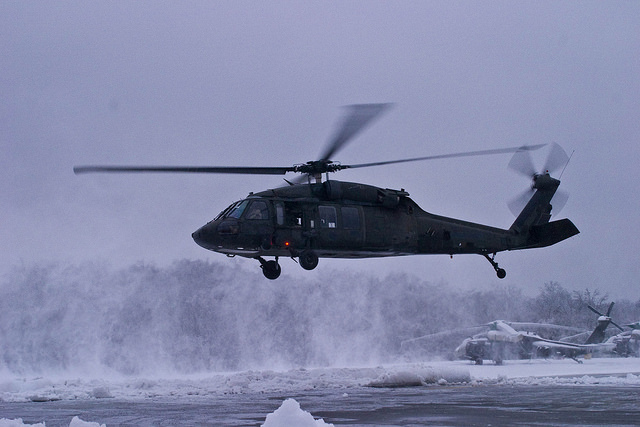
A UH-60 Blackhawk helicopter lifts off on a mission as part of the emergency relief efforts following a massive ice and snow storm that has ravaged Kentucky. (Kentucky National Guard photo)
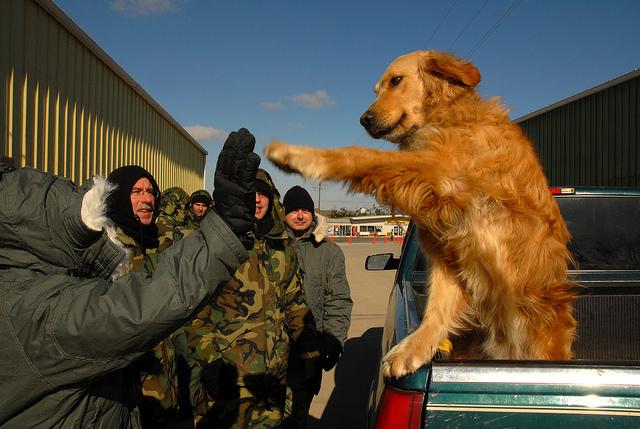
In a light hearted moment Kentucky Air National Guard Master Sgt. Karen Fulton and her team share a light hearted moment, exchanging high fives with a dog belonging to a victim of the ice storms at the LaCenter, Ky. relief station. (Kentucky Air National Guard photo)
Posted by Lt. Col. Kirk Hilbrecht, Director, Kentucky National Guard Public Affairs
Photos courtesy of Drew Franklin, Kentucky Sports Radio, and Staff Sgt. Scott Raymond, Kentucky Guard
University of Kentucky coach John Calipari joins Governor Steve Beshear and Maj. Gen. Edward Tonini in greeting deployed Kentucky Guardsmen overseas via Skype from Calipari’s office in Lexington, Ky., Jan. 23, 2014. (U.S. Army National Guard photo by Staff Sgt. Scott Raymond)
LEXINGTON, Ky —University of Kentucky head basketball coach John Calipari, Kentucky Governor Steve Beshear, and Adjutant General Edward Tonini conducted a Skype call with Kentucky Guard Troops deployed overseas for a third year in a row. Kentucky Troops stationed in Guantanamo Bay, Cuba, Afghanistan and the Middle East had more than 40 minutes to “Coach” the Coach, while hearing inside-the-locker room strategy from the head coach of the 2012 NCAA Men’s Basketball Tournament victors.
Below are pictures of the Skype session, pictures courtesy of Drew Franklin, Kentucky Sports Radio.
Session memorables:
LUNCH?
Spc Lerone Simmons, 133rd Mobile Public Affairs Detachment, Guantanamo Bay, Cuba exclaimed, “Hey Coach, when I get back to the states and after the Wild Cats win the 2014 NCAA championship, I’d like to take you out for lunch to listen to how you strategize a winning game.”
Coach Cal began his discussion on game-strategy, and offered to have this lunch at the Governor’s mansion. The discussion continued with dialogue regarding specific games played by UK thus far.
As the conversation waned, Spc. Simmons stood up and asked, “So, we still on for lunch then, Coach?”
CAMP FATHER-SON.
A Kentucky Troop stationed in the Middle East mentioned how great his experience was during the UK Father/Son basketball camp. Coach Cal talked about how great of a learning experience the camp is for both father and son. The father coaches his son and the son sees his father play basket ball.
Coach Cal extended a special invite to the Fathers deployed overseas.
PRANKS AMONG FRIENDS
A Kentucky Troop stationed in Afghanistan asked UK Basketball player Julius Randle how he was going to retaliate against the pranks of his fellow Wild Cats. Julius explained, “Prior to the U of L game, my mom had to drop off a new pillow ’cause the guys put hot sauce on my pillow.”
So, how Julius was going to ‘get even’ with his fellow teammates? “It’s on a need to know…but it’s gunna be good!”
Links to Coach Cal/Skype Call articles:
KentuckyGuard.com
http://kentuckyguard.com/deployed-kentucky-guardsmen-get-facetime-with-coach-cal/
CoachCal.com
http://www.coachcal.com/26924/2014/01/coach-cal-cats-visits-kentucky-guardsmen-via-skype/
Kentucky Sports Radio
http://kentuckysportsradio.com/basketball-2/coach-cal-gov-beshear-poythress-and-randle-talk-to-troops-overseas/
Story by Staff Sgt. Scott Raymond, Kentucky National Guard Public Affairs
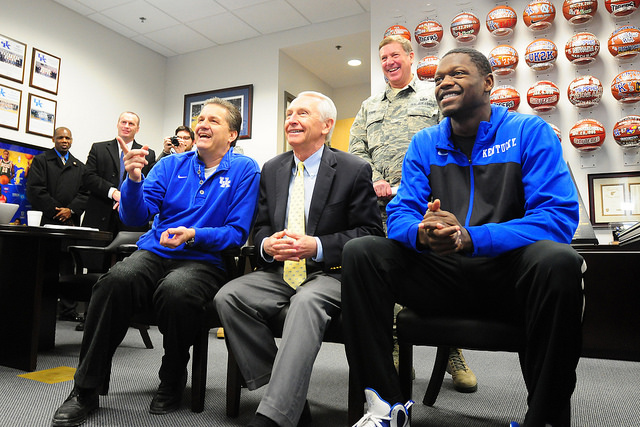
Left to right, University of Kentucky coach John Calipari, Governor Steve Beshear, Maj. Gen. Edward W. Tonini and UK forward Julius Randle speak with Kentucky Guardsmen deployed overseas via Skype from Calipari’s office in lexington, Ky., Jan. 23, 2014. It was the third year in a row that Calipari has been a part of the video conference with the Kentucky Guard. (U.S. Army National Guard photo by Staff Sgt. Scott Raymond)
LEXINGTON, Ky. — For the third year in a row, Kentucky Guardsmen deployed overseas received the unique opportunity to chat with University of Kentucky head basketball coach John Calipari via Skype, Jan. 23, 2014.
Calipari sat down with Governor Steve Beshear and Maj. Gen. Edward W. Tonini, Kentucky’s adjutant general to talk with Soldiers in Afghanistan, the Middle East and at Guantanamo Bay, Cuba.
“Anytime you can touch home when you are eight or nine thousand miles away or even in Cuba which is very isolated, this is a great thing for them, and when you can do it with something a passionate as Kentucky basketball and Coach Cal, I can tell you these young people look forward to it, maybe more so than anything else,” said Tonini. “This could be as special as a call from home for them.”
To see more photos from this story, click here.
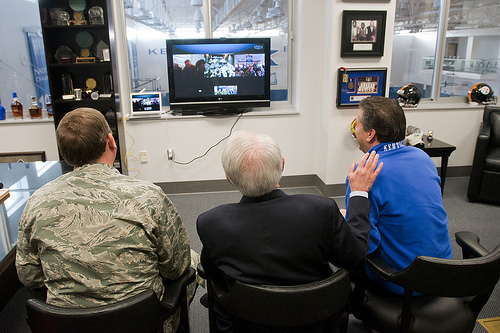
Maj. Gen. Edward Tonini, Kentucky’s adjutant general, Governor Steve Beshear and University of Kentucky coach John Calipari speak with deployed units of the Kentucky National Guard via Skype in Lexington, Ky., Jan. 23, 2014. Soldiers deployed to Afghanistan, the Middle East and Cuba had the special opportunity to discuss Kentucky Basketball with Calipari during the conference. (U.S. Army National Guard photo by Staff Sgt. Scott Raymond)
From his office at the university, Calipari began by thanking the Guardsmen for what they do and how glad he was to see the gatherings of Wildcat fans on the other end again for this special meeting. Soldiers of the 1103rd Military Police Detachment in Afghanistan, 103rd Brigade Support Battalion and Charlie Company of the 2nd Battalion, 238th Aviation in the Middle East and the 133rd Mobile Public Affairs Detachment in Cuba shared the video screen and some time to discuss Kentucky Basketball with the coach.
“When General Tonini said we were going to do this again, I said ‘Great, just tell me when!’,” said Calipari.
The Soldiers got an additional treat when UK basketball players, Julius Randall and Alex Poythress also stopped by to say hello and thank the troops for their service.
Spc. Lerone Simmons with the 133rd asked Calipari to share his ideas on successful leadership, to which Calipari responded with his hopes of speaking to the troops in person once they return later this year.
“I’m definitely looking forward to hopefully meeting with Coach Cal, and bouncing ideas off of him to help us with future decision making,” said Simmons, who compared Calipari’s decisions on the court to some important choices we make in life.
“It was great to be able to Skype with Coach Cal and leadership, it meant a lot to us all here.”
Regardless of the meshing of political figures, generals and sports icons, the meeting was about Kentucky and the support at home for the Guardsmen serving around the world.
To see more coverage of this event, click on the following links:
Video from Skype conference:
Kentucky Sports Radio - http://kentuckysportsradio.
and-randle-talk-to-troops-
Photos by Staff Sgt. Scott Raymond, Kentucky National Guard Public Affairs
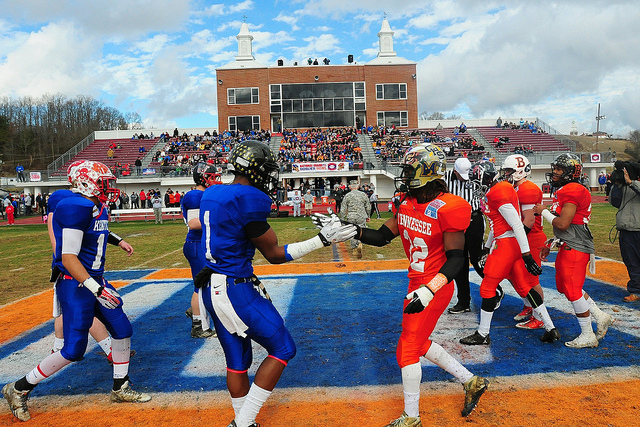
Players greet each other on the field following the coin toss to start the 2014 National Guard Border in Williamsburg, Ky., Jan. 11, 2014. (U.S. Army National Guard photo by Staff Sgt. Scott Raymond)
WILLIAMSBURG, Ky. — The National Guard Border Bowl is a unique event for the Kentucky Guard. The game is also one of a kind with the National Guard in its name and playing such a prominent role. While the all-star football game is about Kentucky and Tennessee, nationally televised broadcasts and a high level of advertising for the Guard, it has been called a model of how to do something big in a little place.
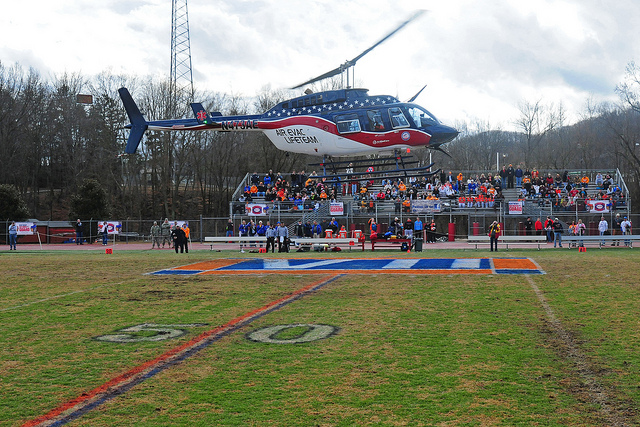
An aircrew with the Air Evac Lifeteam delivers the game ball to the field at the University of the Cumberlands in Williamsburg, Ky., prior to the start of the 2014 National Guard Border Bowl Jan. 11, 2014. (U.S. Army National Guard photo by Staff Sgt. Scott Raymond)
“The National Guard Border Bowl as an event is a fantastic day for the National Guard,” said Kierre Brown, marketing director for the Kentucky National Guard. “This puts small Williamsburg, Kentucky on the map and that’s very beneficial for the community. The growth of this game is tremendous in the seven years and has had quite an effect on Kentucky and I’m sure is just as beneficial for Tennessee as well.”
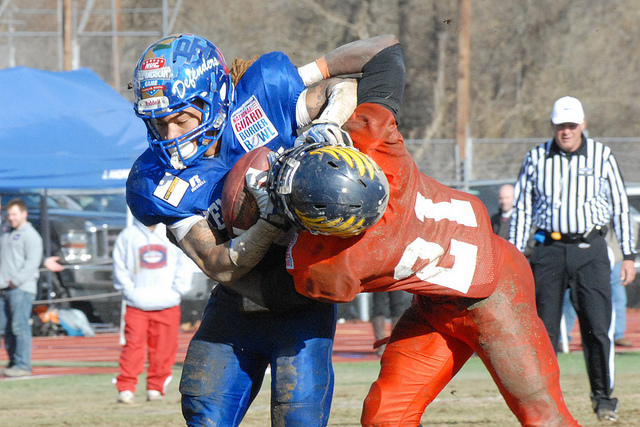
Henry Clay High School’s Elijah Bell is tackled by a player from Tennessee during the National Guard Border Bowl in Williamsburg, Ky., Jan. 11, 2014. (U.S. Army National Guard photo by Staff Sgt. Scott Raymond)
Ultimately the game is about the players. Some of the best high school football players the two states have to offer. It’s another chance for them to shine on the field and potentially catch the attention of college football programs.
“I am honored to play in this game,” said Der’Quoine Mobley Jr., a senior at Louisville Central High School. “It was a phenomenal experience for us considering you have the best head coaches in the state. They get us ready for college ball with the right mindset.”
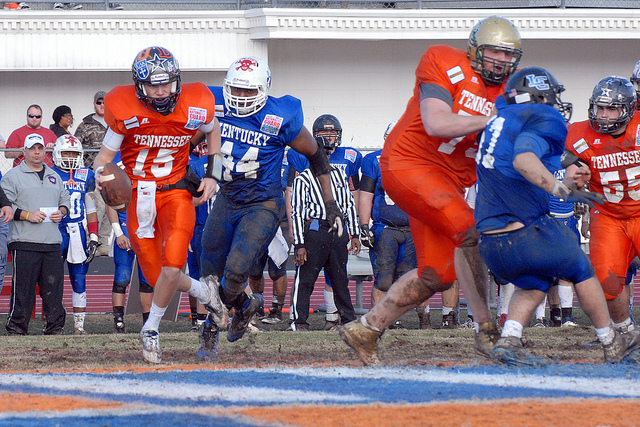
Derik Overstreet from Paducah Tilghman High School chases Tennessee’s quarterback, Devin Smith from Grace Christian Academy during the National Guard Border Bowl in Williamsburg, Ky., Jan. 11, 2014. (U.S. Army National Guard photo by Staff Sgt. Scott Raymond)
Kentucky beat Tennessee 37-13 in a dominating performance from its all-stars. This is the second win in a row for Kentucky, although Tennessee still leads the series 4-3. More than 50 players from each state representing 33 high schools in both Tennessee and Kentucky participated in the game.
To see more photos from this year’s Border Bowl, click here.
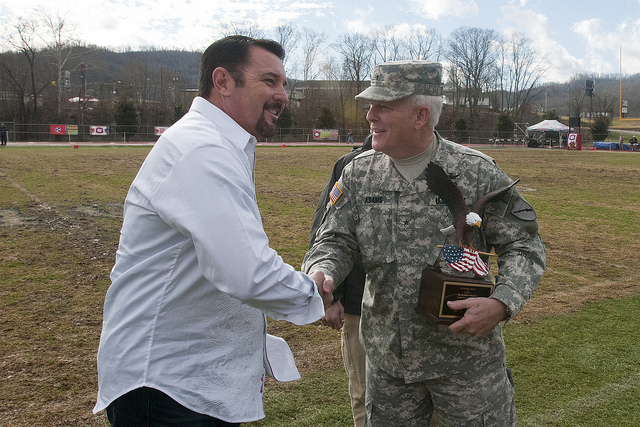
Brig. Gen. Benjamin Adams III, Chief of Staff for the Kentucky Guard presents Dr. Howard Wasdin, former Navy SEAL, the National Guard Border Bowl Ironman Award for his work with high school athletes and coaches. (U.S. Army National Guard photo by Staff Sgt. Scott Raymond)
In addition to the players, coaches and Guardsmen in attendance, guests of the Border Bowl included several Veterans, NFL players and former NCAA coaches and players. Former Navy SEAL Dr. Howard Wasdin, author of the book “SEAL Team Six,” spoke to the players the night before the game and was on hand to sign copies of his book during the game. Veterans from the Korean and Vietnam Wars were honored in the first quarter by the Border Bowl Committee and the Kentucky Guard.
FOX Sports South’s broadcast of the game brought NCAA Hall of Fame coach, Philip Fulmer together with two Super Bowl Champions from the NFL, Marty Moore and Walley Richardson to interact during the event. The people involved with the Border Bowl are a story in its self said Freddie Maggard with Kentucky National Guard Community Relations.
“Players from Kentucky and Tennessee are surrounded by positive role models from registration to post-game,” he said. “The National Guard Border Bowl is much, much more than a football game.”
“It’s life lessons being taught on a hundred yard field.”
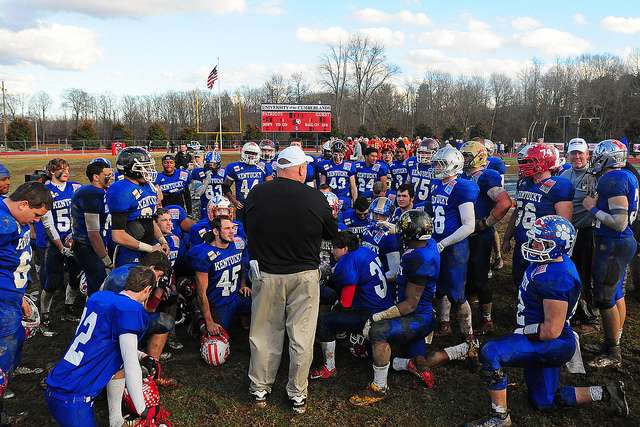
Joe Prince, from Owensboro High School, head football coach for the Kentucky All-Stars, speaks to his victorious team following the 2014 National Guard Border Bowl in Williamsburg, Ky. Jan. 11, 2014. (U.S. Army National Guard photo by Staff Sgt. Scott Raymond)
Story by Staff Sgt. Scott Raymond, Kentucky National Guard Public Affairs
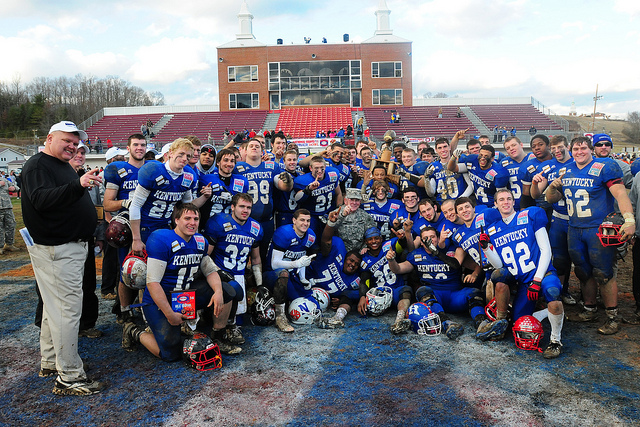
The Kentucky All-Stars celebrate their victory in the National Guard Border Bowl in Williamsburg, Ky., Jan. 11, 2014. Kentucky beat Tennessee 37-13 for their second victory in a row over the interstate rival. (U.S. Army National Guard photo by Staff Sgt. Scott Raymond)
WILLIAMSBURG, Ky. — On a rain-soaked field at the University of the Cumberlands in Williamsburg, Ky., the best high school football players from Kentucky and Tennessee gathered again to play for the bragging rights to the border. As the sun broke through the clouds on Jan. 11, 2014, the two teams squared off in the the seventh annual National Guard Border Bowl.
Kentucky beat their the interstate rival for the second straight year. And also for the second year in a row, thanks to the nationally televised broadcast by FOX Sports South, the game and small border town of Williamsburg were on the map.
“Having such a game like this with the involvement of the National Guard is a great combination,” said Sgt. Trenton Guffey with the 1st Battalion, 623rd Field Artillery. “It seems to make sense that they are connected.”
To see more photos from the 2014 Border Bowl, click here.
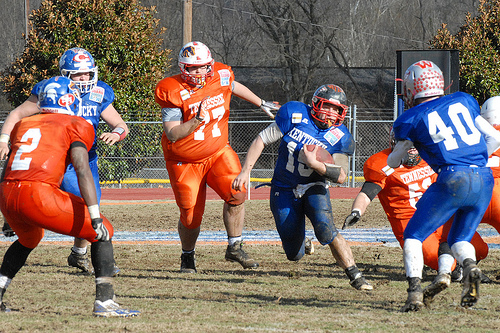
Kentucky’s Tyler Guffey scrambles through the defense during the National Guard Border Bowl in Williamsburg, Ky., Jan. 11, 2014. Guffey led the Kentucky offense to a win in front of family members including his uncle, Sgt. Trenton Guffey of the 1/623rd Field Artillery. (U.S. Army National Guard photo by Staff Sgt. Scott Raymond)
Guffey was on hand to assist with the firing of a cannon with each touchdown scored in the game. But he also volunteered for the assignment to see his nephew Tyler start as the quarterback for Kentucky. Guffey pointed out the similarities of training to be a Soldier or a football player, being parts of the community and how the seven Army Values are instilled in the players.
“Just like us in the Guard being close to local communities with armories, the players are close with their towns,” he said. “And just like the values we are taught and some of the things we stand for, they do the same on the football field. It’s about completing the mission or winning the game.”
Tyler, a senior at Wayne County High School helped lead Kentucky to a dominating 37-13 victory. He said he was happy to have his uncle in attendance and was proud to play in the Border Bowl.
“This has been a great experience, I think this is the best bowl game around,” said the Monticello, Ky. native. “It’s awesome to be able support my uncle and all our troops.”
According to Lt. Col. Fred W. Bates V, commander of the Kentucky National Guard’s Recruiting and Retention Battalion, the game is the only all-star game in the country with such a high level of advertising for the National Guard.
“This is great for the National Guard,” he said. “It’s not just about showing off the National Guard on national television, it’s a great community event for Williamsburg, Kentucky as well.”
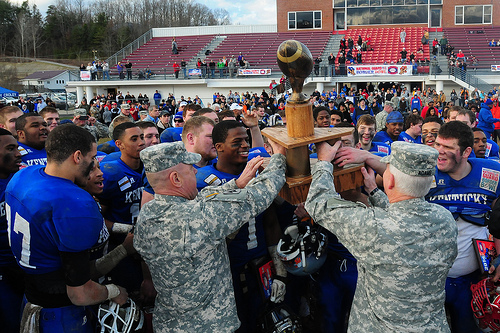
Brig. Gen. Benjamin Adams III (right) and Command Sgt. Maj. Thomas Chumley Jr. present the 2014 National Guard Border Bowl trophy to the Kentucky high school football all-stars in Williamsburg, Ky., Jan. 11, 2014. The game is one of only a few high school match-ups with National Guard sponsorship. (U.S. Army National Guard photo by Staff Sgt. Scott Raymond)
Bates thinks the game is a sign of how the National Guard should interact with their communities. He sees the game as a positive for the Guard, the town and the players, and says more of these types of games will show up around the country.
“We pay for the ability to advertise at his event, and the community runs the event,” he said. “We are able to help them make this a successful event with our resources, but it benefits Kentucky and Tennessee equally.”
The National Guard Border Bowl is a non-profit organization established to provide an all-star game featuring the top players in Kentucky and Tennessee. This game allows players to have the opportunity to play, practice, and battle it out for the rights to the border. It also allows high school seniors an opportunity to gain additional exposure and, perhaps, earn a scholarship for college.
Story by Staff Sgt. Scott Raymond, Kentucky National Guard Public Affairs
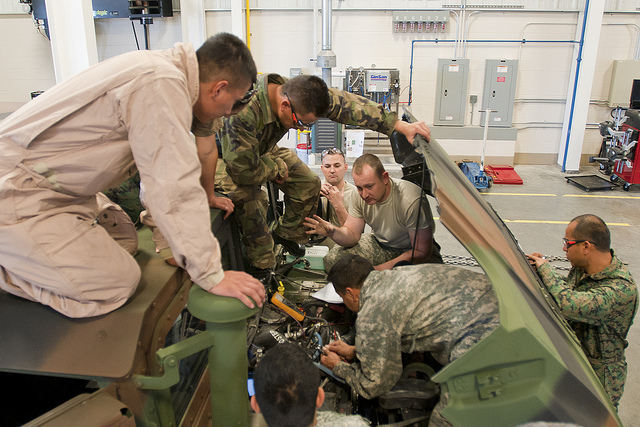
Staff Sgt. Adam Honican (center) with the Kentucky Guard’s Field Maintenance Shop 4 explains the throttle position sensor of a M1152 Humvee to members of the Ecuadorian military in Richmond, Ky., Dec. 11, 2013. The Ecuadorians visited Kentucky to learn more about newer models of the Humvee as part of the State Partnership Program between their country and the commonwealth. (U.S. Army National Guard photo by Staff Sgt. Scott Raymond)
RICHMOND, Ky. — The National Guard’s State Partnership Program celebrated its 20th anniversary in 2013. For 17 of those years, the Kentucky National Guard and the South American country of Ecuador have grown a mutually beneficial relationship of training and cooperation.
While the partnership has seen its livelier days, the Soldiers and Airmen of both countries continue to find common ground in their fields. Several members of the Ecuadorian military visited Frankfort and Richmond, Ky. in December as part of a maintenance-training program, in a fresh sign of the association,
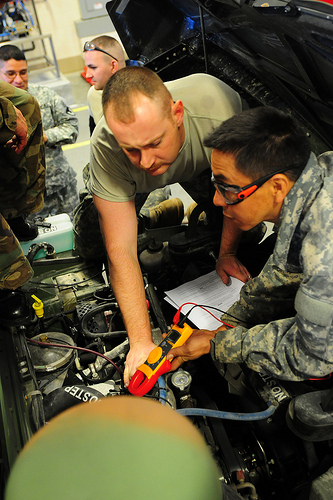
Staff Sgt. Adam Honican assists an Ecuadorian Marine in calibrating a throttle position sensor on a M1152 Humvee in Richmond, Ky., Dec. 11, 2013. Mechanics with the Ecuadorian military do not have the latest equipment to properly maintain their new Humvees, but learned new ways to adapt to the needs of the vehicles. (U.S. Army National Guard photo by Staff Sgt. Scott Raymond)
The purpose of the visit was for the Ecuadorians to see how Kentucky maintains their fleet of M1152 Humvees. Ecuador recently purchased more than 100 of the vehicles from the United States and was seeking the knowledge on the new model.
Members of the Ecuadorian Army and Marines spent several days in Kentucky gaining new ideas for the up-keep of the new Humvees. From the basics of work order flow to the proper way to calibrate a throttle position sensor, Kentucky Guardsmen shared what they knew.
“It’s pretty neat to have the opportunity to teach them things they don’t get in their own country,” said Staff Sgt. David Gross with the Field Maintenance Shop in Richmond. “They were excited to be here and were very willing to learn whatever we had to share. We are more than happy to spread the mechanic knowledge to foreign military partners.”
To see more photos from this story, click here.
Ecuador’s use of its Humvees is quite different from the U.S. Tactical wheeled vehicles are a critical asset for operations along Ecuador’s border regions, particularly the northern border with Colombia. Securing that border is a top priority for both the U.S. and Ecuador. Transnational organized crime, narcotics and human trafficking, and incursions by terrorist organizations are a common and serious threat to Ecuador’s security.
Wheeled tactical vehicles are the primary means for effectively patrolling the austere conditions found in the mountains and jungles in the border region. Ecuador operates their Humvees for long hours in these harsh conditions and improving their vehicles’ mission capability rate is a key factor in achieving border security goals.
Lt. Mayra Artaega with Ecuador’s army led the small group north for the visit. She believes the maintenance and logistics systems of the U.S. military are of the highest standards and working with their partner nation will only enhance their abilities in Ecuador.
“Tactical vehicles are critical to border security for us in Ecuador, but as a small country our financial resources and facilities are much more limited than they are in the U.S.,” she said. “Working with our friends in the Kentucky National Guard and sharing best practices for properly maintaining our new Humvee fleet is one of the best ways we can protect our investment.”
December’s event was the sixth in a series of exchanges focused on Ecuador’s wheeled vehicle program. Two events were conducted in Ecuador, most recently in April of 2012, and the rest have been in Kentucky.
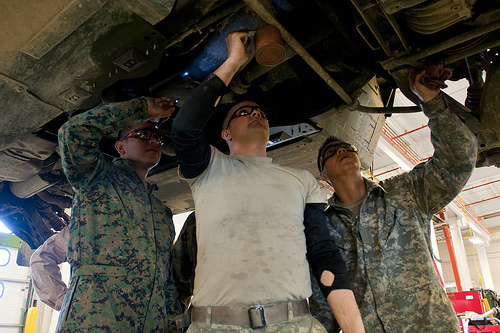
Staff Sgt. David Gross discusses transmission maintenance with two members of the Ecuadorian military on a M1152 Humvee in Richmond, Ky., Dec. 11, 2013. Ecuador has purchased new models of the Humvee and were in need of training on the different methods of maintenance. (U.S. Army National Guard photo by Staff Sgt. Scott Raymond)
According to Lt. Col. Shawn Keller, Kentucky’s State Partnership Program director, the military relationship between the two countries is much better than the strained political relationship of late. The tactical vehicle exchanges with Kentucky and a follow-on visit scheduled for May of 2014 are the only U.S.-Ecuador engagements that Ecuador’s Minister of Defense has approved for 2014. A fact that Keller says speaks volumes for the trust and value that Ecuador has for Kentucky and the state partnership program.
“This event is unique, and it’s not only about Kentucky’s continued efforts to help Ecuador build a strong tactical vehicle maintenance program,” said Keller. “This event also symbolizes Kentucky’s emerging role as a key player in keeping the pilot light burning until the political climate once again allows the U.S. and Ecuador militaries to fully engage.”
“The unique ability to build and maintain lasting relationships with partner countries, even in challenging times, is a hallmark of the National Guard’s State Partnership Program.”
The following is a compilation of significant dates in our Nation’s and commonwealth’s military history. For more on the legacy of our Citizen-Soldiers and Airmen, visit the Kentucky National Guard eMuseum.
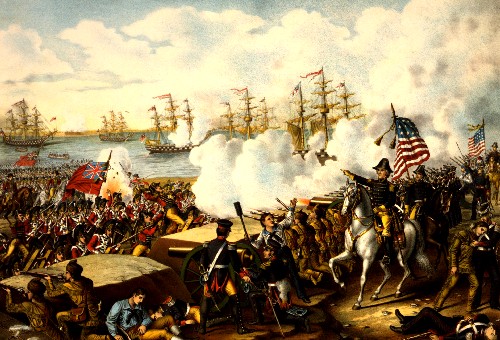
Battle of New Orleans, 1815
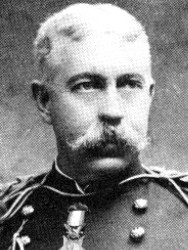
Brig. Gen. John Kerr
January 7, 1815 – 2,500 Kentucky militia, under Maj. Gen. John Thomas, less than one-fourth of them armed (as their arms were on flat-boats, not yet arrived), reach New Orleans. (War of 1812)
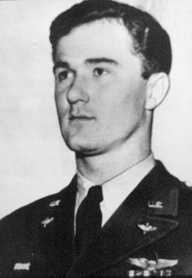
Capt. Thomas Mantell
January 7, 1948 – Capt. Thomas Francis Mantell Jr., was killed while on a training flight with three other P-51Ds (Mustang). Mantell was directed by flight tower at Godman Field, Ft. Knox, to pursue an unidentified flying object. While in pursuit of the object, his aircraft crashed near Franklin, Simpson County, Ky. Capt. Mantell was the first flight casualty of the Kentucky Air National Guard.
January 8, 1815 – American victory at the Battle of New Orleans. (War of 1812)
January 8, 1967 – Operation Cedar Falls (Vietnam War)
January 11, 1862 – Gunboat action at Columbus, Kentucky. (Civil War)
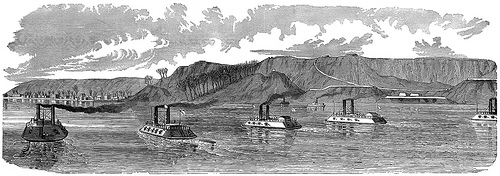
Union gunboats on the Mississippi River near Columbus, Ky., during the Civil War.
January 12, 1945 – 1st Lt. George A. Vanarsdale, Headquarters Company, 192nd Light Tank Battalion (Harrodsburg Tankers) died when the Japanese “Hell Ship” Enoura Maru was sunk (World War II)
January 13, 1917 – Lt. Nathaniel Gibson Hale of Murray’s L Company, Third Kentucky Infantry died of an accidental gunshot wound. Hale was in his tent at the regimental camp, Camp Owen Bierne, some two miles from Fort Bliss, near El Paso, TX. He was part of the Kentucky National Guard contingent called to federal duty to patrol a sixty mile stretch of the border between Fort Bliss and Fort Hancock during the Mexican Punitive Expedition. Hale belonged to the Murray unit, joining as a Pvt. on June 22, 1912. He was promoted to Sgt. and 1st Sgt. and elected 1st Lt. on July 10, 1914.
January 17, 1991 – Operation Desert Storm began
January 18, 1813 – Battle of Frenchtown, Michigan Territory (Monroe, MI) (War of 1812)
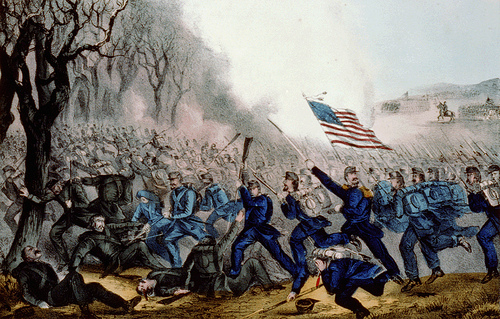
Battle of Mill Springs, Ky., 1862
January 19, 1862– Battle of Mill Springs, Pulaski County (Civil War)
January 20, 1968 – Battle of Khe Sanh began (Vietnam War)
January, 1847 – Maj. John P. Gaines and Capt. Cassius M. Clay, with 30 Kentucky cavalry, along with 50 Arkansas cavalry, are surrounded at Encarnacion by an overwhelming force of Mexican cavalry, and compelled to surrender, taken to the city of Mexico, and imprisoned (Mexican-American War)
January 21, 1839 – The “Louisville Legion,” of dragoons, artillery, infantry and riflemen, authorized as part of the Kentucky Militia.
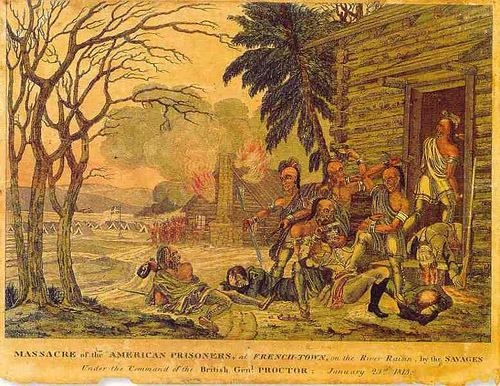
Massacre at the River Raisin, Mich., 1813
January 22-23, 1813 – Battle of the River Raisin, disastrous defeat and massacre of Kentucky troops. “Remember the Raisin” would become the battle cry of Kentucky troops during the remainder of the war in the northwest (War of 1812)
January 22, 1944 – Allies land at Anzio, Italy (World War II)
January 23, 1937 – Sgt. Thomas J. “Tommy” Brown of Madisonville, drowned while on state active duty in response to the flood of 1937. He was assigned to Headquarters Company, 3rd Battalion, 149th Infantry from Madisonville. He is the only known Kentucky National Guardsman who perished on duty during the great flood of 1937. According to newspaper accounts, Brown and 2ndLt. James L. Moore, Pvt. C. W. Anthony and a civilian, Emmett Ashby, were in a boat that lost its stern from vibrations from an outboard motor and quickly sank by the stern throwing all four into the nine-foot deep water. The other three were able to swim to shallow waters but did suffer from exposure and shock. Brown was last seen clinging to the boat bow debris before he sank from sight. The Guardsmen were on a survey mission to assess conditions in Ashbyburg and Jewel City area and Ashby was catching a ride to Ashbyburg in hopes of getting another ride closer to his home. Brown was a butcher in civilian life and was married and had one child. Brown’s battalion commander, Oren Coin, wrote a letter to a legislative committee on the widow’s behalf in December of 1937 seeking some sort of relief for his family. Sgt. Brown’s death most likely was the beginning of the push for the state’s death gratuity for Kentucky National Guardsmen who die on State Active Duty missions.
January 24, 1955 – Col. Philip P. Ardery, senior commander of the Kentucky Air National Guard since its founding, was promoted to the rank of Brig. Gen., the first Kentucky Air Guard member to wear the star of a general officer.
January 25, 1944 – Gustavus Herbert May is appointed Adjutant General of Kentucky by Gov. Simeon Willis.
January 25, 1951 – Operation Thunderbolt began (Korean War)
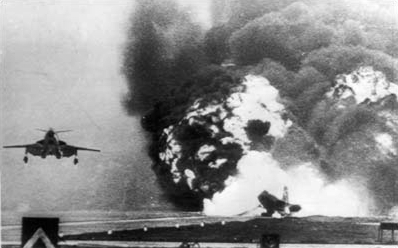
A Kentucky Air National Guard RF-101 Voodoo explodes shortly after take off at Itazuke Air Base, Japan.
January 26, 1968 – All units of the Kentucky Air National Guard except state Headquarters were called to federal service. Kentucky is only one of two states to have both Air and Army Guard units called up in 1968 (the other being Kansas). Kentucky was the only state to have both Air and Army mobilized units deploy overseas. The 165th Tactical Reconnaissance Squadron was assigned, along with two other Air National Guard recon squadrons to a rotation scheme which had each squadron assigned for 60-90 days to the Panama Canal, Alaska and Itazuke Air Base in Japan. During these missions their RF-101 Voodoo jets would photograph areas of interest looking for Soviet, or in the case of Japan, North Korean, naval activity. While the 165th was stationed in Japan in the spring of 1969 one of its pilots, Captain William Seiber, was almost killed when his plane exploded upon take off. The unit returned home and was released from active duty on June 9, 1969. (Pueblo Call-up/Vietnam War)
January 27, 1943 – Sgt. Elzie E. Anness, Headquarters Company, 192nd Light Tank Battalion (Harrodsburg Tankers) died at Camp Tanagawa, Osaka, Japan of dysentery (World War II)
January 28, 1957 – 1st Lt. Owen W. Turner, of Pleasure Ridge (Jefferson County) died when his burning plane crashed near Piedmont, Alabama, some sixty miles west of Atlanta. Turner was flying a T-28 from the Naval Air Station at Atlanta for a navigational proficiency flight to Standiford Field. Turner decided to return to Atlanta because of worsening weather conditions in his flight path. Turner joined the Kentucky Air National Guard in 1948 and was a member of the 165th Fighter Interceptor Squadron.
January 27, 1973 – Signing of Vietnam Peace Accord (Vietnam War)
January 29, 1828 – Preston S. Loughborough is appointed Adjutant General of Kentucky by Gov. Joseph Desha.
January 30, 1968 – Tet Offensive began (Vietnam War)
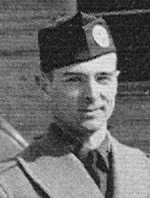
2nd Lt. Archibald Rue
January 31, 1945 – 2nd Lt. Archibald B. “Arch” Rue, Company D, 192nd Light Tank Battalion (Harrodsburg Tankers) died at Camp Fukupka #3 Yawata, Kyushu, Japan of acute colitis (World War II)
January 31, 1956 – Col. Lee J. Merkel, veteran commander of the Kentucky Air National Guard’s base and vice commander of the 123rd Fighter-Interceptor Wing, was killed in an air crash of an F-51 Mustang 10 miles north of Bedford, In.
January 31, 1968 – Battle of Hue began (Vietnam War)