Pages
Stay In Touch
More
© 2013 KentuckyGuard
Story by Staff Sgt. Vicky Spesard, 123rd Airlift Wing Public Affairs
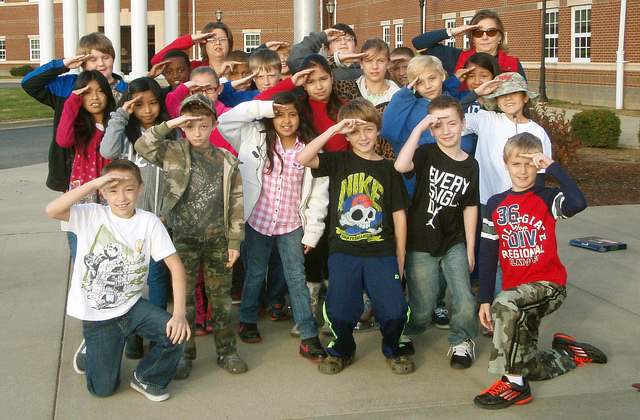
Fourth-grade students from Clear Creek Elementary School in Shelbyville, Ky., sent this photo of themselves in front of their school flag pole to Staff Sgt. Krome Raymond, a Kentucky Air National Guardsman from the Louisville-based 123rd Airlift Wing who is currently deployed to Afghanistan. The children and their teacher, Stephanie Herndon (back row, left), “adopted” Raymond, who sent them an American flag that they hoisted above the building. A traditional Air Guard member, Raymond is a full-time employee of the Shelby County School District, along with his wife, Dawn (back row, right). (Courtesy Photo)
SHELBYVILLE, Ky. — Smiles, laughter and excitement filled Stephanie Herndon’s fourth-grade classroom as her students took out pencils to write another batch of letters to their “adopted” Airman, Staff Sgt. Krome Raymond, a Kentucky Air National Guardsman who is deployed to Afghanistan.
Raymond holds a special place with the students from Clear Creek Elementary School. When he’s not deployed or serving as a traditional “part-time” Air Guardsman at the Louisville-based 123rd Airlift Wing, Raymond works full-time in the Shelby County school district’s maintenance division, and his wife, Dawn, is the school’s secretary.
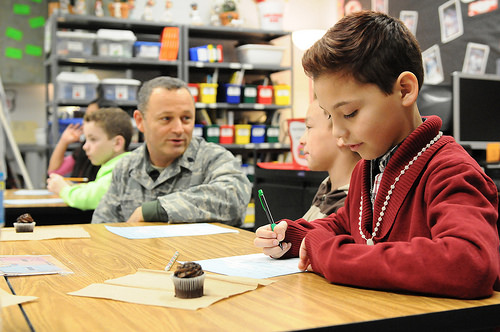
Austin Gozalez, a fourth-grade student at Clear Creek Elementary School in Shelbyville, Ky., writes a letter to Staff Sgt. Krome Raymond, a Kentucky Air National Guardsman who is deployed to Afghanistan, as Raymond’s supervisor, Lt. Col. Armand Bolotte, looks on during a classroom visit Jan. 9, 2014. Gonzalez and his classmates have “adopted” members of the Louisville-based 123rd Airlift Wing for the duration of their deployments, sending them letters and snacks. (U.S. Air National Guard photo by Staff Sgt. Vicky Spesard)
“Our students know him and his wife very well,” Herndon said. “For us to adopt and support him was just an extension of the family that we have here already. It is also a great way for our students to see that the world is larger than their own community. It gives them the chance to broaden their scope of knowledge.”
In addition to the letters, the students have sent care packages of cookies and special treats. The cards and pictures they included line the walls in Raymond’s living quarters. The fourth-graders also sent him a classroom t-shirt bearing the school logo.
“It was awesome to see him wearing our shirt and showing us around his room in Afghanistan with all of our stuff on the walls,” said Joshua Sponel, 9, recalling one of the two times Raymond was able to Skype with the class. “He got all teary and started to cry when he saw us, but it was still really cool!”
In exchange, Raymond has sent the students many letters, pictures and an American flag.
“We flew his flag over our school during our Veteran’s Day show,” said Madalyn Kampschafer, 10. “It was really great to pull it up the flag pole for everyone to see when they came in the building.”
Currently, the flag is making its way through the district to each school building, where it will fly in honor of Raymond and the 12 other deployed members of his unit, the 123rd Logistics Readiness Squadron, where Raymond serves as an assistant ramp services supervisor.
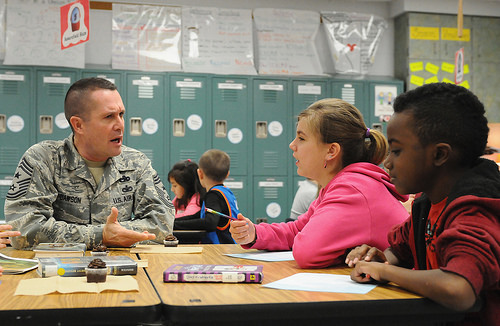
Chief Master Sgt. Ray Dawson, command chief of the Kentucky Air National Guard’s 123rd Airlift Wing in Louisville, Ky., talks with fourth-grade students at Clear Creek Elementary School in Shelbyville, Ky., Jan. 9, 2014, during a visit to thank them for their support of the wing’s deployed Airmen. The students “adopted” unit members who are currently serving in Afghanistan, sending them letters and snacks. (U.S. Air National Guard photo by Staff Sgt. Vicky Spesard)
“Everyone in the school district has been amazing and very supportive,” said Dawn Raymond, wiping tears from her eyes. “It is very difficult to be away from someone you love. Having this kind of support every day makes the time spent apart much easier. All of the staff members here and all of the students have reached out to us in so many ways; it’s just truly wonderful.”
The importance of community and family support is a sentiment shared by Lt. Col. Jeffrey Wilkinson, 123rd Airlift Wing vice commander, who visited Raymond’s adopted classroom along with other members of the wing to offer his appreciation.
“I want to thank all of you for your special letters, cards and packages sent to our Airmen, and especially to Staff Sgt. Raymond,” Wilkinson said to the students. “It is so important for our Airmen to be able to connect to a little piece of home and know the job they are performing is appreciated by many who care for them.”
Sponel summed up his support by explaining that he’s writing to the Airman “because he’s in the military fighting for our freedom and he needs our help.”
Story by Staff Sgt. Scott Raymond, Kentucky National Guard Public Affairs
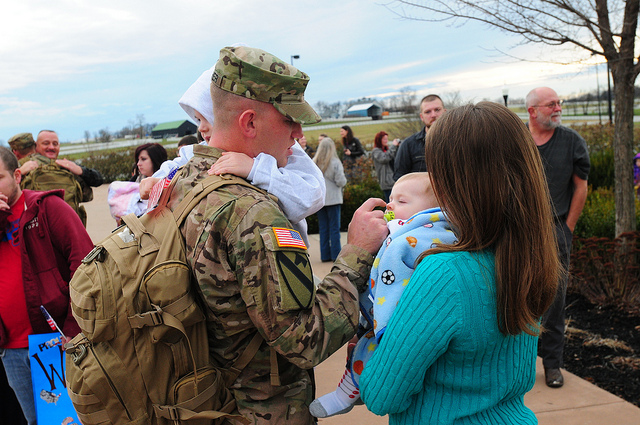
Sgt. Rugger Tincher of the 149th Vertical Construction Company greets his family during a welcome home ceremony for the unit in Lexington, Ky., Dec. 22, 2013. Tincher’s youngest son, Ryan, was born during the unit’s deployment to Afghanistan. (U.S. Army National Guard photo by Staff Sgt. Scott Raymond)
LEXINGTON, Ky. — “This is probably the best gift we could ask for at Christmas,” said Sarah Tincher, wife of Sgt. Rugger Tincher, as she waited patiently outside Alltech Arena in Lexington, Ky. for her husband and father of two.
Just in time for the holidays, the Kentucky National Guard held a welcome home ceremony for the Soldiers of the 149th Vertical Construction Company at the Kentucky Horse Park in Lexington, Ky., Dec. 22, 2013. The Soldiers are home from deployment after spending nearly a year in Afghanistan.
“We are all so excited to have daddy back home, especially for the holidays,” Sarah said with 3-year-old son Colton by her side and 6-month-old Ryan in her arms. The Tinchers said they are happy to begin getting used to their family of four during the holiday season.
To see more photos of the welcome home, click here.
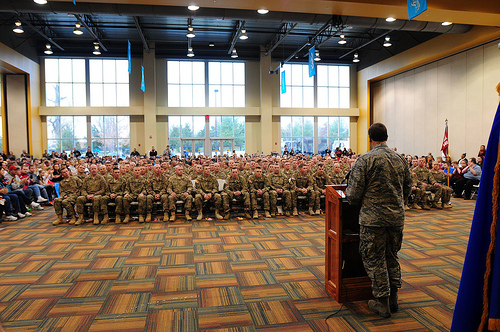
Maj. Gen. Edward W. Tonini, adjutant general for Kentucky speaks during a welcome home ceremony for the Soldiers of the 149th Vertical Construction Company at Alltech Arena in Lexington, Ky., Dec. 22, 2013. Tonini complimented the unit on a successful mission, calling combat engineers a “rare breed” of Soldier, but a group all of Kentucky is proud of. (U.S. Army National Guard photo by Staff Sgt. Scott Raymond)
The combat engineers of the 149th from Cynthiana and Olive Hill, Ky., spent their time in Afghanistan doing what they do best, construction. But the unit was called upon for a variety of assignments to assist Active Duty units in theater.
“I couldn’t put into words our experiences in Afghanistan over the last 10 months,” commented Capt. Adam Evans, commander of the 149th VCC. “I can tell you though that there’s not enough time in the day to list all of our accomplishments. The only way to communicate what we acheived is to say that, I have absolutely commanded the finest Soldiers in the U.S. Military who stood up to every challenge we received.”
The Soldiers built tactical operation centers, medical facilities, dining facilities and living quarters for NATO troops. They performed more than 200 work orders for various forward operating bases throughout the country. The 149th was also asked to assist in the training of Afghan construction workers and conducted several convoy security missions.
Said Evans of the deployment, “One day we’ll all look back and marvel at the impact we had at helping to reshape a country such as Afghanistan.”
Since 9/11, nearly 16,000 Kentucky National Guard Soldiers and Airmen have mobilized in support of the Global War on Terror.
Story by Capt. Gus LaFontaine, 133rd Mobile Public Affairs Detachment
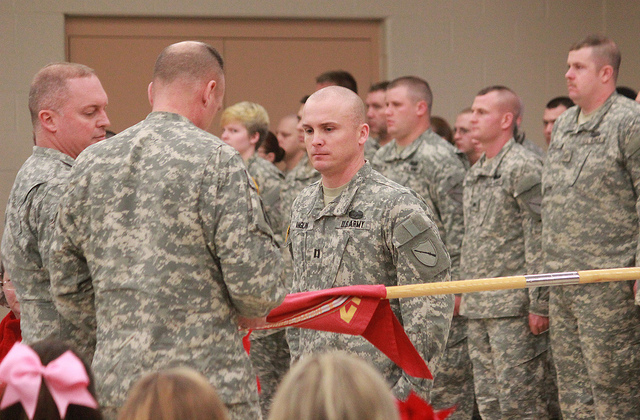
Capt. Nelson Anglin watches as Brig. Gen. Stephen Hogan and Lt. Col. William Ewing attach the Meritorious Unit Commendation streamer to the guidon of the 2123rd Transportation Company in Richmond, Ky., Dec. 15, 2013. The unit was awarded for its work in Afghanistan in 2010. (U.S. Army National Guard photo by Sgt. Shanna Chouinard)
RICHMOND, Ky. — The 2123rd Transportation Company of Richmond, Ky. was awarded the Meritorious Unit Commendation at their home station Dec. 15, 2013. The commendation was awarded to the unit for valorous actions during their deployment to Afghanistan in 2010.
Brigadier General Stephen Hogan was on hand to present the award to the unit during their annual Christmas dinner.
“This is an incredible honor,” said Hogan. “The citation that was read really speaks to itself in terms of what you did over there in the field.”
To see more photos from this story, click here.
Following Hogan’s references to the citation that accompanied the Meritorious Unit Commendation, he spoke to the unit about some points that were not captured in the citation.
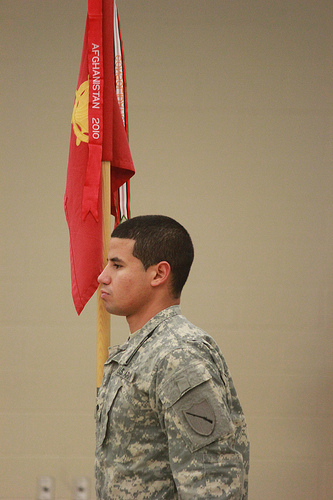
Sgt. Christopher DeLeon bears the guidon during the 2123rd Meritorious Unit Commendation ceremony at Richmond, Ky., Dec. 15, 2013. DeLeon was also recently named the Kentucky Guard’s Soldier of the Year for 2014. (U.S. Army National Guard photo by Capt. Gus LaFontaine)
Hogan spoke of the difficult conditions faced by a transportation company in Afghanistan, the proud history of the 2123rd, and the sacrifice involved in deploying in service of the Kentucky Army National Guard.
In reference to the history of the 2123rd Hogan said, “Going back to 1922, [the 2123rd was] available for every domestic episode, ice storm, and flood. Regardless, the 2123rd has been there.”
He also noted the unit’s deployment to Iraq in 2004.
“The result of your actions over there gave us equal footing and equal credibility with the active component who said that they would never second guess the National Guard again. In this you have shown them how Kentucky Soldiers can fight.“
Capt. Nelson Anglin, commander of the 2123rd, sought to incorporate some of the same history into Sunday’s ceremony by inviting former members of the 2123rd to the award presentation. Anglin is charged with transitioning the unit from their past successes in Afghanistan to training the unit for another deployment in support of Operation Enduring Freedom. He recognized the value of teaching the unit’s new Soldiers about the history of the 2123rd.
“A lot of these new Soldiers probably didn’t understand what some of these veterans experienced out there on the road in a combat environment. For them to be able to see some of the accolades that our unit received while we were deployed will help move our unit forward and help them understand what the training environment is going to be like over the next year. “
Anglin, who was a platoon leader with the 2123rd during their previous deployment to Afghanistan spoke about the challenges and sacrifices the transportation company faced during their deployment.
“We experienced a lot of convoys and a lot of time on the road. We had around 27 Purple Hearts and some combat valor awards with Soldiers doing great things out on the road. “
In his final remarks, Hogan referenced challenge and sacrifice.
“This citation does not speak to the service and the sacrifice that Guardsmen and Citizen Soldiers live every day. You had to leave a job that was likely a great deal more comfortable, satisfying, and suffice to say normally nobody shoots at you when you do your civilian job. But more notably, you had to leave the comfort of your fireplace, your favorite chair and the love and affection of your families in the interest of your nation’s call.”
The general’s remarks sunk in with Anglin.
“To hear from a general and to see the award presented gives everyone an eye opening experience to what we did in theater.”
Story by Staff Sgt. Andrew Short, 1103rd Military Police Detachment Unit Public Affairs Historian Representative
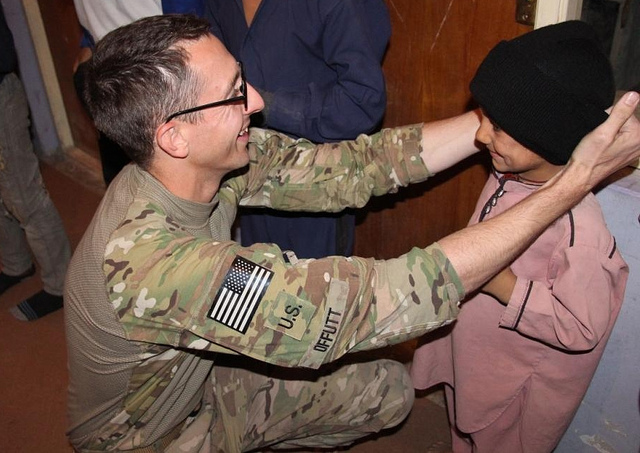
Sgt. Tyler Offutt with the 1103rd Military Police Detachment places a knit cap on an Afghan child at an orphanage in the Balkh Province, Afghanistan, Oct. 22, 2013. Soldiers of the unit delivered coats, gloves, hats, toys and candy to the orphanage to provide the children with warm clothing for the winter. (U.S. Army National Guard photo by Staff Sgt. Andrew Short)
BALKH PROVINCE, Afghanistan — Soldiers of the 1103rd Military Police Detachment out of Brandenburg, Ky., paid a visit to a local orphanage in northern Afghanistan with some much needed items of comfort, Oct. 22, 2013. The unit, led by Sgt. 1st Class Brian Gillock, assisted in a humanitarian mission in preparing children for the harsh winter looming in the near future.
The team arrived in a multi-vehicle convoy loaded with an assortment of winter coats, hats, gloves, candy, and stuffed animals all generously donated by the Jacob Sexton Memorial Afghan Children’s Coat Drive. The drive collects coats to send to children in Afghanistan in honor of Indiana Army National Guard Spc. Jacob Sexton, an Iraq and Afghanistan war veteran who died in October, 2009.
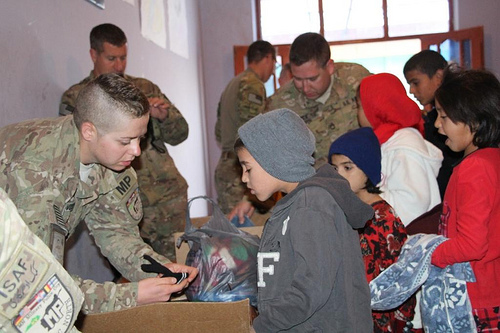
Spc. Jacqueline Voss with the 1103rd Military Police Detachment fits a young Afghan child with new gloves at an orphanage in the Balkh Province, Afghanistan, Oct. 22, 2013. Voss said the experience was one of the best she had experienced while deployed overseas. (U.S. Army National Guard photo by Staff Sgt. Andrew Short)
child for a new pair of winter gloves
“There are few more worthy investments than those we make towards children,” said Staff Sgt. Bradford Stone, a member of the 1103rd security team. “This was one of the most rewarding missions I’ve had the privilege to experience.”
The team was greeted by Rohahza Akbary, principle of the Balkh Orphanage, who welcomed them inside for warm cups of chai. Akbary led the team in to a large corridor filled with a variety of smiling children from all ages. The children grew quiet and curious as box after box was brought into the room. As the boxes were opened, their cautious curiosity was quickly replaced with joy and laughter as the gifts were revealed.
“I have to echo what other Soldiers have said, this is truly one of the most rewarding experiences since arriving here in Afghanistan,” said Maj. Gregory Jefferson. “The children were very happy to receive new clothing and you could see the appreciation in their faces. It was great.”
As the children settled into their new winter gear, their curiosity grew stronger. The children began to mingle with the Soldiers, pointing up at their uniforms and giving them their best “thumbs up with a smile.” One little girl managed to utter the words “thank you” in her best broken English. Akbary informed the troops that dinner time was approaching and that she must prepare the children to eat.
“It was a most fulfilling experience, getting an opportunity to play with the kids and all. I wish we could do this more often,” said Spc. Jacqueline Voss.
The children waved their goodbyes, some with bright smiles and others with a mouth full of candy. The Soldiers of the 1103rd loaded up their trucks and left the orphanage with peace of mind, knowing that for at least one more winter, the children would have something to keep them warm.
“It was an honor to take the lead for such a noble cause,” said Gillock. “Often the people of Afghanistan don’t interact with the U.S., especially in the north. If
this is their sole interaction with us and it’s this positive, while they receive needed coats and articles for warmth, then we are all truly winners in this conflict.”
Story by Spc. John Rader, 149th VCC Unit Public Affairs Historian Representative
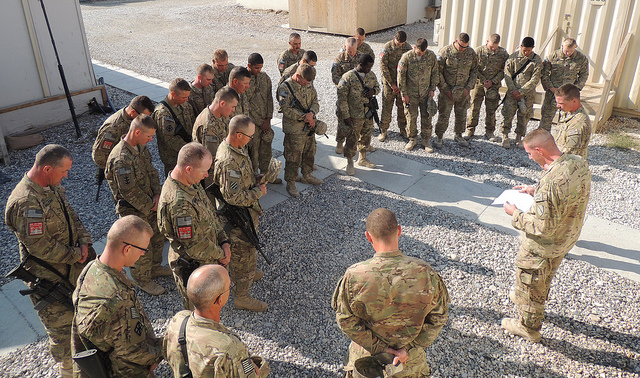
Staff Sgt. Matthew May of the Kentucky National Guard’s 149th Vertical Construction Compnay reads a speech prepared in honor of Sgt. Daniel Wallace to a group of troops, including Army Reserve Soldiers and Guargdsmen from Kentucky, Minnesota and South Carolina at Camp Spann in Northern Afghanistan. The 149th coordinated a memorial ceremony at each of location, Kentucky Soldiers were stationed to honor Wallace on the anniversary of his death in 2008.(Photo courtesy of Sgt. Michael Castorenoa)
BAGRAM, Afghanistan — Members of the 149th Vertical Construction Company honored the memory of one of their own during a remembrance ceremony held at Bagram Airfield, Afghanistan. The Soldiers paid tribute to Sgt. Daniel Wallace on the anniversary of his death in 2008.
During the 2008 deployment, the unit was part of the 201st Engineer Battalion. Charlie Company and Bravo Company of the 201st Engineers make up the now 149th VCC. They were serving as combat engineers tasked with the mission of identifying and defusing improvised explosive devices or IED’s on the roadways in Afghanistan. On Friday, Oct. 31, 2008 during a routine route clearance mission in West Paktika Province, the Guardsmen were halted for a vehicle issue and the unit convoy came under small arms fire by enemy forces. Wallace was mortally wounded during the attack.
Five years after that fateful day, the Kentucky Guardsmen find themselves back on familiar soil in Afghanistan. Although a different mission is on the books for the unit; remembering the patrols of the previous deployment is not difficult as the unit is in the same region of the country and the scenery is still very familiar.
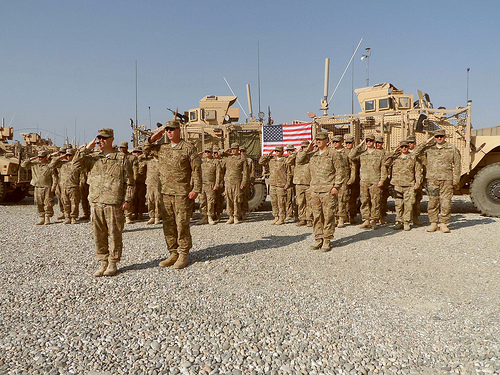
Soldiers of the 149th Vertical Construction Company salute during a memorial ceremony for Sgt. Daniel Wallace in Gamberi, Afghanistan, Oct. 31, 2013. (Photo courtesy of Michael Martin)
“When the 149th is stateside, we hold a service in the Veterans Memorial North Cemetery on Memorial Day for Daniel,” said Capt. Adam Evans, commander of the 149th. “It is a humbling privilege to perform this observance so close to where the event happened on the anniversary. I want Daniel’s family to understand that this ceremony means so much to us. We will honor his sacrifice by remembering his service to our nation. I’ve coordinated with every member of my staff to make this happen at Forward Operating Bases across Afghanistan at the same time so that our moment of silence is companywide.”
Kentucky Guardsmen are stationed all over the Regional Command East and North Territory of Afghanistan so the ceremony called for superb coordination of schedules between all the members the 149th.
Silence fell over the unit as each of the formations were called to attention across Afghanistan promptly at 8:00 am on Thursday Oct. 31, 2013. The American Flag was marched to the mast as Soldiers attached the flag to the halyards and hoisted it in the air. After saluting the colors as the flag was raised, a speech was given in honor of the fallen Soldier, including one of Wallace’s favorite Bible quotes taken from Psalms 9. Also included were personal memories of Wallace and the stories of why the unit stands today. At the same time as the ceremonies, an American flag was flown over the Regional Command East Territory of Afghanistan in an apache helicopter that is out on mission. The flown flag will later be presented to the Wallace family when the unit returns to Kentucky, along with a certificate that reads in a script “flown in the face of the enemy on October 31st 2013”.
“This is the most honorable way we have to remember Sergeant Wallace and his family from where we are,” said Sgt. 1st Class William True. “The Wallace family is still very involved with the unit. They always attend our Christmas dinners and other ceremonies that we hold.”
“It’s a pleasure to see them often and so involved with us. The Soldiers that remember Sergeant Wallace still tell stories of him and they are always smiling and in good spirit when doing so. Daniel had a way to make you laugh that was very unique to his personality. I find myself thinking of him often,” True added.
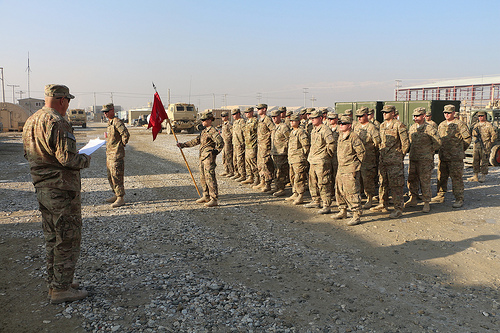
Sgt. 1st Class William True stands in front of the group of the 149th Vertical Construction Co. in Bagram Air Field as he recites Sgt. Daniel Wallace’s favorite bible scripture Psalms 91 just prior to a moment of silence, Oct. 31, 2013. (U.S. Army National Guard photo by Spc. John Rader)
The unit also flew the Kentucky State Flag in place of the South Carolina State Flag of the 122nd Engineer Battalion outside of their tactical operation center for the entire day of Oct. 31 to remember Daniel.
The 149th had the full support of the battalion they fall under during the day of observance. 1st Lt. David Lewis, 122nd Battalion Chaplin was on hand to pay respects and offer his services. Several members of the 333rd Horizontal Engineer Company, from the Army Reserve in Pennsylvania are present at the ceremony held by the main body of the unit at Bagram Airfield. Other members stationed at satellite locations also drew in a larger crowd than just the 149th Soldiers.
“I met Wallace years ago when I was going through Advanced Individual Training for Combat Engineers in Fort Leonard Wood, Missouri,” said 1st Lt. Charles Langston Jr., 122nd Engineer Battalion, South Carolina National Guard. “I recall how Wallace completed that training with honors and graduated at the top of our class. He was already a great Soldier and was in line to be a great leader.”
The simultaneous ceremonies included troops from the 859th Vertical Construction Company, Mississippi National Guard, 850th Horizontal Engineer Company, Minnesota National Guard, 333rd Horizontal Engineer Company, and the 122nd Engineer Battalion.
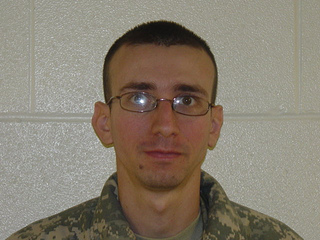
Sgt. Daniel Wallace
“As the leadership and the command of this company changes; I want all the Soldiers of the 149th to remember Sergeant Wallace and ensure his memory lives on by carrying the torch forward,” said Evans. “As we welcome our predecessors into this company, It’s vital that we continue to remind them of the sacrifices this unit has made in the pursuit of freedom. We will never leave a fallen comrade and we will never forget Daniel Wallace.”
Story by Spc. John Rader, 149th VCC Unit Public Affairs Historian Representative
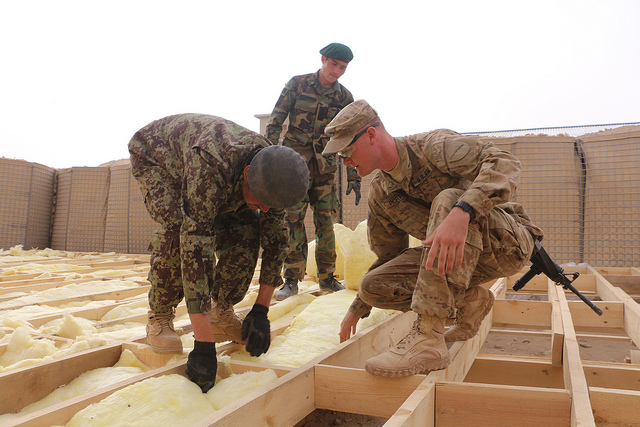
Spc. Clyde Porter of the 149th Vertical Construction Company assists a member of the Afghan National Army install fiber glass insulation in a construction project at Forward Operating Base Lightning, Afghanistan. Porter also assessed the installation by other members of the ANA as part of the unit’s training program with the ANA. (U.S. Army National Guard photo by Spc. John Rader)
BAGRAM, Afghanistan – When the deployment for the Kentucky Guard’s 149th Vertical Construction Company is over, the unit will leave behind more than just the many structures they have built in Afghanistan. They’re leaving behind the knowledge of their construction expertise with the local Afghanistan National Army (ANA) to help ensure the independence of a nation when the U.S. and Coalition forces scale-back their presence in the country.
“This is a mission of building life long bonds and structures with our ANA allies,” said the commander of the 149th, Capt. Adam Evans.
The training schedules cover all aspects of engineering that is organic to the 149th. This has the Kentucky Guardsmen working very closely with the ANA, teaching them the tools of the trade and will also include some priceless experience learned over the years.
“Vertical construction will be the main emphasis of this training mission but horizontal engineering will be incorporated as well,” said Evans. “Even though we are a vertical construction company, we have taken on horizontal training. This allows us to provide full spectrum construction engineering operations to the ANA. We will teach them everything we know to ensure they will be able to build and maintain structures from the ground up without the support of the U.S. and Coalition engineers.”
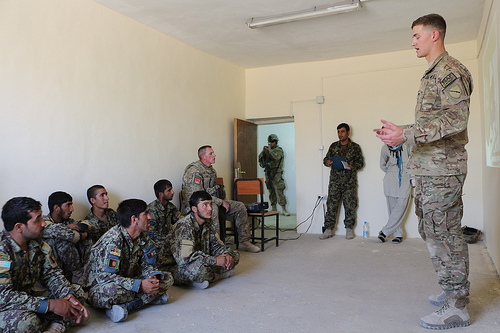
Sgt. Reid Smith of the 149th Vertical Construction Company instructs members of the Afghan National Army on reading blueprints and construction drawings at Forward operating Base Shank, Afghanistan. The class was the first in a lesson plan created by Guardsmen of the 149th specifically for the ANA. (U.S. Army National Guard photo by Spc. John Rader)
The Afghan Army postponed their tactical and combat training a few days out of the week to work with the 149th engineers. The training began with classroom tutorials on basic construction technique and then moved slowly to the hands-on portion of using tools and erecting structures.
The 149th’s 3rd Platoon lead by 1st Lt. Mathew Doyle began spearheading this training in August with Chief Warrant Officer Robert Woita. Situated in the Regional Command East Territory at Forward Operating Base Shank, the two officers began putting together a training curriculum that walks the Afghan Army through a step by step training process in vertical engineering. The training plans that Doyle fostered became a standard that is well accepted among ANA and U.S. Coalition Force leaders. The plan was even adopted as the training model to be passed on to several other ANA brigades throughout Afghanistan. Doyle and 3rd Platoon received great recognition for these contributions to the mission
“I can’t begin to explain how pleased I am with my platoon,” said Doyle. “They have shown time and again that there is no task to big to accomplish. Now that we have the opportunity to expand our experience by teaching our Afghan allies, I’m confident that the men and women of 3rd Platoon will leave this country with a better understanding of the direction Afghanistan is headed. We will teach and be taught and therefore be able to share some amazing experiences when we return back to Kentucky.”
The expertise of 3rd Platoon has been highly praised and acknowledged when it comes to the vertical construction field in Afghanistan. Doyle lead the first big construction project in theater for the company that later became the operations command post for the 149th and the 122nd Engineer Battalion they fall under. They have conducted numerous vertical construction projects since and have earned themselves the opportunity to operate from a satellite location that allows for close proximity with the ANA and the facilities to meet with the Afghan chain of command to accomplish these tasks.
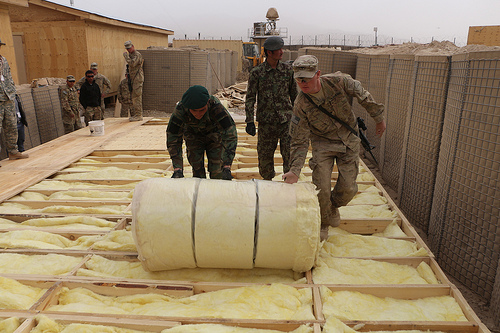
Spc. Clyde Porter with the 149th Vertical Construction Company along with two Afghan National Army Soldiers finish up installing floor insulation at a construction site on Forward Operating Base Lightning, Afghanistan. (U.S. Army National Guard photo by Spc. John Rader)
Additional members of the 149th have been dispatched to other parts of the country to conduct similar training from satellite locations. 1st Lt. Michael Hamblin along with Warrant Officer Jacob Lewis are among a group overseeing the Kentucky Guardsmen in Camp Mike Spann in the Regional Command North Territory. A comparable training curriculum was established by the 149th officers in the Northern Territory because each ANA base employs a different schedule and adjustments must be made as necessary to fit into the program of the Afghan Army.
“Our Soldiers receive a real sense of serving others and giving by passing on their knowledge to the ANA,” said Evans. “At the end of a long work day, ours Guardsmen leave the training site with a great sense of pride and accomplishment. The ANA are really excited and receptive to learning new skills which make it easy to provide training. For our Soldiers, it is a very rewarding experience that they will carry with them long after the deployment is over.”
Many meetings with the Afghan National Army Commanders are held to discuss timelines, checks on learning in the form of quizzes for the ANA engineers, schedules for their troops, and training resources that are available. This is the first challenge for the Guardsmen and it all comes together with the help of local interpreters that bridge the language gap from one nation to another.
“We start by teaching the ANA to request materials for training the way we do. There is some paperwork involved but it only ensures accountability for materials such as lumber for construction or fuel to fill the heavy equipment they will learn to operate,” said Hamblin. “In a part of the world where most things are accomplished with a handshake and a good faith jester, we try to explain the importance of following the proper chain of command when requesting supplies so that when we leave there is an accountable system established. This is the most difficult hurdle thus far.”
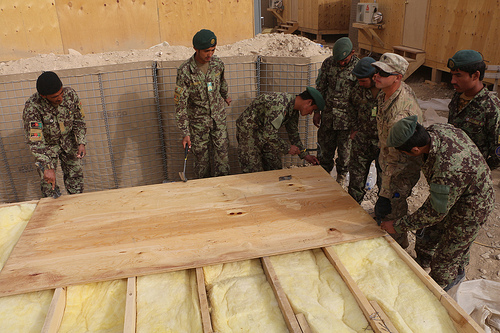
Spc. Chase Hanshaw of the 149th Vertical Construction Company helps guide a group of Afghan National Army Soldiers in laying the first piece of flooring for a “B hut” during a training class at Forward Operating Base Lightning, Afghanistan. (U.S. Army National Guard photo by Spc. John Rader)
Once the training is in full swing, the 149th troops get to work passing along the engineering know how and check the retention of information by administering periodic testing. The vertical engineer team give written exams that have been translated from English to Dari, which is the local dialect in the North. The heavy equipment team grade their students by watching them operate the equipment after giving them a task to perform with the heavy machinery. All is part of a bigger picture to guarantee that the ANA will be ready to continue training and execute their own missions by the time the 149th is ready to redeploy back to Kentucky.
“Were making leaps and bounds with the Afghan Army despite the language barrier we face,” said Lewis. “All seem very eager to learn and show up to class early. It’s a great experience to be given the chance, not only to teach but to get to know them on a much more personal level. Everyday it’s a different experience working with the ANA and it’s also very exciting at the same time.”
In addition to the 149th currently being engaged in two separate Afghan Army training missions, the unit is presently making plans to adopt a few more similar missions in other parts of the Regional Command East Territory. This will put the Kentucky Guardsmen at the top of the list for having the most missions that involve direct contact with the ANA. The company will now shift focus from construction to construction training as the end of another deployment for the 149th is just around the corner.
“Afghanistan is moving forward and with the right tools they will succeed,” said unit 1st Sgt. Grayden Colegrove. “I’m very pleased that we had a chance to be a big part of the training that will later show when Afghanistan is on its own. Our vertical structures may someday be demolished, but the ability to educate and pass on our experience to the people of Afghanistan will last long after our buildings come down. We will return home and back to our civilian jobs knowing we left a legacy here in Afghanistan.”
Story and photos by Spc. John Rader, 149th VCC Unit Public Affairs Historian Representative
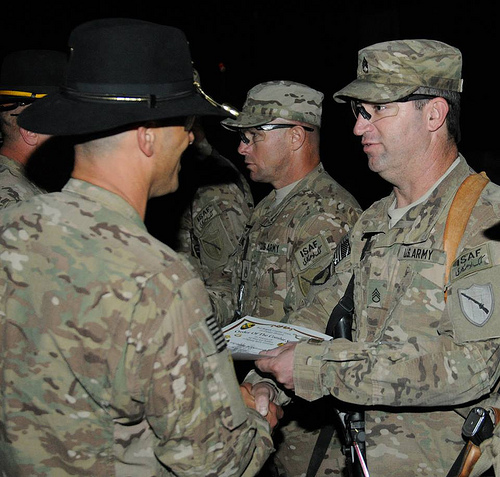
Staff Sgt. Andy Wiglesworth with the 149th Vertical Construction Company is presented the Order of the Combat Spur by Col. Robert Whittle Jr., commander of the 2nd Brigade, 1st Cavalry Division at Bagram Airfield in Afghanistan, Aug. 4, 2013. (Photo courtesy of 2/1 Cavalry)
Bagram Air Field, Afghanistan — In June, the Soldiers of the 149th Vertical Construction Company were tasked with a very high priority construction mission at Bagram Air Field in Afghanistan. The engineers were tasked with constructing a two story tactical operation command center for the 2nd Brigade, 1st Cavalry Division, known as the “Black Jack” Brigade that was due to arrive in Afghanistan during the summer. The Guardsmen were very familiar with the build as it mirrors the office space they constructed for their own operations area that they share with the 122nd Engineer Battalion from the South Carolina National Guard.
The task was assigned to 1st Platoon with Warrant Officer Jacob Lewis at the helm as the officer in charge of construction. The build took two months to complete and houses 45 offices, two large conference rooms, and two large command centers.
Check out all the photos of the ceremony on the “Black Jack” Brigade’s Facebook page, here.
Daily updates to the project were passed up the chain of command so the 149th leadership, the 122nd Engineers, the 555 Engineer Brigade, the 101st Airborne Division, and the International Security Assistance Force Joint Command (IJC) can track the progress of the construction. All eyes in the Regional Command East Territory were on the 149th as each phase of the project came closer to completion.
With the experience of one similar build completed by 3rd Platoon with Warrant Officer Robert Wiota as the officer in charge of construction, the unit already has a notch in their belt for this particular build. Construction began and continued without any glitches or issues arising. Each phase of the project rolled along flawlessly as the 149th ran 24-hour operations made up of 1st, 2nd, and 3rd shifts that maneuvered seven days a week. With the first 30 days complete, the Soldiers were already days ahead of schedule and their progress was noted by everyone in their chain of command.
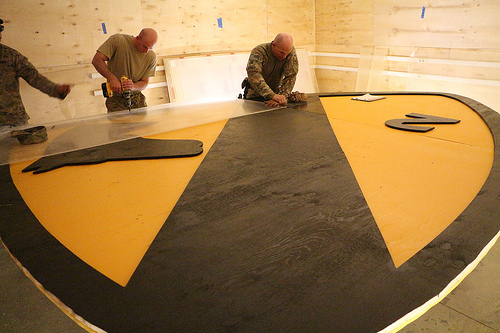
Soldiers of the 149th Vertical Construction Company put the final touches on a table in the shape of the 1st Cavalry Division patch at Bagram Airfield, Afghanistan, July, 2013. 149th Soldiers wanted to add a personal touch to the construction and came up with the idea for the table to honor the cavalry. (U.S. Army National Guard photo by Spc. John Rader)
“I’ve said it once, and I’ll say it again, the 149th VCC is the flagship company of this battalion,” said Lt. Col. Victor Brown, commander of the 122nd. “This company continues to amaze me.”
With more and more of the smaller operating bases in Afghanistan closing or decreasing in size, Bagram is growing as more troops arrive there to begin or continue operations from the still thriving air field. With the 1st Cavalry Division arriving, Bagram is the right choice for such a large outfit that will operate in every Regional Command Territory in theater, making it imperative to have command centers to occupy upon the arrival of their main body.
“The work and sweat that these troops put into this project is noted by not only me, but everyone up the chain,” explained Lewis. “I couldn’t ask for a better group of soldiers. They pay attention to every detail, catch things that I haven’t seen yet, and fix it right away without being told.”
Since the build is designed to not be a permanent fixture, the two story structure is constructed under a large area maintenance shelter and uses only two key elements of the vertical construction trade- carpentry and electrical work.
“I give all the troops in my squad the ability to learn as we go along,” said 149th’s Staff Sgt. Steven Willoughby, 2nd Squad Leader. “We try not to rush things for two reasons. One reason we don’t, is so that the soldiers that are not too familiar with this type of work can get a hands-on approach to learning the skill. The second reason is to ensure quality of the craftsmanship. We want to present an excellent product to the 2/1 Cavalry when they arrive.”
“Our name will be attached to the quality of this structure long after we leave and have done our part,” he said.
On July 22nd 2013, the construction project assigned to the 149th Vertical Construction Company was marked complete, ready to be presented to Col. Robert Whittle Jr. and his staff of the 2/1 Cavalry that will operate out of the structure. Preparing for the walk-through, Lewis instructed 1st Platoon to put the finishing touches on a side project to add a unique and personal touch for both the engineers of the 149th and the Troopers of the 2/1 Cavalry.
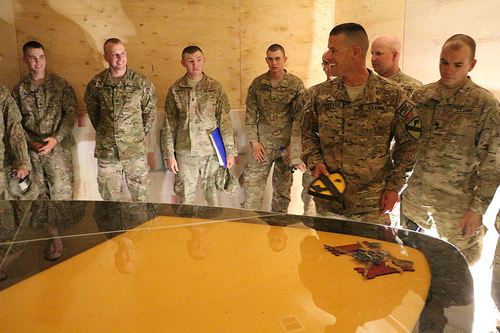
Soldiers of the 149th Vertical Construction Company present a large wooden table in the shape of the 1st Cavalry Division patch to Col. Robert Whittle Jr., commander of the 2nd Brigade, 1st Cavalry Div., at Bagram Airfield, Afghanistan, July 22, 2013. Whittle said the table will go wherever the unit goes, and will return with them to the U.S. at Fort Hood, Texas. (U.S. Army National Guard photo by Spc. John Rader)
“I sent back plans to Kentucky and had them drawn up and send back to me for this surprise side project,” said Lewis. “All the Soldiers involved were on board with this addition to our construction task and pitched in when and where they could. Most of my guys stayed long after their shift had ended to work on this and it really is the icing on the cake.”
As the walk through comes to an end, Chief Lewis directed his leadership to the last conference room in the building that had not been seen yet. The door opens to find all the 149th, 1st Platoon engineers standing behind a conference table that was built with that personal touch. The table is in the shape of the calvary patch and adorns all the likeness of the very recognizable yellow shield that is established as the symbol of the United States Calvary.
“I don’t know what to say here… what you all did here is amazing. I’m literally at a loss for words,” said Whittle. “I will make sure we take this table wherever we go, and when we get back home, I will make sure we hang this up at our headquarters in Fort Hood.”
To show the gratitude of the “Black Jack” Brigade to the 149th Soldiers that worked day in and day out on the construction, a surprise ceremony was held to induct those Soldiers into the “Order of the Combat Spurs.” From that day forth, the 2/1 Calvary Division recognizes the Soldiers of the 149th by issuing this award that authorizes the troops that are given the prestigious honor to wear the Calvary Stetson and Combat Spurs in noted situations as honorary members of the Calvary.
The tradition of the Order dates back to medieval times and roots itself in knighthood, where the awarding of spurs symbolized entry and ranks into the fraternity of mounted warriors. Usually the squire aspiring to knighthood would complete some tasks or deeds to prove his worth on the battlefield. Under these criteria, the 149th Soldiers performed such tasks and were awarded the esteemed honor.
“This is really an amazing award to take home,” said Sgt. Gary Forsyth, of the 149th. “It’s an award that not every Soldier has the opportunity to obtain, especially since we’re engineers, and now, an honorary part of the Calvary community.”
“Everyone worked really hard on this project and we have been awarded to a great extent for our hard work,” continued Forsyth. “I couldn’t be happier with the construction process and how the build turned out.”
The Kentucky Guardsmen added this to their long list of accomplishments while in theater. With just a few more months left in Afghanistan; the engineering projects in Bagram and all across Regional Command East and North Territories will continue.
“We have some great projects in front of us in the coming months and I couldn’t be more proud of these Soldiers,” said 149th Commander, Capt. Adam Evans. “They have worked on so many projects, completed some very difficult task, and always seem to rise to the occasion to get the job done with a touch of excellence.”
“It’s the little recognitions like this that keeps these troops going day in and day out. We will be back in Kentucky in just a few short months and we will have plenty of stories for our families.”
Story by Staff Sgt. Sidney Hoffmann, ADT 5 Unit Public Affairs Historian Representative
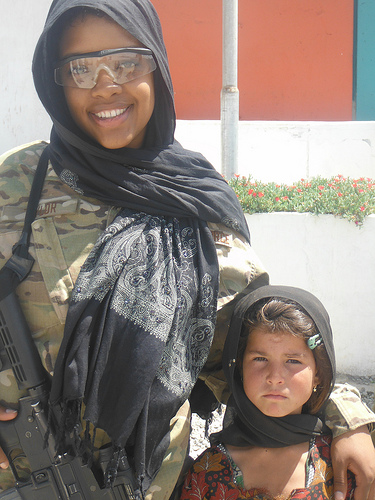
Master Sgt. Zakiya Taylor with Kentucky’s Agribusiness Development Team 5 stands with the daughter of a woman attending a canning class in Zaharay District, Afghanistan. The class, facilitated by U.S. Service members was a refresher course for local women to preserve foods for their families. (U.S. Army National Guard photo by Staff Sgt. Sidney Hoffmann)
ZAHARAY DISTRICT, Afghanistan — Kentucky Agribusiness Development Team 5 has completed many projects with this humanitarian mission here in Regional Command South, Afghanistan. One project they became a part of was a canning class facilitated by a U.S. Army Female Engagement Team from Fort Bliss, Texas.
The FET coordinated the location and ensured the information got out to the local women about the class. Master Sgt. Zakiya Taylor of ADT 5 provided the instructor from Kandahar City and distributed the supplies, which included the steam pot, funnels, ladles, jars, jar lifters, and sealers.
“With the supplies, we were able to provide approximately 40 local Afghan women with the tools and knowledge necessary to begin canning fruits and vegetables in their own homes,” said Taylor, ADT 5’s food preservation specialist.
Reinforcing the idea of Afghans teaching Afghans, the team contracted with a young Afghan woman, Laila Afag, from Kandahar City to teach the classes. A successful business woman in her own right, Afag co-owns three canning factories in the city and is an expert in teaching canning techniques for fruits and vegetables. Additionally, six of the women were teachers in the local area and would be able to pass along what they had learned in the class to others. Interestingly, one of the local teachers is a fifteen year old girl from Zharay, she was one of the few that could read, write and understand the material. The teachers were excited to display their educational skills and Afag allowed the teachers to assist her in presenting to the class.
“The canning supplies we were able to provide will be for home use and the demonstration classes given by Laila Afag will help the women preserve their produce,” said Taylor. “This makes them not only marketable in the future, but a sustainable tool to pass down to future generations.”
Since refrigeration and cold storage is not readily available in many of the local homes here, being able to store foods for longer periods of time is essential for the survival of the people.
Afag was highly motivated and proud she could extend her knowledge and services to this project.
“It is an easy craft; one they can pass down from one generation to the next,” she said. “They will be able to can and preserve a large variety of food if done correctly. The knowledge is there, because it is popular in this area.”
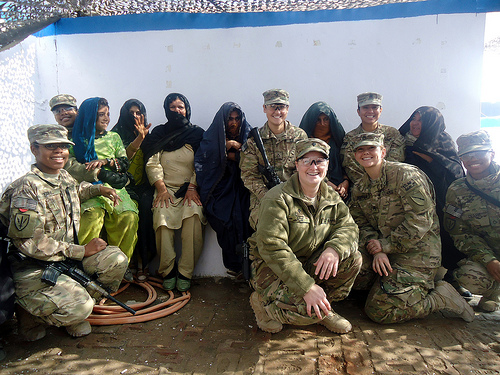
Female Soldiers with Kentucky’s Agribusiness Development Team 5 gather for a group photo with women and children in the Zaharay District, Afghanistan. The Afghan women attended a canning class while some Soldiers helped with a children’s class. (Courtesy photo)
It is important to note these women are familiar with the process; however, the value-added is having the proper tools and focusing on sanitary techniques.
The class included the process of paste canning, pickling and fruits preserving. Each woman was provided a handout to follow along with during the presentation. The material was presented at a very basic level, which provided beginners a jumpstart on making quality preserves without studying the science of preserving. The women were very interested in participating and learning about the canning process. Afterward, many women stated they felt confident and certain they could effectively implement these techniques at home.
A high note of the event was when the Zharay District Governor, Sayeed Ashina Agha, and Director Bismullah Khan, District Education Representative, came on the last day of training to recognize the women and give them encouragement and support for their participation. Even though the Taliban threats occur and transportation is not always an option to get to Forward Operating Base Pasab, these women truly risk their lives to take advantage of the programs provided for them.
“There is nothing like seeing their smiling faces and knowing the team has done something these women will take with them for the rest of their lives,” said Taylor.
Story by 1st Lt. Dwight Bushong and Sgt. Jamie Pungirum, ADT 5
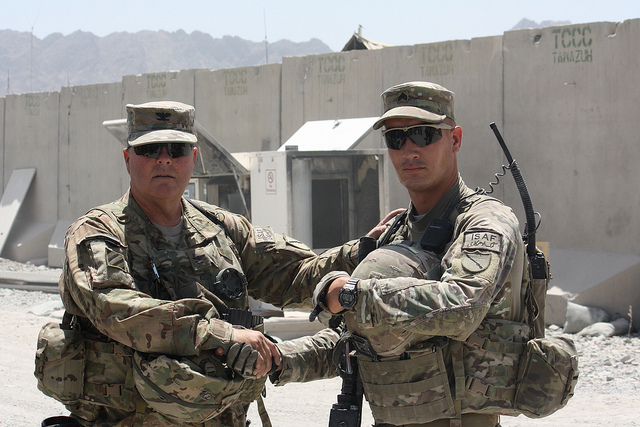
Col. Bob Hayter, left, commander of Kentucky’s Agribusiness Development Team 5 congratulates Sgt. Zachary Leidecker at Forward Operating Base Pasab, Afghanistan, following the completion of Leidecker’s 100th combat mission in country, July, 2013. (U.S. Army National Guard photo by Sgt. Jamie Pungirum)
FORWARD OPERATING BASE PASAB, Afghanistan — It was a day like every other, with the blazing sun searing down on the arid earth below causing temperatures to soar to one hundred and eight degrees. For Sgt. Zackery Leidecker of Kentucky’s Agribusiness Development Team 5, the day marked a great accomplishment and success for not only him, but for the entire team.
On this day, Leidecker was the first member of the ADT 5 to complete his 100th combat patrol in Kandahar Province of Southern Afghanistan. The unit as a whole conducted more than 190 missions while in the country.
Leidecker served in multiple positions during his tour of duty that included truck commander, gunner, dismount security, and personal security detachments.
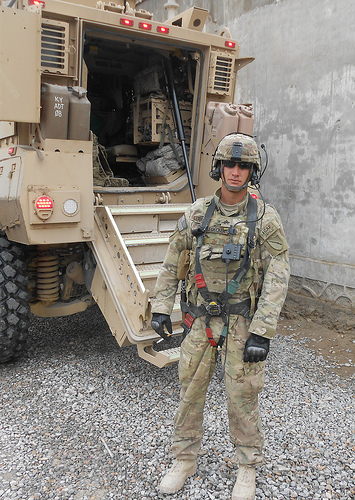
Sgt. Zachary Leidecker with Agribusiness Development Team 5 pauses behind his vehicle prior to a mission in the Kandahar Province, Afghanistan, July, 2013. Leidecker participated in more than half the unit’s combat mission while deployed, serving as driver, gunner and security. (U.S. Army National Guard photo by Sgt. Jamie Pungirum)
“As the platoon leader, I cannot be more proud of his accomplishments while on the team,” said 1st Lt. Dwight Bushong. “He is a Soldier that is always taking the first step forward to get the mission accomplished, no matter the task.”
To see more photos from this story, click here.
“In my eyes as an Army officer and a leader of Soldiers, I see a bright future for this young non-commissioned officer,” said Bushong. “I look forward to seeing his continued success in the Kentucky Army National Guard. I would gladly have him as part of my combat team any day.”
When asked about how he feels about this day, Leidecker replied humbly, “I feel very accomplished, but there is no way I could have done this alone.”
This is not Leidecker’s first combat tour on foreign lands where he was part of great things. According to him, on his last deployment to Iraq with the 2113th Transportation Company, his truck crew completed the most missions in the unit. When inquired as to what his favorite position to work in was, he stated simply, “I have no preference on what I do on mission, as long as I can be a part of the mission, I’m happy.”
“He has played a vital role as a gunner. Ninety percent of the time he was the gunner of the lead truck, always ready and on his toes for whatever may come,” said Sgt. 1st Class Richard Harris, Leidecker’s platoon sergeant.
As the lead truck gunner, it is Leidecker’s eyes that were the first to spot anything the convoy may have came across. He was constantly on the lookout for potential threats including improvised explosive devices, complex ambushes, or just the ever constant jumble of traffic in downtown Kandahar City.
However, Leidecker’s real potential seems to become more obvious after speaking with Pvt. John Amis. The young Soldier is first to acknowledge Leidecker’s willingness to step up as a mentor and teacher.
“He is a great example for us lower enlisted,” said Amis. “He shows if you put the time and effort in something you will be rewarded. More importantly for most of us, he has taught us our job from the ground up.”
“When I came to the team, I really didn’t know what it was going to be like being a gunner on combat patrols. With his guidance and leadership, it has made me a better gunner and a better Soldier.”
Story and photos by Staff Sgt. Sidney Hoffmann, ADT 5 Unit Public Affairs Historian Representative
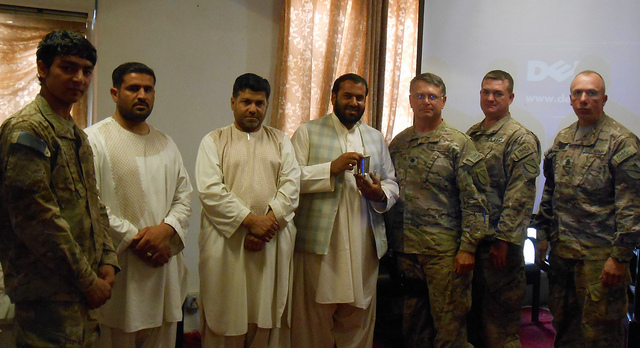
Lt. Col. Dallas Kratzer, Maj. Bill Hatfield and Sgt. Maj. David Munden meet with District Education Representative Bismillah Khan (center) and fellow Kandahar University staff members. Kentucky Agribusiness Development Team 5 took an educational approach to an agricultural problem and found great enthusiasm and success. (U.S. Army National Guard photo by Staff Sgt. Sidney Hoffmann)
ZHARI DISTRICT, KANDAHAR PROVINCE, Afghanistan — Before Kentucky Agribusiness Development Team 5 left the U.S. for its service in Afghanistan, it was their desire to bring agricultural leadership education to Afghanistan. The Soldiers and Airmen all held a strong belief that the future of Afghanistan lay in the hearts of young men and women who were open to learning new agricultural information, skills, techniques, and leadership abilities to equip them for a new Afghanistan that could stand on its own and serve its people.
“The key to Afghanistan’s success is the education of its young people, especially as it relates to agriculture,” said Col. Bob Hayter, the team’s commander. “Approximately 80% of Afghanistan’s economy is based on agriculture.”
Lt. Col. Dallas Kratzer agreed, adding that, “Much of the agriculture success in the US has its roots from organizations like 4H and FFA. It’s time to help partner, encourage and foster a Future Farmers of Afghanistan.”
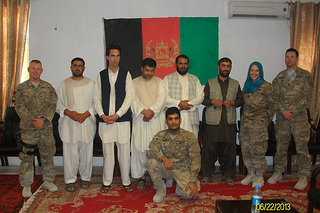
Tech. Sgt. Nathan Steele, Capt. Lund, 1st Lt. Benjamin Maillet worked with the Assistant District Governor of Zhari and Kandahar University Professors to educate local citizens on a wide variety of agricultural practices. (U.S. Army National Guard photo by Staff Sgt. Sidney Hoffmann)
Youth Leadership organizations like FFA and 4H have had a huge impact on American Agriculture. In many ways these organizations have shaped the American culture in entrepreneurship and leadership to where we are today. With 4H celebrating its 100 year anniversary and FFA celebrating it 75 year anniversary this past year, it is no wonder the United States has come so far with these combined years of investment leading to the agriculture leadership and ingenuity across our great country.
The first task was to identify a program that had an Afghan look and feel to it, being easily accepted by the Afghan culture and community. Curriculum promoted by KY ADT 3, written in Pashto, and supported by the Ministry of Agriculture at the capital in Kabul were found, along with several boxes of books, patches, and pins that students could earn while moving through the program.
The program selected was built on four important pillars; learning, doing, earning, and serving. Team members found this to be very profound as it is modeled programs like 4H back home, focusing on using the head, hands, heart, and health.
“This principle of ‘earning’ is important,” said Tech. Sgt. Nathan Steele who, along with 1st Lt. Benjamin Maillet, made up ADT 5’s Team Zhari. “After decades of war, a lot of Afghans have a difficult time looking at agriculture as a means to generate income, as a lot of families are simply using their farms to sustain them. Until recently, the district was too dangerous to travel to conduct business transactions, so most families produced only what they needed, not necessarily what they could sell for profit at the local market.”
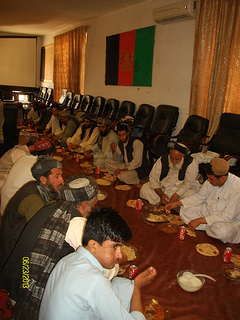
High school and middle school teachers attend a course given by the Kandahar University Professors in the Zhari District, Kandahar Province, Afghanistan. The teachers’ instruction was facilitated by 1st Lt. Benjamin Maillet and Tech Sgt. Nathan Steele of Kentucky’s ADT 5. (U.S. Army National Guard photo by Staff Sgt. Sidney Hoffmann)
With a solid foundation of an Afghan Youth Agriculture FFA style program already in existence, the Kentucky Guardsmen did not have to reinvent the wheel; they just had to find an avenue to implement this program successfully in Zhari. Although the program was intended to work through the District Director of Agriculture Irrigation and Livestock, the team took a different approach, building a relationship with the Director of Education Dr. Bizmillah Kahn. Together they started a Youth Agricultural Program in his district, as an after school program to over 500 students in two high schools and one middle school, teaching both boys and girls, eventually expanding it to all 5,000 students.
The curriculum was printed as a 70 plus page book in color giving teachers the ability to teach students about water management, irrigation techniques, soil management, wheat & corn production, chicken and egg production, terracing and rice production, and the water cycle that could have immediate impacts when students take this information back home to their families, having a lasting impact on their future.
Most important, the program was about Afghans teaching Afghans teaching Afghans! Kandahar University professors were going to teach high school teachers, who were going to teach students in their classrooms. Furthermore, according to Dr Bismillah Kahn, those high school teachers who received training were going to train other teachers to teach this program in their classrooms.
The Youth Agricultural Training was a huge success. It was supported by and attended by the district governor and the assistant district governor of Zhari, who encouraged them to teach this program well in their schools so the students could take these skills home with them to help their families, that this would bring honor for them.
Tech. Sgt. Nathan Steele hands school supplies over to District Education Representative Bismillah Khan. The supplies were donated by Luhr Elementary School and Midway College in Kentucky. (U.S. Army National Guard photo by Staff Sgt. Sidney Hoffmann)
Along with this program KY ADT 5 delivered school supplies donated from Luhr Elementary School and Midway College in Kentucky to Dr. Bismillah Kahn to give out in his schools. This further created momentum for this program as they now had supplies to work with while making a friendly link between the students and teachers from the US, to those in Afghanistan.
Team Zhari’s outside the box thinking was instrumental to the program’s success. They had done two things never done before; moving the program through the Director of Education and creating a 70 plus page curriculum in color for the Youth Agricultural Program to meet the specific needs of the district.
“It was the right call to move this program through the Director of Education Dr. Bismillah Kahn,” said Maillet. “In Afghanistan, having the right program is not enough. You have to put it into the hands of the right people if you want to see it to succeed.”
“This Youth Agricultural Program is the most sustainable thing KY ADT 5 has done and has the potential to last years after we are long gone,” said Steele. “We just put valuable agricultural information into the hands of Afghans they put together themselves, through a program they are excited about expanding themselves.”
“My grandfather always told me hast makes waste,” added Steele. “This time we didn’t care more about this program than the Afghans did, we moved slowly and carefully, they took ownership of it and are carrying it forward. I guess he was right.”
“The way you change a culture is to engage and inspire the youth,” said Kratzer. “A program like this has the ability to effect change a generation from now. What these students will learn can never be taken away from them.”
Future success of this Youth Agricultural Program and impact on the Province of Kandahar is yet to be seen, but based on programs in the United States, its effect could be far reaching and last for years to come.
“We may never know what far reaching impacts that one idea or program can have,” said Hayter. “We have planted a lot of ideas or seeds here in Afghanistan. Who knows what it will look like when these ideas take root and grow into something we could never imagine.”