
Pages
Stay In Touch
More
© 2013 KentuckyGuard
Story by 2nd Lt. James Killen, 123rd Airlift Wing Public Affairs
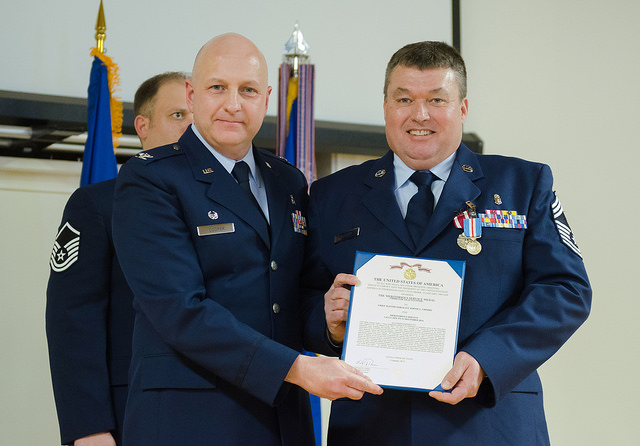
Col. Michael Cooper (left), commander of the 123rd Medical Group, presents Chief Master Sgt. Johnie Cherry with a Meritorious Service Medal during Cherry’s retirement ceremony at the Kentucky Air National Guard Base in Louisville, Ky., Feb. 7, 2015. Cherry retired after more than 34 years of service to the active-duty Air Force and Air National Guard. (U.S. Air National Guard photo by 2nd. Lt. James Killen)
KENTUCKY AIR NATIONAL GUARD BASE, LOUISVILLE, Ky. — After more than 34 years of service to the active-duty Air Force and Air National Guard, Chief Master Sgt. Johnie L. Cherry officially retired during a ceremony held at the Base Annex here Feb. 7.
Cherry, superintendent of the 123rd Medical Group, was responsible for managing health services and medical administrative functions.
The commander of the 123rd Medical Group, Col. Michael Cooper, said he had a deep respect for Cherry’s values and dedication to serve others.
“In our military service we’ve all had someone who was our chief, and I know that for many of you and countless others who could not be here today, Chief Cherry has been, and will always be, your chief,” Cooper told the audience.
Cherry served as a medical service specialist in the active-duty Air Force before joining the Kentucky Air National Guard. He would later cross-train as a public health technician and health services manager before taking responsibility as superintendent.
His decorations include three Air Force Achievement Medals, four Air Force Commendation Medals and three Meritorious Service Medals, in addition to other distinguished awards.
Cherry took the podium to thank the people he said made his career possible. He choked up as he addressed his wife, Sherry, saying, “Without you, this day could not be possible. You are my rock, my inspiration, and I love you with all my heart.”
“To the 123rd Airlift Wing,” Cherry concluded, “as reflected by the many devices on my uniform, you really are an outstanding unit, and the number one airlift wing in the United States Air Force. Thank you.”
By Senior Airman Vicky Spesard 123rd Airlift Wing Public Affairs

Col. Neil Mullaney (right), outgoing director of the Air Staff at Joint Forces Headquarters—Kentucky, receives a Meritorious Service Medal, third Oak Leaf Cluster, from Brig. Gen. Mark Kraus, Kentucky’s assistant adjutant general for Air, during a retirement ceremony Feb. 2, 2013, at the Kentucky Air National Guard Base in Louisville, Ky. Mullaney participated in four conflicts and commanded multiple units during his 24-year career. (U.S. Air Force photo illustration by Senior Airman Vicky Spesard, Kentucky Air National Guard)
KENTUCKY AIR NATIONAL GUARD BASE, LOUISVILLE, Ky. — Col. Neil Mullaney was honorably retired from the Armed Forces during a ceremony held in his honor Feb. 2 at the 123rd Airlift Wing, closing out a military career spanning more than 24 years of dedicated service to the Air Force and Kentucky Air National Guard.
Hundreds of friends, family and colleagues gathered at the Base Annex to pay tribute to Mullaney, the outgoing director of Air Staff at Joint Forces Headquarters—Kentucky.
“Col. Mullaney has enjoyed a more diverse career than any officer that I know of,” said Brig. Gen. Mark Kraus, Kentucky’s assistant adjutant general for Air. “His accomplishments are an impressive list. He is passionate about what he does, with a relentless quest for new challenges. He didn’t just pass through from position to position. You could count on him to punch above his weight class toward mission accomplishment and serve as an inspiration to those around him.
“For those he led,” Kraus continued, “they would follow him anywhere.”
After his remarks, Kraus presented Mullaney with a Meritorious Service Medal (third Oak Leaf Cluster), a Kentucky Distinguished Service Medal and the official certificate of retirement.
A 1988 graduate of the University of Louisville Air Force ROTC program and a veteran of four different conflicts, Mullaney began his active-duty career at Hurlburt Field, Fla., where he was assigned to the 1st Special Operations Wing. He soon deployed to Panama in support of Operations Just Cause and Promote Liberty, planning and executing special operations missions against Manuel Noriega’s Panamanian Defense Forces. Mullaney later deployed to Saudi Arabia and Kuwait, where he was part of a special operations task force that tracked and targeted Scud Missile sites in support of Operations Desert Shield and Desert Storm.
In 1994, Mullaney left active duty and began his Reserve career with the Kentucky Air National Guard, serving as chief of Intelligence Operations. Three years later, he was selected as detachment commander of the 205th Combat Communications Squadron, beginning a 16-year span in which he would command five different units. In 2000, Mullaney was selected to be the first commander of the newly formed 41st Civil Support Team, a unique unit designed to support civil authorities at the scene of incidents involving weapons of mass destruction.
In 2003, Mullaney was named commander of the 123rd Aircraft Maintenance Squadron, and he deployed to Southwest Asia in support of Operation Iraqi Freedom, supervising maintenance of 24 C-130 aircraft while maintaining a 99 percent mission effectiveness rate.
Mullaney was next selected as commander of the 123rd Maintenance Group in 2006, leading subject matter expert teams to Ethiopia, Kuwait and Yemen. Five years later, he deployed to Afghanistan as the first Air National Guard officer to lead an Agribusiness Development Team. During the deployment, the group of Kentucky Army and Air National Guardsmen conducted more than 250 missions in support of government stabilization.
“There are three positions you should always be in during your career,” Mullaney said, addressing the crowd. “You can have someone give you an opportunity, be there in support of that opportunity, or provide that opportunity. I think it is best to be providing that opportunity. It is so much more rewarding than anything you will receive on your own. My prayer is that I can look back on my career and see that I have helped someone else.
“There has always been someone throughout my career to give me that opportunity,” he continued. “At every stage and every unit, there have always been a group of people who wouldn’t let me fail — those people who just made things happen: a long list of chiefs and people whose names don’t get mentioned. I am deeply touched by everyone who has shown up here today. You are a huge part of my life, and I want to thank you for everything.”
Story by Maj. Dale Greer, 123rd Airlift Wing Public Affairs

Members of the 123rd Special Tactics Squadron Combat Controllers received several military decorations at the Kentucky Air National Guard Base in Louisville, Ky. on June 28, 2012. The combat controllers are flanked by and were presented the decorations by Lt. Gen. Eric Fiel, commander of the U.S. Air Force Special Operations Command and the Adjutant General of the Commonwealth of Kentucky, Maj. Gen. Edward W. Tonini. (U.S. Air Force photo by Master Sgt. Phil Speck)
KENTUCKY AIR NATIONAL GUARD BASE, LOUISVILLE, Ky. — The Afghan countryside is an unforgiving place for American troops, with the kinds of unknown threats and hidden dangers that can turn a routine patrol into a bloody fight for survival.
Tech. Sgt. Bryan Hunt, a combat controller in the Kentucky Air National Guard’s 123rd Special Tactics Squadron, was reminded of that fact once again on March 31 while conducting a reconnaissance patrol in Eastern Afghanistan as part of a U.S. Army Special Forces Team.
Hunt was serving as the gunner in the first of four all-terrain vehicles as his patrol entered a remote village rarely visited by coalition forces. In the blink of an eye, the patrol came under attack when an insurgent fired a rocket-propelled grenade at Hunt’s ATV.

Lt. Gen. Eric Fiel, commander of the U.S. Air Force Special Operations Command, presents an Air Force Combat Action Medal to Tech. Sgt. Bryan Hunt, 123rd Special Tactics Squadron combat controller, at the Kentucky Air National Guard Base in Louisville, Ky. on June 28, 2012. Hunt was also awarded a Purple Heart for being wounded in action while serving overseas. (U.S. Air Force photo by Master Sgt. Phil Speck)
The ordnance threaded a narrow gap between Hunt and his driver, passing Hunt’s head so closely that the fins of the RPG cut his face as it flew by. The grenade then struck the ATV’s roll cage, inches from Hunt’s head, and detonated on his rucksack. Both men suffered concussions from the blast, and Hunt received lacerations to his face and a fractured nose.
Despite his injuries, Hunt instinctively returned fire with his vehicle-mounted machine gun. He then transitioned to an assault rifle and a 40mm grenade launcher to break up the ambush. This allowed the special forces team leader to take cover behind a mud wall and return fire, buying time for the rest of the team to repel the enemy.
For his performance under fire and for sustaining injuries during combat, Hunt was awarded the Purple Heart and an Air Force Combat Action Medal June 28, during a ceremony held at the Kentucky Air National Guard Base in Louisville. Seven other members of Hunt’s unit also were recognized for exceptional service during recent deployments to Iraq and Afghanistan, earning nine decorations ranging from the Bronze Star Medal to the Air Force Commendation Medal.
“Days like today remind us of the truth that humans are more important than hardware, and that the operators we send out to tackle America’s security challenges are among America’s finest,” said Lt. Gen. Eric Fiel, commander of the U.S. Air Force Special Operations Command, who traveled to Louisville to personally bestow the awards.
“Battlefield Airmen live on forward operating bases and in austere corners of the world, where ground special operations forces demand precision integration with combat air power,” Fiel continued, speaking to an audience of more than 300 friends, family and coworkers. “You never fail to rise to the occasion, because you know better than anyone that the success of the mission — and often the lives of our brothers — depends on you.
“You are the authorities on airpower in the joint Special Operations Forces battle space, and the nature of your service is unique. It demands a formidable warrior who can calmly employ decisive skills one moment and unleash hell in the next.
We will continue to defend this nation and bring harm to our enemies no matter where they hide, and I know the 123rd Special Tactics Squadron will continue to call in the airpower we need in that fight.”
The 123rd Special Tactics Squadron is the only special operations unit in the Air National Guard with both combat controllers and pararescue personnel. Mission sets include clandestine deployment by land, sea and air to establish and control austere airfield and assault-zone operations, according to Lt. Col. Jeff Wilkinson, squadron commander. Members also conduct environmental reconnaissance and tactical weather forecasting; battlefield trauma care; and personnel and equipment recovery operations, including casualty evacuation and combat search and rescue.
Kentucky’s adjutant general, Maj. Gen. Edward W. Tonini, praised all eight Airmen for their unsurpassed dedication to duty, telling the audience that they routinely “put their lives on the line under the most extreme hardships and save untold lives in the process.”
“I am so proud to be here, among all of you,” he said, “but it is a special honor to be here with these men, these quiet professionals who truly embody the spirit of unbridled service.”
The seven other STS members who received awards were:
 • Master Sgt. Robert Fernandez, a combat controller, earned a Bronze Star Medal for meritorious achievement while deployed to Afghanistan in support of Operation Enduring Freedom from Nov. 16, 2011 to May 1, 2012. During this period, Fernandez led a 21-person team to manage operations, logistics, resupply and intelligence for 61 combat controllers, tactical air control party members and special operations weathermen conducting combat operations at 46 different locations. He also oversaw the coordination of 5,046 close-air support aircraft and 1,908 combat missions resulting in the kill or capture of 510 enemy combatants.
 • Master Sgt. Aaron May, a combat controller, earned a Bronze Star Medal for meritorious achievement while deployed to Afghanistan in support of Operation Enduring Freedom from Nov. 16, 2011 to May 1, 2012. During this period, May oversaw 61 Air Force special tactics operators attached to Army, Navy and Marine Corps special operations teams throughout Afghanistan. He also supervised the coordination of 1,980 combat missions resulting in the employment of 70,000 pounds of air-to-ground ordnance and 188 enemy killed.
 • Tech. Sgt. Harley Bobay, a combat controller, earned a Bronze Star Medal for meritorious achievement while deployed to Afghanistan in support of Operation Enduring Freedom from Nov. 16, 2011 to May 1, 2012. Bobay also received an Air Force Combat Action Medal. During his deployment, Bobay and a team of special operators conducted 32 combat reconnaissance patrols and 22 tactical ground movements while engaging with hostile forces. On one occasion, Bobay was pinned down by a barrage of heavy machine-gun fire and rocket-propelled grenades. Exposing himself to incoming fire, he rapidly acquired the target and directed 30mm canon fire from an overhead AC-130 gunship, killing six insurgents. On eight other occasions, Bobay directed air-to-ground containment fires to protect arriving resupply convoys from enemy attack.
 • Tech. Sgt. Jeff Kinlaw, a combat controller, earned a Bronze Star Medal for meritorious achievement while deployed to Afghanistan in support of Operation Enduring Freedom from Nov. 16, 2011 to May 1, 2012. Kinlaw also received an Air Force Combat Action Medal. During this period, Kinlaw was the sole Airman serving as a Joint Terminal Attack Controller assigned to two Army Special Forces Teams conducting village stability operations. He later was partnered with a 100-man Afghan commando unit conducting battlefield operations. His coordination of multiple air-to-ground strikes from eight A-10s and six AH-64s resulted in five enemy killed in action and four forfeited fighting positions destroyed.
 • Maj. Sean McLane, a special tactics officer, earned a Meritorious Service Medal for outstanding achievement while deployed to Afghanistan in support of Operation Enduring Freedom from Aug. 17, 2011 to Dec. 1, 2011. During this period, McLane led an 85-person special tactics squadron conducting daily combat operations across Afghanistan. Noting that air support tactics had grown stale in the theater, he initiated a real-time, lessons-learned and best-practices evaluation process which ensured no rules-of-engagement violations, no civilian casualties and no friendly-fire incidents. His leadership enabled the execution of 2,291 ground operations controlling 400 air strikes that resulted in 1,058 enemy fighters killed and 172 wounded.
 • Master Sgt. Michael Newman, a combat controller, earned an Air Force Commendation Medal for outstanding achievement while deployed to Iraq and Afghanistan in support of operations Enduring Freedom and New Dawn from Aug. 18, 2010 to Nov. 18, 2010. During this period, Newman served for two months as a Joint Attack Controller for an Army Special Forces Team in Iraq, conducting 14 missions in conjunction with Iraqi Security Forces. He was then assigned to the Special Tactics Assault Zone Reconnaissance Team in Afghanistan, where he provided air traffic control for fixed- and rotary-wing aircraft, as well as control of re-supply airdrops.
 • Senior Airman John Kane, a combat controller, earned an Air Force Commendation Medal for outstanding achievement while deployed to Afghanistan in support of Operation Enduring Freedom from Aug. 18, 2010 to Nov. 18, 2010. During this period, Kane conducted 50 combat patrols through enemy terrain laden with improvised explosive devices. He also controlled 120 close-air support and intelligence, surveillance and reconnaissance platforms that provided ground commanders with real-time battlefield data. On four separate missions, Kane and his team were attacked by insurgent forces, and each time Kane responded by directing airpower to neutralize the situation. As his team’s air-to-ground expert, he flawlessly controlled the airdrop of three tons of mission-essential supplies and equipment to troops on the ground.
To see more photos from this story, click here
Bronze Star Medals are earned for heroic or meritorious achievement in connection with military operations against an armed enemy. Meritorious Service Medals and Air Force Commendation Medals recognize outstanding achievement or service. Combat Action Medals are awarded to Airmen for active participation in combat, having been under direct and hostile fire or physically engaging hostile forces with direct and lethal fire.
The 123rd Special Tactics Squadron remains one of the most heavily deployed units in the Air National Guard, from hurricane-recovery efforts in the United States to combat operations in Iraq and Afghanistan, Wilkinson said.
In the past three years alone, the unit’s Airmen were deployed overseas for more than 4,600 days, conducting over 950 ground-combat missions and 10,000 hours of Combat Search and Rescue operations credited with saving more than 50 personnel, he said.
The unit’s combat controllers were among the first U.S. forces on the ground following a devastating earthquake that struck Haiti in 2010, directing the first C-17 airdrops of humanitarian aid and controlling a massive resupply effort that delivered 20,000 pounds of food, water and medicine.
Following Hurricane Katrina in 2005, members of the 123rd Special Tactics Squadron established and operated a helicopter landing zone on a highway overpass in New Orleans, helping evacuate nearly 12,000 citizens.
The unit is comprised primarily of combat controllers, pararescuemen and special operations weathermen.
Combat controllers are some of the most highly trained personnel in the U.S. military, Wilkinson said. As FAA-certified air traffic controllers, they deploy undetected into combat and hostile environments to establish assault zones or airfields while simultaneously conducting air traffic control, fire support, command and control, direct action, counter-terrorism, foreign internal defense, humanitarian assistance and special reconnaissance.
Pararescuemen are parachute-jump qualified trauma specialists who must maintain Emergency Medical Technician-Paramedic credentials throughout their careers. With this medical and rescue expertise, PJs are able to perform life-saving missions in the world’s most remote areas, Wilkinson said. A PJ’s primary function is personnel recovery specialist, with emergency medical capabilities in humanitarian and combat environments. PJs deploy in any available manner, to include air-land-sea tactics, into restricted environments to authenticate, extract, treat, stabilize and evacuate injured personnel.
Special operations weathermen are meteorologists with advanced tactical training to operate in hostile or denied territory, Wilkinson said. They gather and interpret weather data and provide intelligence from deployed locations while working primarily with Air Force and Army Special Operations Forces.
The 123rd Special Tactics Squadron’s parent organization is the Louisville-based 123rd Airlift Wing, the main operational unit of the Kentucky Air National Guard. When under federal control, the 123rd Special Tactics Squadron reports to the U.S. Air Force Special Operations Command, which is headquartered at Hurlburt Field, Fla.
